
Key Takeaways
- Bucket tooth compatibility depends on adapter system, pin type, and machine tonnage
- OEM part numbers provide the most reliable cross-reference for aftermarket sourcing
- Proper tooth selection can extend service life by 40-60% over generic alternatives
- Pin and retainer systems vary significantly between manufacturers — mixing brands creates failure points
- Preventive replacement at 70% wear prevents costly adapter damage
Understanding Excavator Bucket Tooth Systems
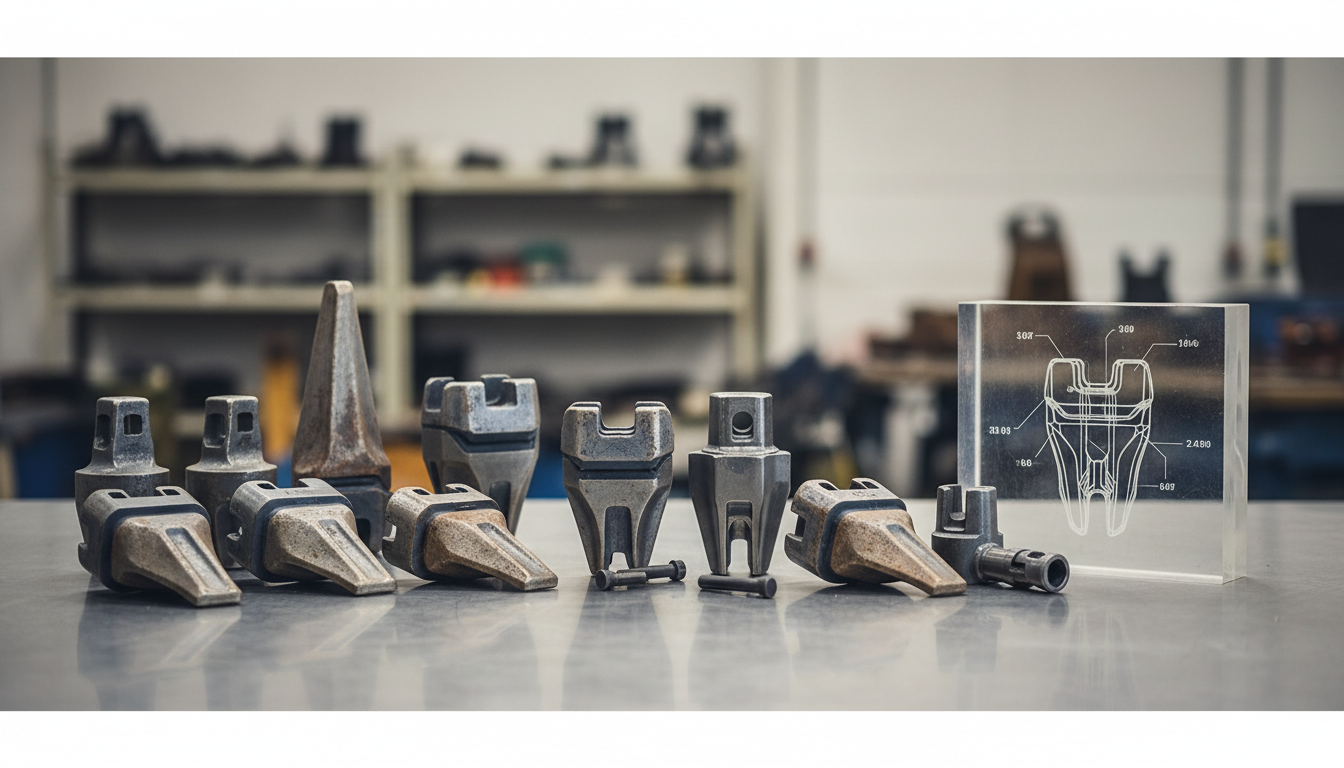
When your CAT 320’s bucket teeth start showing wear patterns after 800 operating hours, you’re facing a decision that impacts both immediate costs and long-term productivity. The excavator bucket tooth isn’t just a replaceable wear item — it’s the primary interface between your machine and the material you’re moving.
Tooth-to-Adapter Interface Design
Modern excavator bucket teeth attach through three primary systems: pin-through designs, twist-lock mechanisms, and bolt-on configurations. The J-series from Caterpillar uses a vertical pin system where the 8E6208 pin secures the 1U3202 tooth to the adapter nose. Komatsu’s equivalent system employs their own pin geometry — attempting to cross-match these components creates stress concentration points that lead to premature failure.
We’ve documented cases where operators mixed CAT pins with Komatsu teeth, resulting in adapter cracking within 200 hours. The metallurgy might be similar, but the load distribution patterns are engineered specifically for each manufacturer’s geometry.
Load Distribution and Wear Patterns
Excavator bucket teeth experience three distinct wear zones: the cutting tip, the side wear areas, and the base connection point. A properly selected tooth distributes impact forces across the entire adapter interface, while an incompatible tooth creates stress risers that propagate cracks through the adapter casting.
Tiger teeth and twin-tiger configurations extend service life in abrasive conditions by presenting a narrower cutting profile initially, then wearing to a broader surface as material removal progresses. Standard dirt teeth work effectively in general excavation but wear faster in rocky conditions.
Pin and Retainer Compatibility
The pin and retainer system determines how securely your tooth stays attached during high-impact operations. Caterpillar’s 8E6208 pin works exclusively with their J200 series teeth and requires the corresponding 8E6209 retainer. Substituting generic pins might save $3 per unit initially, but we’ve seen tooth loss incidents that cost $400 in replacement parts plus downtime.
Hensley’s H&L system uses a different pin geometry entirely — their 23FP flex pin provides some lateral movement to absorb side loads, while CAT’s rigid pin system transfers all forces directly to the adapter. Understanding these design philosophies helps explain why cross-compatibility often fails in field conditions.
OEM vs Aftermarket Quality Standards
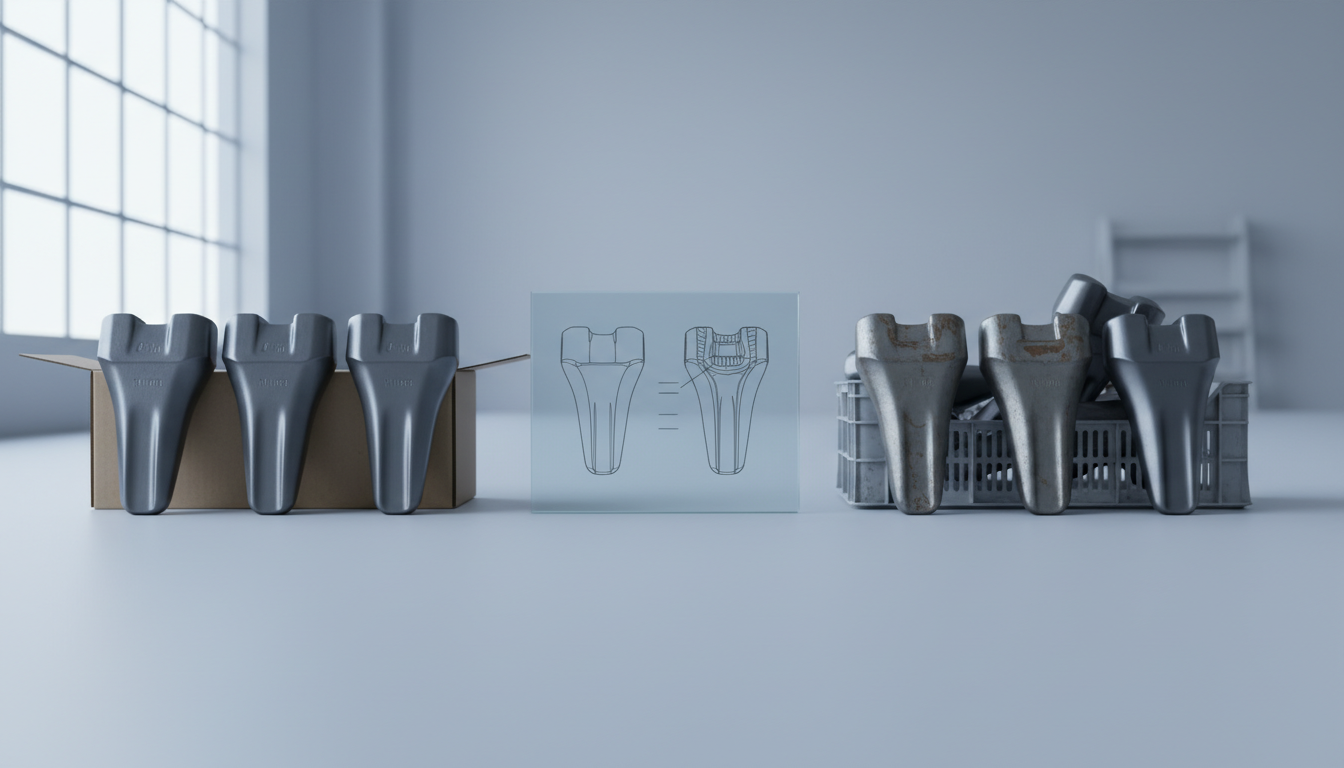
The quality gap between OEM excavator bucket teeth and aftermarket alternatives has narrowed significantly, but critical differences remain in metallurgy, heat treatment, and dimensional tolerances. We source from foundries that supply OEM manufacturers directly, ensuring the same alloy compositions and manufacturing processes.
Metallurgical Specifications
OEM bucket teeth typically use medium-carbon steel with 0.25-0.35% carbon content, heat-treated to achieve 38-42 HRC hardness at the cutting edge while maintaining 28-32 HRC at the base for toughness. Inferior aftermarket teeth often use recycled steel with inconsistent carbon content, resulting in either brittle fractures or excessive wear rates.
Our quality control process includes hardness testing at three points on each tooth casting. Teeth that fall outside the specified range get rejected before shipping. This additional step adds roughly 15% to our processing time but eliminates the field failures we documented with lower-grade alternatives.
Dimensional Accuracy and Fit
OEM specifications typically maintain ±0.5mm tolerance on critical dimensions like pin hole diameter and adapter interface surfaces. Generic aftermarket teeth often exceed ±1.5mm variation, creating loose fits that accelerate wear on both the tooth and adapter.
A loose-fitting tooth allows micro-movement during operation, gradually enlarging the pin holes and wearing the adapter nose. We’ve measured adapter replacement costs averaging $180-250 per position when operators consistently use poorly-fitted teeth over 2000+ operating hours.
Surface Treatment and Coating
Many OEM teeth receive phosphate coating or similar surface treatments that provide corrosion resistance and improve paint adhesion. While these treatments don’t directly impact digging performance, they prevent rust formation during storage and extend the service life in marine or chemical environments.
Aftermarket teeth from reputable suppliers include similar surface treatments, while budget alternatives often ship with minimal surface preparation. The cost difference is typically $2-4 per tooth, but the corrosion protection becomes valuable for equipment operating in coastal areas or chemical processing facilities.
Caterpillar Bucket Tooth Specifications
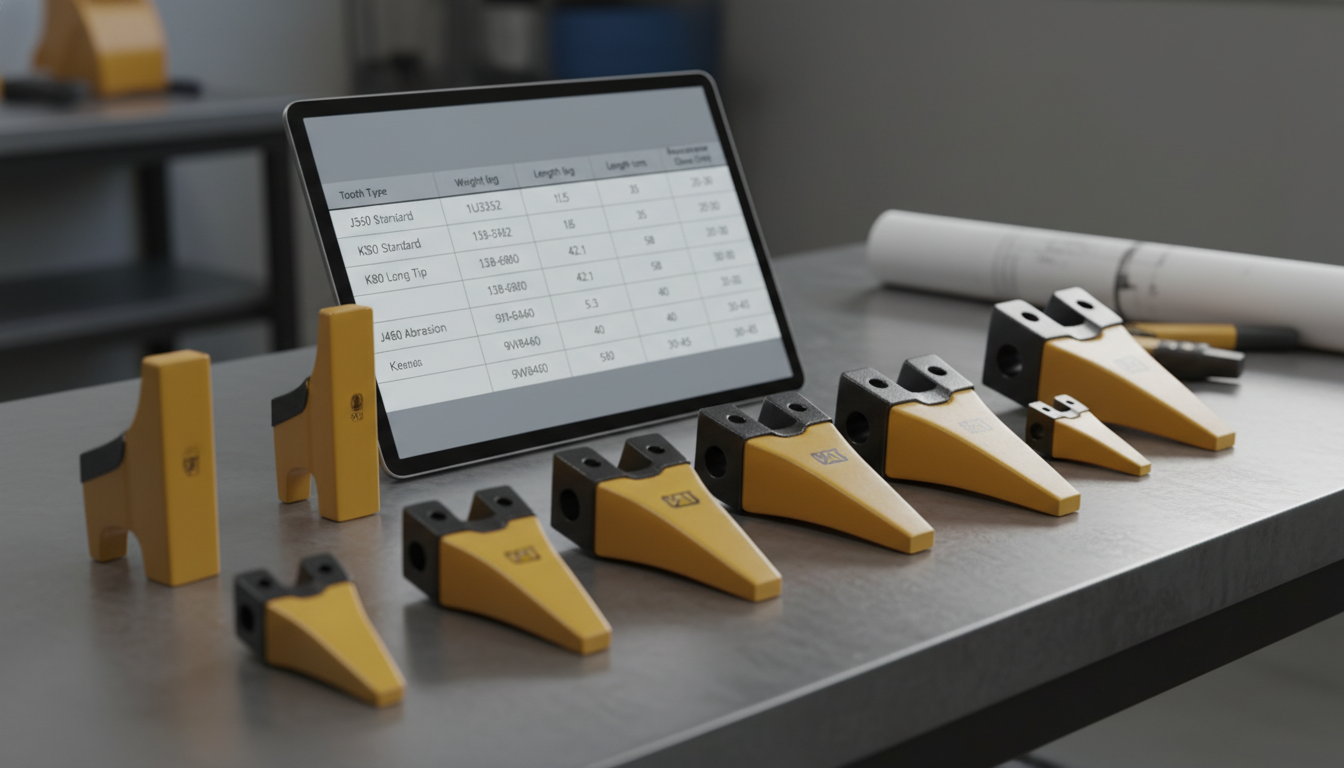
Caterpillar’s J-series bucket teeth represent the most widely-used system globally, with the J200 series covering excavators from 12-25 tonnes and the J250 series handling 25-35 tonne machines. Understanding CAT’s part numbering system helps identify compatible alternatives and plan replacement schedules.
J200 Series Applications
The 1U3202 standard dirt tooth fits CAT 312, 315, 318, and 320 excavators, along with compatible machines from other manufacturers using the same adapter geometry. This tooth measures 89mm wide at the base with a 41mm pin hole diameter, secured by the 8E6208 pin and 8E6209 retainer combination.
For rocky conditions, the 1U3202T tiger tooth provides extended service life through its reinforced tip design. The initial cutting width starts at 32mm compared to 45mm for the standard tooth, concentrating cutting forces for better penetration in consolidated materials.
J250 Series Heavy-Duty Applications
Larger excavators like the CAT 325, 330, and 336 use the J250 system with the 1U3252 standard tooth. These teeth handle significantly higher impact loads and use the 8E6259 pin system with increased shear strength ratings.
The dimensional differences between J200 and J250 systems prevent cross-compatibility — the pin diameters, hole spacing, and adapter interface geometries are completely different. Attempting to force a J200 tooth onto a J250 adapter results in immediate failure under load.
Specialty Tooth Configurations
CAT offers several specialty tooth designs for specific applications: the 1U3202L long tooth for trenching operations, the 87298200 twin-tiger for extreme abrasion resistance, and various bolt-on unitooth designs for specialized buckets.
Each specialty tooth requires specific adapter configurations and may need different pin/retainer combinations. The long tooth design, for example, shifts the center of gravity forward, increasing the moment arm and requiring stronger pin materials to handle the additional stress.
Komatsu and Volvo Compatibility Guide

While Caterpillar dominates the North American market, Komatsu and Volvo excavators require their own specific tooth systems. Cross-referencing between brands requires careful attention to dimensional specifications and load ratings.
Komatsu Tooth Systems
Komatsu uses their own proprietary tooth designs across their PC-series excavators. The PC200 class machines (PC200, PC210, PC220) typically use teeth similar in size to CAT’s J200 series but with different pin hole locations and adapter interface angles.
Komatsu part numbers follow a different convention entirely — their 20X-70-14160 tooth for PC200 excavators has no direct CAT equivalent, though aftermarket suppliers offer cross-compatible alternatives. The key difference lies in the pin orientation: Komatsu uses a horizontal pin system while CAT employs vertical pins.
Volvo EC Series Requirements
Volvo’s EC-series excavators (EC210, EC240, EC290) use yet another tooth system with their own geometric specifications. The EC210 typically uses a tooth roughly equivalent to CAT’s J200 size but with Volvo’s specific adapter interface.
Volvo emphasizes fuel efficiency in their designs, which translates to lighter-weight tooth systems that may not handle the same impact loads as equivalent CAT or Komatsu components. Operators switching between brands often notice differences in tooth durability under identical working conditions.
Cross-Brand Compatibility Challenges
Mixing tooth systems between manufacturers creates several problems: mismatched load ratings, different wear patterns, and incompatible replacement schedules. A Komatsu tooth on a CAT adapter might physically fit but will wear differently and potentially damage the adapter over time.
We recommend maintaining brand consistency within each machine’s tooth system while sourcing from aftermarket suppliers who maintain OEM specifications. This approach provides cost savings without compromising compatibility or performance.
Sizing and Measurement Guidelines
Accurate measurement of existing excavator bucket teeth ensures proper replacement part selection and prevents costly ordering mistakes. The key dimensions include base width, height, pin hole diameter, and overall length from tip to base.
Critical Dimension Identification
Start by measuring the tooth base where it contacts the adapter — this rectangular section determines compatibility more than the cutting tip profile. Measure the outside width and height of this base section using calipers for accuracy. Standard measurements for common systems: J200 series measures 89mm wide by 67mm high, while J250 series measures 108mm wide by 82mm high.
Pin hole diameter and location are equally critical. CAT J200 teeth use a 41mm diameter hole positioned 25mm from the base, while Komatsu systems often use 38mm holes in different locations. A 3mm difference in pin hole size might seem minor, but it creates dangerous play that leads to tooth loss.
Wear Pattern Assessment
Examine wear patterns on existing teeth to determine if you’re using the optimal tooth type for your application. Excessive side wear indicates rocky conditions that might benefit from tiger teeth or side-cutter configurations. Rapid tip wear in soft materials suggests standard dirt teeth are appropriate but replacement intervals need adjustment.
Measure remaining material thickness at the thinnest point — most operators replace teeth when they reach 30-40% of original thickness. Waiting until complete wear-through risks adapter damage that costs significantly more than proactive tooth replacement.
Adapter Condition Evaluation
Before ordering replacement teeth, inspect the adapter noses for wear, cracks, or dimensional changes. Worn adapters create loose fits that accelerate tooth wear and may require oversized teeth or adapter replacement.
Check pin hole condition in the adapter — elongated or worn holes indicate the need for adapter service before installing new teeth. Installing premium teeth on worn adapters wastes money and creates safety hazards from potential tooth loss during operation.
Installation and Maintenance Best Practices
Proper installation of excavator bucket teeth extends service life and prevents premature failure of both teeth and adapters. The installation process involves more than simply driving pins through holes — proper technique ensures optimal load distribution and secure retention.
Pin Installation Technique
Use the correct pin driver tool for your tooth system — CAT recommends their specific pin punch tools that match pin diameter and provide proper support during installation. Generic hammers and punches can damage pins or create stress concentrations that lead to failure.
Drive pins from the correct direction according to manufacturer specifications. Most systems require installation from the outside of the bucket toward the center, ensuring the retainer groove faces outward for proper clip installation. Reversed pins create retention problems and may fall out during operation.
Torque Specifications and Retainer Clips
Pin installation requires specific impact force — too little leaves pins loose, while excessive force can crack the tooth casting or deform the pin. Experienced technicians develop a feel for proper installation, but new operators should practice on scrap teeth before working on production equipment.
Retainer clips must seat fully in the pin groove and lie flat against the tooth surface. Partially installed retainers allow pins to migrate during operation, eventually leading to tooth loss. Replace bent or damaged retainers rather than attempting to straighten them.
Preventive Maintenance Schedule
Inspect bucket teeth daily during pre-operation checks, looking for loose pins, missing retainers, or excessive wear. Weekly detailed inspections should include pin tightness checks and wear measurement at consistent points on each tooth.
Plan replacement schedules based on operating conditions and historical wear rates. Abrasive conditions might require tooth replacement every 400-600 hours, while general excavation allows 800-1200 hour intervals. Maintaining detailed records helps optimize replacement timing and inventory planning.
| Operating Condition | Expected Service Life | Replacement Indicator |
|---|---|---|
| General excavation | 800-1200 hours | roughly a third thickness remaining |
| Rocky/abrasive | 400-600 hours | over half thickness remaining |
| Demolition | 300-500 hours | over half thickness remaining |
Cost Analysis and Procurement Strategy
Excavator bucket teeth represent a significant operating expense for construction and mining operations. A systematic approach to procurement balances initial cost, service life, and total cost of ownership while maintaining equipment availability.
Total Cost of Ownership Calculation
Calculate tooth costs per operating hour rather than per unit to make informed procurement decisions. A $25 OEM tooth lasting 800 hours costs $0.031 per hour, while a $15 aftermarket tooth lasting 400 hours costs $0.038 per hour — the premium tooth provides better value despite higher initial cost.
Include installation labor in your calculations. Teeth requiring frequent replacement increase maintenance costs beyond the part price. Factor in operator time, service truck dispatch, and potential production delays when comparing alternatives.
Inventory Management Strategies
Maintain strategic inventory based on your fleet composition and operating patterns. Stock 2-3 complete sets of teeth for each excavator size in your fleet, plus over half additional inventory for high-wear positions like the center teeth that experience maximum impact loads.
Consider seasonal demand patterns — construction operations typically consume more teeth during spring and summer months when ground conditions are more abrasive. Mining operations may see increased wear during specific ore processing campaigns or when working in particularly hard formations.
Supplier Evaluation Criteria
Evaluate suppliers on total service capability, not just unit pricing. Consider delivery reliability, technical support, warranty terms, and return policies for incorrect orders. A supplier offering 5-day global delivery with technical support provides more value than one with marginally lower prices but inconsistent availability.
Quality consistency matters more than absolute lowest pricing. Establish relationships with suppliers who provide batch-to-batch consistency and stand behind their products with meaningful warranties. Document supplier performance to guide future procurement decisions.
Global Supply Chain and Delivery Considerations
Excavator bucket teeth procurement involves complex global supply chains with manufacturing concentrated in specific regions and distribution networks spanning worldwide. Understanding these dynamics helps optimize procurement timing and costs.
Manufacturing Hub Locations
Most aftermarket excavator bucket teeth manufacturing occurs in China, India, and Turkey, with some specialty production in North America and Europe. Chinese foundries dominate volume production with competitive pricing, while Turkish manufacturers often provide superior metallurgy for premium applications.
Lead times vary significantly by region and season. Chinese suppliers typically require 15-30 days for standard items, extending to 45-60 days during Chinese New Year and Golden Week periods. European suppliers offer shorter lead times but at premium pricing that may not justify the time savings for routine replacements.
Shipping and Logistics Optimization
Bucket teeth ship efficiently due to their high density and standardized packaging. A 20-foot container holds approximately 2000-3000 teeth depending on size, making ocean freight cost-effective for large orders. Air freight becomes economical for urgent requirements or smaller quantities.
Consider consolidating orders across multiple machine types to achieve better freight rates and reduce per-unit logistics costs. Mixed containers with teeth, pins, adapters, and cutting edges optimize shipping density while providing complete inventory replenishment.
Customs and Documentation Requirements
Excavator bucket teeth typically classify under HS code 8431.49 for machinery parts, with duty rates varying by country of origin and destination. Most favored nation status and trade agreements significantly impact landed costs — Chinese-manufactured teeth may carry different duty rates than Turkish or Indian alternatives.
Proper documentation prevents customs delays that can extend delivery times by weeks. Ensure suppliers provide accurate commercial invoices, packing lists, and certificates of origin. Some markets require additional documentation like material certificates or conformity declarations.
Frequently Asked Questions
How do I identify the correct excavator bucket teeth for my machine?
Start by locating part numbers stamped on existing teeth, typically found on the back or top surface. If numbers are worn off, measure the tooth base dimensions (width and height), pin hole diameter, and note your machine model. CAT J200 series teeth measure 89mm wide by 67mm high with 41mm pin holes, while J250 series are 108mm by 82mm. When in doubt, contact your parts supplier with photos and measurements for positive identification.
Can I mix different brands of bucket teeth on the same excavator?
Mixing brands creates compatibility issues and uneven wear patterns. While some aftermarket teeth cross-reference to OEM specifications, combining different manufacturers’ teeth on the same bucket leads to inconsistent performance and potential adapter damage. Stick with one tooth system per machine, whether OEM or a consistent aftermarket alternative that maintains proper specifications.
When should I replace excavator bucket teeth?
Replace teeth when they reach 30-roughly a third of original thickness in general excavation, or 50-over half in abrasive conditions. Waiting until complete wear-through risks expensive adapter damage. Inspect teeth daily and measure thickness weekly at consistent points. Plan replacements based on operating hours: typically 800-1200 hours for general work, 400-600 hours in rocky conditions.
What’s the difference between standard and tiger teeth?
Standard dirt teeth have broader cutting surfaces (typically 45mm wide) optimized for general excavation in soil and soft materials. Tiger teeth start with narrower cutting edges (32mm) that concentrate cutting forces for better penetration in rocky or consolidated materials. Tiger teeth cost 20-roughly a third more but last longer in abrasive conditions, making them cost-effective for specific applications.
How do I prevent bucket teeth from falling off during operation?
Ensure proper pin installation using manufacturer-specified tools and techniques. Drive pins from the correct direction (usually outside toward center) and verify retainer clips seat fully in pin grooves. Inspect pin tightness daily and retainer condition weekly. Loose pins indicate worn adapters that need service before installing new teeth. Never reuse damaged pins or retainers.
Are aftermarket bucket teeth as good as OEM parts?
Quality aftermarket teeth from reputable suppliers match OEM specifications for metallurgy, dimensions, and heat treatment. The key is sourcing from manufacturers who supply OEM companies directly or maintain equivalent quality standards. Avoid generic teeth with loose tolerances or unknown metallurgy. Premium aftermarket teeth typically cost 20-roughly a third less than OEM while providing comparable service life.