
When your CAT 793F haul truck’s transmission starts slipping at 3 AM on a remote copper mine site, you don’t have the luxury of waiting three weeks for an OEM part to clear customs. Every hour that 400-ton beast sits idle costs roughly $2,000 in lost productivity , and that’s before factoring in the ripple effects across your entire operation.
We’ve been supplying mining equipment parts to operations across six continents since 2006, and the pattern is always the same: procurement teams scramble between OEM dealers, aftermarket suppliers, and salvage yards, hoping to find the right part at the right price with acceptable lead times. It doesn’t have to be this complicated.
Understanding Mining Equipment Parts Categories
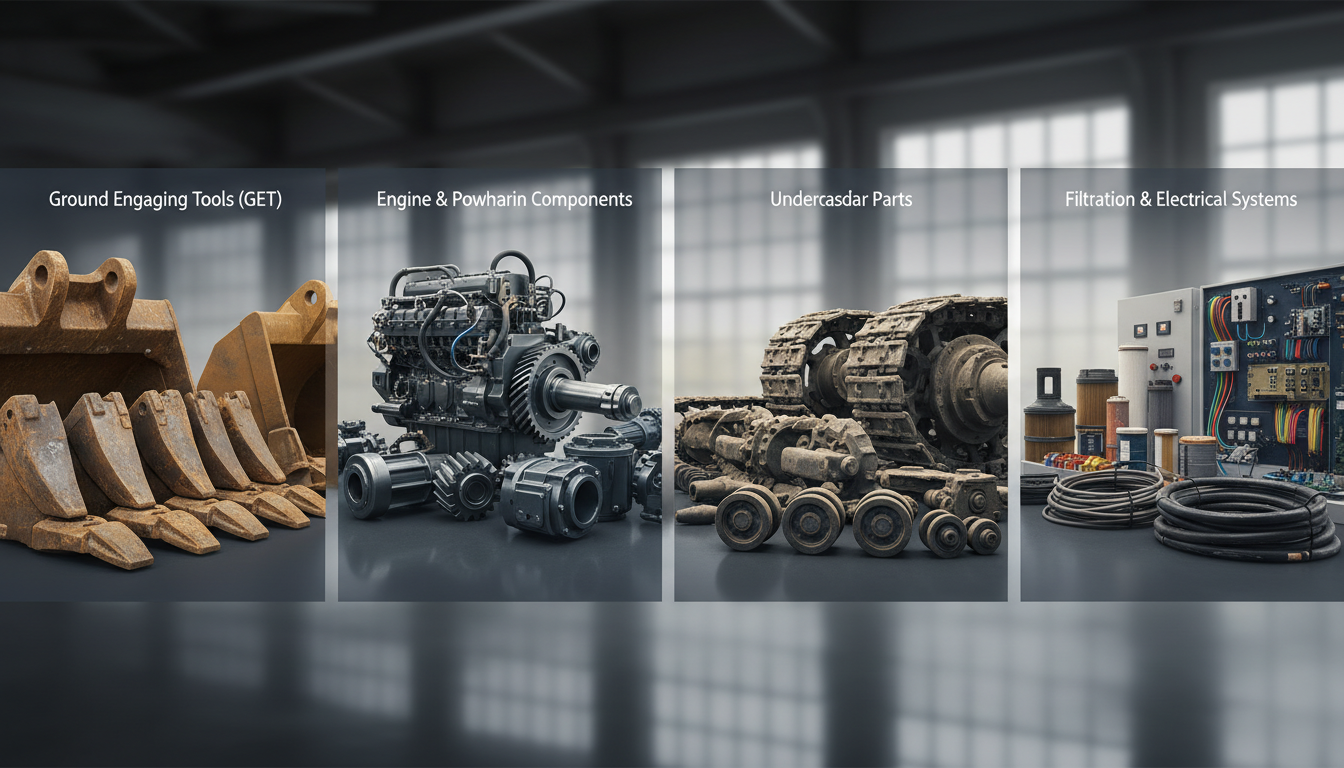
Mining operations depend on hundreds of different component types, each with distinct failure patterns, replacement intervals, and sourcing strategies. Getting the categorization right determines whether you’re buying smart or burning budget.
Wear Components vs Critical Systems
Wear components , bucket teeth, cutting edges, crusher liners , fail predictably based on tonnage processed and material hardness. These parts represent roughly 60% of most mines’ annual parts spend, but they’re also the easiest to source from multiple suppliers. Critical systems like hydraulic pumps, final drives, and engine blocks require more careful sourcing decisions.
The key difference: wear components can often be upgraded or modified for better performance, while critical systems demand exact OEM specifications to maintain warranty coverage and operational safety. We’ve seen mines save 30-40% on wear components by switching to engineered aftermarket alternatives, but the same approach backfires spectacularly on hydraulic systems.
Planned vs Emergency Procurement
Planned maintenance parts , filters, fluids, scheduled replacement items , should represent 70-80% of your annual parts budget. These components can be sourced competitively, consolidated with preferred suppliers, and stocked strategically based on consumption forecasts.
Emergency parts procurement is where costs explode. When a Komatsu PC8000 excavator’s swing motor fails unexpectedly, you’re paying premium freight, expedite fees, and often accepting higher unit costs just to minimize downtime. Smart procurement teams maintain emergency stock for high-impact failures while negotiating framework agreements for rapid response.
OEM vs Aftermarket Quality Tiers
Not all aftermarket parts are created equal. Premium aftermarket suppliers like us manufacture to OEM specifications using identical materials and processes , often in the same factories that produce OEM parts. Mid-tier aftermarket focuses on functional equivalence at lower cost, while economy aftermarket prioritizes price over longevity.
The procurement decision depends on application criticality and total cost of ownership. A hydraulic seal kit for a production shovel demands OEM-quality materials and precision manufacturing. A cab door handle can safely use economy aftermarket without operational risk.
Brand Compatibility and Cross-Reference Systems

Modern mining fleets rarely consist of single-brand equipment. A typical operation might run Caterpillar haul trucks, Komatsu excavators, Volvo wheel loaders, and Atlas Copco drill rigs , each with distinct parts numbering systems, supplier networks, and compatibility requirements.
OEM Part Number Decoding
Every major manufacturer uses proprietary part numbering systems that encode critical information about specifications, supersessions, and applications. Caterpillar’s system includes prefix codes that indicate product family, while Komatsu embeds material specifications directly in part numbers.
Understanding these systems prevents costly mistakes. When a CAT 777G truck needs a transmission filter (part number 1R-0739), the “1R” prefix indicates it’s a service part, while the numeric sequence ties to specific transmission models and service intervals. Substituting a similar-looking filter from another application can cause catastrophic failure.
Professional parts suppliers maintain complete cross-reference databases that map OEM numbers to aftermarket equivalents, superseded parts, and application-specific variations. These databases represent years of engineering validation and field testing , not just dimensional matching.
Interchangeability Across Equipment Generations
Mining equipment manufacturers frequently update designs while maintaining backward compatibility for key components. A Komatsu PC1250 excavator might share hydraulic cylinders with the newer PC1250-11 model, but use different electronic control modules.
This creates opportunities for cost optimization through strategic sourcing. Older-generation parts often cost less than current-production equivalents while delivering identical performance. However, availability becomes an issue as manufacturers discontinue support for legacy models.
We maintain detailed compatibility matrices that track these relationships across equipment generations. When sourcing parts for a mixed-age fleet, these matrices identify opportunities to standardize on common components and reduce inventory complexity.
Regional Specification Variations
The same equipment model sold in different markets often uses region-specific components to meet local regulations, operating conditions, or supplier preferences. A CAT 789C haul truck sold in Australia might use different engine emission components than an identical model sold in Chile.
These variations create sourcing challenges for multinational mining companies operating standardized fleets across multiple countries. Parts that work perfectly at one site might not be compatible with identical equipment at another location.
Critical Mining Equipment Parts by Application
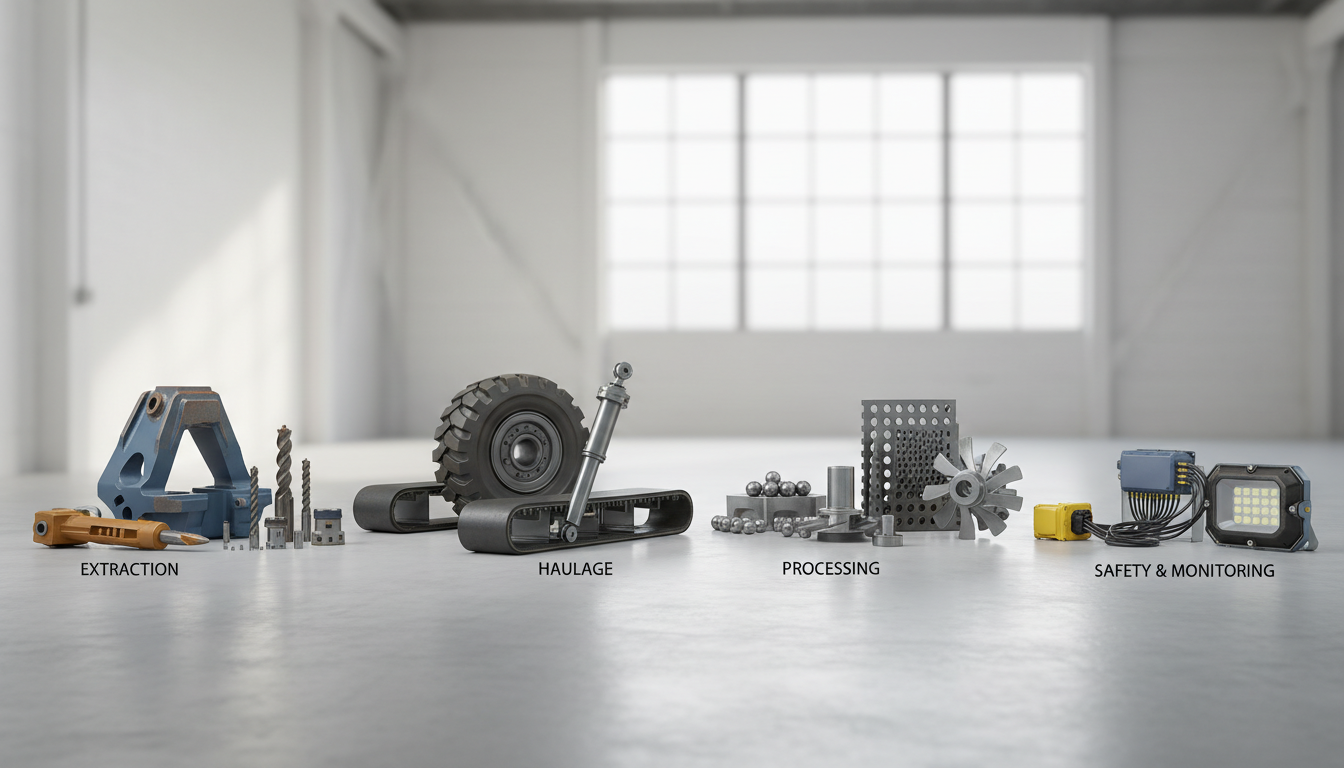
Different mining applications create distinct parts failure patterns and sourcing priorities. Surface mining operations face different challenges than underground mines, while processing plants have their own unique requirements.
Surface Mining Equipment Components
Large-scale surface mining relies on massive equipment operating in harsh conditions. Haul trucks, wheel loaders, and hydraulic excavators dominate parts spend, with specific failure patterns driven by payload weights, cycle times, and environmental factors.
Haul truck tires represent the single largest consumable expense for most surface operations, often accounting for 15-20% of total operating costs. A single tire for a CAT 797F costs roughly $40,000, and a complete set lasts 3,000-6,000 hours depending on road conditions and operator technique.
Hydraulic components , cylinders, pumps, valves , fail frequently due to contamination from dust and debris. These parts require careful sourcing because hydraulic system failures can cause catastrophic accidents. We’ve seen operations save significant money by implementing complete hydraulic filtration programs while sourcing premium aftermarket components for non-critical applications.
Underground Mining Specialized Parts
Underground operations present unique challenges: confined spaces, explosive atmospheres, and specialized equipment that’s often custom-configured for specific mine layouts. Load-haul-dump (LHD) vehicles, continuous miners, and roof bolters use components rarely found in surface applications.
Ventilation systems are critical for underground safety, requiring specialized fans, ducting, and monitoring equipment. These components must meet strict safety certifications and often require OEM parts to maintain regulatory compliance. However, routine maintenance items like fan belts and motor bearings can be sourced from aftermarket suppliers.
Explosion-proof electrical components demand particular attention. Any modification or substitution must maintain safety certifications, making aftermarket sourcing more complex. We work with certified testing laboratories to validate aftermarket electrical components for underground applications.
Processing Plant Wear Components
Crushing, grinding, and separation equipment in processing plants creates predictable wear patterns based on ore characteristics and throughput rates. Crusher liners, mill grinding media, and screen panels represent major consumable expenses with well-established replacement intervals.
These applications offer excellent opportunities for aftermarket sourcing because performance can be measured objectively , tons processed per liner set, grinding efficiency, screen life. We’ve helped processing plants reduce liner costs by 25-35% while improving throughput through engineered aftermarket designs.
Sourcing Strategies: OEM vs Aftermarket Decision Framework
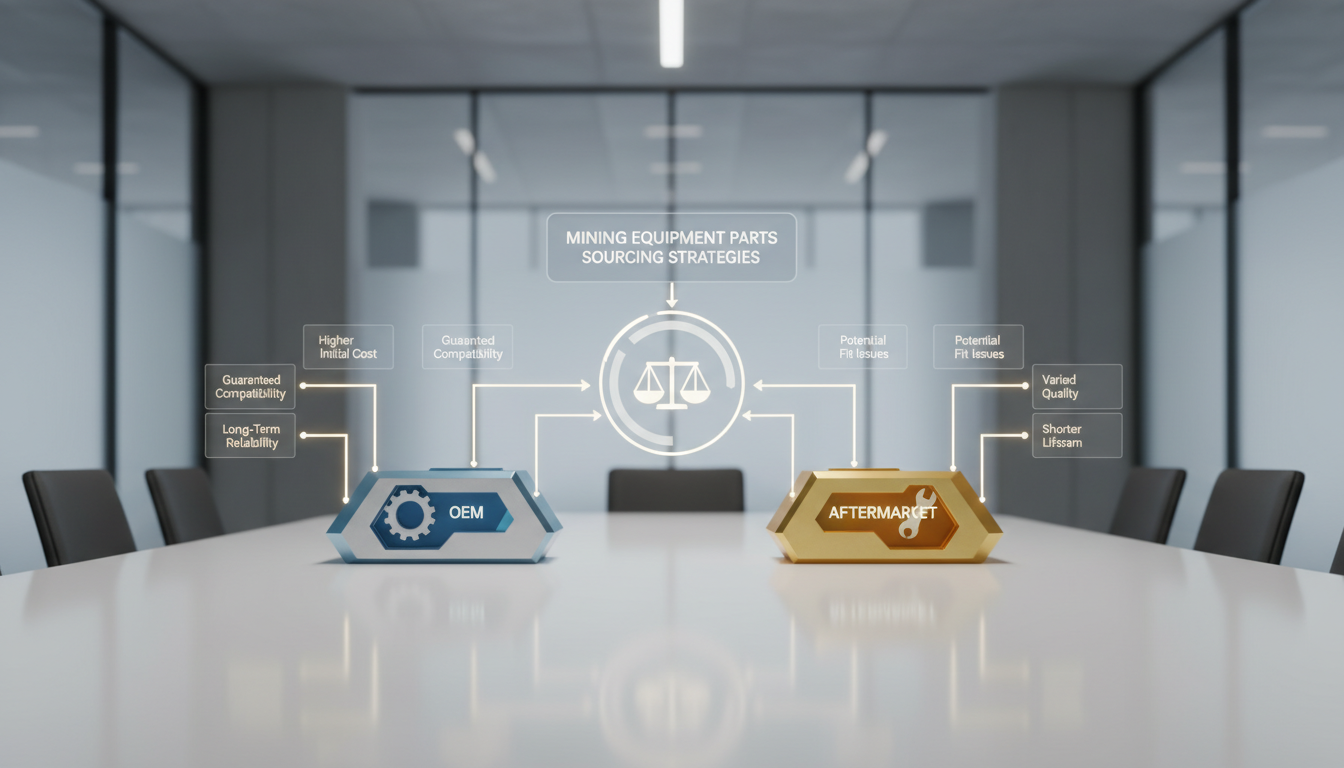
The OEM versus aftermarket decision shouldn’t be based on price alone. Smart procurement teams evaluate total cost of ownership, risk tolerance, and operational impact to make sourcing decisions that optimize long-term fleet performance.
When OEM Parts Are Non-Negotiable
Certain applications demand OEM parts regardless of cost considerations. Safety-critical components, warranty-covered equipment, and highly-engineered systems typically require OEM sourcing to maintain operational integrity and regulatory compliance.
Electronic control modules, safety systems, and emission-related components almost always require OEM parts. These systems are tightly integrated with equipment software and diagnostic systems. Aftermarket substitutes might function initially but can cause unpredictable failures or void warranty coverage.
New equipment under warranty presents another clear case for OEM parts. Warranty claims can be denied if aftermarket parts contribute to failures, even if the aftermarket part itself wasn’t defective. The potential cost of a denied warranty claim often exceeds any savings from aftermarket sourcing.
Aftermarket Opportunities for Cost Optimization
High-volume consumables, wear components, and routine maintenance items offer the best opportunities for aftermarket sourcing. These parts typically have well-understood specifications, multiple qualified suppliers, and predictable failure modes.
Hydraulic filters, engine oil filters, and air filters are excellent candidates for aftermarket sourcing. These components use standard specifications and materials, allowing aftermarket suppliers to deliver equivalent performance at 20-roughly a third cost savings. The key is working with suppliers who maintain proper certifications and quality control.
Structural components like bucket teeth, cutting edges, and wear plates can often be improved through aftermarket engineering. We’ve developed enhanced metallurgy and geometry modifications that extend service life beyond OEM specifications while reducing unit costs.
Risk Assessment and Total Cost Analysis
Effective sourcing decisions require complete risk assessment that considers failure consequences, not just part costs. A $500 hydraulic seal might seem like a minor expense, but if it fails and causes $50,000 in secondary damage, the sourcing decision becomes critical.
We recommend a structured approach: categorize parts by failure impact (high/medium/low), evaluate supplier capabilities and certifications, and calculate total cost of ownership including installation labor, downtime costs, and failure risks. This framework helps procurement teams make consistent, defensible sourcing decisions.
Global Supply Chain and Lead Time Management
Mining operations often exist in remote locations far from major industrial centers, creating complex logistics challenges that can make or break parts availability. Understanding global supply chains and managing lead times effectively separates successful operations from those plagued by chronic downtime.
Regional Supply Hub Strategy
Major mining equipment manufacturers maintain regional parts distribution centers, but coverage varies significantly by geography and equipment type. Caterpillar has strong distribution networks in established mining regions like Australia and Chile, but coverage becomes spotty in emerging markets.
Smart procurement teams map supplier locations against their operational footprint to identify coverage gaps and lead time risks. A mine in Kazakhstan might receive faster service from European suppliers than from traditional North American sources, despite equipment being manufactured in the US.
We maintain strategic inventory positions in key mining regions , Perth for Australian operations, Santiago for South American mines, Johannesburg for African projects. This distributed approach reduces average lead times from 3-4 weeks to 5-7 days for most common components.
Customs and Documentation Challenges
International parts shipments face complex customs requirements that can add weeks to delivery times if not managed properly. Mining equipment parts often require specific documentation, duty classifications, and import permits that vary by country and component type.
Hydraulic components containing oil might be classified as hazardous materials, requiring special handling and documentation. Electronic components could face additional scrutiny for dual-use technology restrictions. These requirements aren’t just bureaucratic hurdles , they’re legal compliance issues that can result in shipment seizures or significant delays.
Professional parts suppliers maintain customs expertise and established relationships with freight forwarders who understand mining industry requirements. This infrastructure investment pays dividends when urgent shipments need to clear customs quickly.
Emergency Logistics and Expedited Shipping
When critical equipment fails unexpectedly, normal logistics timelines become irrelevant. Emergency parts procurement requires pre-established relationships with suppliers who can mobilize quickly and freight networks capable of handling urgent shipments.
Air freight becomes cost-effective for high-value, compact parts when downtime costs exceed transportation premiums. A $10,000 hydraulic pump might justify $3,000 in expedited shipping if it prevents $50,000 in lost production. However, large structural components might require surface transportation regardless of urgency.
We maintain emergency response protocols that can mobilize parts within hours of receiving orders. This includes pre-positioned inventory, dedicated air freight relationships, and 24/7 logistics coordination. These capabilities aren’t cheap to maintain, but they’re invaluable when production depends on rapid response.
Quality Assurance and Certification Requirements
Mining equipment operates in demanding conditions where component failures can have catastrophic consequences. Quality assurance isn’t just about preventing warranty claims , it’s about maintaining operational safety and avoiding accidents that could shut down entire operations.
Industry Standards and Certifications
Mining equipment parts must meet various industry standards depending on application and geographic location. ISO 9001 quality management systems are baseline requirements, but specialized applications demand additional certifications.
Underground mining equipment requires explosion-proof certifications (ATEX in Europe, MSHA in the US) for electrical components. These certifications involve extensive testing and documentation that aftermarket suppliers must maintain to serve underground applications legally.
Hydraulic components often require ISO 4406 cleanliness standards and pressure testing certifications. Structural components might need material certifications showing steel grades, heat treatment records, and dimensional inspections. These aren’t optional paperwork , they’re legal requirements for safe operation.
Material Traceability and Documentation
Critical mining equipment parts require complete material traceability from raw materials through final assembly. This documentation enables failure analysis, warranty claims, and regulatory compliance reporting.
When a hydraulic cylinder fails catastrophically, investigators need to trace the failure back to material sources, manufacturing processes, and quality control records. Without proper documentation, the entire investigation becomes speculation, and lessons learned can’t be applied to prevent future failures.
We maintain complete traceability systems that track materials from certified suppliers through our manufacturing processes. Every component ships with material certificates, dimensional inspection reports, and test results that enable complete failure analysis if needed.
Field Testing and Performance Validation
Laboratory testing can validate basic specifications, but mining equipment operates in conditions that are difficult to replicate in controlled environments. Field testing programs provide real-world performance data that laboratory tests can’t capture.
We work with mining operations to conduct structured field trials of new aftermarket components. These trials include baseline performance measurements, regular inspections, and detailed failure analysis when components reach end of life. The data collected helps refine designs and validate performance claims.
Field testing also builds confidence with procurement teams who need to justify sourcing decisions to senior management. Documented performance data from similar operations provides compelling evidence for aftermarket adoption.
Cost Optimization and Procurement Best Practices
Effective mining equipment parts procurement requires balancing multiple competing priorities: minimizing costs, ensuring availability, maintaining quality, and managing risks. The most successful operations develop systematic approaches that optimize total cost of ownership rather than just unit prices.
Strategic Inventory Management
Mining operations must balance inventory carrying costs against stockout risks that can shut down production. The optimal approach varies by part criticality, lead times, and failure predictability.
High-value, slow-moving parts like engine blocks or final drives shouldn’t be stocked routinely. Instead, establish framework agreements with suppliers who maintain inventory and can deliver within acceptable timeframes. This approach transfers inventory carrying costs to suppliers while ensuring availability.
Fast-moving consumables like filters, belts, and wear components should be managed using statistical inventory models that balance carrying costs against stockout risks. Modern inventory management systems can optimize these trade-offs automatically, but they require accurate consumption forecasts and lead time data.
We help mining operations develop inventory strategies that align with their operational priorities and risk tolerance. This includes analyzing historical consumption patterns, identifying critical spares, and establishing optimal stocking levels for different component categories.
Supplier Relationship Management
Long-term supplier relationships create value beyond just competitive pricing. Established suppliers understand your equipment mix, operational patterns, and service requirements, enabling them to provide better support when problems arise.
However, single-sourcing creates supply chain risks that can be catastrophic for mining operations. The optimal approach involves primary suppliers for routine requirements plus qualified backup sources for critical components.
Supplier performance should be measured on multiple dimensions: price competitiveness, delivery reliability, quality performance, and technical support capability. Regular supplier reviews help identify improvement opportunities and ensure continued alignment with operational requirements.
Technology Integration and Digital Procurement
Modern procurement systems can automate routine transactions, provide real-time inventory visibility, and enable data-driven decision making. However, technology implementation must align with operational realities and user capabilities.
Electronic catalogs and automated ordering systems work well for routine consumables but may not handle complex technical specifications or emergency requirements effectively. The key is implementing technology that enhances human decision-making rather than replacing it entirely.
Predictive maintenance systems generate valuable data about component failure patterns and replacement timing. This information can optimize inventory levels, improve procurement planning, and identify opportunities for preventive interventions that extend component life.
Future Trends in Mining Equipment Parts Supply
The mining equipment parts industry is evolving rapidly, driven by technological advances, changing operational requirements, and new business models. Understanding these trends helps procurement teams prepare for future challenges and opportunities.
Additive Manufacturing and On-Demand Production
3D printing technology is beginning to impact mining equipment parts supply, particularly for low-volume, complex components that are expensive to manufacture using traditional methods. While current technology limitations restrict applications to non-critical parts, capabilities are expanding rapidly.
The most promising near-term applications involve rapid prototyping for custom modifications, production of obsolete parts for legacy equipment, and emergency manufacturing of simple components at remote mine sites. As materials science advances, more critical applications will become feasible.
However, quality assurance and certification requirements will remain challenging for additive manufacturing. Mining operations can’t accept experimental parts in critical applications, so adoption will be gradual and focused on proven applications.
Digital Twins and Predictive Maintenance
Digital twin technology creates virtual models of physical equipment that can predict component failures before they occur. This capability transforms parts procurement from reactive to proactive, enabling optimized inventory management and planned maintenance scheduling.
Predictive maintenance systems analyze equipment sensor data, operating conditions, and historical failure patterns to forecast when specific components will need replacement. This information enables procurement teams to source parts proactively rather than reactively, reducing costs and minimizing downtime.
The technology is still maturing, but early adopters are seeing significant benefits in reduced emergency procurement, optimized inventory levels, and improved equipment availability.
Sustainability and Circular Economy Initiatives
Environmental sustainability is becoming a significant factor in mining equipment parts procurement. Operations are increasingly focused on extending component life, improving recyclability, and reducing environmental impact throughout the supply chain.
Remanufacturing programs can deliver OEM-quality components at reduced cost while minimizing environmental impact. These programs work particularly well for high-value components like engines, transmissions, and hydraulic pumps that can be rebuilt multiple times.
Component life extension through improved materials, coatings, and designs reduces total parts consumption while improving operational efficiency. We’re seeing increased demand for engineered solutions that optimize total cost of ownership rather than just initial purchase price.
Pro Tip: When evaluating remanufactured components, ensure the supplier provides complete warranties and performance guarantees equivalent to new parts. Quality remanufacturing can deliver 90-the vast majority of new part performance at 60-most of new part cost.
Ready to optimize your mining equipment parts procurement? Our global network delivers OEM-quality components with 5-day delivery to mining operations worldwide. Shop OEM-quality spare parts with global 5-day delivery at 3genexport.com