
Reducing downtime with preventive parts replacement is the systematic practice of replacing wear-prone components at scheduled intervals to avoid unexpected failures and maintain steady production.
Key Takeaways
- Unplanned downtime can account for up to 20% of productivity losses in manufacturing, according to Deloitte research.
- parts replacement shifts maintenance from reactive to proactive, slashing emergency repair costs that often run 3-5 times higher than planned maintenance.
- A structured program identifies critical wear parts, sets replacement intervals, and ensures spare parts availability to minimize delays.
- Integrating technology like IoT sensors and fleet management software triggers timely replacements before failures occur.
- Companies using strategic parts replacement see measurable improvements in uptime, equipment lifespan, and operational safety.
- Adopting a proactive maintenance culture, backed by proper training and reliable suppliers like 3GEN Export, sustains long-term results.
Understanding Preventive Parts Replacement Strategy

The core idea behind these replacement is simple: don’t wait for a component to fail. In heavy machinery and industrial equipment, certain parts, bearings, seals, belts, filters, hydraulic hoses, degrade predictably under normal operating conditions. By monitoring hours of use, cycles, or calendar time, operators can schedule swaps during planned service windows, avoiding the chaos of a sudden breakdown. This approach is a cornerstone of preventive maintenance, a strategy that, unlike reactive maintenance, keeps equipment running at peak efficiency and dramatically cuts unplanned stoppages. At 3GEN Export, we’ve seen firsthand how such parts replacement can keep production lines moving without interruption.
The Role of Wear Parts in Equipment Failure
Every machine has components designed to sacrifice themselves to protect more expensive assets. Brake pads, oil filters, cutting edges, and couplers all have finite service lives outlined in OEM manuals. Ignoring these limits invites failure. For example, a worn hydraulic seal can lead to fluid contamination, which then damages pumps and valves, a $50 seal ignored ultimately causing $5,000 in repairs. By proactively tracking wear-part condition, companies can replace these items during scheduled downtime, not during an emergency. According to industry standards like ISO 55000, asset management should prioritize such preventive actions to sustain reliability.
How Scheduled Replacement Differs from Reactive Fixes
Reactive maintenance, fixing equipment only after it breaks, may seem cheaper in the short term, but its hidden costs quickly mount. When a machine goes down unexpectedly, you pay for expedited shipping, overtime labor, and lost production, often costing thousands of dollars per hour. In contrast, scheduled replacements allow you to order parts in advance from trusted suppliers like 3GEN Export, install them during planned maintenance windows, and keep costs predictable. The 80/20 rule in maintenance suggests that roughly 20% of components cause 80% of unplanned failures; targeting those parts with reducing downtime with preventive parts replacement yields the greatest return on effort. This shift from reactive to proactive saves both time and money while improving overall equipment effectiveness (OEE).
The True Cost of Unplanned Downtime
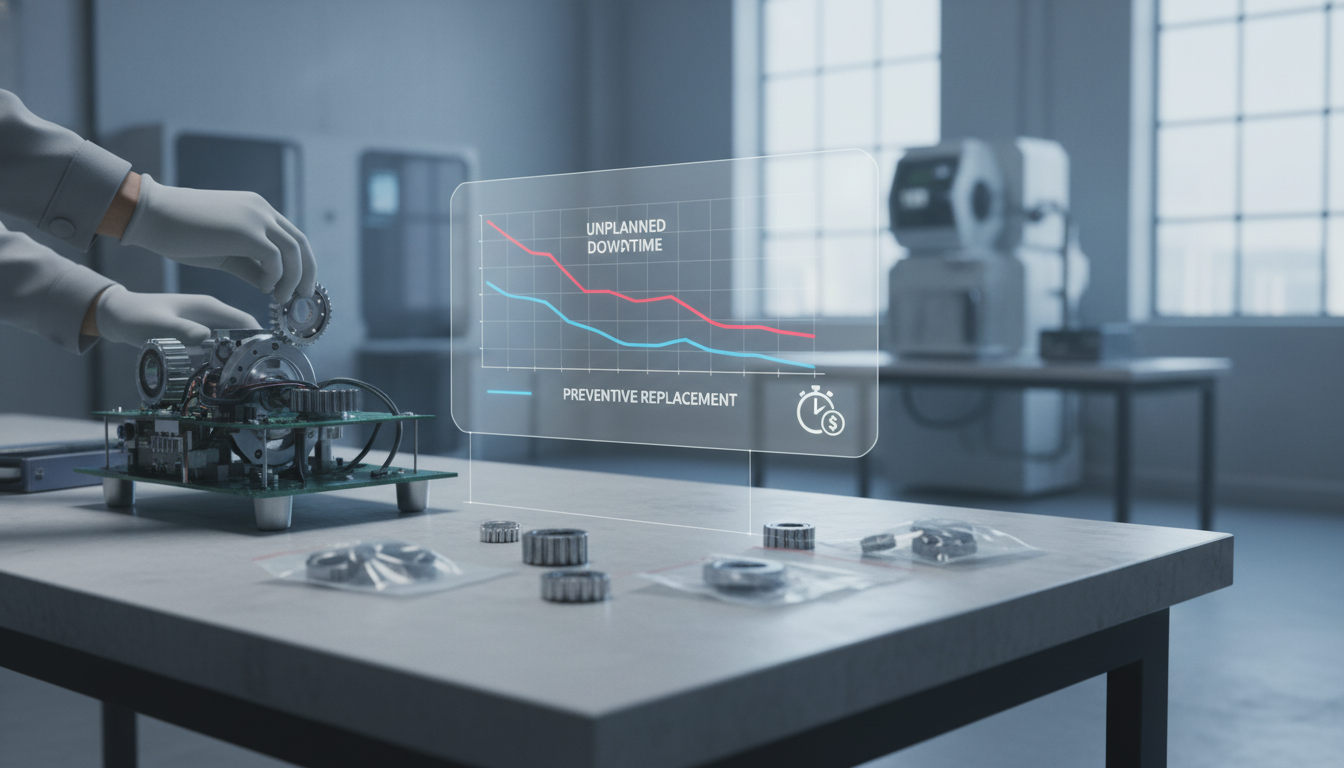
Understanding the financial impact of downtime is essential to justify reducing downtime with preventive parts replacement. A Deloitte study highlights that unplanned downtime can erode up to 20% of overall productivity in manufacturing. But the damage doesn’t stop there. When a critical machine stops, every downstream operation feels the ripple effect: delayed orders, idle workers, and missed customer deadlines. For heavy equipment operations, one hour of lost production can easily translate into $10,000 or more in direct losses, not counting reputational harm.
Direct Costs: Production Loss and Emergency Repairs
Direct costs are the most visible. They include the value of goods not produced, wages paid to idle staff, and the premium prices for rush parts and expedited service calls. A hydraulic press out of service for just 3 hours can cost a forging plant $30,000 in lost output, assuming a production rate of $10,000 per hour. Emergency repair costs are typically 30-50% higher than planned maintenance due to overtime and express logistics. By comparison, a preventive replacement of the same press’s seals and valves might cost only $2,000 in parts and 2 hours of scheduled downtime. The math strongly favors proactive action.
Indirect Costs: Reputation, Safety, and Morale
Indirect costs are harder to quantify but equally damaging. Late deliveries frustrate customers and can lead to lost contracts. Equipment failures often create safety hazards; a sudden hydraulic burst can cause injuries and OSHA penalties. Moreover, frequent breakdowns erode team morale, operators and mechanics become stressed by constant firefighting. A stable program for reducing downtime with preventive parts replacement fosters a safer, more predictable work environment, which in turn boosts employee retention and customer trust. Investing in reliability sends a clear message that the company values quality and consistency.
“Research by Deloitte indicates that unplanned downtime can account for as much as 20% of overall productivity losses in industrial manufacturing.”
Scheduling Parts Replacement for Maximum Uptime

Determining the optimal time to replace a part is both science and art. Manufacturers like Caterpillar publish detailed service manuals with recommended intervals, such as changing hydraulic oil every 2,000 hours or replacing air filters every 500 hours. However, real-world conditions (dust, temperature, load) can accelerate wear. That’s why many operations now complement OEM recommendations with condition monitoring, using data to refine schedules. A study in the Computational Intelligence and Neuroscience journal applied Weibull distribution models to calculate optimal preventive maintenance periods, proving mathematically that scheduled interventions increase mean time between failures by 15-25%. These models help balance the risk of premature replacement against the cost of unexpected failure.
Using Failure Data to Determine Intervals
Every machine leaves a trail of data. Maintenance logs, sensor readings, and inspection reports reveal patterns of component degradation. For instance, if conveyor belt bearings typically fail between 8,000 and 10,000 hours, a smart plan replaces them at 7,000 hours to stay well ahead of the curve. Software like Cat VisionLink or PT Chronos’ Necton platform aggregates such data across a fleet, highlighting assets at risk. At 3GEN Export, we advise clients to track mean time between failures (MTBF) for critical parts and set replacement triggers at 80% of that value. This proactive buffer reduces unscheduled downtime by keeping parts inventories aligned with actual consumption rates.
Balancing Cost and Risk with Inventory Management
Holding too many spare parts ties up capital and warehouse space; holding too few risks equipment being idle for days or weeks while waiting for a replacement. A well-designed program for reducing downtime with preventive parts replacement optimizes inventory levels based on lead times and component criticality. For example, a common filter might be stocked in bulk locally, while a specialized pump may be ordered just-in-time from a supplier like 3GEN Export, which ships within 48 hours from strategic locations. This balance minimizes carrying costs while ensuring that when a scheduled replacement is due, the part is on hand. Companies that neglect this often face a stark choice: pay for expensive air freight or endure production stoppages lasting weeks.
Building a Preventive Parts Replacement Program

Creating an effective program requires a structured approach. Follow these steps to implement reducing downtime with preventive parts replacement in your facility.
- Asset Prioritization: List all equipment and rank by criticality. Assign the highest priority to machines that would halt production if failed.
- Identify Wear Parts: For each critical asset, list all components with recommended service intervals from OEM manuals or historical failure data.
- Set Replacement Triggers: Determine the optimal time or usage threshold for replacement, such as every 2,000 hours or annually. Add a safety margin (e.g., replace at 80% of expected life).
- Source Reliable Suppliers: Partner with OEMs or aftermarket specialists like 3GEN Export to ensure genuine or high-quality parts are available on time. Verify lead times and stock availability.
- Implement Tracking Systems: Use a computerized maintenance management system (CMMS) or simple spreadsheets to log hours, record replacements, and trigger alerts.
- Train Personnel: Ensure maintenance teams understand the schedule and can perform replacements efficiently. Cross-train operators to spot early wear signs.
- Continuously Improve: Review failure data quarterly. Adjust intervals based on actual wear rates and operational changes.
Roles and Responsibilities for a Successful Rollout
Assign ownership at every level. A maintenance planner can manage schedules and parts procurement, while technicians execute the replacements. Managers must champion the program and allocate budget. Often, the biggest obstacle is cultural resistance; operators accustomed to “run-to-fail” may see preventive swaps as unnecessary. Education on the cost of downtime versus the cost of routine replacement usually wins them over. Involving employees early is key to success. When staff see lower stress and fewer emergencies, buy-in increases.
“Empowering employees and adopting a proactive mindset are critical for reducing downtime, as noted by industry experts at Tanktemp.”
Integrating with Existing Maintenance Strategies
Reducing downtime with preventive parts replacement fits alongside other maintenance approaches like predictive maintenance (condition-based) and total productive maintenance (operator-driven). For example, vibration analysis might indicate a bearing is degrading, triggering an early replacement before the scheduled date. This hybrid method maximizes uptime by using data to refine the schedule dynamically. Facilities following ANSI standards for machinery safety can integrate parts replacement checklists directly into their safety inspections, ensuring compliance. At 3GEN Export, we help clients merge these strategies into one workflow, leveraging our extensive parts catalog and rapid logistics to support any maintenance philosophy.
Leveraging Technology to Optimize Parts Replacement
Modern technology has transformed preventive maintenance from a calendar-based chore into a precise, data-driven science. Sensors, IoT platforms, and cloud-based CMMS now enable real-time tracking of equipment health. For instance, Artesis offers predictive maintenance systems that monitor motor current signatures to detect early-stage faults, automatically notifying teams when a part needs attention. This digital shift reduces unnecessary replacements while ensuring that no critical component exceeds its safe operating life. The approach becomes more effective when technology provides accurate usage data rather than relying on assumptions. The result is a leaner spare parts inventory and fewer surprises.
Condition Monitoring and Automated Alerts
Condition monitoring tools, vibration sensors, thermography cameras, oil analysis kits, provide early warning of impending failure. When a monitored parameter exceeds a preset threshold, the system can automatically generate a work order and even order the required part from an integrated supplier like 3GEN Export. This closed-loop process slashes reaction time from days to hours. For example, a fleet of excavators in California equipped with telematics reduced hydraulic hose failures by 40% simply by replacing hoses when pressure spikes were detected, months before the OEM’s 4,000-hour recommendation. Such proactive interventions are impossible without the right technology stack.
Fleet Management and Remote Logistics
For companies with multiple job sites, common in construction, mining, and agriculture, centralizing parts management is a challenge. Cloud-based platforms like Cat VisionLink or Gregory Poole’s dealer portal allow fleet managers to view usage hours across all machines, schedule preventive replacements, and direct parts shipments to exact locations. In regions like the Middle East or North Africa, where 3GEN Export frequently serves, having a logistics partner that understands local customs and can deliver OEM-grade parts within 48 hours is a game changer. This combination of technology and supply chain agility ensures that replacing a part is never the bottleneck.
Comparing Maintenance Strategies
Choosing the right maintenance approach is crucial for profitability. The table below contrasts three primary strategies, reactive, preventive, and predictive, highlighting how each handles parts replacement and its impact on downtime. Reducing downtime with preventive parts replacement falls squarely in the preventive column, but often blends with predictive data for even better results.
| Strategy | Description | Parts Replacement Trigger | Downtime Impact | Typical Cost Savings |
|---|---|---|---|---|
| Reactive (Run-to-Fail) | Replace parts only after they fail. | Breakdown | High (unscheduled, prolonged) | 0-5% over base (often costlier due to emergency repairs) |
| Preventive (Scheduled Replacement) | Replace parts at fixed intervals (hours, cycles, calendar). | Time/Usage | Low (planned, minimized) | 15-30% compared to reactive |
| Predictive (Condition-Based) | Replace parts based on real-time condition data. | Sensors/diagnostics | Very low (proactive, precise) | 25-40% compared to reactive |
Why Preventive Parts Replacement Offers the Best ROI
Pure predictive maintenance, while ideal, requires substantial investment in sensors and analytics, often only justifiable for the most critical assets. Reducing downtime with preventive parts replacement provides a practical middle ground: it eliminates guesswork and most catastrophic failures without the need for high-end technology. For a typical heavy equipment fleet, a preventive program costs about 1-3% of replacement asset value annually, far less than the 5-10% losses typical of reactive repairs. Coupled with a reliable parts supply from 3GEN Export, this strategy delivers consistent returns by keeping machines producing rather than parked.
Industry Standards That Support Preventive Replacement
International standards reinforce the value of scheduled parts replacement. ISO 55000 (Asset Management) and ANSI/ASSP Z244.1 (Lockout/Tagout) emphasize systematic maintenance to ensure safety and reliability. Following these standards not only reduces downtime but also simplifies regulatory compliance. In many industries, insurance premiums are 10-15% lower for companies that document a robust preventive maintenance program. By adhering to these guidelines, businesses demonstrate a commitment to operational excellence. At 3GEN Export, we help clients align their parts replacement schedules with ISO requirements, ensuring every component swap is traceable and justified.
Pros and Cons
Pros
- Predictable Costs: Budget for scheduled replacements rather than emergency repairs
- Reduced Downtime: Planned maintenance windows minimize production interruptions
- Extended Equipment Life: Regular part replacement prevents cascading failures
- Improved Safety: Proactive maintenance reduces risk of sudden equipment failure
- Better Planning: Advance notice allows optimal scheduling and resource allocation
Cons
- Higher Upfront Costs: Requires investment in spare parts inventory and planning systems
- Potential Over-Maintenance: May replace parts before absolutely necessary
- Complex Scheduling: Coordinating multiple machines and maintenance windows can be challenging
- Cultural Resistance: Staff may resist changing from familiar reactive approaches
Overcoming Common Implementation Obstacles
Even with the best intentions, implementation can stumble on several hurdles. Awareness of these challenges and proactive solutions are essential to sustain a successful program. From parts availability to employee pushback, each obstacle has a countermeasure.
Inventory Pitfalls: Too Much or Too Little
Stocking the right parts in the right quantities is a delicate balance. A 15-year-old machine, no longer supported by the OEM, poses a particular risk because replacements may be scarce. Conversely, overstocking common items wastes capital. The key is to classify parts using a criticality matrix (A, B, C classification) and partner with a supplier that offers fast, global shipping. 3GEN Export’s extensive network and inventory management tools help customers avoid both extremes by providing just-in-time delivery of high-mover items and expedited sourcing for rare components. This ensures that when reducing downtime with preventive parts replacement calls for a component, the part is on the shelf, no more, no less.
Cultural Resistance to Change
Transitioning from a reactive culture takes leadership and communication. Mechanics accustomed to replacing parts only when broken may view preventive swaps as wasteful. However, showing them data on reduced emergency call-outs and overtime often changes minds. Leadership must also budget appropriately; a preventive program requires upfront spending on parts and planning, but the total cost of ownership consistently drops by 15-25%. As one seasoned plant manager at a California processing facility noted, “Moving to preventive parts replacement cut our maintenance overtime by 60% and raised overall equipment effectiveness by 12%.” Sharing such successes internally builds momentum.
Complex Scheduling in Multi-Shift Operations
Facilities running 24/7 struggle to find downtime windows for replacements. Here, creativity is needed: brief, focused shutdowns (e.g., during shift changes), or using backup equipment while primary machines are serviced. Advanced planning software can model production schedules and suggest optimal replacement times with minimal production impact. In Saudi Arabia, where some plants operate continuously due to high demand, our clients schedule major part replacements during national holidays or religious observances when production naturally slows. This type of foresight keeps uptime maximized without sacrificing maintenance quality.
Frequently Asked Questions
What is the 80/20 rule in maintenance?
The 80/20 rule suggests that roughly 80% of maintenance costs or downtime events arise from 20% of equipment components. Focusing reducing downtime with preventive parts replacement on that critical 20% yields the greatest reduction in unplanned downtime.
What is the best way to minimize downtime of equipment and facilities?
The best way is a combination of preventive maintenance, including scheduled parts replacement, condition monitoring, and operator training. This proactive approach addresses potential failures before they cause stoppages.
How often should preventive parts replacement be performed?
Frequency depends on OEM recommendations and actual operating conditions. Generally, wear parts are replaced every 250 to 2,000 hours of use. Data from maintenance logs and sensors can refine these intervals for your specific environment.
Does preventive parts replacement eliminate all unplanned downtime?
No strategy can eliminate 100% of failures, but a well-executed program can reduce unscheduled downtime by 30-50%. Unexpected events like operator error or sudden catastrophic failure can still occur, but their likelihood drops dramatically.
How do I source reliable replacement parts for older equipment?
Partner with a specialist supplier like 3GEN Export, which has access to a global network of OEM and aftermarket parts. Even for machines 15+ years old, we can often locate or manufacture the needed components.
Is preventive parts replacement more expensive in the long run?
No. While it requires upfront spending on parts and labor, it avoids the much higher costs of emergency repairs, lost production, and premature equipment replacement. Studies show a 3:1 to 5:1 return on investment.
Shop OEM-quality spare parts with global 5-day delivery at 3genexport.com