
Key Takeaways
- Used construction equipment parts typically cost 50–75% less than new OEM equivalents, while rebuilt and aftermarket options provide balanced value.
- Always match the exact OEM part number to your machine’s serial number to avoid costly fitment errors.
- Reputable suppliers offer warranties of 90 days or more on hard parts and maintain inventories of over 200,000 components.
- Export buyers must confirm international shipping, customs documentation, and brand availability in destination regions before purchase.
- Proper part verification and supplier selection prevent downtime that costs operations hundreds of dollars per day.
Construction equipment parts for sale are the engines, transmissions, hydraulic cylinders, undercarriage components, and other assemblies that keep excavators, loaders, dozers, and off-road trucks operating on jobsites worldwide.
What to Look for When Buying Construction Equipment Parts
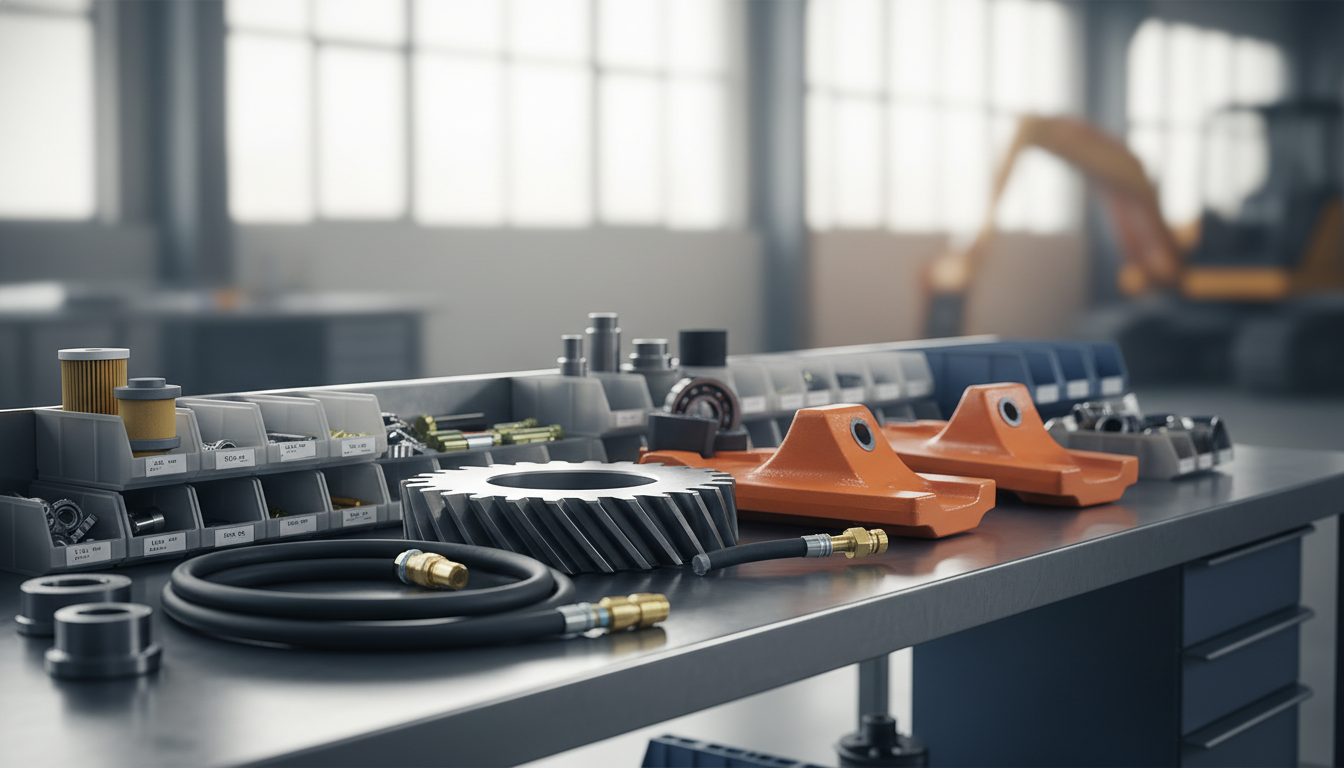
Purchasing heavy equipment parts requires more than just matching a part number. The average heavy machine contains thousands of individual components, and choosing incorrectly can lead to extended downtime. A structured approach helps you secure the right part at the right price, whether you need a replacement final drive for a Komatsu PC120-6 or a rebuilt cylinder for a John Deere 624K wheel loader.
Understand OEM Part Numbers and Cross-Referencing
An OEM part number is a unique identifier assigned by the manufacturer to a specific component. Every part on a Caterpillar, Volvo, or Hitachi machine carries a number stamped or tagged on the housing. When sourcing used or aftermarket replacements, cross-reference that number with the supplier’s database. Construction Equipment Parts, with over 200,000 listings, lets you search by part number directly. For machines with replaced engines or retrofitted attachments, have the serial number of the base machine and any installed assemblies ready.
Inspect Condition and Return Policies
Not all “used” parts are equal. Salvage yards grade parts based on testing and visual inspection. A quality supplier will stand behind its components: for instance, Wengers of Myerstown offers a 90-day warranty on all hard parts, accepting returns with no questions asked. Before purchasing, ask for photos of the actual part, hours of use (if available), and whether any reconditioning has been done. If buying sight unseen, this documentation is your first line of defense.
Evaluate Supplier Reputation
Look for suppliers with verified reviews and a track record. ConEquip, which has served the industry since 2008, holds a 4.9 out of 5 rating based on over 4,000 customer reviews. Vander Haag’s has been in the salvage business for more than 80 years. Choose a supplier that specializes in construction equipment, not just general salvage, to ensure the staff understands the demands of off-highway applications and can advise on interchangeability across brands.
New, Used, Rebuilt, or Aftermarket: Deciding on Part Condition

The four main conditions for construction equipment parts each suit different budgets, machine ages, and downtime tolerances. Understanding the trade-offs helps you avoid overpaying for a part that will outlive the machine or underinvesting and risking early failure.
| Condition | Price vs. New OEM | Typical Warranty | Best For |
|---|---|---|---|
| New OEM | 100% (list price) | 6–12 months | Critical powertrain components, machines under lease or warranty |
| Used / Salvage | 25–50% | 30–90 days | Older machines, low-budget repairs, non-critical attachments |
| Rebuilt | 50–75% | 90 days–1 year | Mid-life machines, balancing cost with factory-spec performance |
| Aftermarket | 70–90% | 6 months–1 year | Price-sensitive replacements, high-wear items like bucket teeth and filters |
According to Wengers of Myerstown, equipment owners who choose used parts save an average of 50–75% compared to new OEM pricing. Rebuilt components, where worn internals are replaced but the original housing is reused, often perform like new at roughly two-thirds the cost. Aftermarket parts, manufactured by third parties to OEM specifications, fill the middle ground for fleets that want new quality without original manufacturer markup.
Pros and Cons of Buying Used Construction Equipment Parts

Pros
- Significant cost savings of 50-75% compared to new OEM parts
- Immediate availability from large salvage yard inventories
- Proven performance history from field-tested components
- Environmental benefits through parts recycling and reuse
- Access to discontinued parts for older machine models
Cons
- Limited or shorter warranty periods compared to new parts
- Unknown service history and remaining useful life
- Potential for hidden damage or wear not visible during inspection
- No guarantee of availability for specific part numbers
- Risk of receiving incorrect or mislabeled components
Top Brands and Sources for Heavy Equipment Components

Major manufacturers dominate the construction equipment landscape, and any parts supplier worth considering must carry inventory for them. AMS Parts, for example, stocks components for over 20 brands including Bobcat, Case, Caterpillar, Daewoo, Doosan, Hitachi, Hyundai, JCB, John Deere, Kobelco, Komatsu, Kubota, Link Belt, New Holland, Samsung, Takeuchi, Timberjack, Volvo, and Yanmar. When evaluating a source, consider not just the brands listed but the depth of stock for your specific model series.
Online Marketplaces vs. Specialized Salvage Yards
Online platforms like eBay provide access to a huge number of listings, but verifying quality and compatibility falls entirely on the buyer. Specialized salvage companies like Adelman’s or Vander Haag’s offer curated inventories with inspection reports and warranty protection. For critical engine or transmission components, working with a recognized heavy equipment parts supplier reduces the risk of receiving a mislabeled or defective unit.
Regional Availability and Shipping
If your operations are in the Midwest, yards in Iowa and Indiana, such as Vander Haag’s, can shorten transit times. East Coast buyers often turn to CE Parts in Chesapeake, VA or ConEquip in Buffalo, NY. Confirm shipping costs and lead times before ordering; a lower purchase price can be quickly offset by freight charges on a 500 lb axle.
How to Verify Part Compatibility and Avoid Costly Mistakes
One of the most common errors in parts purchasing is assuming that “close enough” will work. A final drive for a Caterpillar 320D is not the same as one from a 320CL, and an axle from a Volvo L160 may not bolt into an L180. When searching for construction equipment parts for sale, follow this step‑by‑step process to guarantee fitment.
- Record the machine’s VIN, model, and serial number. This data is typically on a plate inside the cab or on the frame.
- Locate the part’s OEM number. Check the old part for a stamped number, or consult the machine’s parts manual.
- Cross‑reference with the supplier’s catalog. Use the part number search function. If the exact number is not available, ask the supplier to check interchangeability with superseding numbers or compatible models.
- Provide photos of the old component. Send images of the data plate, overall part, and any mounting holes or connection points. This helps salvage yards confirm visual match.
- Confirm returns policy. Even with correct numbers, variances can occur. Ensure the supplier has a return window, preferably 30 days or longer, and test the part immediately upon arrival.
Export Considerations When Buying Construction Equipment Parts
For international buyers, finding construction equipment parts for sale is only half the battle; navigating customs, freight, and regional compatibility adds layers of complexity. Whether you are shipping to Latin America, Africa, the Middle East, or Asia, several practices will keep your procurement on track.
Choosing an Export-Savvy Supplier
Not all suppliers ship internationally or understand export documentation. Look for companies with a dedicated export department. Adelman’s, for example, highlights export parts as a distinct service category. An experienced exporter will handle the commercial invoice, packing list, and certificate of origin, and can advise on whether the part qualifies for any free trade agreement benefits.
Documentation and Compliance
Customs clearance can stall a shipment for days if paperwork is incomplete. Ensure the supplier provides a detailed invoice with the harmonized system (HS) code for each part. Some countries require fumigation certificates for used equipment parts or proof of origin to determine duty rates. Working with a freight forwarder familiar with heavy machinery simplifies the process; many parts suppliers can recommend one.
Currency and Payment Terms
Price quotes in U.S. dollars are standard, but you should clarify whether taxes or duties are included. Many export suppliers require wire transfer or an irrevocable letter of credit for first-time buyers. Budget an additional 3–5% for currency conversion fees if paying from a non‑USD account.
Brand Support in Destination Country
Before ordering, verify that the brand you are buying has local service and parts support in your country. A Komatsu part sourced from the U.S. may be identical to one sold by the local dealer, but if future warranty claims or technical assistance are needed, you want to know the local network can help. Stick to globally supported brands like Caterpillar, Volvo, Deere, and Hitachi when possible.
Pricing and Budgeting: What You Should Expect to Pay
Construction equipment parts for sale cover an enormous price range. A used bucket pin may cost $50, while a complete rebuilt engine for a large excavator can run $30,000. Budgeting correctly requires understanding the cost drivers: component complexity, availability, and condition.
- Budget (used, minor parts): $50–$500. Examples: pins, bushings, small hydraulic cylinders, filters.
- Mid‑range (rebuilt, major assemblies): $1,000–$10,000. Examples: final drives, swing motors, pumps, radiators.
- Premium (new OEM, complete powertrain): $10,000–$50,000+. Examples: engines, transmissions, complete undercarriage kits.
Beyond the part price, factor in shipping, potential tariffs (up to 25% in some countries for heavy machinery parts), and installation labor. If downtime is costing you $500 per day, paying an extra 10% for expedited shipping from a supplier with the part in stock often pencils out quickly.
Care and Maintenance Tips to Extend Part Life
The best way to reduce your long‑term parts bill is to extend the service life of the components you already have. Heavy equipment operates in punishing environments, but consistent maintenance practices make a measurable difference.
- Adhere to manufacturer service intervals for oil and filter changes. Contaminated oil is the leading cause of hydraulic pump and engine failure.
- Grease all pivot points daily. Undercarriage and linkage pins on excavators and loaders wear rapidly without lubrication.
- Inspect undercarriage components for uneven wear. Track adjusters, idlers, and sprockets should be replaced before they damage adjacent parts.
- Keep the machine clean. Dirt and debris packed around cylinders and seals accelerate corrosion and wick moisture into electrical connectors.
- Use OEM or high-quality aftermarket filters. Cheap filters offer lower efficiency at trapping contaminants, increasing long‑term wear on engines and hydraulics.
Many salvage yards and parts suppliers offer inspection services or can recommend service providers. Taking advantage of their expertise can help you identify weak points before they become breakdowns.
Selling Your Old Equipment for Salvage
When your machine reaches end-of-life, selling it to a salvage yard can recover significant value while ensuring usable components reach other operators. Most salvage yards evaluate machines based on model year, hours, overall condition, and demand for specific parts from that model series.
Before contacting buyers, gather maintenance records, hour meter readings, and a list of any recent major repairs or component replacements. Clean machines with complete service histories typically command higher prices. Some yards offer pickup services, while others require you to deliver the machine to their facility.
Frequently Asked Questions
What is the difference between rebuilt and remanufactured parts?
A rebuilt part is a used component that has been cleaned and had only the failed or worn elements replaced. A remanufactured part is completely disassembled and restored to original specifications with all new wear parts, often including a longer warranty. For high-stress applications, remanufactured is the safer choice.
How quickly can I get construction equipment parts delivered?
Delivery times vary by supplier and location. Domestically, many suppliers ship within 24–48 hours if the part is in stock. International shipping can take 3–10 business days via air freight or 2–6 weeks by ocean, depending on customs clearance.
Can I return a used part if it doesn’t fit?
Most reputable suppliers offer exchange terms if the part is returned in the condition received and within a specified window, commonly 30 days. Always check the return policy before purchasing; some heavy assemblies may have a restocking fee.
Is it safe to buy construction equipment parts online?
Yes, if you use established suppliers with verified physical locations and positive customer reviews. Avoid sellers who cannot provide clear photos of the actual part or who offer no return option.
Do aftermarket parts void my machine’s warranty?
In the United States, the Magnuson-Moss Warranty Act generally prohibits manufacturers from voiding a warranty solely because you use an aftermarket part, unless they can prove the aftermarket part caused the failure. Still, for machines still under OEM warranty, it is often safest to use OEM or OEM-approved components.
How do I know if a used part has been properly inspected?
Ask the supplier for their inspection checklist. Quality salvage yards test hydraulic components under pressure, check for cracks with dye penetrant, and verify tolerances with micrometers. If a supplier cannot describe their inspection process in detail, consider that a red flag.
In summary, reliable construction equipment parts for sale come from suppliers who invest in thorough inspection, transparent warranty, and deep inventories. By matching part numbers precisely and weighing condition against your operational needs, you can keep any machine, from a mini excavator to a 50‑ton truck, running profitably. Shop OEM-quality spare parts with global 5-day delivery at 3genexport.com.