
Construction equipment parts near me are the OEM, aftermarket, used, and rebuilt components available from local or regional suppliers to get your heavy machinery back online fast. When a machine goes down on-site, proximity to the right part is the difference between a two-hour fix and a two-week project delay.
Key Takeaways
- Local suppliers can provide same-day parts availability, cutting machine idle time significantly compared to waiting on national freight.
- Part conditions include new OEM, aftermarket, used, rebuilt, and remanufactured, each with different price and quality trade-offs.
- Verifying part numbers and serial numbers ensures compatibility and prevents costly wrong orders.
- National distributors often carry larger inventories but may add 10-20% to part cost through freight charges.
- Aftermarket parts from established brands typically cost 15-25% less than OEM equivalents while meeting ISO or ASTM standards.
- As of 2026, global suppliers like 3GEN Export offer OEM-quality parts with 5-day worldwide delivery, bridging the gap between local urgency and international inventory depth.
Understanding Part Conditions: New, Used, Rebuilt, and Aftermarket
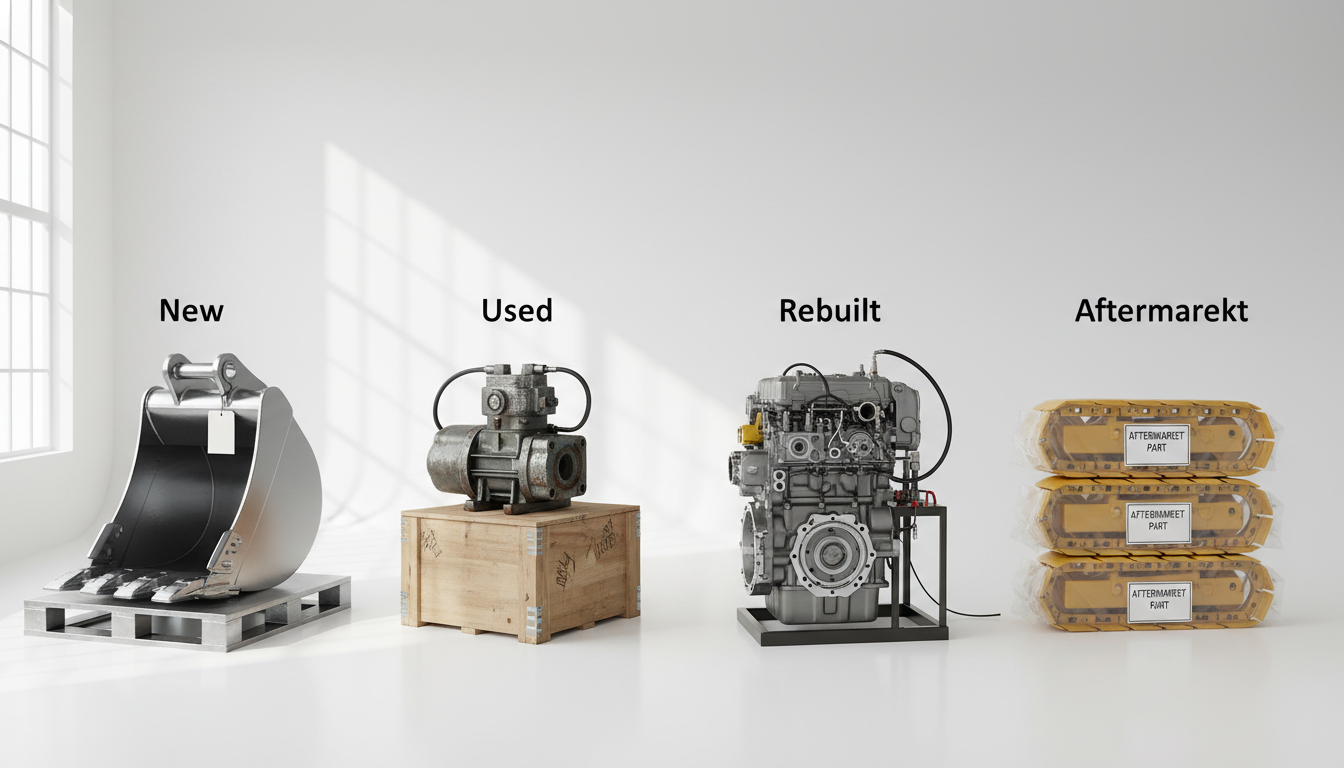
A construction equipment part’s condition defines its manufacturing origin, wear state, and performance expectation. The industry recognizes five standard tiers, and choosing the wrong one for your application is an expensive mistake.
- New OEM (Original Equipment Manufacturer): Parts built by the machine’s manufacturer or its licensed supplier, guaranteeing exact fit and original performance. OEM parts are the premium tier, often required for warranty compliance on Caterpillar, Komatsu, Volvo, and similar brands.
- New Aftermarket: Components produced by third-party manufacturers that match or exceed OEM specifications. According to Construction Equipment Magazine, they typically offer 15-25% cost savings compared to OEM, making them the most common choice for fleet managers watching margins.
- Used (Take-Off): Genuine parts salvaged from dismantled or retired machines. Inspected and sold as-is, these are ideal for budget-conscious repairs on older equipment where OEM availability is limited.
- Rebuilt: Used cores that have been disassembled, cleaned, and had obviously worn components replaced. Rebuilt parts restore functionality at a fraction of new cost but typically carry shorter warranties of 6-12 months.
- Remanufactured: Similar to rebuilt but performed to stricter OEM specifications, including upgraded components, comprehensive testing, and a warranty comparable to new. This is the tier most procurement managers choose for high-value drivetrain components.
Leading suppliers like H&R Construction Equipment Parts, which has served over 50,000 customers since 1984, stock all five conditions. Their catalog illustrates how a single final drive part number can be sourced as new, reconditioned, or rebuilt. Always request quotes across at least two conditions before committing.
“The condition tier you choose should match the remaining service life of the host machine. Putting a new OEM transmission into a unit with 12,000 hours and a cracked frame is a poor capital decision.” – 3GEN Export Technical Team, based on field procurement experience across 40+ equipment brands.
How to Find Construction Equipment Parts Near Me
Finding near me starts with local dealer networks and salvage yards, not a generic web search. Physical proximity matters: a nearby supplier can deliver or offer same-day pickup, cutting machine idle time before it compounds into schedule delays. Here are the most effective sourcing channels.
- Manufacturer Dealer Networks: Brands like Caterpillar, Komatsu, Volvo, and John Deere operate authorized dealer locations nationwide. Scott Equipment in Little Rock, AR, for example, is an authorized dealer for Volvo and Kobelco, stocking genuine parts and offering 24/7 on-call service. These dealers are your first call for warranty-sensitive repairs.
- Independent Distributors and Salvage Yards: Heavyquip is recognized as the largest independent retail construction parts company in North America, with branches across 15 states. Their undercarriage department accounts for roughly 50% of annual sales, which signals the depth of local availability for track components, rollers, and sprockets.
- Online Aggregators with Live Inventory: Many regional suppliers now list real-time stock online. Construction Equipment Parts Inc. (CEParts) displays over 200,000 parts with condition and pricing, letting you confirm availability before making the drive to their Chesapeake, VA facility.
- Direct Phone Inquiries for Urgent Needs: When a machine is down, a phone call beats a web form every time. Suppliers like Arkansas Tractor Parts & Supply specialize in immediate best-price quotes, because they understand that downtime can cost thousands of dollars per day.
- Global Specialists for Hard-to-Find Components: For rare or discontinued parts, international suppliers with deep OEM-standard inventories fill the gap. 3GEN Export ships this type of me and worldwide within 5 days, covering Caterpillar, Komatsu, Volvo, Atlas Copco, and 40+ additional brands.
Step-by-Step: Sourcing Construction Equipment Parts Near Me
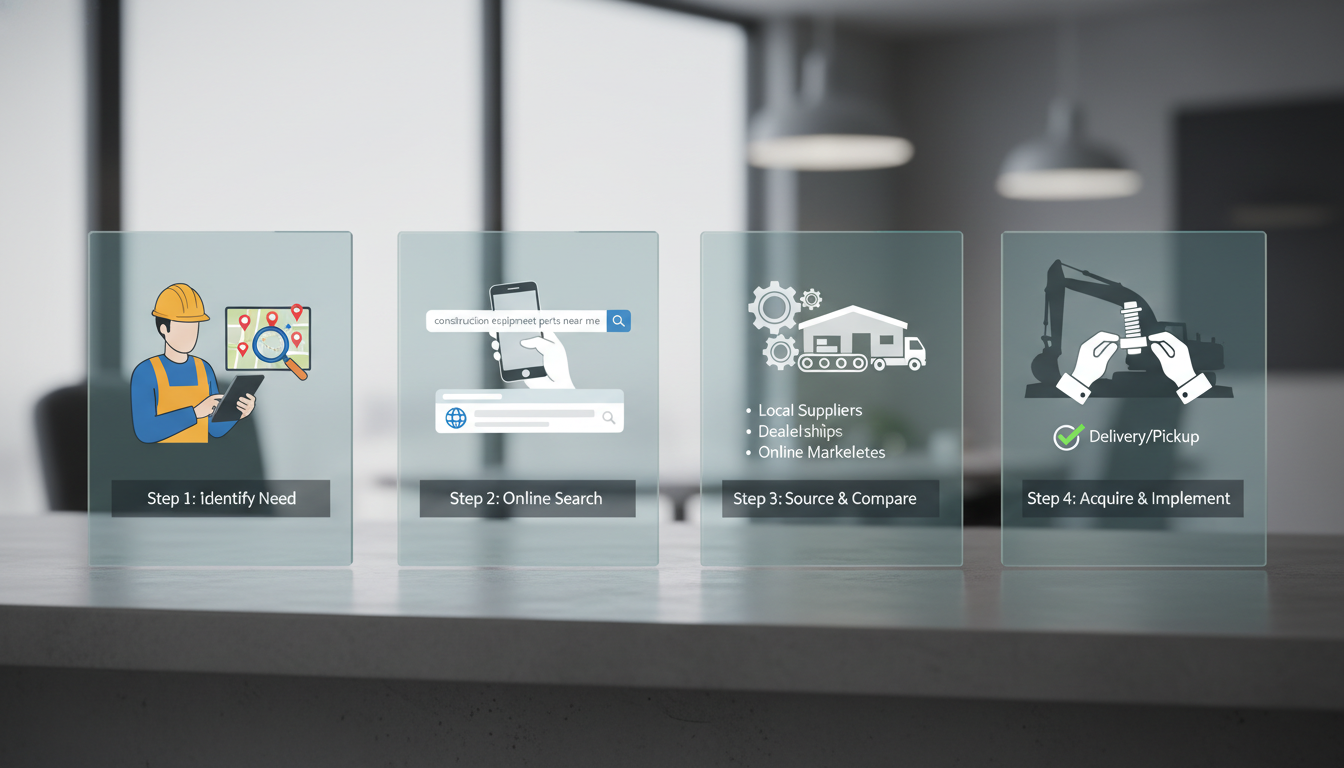
Use this proven process to secure the right this kind of near me efficiently, whether you’re sourcing locally or internationally.
- Identify the Part Number: Locate the exact OEM number from the machine’s manual, the old part stamp, or the manufacturer’s online catalog. Record it alongside the machine’s model and serial number. This single step prevents the majority of wrong-part orders.
- Check Local Inventory Online: Visit supplier websites that allow part-number searches. H&R Parts, CEParts, and most heavy equipment salvage yards maintain searchable databases. Titan Machinery, which operates over 100 full-service construction and agriculture dealerships across the US, Europe, and Australia, also offers online parts lookup through its dealer portal.
- Request Quotes from at Least 3 Sources: Ask for new, aftermarket, and rebuilt options simultaneously. Provide your machine’s serial number so the supplier can verify fitment. Price differences of 20-40% between sources on the same part number are common.
- Verify Compatibility: Cross-reference the part number with your equipment’s serial number break. Many models have mid-production specification changes that affect dimensions. Murphy Tractor, an authorized John Deere construction equipment dealer, provides online parts ordering with serial number filters specifically to catch these variations.
- Compare Total Landed Cost: Include freight, tax, and any core charges. Local pickup can save $50-$200 in shipping on mid-size components and gets the part installed the same day. For heavy undercarriage components, freight alone can add 10-20% to the invoice.
- Confirm Warranty and Return Policy: OEM parts typically carry a 12-month warranty. Aftermarket warranties range from 6-12 months depending on the supplier. Always ask about restocking fees and return windows before placing the order.
- Place the Order and Arrange Pickup or Delivery: For local suppliers, will-call or curbside pickup is fastest. For international or national shippers, confirm the dispatch date in writing and plan your maintenance window accordingly.
Local vs. National Suppliers: What’s Best for Your Fleet?
Choosing between the equipment parts near me from a local dealer versus a national online supplier depends on three factors: urgency, part complexity, and total landed cost. Neither channel wins every scenario. Use the table below to match your situation to the right source.
| Aspect | Local Supplier (e.g., Heavyquip branch, authorized dealer) | National or Global Supplier (e.g., H&R Parts, CEParts, 3GEN Export) |
|---|---|---|
| Inventory Breadth | Focused on regional machine populations. May lack rare or discontinued components. | Over 200,000 parts across dozens of brands. Better for uncommon models and older equipment. |
| Turnaround Time | Same-day or next-day pickup eliminates shipping lag entirely. | Ground shipping takes 2-5 days domestically. Global specialists like 3GEN Export deliver within 5 days internationally. |
| Shipping Costs | None for pickup. Minimal for local courier on small parts. | Freight adds 10-20% to part cost, especially for heavy undercarriage and drivetrain components. |
| Personal Relationship | Face-to-face support, emergency priority, and local machine expertise. | Phone and email assistance with detailed online specs and cross-reference tools. |
| Price Competitiveness | May price-match national quotes. No shipping cost advantage for the buyer. | Often lower markups due to volume purchasing. Shipping costs partially offset the savings. |
| Warranty and Returns | In-person returns. Credit applied at the counter same day. | Mail-back returns. Core exchange handled by freight. Allow 5-10 business days for credit. |
For common wear parts, including track springs, bucket links, and radiators, local salvage yards frequently offer substantial savings over new OEM pricing. For sophisticated components such as transmissions, final drives, and swing motors, a dedicated national or global specialist provides reconditioned units backed by rigorous testing and documented warranty terms.
Pros and Cons of Buying Construction Equipment Parts Near Me
Local sourcing for construction equipment parts near me offers clear operational advantages, but it also comes with real limitations that fleet managers need to plan around.
Pros
- Same-day or next-day availability eliminates freight wait times and gets machines back online faster.
- Face-to-face supplier relationships often translate to priority service during peak demand or emergency breakdowns.
- No shipping costs on pickup orders, which can save $50-$200 on mid-size parts and more on heavy components.
- Easier returns and exchanges: bring the wrong part back to the counter and swap it on the spot.
- Local dealers carry regional machine knowledge, knowing which models are common in your area and stocking accordingly.
Cons
- Inventory depth is limited to regional machine populations. Rare models, discontinued parts, and specialized components are often unavailable locally.
- Local pricing may be higher than national or global suppliers, particularly for high-volume commodity parts like undercarriage links and pins.
- Operating hours restrict access. A breakdown at 2 AM on a Sunday may leave you waiting until Monday morning regardless of proximity.
- Quality consistency varies between independent salvage yards. Without a standardized inspection process, used parts carry higher fitment risk.
What to Look for When Buying Heavy Equipment Parts
Evaluating construction equipment parts near me requires more than confirming the part number matches. These criteria separate a reliable purchase from a costly repeat repair.
Material and Build Quality
Verify that aftermarket steel components meet ASTM or ISO standards. Casting marks, weight, and surface finish often reveal quality differences that photos don’t capture. OEM parts use precision-machined castings with specific hardening treatments. Cheap imitations frequently skip the hardening step, leading to premature wear within the first 500 operating hours.
Fit and Compatibility
Always provide your machine’s full model and serial number. Many models have mid-production specification changes that affect part dimensions. A Volvo EC330B LC track spring assembly (part #14562927) differs from later C-series variants, and ordering without the serial number break is a common source of returns and delays.
Price Range Expectations
- Budget tier (used or aftermarket undercarriage links, pins, seals): $50-$500 per piece.
- Mid-range (rebuilt cylinders, new aftermarket final drives): $500-$5,000.
- Premium (new OEM transmissions, complete final drives): $5,000-$30,000 and above.
Remanufactured components sit between mid-range and premium, offering new-like performance with savings of 20-30% over new OEM pricing, according to industry maintenance data.
Warranty and Support
Prioritize suppliers that stand behind their parts in writing. A rebuilt transmission with a 12-month warranty from a reputable shop is a safer procurement decision than a cheap online listing with no stated coverage. Ask for the warranty terms before the invoice is generated, not after.
Maintenance Practices That Extend Part Life
Proper maintenance is the most cost-effective parts strategy available. Per OEM service bulletins for Caterpillar and Komatsu equipment, cleaning hydraulic filters every 250 operating hours, inspecting undercarriage wear daily, and storing spare parts in a dry, climate-controlled environment can meaningfully extend component service life. Following OEM service intervals consistently is the single highest-return maintenance habit for any fleet.
“Procurement managers who track total cost of ownership, not just purchase price, consistently choose remanufactured or high-quality aftermarket parts for wear components. The 20-30% savings over new OEM compounds across a fleet of 20 or more machines.” – 3GEN Export Procurement Advisory, updated for 2026.
Financing and Service Integration: Beyond the Parts Transaction
Large parts purchases, particularly complete drivetrain replacements costing $20,000-$28,000, often require financing options that smaller local suppliers cannot offer. Titan Machinery, which operates over 100 full-service dealerships across the US, Europe, and Australia, integrates parts supply with equipment financing, rental programs, and full-service repair. This model reduces the administrative burden on fleet managers who would otherwise coordinate three separate vendors for a single major repair event.
Scott Equipment in Little Rock, AR, takes a similar approach, pairing 24/7 on-call parts support with crane rental and repair services for Volvo and Kobelco equipment. For procurement managers running mixed fleets, suppliers that bundle parts, service, and financing into a single account relationship reduce transaction costs and simplify warranty tracking.
As of 2026, 3GEN Export extends this model to international buyers, offering OEM-standard parts for Caterpillar, Komatsu, Volvo, Atlas Copco, and 40+ brands with global delivery in 5 days. For fleet operators in regions where local dealer networks are thin, this closes the availability gap without sacrificing part quality or warranty coverage.
Frequently Asked Questions
What does OEM mean in construction equipment parts?
OEM stands for Original Equipment Manufacturer. These are parts made by the same company that built your machine, or by a licensed supplier to identical specifications, guaranteeing a perfect fit and factory performance. They are the premium option and are often required for warranty work on brands like Caterpillar, Komatsu, and Volvo.
How can I find construction equipment parts near me fast?
Start by searching online with your exact part number and location, then call local dealers and salvage yards directly to confirm stock. Ask specifically about same-day pickup. For parts unavailable locally, global suppliers like 3GEN Export ship construction equipment parts near me and to any destination within 5 days.
Are aftermarket parts as reliable as OEM?
High-quality aftermarket parts from established manufacturers can match or exceed OEM durability. According to Construction Equipment Magazine, they typically cost 15-25% less than OEM equivalents. Always verify that the parts meet ISO or ASTM standards and come with a documented warranty before purchasing.
What is the difference between rebuilt and remanufactured?
Rebuilt parts have individually repaired or replaced worn components, restoring basic function at lower cost. Remanufactured parts are fully restored to OEM specifications, with all wear components replaced, upgraded, and tested to factory standards. Remanufactured units typically carry longer warranties and are the preferred choice for critical drivetrain components.
Can I return a part if it doesn’t fit?
Most suppliers allow returns within 30 days if the part is uninstalled and in original condition. Restocking fees of 10-20% are common for non-defective returns. Always confirm the return policy before ordering, and double-check fitment using your machine’s full serial number to avoid the situation entirely.
What is the average cost of common heavy equipment parts?
Costs vary widely by component type and condition. A new track spring assembly typically runs $1,200-$1,500, a rebuilt final drive $5,500-$7,500, and a rebuilt transmission $20,000-$28,000. Used parts can reduce these figures by 40-60%. Always request written quotes across at least two condition tiers before committing to a purchase.
Source Your Construction Equipment Parts Near Me or Worldwide with 3GEN Export
Downtime is the single biggest profit drain in construction, mining, and energy operations. By strategically sourcing construction equipment parts near me, you tap into immediate availability, eliminate unnecessary shipping delays, and build supplier relationships that pay off when the next emergency hits. Whether you’re working with a local dealer like Heavyquip, a national specialist like H&R Parts, or a global supplier like 3GEN Export, the priorities stay the same: verified compatibility, transparent warranty terms, and total landed cost.
Bookmark your top three nearby suppliers today. And for hard-to-find OEM-quality parts with 5-day global delivery, shop at 3genexport.com. We stock components for Caterpillar, Komatsu, Volvo, Atlas Copco, and 40+ brands, and our team is ready to verify fitment before you order.