
Heavy machinery spare parts are replacement components designed to maintain, repair, or upgrade excavators, bulldozers, loaders, and graders across construction, mining, and energy operations. These critical components ensure equipment reliability and minimize costly downtime in demanding industrial environments.
Key Takeaways
- spare parts sourced from reputable suppliers minimize equipment downtime and extend service life.
- OEM parts offer guaranteed fit and warranty, while aftermarket alternatives can cost 2-3 times less without sacrificing quality from trusted brands like CTP, ITR, and SRP.
- Always cross-reference part numbers with your machine’s serial number to avoid compatibility issues.
- Stocking high-wear items such as filters, hoses, and undercarriage components prevents emergency repair delays.
- International suppliers often provide competitive pricing but require longer lead times, plan orders accordingly.
Understanding Heavy Machinery Spare Parts
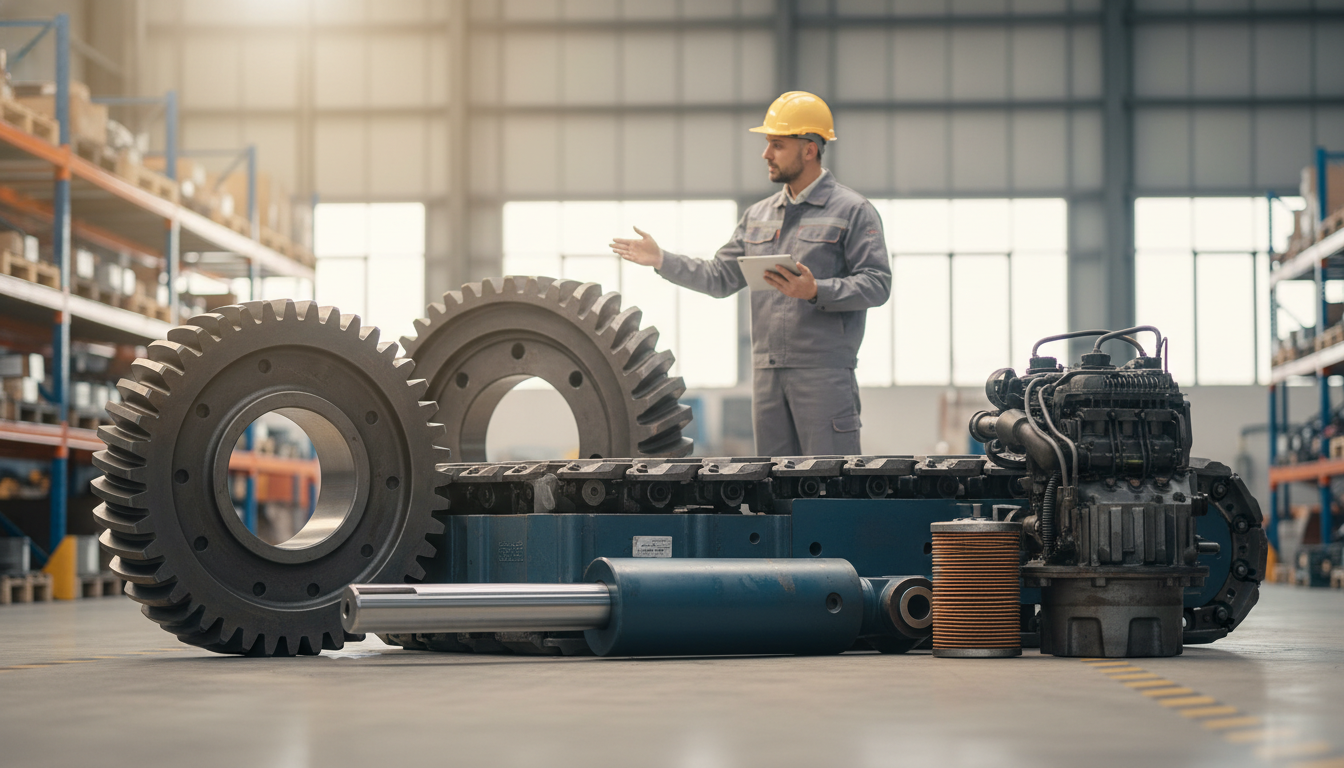
these parts encompass everything from engine components and hydraulic systems to undercarriage parts and electrical systems. The global market for these parts is vast, with catalogs containing over 8 million known references, according to TVH, a leading parts distributor. For fleet managers, understanding the types and sources of such spare parts is critical to keeping machinery operational in demanding environments like construction, mining, and agriculture.
the machinery spare parts fall into two main categories: OEM (Original Equipment Manufacturer) and aftermarket. OEM parts are made by the same companies that built the original equipment, ensuring exact specifications and full warranty coverage. Aftermarket parts are produced by third-party manufacturers and often provide significant cost savings, sometimes 2-3 times cheaper than OEM, while meeting or exceeding industry standards. Major brands like Caterpillar, Komatsu, Volvo, and John Deere each have extensive parts networks, but aftermarket suppliers like Heavy Equipment Spare Parts (HESP) offer catalogs with over 1.4 million Caterpillar references alone.
OEM vs. Aftermarket Heavy Machinery Spare Parts: Cost-Benefit Comparison
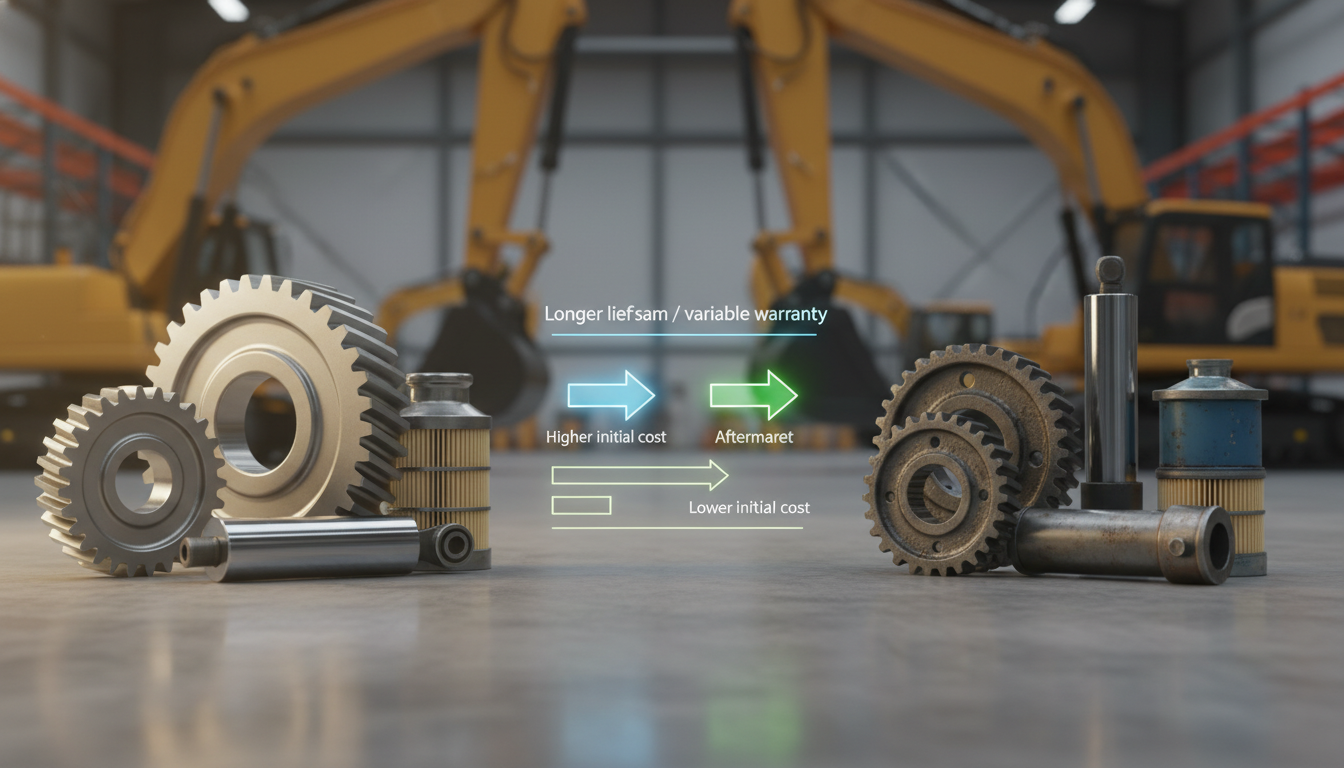
Choosing between OEM and aftermarket parts depends on factors like budget, application criticality, and part availability. The table below breaks down the key differences to help you decide.
| Parameter | OEM Parts | Aftermarket Parts |
|---|---|---|
| Cost | Higher price point; reflects brand premium and warranty inclusion. | 2-3 times lower cost; savings of 50-66% are common for high-volume wear items. |
| Availability | Limited to authorized dealer networks; may require longer lead times for older models. | Widely available online through global distributors like Machinery Parts Warehouse, stocking new, used, and rebuilt options. |
| Warranty | Full manufacturer warranty, often 12-24 months. | Varies by manufacturer; reputable brands offer 6-12 months, but some have limited or no warranty. |
| Quality | Guaranteed to meet original equipment specs and tolerances. | Quality ranges from subpar to OEM-equivalent; trusted aftermarket brands like CTP (Caterpillar), ITR (undercarriage), and SLP (Volvo) meet strict standards. |
| Fit | Precise fit with no modifications needed. | Generally fits well, but minor adjustments might be required on some assemblies. |
| Best For | Safety-critical systems, engine internals, and equipment under active warranty. | High-frequency consumables (filters, belts, hoses), undercarriage components, and older machines out of warranty. |
“Our aftermarket Caterpillar replacement parts are 2-3 times cheaper than original, yet offer very high quality. For budget-conscious fleets, they are a cost-effective alternative without compromising machine uptime.” , Heavy Equipment Spare Parts (hespareparts.com)
For example, a genuine Caterpillar hydraulic filter for a 320 excavator might cost $80, while a high-quality aftermarket equivalent from Baldwin or Fleetguard can be found for under $30. However, for a turbocharger or electronic control module, OEM is often the safer choice due to the precision required.
Top 10 Must-Have Heavy Machinery Spare Parts
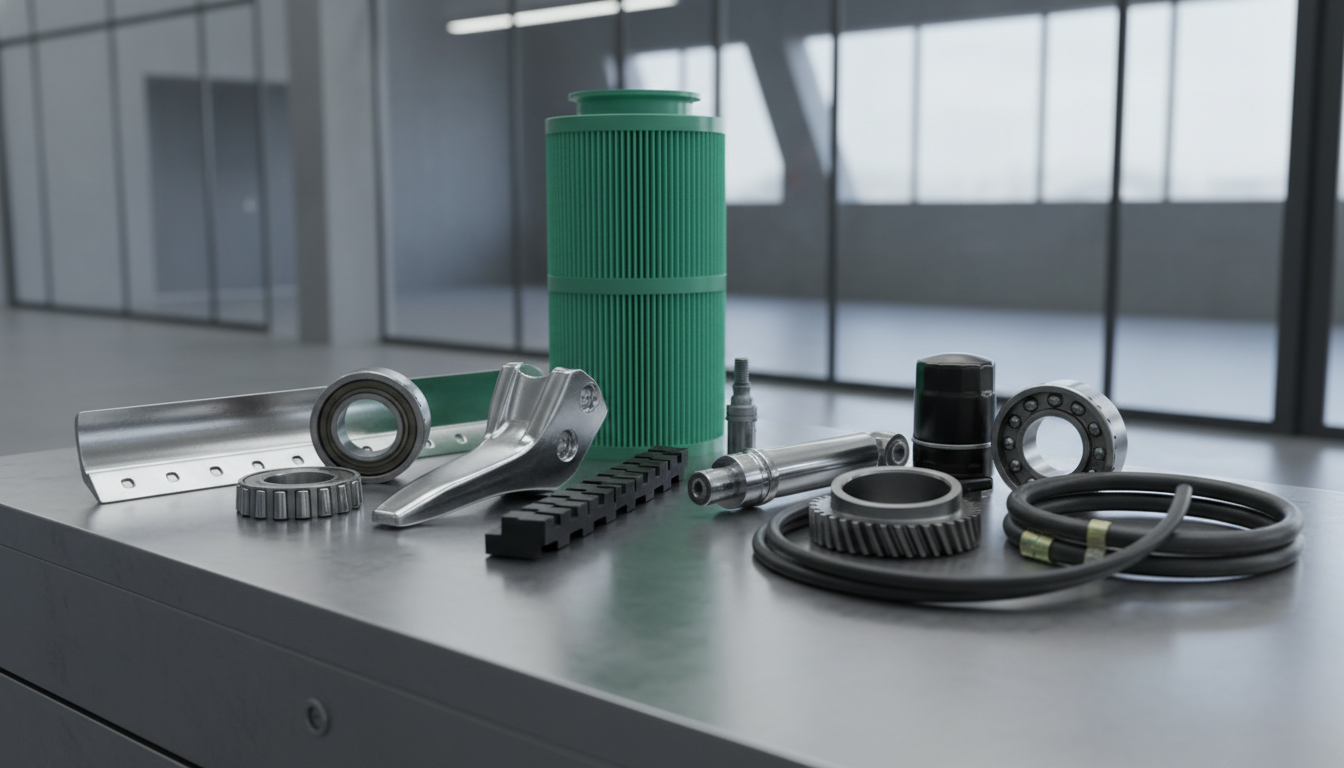
Keeping these 10 categories of heavy machinery in stock can drastically reduce downtime, according to industry experts at SIPA. The list prioritizes components with high wear rates and critical function.
- Hydraulic Filters – Clean hydraulic fluid prevents pump and valve failures. Replace every 250-500 operating hours.
- Engine Oil Filters – Removes contaminants to protect bearings and cylinder walls. Low-cost insurance against major engine damage.
- Air Filters – Essential in dusty job sites; a clogged filter can sap 10-15% of engine power and increase fuel consumption.
- Fuel Filters – Modern common-rail fuel systems require spotless fuel; a $20 filter can prevent a $5,000 injector replacement.
- Undercarriage Components – Track shoes, rollers, idlers, and sprockets wear quickly on tracked equipment. Check aftermarket options from ITR for 40-50% savings over OEM.
- Brake Pads & Discs – Safety-critical; inspect monthly on wheel loaders and articulated trucks.
- Seals & Gaskets – Small yet vital to prevent fluid leaks; maintain a seal kit for each machine’s hydraulic cylinders.
- Alternators & Starters – Electrical failures often hit without warning; keep a rebuilt spare for popular models.
- Hoses & Belts – Rubber deteriorates from heat and pressure; replace belts every 1,000 hours and check hoses for cracks weekly.
- Lights & Electrical Fittings – Work lights, connectors, and fuses ensure safe night operation and regulatory compliance.
“We recommend keeping at least one complete set of filters and hoses for every active machine in your fleet. It’s a minimal investment that prevents costly last-minute sourcing.” , Machinery Parts Warehouse (machinerypartswarehouse.com)
What to Look For When Buying Heavy Machinery Spare Parts
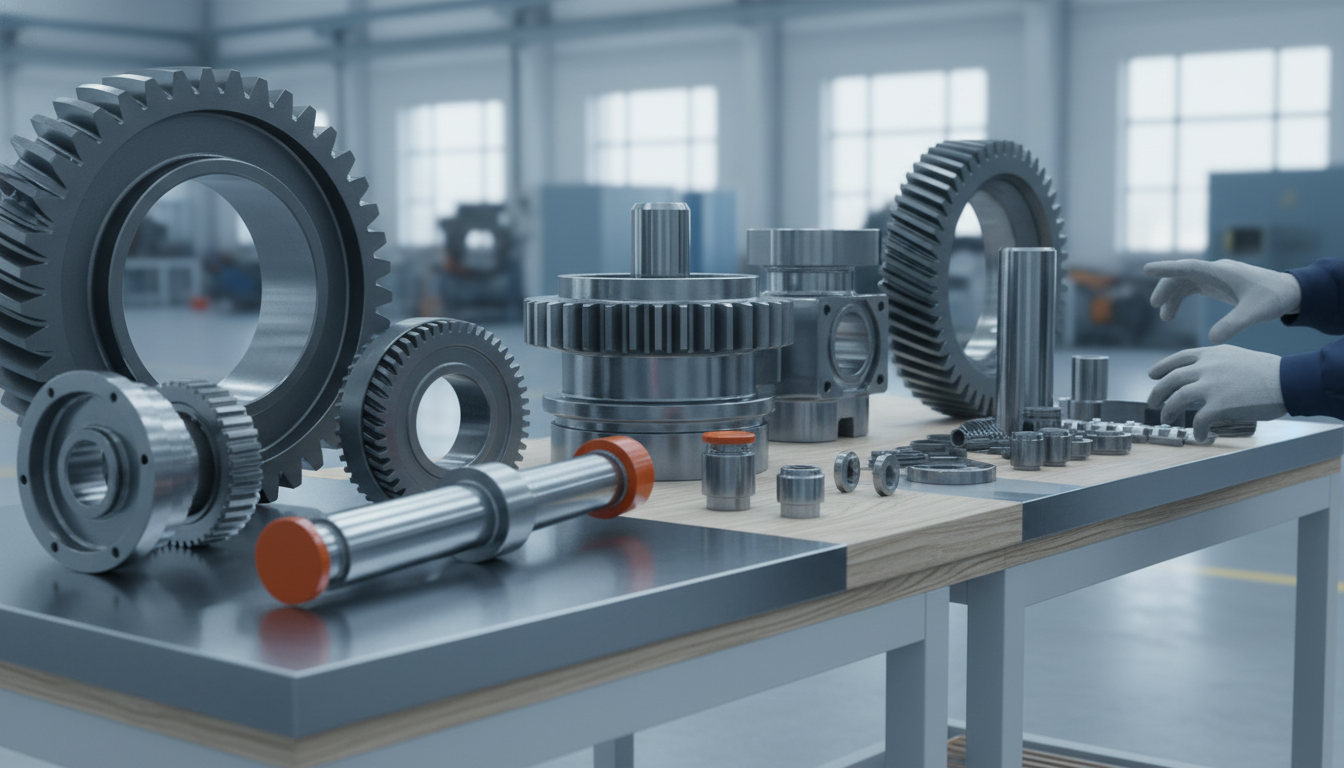
Not all spare parts are created equal. Use these criteria to evaluate parts before purchasing:
- Compatibility – Always cross-check the part number against your machine’s serial number. Many brands have serial number breaks that change specifications.
- Material & Build Quality – For structural parts like teeth, edges, and undercarriage, look for hardened steel or specific alloys. Verify that aftermarket brake pads meet OEM friction ratings.
- Brand Reputation & Certifications – Trusted aftermarket producers like Bosch Rexroth, CTP, and ITR are certified to ISO 9001 and often supply original manufacturers.
- Warranty & Return Policy – A supplier confident in their these parts offers at least a 6-month warranty. Understand restocking fees and return windows.
- Price & Total Cost of Ownership – Cheapest upfront may cost more if it wears twice as fast. Compare expected service life in hours.
- Delivery Time & Logistics – Domestic suppliers can ship within 1-3 days; international orders from Germany or South Korea may take 1-2 weeks but save 20-30% on cost. Choose DAP Incoterms to manage customs.
Price Ranges to Expect
When budgeting for such spare parts, expect the following broad ranges:
- Budget/Aftermarket: Hydraulic filters $15-$50, engine belts $10-$40, oil seals $5-$25.
- Mid-Range: Aftermarket alternators $200-$500, track rollers $150-$400, brake pad sets $80-$200.
- Premium/OEM: OEM turbochargers $1,000-$5,000, complete undercarriage kits $5,000-$15,000, electronic control modules $2,000-$8,000.
These prices are indicative and vary by brand and model. Always request quotes from multiple suppliers to secure the best deal.
Sourcing Heavy Machinery Spare Parts: Domestic vs. International
Where you buy the machinery spare parts impacts cost, speed, and supply chain reliability. Here’s how the two approaches stack up.
Domestic Suppliers
U.S.-based distributors like Machinery Parts Warehouse in Peru, Illinois, and Miami, Florida, offer rapid shipping and knowledgeable support. They often stock both OEM and aftermarket for American brands and can resolve part identification issues over the phone. The main advantage is speed, critical when a down machine is costing $500 per hour in lost revenue.
International Suppliers
Companies such as HESP (global) and MachineryParts.de in Germany source directly from manufacturers in Europe, South Korea, and Japan. They provide access to hard-to-find parts for European equipment like Liebherr or Terex Fuchs, often at 20-40% lower prices. Main considerations: longer lead times, shipping costs, and import duties. Using a certified partner like Bosch Rexroth assures compliance with OEM specifications even when ordering from abroad.
Building a Spare Parts Inventory Management System
An organized inventory of heavy machinery is not just a bin of parts, it’s a system that aligns with your maintenance schedule and reduces emergency purchases. Follow these steps to build one:
- Step 1: Audit Your Fleet – List every machine, model, serial number, and current hour meter reading. Note high-wear items from manufacturer maintenance guides.
- Step 2: Identify Critical Parts – Using OEM parts books, list components that would cause immediate work stoppage if failed: starters, alternators, hydraulic pumps, and specific sensors.
- Step 3: Set Par Levels – For consumables like filters and belts, set a minimum quantity to trigger reorder. For example, keep three sets per active machine.
- Step 4: Choose Suppliers – Diversify sources: one reliable domestic supplier for emergency orders, and one international for planned bulk purchases.
- Step 5: Implement a Tracking System – Use software or even a simple spreadsheet to record part numbers, shelf locations, quantities, and consumption rates. Adjust par levels based on usage patterns.
Fleets that adopt such a system report fewer emergency repairs and more predictable maintenance budgets, as noted by TVH. Many suppliers also offer consignment stock programs to reduce upfront inventory costs.
Rebuilding vs. Replacing Heavy Equipment Components
When spare parts reach end-of-life, fleet managers face a choice: rebuild existing components or replace them entirely. Rebuilding involves disassembling worn parts, replacing internal components, and reassembling to OEM specifications. This approach typically costs 40-60% less than new OEM parts and extends component life by 80-90% of original specifications. Hydraulic cylinders, transmissions, and engine blocks are prime candidates for rebuilding.
Replacement with new these parts offers guaranteed performance and full warranty coverage but at premium cost. Choose rebuilding for older equipment where downtime flexibility exists, and replacement for critical machines where reliability cannot be compromised.
Pros and Cons
Pros
- Aftermarket heavy machinery spare parts offer significant cost savings of 50-66% compared to OEM pricing
- Global supplier networks provide access to hard-to-find parts for older or specialized equipment
- Competitive pricing from international suppliers reduces total fleet maintenance costs
- Wide availability of both new and rebuilt options extends equipment service life
- Trusted aftermarket brands like CTP and ITR meet or exceed OEM quality standards
Cons
- International shipping adds 1-2 weeks to delivery times for urgent repairs
- Quality varies significantly among aftermarket suppliers, requiring careful vendor selection
- Warranty coverage is typically shorter than OEM parts (6-12 months vs. 12-24 months)
- Import duties and shipping costs can offset some price advantages on smaller orders
- Part compatibility issues may require minor modifications during installation
Care and Maintenance Tips for Spare Parts
Proper care does not end at installation. Even heavy machinery spare parts in storage need attention to ensure they function when needed.
- Storage Environment – Keep parts in a clean, dry area away from direct sunlight and extreme temperatures. Rubber hoses and belts degrade faster in heat.
- Lubrication – Pre-grease stored bearings and seals to prevent corrosion.
- Rotation – Use the first-in, first-out (FIFO) method for filters and fluids to avoid expiration.
- Documentation – Attach original packaging or tags with part numbers and date of purchase for warranty claims.
- Inspection Before Use – Even new parts can have transport damage; inspect O-rings, threads, and electrical connectors before installation.
Shop OEM-quality spare parts with global 5-day delivery at 3genexport.com
Frequently Asked Questions
How do I find the right part number for my machine?
Check the OEM parts manual or use the manufacturer’s online catalog by entering your equipment’s serial number. Many aftermarket suppliers also provide cross-reference tools on their websites to identify compatible heavy machinery spare parts.
Are aftermarket heavy machinery spare parts reliable?
Yes, if sourced from reputable manufacturers like CTP, ITR, or Fleetguard. These brands often exceed ISO standards and come with a warranty. Avoid unbranded, ultra-cheap parts that may compromise equipment reliability.
What is the typical shipping time for international orders?
International shipping from Europe or Asia typically takes 7-14 business days via air freight and 4-8 weeks via ocean freight. Suppliers often offer DAP Incoterms, meaning they handle transport to your nearest port but you manage customs clearance.
Can I return parts if they don’t fit?
Most suppliers accept returns within 30 days if the part is unused and in original packaging, but restocking fees of 15-25% are common. Always verify compatibility before ordering heavy machinery spare parts.
Is it better to buy from a dealer or an independent distributor?
Dealers provide brand-specific expertise and full warranty support but at premium prices. Independent distributors often offer a wider range of brands and competitive aftermarket pricing, ideal for mixed fleets requiring diverse heavy machinery spare parts.
How often should I replace hydraulic filters?
Replace hydraulic filters every 250-500 operating hours or as recommended by the OEM. In dusty environments, consider more frequent changes to prevent system contamination and extend the life of other hydraulic components.