
Key Takeaways
- Mining equipment crushing parts are wear components like mantles, jaw plates, and blow bars that directly impact crusher uptime and cost per ton.
- Material selection – high manganese, chrome iron, TIC inserts, or ceramic composites – determines wear life and overall operating expense.
- OEM parts guarantee precise fit and performance; aftermarket alternatives offer cost savings and custom options when sourced from trusted suppliers.
- Total Cost of Ownership (purchase price plus downtime, labor, and wear life) should guide every buying decision.
- Global suppliers with rapid delivery and engineering support minimize operational disruptions in remote mining sites.
- Remanufacturing and rebuild programs can extend crusher frame life while cutting capital expenditure by 30-50% versus new equipment.
Mining equipment crushing parts are the wear components – mantles, jaw plates, blow bars – that protect crushers in mineral processing. Selecting the right materials and supplier reduces downtime and extends component life.
What Are Mining Equipment Crushing Parts?

Mining equipment crushing parts are wear-resistant components that shield core crushing machinery from abrasion, impact, and material flow. They include jaw dies, cone mantles, blow bars, and various liners. These parts form the primary contact surface between rock and crusher, meaning their quality determines both how effectively material is reduced and how often unplanned shutdowns occur. A mantle is the cone-shaped wear liner that crushes material against the concave bowl in a cone crusher, while jaw plates are the stationary and moving steel pieces that grip and break rock in a jaw crusher. Without premium crushing parts, even the most robust crushers suffer accelerated wear, reduced throughput, and higher cost per ton.
According to Metso, “Only the OEM has the insight to engineer parts that can take into account even the smallest design details of the crusher.” This precision reduces stress concentrations and extends component life significantly.
Per industry maintenance data from Penticton Foundry, chrome white iron can outlast AR400 steel by a factor of 10 and AR600 steel by a factor of 3 in abrasive sliding wear applications – a critical benchmark when calculating total cost of ownership for high-tonnage operations.
Types of Mining Equipment Crushing Parts
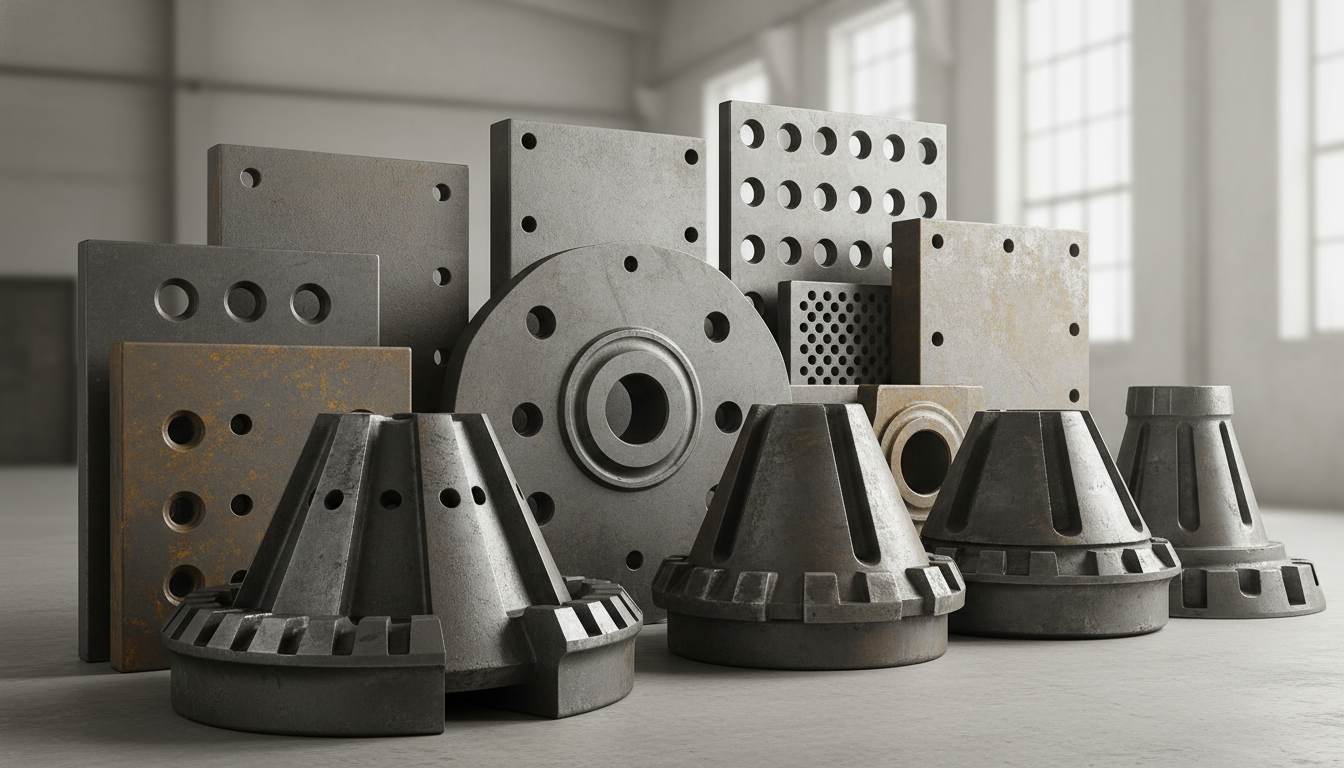
Different crusher designs require specifically engineered wear parts. Matching the right component to your machine and application is the first step in a successful replacement strategy.
Jaw Crusher Wear Parts
Jaw crushers are primary crushers that handle large, abrasive feed. Key wear components for jaw crushers include:
- Jaw plates (fixed and movable) – the main crushing surfaces, typically made of high manganese steel (Mn13, Mn18, Mn22) or Mn-Cr alloys.
- Cheek plates – side liners that protect the crusher frame; often upgraded to Hardox 450/500 or with tungsten carbide embedding for extreme wear resistance, as used by Cutting Edge Supply in their custom cheek plate programs.
- Toggle plates and wedges – safety and adjustment components that also influence crusher performance.
Cone Crusher Wear Parts
Cone crushers reduce rock by squeezing material between a rotating mantle and a stationary bowl liner. Essential wear components are:
- Mantles – cone-shaped liners that gyrate inside the crushing chamber.
- Concaves (bowl liners) – the stationary outer ring that works with the mantle.
- Torch rings – used to heat and shrink-fit mantles during installation.
- Feed cones and hopper liners – protect the infeed area from impact and abrasion.
Metso has held original Symons cone crusher drawings and specifications since 1928, giving OEM suppliers a dimensional accuracy advantage that aftermarket foundries must reverse-engineer to match.
Gyratory Crusher Parts
Gyratory crushers, often used as primary units in large mining operations, demand massive, durable parts. Typical wear items include mantles, spider arm liners, rim liners, and rock splitters. Manufacturers like ESCO and Spokane Industries supply castings engineered for high-tonnage applications where a single unplanned shutdown can cost $10,000 or more per hour in lost production.
Impact Crusher Parts (HSI/VSI)
Impact crushers use high-speed rotors to hurl material against breaker plates. The wear components here consist of:
- Blow bars (impeller bars) – the leading edge that strikes the rock; available in high chrome iron, martensitic steel, or ceramic composites.
- Impact plates and side liners – stationary surfaces that absorb repeated blows and must be matched carefully to feed material hardness.
Material Options for Crushing Parts
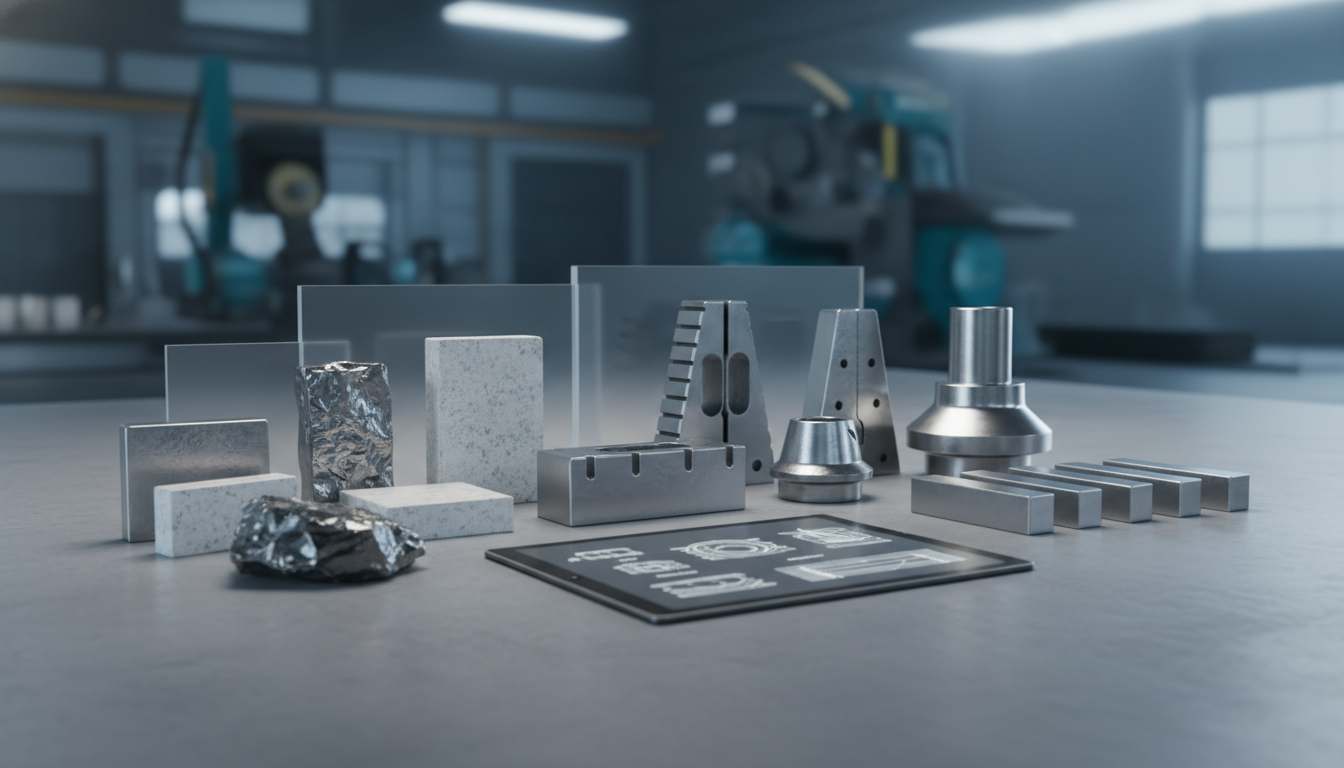
The material composition of a wear part is the single biggest factor affecting its lifespan and cost per ton. Modern foundries offer a spectrum of alloys, each suited to specific crushing conditions.
| Material | Hardness (HRC) | Wear Resistance | Best Applications | Cost Level |
|---|---|---|---|---|
| High Manganese Steel | 45-55 | ★★★☆☆ | Jaw plates, cone mantles, hammers | $ |
| High Chrome Iron | 56-65 | ★★★★☆ | Blow bars, impact plates, liners | $$ |
| Martensitic Steel | 48-58 | ★★★★☆ | Blow bars, hammers | $$ |
| TIC Inserts | >60 | ★★★★★ | High-wear jaw plates, blow bars | $$$ |
| Ceramic Composite | >65 | ★★★★★ | Impact parts, side liners | $$$ |
High manganese steel work-hardens under repeated impact, forming a tougher surface while the core remains ductile. This makes it ideal for jaw plates and mantles where heavy blows are common. High chrome iron offers superior abrasion resistance in low-impact, sliding wear scenarios. According to Penticton Foundry, chrome white iron outlasts AR400 steel by a factor of 10 and AR600 by a factor of 3. TIC insert parts, per data from Econe Wear, can deliver substantially longer wear life than standard manganese steel in extreme abrasive conditions – making them worth the $$$-tier price point in high-tonnage operations.
OEM vs. Aftermarket Parts: Making the Right Choice
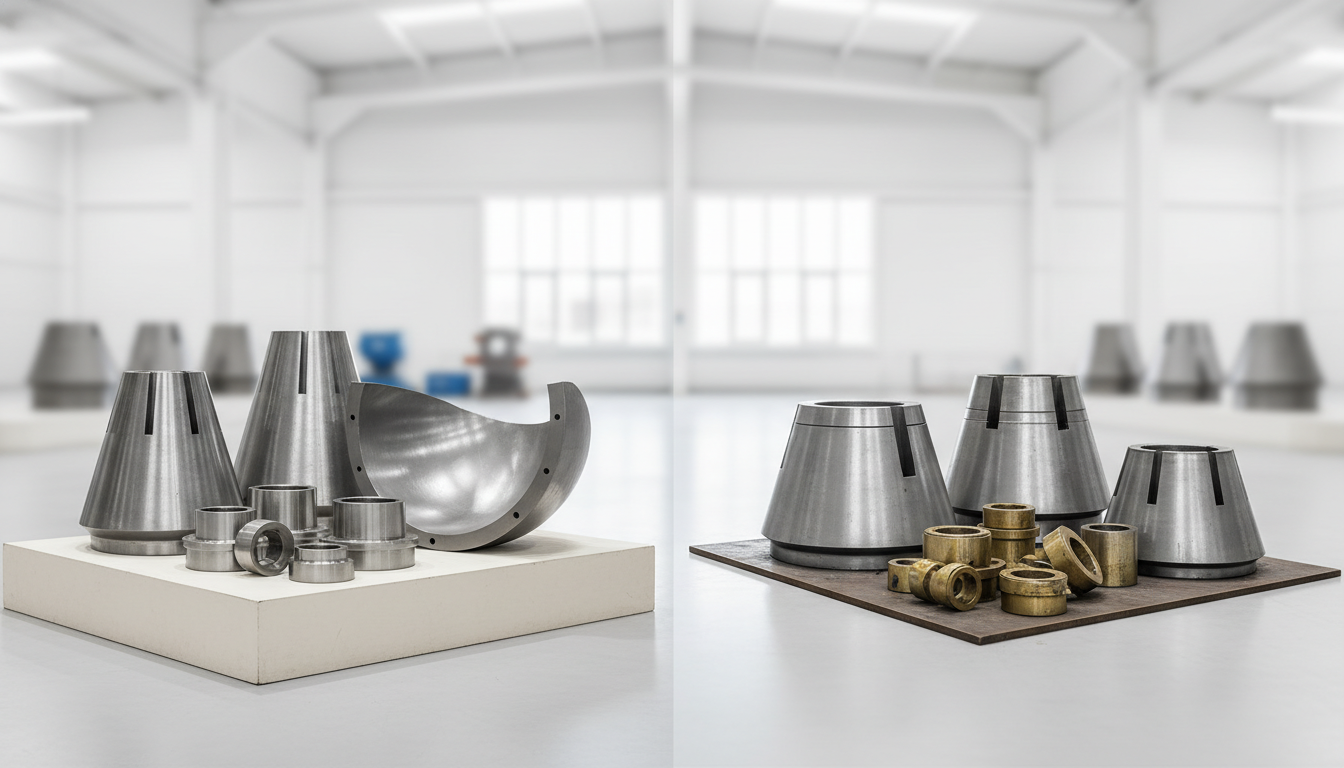
Sourcing mining equipment crushing parts means choosing between original manufacturer supply and aftermarket alternatives. Both paths carry real trade-offs that hit your bottom line differently depending on application severity and budget cycle.
| Feature | OEM Parts | Aftermarket Parts |
|---|---|---|
| Initial Cost | Higher, typically 15-30% more | Lower, often providing immediate savings |
| Fit & Compatibility | Perfect, designed to exact drawings | Variable; reputable suppliers reverse-engineer to OEM specs |
| Material Quality | Consistent, proprietary alloys | Can match or exceed OEM if from high-end foundries |
| Warranty | Full manufacturer warranty | Limited or trade warranty; depends on supplier |
| Lead Time | May be longer for some brands | Often faster, with some suppliers shipping within 2 days |
| Customization | Limited to factory options | Extensive; design changes, material upgrades, site-specific solutions |
For critical high-tonnage operations where unscheduled downtime costs thousands per hour, OEM parts from Metso, Sandvik, or Weir Minerals often prove their worth in predictable performance. Many mining sites achieve excellent results with aftermarket parts from companies like ESCO, Durex, or Cutting Edge Supply – particularly when those suppliers offer on-site engineering support. Quarry Parts ships in-stock items within 2 days, a logistics benchmark that matters enormously on remote sites where every idle shift erodes margin.
Pros and Cons of Aftermarket Mining Equipment Crushing Parts
Aftermarket sourcing is the dominant choice for most mid-sized mining operations. Understanding the real advantages and limitations helps procurement teams make defensible decisions.
Pros
- Lower unit cost: Aftermarket parts typically run 15-30% below OEM list price, freeing budget for other maintenance priorities.
- Faster availability: Regional stock programs from suppliers like Quarry Parts and H-E Parts mean parts ship within 48 hours versus weeks for some OEM back-orders.
- Material upgrades: Aftermarket foundries can supply TIC-inserted or ceramic-composite versions of parts that OEMs only offer in standard manganese – extending wear life without changing the machine.
- Custom profiles: Suppliers can modify liner geometry to suit your specific feed gradation, improving throughput and reducing fines generation.
- Competitive pressure: Using aftermarket quotes as leverage keeps OEM pricing honest across your fleet.
Cons
- Dimensional risk: Poorly reverse-engineered parts can cause premature failure or void OEM frame warranties. Always demand material certificates and dimensional reports.
- Inconsistent quality: Economy-tier foundries vary batch to batch. Stick to suppliers who provide metallurgical test reports with each shipment.
- Limited warranty coverage: Most aftermarket suppliers offer trade warranties rather than full replacement guarantees, shifting risk back to the buyer.
- No OEM engineering data: Aftermarket suppliers lack access to the original stress-analysis models, which matters most for precision-fit mechanical components like main shaft sleeves.
What to Look For When Buying Crushing Parts
Beyond material and source, several practical criteria determine whether a part will keep your crusher running profitably. Follow these steps when evaluating any supplier or part:
- Verify crusher model and serial number. Even identical-looking models can have dimensional differences. Always provide full machine identification to your supplier.
- Analyze wear patterns. Uneven wear on existing parts may signal a need for a different alloy, a change in feed distribution, or a modified liner profile.
- Compare material specifications. Use the table above and consult with foundry engineers. A part that wears 30% slower may cost 20% more but reduce overall cost per ton meaningfully.
- Assess total cost of ownership (TCO). TCO covers purchase price, installation labor, downtime during change-outs, and disposal. A premium TIC-inserted jaw plate might cut annual replacements from four to one, slashing TCO across the board.
- Check supplier logistics. In remote mining locations, part availability is critical. Look for suppliers with global warehouses and the ability to ship within 48 hours, as offered by H-E Parts and Haladjian Minerals Solutions.
- Demand after-sales support. The best suppliers provide on-site installation guidance, wear monitoring programs, and engineering input for continuous improvement.
Applying this checklist consistently transforms the purchase of mining equipment crushing parts from a reactive expense into a proactive asset management strategy.
Remanufacturing and Rebuild Programs
Remanufacturing is a cost-effective alternative to full replacement for crusher frames, heads, and mechanical assemblies. Companies like H-E Parts International and Haladjian Minerals Solutions run structured rebuild programs that can extend crusher frame life by 5-10 years while cutting capital expenditure by 30-50% versus purchasing new equipment. As of 2026, rebuild programs are gaining traction across copper, iron ore, and aggregate operations as capital budgets tighten globally.
A typical rebuild cycle includes dimensional inspection, crack detection, re-machining of worn bores, replacement of all wear liners and seals, and a load-test before return to service. The result is a machine that performs to original specification at a fraction of new-unit cost. For procurement teams managing aging fleets, this option deserves a line item in every capital planning cycle.
Safety and Regulatory Considerations
Crusher maintenance carries serious safety obligations. In the United States, the Mine Safety and Health Administration (MSHA) mandates lockout/tagout procedures, guarding standards, and inspection intervals for crushing equipment. Globally, equivalent standards apply under ISO 11684 (safety signs) and local mining codes. Using substandard or incorrectly sized wear parts can create catastrophic failure modes – flying fragments from a fractured blow bar, for example, represent a direct MSHA violation and a life-safety risk.
Always confirm that replacement parts meet or exceed the original equipment manufacturer’s material specifications. Reputable suppliers provide material test reports (MTRs) and dimensional certificates on request. This documentation also protects your operation during MSHA audits by demonstrating due diligence in parts selection.
Price Range Expectations
Costs for individual crushing parts span a wide spectrum. While specific prices shift with commodity markets, the general tiers are:
- Budget / Economy – Basic manganese jaw plates or blow bars from economy foundries: $500-$1,500 per piece. Suitable for low-tonnage quarries or non-critical secondary crushers.
- Mid-Range / Standard – Aftermarket parts meeting OEM specs or well-known brand names (e.g., ESCO, Durex): $1,500-$5,000. Common in most mid-sized mining operations.
- Premium / High-Performance – TIC inserts, ceramic composites, or genuine OEM parts from Metso or Sandvik: $5,000-$20,000+. Reserved for high-impact, high-tonnage gyratory and cone crushers where uptime is critical.
The cheapest part often becomes the most expensive when unplanned shutdowns stall a whole processing line. A 20-30% higher part price that delivers meaningfully longer wear life almost always lowers cost per ton. A 10-hour reduction in annual downtime can save over $50,000 in lost production at a typical mine.
Care and Maintenance of Crushing Parts
Even the best mining equipment crushing parts fail prematurely if not installed and monitored correctly. Follow these best practices to maximize service intervals:
- Torque to spec. Under-tightened bolts on jaw dies or mantle nuts create micro-movements that accelerate wear and fatigue. Always use OEM-specified torque values and calibrated tools.
- Rotate or flip symmetrical parts (jaw plates, blow bars) at mid-life to even out wear across the full surface.
- Monitor wear limits. Most crushing parts are designed with wear indicators; replace before the backing material is exposed to avoid frame damage.
- Use proper backing compounds for cone liners to ensure even load distribution across the mantle and concave.
- Schedule inspections during planned maintenance windows – catch worn parts before they fail catastrophically and trigger unplanned shutdowns.
According to manufacturer service bulletins from Sandvik and Metso, the majority of premature wear part failures trace back to improper installation – specifically under-torqued fasteners and missing or incorrect backing compound – rather than material defects. Correct installation procedure is as important as material selection.
Where 3GEN Export Fits In
We supply OEM-quality mining equipment crushing parts for Caterpillar, Komatsu, Volvo, Atlas Copco, and 40+ additional brands from a global logistics network built for industrial procurement. Our parts ship to active mining sites across Africa, Southeast Asia, Latin America, and the Middle East – typically within 5 business days from order confirmation. Every part comes with full material documentation and compatibility verification against your crusher model and serial number.
Need a mantle for a Metso HP500, jaw plates for a Sandvik CJ412, or blow bars for a Hazemag APK series? Our technical team matches parts to machine specs, not just catalog numbers. Browse our crushing parts categories or search by equipment brand to find what your operation needs.
Frequently Asked Questions
How do I know when to replace my crusher wear parts?
Replace parts when they reach 70-80% of original thickness, or when you notice reduced throughput, coarser product, or increased fines. Wear indicators built into the part give a clear visual cue before backing material is exposed.
Are OEM parts always better than aftermarket?
Not always. For highly stressed, precision-fit components like main shaft sleeves, OEM is the safer choice. For wear liners, many aftermarket providers match or exceed OEM performance at a lower price, especially when supplying advanced alloys like TIC inserts or high chrome iron.
What is the typical lead time for custom crushing parts?
Standard stock items can ship within 48 hours. Custom-engineered parts, requiring new patterns or special alloys, typically take 4-8 weeks. Global suppliers with regional stock can cut this lead time significantly for common crusher models.
Can I use the same material for all my crushing parts?
No. Jaw crushers in high-impact applications benefit from high manganese steel; impact crushers processing sandy, abrasive feed often need high chrome iron. A one-size-fits-all approach leads to shortened service life or catastrophic breakage.
What is the return policy for mining equipment crushing parts?
Most suppliers accept returns of unused, stock-item parts within 30 days, though restocking fees may apply. Custom-made parts are generally final sale. Always confirm return terms before placing an order, particularly for high-value premium components.
How can I lower my total cost per ton?
Invest in premium materials that extend wear life, optimize crusher settings to reduce uneven wear, and partner with a supplier who offers wear monitoring and just-in-time delivery. A 10-hour reduction in annual downtime can save over $50,000 in lost production at a typical mine.