
When your CAT 336 excavator’s hydraulic pump starts cavitating on a $2.3 million infrastructure project, you don’t have time to debate OEM versus aftermarket. You need the right part, delivered fast, at a price that won’t crater your maintenance budget.
We’ve been supplying parts construction equipment across six continents since 2006, and the patterns are clear: companies that master their parts procurement strategy reduce downtime by roughly 40% while cutting parts costs by 20-30%. The ones that don’t? They’re the ones calling us at 2 AM from a jobsite in Kazakhstan.
Understanding Construction Equipment Parts Categories
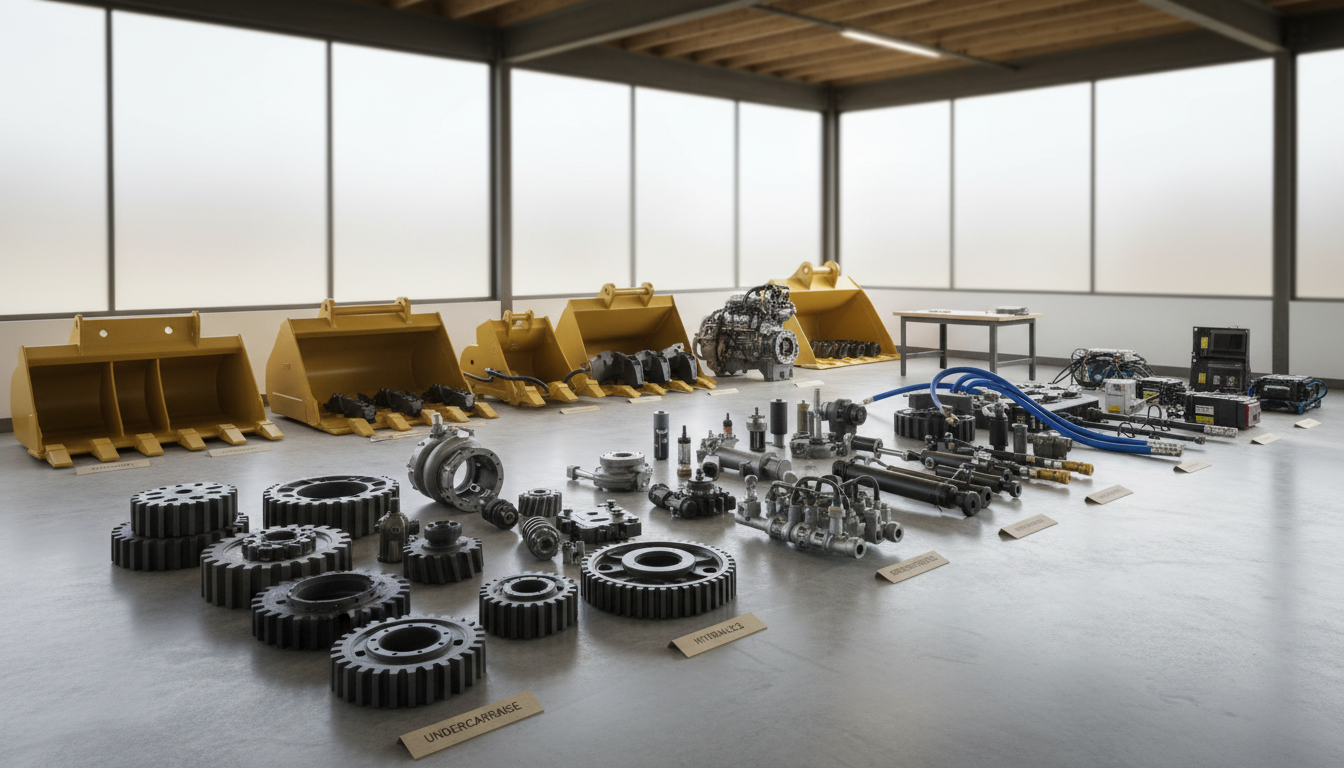
Construction equipment parts fall into distinct categories, each with different sourcing strategies, lead times, and cost implications. Understanding these categories shapes every procurement decision you’ll make.
Engine and Powertrain Components
Engine parts represent the highest-stakes category in construction equipment procurement. A failed turbocharger on a Komatsu PC800 doesn’t just stop one machine — it can halt an entire mining operation. We stock complete engine rebuild kits for Caterpillar C15, C18, and 3406E engines, plus Komatsu SAA6D140E and Volvo D13 powerplants.
Turbochargers, fuel injectors, and cylinder heads demand OEM-specification precision. Aftermarket alternatives exist, but the risk-reward calculation shifts dramatically based on your application. A rental fleet might accept aftermarket fuel pumps for cost savings, while a mining operation processing 50,000 tons daily cannot afford the reliability risk.
Hydraulic System Parts
Hydraulic components drive the core functionality of excavators, loaders, and dozers. Main hydraulic pumps, swing motors, and travel motors represent significant investments — often $8,000-$15,000 per component for larger machines.
Seal kits offer the highest return on maintenance investment. A complete hydraulic cylinder seal kit for a CAT 325 costs roughly $200-400 but prevents a $3,000 cylinder replacement. We maintain seal kit inventory for Caterpillar, Komatsu, Volvo, Hitachi, and Hyundai machines, with same-day shipping to major markets.
Undercarriage and Wear Parts
Track chains, sprockets, rollers, and cutting edges fall into the high-frequency replacement category. These parts experience predictable wear patterns, making them ideal for bulk purchasing and preventive replacement scheduling.
Aftermarket undercarriage parts often provide 80-90% of OEM performance at 60-70% of the cost. For applications with moderate duty cycles, this represents substantial savings without meaningful performance compromise.
OEM vs Aftermarket Parts: Making the Right Choice

The OEM versus aftermarket decision isn’t binary — it’s a risk-adjusted calculation based on machine criticality, operating environment, and total cost of ownership.
When OEM Parts Make Sense
OEM parts deliver guaranteed compatibility and maximum reliability, but at premium pricing. Choose OEM for mission-critical components where failure costs exceed the price differential. A mining operation running 24/7 schedules justifies OEM main hydraulic pumps and final drives.
Warranty considerations also favor OEM parts. Many equipment manufacturers void warranties for aftermarket component failures, creating potential liability exposure worth thousands of dollars. New machines under warranty should generally receive OEM parts for major component replacements.
Aftermarket Advantages and Applications
Quality aftermarket parts now match OEM specifications for many applications, manufactured by the same suppliers serving OEM channels. Aftermarket hydraulic filters, air filters, and basic wear items often provide identical performance at 30-50% cost savings.
Aftermarket parts excel in high-wear applications where frequent replacement is expected. Track pads, cutting edges, and bucket teeth see regular replacement regardless of quality level, making cost optimization the primary consideration.
Remanufactured Parts Strategy
Remanufactured components offer OEM-quality performance at aftermarket pricing for major assemblies. Remanufactured transmissions, final drives, and hydraulic pumps undergo complete teardown, inspection, and rebuild processes using OEM specifications.
We’ve seen remanufactured Caterpillar final drives deliver 5,000+ operating hours — matching new component performance while saving $4,000-6,000 per unit. The key is sourcing from reputable remanufacturers with complete warranty coverage.
Global Sourcing and Supply Chain Optimization

Construction projects operate globally, but parts procurement often remains frustratingly local. Smart procurement managers build global supply networks that deliver parts anywhere, anytime.
Regional Supply Hub Strategy
Establishing supply relationships in key global regions reduces lead times and shipping costs for international projects. We maintain inventory hubs in Dubai for Middle East projects, Singapore for Asia-Pacific operations, and Panama for Latin American sites.
Regional sourcing also provides currency hedging benefits. Purchasing parts in local currencies reduces foreign exchange exposure while supporting local supplier relationships that prove valuable during supply disruptions.
Emergency Parts Logistics
Critical part failures don’t respect business hours or geographic boundaries. Emergency logistics capabilities separate professional suppliers from parts vendors. We’ve delivered hydraulic pumps to remote mining sites in Mongolia within 48 hours using charter flights and local courier networks.
Building emergency logistics relationships before you need them proves essential. Identify suppliers with 24/7 support capabilities, global shipping partnerships, and inventory depth for your specific equipment fleet.
Customs and Documentation Management
International parts shipments require proper documentation, classification, and customs handling. Incorrect paperwork can delay critical parts for days or weeks while equipment sits idle.
Professional parts suppliers handle customs documentation, duty calculations, and import/export compliance automatically. This service alone justifies working with established global suppliers rather than attempting direct manufacturer relationships for international projects.
Cost Optimization Strategies for Parts Procurement

Effective parts procurement balances immediate costs against total ownership expenses, downtime risks, and operational requirements.
Bulk Purchasing and Inventory Management
High-wear items like filters, belts, and hydraulic fluids benefit from bulk purchasing strategies. Ordering six months of filter inventory reduces per-unit costs by 15-about one in five while ensuring parts availability during supply disruptions.
However, bulk purchasing requires careful inventory management to prevent obsolescence. Track usage patterns, monitor shelf life for rubber components, and rotate stock to maintain freshness. We help clients establish min/max inventory levels based on historical consumption data and lead time variability.
Preventive Maintenance Parts Planning
Scheduled maintenance creates predictable parts demand, enabling advance purchasing at better pricing. Order transmission filters, hydraulic oil, and wear parts 30-60 days before scheduled maintenance windows to capture volume discounts and ensure availability.
Preventive parts planning also enables better labor scheduling. Having all required parts on-site before maintenance begins reduces technician downtime and accelerates equipment return to service.
Total Cost of Ownership Analysis
Cheapest initial price rarely equals lowest total cost. Factor in reliability, warranty coverage, installation labor, and potential downtime costs when evaluating parts options. A $500 aftermarket hydraulic pump that fails after 1,000 hours costs more than a $800 OEM pump lasting 3,000 hours.
We provide total cost analysis for major component decisions, incorporating failure rate data, warranty terms, and replacement labor costs. This analysis often reveals that mid-tier aftermarket parts offer the optimal cost-performance balance.
Quality Assurance and Parts Authentication
Counterfeit parts represent a growing threat in global construction equipment markets, potentially causing catastrophic failures and safety hazards.
Identifying Authentic Parts
Authentic OEM parts include specific packaging, labeling, and documentation that counterfeiters struggle to replicate perfectly. Caterpillar parts feature holographic labels, unique part numbers, and specific packaging materials. Komatsu uses distinctive part number formats and packaging colors.
Price discrepancies often signal counterfeit parts. Genuine CAT hydraulic filters don’t sell for most below list price from legitimate suppliers. If pricing seems too good to be true, investigate the source carefully.
Supplier Verification and Certification
Work with suppliers who provide clear supply chain documentation and manufacturer authorization. Authorized dealers and distributors maintain direct relationships with OEM manufacturers, ensuring part authenticity and warranty coverage.
We maintain authorized dealer relationships with major manufacturers and provide complete supply chain documentation for every part shipment. This documentation proves essential for warranty claims and quality audits.
Testing and Validation Procedures
Critical components warrant additional verification beyond visual inspection. Hydraulic components should undergo pressure testing, electrical parts require continuity checks, and wear items need dimensional verification against OEM specifications.
For high-value components, consider third-party testing services that verify material composition, hardness, and performance characteristics. This additional cost proves worthwhile for components where failure could cause significant damage or safety risks.
Digital Parts Management and Technology Integration
Modern parts procurement uses digital tools for inventory management, predictive maintenance, and supply chain optimization.
Parts Identification and Cataloging Systems
Digital parts catalogs eliminate guesswork in parts identification and ordering. Modern systems use machine serial numbers, component photos, and technical specifications to ensure correct part selection.
QR codes and RFID tags on equipment enable instant parts lookup using mobile devices. Technicians can scan equipment components and immediately access parts information, availability, and pricing without returning to the office.
Predictive Maintenance Integration
Telematics data from construction equipment provides insights into component wear patterns and failure prediction. Oil analysis, vibration monitoring, and performance data help predict when parts will need replacement.
This predictive capability enables proactive parts ordering before failures occur, reducing emergency procurement costs and minimizing downtime. We integrate with major telematics platforms to provide automated parts recommendations based on equipment condition data.
Inventory Management Software
Professional inventory management systems track parts consumption, predict demand, and optimize reorder points. These systems prevent stockouts while minimizing carrying costs for slow-moving inventory.
Cloud-based inventory systems enable real-time visibility across multiple locations and projects. Project managers can check parts availability instantly and coordinate transfers between sites to optimize utilization.
Maintenance Planning and Parts Scheduling
Effective maintenance planning synchronizes parts availability with scheduled service intervals, reducing both inventory costs and equipment downtime.
Service Interval Optimization
Aligning parts replacement with natural service intervals maximizes labor efficiency and minimizes handling costs. Replace hydraulic filters during scheduled oil changes, install new cutting edges during track maintenance, and update wear parts during major inspections.
Extended service intervals require careful parts planning to ensure availability when needed. Order long-lead-time items like hydraulic pumps and final drives 60-90 days before scheduled replacement to avoid delays.
Seasonal Parts Preparation
Construction equipment faces different stresses across seasons, creating predictable parts demand patterns. Winter operations increase battery, heating system, and cold-weather fluid requirements. Summer conditions accelerate cooling system and air conditioning component wear.
Prepare seasonal parts inventory 30-45 days before weather transitions. Stock engine block heaters, battery blankets, and winter-grade fluids before cold weather arrives. Order cooling system components, air conditioning parts, and high-temperature hydraulic fluids before summer operations begin.
Project-Specific Parts Planning
Different construction applications create unique parts wear patterns. Demolition work accelerates cutting edge and hydraulic cylinder wear. Road construction increases undercarriage and engine air filter consumption. Mining operations demand frequent GET (Ground Engaging Tools) replacement.
Analyze historical parts consumption by project type to develop application-specific parts kits. Pre-position high-wear items at project sites based on expected consumption rates and lead times.
Emergency Response and Critical Parts Management
Equipment failures don’t follow convenient schedules. Building emergency response capabilities ensures critical parts reach failed equipment quickly, minimizing costly downtime.
Critical Parts Identification
Identify parts whose failure stops equipment operation immediately. Main hydraulic pumps, final drives, transmissions, and engine components fall into this category. Maintain emergency stock levels or establish expedited supply agreements for these critical components.
Document alternative part sources for critical components. If your primary supplier cannot deliver a needed transmission within 24 hours, know which secondary suppliers maintain inventory and can provide emergency shipments.
24/7 Support Networks
Equipment failures occur around the clock, especially on projects with extended operating schedules. Establish relationships with suppliers offering 24/7 technical support and emergency parts dispatch.
We maintain 24-hour support capabilities with technical specialists available for emergency parts identification and expedited shipping coordination. Our global network enables parts delivery to remote locations within 48-72 hours for most components.
Temporary Repair Solutions
Sometimes permanent parts aren’t immediately available, but temporary repairs can restore equipment operation while proper parts are sourced. Hydraulic hose repairs, welded cutting edges, and rebuilt components can provide interim solutions.
Maintain relationships with mobile repair services and local machine shops capable of emergency repairs. These services often prove more cost-effective than expedited parts shipping for temporary solutions.
Smart procurement of parts construction equipment requires balancing cost, quality, availability, and risk across global supply chains. Companies that master this balance reduce operating costs while improving equipment reliability and project outcomes.
Ready to optimize your construction equipment parts procurement? Shop OEM-quality spare parts with global 5-day delivery at 3genexport.com