Ammann Spare Parts Guide: Sourcing & Maintenance 2026
Uncategorized
March 31, 2026
Introduction — Why Ammann Parts Availability Defines Fleet Uptime
Ammann spare parts sit at the intersection of precision engineering and operational necessity. When a vibratory drum bearing seizes on an AV 95-2 tandem roller mid-project, or when an asphalt plant burner assembly fails during peak paving season, every hour of downtime translates directly into schedule overruns and cost penalties. For fleet managers and procurement officers in construction, road building, and infrastructure development, maintaining a reliable supply of correctly specified Ammann replacement components is not a maintenance luxury — it is a core operational discipline.
The Ammann Group, headquartered in Langenthal, Switzerland, manufactures one of the broadest compaction equipment portfolios in the world. Their machines — ranging from lightweight vibratory plates and rammers to heavy single-drum soil compactors exceeding 25 tonnes and continuous-mix asphalt plants producing up to 500 t/h — are deployed across every continent and climate zone. This global footprint creates a complex spare parts supply challenge: OEM lead times from Europe can stretch weeks, while a job site in Southeast Asia, Sub-Saharan Africa, or the Middle East cannot afford to wait.
This guide is written for maintenance engineers, equipment managers, and procurement specialists who need authoritative, technical information about Ammann spare parts — what they are, how they fail, how OEM compares to aftermarket quality, and how to source them efficiently on a global scale. Whether you operate a fleet of APR reversible plate compactors, a line of VH series soil rollers, or a full asphalt production facility built around Ammann mixing technology, the principles covered here apply directly to your service strategy.
What Are Ammann Spare Parts? Functions, Categories & OEM Specs
Ammann spare parts encompass the full spectrum of replacement and maintenance components engineered to maintain the operational integrity of Ammann compaction equipment and asphalt plant machinery. They range from high-cycle consumables — such as air filters, hydraulic seals, and vibration dampers — to long-life structural components including exciter shaft assemblies, drum drive motors, and mixer paddles. Each part is designed within strict dimensional and material tolerances that govern the performance envelopes published in Ammann’s technical documentation.
The Ammann product line spans six primary equipment families, each with its own spare parts taxonomy: light compaction equipment (rammers, vibratory plates), tandem asphalt rollers, single-drum soil compactors, pneumatic tyred rollers, asphalt pavers, and asphalt mixing plants. Across this range, spare parts are typically grouped into four service kits defined by Ammann’s own service framework — wearing kits, repair kits, maintenance kits, and emergency kits — a structure that directly informs how procurement teams should organise their inventory.
Ammann Spare Parts Master Category Reference
Ammann spare parts fall into six functional categories spanning all equipment types. The table below maps each category to its primary components and the equipment families most dependent on that parts group — a reference frame for structuring procurement priorities and warehouse inventory.
| Parts Category | Key Components | Primary Equipment Family |
|---|---|---|
| Compactor Parts | Drums, vibration units, exciter bearings, rubber buffers, scrapers, drive belts | AV / VH rollers, APR / APH plates, ATR rammers |
| Engine Parts | Air / fuel / oil filters, pistons, injectors, turbochargers, cylinder gaskets | All self-propelled rollers & plant equipment |
| Hydraulic System Parts | Hydraulic pumps, motors, hoses, cylinders, seal kits, control valves, filters | AV / VH series, pavers, asphalt plants |
| Asphalt Plant Components | Burners, drum liners, mixer paddles, filters, baghouse elements, conveyor belts | ACP / ACC / SCC mixing plants |
| Electrical & Cooling Parts | Alternators, starters, radiators, temperature sensors, ACE control boards | All models with electronic compaction control |
| Wear & Attachment Parts | Cutting edges, scraper blades, paver screed parts, wear plates, track pads | Pavers, compactors, wheeled rollers |
Ammann ACE Technology Parts — What Makes Them Different
Ammann’s proprietary ACE (Ammann Compaction Expert) intelligent compaction system is fitted across both heavy and light compaction equipment. ACE continuously measures soil stiffness in real time and automatically adjusts vibration amplitude and frequency to match ground conditions. The electronic control boards, accelerometer sensors, and display modules that power ACE are classified as specialty spare parts with longer lead times and stricter specification requirements than standard mechanical components. When sourcing ACE system parts, procurement teams should insist on exact part number confirmation and compatibility verification against the specific firmware version installed on the machine.
Role in Compaction & Asphalt Plant Systems
Each Ammann spare part functions as a precision node within a larger, integrated system. In a vibratory roller such as the AV 115-2 tandem asphalt compactor, the exciter unit generates centrifugal force through counter-rotating eccentric masses housed in sealed bearing assemblies within the drum shell. The bearing quality, the eccentric mass tolerances, and the integrity of the rubber isolation mounts between drum and frame collectively determine whether the machine achieves its rated centrifugal force — typically ranging from 18 kN to over 60 kN depending on amplitude setting — and whether that force transmits cleanly into the asphalt mat without destructive resonance bouncing back into the frame.
In asphalt mixing plants of the ACP Contimix or ACC Countermix families, the spare parts ecosystem is even more interdependent. The burner assembly controls drum temperature and therefore binder viscosity; the baghouse filter elements govern particulate emissions compliance; the mixer paddles and their wear liners determine batch homogeneity and cycle time. A worn paddle that reduces mixing efficiency by even 5–8% across a production run of 300
t/h translates into significant material quality variance — variance that becomes apparent only when the asphalt mat shows early ravelling or rutting under traffic load. The spare part, in this context, is not just a maintenance item but a quality control variable.
Understanding which system each part belongs to is the first step toward intelligent inventory management. For a deeper breakdown of parts by equipment type, refer to our Ammann spare parts category guide, which maps components to specific model families across the full Ammann machine range.
Ammann Model Range — Equipment-to-Parts Dependency Map
| Model Series | Equipment Type | Operating Weight | Highest-Demand Spare Parts |
|---|---|---|---|
| AV 85-2 / AV 95-2 / AV 115-2 | Double drum asphalt roller | 1.7 – 14 t | Exciter bearings, rubber buffers, scraper blades, hydraulic seals |
| VH 170 / VH 300 / VH 850 / VH 1150 | Single drum soil compactor | 7 – 25 t | Drum drive motors, articulation joint pins, engine filter kits, ACE sensors |
| AP 240 / VP 2400 | Pneumatic tyred roller | 6 – 24 t | Tyre assemblies, ballast components, hydraulic hoses, brake kits |
| APH 55 / APH 75 ACE | Heavy reversible vibratory plate | Up to 750 kg | Exciter oil seals, belt drive kits, air filters, vibration isolators |
| APR 2220 / APR 3020 | Reversible plate compactor | Up to 320 kg | Clutch assemblies, base plate wear kits, fuel filter elements |
| ATR 59 / ATR 66 | Rammer | Up to 90 kg | Rammer foot / shoe kits, spring assemblies, engine maintenance kits |
| ACP Contimix / ACC Countermix | Asphalt mixing plant | 90 – 500 t/h output | Burner elements, baghouse filters, mixer paddles, conveyor belts, sensor kits |
| AFW 600-2 / AFT tracked pavers | Asphalt paver | 5.8 – 20 t | Screed tamper bars, auger wear parts, hydraulic pump kits, tow point pins |
What Are the Most Common Ammann Equipment Failure Modes?
Ammann equipment failure modes cluster around five primary systems: the vibration exciter unit, the hydraulic drive circuit, the engine filtration system, the wear-contact surfaces, and the electronic compaction control (ACE). Exciter bearing fatigue is the single highest-frequency failure in Ammann rollers, typically presenting as abnormal drum vibration, audible bearing rumble, and reduced centrifugal force output — all detectable before catastrophic seizure if a structured inspection schedule is in place.
| Failure Mode | Affected System | Observable Symptoms | Replacement Part |
|---|---|---|---|
| Exciter bearing fatigue | Vibration unit | Abnormal drum vibration, rumbling noise, reduced centrifugal force | Exciter bearing set, seal kit |
| Rubber isolation buffer degradation | Frame-drum interface | Excessive frame vibration transmitted to cab/ROPS, cracked welds | Anti-vibration mount / rubber buffer kit |
| Hydraulic pump cavitation | Hydraulic drive circuit | Loss of traction, overheating, foamy hydraulic oil, noise under load | Hydraulic pump, suction filter, return-line filter |
| Engine air filter blockage | Engine intake | Power loss, black exhaust smoke, elevated fuel consumption, high intake vacuum | Primary & secondary air filter elements |
| Articulation joint pin wear | Steering / frame articulation | Play in steering response, clunking under articulation load, uneven tyre/drum wear | Articulation pin & bushing kit |
| Scraper blade wear-through | Drum cleaning system | Asphalt pickup on drum surface, mat tears, finish defects on asphalt layer | Polyurethane / rubber scraper blade set |
| ACE sensor signal loss | Electronic compaction control | ACE display error codes, compaction measurement disabled, erratic amplitude control | ACE accelerometer sensor, control board |
| Asphalt plant burner atomiser fouling | Drying drum / burner | Uneven flame pattern, temperature fluctuation, high fuel consumption, emission exceedance | Burner nozzle / atomiser assembly, flame sensor |
| Baghouse filter element saturation | Dust collection system | Elevated pressure drop across filter bank, increased emissions opacity, reduced plant output | Baghouse filter cartridges / sleeves |
OEM vs. Aftermarket Ammann Parts — Detailed Comparison
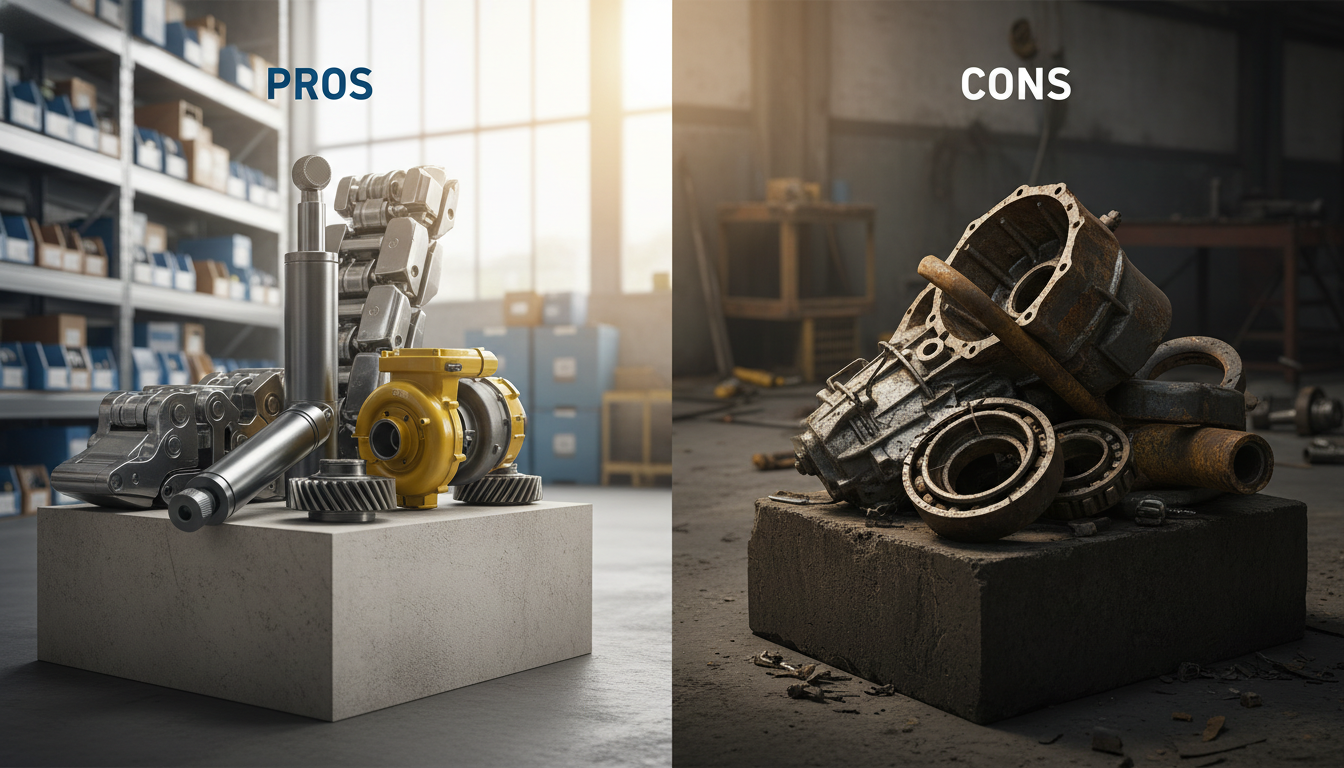
The OEM vs. aftermarket debate in heavy equipment spare parts is rarely binary. The critical variable is not simply “original vs. copy” but rather the depth of engineering specification adherence in the aftermarket part — dimensional accuracy, material grade, surface treatment, and quality control documentation. A correctly engineered OEM-equivalent aftermarket part for a high-volume component like an engine oil filter or a hydraulic return filter represents negligible technical risk while offering procurement flexibility. By contrast, a dimensionally undersized exciter shaft bearing sourced from an unverified supplier introduces system-level failure risk that far exceeds any cost saving. For a comprehensive framework on evaluating aftermarket part quality across heavy equipment brands, see our OEM vs. aftermarket parts evaluation guide.
OEM vs. OEM-Equivalent Aftermarket — Specification
Matrix
| Evaluation Criterion | Ammann OEM Part | High-Quality OEM-Equivalent | Low-Quality Aftermarket |
|---|---|---|---|
| Dimensional tolerance | Factory spec, verified | Matched to OEM drawing | Often ±0.2–0.5mm off spec |
| Material grade | Specified alloy / compound | Equivalent grade, tested | Substituted, unverified |
| Surface treatment | Phosphating / nitriding / HT as specified | Replicated process, documented | Often omitted or incomplete |
| QC documentation | Full traceability, CoC | ISO-compliant CoC available | None or generic |
| Lead time (ex-Europe) | 2–6 weeks typical | 3–10 days from regional stock | Variable, unpredictable |
| Warranty applicability | Full OEM warranty | Supplier warranty, documented | No effective warranty |
| Relative cost index | 1.0× (baseline) | 0.55–0.75× | 0.25–0.40× |
| Risk profile | Lowest | Low–medium (spec-dependent) | High — system damage risk |
The cost index comparison above makes a fundamental point: a credible OEM-equivalent part typically costs 55–75% of the OEM price while delivering comparable service life and functional performance. The cost differential on a low-quality part drops further to 25–40%, but the total cost of ownership — factoring in shortened service intervals, secondary damage to mating components, and unscheduled downtime — routinely exceeds OEM cost within one
or two service cycles.
A practical tiering strategy for Ammann fleet maintenance: use OEM parts for safety-critical and tolerance-sensitive components (exciter bearing assemblies, hydraulic pump cartridges, ACE sensors, articulation pins); use verified OEM-equivalent aftermarket parts for high-consumption consumables (filter elements, scraper blades, rubber buffers, gasket sets); avoid unverified aftermarket entirely for structural and load-bearing components where dimensional
accuracy directly governs fatigue life.
The European standard Ammann Genuine Spare Parts & Service Kits (official) defines the four OEM service kit tiers — wearing, repair, maintenance, and emergency — that form the recommended procurement baseline for any Ammann fleet.
Global Sourcing & Quality Assurance for Ammann Spare Parts
Sourcing Ammann spare parts outside of the European OEM network requires a disciplined supplier qualification process. Fleet managers operating in regions with limited Ammann dealer coverage — across much of Sub-Saharan Africa, Central Asia, Southeast Asia, and parts of Latin America — face a consistent challenge: parts identified in the Ammann electronic parts catalogue may carry lead times of four to six weeks from the European distribution network. For machines running critical paths on infrastructure contracts, this wait is commercially untenable.
The supplier qualification checklist for Ammann OEM-equivalent parts should address five dimensions: part number cross-referencing against the OEM catalogue, dimensional inspection reports or CMM data for tolerance-critical parts, material certification documents (mill certificates for metallic parts, compound specifications for rubber/polymer parts), ISO 9001 production quality certification of the manufacturing facility, and documented testing protocols for functional parts such as hydraulic pumps, control valves, and sensors. Suppliers who can provide documentation across all five dimensions represent a reliable OEM-equivalent source; suppliers who can address only one or two should be restricted to non-critical consumables only.
Supplier Qualification — Five-Dimension Checklist
| Qualification Dimension | Required Evidence | Critical For |
|---|---|---|
| Part number cross-reference | Verified OEM catalogue match | All parts |
| Dimensional inspection data | CMM report or drawing + tolerance confirmation | Bearings, seals, pins, wear plates |
| Material certification | Mill certificate / compound spec sheet | Structural parts, rubber mounts, hydraulic seals |
| Manufacturing ISO certification | Current ISO 9001 certificate | All supplier facilities |
| Functional testing protocol | Test bench data / pressure certification | Hydraulic pumps, control valves, ACE sensors |
Sourcing Ammann Spare Parts Globally
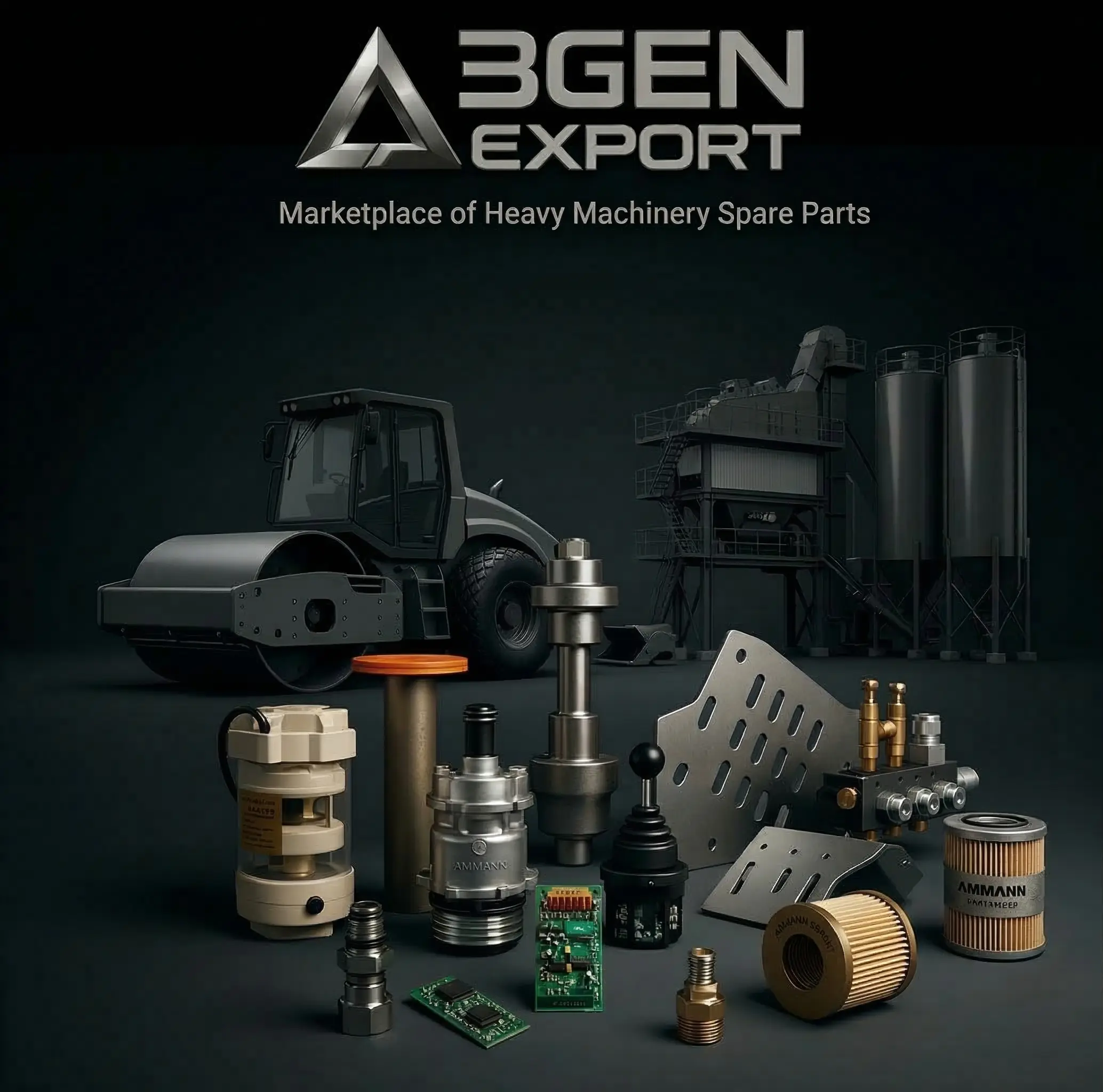
3GEN Export maintains an Ammann spare parts catalogue covering compactor parts, asphalt plant components, engine kits, hydraulic system assemblies, and electrical/cooling components — each manufactured to strict international standards with full OEM-equivalent specification documentation. Parts are shipped globally with competitive lead times, directly addressing the supply gap for fleets operating outside the European dealer network.
Maintenance Schedules & Installation Protocols for Ammann Equipment
Correct installation of Ammann spare parts is as important as part quality selection. A correctly specified exciter bearing installed with the wrong pre-load torque, contaminated lubricant, or improper seal seating will fail prematurely regardless of its material quality. Ammann publishes torque specifications, lubricant grades, and clearance tolerances in the model-specific workshop manuals; these values must be treated as hard limits, not guidelines.
Ammann Roller & Compactor Maintenance Interval
Reference
| Service Interval | Tasks | Parts Required |
|---|---|---|
| Every 10 hours (daily) | Engine oil level, hydraulic fluid level, air filter pre-cleaner, drum scraper condition, water sprinkling system | — |
| 250 hours | Engine oil & filter change, fuel filter replacement, lubrication of all grease points, drum drive belt tension check | Engine oil filter, fuel filter element, grease cartridges |
| 500 hours | Air filter primary element replacement, hydraulic return filter, exciter oil level check, water pump inspection | Air filter element, hydraulic return filter, exciter oil |
| 1,000 hours | Hydraulic oil & tank filter replacement, exciter oil change & seal inspection, articulation pin lubrication & clearance check, scraper blade replacement | Hydraulic oil, tank filter, exciter seal kit, scraper blade set |
| 2,000 hours | Full exciter bearing inspection / replacement, rubber isolation mount assessment, ACE sensor calibration, hydraulic pump pressure test, coolant system service | Exciter bearing set, rubber buffer kit, coolant, hydraulic pump seal kit |
| 4,000 hours | Engine overhaul assessment, full hydraulic system audit, exciter shaft inspection for fatigue cracks, articulation joint pin & bushing replacement | Engine rebuild kit, articulation pin-bushing set, full hydraulic seal kit |
Ammann Exciter Bearing Replacement — Step-by-Step Protocol
Replacing exciter bearings on Ammann vibratory rollers (AV and VH series) requires removing the drum assembly, accessing the exciter unit housing, extracting worn bearings under controlled temperature, and reinstalling with correct pre-load and fresh oil seals. Always consult the model-specific workshop manual for torque specifications before beginning.
- Isolate and secure the machine. Park on a level surface, engage the parking brake, turn off the engine, and wait for all hydraulic pressure to dissipate. Lockout/Tagout (LOTO) the main battery disconnect before removing any drum assembly covers.
- Drain exciter oil. Remove the exciter housing drain plug and drain the full oil charge into a clean container. Note any metallic particles or discoloration in the drained oil — heavy metallic contamination confirms bearing failure and may indicate shaft scoring requiring further inspection.
- Remove the drum assembly. Following the model-specific workshop procedure, detach the drum drive coupling, disconnect the hydraulic motor, and support the drum with an appropriate lifting fixture before removing the drum-to-frame mounting fasteners. Never allow the drum to hang unsupported from hydraulic hoses.
- Access and disassemble the exciter housing. Remove the exciter end cover fasteners (note torque specification for reassembly), extract the eccentric shaft assembly using a bearing puller, and lay out all components on a clean workbench. Do not intermix components from left and right exciter units on tandem-drum machines.
- Extract worn bearings. Use an induction heater or hydraulic bearing puller to remove the worn bearings from the shaft. Never use a direct-impact method — hammer blows transmit load through the rolling element path and damage the shaft journals. Inspect shaft journals for scoring; light scoring (below 0.05 mm) can be polished; deep scoring requires shaft replacement.
- Install new bearings and oil seals. Heat the new bearing to 80–100°C using an induction heater and slide onto the shaft, seating firmly against the shoulder. Allow to cool before installing new oil seals — always use the seal installation tool to avoid lip distortion. Replace both inner and outer seals regardless of their visual condition when a bearing replacement is performed.
- Reassemble the exciter unit and fill with oil. Reinstall the eccentric shaft assembly and exciter end cover, torquing fasteners to the workshop manual specification. Fill the exciter housing with the specified oil grade and quantity — typically an ISO VG 220 gear oil to the fill hole level. Over- or under-filling is a leading cause of premature bearing re-failure.
- Reinstall the drum and run commissioning check. Reattach the drum assembly, reconnect the drive coupling and hydraulic motor, and torque all fasteners to specification. Start the machine and run at idle for 10 minutes before engaging vibration. Check for oil leaks, abnormal noise, and correct ACE sensor readout before returning the machine to operational duty.
OEM-Equivalent Parts, Ready to Ship Globally
3GEN Export supplies OEM-equivalent Ammann spare parts — including exciter bearing kits, hydraulic seal assemblies, engine filter sets, and asphalt plant wear components — with fast international dispatch to construction and infrastructure projects worldwide. Every part ships with a Certificate of Conformance and full dimensional verification documentation.
Keeping Your Ammann Fleet Mission-Ready
Ammann spare parts management is ultimately a function of system-level thinking. Each component — from a drum scraper blade to an ACE control board — exists within an interdependent mechanical and electronic architecture that determines whether a machine achieves its rated compaction performance, fuel efficiency, and operational lifespan. The procurement decisions made at the parts sourcing stage ripple directly into maintenance cost curves, machine
availability rates, and ultimately the commercial performance of every project the equipment supports.
The most effective Ammann fleet maintenance programs share three structural characteristics: a tiered parts sourcing strategy that matches part quality standards to component criticality, a proactive service interval discipline built on Ammann’s published maintenance schedules rather than reactive failure response, and a qualified global supply partner who can deliver correctly specified Ammann spare parts with short lead times regardless of project location.
For fleets operating intensive compaction or asphalt production cycles, these three elements together are what separate predictable, cost-controlled maintenance from costly, schedule-disrupting breakdowns.
Whether your operation runs a single APH 75 plate compactor on a utility repair crew or a multi-machine fleet of VH series soil rollers and ACP mixing plants on a major road construction programme, the fundamental principle remains identical: the right Ammann spare parts, sourced from a verifiable supplier, installed by a competent technician following the workshop manual procedure, represent the most cost-effective maintenance investment available to any
fleet manager.
Frequently Asked Questions
Q: How do I identify the correct Ammann spare part number for my machine?
A: Locate the machine serial number plate, typically on the front frame or ROPS structure, and cross-reference it in the Ammann electronic parts catalogue (EPC) for your model series. The EPC uses serial number ranges to identify model-year specific parts, which is critical because the same part name may carry different part numbers across production years. If your serial number is not in the EPC, contact your Ammann dealer or a specialist spare parts supplier with the serial number, model, and a high-resolution photo of the component for cross-reference identification.
Q: What is the difference between Ammann wearing kits, repair kits, maintenance kits, and emergency kits?
A: Ammann’s four service kit categories serve distinct purposes. Wearing kits cover high-cycle consumable components — scrapers, filters, belts — replaced at regular intervals. Repair kits bundle parts needed to restore a specific failed subsystem such as a hydraulic cylinder or exciter unit. Maintenance kits package all parts required for a scheduled service interval (250, 500, or 1,000 hours). Emergency kits contain the highest-priority fast-failure parts — filters, seals, and belts — recommended as on-site stock to minimise unplanned downtime between scheduled deliveries.
Q: Can aftermarket Ammann spare parts void the machine warranty?
A: In most jurisdictions, using aftermarket parts does not automatically void an equipment warranty — the OEM must demonstrate that the aftermarket part directly caused the failure in question. However, using non-OEM parts for warranty-active machines carries a documentation burden. Retain all installation records, part certificates, and service reports. For machines still under factory warranty, the safest approach is to use OEM or certified OEM-equivalent parts that carry a supplier warranty and full specification documentation. Consult your regional Ammann dealer for specific warranty terms applicable to your equipment.
Q: What exciter oil specification do Ammann vibratory rollers require?
A: Ammann vibratory rollers typically specify an ISO VG 220 gear oil for exciter housing lubrication under standard operating temperature conditions. However, the exact specification — including viscosity grade and additive package (EP vs. non-EP) — varies by model and climate zone. High-temperature environments or continuous heavy-load operation may require a higher viscosity grade. Always confirm the exact oil specification in the model-specific operation and maintenance manual before filling; incorrect oil specification is a common and avoidable cause of accelerated exciter bearing failure.
Q: How can global construction projects source Ammann spare parts with short delivery lead times?
A: Projects outside Europe face OEM lead times of four to six weeks from Ammann’s Swiss/European supply chain. Three strategies reduce this exposure: maintaining an emergency parts stock of high-failure-risk consumables on-site based on the manufacturer’s emergency kit recommendations; engaging a qualified OEM-equivalent aftermarket supplier with regional distribution capability who can dispatch within days; and building a 90-day rolling forecast of consumable parts requirements to enable advance ordering. Specialist exporters with established Ammann parts catalogues and international logistics infrastructure can typically match or exceed OEM quality specification while delivering significantly shorter lead times to remote project locations.
“Manufactured in Turkey, these products are made using the latest technologies and built to meet the highest international standards. Each machine is a high-quality copy of the original, ensuring durability, precision, and performance that you can rely on for modern construction and metalworking projects.”
Useful Links
- Construction Equipment, Heavy Equipment Parts, Industrial Procurement
- Compressed Air Systems, Industrial Equipment, Maintenance
- Equipment Maintenance, Heavy Machinery Parts, Industrial Procurement
- Construction Equipment, Heavy Machinery Parts, Hitachi Parts