
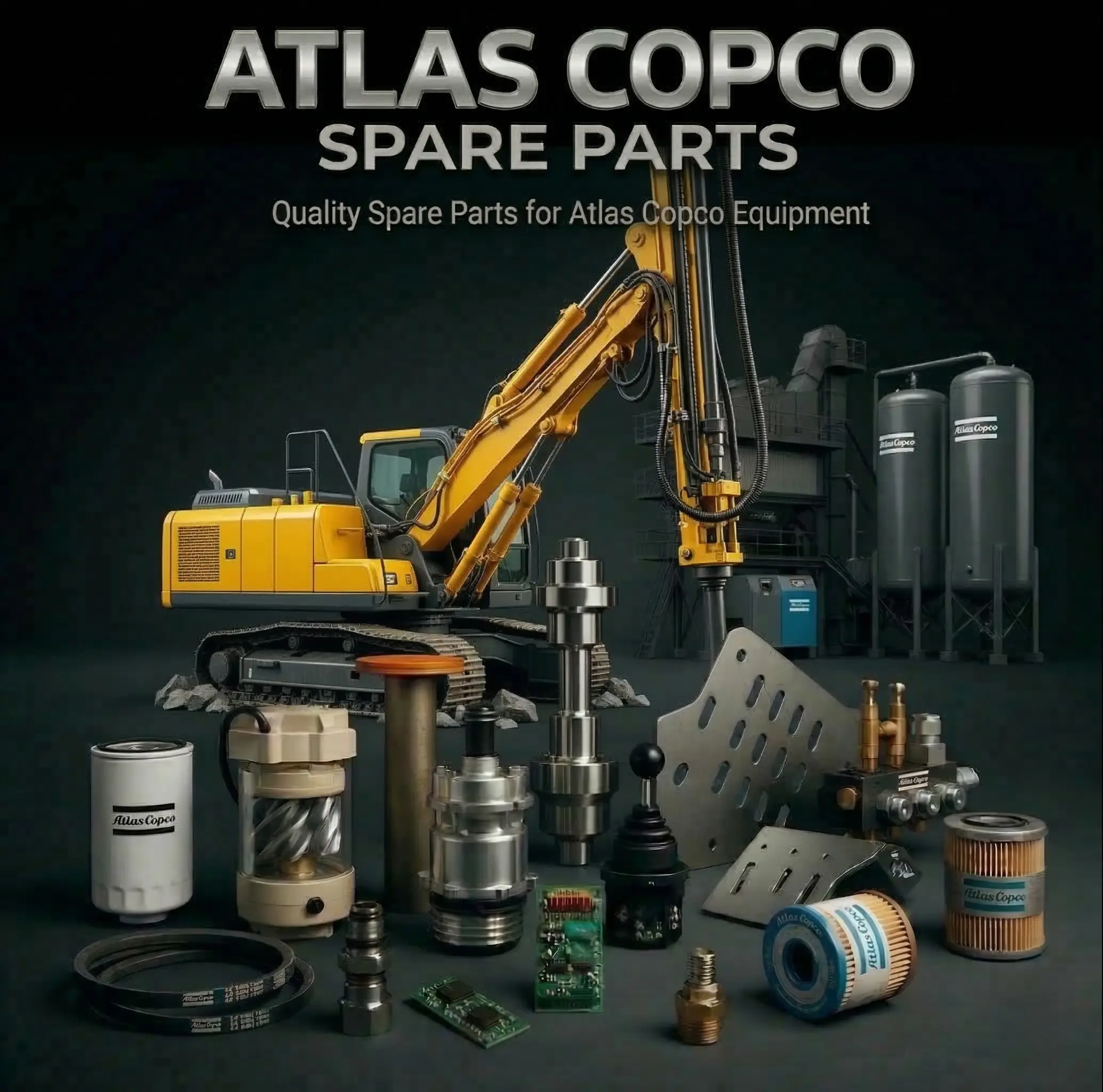
Atlas Copco Spare Parts: 7 Critical Failure Modes and How to Fix Them
Uncategorized
March 11, 2026
Why Atlas Copco Spare Parts Management Is a Production-Critical Decision
One failed seal. One clogged separator. One ignored pressure drop. For any plant running Atlas Copco GA series rotary screw compressors, these are not minor inconveniences — they are the beginning of critical, cascading failures that halt production lines and incinerate budgets.
Managing Atlas Copco spare parts is not merely a maintenance function — it is a strategic production decision with measurable financial consequences. According to Atlas Copco’s own lifecycle cost analysis, a single day of unplanned downtime due to compressor failure can cost more than an entire year’s scheduled maintenance budget. Energy costs alone account for 70% to 80% of total cost of ownership over a compressor’s service life, and a poorly maintained machine consumes significantly more energy to produce the same volume of compressed air as a well-serviced unit. When you factor in the role that compressed air plays in pneumatic conveying, spray painting, instrumentation, process automation, and power tooling across construction, mining, and manufacturing sectors, the stakes become undeniable.
Proactive Atlas Copco spare parts management — particularly for consumables such as oil separator elements, air filter elements, oil filters, and inlet valves — is the single most reliable method for preserving machine availability, protecting downstream equipment, and controlling operating expenditure over the full asset lifecycle. This article identifies the 7 critical failure modes that procurement officers and maintenance engineers must understand before the next service interval arrives.
The GA series — Atlas Copco’s flagship oil-injected rotary screw compressor line — covers models from GA5 through GA1410, serving facilities that demand continuous, reliable compressed air at pressures between 5.5 and 13 bar. Understanding the spare parts that govern this system’s reliability is the first step toward eliminating unscheduled shutdowns.
What Are Atlas Copco GA Series Spare Parts?
Atlas Copco GA series spare parts are the consumable and serviceable components engineered specifically for oil-injected rotary screw compressors in the GA product family.
The Atlas Copco GA series compressor operates on the principle of two intermeshing helical rotors — a male and female screw element — that progressively compress air while oil is injected for cooling, lubrication, and sealing. For this system to function within OEM design tolerances, a precise set of consumable parts must be maintained on a strict schedule. The oil separator element (primary part numbers: 2901077901 for GA11–GA30C; 1622569300 for GA55–GA75AP; 1614642300 for GA90–GA160 series) is arguably the most critical single consumable: it removes entrained oil aerosols from the compressed air stream before delivery to downstream equipment, with a filtration efficiency rated at 99.99% at 0.1 micron when new. As the element ages — typically beyond 4,000 operating hours or 12 months — differential pressure across the separator rises, energy consumption climbs, and oil carry-over into the distribution network contaminates instrumentation, processes, and pneumatic tools.
The air filter element (1503019000 for GA5/7/10; 1613950300 for GA90AP) protects the screw element from ambient particulates that would accelerate rotor and bearing wear. The oil filter (1513033700 for GA5/7/10; 1613610500 for GA90/110/132/160) maintains oil circuit cleanliness to prevent varnish deposit formation on rotors and bearings. Thermostatic bypass valves, inlet valves, minimum pressure valves, and the Elektronikon controller’s sensor suite round out the serviceable component set that governs system performance.
Key Atlas Copco GA Series Part Numbers by Model Range
The table below covers the three primary filter/separator consumables across common GA model variants — verified against published OEM part lists.
| Model Range | Oil Separator P/N | Air Filter P/N | Oil Filter P/N | Service Interval |
|---|---|---|---|---|
| GA5 / GA7 / GA10 | 1513005800 | 1503019000 | 1513033700 | 4,000 h / annual |
| GA11 / GA15 / GA18 / GA22 / GA30 | 2901077901 | 1619378400 | 1613610500 | 4,000 h / annual |
| GA55 / GA75 (AP) | 1622569300 | 1622185501 | 1622314200 | 4,000–8,000 h |
| GA90 / GA110 / GA132 / GA160 | 1614642300 | 1619378400 | 1613610500 | 8,000 h |
| GA55 / GA75 / GA90 VSD | 2901920040 | 1613950300 | 1613610500 | 4,000 h / annual |
Role of Consumable Parts in the Rotary Screw Compression System
Every consumable in the Atlas Copco GA system is positioned at a critical control point — removing contaminants, regulating flow, managing thermal load, or protecting rotating components. None operates in isolation.
To understand why Atlas Copco spare parts demand disciplined management, consider the system as a chain of interdependent control points rather than a collection of individual parts. Ambient air enters through the air filter element, which removes particulates before they can reach the screw element and score the precisely machined rotor profiles. Oil is injected at the compression stage for lubrication, cooling, and sealing — this oil must be continuously conditioned by the oil filter and thermostatic bypass valve to maintain viscosity and cleanliness. After compression, the air-oil mixture passes through the oil separator tank, where gravity separation and the separator element remove entrained oil aerosols down to 0.1 micron.
The minimum pressure valve (MPV) maintains a minimum back-pressure of approximately 4 bar in the separator tank to ensure oil circulation to the screw element under all load conditions. The inlet valve (IV) modulates airflow to match demand, acting as the primary load/unload mechanism. When any single link in this chain degrades — a clogged air filter, a saturated oil separator, a leaking inlet valve piston seal — the failure propagates rapidly. Increased differential pressure across the air filter elevates suction resistance, reducing volumetric efficiency and raising discharge temperature.
Elevated discharge temperature degrades oil viscosity, accelerates oxidation, and deposits varnish on rotor surfaces and bearings, ultimately shortening the life of the most expensive component in the system: the screw element itself. This cascading failure mechanism is why Atlas Copco engineers prescribe strict, time-based service intervals rather than condition-based intervals for primary consumables.
For the complete Atlas Copco spare parts catalog — including GA, GX, ZR, ZT, and ZH series components — visit the dedicated brand page:
Atlas Copco Spare Parts at 3GEN Export.
What Are the 7 Most Critical Atlas Copco Compressor Failure Modes?
The 7 most critical Atlas Copco GA compressor failure modes are: clogged air filter element, saturated oil separator element, inlet valve piston seal failure, minimum pressure valve malfunction, thermostatic bypass valve failure, screw element bearing wear, and Elektronikon sensor fault. Each failure mode has a distinct symptom profile, urgency level, and corrective action that maintenance teams must be equipped to identify before damage escalates.
| # | Failure Mode | Key Symptom | Likely Cause | Urgency | Action |
|---|---|---|---|---|---|
| 1 | Clogged Air Filter Element | High intake ΔP, elevated discharge temp, reduced flow | Dusty environment, overdue service interval | HIGH | Replace at 4,000 h or ΔP > 25 mbar |
| 2 | Saturated Oil Separator Element | Oil in downstream air, high separator ΔP, energy spike | Extended service life beyond 4,000 h / 12 months | CRITICAL | Replace immediately; flush oil circuit |
| 3 | Inlet Valve (IV) Piston Seal Failure | No load/unload response, continuous full-load running | Seal wear, oil contamination of actuator | HIGH | Replace IV seal kit; inspect solenoid valve |
| 4 | Minimum Pressure Valve (MPV) Malfunction | Oil starvation to screw element, pressure fluctuation | Spring fatigue, seat erosion, varnish deposits | CRITICAL | Replace MPV assembly; inspect oil lines |
| 5 | Thermostatic Bypass Valve Failure | High discharge temperature alarms, thermal shutdown | Failed wax element, stuck valve body | MEDIUM | Replace thermostatic element; clean cooler |
| 6 | Screw Element Bearing Wear | Elevated vibration, metallic particles in oil, noise | Overdue oil/filter service, oil contamination | CRITICAL | Bearing replacement or element overhaul at 40,000 h |
| 7 | Elektronikon Controller Sensor Fault | Erratic alarms, false shutdowns, wrong pressure readings | Sensor drift, moisture ingress, wiring corrosion | MEDIUM | Replace affected sensor; verify cable integrity |
Understanding these 7 failure modes in operational context is what separates reactive maintenance programs from proactive reliability strategies. In high-duty-cycle industrial environments — continuous process plants, underground mining operations, large-scale construction sites — GA series compressors may accumulate 6,000 to 8,000 operating hours per year, meaning the 4,000-hour service interval arrives every six to eight months under full-load conditions. Postponing oil separator replacement by even 1,000 hours beyond the recommended interval creates a compounding risk: the separator differential pressure rises, forcing the drive motor to work harder to maintain target delivery pressure; oil carry-over begins contaminating downstream dryers and filters; and elevated operating temperatures accelerate oil degradation, increasing the rate of varnish formation on bearing races and rotor clearance surfaces. The financial case for timely spare parts replacement is not theoretical — Atlas Copco’s own lifecycle cost analysis confirms that tailoring maintenance frequency to actual operational load and site conditions reduces total cost of ownership by an average of 35%.
For procurement officers managing multi-machine fleets, the critical insight is that skipping one service kit — typically valued at USD 150–400 depending on model — to save budget can trigger a screw element replacement event valued at USD 8,000 to 25,000, not counting lost production. The seven failure modes above are the specific intervention points where that risk calculus plays out most frequently in the field.
OEM vs. Aftermarket Atlas Copco Parts: Which Performs Better?
Genuine Atlas Copco OEM parts deliver superior fit, certified performance, and warranty protection — but at a significant price premium over aftermarket alternatives. OEM-equivalent parts from verified industrial suppliers offer a middle path: engineered to the same functional specifications, manufactured from equivalent materials, and available at 20–40% below OEM list price with no compromise to machine performance or service life.
| Criterion | OEM (Atlas Copco Genuine) | Generic Aftermarket | 3GEN OEM-Equivalent |
|---|---|---|---|
| Dimensional Fit | Original drawings — exact | Reverse-engineered — variable | Spec-matched — consistent |
| Filtration Efficiency | 99.99% @ 0.1 µm (certified) | Uncertified — may vary ±15% | 99.99% @ 0.1 µm (tested) |
| Service Life | 4,000–8,000 h (guaranteed) | 3,500–5,200 h (stated, unverified) | 4,000–8,000 h (validated) |
| Warranty Preservation | Full OEM warranty intact | May void OEM warranty | 1-year component warranty |
| Price Index | 100% (baseline) | 40–60% of OEM | 60–80% of OEM |
| Global Lead Time | Variable (3–21 days by region) | Variable (no SLA) | 5 business days worldwide |
| Documentation | Full OEM traceability | Minimal or none | CoC, test reports on request |
The procurement risk calculus for Atlas Copco spare parts is nuanced and deserves field-level scrutiny rather than a blanket OEM-only or price-first policy. Genuine OEM parts are manufactured from the original compressor drawings, ensuring that every dimensional and material specification matches the design intent for the specific model and serial number. For critical pressure-retaining or rotating components — particularly screw element bearings, shaft seals, and minimum pressure valve assemblies — the argument for OEM sourcing is compelling: third-party reverse engineering introduces dimensional tolerances that may be acceptable in isolation but can interact destructively with adjacent components under sustained operating loads. Atlas Copco’s own technical documentation explicitly warns that using non-genuine parts on turbomachinery variants (ZH centrifugal compressors) may void applicable warranties and, more critically, may compromise safety-critical design margins.
However, for consumable filter elements — where the primary performance criterion is filtration media efficiency, housing dimensional conformance, and sealing gasket material compatibility — high-quality OEM-equivalent parts from industrial suppliers with verifiable quality management systems (ISO 9001-certified manufacturing, documented test protocols) represent a commercially rational alternative that major fleet operators in mining, construction, and process manufacturing have adopted at scale. The key due-diligence requirement is supplier documentation: any OEM-equivalent Atlas Copco spare parts supplier must be able to provide a Certificate of Conformance, filtration efficiency test data, and material compliance declarations, particularly for food-grade or pharmaceutical compressed air applications where oil carry-over limits are governed by ISO 8573-1 Class 1 or Class 2 standards.
Explore the full range of certified OEM-equivalent compressor components:
Compressor Parts Catalog at 3GEN Export.
Sourcing & Quality Assurance for Atlas Copco Spare Parts
Global procurement of Atlas Copco spare parts has become significantly more complex in the post-2020 industrial supply chain environment, with OEM lead times extending to 3–6 weeks in high-demand periods and regional distributor inventory coverage becoming increasingly inconsistent.
For fleet managers operating in Africa, the Middle East, Central Asia, and Southeast Asia — regions where Atlas Copco’s local distribution network is thinner than in Europe or North America — the ability to source verified, OEM-equivalent Atlas Copco spare parts with predictable lead times and documented quality assurance is a direct operational differentiator. A sound global sourcing strategy for Atlas Copco consumables must address four dimensions: supplier qualification, part verification, documentation integrity, and logistics reliability. Supplier qualification requires confirming ISO 9001 certification, reviewing product testing protocols for filtration efficiency and dimensional conformance, and validating cross-reference accuracy against the OEM part number system — since incorrect part number substitution is one of the most common sources of fitment failures in the field. Part verification goes beyond cross-reference matching: for oil separator elements, physical verification of the element O-ring dimensions, media pleat count, housing height, and thread pitch is necessary to confirm that a substitute part will function within the original design envelope.
Documentation integrity — Certificate of Conformance, material safety data sheets for lubricants, and test reports — is increasingly required by end-user procurement departments in regulated industries and by ISO 55001-compliant asset management programs. Logistics reliability, particularly for emergency orders, demands a supplier with confirmed stock availability rather than on-demand manufacturing: a 5-business-day guaranteed delivery window to any global port of entry is the benchmark that separates strategic spare parts partners from catalogue vendors. 3GEN Export addresses all four dimensions for Atlas Copco spare parts procurement, maintaining stocked inventory of GA series filter kits, inlet valve seal kits, minimum pressure valve assemblies, and thermostatic elements, supported by a 1-year warranty on all supplied components and bulk pricing available for fleet procurement contracts.
Source Atlas Copco Spare Parts Globally with 3GEN Export
3GEN Export supplies OEM-equivalent Atlas Copco spare parts — GA series service kits, oil separators, filter elements, inlet valves, and more — to fleet operators across 50+ countries. 5-day global delivery, 1-year component warranty, bulk pricing for procurement contracts. Certificate of Conformance and technical documentation available on request.
Installation & Preventive Maintenance Protocol
Correct installation of Atlas Copco spare parts is as critical as the parts themselves. Even genuine OEM components installed incorrectly — wrong torque, missing O-ring lubrication, reversed separator element orientation — will underperform or fail prematurely.
A rigorous pre-installation checklist prevents the most common post-service failures in Atlas Copco GA compressors. Before beginning any service work, the machine must be fully isolated: disconnected from the electrical supply via the main isolator, depressurized to zero bar as confirmed on the system pressure gauge, cooled to ambient temperature, and locked out in accordance with site LOTO (Lockout/Tagout) procedures. Cross-contamination of the oil circuit is the most insidious installation error: when replacing the oil separator element, any residual oil from the old element that is allowed to drain back into the oil circuit should be flushed out with a full oil change using Atlas Copco Roto-Inject fluid or an OEM-equivalent ISO VG 46 turbine oil. Failure to perform a coincident oil change when replacing the separator element is a common maintenance shortcut that dramatically reduces the service life of the new separator — because degraded oil with oxidation byproducts will begin loading the new element media from the first hours of operation.
Torque specifications must be respected during re-assembly: separator tank lid bolts on GA30–GA90 models torque to 40–45 Nm in a cross-pattern sequence; over-torquing deforms the O-ring groove and creates a leak path that bypasses the separator. All replacement gaskets and O-rings supplied in the service kit must be replaced simultaneously — reusing old seals is the second most common cause of post-service oil leaks. After service completion, the compressor should be started on-load for a minimum 30-minute break-in run, with discharge temperature, separator differential pressure, and oil pressure monitored at 5-minute intervals to confirm normal operating parameters before returning the machine to unattended production service.
Atlas Copco GA Series Oil Separator & Filter Kit Replacement — Step-by-Step Protocol
This procedure covers the scheduled replacement of the oil separator element, oil filter, and air filter element on Atlas Copco GA series rotary screw compressors at the 4,000-hour or annual service interval. Follow these steps to ensure correct installation and zero post-service oil leaks.
- LOTO & Depressurize: Isolate main power at the disconnect switch. Press the emergency stop button. Open the manual drain valve to vent system pressure to zero bar. Confirm zero pressure on the Elektronikon display and system gauge before proceeding.
- Drain Oil Circuit: Position an appropriately sized drain pan under the oil drain plug. Remove the drain plug and allow all oil to drain completely. Inspect the drained oil for metallic particles, milky coloration (water ingress), or dark carbonization — each indicates a secondary failure requiring investigation before refill.
- Remove Oil Separator Element: Unscrew the separator tank lid bolts in a cross-pattern sequence to prevent gasket distortion. Lift out the lid assembly. Remove the old separator element, noting orientation. Discard the old element O-rings — do not reuse. Clean the tank interior and lid mating surfaces with a lint-free cloth.
- Install New Separator Element: Lightly lubricate the new O-rings with clean compressor oil. Install the O-rings into their grooves without stretching. Insert the new separator element in the correct orientation (arrow indicating airflow direction, if marked). Replace the tank lid and tighten bolts to 40–45 Nm in a cross-pattern sequence.
- Replace Oil Filter & Air Filter Elements: Unscrew the oil filter element (spin-on type on most GA models) counter-clockwise. Lightly oil the new element gasket and install clockwise until gasket contact, then 3/4 turn more — do not over-tighten. For the air filter, release housing clips, remove old element, wipe housing interior, and insert new element with gasket seated correctly in the housing groove.
- Refill Oil Circuit & Reset Service Timer: Refill the oil sump with the correct type and volume of compressor oil as specified on the machine nameplate (typically 7–12 litres for GA18–GA30). Check the sight glass to confirm the correct level. Access the Elektronikon controller service reset menu and reset the oil, oil filter, separator, and air filter service timers to zero hours.
- Break-In Run & Verification: Re-energize the machine. Start in manual load mode. Monitor discharge temperature (target: < 95°C), separator differential pressure (target: < 0.8 bar when new), oil pressure (target: 2.8–4.2 bar depending on model), and check all service points for oil leaks at 5, 15, and 30 minutes. Log all readings in the machine service record before returning to automatic operation.
Need Atlas Copco GA Series Service Kits Delivered Globally?
3GEN Export stocks complete Atlas Copco GA series maintenance kits — oil separator elements, air filters, oil filters, and O-ring sets — for same-week dispatch to any global destination. OEM-equivalent quality, 1-year warranty, bulk pricing available for fleet procurement teams.
Conclusion: Protecting Uptime with the Right Parts Strategy
The case for disciplined Atlas Copco spare parts management is ultimately a financial argument disguised as a technical one. When fleet managers and procurement officers engage with Atlas Copco spare parts as a strategic asset class rather than a reactive cost center, the outcomes are measurable and consistent: reduced energy consumption per cubic meter of compressed air delivered, extended screw element service life toward the 40,000-hour overhaul benchmark, fewer Elektronikon alarm events, and — most critically — zero unplanned production shutdowns attributable to preventable compressor failures. The 7 critical failure modes identified in this article represent the inflection points where that strategy either succeeds or collapses. Neglecting the oil separator element beyond its 4,000-hour interval is not merely a maintenance shortcut; it is a direct transfer of capital expenditure from a USD 200 service kit to a potential USD 20,000 screw element replacement event.
Overlooking the minimum pressure valve’s condition during a scheduled service is not a minor oversight; it is an open pathway to sudden bearing starvation and catastrophic element seizure during peak production demand. A proven preventive maintenance program — anchored to OEM-specified service intervals, documented with service records, executed with verified OEM-equivalent parts, and supported by a global supply partner capable of 5-day delivery to any location worldwide — is the most reliable investment an industrial facility can make in compressed air system uptime. As Variable Speed Drive technology, IoT-enabled Elektronikon monitoring, and energy recovery systems continue to raise the performance ceiling of Atlas Copco compressor installations, the quality of the spare parts and the discipline of the maintenance program remain the foundation that determines whether that technology delivers its designed return on investment over a 10-to-15-year asset lifecycle. Source verified, document rigorously, and schedule proactively — that is the reliable path to maximum uptime with Atlas Copco compressor assets.
Contact 3GEN Export today to request a bulk quote for your Atlas Copco GA series spare parts program — global delivery, certified quality, and the technical documentation your procurement team requires.
Frequently Asked Questions
Q: How often should Atlas Copco GA series oil separator elements be replaced?
A: Atlas Copco recommends replacing the oil separator element every 4,000 operating hours or once per year, whichever comes first, for standard GA series compressors. High-duty models (GA90+) with extended service intervals may allow up to 8,000 hours under ideal conditions. Exceeding these intervals causes elevated differential pressure, increased oil carry-over, and energy waste.
Q: What is the part number for the oil separator on an Atlas Copco GA18 VSD?
A: The Atlas Copco GA18 VSD (and GA11 through GA30C) uses oil separator element part number 2901077901, also listed as 1622051600 in some catalogs. The box includes two O-rings (0663211123 and 0663211124). Always verify against your specific serial number, as part numbers may vary between production batches and model years.
Q: Will using non-OEM Atlas Copco spare parts void my compressor warranty?
A: Using non-genuine parts may void Atlas Copco’s OEM warranty on machines still under the original warranty period. However, for machines beyond the warranty period, OEM-equivalent parts from verified industrial suppliers — provided they meet dimensional and performance specifications and are accompanied by a Certificate of Conformance — are widely used by major fleet operators without adverse impact on machine performance or service life.
Q: What causes high discharge temperature on an Atlas Copco GA compressor?
A: High discharge temperature on Atlas Copco GA compressors is most commonly caused by a failed or stuck thermostatic bypass valve, a clogged oil cooler or air-side cooler, low oil level, or ambient temperatures exceeding the compressor’s design envelope. A clogged air filter element can also contribute by reducing intake airflow and increasing compression work. Inspect all four causes before condemning the cooling system.
Q: Can Atlas Copco spare parts be sourced globally with fast delivery?
A: Yes. Specialist industrial spare parts exporters — including 3GEN Export — maintain stocked inventory of Atlas Copco GA series consumables and service kits for dispatch within 24–48 hours of order confirmation, with 5-business-day delivery to major ports in Africa, the Middle East, Southeast Asia, and Central Asia. Bulk procurement pricing and advance stocking agreements are available for fleet operators managing multiple Atlas Copco machines across multiple sites.
Q: What is the function of the minimum pressure valve in an Atlas Copco compressor?
A: The minimum pressure valve (MPV) in Atlas Copco GA series compressors maintains a minimum back-pressure of approximately 4 bar in the oil separator tank during start-up and all operating conditions. This back-pressure ensures that oil is continuously circulated from the separator tank to the screw element for lubrication and cooling. A failed MPV — either stuck open or with a fatigued spring — can cause oil starvation to the screw element bearings, leading to rapid and catastrophic element failure.
“Manufactured in Turkey, these products are made using the latest technologies and built to meet the highest international standards. Each machine is a high-quality copy of the original, ensuring durability, precision, and performance that you can rely on for modern construction and metalworking projects.”
Useful Links
- Construction Equipment, Heavy Equipment Parts, Industrial Procurement

- Compressed Air Systems, Industrial Equipment, Maintenance

- Equipment Maintenance, Heavy Machinery Parts, Industrial Procurement
- Construction Equipment, Heavy Machinery Parts, Hitachi Parts