
Mining equipment spare parts are replacement components that keep crushers, mills, shovels, drills, and haul trucks running at full capacity. Selecting the right type, whether OEM, aftermarket, or refurbished, requires matching material specifications, lead time, and total cost of ownership to your mine’s actual duty cycle.
Key Takeaways
- spare parts fall into three categories: wear parts, mechanical parts, and consumables. Matching the right category to the right application prevents costly unplanned downtime.
- OEM parts guarantee exact fit and factory warranty. Aftermarket parts from ISO 9001-certified suppliers typically cost 40-80% of OEM price. Refurbished components from certified rebuilders like RMS Mining Solutions offer a proven middle path.
- Always verify material grade, ISO certifications, and model compatibility. Request mill test certificates for critical structural parts before committing to any order.
- Factor total cost of ownership, lead times, and supplier logistics into every purchase decision. A 24-48 hour delivery capability can save tens of thousands in lost production per incident.
- Suppliers with 80,000+ part inventories and global logistics networks, including consignment stock near your mine site, reduce both downtime risk and working capital requirements.
What Are Mining Equipment Spare Parts?
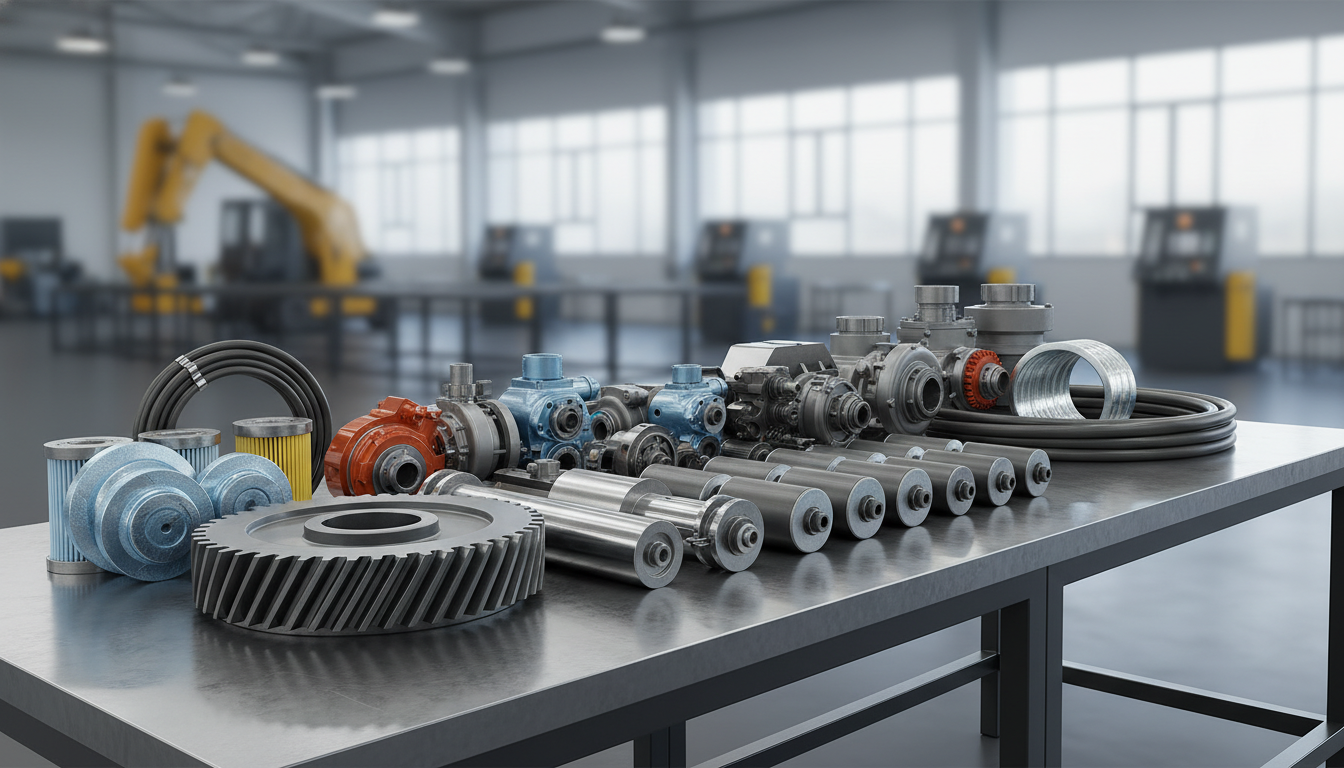
this type of parts are the replacement components that sustain every piece of heavy machinery on a mine site, from a Metso jaw crusher to a Caterpillar 797F haul truck. Every machine depends on a continuous supply of parts to maintain safety, productivity, and regulatory compliance. These parts fall into three broad categories.
Wear Parts vs. Mechanical Parts vs. Consumables
- Wear parts are components that sacrifice themselves to protect the main machinery: crusher liners, mill liners, screen media, bucket teeth, and haul truck bed liners. They are replaced on planned intervals based on tonnage processed or hours of operation.
- Mechanical parts include bearings, seals, hydraulic cylinders, gearboxes, pumps, and structural elements like frames and booms. Failure often arrives without warning and causes immediate, unscheduled downtime.
- Consumables are items like filters, lubricants, drill bits, and cutting edges that are consumed rapidly during regular operation.
According to Grand View Research’s global mining equipment market analysis, demand for high-efficiency machinery continues to grow, which directly fuels the need for a reliable supply of spare parts. Mines that stock the right mining equipment spare parts and manage them proactively reduce unplanned downtime compared to those that order reactively. The financial difference between a planned change-out and an emergency repair can easily reach $50,000 or more per incident once lost production is factored in.
OEM vs. Aftermarket vs. Refurbished: Which Parts Are Right for You?
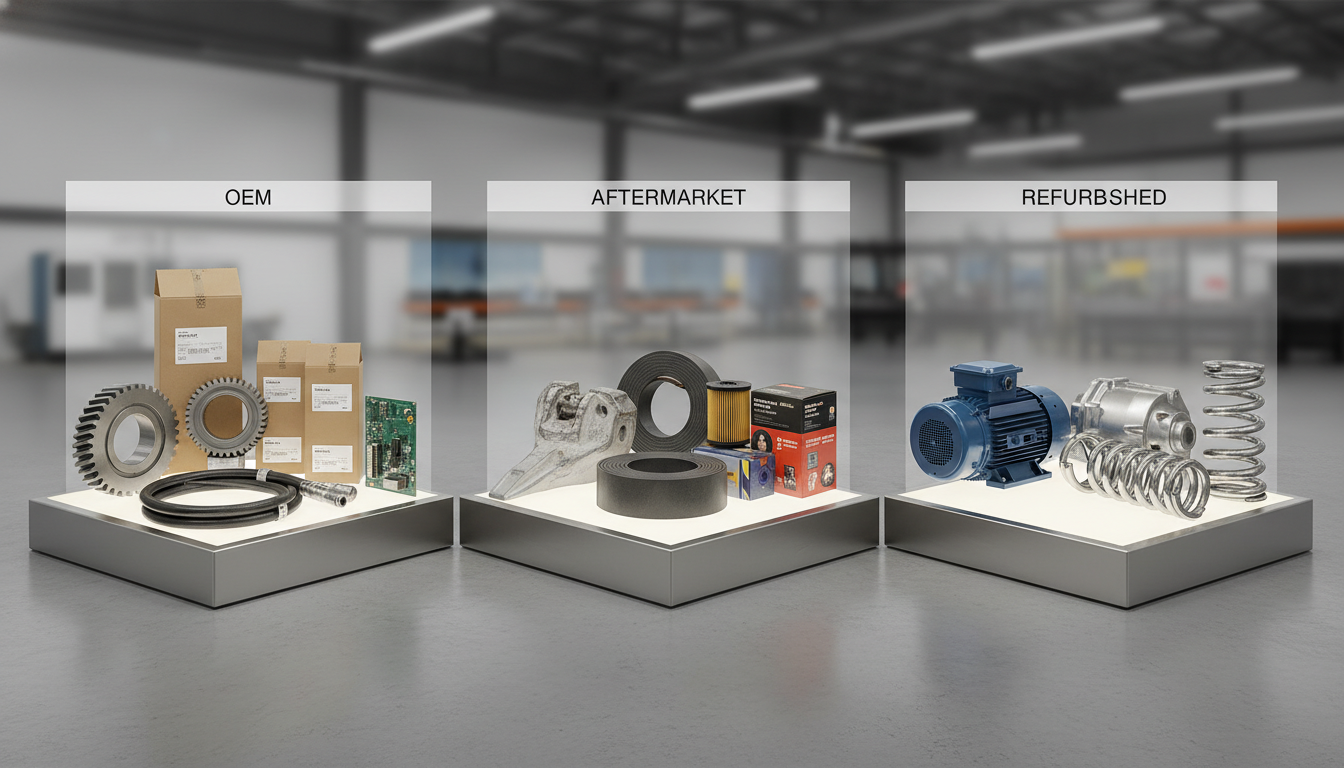
Choosing between OEM, aftermarket, and refurbished mining equipment spare parts is the single most consequential procurement decision you will make. Each path offers distinct trade-offs in cost, lead time, and service life.
| Criteria | OEM Parts | Aftermarket Parts | Refurbished Parts |
|---|---|---|---|
| Source | Original equipment manufacturer (e.g., Metso, Caterpillar, Komatsu) | Independent producers engineered to OE spec | Used components inspected, repaired, and recertified |
| Quality & Fit | Guaranteed 100% fit and original material grades | Varies by supplier; look for ISO 9001-certified facilities | Qualified to at least 50% remaining service life (per RMS Mining Solutions standard) |
| Lead Time | May be longer for legacy models; stock depends on manufacturer | Often shorter with large distributors like Mining Element (130,000+ catalogue positions) | Shorter if the core is already rebuilt; otherwise depends on rebuild cycle |
| Warranty | Full factory warranty (typically 6-12 months) | Supplier warranty (varies, usually 6-12 months) | Limited warranty on workmanship and remaining life |
| Cost vs. OEM | 100% baseline | Typically 40-80% of OEM price | 30-70% of new OEM price, depending on remaining life |
OEM parts from Metso and Sandvik are the safest choice for critical high-speed assemblies where failure risk is unacceptable. Metso, for example, supplies OEM spare parts across crushers, mills, slurry pumps, and apron feeders, with full traceability back to original design specifications. For many wear and structural applications, though, high-quality aftermarket components from ISO 9001-certified suppliers deliver equivalent performance at a meaningfully lower cost. Refurbished parts are ideal for older machinery or emergency situations when new parts are unavailable. RMS Mining Solutions warehouses over 80,000 refurbished and surplus parts and certifies a minimum 50% remaining service life on every component it ships.
Pros and Cons of Each Spare Parts Category
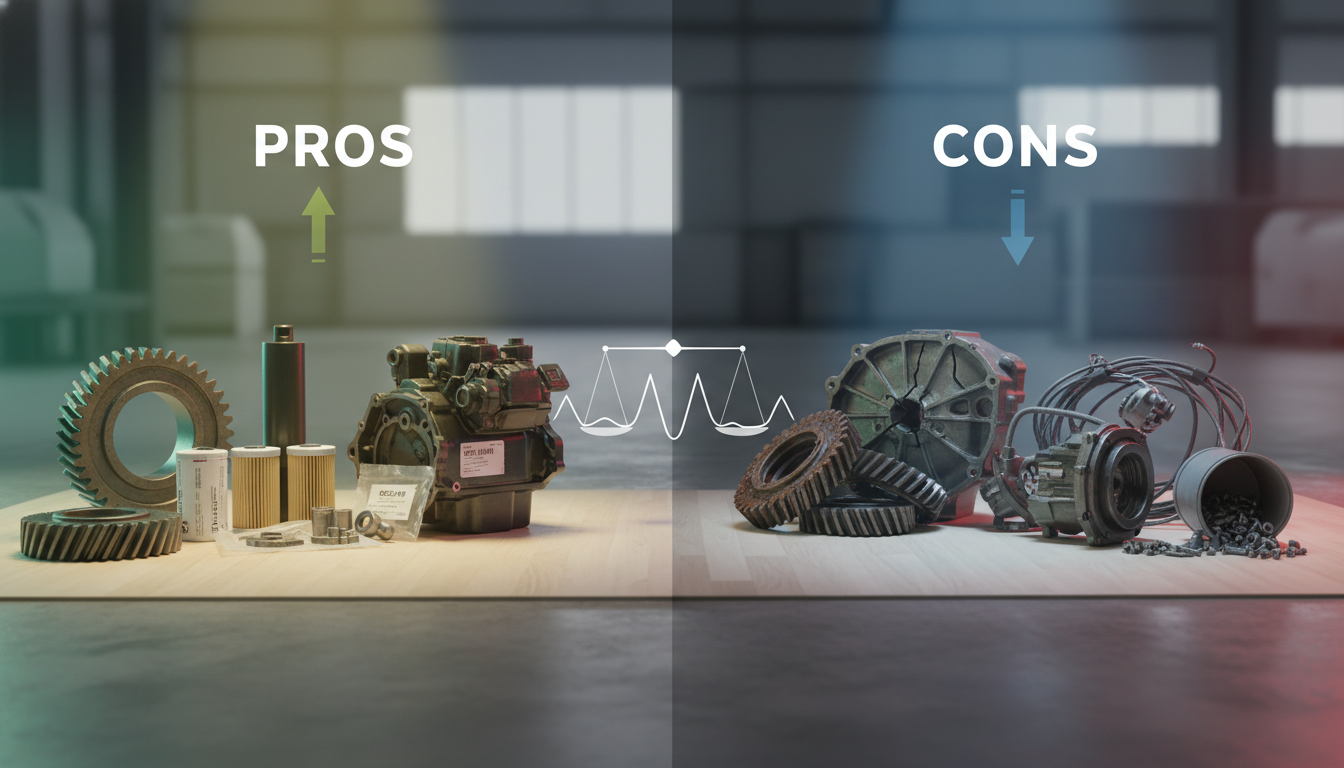
Pros
- OEM parts provide guaranteed fit, full factory warranty, and complete material traceability, which is critical for safety-critical assemblies.
- Aftermarket parts from ISO 9001-certified suppliers like Mining Element can be re-engineered to extend service life or reduce component weight, often improving on the original design for specific duty cycles.
- Refurbished parts reduce procurement costs by 30-70% compared to new OEM pricing and are available immediately when new stock is on back-order.
- Suppliers like Boundary Equipment offer on-site manufacture and repair services for Caterpillar, Komatsu, Bucyrus Erie, Hitachi, O&K, and P&H shovels and drills, reducing the need to ship large components off-site.
Cons
- OEM parts carry the highest upfront cost and can have extended lead times for legacy or discontinued models.
- Aftermarket parts vary significantly in quality. Without ISO certification and dimensional inspection reports, you risk premature failure and voided equipment warranties.
- Refurbished parts require careful vetting. A component certified to 50% remaining life may not be appropriate for a high-cycle, safety-critical application where failure consequences are severe.
- Used or dismantled equipment sourcing, while cost-effective for some applications, introduces uncertainty around component history and remaining fatigue life.
What to Look For When Buying Mining Equipment Spare Parts
Evaluating a mining equipment spare parts supplier requires more than comparing price lists. Assess these five criteria before placing any order.
- Material certifications. Request mill test reports for structural parts and high-stress components. Verify alloys match the OEM specification, especially in crusher wear parts where manganese content directly affects work-hardening performance.
- Dimensional accuracy. Ask for a quality inspection report. Aftermarket parts should be reverse-engineered from OEM-drawn geometry, not just dimensional scans. Even minor deviations in fit can accelerate wear or cause catastrophic failure.
- Surface treatments and heat treatment records. Hardfacing, induction hardening, or carburizing must match the original design. Reputable suppliers like Mining Element re-engineer components to customer duty cycles, often improving surface hardness over OEM grades.
- Packaging and preservation. Bearings, seals, and electronic components require climate-controlled packaging and rust-preventive coatings. Parts stored without proper preservation may already be damaged before installation.
- Supplier logistics and support. Does the supplier maintain consignment stock near your mine? Can they ship to remote sites within 48 hours? 3GEN Export maintains a global logistics network specifically designed for open-pit and underground operations across the Americas, Africa, and Asia.
Price ranges vary widely. Standard wear liners for a cone crusher typically run $500-$5,000 depending on size and material grade. A replacement hydraulic cylinder for a Komatsu 830E haul truck costs $20,000-$80,000 new, or $8,000-$30,000 refurbished. Always request a bundled quote across multiple SKUs to secure volume discounts. Our team at 3GEN Export routinely helps procurement managers consolidate orders to reduce per-unit freight costs significantly.
Hydraulic System Components: A Closer Look
Hydraulic system failures account for a significant share of unplanned downtime across mining fleets, making hydraulic spare parts a priority category for any maintenance supervisor. Beyond cylinders, a complete hydraulic parts strategy covers hydraulic pumps, control valves, hydraulic motors, hose assemblies, accumulators, and filtration units.
Each component has its own failure signature. Hydraulic pumps typically show declining pressure output before full failure, giving maintenance teams a warning window of days to weeks. Control valves and solenoids tend to fail more abruptly. Hose assemblies in high-vibration environments, such as those on Caterpillar 785 or Komatsu 730E haul trucks, should be inspected at every planned service interval and replaced proactively rather than reactively. According to OEM service bulletins from both Caterpillar and Komatsu, hydraulic fluid contamination above ISO cleanliness code 18/16/13 accelerates pump and valve wear significantly. Maintaining clean fluid and replacing filtration elements on schedule is the single highest-return maintenance action in any hydraulic system.
“In mining, where downtime has significant financial implications, proactive maintenance practices are essential. The cost of a planned parts replacement is almost always a fraction of the cost of an unplanned failure.” – Industry maintenance engineering consensus, referenced across multiple OEM service guidelines
Total Cost of Ownership: The Real Price of Spare Parts
Upfront price tells only a fraction of the story for any mining equipment spare parts purchase. Total cost of ownership (TCO) includes installation labor, production lost during downtime, fuel or power penalties from inefficient parts, and disposal costs. Use this three-step TCO framework before every major parts decision.
- Calculate the cost of downtime. If an unplanned stop costs your mine $20,000 per hour, a $5,000 part that ships in three days may be more expensive in total than a $10,000 part delivered within 24 hours.
- Factor in service life. A wear part that lasts 20% longer can justify a 30 percent higher purchase price if it reduces change-out frequency and associated labor costs.
- Include freight and inventory carrying costs. Holding safety stock ties up capital. Suppliers that offer consignment stock or just-in-time delivery reduce working capital requirements and free up cash for other operational priorities.
As a practical example: an iron ore operation that switched from lowest-cost screen panels to a co-engineered aftermarket solution increased panel life by 40 percent and cut annual freight costs by 25 percent, delivering a net saving of over $200,000 per screen deck annually. Work with a supplier that understands TCO and can provide field performance data to support their claims.
Logistics and Lead Time: Getting Parts to Remote Mine Sites
Mine sites in the Atacama Desert, the Canadian Shield, or the Pilbara share one challenge: distance from major supply hubs. Delays in receiving mining equipment spare parts ripple directly into lost production shifts. A reliable export-oriented supplier must offer the following.
- Regional warehouses. Proximity to mining clusters cuts transit time sharply. Haladjian Minerals Solutions, for instance, operates a parts hub in France serving African and European mines and provides stock management assistance for Metso and Sandvik parts. 3GEN Export leverages its global logistics network to serve clients across the Americas, Africa, and Asia with typical delivery windows of 3-7 days by air freight.
- Expedited freight options. Air freight for critical components and sea freight for planned stock replenishments. The right supplier offers both and helps you choose based on urgency and cost.
- Digital inventory access. A supplier with a live online catalog lets procurement teams check stock levels and place orders around the clock, reducing the lag between identifying a need and placing an order.
- Customs expertise. Correct HS codes and documentation prevent border delays. This is especially important for shipments moving under preferential tariff programs or into markets with complex import regulations.
Before committing to a new supplier, conduct a trial order to test their shipping speed, documentation quality, and communication responsiveness. A supplier that performs well on a $2,000 test order will almost certainly perform well on a $200,000 emergency shipment.
“Procurement teams that treat logistics capability as a primary supplier selection criterion, not an afterthought, consistently achieve lower total parts costs than those that focus on unit price alone.” – Based on supply chain best practices documented in SAE International procurement guidelines for heavy equipment operations
Care and Maintenance: Extending the Life of Your Parts
Even the best mining equipment spare parts fail prematurely if stored or installed incorrectly. Good maintenance habits protect your investment and extend service intervals across your entire fleet.
- Store bearings and seals in their original packaging, in a dry, vibration-free environment. Contamination is the leading cause of early bearing failure, according to bearing manufacturer technical guidelines.
- Rotate stock using first-in, first-out logic. This is especially critical for rubber and polyurethane parts that degrade with age regardless of whether they have been installed.
- Follow OEM torque and alignment procedures during installation. Misaligned gearboxes or improperly tensioned V-belts destroy new components within days of installation.
- Track part history digitally. Use CMMS software to record every spare part’s install date, run hours, and inspection notes. This data feeds better forecasting and helps identify counterfeit or sub-standard components before they cause failures.
Suppliers like Boundary Equipment and Mining Element often provide installation guidance and field service support, reducing the risk of installation errors. Regularly communicating with your parts provider about observed failure modes can also lead to design improvements that extend service life across your entire fleet. As of 2026, more suppliers are offering digital failure analysis reports as a standard part of their after-sales service, which is worth requesting when evaluating new vendors.
Used and Dismantled Equipment as a Parts Source
Used or dismantled mining equipment is an often-overlooked source of spare parts, particularly for older or discontinued models where new OEM stock is no longer available. Purchasing a dismantled Caterpillar 793 or Komatsu 930E for parts can yield dozens of serviceable components at a fraction of new replacement cost.
The key risk is component history. Unlike a certified refurbished part from RMS Mining Solutions, a component pulled from dismantled equipment may have unknown run hours, undocumented repairs, or hidden fatigue damage. Always request maintenance records, inspect critical components with NDT (non-destructive testing) methods before installation, and limit this sourcing strategy to lower-criticality applications or genuine emergency situations. For structural and safety-critical parts, certified new or refurbished components remain the responsible choice.
Frequently Asked Questions
What are the most commonly replaced mining equipment spare parts?
Hydraulic cylinders, bearings, crusher wear liners, conveyor belt components, drill bits, and engine filters are among the most frequently replaced components across most mining fleets. The specific list depends on your equipment mix and operating conditions, but stocking these categories proactively prevents the majority of unexpected downtime events.
How do I know if an aftermarket part will fit my machine?
Reputable aftermarket suppliers reverse-engineer parts from OEM-drawn specifications and typically include a fitment guarantee. Always verify that the part number cross-references to your specific machine model and serial number range. For critical fits, request dimensional inspection reports before installation.
Are refurbished mining equipment spare parts safe to use?
Yes, when sourced from a certified rebuilder. Companies like RMS Mining Solutions disassemble, clean, repair, and test each component, certifying a minimum 50 percent remaining service life before shipment. Always request the inspection report and ask about core return options if your existing part is rebuildable.
How long does it take to ship mining spare parts internationally?
Standard sea freight typically takes 4-8 weeks depending on origin and destination. Air freight delivers in 3-7 days for most international routes. Suppliers like 3GEN Export offer expedited air freight for emergency orders and maintain consignment stock in key regions to reduce lead times to 24-48 hours for stocked items.
Which is cheaper in the long run: OEM or aftermarket?
Total cost of ownership analysis consistently shows that aftermarket parts from ISO 9001-certified suppliers often deliver 20-40 percent lower overall costs when you account for purchase price, service life, and installation labor. For high-risk, non-redundant components, however, the reliability assurance of OEM parts may outweigh the initial price difference.
What certifications should I look for in a mining parts supplier?
ISO 9001:2015 certification is the minimum standard for quality management systems. For structural parts, ASTM or EN material standards apply. Leading suppliers also hold ISO 14001 (environmental management) and ISO 45001 (occupational health and safety) certifications, which reflect a mature and accountable manufacturing operation.
Ready to source OEM-quality mining equipment spare parts with fast global delivery? Shop our full catalog and get a consolidated quote at 3genexport.com, where our team ships to mine sites across 60+ countries with typical air freight delivery in 3-5 business days.