
B2B Construction Parts Marketplace: Buying Guide 2026
A b2b construction parts marketplace connects buyers with OEM-quality parts fast. Compare top platforms, pricing tiers, and selection criteria for 2026.
Loading article…
Article Not Found
The article you're looking for doesn't exist or may have been removed.
Back to BlogKey Takeaways
- A B2B construction parts marketplace connects procurement teams directly with verified suppliers, cutting lead times and overhead costs.
- As of 2026, only 20% of building materials and construction companies have adopted digital procurement platforms, according to OroCommerce industry data.
- Evaluate platforms on inventory visibility, ERP integration, quote workflows, and vendor reliability before committing.
- Mobile ordering and self-service portals reduce routine purchasing calls and free your team for higher-value work.
- OEM-quality parts with verified compatibility data are non-negotiable for heavy equipment fleets operating in construction, mining, and energy sectors.
- 3GEN Export ships OEM-standard spare parts globally with 5-day delivery, serving Caterpillar, Komatsu, Volvo, Atlas Copco, and 40+ brands.
B2B Construction Parts Marketplace: A Buying Guide for 2026
A b2b construction parts marketplace is an online platform that connects industrial buyers directly with verified suppliers of heavy equipment spare parts, construction materials, and OEM-grade components at scale.
Understanding B2B Construction Parts Marketplaces
A construction parts marketplace is a digital procurement channel built specifically for the complexity of industrial buying: layered account structures, bulk pricing, RFQ workflows, and compatibility requirements that generic retail platforms cannot handle. According to OroCommerce industry data, 80% of building materials sales still run offline, meaning the majority of procurement teams are leaving real efficiency gains on the table.
What Is a B2B Marketplace?
A B2B marketplace is a digital platform where businesses buy and sell products or services at volume. In construction and heavy equipment, these platforms focus on spare parts, structural materials, tools, and capital equipment. The key difference from consumer platforms: pricing is negotiated, accounts are tiered, and orders are tracked against project budgets rather than individual transactions.
Why Digital Procurement Matters in 2026
The construction sector is under pressure from material shortages, project delays, and tighter margins. Digital procurement platforms address all three by centralizing supplier data, automating quote requests, and giving buyers real-time inventory visibility. As OroCommerce notes, only 20% of construction companies have adopted eCommerce procurement solutions, which means early adopters hold a clear competitive advantage this year.
"Before, every invoice or price update meant another call or email. Now our customers just log in and find it themselves." - Kevin Pearson, Project Manager, UFP Industries (via OroCommerce)
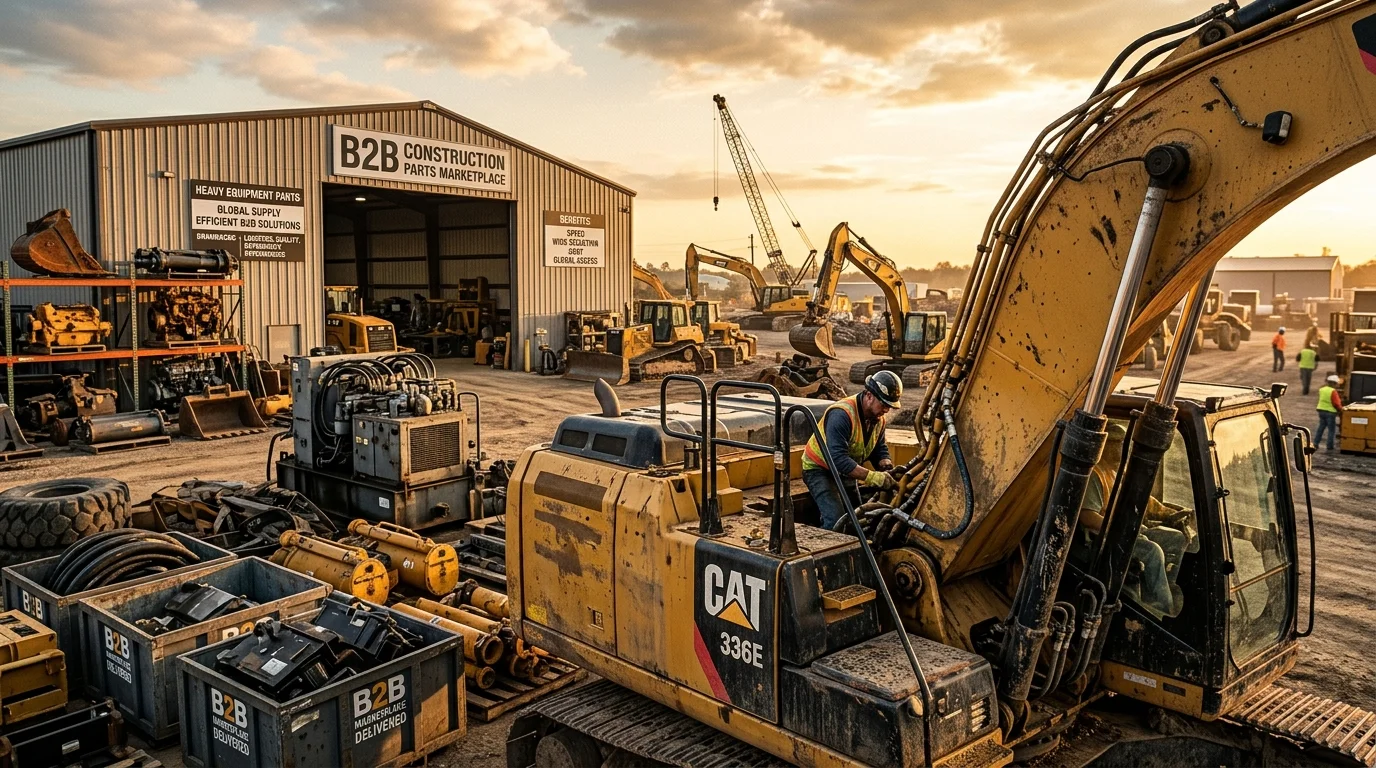
Benefits and Drawbacks of Using a Construction Parts Marketplace
Pros
- Direct supplier access: Bypass distributors and negotiate pricing directly with manufacturers or authorized dealers.
- Time savings: Automated RFQ workflows and online catalogs replace hours of phone-based sourcing. AMAST users report receiving multiple bids within hours of submitting a project shopping list.
- Wider product range: Platforms like AMAST list over 300,000 SKUs across over 400 vendors, giving buyers genuine choice without managing dozens of supplier relationships manually.
- Real-time inventory visibility: Know what's in stock before you order, reducing project delays caused by parts shortages.
- Mobile ordering: Field teams can place orders from site using smartphone apps, scanning product codes to build accurate purchase lists.
- Competitive pricing: According to AMAST user data, contractors have received bids averaging a 12% discount compared to standard pricing when using competitive quote requests.
Cons
- Platform fees: Some marketplaces charge listing fees, transaction fees, or subscription costs that erode savings on smaller orders.
- Variable vendor quality: Open marketplaces may include unvetted suppliers. OEM-standard parts require verified sourcing to ensure compatibility and safety.
- Integration complexity: Connecting a marketplace to your existing ERP (SAP, Oracle, Ariba) takes time and technical resource upfront.
- Return policy inconsistency: Policies vary by vendor. Industrial parts often have strict return conditions, especially for custom or serialized components.
- Learning curve: Teams accustomed to offline procurement need training to use digital platforms effectively.
What to Look For in a Construction Parts Marketplace
Not every platform is built for heavy industrial procurement. Here are the criteria that separate capable platforms from generic directories.
OEM Compatibility Data
For heavy equipment spare parts, compatibility is everything. A platform must provide detailed part specifications, OEM cross-reference numbers, and equipment model compatibility. A seal kit listed without a CAT or Komatsu part number is a liability, not a solution. Look for platforms that centralize specs, safety documents, and technical attributes so your team can buy with confidence without calling support.
Inventory Management
Effective inventory management tools let procurement teams track stock levels in real-time, reducing the risk of shortages and overstocking. Cloudfy's platform, for example, includes built-in inventory management that lets suppliers set thresholds, support back-ordering, and send automatic restock notifications. For buyers, this means fewer surprise delays mid-project.
Pricing Structures and Trade Accounts
Industrial procurement requires more than a price tag. Look for platforms that support trade pricing, volume discounts, project-based pricing, and custom catalogs for different account tiers. The best platforms show each buyer their own pricing, promotions, and payment terms rather than a one-size-fits-all rate card.
ERP and E-Procurement Integration
If your business runs SAP, Oracle, or a similar ERP, the marketplace must integrate cleanly. Platforms like OroCommerce and Cloudfy offer API-first architecture and out-of-the-box connections to procurement tools like SAP Ariba and Coupa. This keeps order data, inventory counts, and invoicing synchronized without manual re-entry.
Quote and Approval Workflows
Complex B2B purchases require multi-level approvals. A capable platform handles RFQ creation, revision tracking, and approval routing digitally, so nothing falls through the cracks on large or time-sensitive orders.
Vendor Verification and Quality Assurance
Open marketplaces carry risk. Prioritize platforms that vet their supplier network or, better still, source directly from manufacturers and authorized distributors. For OEM-standard parts, this is non-negotiable: a counterfeit hydraulic seal or underspec'd filter element can cause catastrophic equipment failure.
How to Choose the Right Platform for Your Operation
The right platform depends on what you're buying, how often, and at what volume. Here's how to match platform type to procurement need.
For Spare Parts and Heavy Equipment Components
If your priority is sourcing OEM-quality spare parts for Caterpillar, Komatsu, Volvo, or Atlas Copco equipment, you need a specialist supplier with verified compatibility data and global logistics capability. Generic construction marketplaces rarely carry serialized components or hydraulic system parts with the technical depth required. A dedicated parts supplier like 3GEN Export provides OEM-standard components across 40+ brands with documented compatibility and 5-day global delivery.
For Construction Materials at Volume
If you're sourcing structural materials, safety equipment, or consumables for a large project, a broad marketplace like AMAST (over 300,000 SKUs, over 400 vendors) or DirectIndustry (550,000 industrial products, 2.7 million monthly visitors) gives you the vendor breadth to run competitive quote processes and find local or regional suppliers quickly.
For Surplus and Liquidation Stock
Platforms like OffloadIt serve contractors looking to buy or sell excess materials and used equipment. This is useful for clearing project leftovers or finding cost-effective materials for non-critical applications. It is not the right channel for OEM-grade spare parts where traceability and quality certification matter.
For Enterprise Procurement Teams
Large operations with complex account hierarchies, multi-branch purchasing, and ERP dependencies need a platform built for that complexity. OroCommerce and Cloudfy both offer purpose-built B2B eCommerce infrastructure with CPQ, project management, and contractor storefronts. These are platform investments, not simple marketplaces.
Step-by-Step Process for Buying Construction Parts
- Identify your needs: Determine the specific parts, materials, or tools required. For equipment parts, note the OEM part number, equipment model, and serial number range.
- Research platforms: Match the platform type to your procurement need using the criteria above.
- Verify vendor credentials: Check supplier authorization status, quality certifications, and customer reviews before requesting quotes.
- Compare vendors: Evaluate suppliers on pricing, lead time, stock availability, and return policy. Request quotes from multiple vendors simultaneously.
- Request quotes: Use the platform's RFQ tools to submit your requirements. Include quantities, delivery location, and required delivery date.
- Place your order: Once you've confirmed pricing, compatibility, and lead time, place the order through the platform and confirm payment terms.
- Track your order: Use the platform's tracking tools to monitor shipment status. For international orders, confirm customs documentation is included.
Comparison of Top B2B Construction Marketplaces
| Platform | Best For | Key Features | Vendor / Product Scale | Notable Strength |
|---|---|---|---|---|
| 3GEN Export | OEM spare parts, heavy equipment | OEM-standard parts, global shipping, 40+ brands | Caterpillar, Komatsu, Volvo, Atlas Copco +40 | 5-day global delivery, verified compatibility |
| OroCommerce | Enterprise construction eCommerce | CPQ, RFQ, project management, ERP integration | Platform (not a marketplace) | Full B2B commerce infrastructure |
| AMAST | Construction materials, local sourcing | Quote requests, vendor comparison, mobile app | Over 400 vendors, over 300,000 SKUs | Competitive bidding, 12% avg discount reported |
| Cloudfy | Mid-to-large construction suppliers | Mobile ordering, ERP integration, custom catalogs | Varies by deployment | Ariba/Coupa punchout, barcode scanning |
| DirectIndustry | Industrial product sourcing | Product catalogs, RFQ, e-magazine | 550,000 products, 2.7M monthly visitors | Broad industrial coverage |
| OffloadIt | Surplus materials, used equipment | Free listings, no commissions, local reach | 4,870+ active listings | Zero-fee model for contractors |
Price Range Guidance for Construction Parts Procurement
Pricing in industrial procurement varies widely depending on part type, brand, and sourcing channel. Here's a practical framework for setting budget expectations.
Budget Tier: Surplus and Aftermarket
Surplus marketplaces like OffloadIt list construction materials and tools across a wide range, from small consumables to structural components. This channel suits non-critical materials where traceability is less important. For OEM spare parts, aftermarket alternatives can reduce unit cost but require careful vetting to confirm they meet manufacturer specifications.
Mid-Range Tier: Verified Aftermarket and OEM-Equivalent
OEM-equivalent parts from authorized distributors offer a balance of cost and quality. These parts meet manufacturer specifications and carry warranty coverage, but are priced below direct OEM list price. This is the most common tier for fleet maintenance teams managing operating costs without compromising equipment reliability.
Premium Tier: Genuine OEM Parts with Full Traceability
Genuine OEM parts from authorized sources carry full traceability, manufacturer warranty, and guaranteed compatibility. For critical systems, including hydraulics, powertrain, and undercarriage, this is the only defensible choice. Downtime on a mining or construction site costs far more than the price difference between OEM and a cheaper alternative. At 3GEN Export, we supply OEM-standard parts across this tier for Caterpillar, Komatsu, Volvo, and 40+ brands with full documentation.
"Supply chain disruptions are still a big challenge for construction businesses. Sharing accurate views of stock levels in near real time encourages customers to place their orders." - Cloudfy, B2B eCommerce Platform for the Construction Industry
Care and Maintenance of Construction Parts
Proper maintenance extends part life, protects equipment warranties, and keeps your fleet operational. These practices apply whether you're managing a single excavator or a multi-machine fleet across multiple sites.
- Regular inspections: Check wear components, seals, and filters before each shift. Catching early-stage wear prevents catastrophic failure and unplanned downtime.
- Follow OEM service intervals: Manufacturer service bulletins define replacement intervals for filters, fluids, and wear parts. Deviating from these intervals voids warranties and increases failure risk.
- Proper storage: Store spare parts in a dry, climate-controlled environment. Seals and rubber components degrade rapidly in UV exposure or temperature extremes.
- Use OEM-compatible fluids: Hydraulic systems are particularly sensitive to fluid specification. Using non-approved fluids can damage seals and void OEM warranty coverage.
- Document everything: Maintain a parts log with installation dates, part numbers, and service intervals. This data is essential for warranty claims and fleet lifecycle planning.
Pro Tip: When ordering replacement seals or filters for Caterpillar or Komatsu equipment, always cross-reference the OEM part number against your equipment serial number. Part specifications can change across production runs, and ordering by model alone can result in incompatible components.
What to Expect: The 2026 Outlook for Digital Construction Procurement
The shift to digital procurement in construction is accelerating. Platforms are adding AI-assisted quote matching, real-time logistics tracking, and deeper ERP integrations. For procurement managers, this means faster sourcing cycles and better price transparency across the supply chain.
The gap between digitally-enabled buyers and those still relying on phone-based procurement is widening. Teams that establish reliable digital supplier relationships now, including verified OEM parts suppliers with global logistics capability, will be better positioned to manage project timelines and cost targets as market conditions tighten.
For heavy equipment fleets specifically, the priority is supplier reliability over platform novelty. A marketplace with 300,000 SKUs is only useful if the parts are genuine, compatible, and delivered on time. That's the standard we hold ourselves to at 3GEN Export.
Frequently Asked Questions
What should I consider when choosing a B2B construction marketplace?
Prioritize OEM compatibility data, vendor verification, ERP integration capability, and quote workflow tools. For heavy equipment spare parts specifically, confirm that the supplier provides OEM part numbers, equipment model compatibility, and documented quality standards. Pricing structure and return policy should also be reviewed before committing to a platform.
How do I ensure I get the best price on construction parts?
Submit RFQs to multiple vendors simultaneously and compare total landed cost, including shipping, duties, and lead time, not just unit price. Platforms like AMAST report that competitive bidding has delivered an average 12% discount for contractors compared to standard pricing. For OEM parts, balance cost against quality risk: a cheaper part that causes equipment failure costs far more than the savings.
Can I return items purchased through a B2B marketplace?
Return policies vary by marketplace and vendor. For industrial spare parts, many suppliers have strict return conditions, particularly for serialized components, hydraulic parts, or items that have been installed. Always confirm the return policy in writing before placing a large order, and check whether restocking fees apply.
Are there fees associated with using a B2B construction marketplace?
Fee structures vary significantly. Some platforms charge suppliers listing or transaction fees, which may be passed to buyers through pricing. Others operate on subscription models. Review the fee structure carefully and factor it into your total cost of procurement. Platforms like OffloadIt operate with no listing fees or commissions for contractors.
How do I verify that parts are genuine OEM quality?
Request documentation: OEM part numbers, manufacturer certificates of conformance, and supplier authorization letters. Reputable suppliers will provide these without hesitation. At 3GEN Export, every part ships with full compatibility documentation and OEM-standard quality assurance across Caterpillar, Komatsu, Volvo, Atlas Copco, and 40+ brands.
How can I track orders placed through a construction parts marketplace?
Most capable platforms provide real-time order tracking within the buyer portal. For international shipments, confirm that the supplier provides shipment tracking numbers, customs documentation, and estimated delivery windows. At 3GEN Export, we provide tracking and logistics support for all global orders, with standard delivery in 5 days to most destinations.
What if I have a dispute with a vendor?
Contact the marketplace's customer support team first. Most platforms have dispute resolution processes that can mediate between buyer and vendor. For parts quality disputes, document the issue with photos and part numbers before initiating a claim. Choosing suppliers with clear quality guarantees and responsive support reduces the likelihood of disputes reaching this stage.
Ready to source OEM-quality spare parts for your fleet? Shop verified components for Caterpillar, Komatsu, Volvo, Atlas Copco, and 40+ brands with global 5-day delivery at 3genexport.com.