
B2B Heavy Equipment Parts Platform Guide 2026
A b2b heavy equipment parts platform connects global buyers with verified OEM suppliers. Compare top platforms, key features, and procurement tips for
Loading article…
Article Not Found
The article you're looking for doesn't exist or may have been removed.
Back to BlogKey Takeaways
- A b2b heavy equipment parts platform is a digital marketplace connecting procurement teams with verified OEM and aftermarket suppliers worldwide.
- Top platforms offer real-time inventory sync, ERP integration, verified supplier networks, and global logistics support.
- Compatibility verification, supplier track records, and return policies are the three factors that matter most when sourcing parts online.
- Platforms like JumboBee operate on a commission-only model with no listing fees, while others like SyncSpider focus on ERP-driven automation for OEMs and distributors.
- Proper storage, routine inspections, and adherence to OEM maintenance schedules extend part life and reduce total cost of ownership.
Introduction
A b2b heavy equipment parts platform is a digital marketplace that connects industrial buyers with verified suppliers of heavy machinery components, streamlining procurement across construction, mining, and energy sectors.
Understanding B2B Heavy Equipment Parts Platforms
A parts platform acts as a centralized procurement hub where fleet managers, maintenance supervisors, and purchasing teams can source OEM and aftermarket components without the friction of traditional phone-and-fax ordering. The shift is real: as buying habits in the heavy-duty parts industry have evolved over the past five years, customer expectations for convenience, speed, and accuracy have pushed suppliers to build self-service digital channels, according to industry commentary from The Heavy Duty Parts Report.
These platforms replace disconnected sales, service, and logistics systems with a single interface. Dealers get real-time access to availability and pricing. Buyers can reorder accessories or spare parts without waiting on a sales rep. That combination cuts lead times and reduces manual entry errors across the supply chain.
"We've finally found a solution. It aggregates data, optimizes workflows, and improves multichannel business management. We no longer need to handle API parameters for each vendor. We've saved countless hours and can focus on what we do best." - Dana D, Owner, This and That Solutions (via SyncSpider case study)
What Is a B2B Heavy Equipment Parts Platform?
A this type of platform is a digital marketplace that allows businesses to connect with suppliers and manufacturers of heavy machinery parts, featuring extensive catalogs, compatibility tools, and order management dashboards. Unlike a general e-commerce site, these platforms are built for industrial complexity: configurable quotes, contract-based pricing per account, ERP synchronization, and multi-location dealer support are standard expectations, not premium add-ons.
Key Features of B2B Platforms
- Inventory Management: Real-time tracking of stock levels pulled directly from ERP or warehouse management systems, so buyers see accurate availability before placing an order.
- Supplier Verification: Vetted supplier networks ensure buyers are transacting with reputable, often ISO-certified sources rather than unknown resellers.
- Contract-Based Pricing: Account-specific pricing models reflect negotiated rates, volume discounts, and warranty terms per buyer type.
- Order Tracking: End-to-end visibility from order confirmation through customs clearance and final delivery.
- Automated Document Handling: Delivery notes, installation instructions, service records, and invoices generated and attached per order automatically.
Benefits of Using a B2B Heavy Equipment Parts Platform
- Global Reach: Access to verified suppliers and buyers across 100+ countries, enabling international sourcing without a dedicated import/export team.
- Cost Efficiency: Side-by-side vendor comparison and bulk pricing options reduce per-unit costs on high-volume orders.
- Reduced Manual Errors: Automated ordering and reordering workflows eliminate the transcription mistakes common in phone and email-based procurement.
- Faster Procurement Cycles: Self-service portals let buyers configure, quote, and order without waiting for a sales rep, compressing procurement timelines significantly.
Top B2B Heavy Equipment Parts Platforms in 2026
As of 2026, the market for heavy equipment procurement has matured into a set of specialized platforms, each serving a distinct buyer profile. Below is a comparison of the leading options based on verified competitor data.
| Platform | Key Features | Target Audience | Strengths |
|---|---|---|---|
| Alibaba | Global marketplace, verified suppliers, trade assurance, bulk pricing | International buyers sourcing at scale | Widest product range, competitive pricing, established trust infrastructure |
| JumboBee | Global logistics, escrow payments, built-in shipping and customs clearance, end-to-end sales tools | Heavy equipment sellers targeting export markets | No listing fees, commission-only model, sells to 100+ countries |
| SyncSpider | ERP and PIM integration, self-service portals, configure-to-order, automated document handling | OEM manufacturers and distributors with dealer networks | Real-time inventory sync, multi-location dealer support |
| IronPlanet | Used machinery auctions, inspection reports, transparent bidding | Buyers of pre-owned heavy equipment | Verified condition reports, established auction infrastructure |
| TradeIndia | Local sourcing, direct buyer-seller interaction, free registration | India-based buyers and sellers | Cost-effective entry point for regional procurement |
| 3GEN Export | OEM-quality spare parts for 40+ brands, global 5-day delivery, B2B procurement focus | Fleet managers, mining and construction procurement teams | Caterpillar, Komatsu, Volvo, Atlas Copco compatibility; direct export expertise |
Pros and Cons of Using a B2B Heavy Equipment Parts Platform
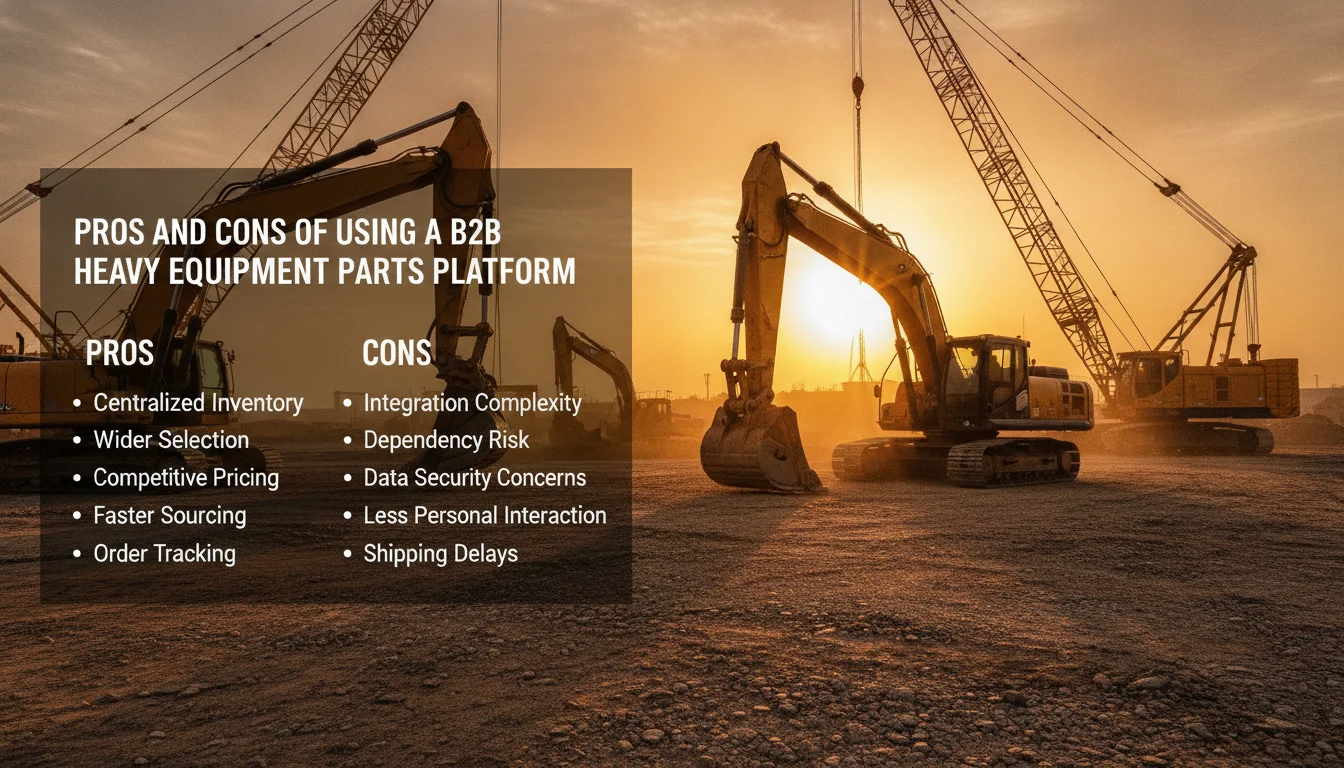
Every procurement channel has trade-offs. Understanding them helps you choose the right platform for your operation rather than defaulting to the most familiar name.
Pros
- Verified supplier networks reduce the risk of counterfeit or substandard parts entering your fleet.
- Real-time inventory visibility prevents ordering delays caused by stock discrepancies between catalog listings and actual warehouse levels.
- Global reach opens sourcing options beyond your local market, often at more competitive prices.
- Automated workflows cut manual processing time on quotes, purchase orders, and invoices.
- Self-service portals let your team reorder standard parts at any hour without waiting on a sales contact.
Cons
- Compatibility risk remains if the platform lacks robust make-model-serial filtering tools for your specific equipment.
- Commission structures on some platforms add cost to every transaction, which compounds on high-volume orders.
- Integration complexity can be significant if your ERP or WMS requires custom API work to connect with the platform.
- Quality variance exists across seller tiers on open marketplaces, making supplier verification a non-negotiable step.
What to Look For When Buying on a B2B Heavy Equipment Parts Platform
The right platform for your operation depends on four practical criteria: part quality standards, compatibility tools, pricing structure, and support responsiveness.
Material and Quality Standards
Confirm that parts meet OEM specifications or recognized industry standards before placing an order. Look for platforms that publish detailed part descriptions, material grades, and applicable equipment models. According to manufacturer specifications from brands like Caterpillar and Komatsu, using non-compliant components can void warranties and accelerate wear on adjacent systems. Platforms that list ISO-certified suppliers or carry OEM-equivalent part numbers give you a verifiable quality baseline.
Fit and Compatibility
Verify compatibility against your equipment's make, model, and serial number range before committing to a purchase. The best platforms include cross-reference tools that map aftermarket part numbers to OEM equivalents. For Caterpillar, Komatsu, Volvo, and Atlas Copco equipment, serial-number-based filtering is the most reliable method. If a platform cannot confirm compatibility at that level of detail, treat it as a risk factor.
"The equipment owners often find it difficult to get spare parts for their machinery from the original equipment manufacturer after the initial warranty expires. These owners often have to rely on aftermarket suppliers." - Avinash Sangurmath, Co-founder, YantraLive (via Constrofacilitator)
Pricing Structure
Evaluate the full cost of transacting on a platform, not just the listed part price. Some platforms charge listing fees to sellers, which get passed through to buyers in the form of higher prices. Others, like JumboBee, operate on a commission-only model with no upfront listing costs. Bulk pricing tiers and contract-based pricing for repeat buyers can reduce per-unit costs on high-volume procurement programs. Always request a landed cost estimate that includes shipping, customs duties, and any platform transaction fees.
Customer Support and After-Sale Service
A responsive support team is not a luxury in industrial procurement. It is a requirement. Order disputes, compatibility questions, and return logistics on heavy components are complex. Prioritize platforms that offer dedicated account management for B2B buyers, clear return and warranty policies, and documented escalation paths for order issues.
How to Optimize Your Heavy Equipment Parts Purchasing Process
Optimizing procurement on a this kind of parts platform requires process discipline, not just platform selection. These three steps consistently reduce downtime and procurement costs for fleet operations.
Step 1: Establish Clear Procurement Guidelines
Define approved supplier tiers, acceptable part grades (OEM, OEM-equivalent, aftermarket), and maximum lead times before your team places a single order. Without documented criteria, purchasing decisions default to whoever responds first rather than whoever offers the best value. Align your guidelines with OEM service bulletin requirements for your specific equipment brands.
Step 2: Use Technology to Manage Inventory and Reorder Points
Integrate your platform of choice with your ERP or inventory management system. Platforms like SyncSpider are built specifically for this: live inventory, pricing, and availability pulled directly from your ERP eliminate the manual reconciliation that causes ordering errors. Set reorder triggers for high-consumption parts like filters, seals, and wear components so you are never sourcing under pressure.
Step 3: Review Supplier Performance Regularly
Assess your active suppliers on a quarterly basis. Track on-time delivery rates, part rejection rates, and response times on order issues. Platforms that provide transaction history and supplier ratings make this review straightforward. Rotate or replace underperforming suppliers before a pattern of delays becomes a fleet availability problem.
Care and Maintenance of Heavy Equipment Parts
Sourcing the right part is only half the equation. How you store, inspect, and maintain components directly affects their service life and your total cost of ownership.
Regular Inspections
Conduct routine visual and functional checks on installed parts to catch wear before it becomes failure. For hydraulic seals, track any sign of weeping or discoloration around cylinder rods. For undercarriage components on Caterpillar and Komatsu excavators, measure track pitch and bushing wear against OEM wear limits. Early detection consistently costs less than emergency replacement.
Proper Storage
Store spare parts in a clean, dry, temperature-controlled environment. Rubber seals and O-rings degrade in UV-exposed or high-humidity storage. Steel components require rust inhibitor treatment if stored for extended periods. Keep parts in original packaging until installation to preserve manufacturer-applied coatings and dimensional tolerances.
Follow OEM Maintenance Schedules
Adhere to the maintenance intervals and procedures specified in your equipment's service manual. According to OEM service bulletins for Caterpillar and Komatsu equipment, skipping scheduled maintenance intervals accelerates wear on connected systems and can void remaining warranty coverage. Using OEM-quality replacement parts at the correct service intervals is the most cost-effective way to extend machine life.
Pro Tip: Keep a digital maintenance log linked to each machine's serial number. When sourcing replacement parts on a B2B platform, your service history gives suppliers the context they need to recommend the correct part grade and specification the first time.
Why 3GEN Export Is Built for B2B Industrial Procurement
We've supplied OEM-quality spare parts for Caterpillar, Komatsu, Volvo, Atlas Copco, and 40+ additional brands since 2006. Our parts catalog covers construction, mining, and energy equipment with global 5-day delivery to most markets. Every part ships with full compatibility documentation and is sourced to OEM specifications.
For procurement teams managing multi-brand fleets across multiple sites, our brand pages provide model-specific part references, cross-reference tools, and direct access to our B2B account team. We handle export documentation, customs compliance, and freight coordination so your team focuses on operations rather than logistics.
This year, we've expanded our inventory depth across undercarriage components, hydraulic seal kits, and filtration systems for the most common Caterpillar and Komatsu excavator models. If you manage a fleet and need a reliable supply partner, shop OEM-quality spare parts with global 5-day delivery at 3genexport.com.
Frequently Asked Questions
Which B2B platform is best for heavy equipment parts?
The best platform depends on your specific procurement needs. For global sourcing at scale, Alibaba offers the widest supplier network. For export sales with built-in logistics, JumboBee provides commission-only listing with shipping and customs support. For OEM-quality parts with guaranteed compatibility across Caterpillar, Komatsu, Volvo, and Atlas Copco equipment, 3GEN Export is purpose-built for B2B industrial procurement with global 5-day delivery.
What are some popular B2B sales platforms for industrial machinery?
As of 2026, the most referenced platforms in the heavy equipment space include Alibaba, JumboBee, SyncSpider, IronPlanet, ThomasNet (North America), and IndiaMART (India). Each serves a different buyer profile: general sourcing, used equipment auctions, ERP-integrated dealer networks, or regional markets. Specialized suppliers like 3GEN Export fill the gap for buyers who need OEM-specification parts with verified compatibility rather than a broad open marketplace.
What is the best B2B portal for manufacturers and OEM distributors?
SyncSpider's B2B portal is specifically designed for OEM machine manufacturers and distributors with dealer networks. It offers ERP and PIM integration, configure-to-order functionality, contract-based pricing per account, and automated document handling. For distributors focused on spare parts supply rather than machine configuration, a dedicated parts supplier with a verified catalog is often more efficient than a general portal.
How do I ensure the quality of parts purchased on a B2B platform?
Source from platforms that list verified suppliers, publish OEM part number cross-references, and provide material specifications for each component. Request documentation confirming the part meets manufacturer specifications before approving a new supplier. For critical systems like hydraulics, undercarriage, and powertrain, insist on OEM-equivalent or OEM-sourced parts rather than unspecified aftermarket alternatives.
Can I return parts if they are not compatible with my equipment?
Most established B2B platforms have return policies, but terms vary significantly. JumboBee uses escrow-based buyer protection. Open marketplaces like Alibaba rely on trade assurance programs. Always confirm the return window, restocking fees, and who bears return freight costs before placing an order. The most reliable way to avoid returns is to use a supplier who verifies compatibility by make, model, and serial number before shipment.