
B2B Heavy Machinery Procurement Platform Guide 2026
A b2b heavy machinery procurement platform connects global buyers with verified suppliers. Compare top platforms, features, and costs for smarter sourcing.
Loading article…
Article Not Found
The article you're looking for doesn't exist or may have been removed.
Back to BlogA b2b heavy machinery procurement platform is an online marketplace where industrial businesses buy, sell, and source heavy equipment and spare parts at scale. As of 2026, the global heavy equipment industry is valued at $580 billion, and digital procurement channels now handle a growing share of that volume.
Key Takeaways
- Selecting the right platform directly affects lead times, supplier quality, and total procurement cost.
- Verified supplier networks and ISO 9001 certification are the two non-negotiable filters for serious B2B buyers.
- According to industry research, B2B companies with advanced digital capabilities outperform peers by 3.5 times in revenue growth and enjoy 27% higher profit margins.
- Machinery Partners, a U.S.-based marketplace, raised $11 million in funding to expand heavy equipment procurement across 35 states and internationally.
- Platform choice should match your sourcing geography: global, regional, or specialist used-equipment markets each require a different tool.
- OEM-quality spare parts with fast global delivery are available at 3genexport.com for Caterpillar, Komatsu, Volvo, and 40+ other brands.
Why Use a B2B Heavy Machinery Procurement Platform?
Using a dedicated procurement platform gives industrial buyers structured access to verified suppliers, competitive pricing, and documented equipment histories that a cold phone call or trade-show visit simply cannot match. Here are the core advantages:
- Global Reach: Connect with suppliers and buyers worldwide, expanding your sourcing options beyond local distributors.
- Cost Efficiency: Compare prices from multiple vendors side by side to secure competitive rates without lengthy RFQ cycles.
- Verified Suppliers: Many platforms offer access to verified or ISO-certified sellers, reducing counterparty risk on high-value orders.
- Wide Product Range: From excavators to CNC machines, a single platform can cover your entire equipment category list.
"Machinery Partner has brought a new approach to heavy machinery procurement designed to support industrial businesses facing labor shortage and needing more specialized equipment." - Clement Cazalot, Co-founder and CEO, Machinery Partners (via Digital Commerce 360, 2024)
Pros and Cons of B2B Heavy Machinery Procurement Platforms
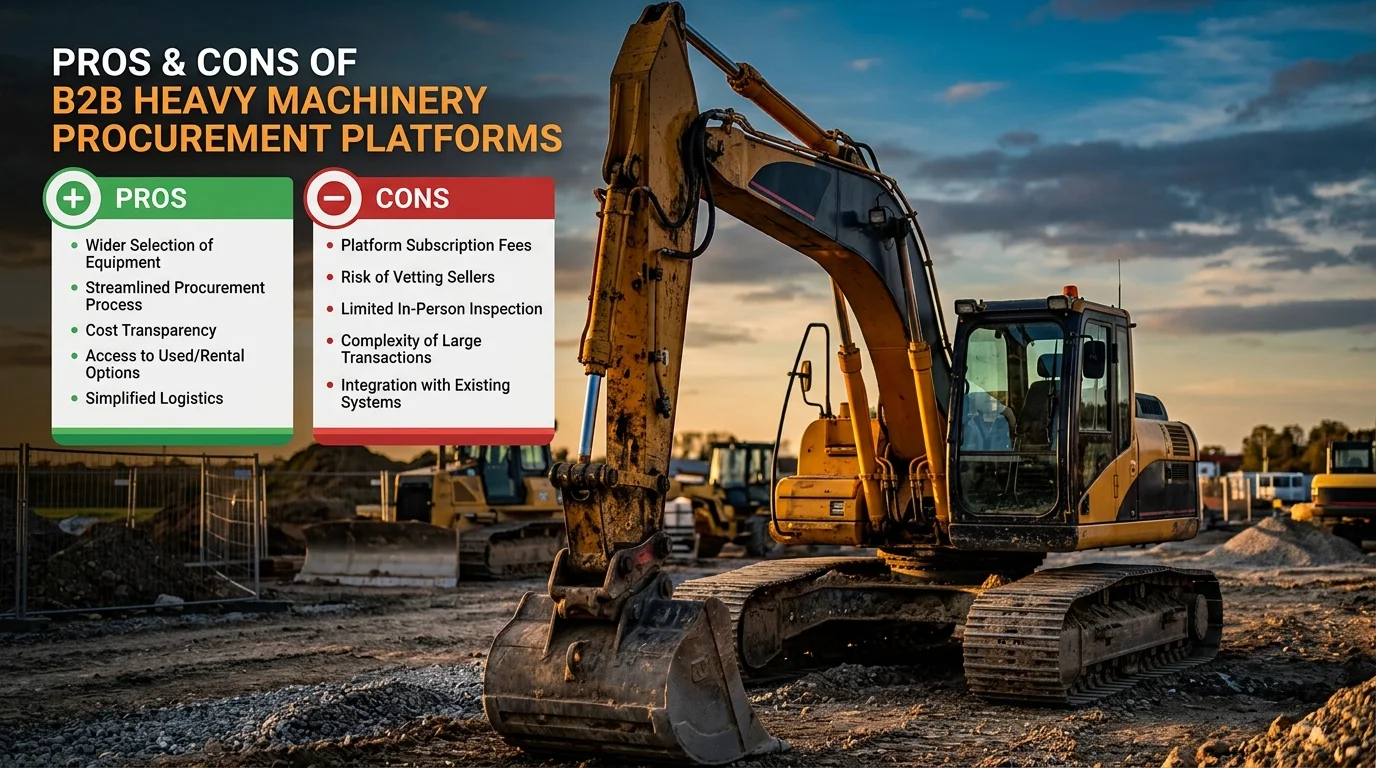
Pros
- Supplier transparency: Verified profiles, ratings, and certification badges reduce the risk of dealing with unqualified vendors.
- Price competition: Multiple suppliers bidding on the same spec drives prices down without requiring a dedicated procurement team to manage the process.
- Speed: Digital RFQ tools and pre-negotiated catalog pricing cut sourcing cycles from weeks to days.
- Documentation: Inspection reports, compliance certificates, and shipping records are stored in one place, simplifying audits.
- Global logistics integration: Leading platforms connect directly with freight forwarders, reducing the coordination burden on your team.
Cons
- Quality variance: Not every listing on an open marketplace meets OEM standards. Buyers must still verify specs independently before committing to large orders.
- Lead time uncertainty: Cross-border shipments from marketplace sellers can carry unpredictable customs delays, especially for oversized equipment.
- Platform fees: Transaction fees, subscription tiers, and trade-assurance premiums add cost that must be factored into total landed price.
- Limited after-sales support: General marketplaces rarely offer the technical support or warranty coverage that a specialist supplier provides.
Top B2B Heavy Machinery Procurement Platforms in 2026
Several platforms stand out in 2026 for their features, user experience, and market reach. The table below compares the leading options across key procurement criteria.
| Platform | Category | Key Features | Best For |
|---|---|---|---|
| Alibaba | Global Marketplace | Verified suppliers, trade assurance, bulk pricing | International sourcing at competitive rates |
| Made-in-China | China-Based Marketplace | Factory-direct prices, multiple language support | Importers seeking Chinese machinery |
| Global Sources | International Marketplace | Verified suppliers, sourcing fairs worldwide | Authentic, high-quality machinery |
| Machinery Partners | U.S. Marketplace | Procurement, financing, support for builders | Construction and agriculture sectors |
| IronPlanet | Used Machinery Marketplace | Auctions, inspection reports | Affordable used equipment |
| ThomasNet | North American Industrial Directory | Manufacturing equipment, parts, custom fabrication | Industrial buyers in North America |
| Kompass | Global Business Directory | Detailed company profiles, B2B matching in 70+ countries | Multi-region supplier discovery |
| 3GEN Export | OEM Spare Parts Specialist | OEM-standard parts, 40+ brands, 5-day global delivery | Fleet maintenance teams needing fast, reliable parts |
What to Look For When Evaluating a Platform
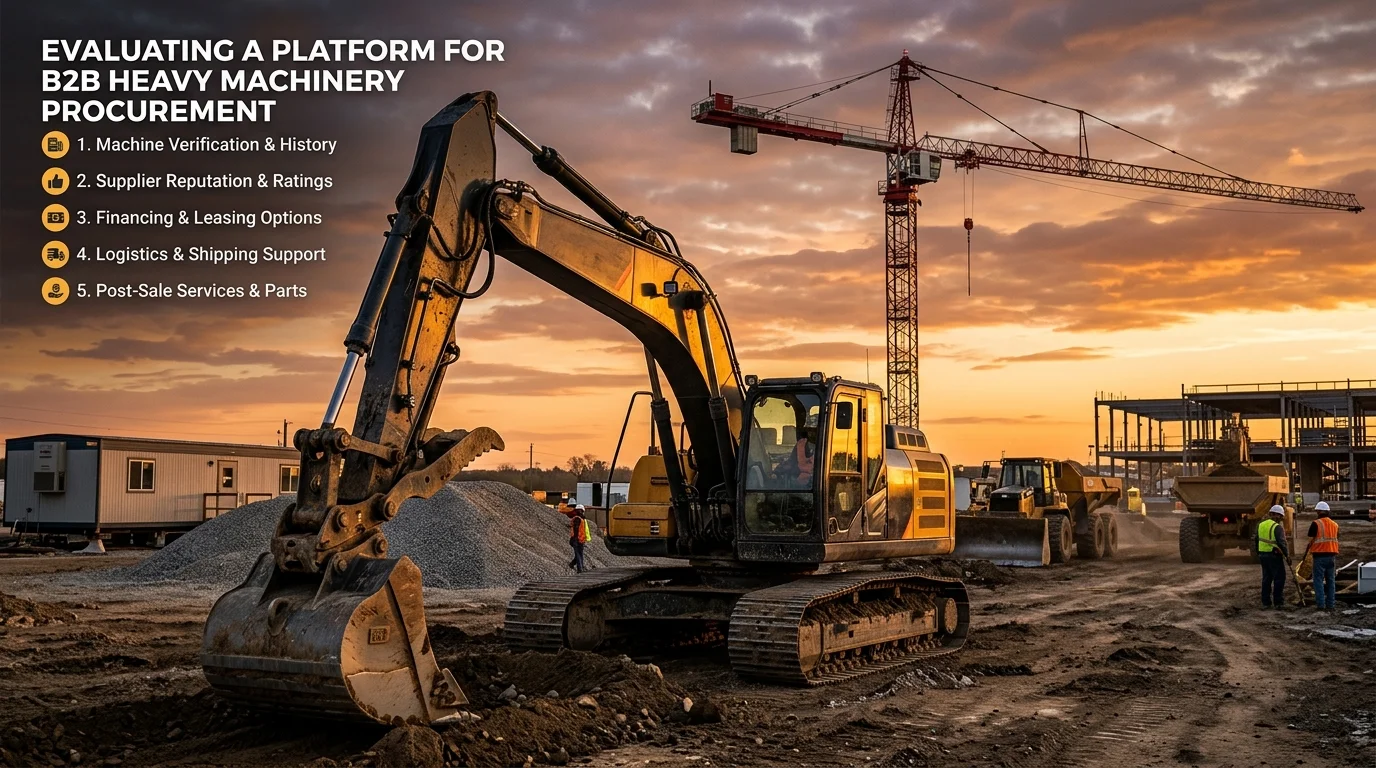
The right platform for your operation depends on four practical criteria: supplier verification depth, parts compatibility data, logistics capability, and after-sales support. Here is how to assess each one.
Supplier Verification and Certification
Prioritize platforms that require suppliers to hold ISO 9001 certification for quality management. ISO 9001 and ISO 27001 are the two baseline standards that serious industrial suppliers maintain, covering both product quality and data security. A platform that publishes audit results and buyer reviews gives you independent evidence beyond a self-reported badge.
Parts Compatibility and Technical Data
For spare parts procurement specifically, the platform must provide OEM part numbers, cross-reference data, and compatibility charts by machine model and serial number range. Ordering the wrong seal kit for a Caterpillar 320 or the wrong hydraulic pump for a Komatsu PC200 costs more in downtime than the part itself. Platforms that integrate with OEM service bulletins or publish spec sheets reduce that risk significantly.
Logistics and Lead Time Transparency
Ask every shortlisted platform one direct question: what is the guaranteed lead time to your primary job site? General marketplaces often list shipping estimates that exclude customs clearance, port handling, and last-mile delivery. Specialist suppliers like 3GEN Export publish a 5-day global delivery commitment because the logistics chain is pre-built, not assembled per order.
After-Sales Support and Warranty
Heavy machinery parts carry real consequences when they fail. Confirm that the platform or supplier offers a clear warranty policy, technical support contacts, and a returns process for incorrect or defective parts. This is where specialist B2B suppliers consistently outperform general marketplaces.
How to Choose the Right Platform for Your Use Case
Platform selection should follow your sourcing profile, not the other way around. Here are three concrete scenarios to guide the decision.
Scenario 1: Large-Scale New Equipment Procurement
A mining company sourcing five new haul trucks and a fleet of loaders needs a platform with verified manufacturer listings, financing options, and multi-unit pricing. Alibaba and Machinery Partners both serve this profile. Alibaba's trade assurance program provides payment protection on large orders, while Machinery Partners offers integrated financing for construction and agriculture buyers across 35 U.S. states.
Scenario 2: Used Equipment on a Tight Budget
A contractor rebuilding after a project loss needs serviceable equipment fast, without new-equipment capital outlay. IronPlanet's auction model with independent inspection reports is purpose-built for this. Buyers get documented machine condition before bidding, which removes the guesswork that makes used-equipment purchases risky.
Scenario 3: Ongoing Spare Parts Supply for a Mixed Fleet
A fleet maintenance supervisor managing Caterpillar, Komatsu, and Volvo machines across multiple sites needs a single-source supplier with deep parts coverage, fast shipping, and technical compatibility data. General marketplaces rarely cover this profile well. A specialist like 3GEN Export, stocking OEM-standard parts for 40+ brands with 5-day global delivery, is the operationally sound choice.
"Research reveals that B2B companies with advanced digital capabilities outperform their peers by 3.5 times in revenue growth and enjoy 27% higher profit margins." - Elogic Commerce, B2B Ecommerce for Machinery and Equipment (updated October 2026)
Price Range Guidance: Budget, Mid-Range, and Premium
Understanding the cost tiers across procurement channels helps you set realistic budgets and avoid surprises at the invoice stage.
| Tier | Typical Source | What You Get | Trade-Off |
|---|---|---|---|
| Budget | Used equipment auctions (IronPlanet, Ritchie Bros.) | Serviceable equipment at below-market prices | Higher maintenance risk, limited warranty |
| Mid-Range | Regional B2B marketplaces, verified aftermarket parts suppliers | OEM-compatible parts and refurbished equipment with basic support | Variable lead times, mixed quality control |
| Premium | OEM dealers, specialist suppliers (e.g., 3GEN Export) | OEM-standard parts, full documentation, fast global delivery, technical support | Higher unit cost, offset by lower downtime risk |
For critical components - hydraulic cylinders, engine seals, undercarriage parts - the premium tier is almost always the correct financial decision. One unplanned machine shutdown on a mining or construction site costs multiples of the price difference between a budget and premium part.
How to Optimize Your Procurement Process
Streamlining procurement reduces both cost and lead time. Follow these steps to build a repeatable, auditable process.
- Research: Map your equipment fleet by brand, model, and serial number range before approaching any platform. This data is the foundation of every parts compatibility check.
- Compare: Use the comparison tables above to shortlist two or three platforms that match your sourcing geography and equipment category.
- Engage: Request formal quotes from shortlisted suppliers. Ask specifically about OEM part number cross-references and stock availability for your top 20 high-consumption parts.
- Negotiate: Volume commitments, blanket purchase orders, and multi-year supply agreements all create negotiating leverage. Use them.
- Monitor: Track supplier on-time delivery rates and part rejection rates quarterly. Replace underperforming suppliers before a critical shortage forces your hand.
Care and Maintenance: What to Expect After Procurement
Procurement does not end at the purchase order. Proper maintenance practices protect the investment and extend equipment service life significantly.
- Regular Inspections: Schedule routine inspections at OEM-recommended intervals to catch wear before it becomes failure. Most OEM service bulletins specify inspection intervals by operating hours, not calendar time.
- Lubrication: Ensure all moving parts receive the correct lubricant grade at the correct interval. Using the wrong viscosity on a Komatsu final drive or a Volvo swing bearing accelerates wear faster than skipping lubrication entirely.
- Cleaning: Keep machinery clean, particularly around hydraulic fittings and electrical connectors. Contamination is the leading cause of hydraulic system failures in construction and mining equipment.
- Parts Inventory Planning: Maintain a buffer stock of your highest-consumption wear parts: filters, seals, belts, and undercarriage components. A 2-3 week buffer eliminates most emergency procurement situations.
- Documentation: Record every part replacement with the OEM part number, installation date, and machine hours. This data drives smarter procurement decisions and supports warranty claims.
Pro Tip: Cross-reference every replacement part against the OEM service bulletin for your specific machine serial number range. A seal kit that fits a CAT 320D may not be compatible with a CAT 320D2. The serial number range is the definitive compatibility filter, not the model name alone.
The 2026 Outlook: Where B2B Machinery Procurement Is Heading
This year, two trends are reshaping how procurement managers source heavy equipment and parts. First, digital-first procurement is accelerating. According to Elogic Commerce's October 2026 review, B2B companies that have adopted advanced digital procurement capabilities are outperforming peers by 3.5 times in revenue growth. Procurement teams that still rely on phone-based ordering and paper catalogs are losing ground on both speed and cost.
Second, the specialist supplier is gaining ground over the general marketplace. As fleet complexity increases - with mixed-brand fleets spanning Caterpillar, Komatsu, Volvo, Atlas Copco, and others - procurement managers need suppliers who understand the technical differences between models, not just sellers who list parts by keyword. Platforms and suppliers that invest in compatibility data, OEM cross-references, and technical support are the ones winning long-term supply contracts in 2026.
Machinery Partners' $11 million funding round in 2024, backed by Armory Square Ventures and Pritzker Group, signals that institutional capital agrees: specialized B2B procurement platforms for heavy equipment are a durable market, not a passing trend. The $580 billion global heavy equipment industry is large enough to support multiple specialist platforms alongside the general marketplaces.
Frequently Asked Questions
Which platform is best for B2B heavy machinery procurement?
The best platform depends on your sourcing geography and equipment type. Alibaba is the largest B2B platform globally and suits international sourcing at competitive rates. Machinery Partners is the strongest option for U.S. construction and agriculture buyers. For OEM-standard spare parts with fast global delivery, specialist suppliers like 3GEN Export outperform general marketplaces on technical accuracy and lead time reliability.
Which is the biggest B2B platform in the world?
Alibaba is the largest B2B platform globally, offering an enormous range of industrial and construction machinery including excavators, loaders, CNC machines, and spare parts. Its trade assurance program and verified supplier network make it the default starting point for international sourcing.
What are examples of B2B platforms for heavy machinery?
Leading examples include Alibaba (global), Made-in-China (China-sourced machinery), Global Sources (verified international suppliers), IronPlanet (used equipment auctions), ThomasNet (North American industrial directory), Kompass (global business matching in 70+ countries), and 3GEN Export (OEM spare parts for 40+ brands with 5-day global delivery).
How do I verify supplier reliability on a B2B platform?
Look for platforms that require ISO 9001 certification, publish independent buyer reviews, and provide audit documentation. For spare parts specifically, ask the supplier to provide OEM part number cross-references and a sample compliance certificate before placing a large order. Platforms that offer trade assurance or escrow payment add a financial layer of protection on top of supplier vetting.
Can I negotiate prices on B2B procurement platforms?
Yes. Most platforms support direct supplier negotiation, and volume commitments consistently produce better pricing. Blanket purchase orders, multi-year supply agreements, and consolidated shipping arrangements are the three most effective negotiating tools for procurement managers sourcing heavy machinery parts at scale.
What maintenance is required after procuring heavy machinery parts?
Install parts at OEM-recommended intervals, use the correct lubricant grade for each application, and document every replacement with the OEM part number and machine hours. Maintaining a 2-3 week buffer stock of high-consumption wear parts eliminates most emergency procurement situations and keeps machines running on schedule.
Shop OEM-quality spare parts for Caterpillar, Komatsu, Volvo, Atlas Copco, and 40+ brands with global 5-day delivery at 3genexport.com.