
B2B Industrial Parts Procurement: Expert Guide
Master b2b industrial parts procurement with expert supplier evaluation, cost strategies, and OEM-quality parts. Fast global delivery at 3genexport.com.
Loading article…
Article Not Found
The article you're looking for doesn't exist or may have been removed.
Back to BlogB2B industrial parts procurement is the process of sourcing components and services from other businesses for industrial applications. It involves larger transaction volumes, formal contracts, and complex multi-stakeholder decisions that set it apart from consumer purchasing.
Key Takeaways
- parts procurement covers the full cycle from need recognition through supplier qualification, negotiation, and ongoing relationship management.
- According to Thomas Publishing data, 70% of the industrial buying journey is complete before a buyer ever contacts a supplier.
- Supplier evaluation must go beyond price: reliability, technical support, and scalability all affect long-term operational costs.
- Custom parts procurement carries higher risk and longer lead times than catalog purchasing, requiring tighter cross-functional coordination.
- E-procurement platforms reduce manual work, minimize errors, and give procurement teams real-time visibility into spending and supplier performance.
- Clear specifications and dual-sourcing strategies are the two most effective risk controls in any this type of procurement program.
Understanding B2B Industrial Parts Procurement
B2B industrial parts procurement is the structured process by which one business sources, negotiates, and acquires components, materials, or services from another business. Unlike consumer purchasing, it involves larger transaction volumes, formal approval workflows, and ongoing supplier relationships that directly affect production continuity.
What Is B2B Procurement?
B2B procurement is the end-to-end process of defining sourcing needs, identifying qualified suppliers, requesting quotes, evaluating offers, negotiating terms, and maintaining the supplier relationship after the purchase order is issued. Every step carries commercial and operational consequences.
"B2B procurement involves larger transaction volumes, more complex decision-making, formal contracts, and ongoing supplier relationships" - per Procurement Tactics editorial review, updated December 2025.
For heavy equipment operators and fleet maintenance teams, this means every bearing, seal kit, or hydraulic component you source goes through a deliberate qualification process. Cutting corners at the supplier evaluation stage is where most unplanned downtime originates.
Key Components of B2B Industrial Parts Procurement
- Supplier Evaluation: Assessing potential suppliers based on quality consistency, on-time delivery record, and service capabilities.
- Cost Management: Analyzing total cost of ownership, including purchase price, lead time risk, maintenance burden, and operational costs.
- Compliance and Quality Assurance: Confirming that suppliers meet OEM specifications and relevant industry standards before placing orders.
The Industrial Buying Journey
The industrial buying journey is a six-phase sequence that B2B buyers follow from recognizing a need to completing a purchase. Understanding each phase helps procurement teams and suppliers align at the right moment.
"70% of the industrial buying journey is complete before a buyer ever contacts a supplier" - Thomas Publishing, sourced from blog.thomasnet.com, September 2026.
That figure has real consequences. By the time your team reaches out to a supplier, you've already formed strong preferences based on online research, peer recommendations, and technical documentation. Suppliers who don't show up with clear specs, compatibility data, and pricing transparency during the research phase are effectively eliminated before the conversation starts.
Phases of the Buying Journey
- Need Recognition: A buyer identifies a problem, such as a worn hydraulic seal or a failed undercarriage component, and defines the requirement.
- Research: The team gathers information on compatible parts, OEM specifications, and potential suppliers across online platforms and industry directories.
- Design: Technical leads and engineers develop precise specifications, especially for custom or non-catalog components.
- Evaluation: Buyers assess suppliers on product quality, lead times, pricing, and after-sales support.
- Shortlist: The field narrows to final candidates. At this stage, total cost of ownership and responsiveness become the deciding factors.
- Purchase: Contracts are signed and the purchase order is issued. In industrial procurement, this marks the beginning of a supply partnership, not the end of the process.
What to Look For When Buying Industrial Parts
Effective b2b industrial parts procurement depends on evaluating several criteria beyond unit price. Each factor below directly affects equipment reliability and your total maintenance budget.
Material Quality
Material quality determines how long a component performs under load, heat, and contamination. Require suppliers to provide material certifications and documentation confirming compliance with OEM specifications for the brand in question, whether that's Caterpillar, Komatsu, Volvo, or Atlas Copco.
Supplier Reliability
A supplier's on-time delivery record is as important as their product quality. One late shipment on a critical component can idle an entire fleet. Ask for references, check delivery performance history, and confirm that the supplier maintains adequate inventory depth for your most-used part categories.
Cost and Value
Unit price is only one input. Factor in lead time risk, freight costs, warranty terms, and the cost of a potential quality failure. A component priced 15-20% higher from a verified OEM-standard supplier often delivers better total value than a cheaper alternative with no traceability.
Supplier Evaluation Criteria
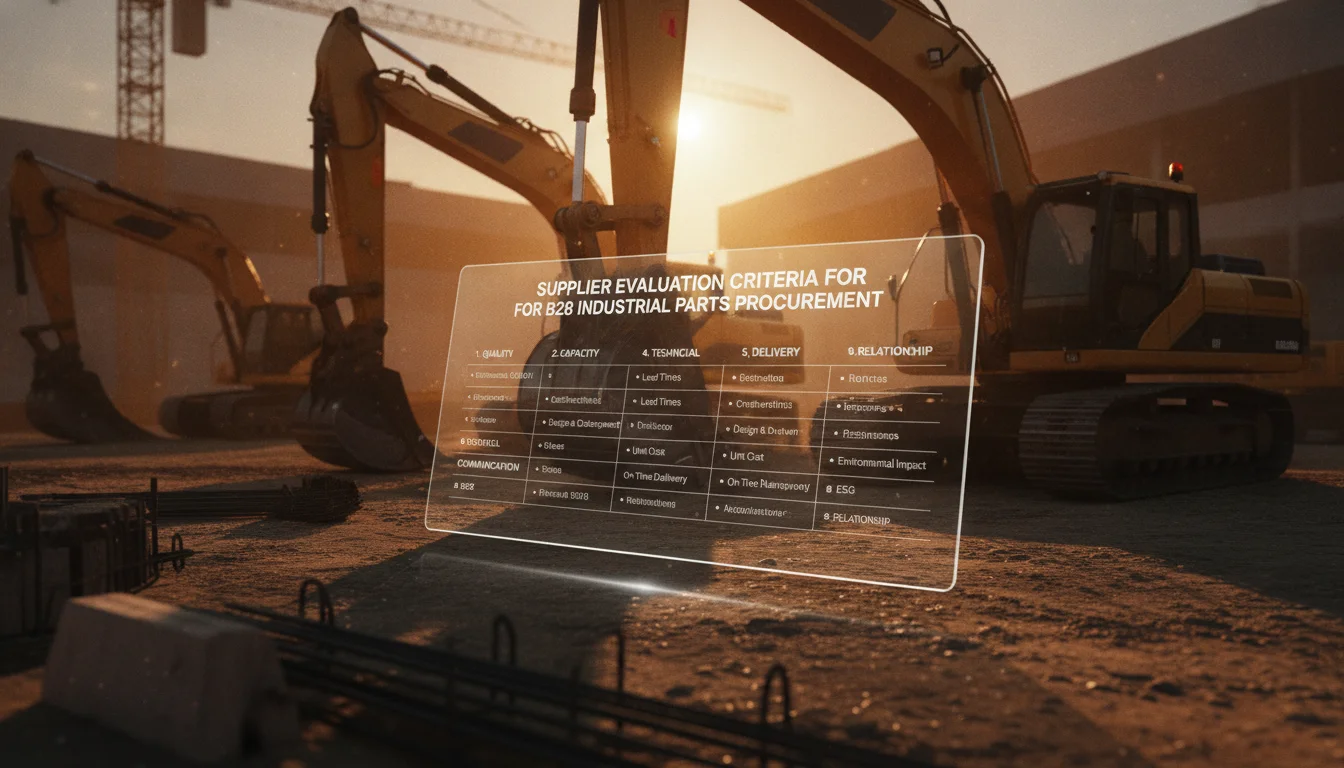
Choosing the right supplier is a strategic decision that directly affects operational costs and production continuity. Use the criteria below as a structured evaluation framework.
Quality Assurance
Assess the supplier's quality control processes. Look for documented inspection procedures, material traceability, and adherence to recognized quality management standards. At 3GEN Export, every part we ship is verified against OEM specifications before dispatch.
Technical Support
Evaluate the level of technical support the supplier provides. This includes assistance with part number cross-referencing, compatibility confirmation, installation guidance, and troubleshooting. For complex assemblies, this support can prevent costly fitment errors.
Scalability
Confirm whether the supplier can scale to meet growing demand. For fleet operators expanding operations or mining companies ramping up production, a supplier who can't grow with you becomes a bottleneck within 12-18 months.
Pros and Cons of B2B Industrial Parts Procurement Approaches
Pros
- Access to OEM-standard components with full material traceability and compliance documentation.
- Established supplier relationships reduce lead times and improve priority access during supply shortages.
- Bulk purchasing and contract pricing lower per-unit costs for high-volume operations.
- Dedicated technical support reduces fitment errors and warranty disputes.
Cons
- Qualifying new suppliers requires time and resources, especially for custom or hard-to-find components.
- Single-source dependency creates supply chain risk if a supplier faces production disruptions.
- Custom parts procurement carries longer lead times and higher per-unit costs than catalog purchasing.
Utilizing Technology in Procurement
Technology is now central to efficient b2b industrial parts procurement, from supplier discovery through order tracking and spend analysis.
Procurement Platforms
E-procurement platforms automate supplier management, purchase order generation, and order tracking. According to Procurement Tactics, these systems reduce manual work, minimize errors, and give procurement managers real-time visibility into spending patterns and supplier performance. The initial setup investment typically pays back within the first full procurement cycle.
Data Analytics
Spend analytics tools identify where your procurement budget is concentrated, which suppliers are underperforming on delivery, and where consolidation opportunities exist. For fleet maintenance teams managing parts across multiple equipment brands, this visibility is essential for controlling costs.
Custom Parts Procurement Challenges
Custom parts procurement is significantly more complex than standard catalog purchasing, and the consequences of getting it wrong are proportionally larger.
According to Fictiv's 2025 State of Manufacturing and Supply Chain Report, cited by NetSuite, 91% of manufacturing leaders face barriers to product innovation and introduction, with nearly half struggling to source fast, high-quality solutions for low-volume builds. Custom procurement sits at the center of that challenge.
Defining Specifications
Clear, complete specifications are the foundation of successful custom parts procurement. Incomplete drawings or ambiguous tolerances lead to parts that don't fit, rework costs, and delayed production. Engineering, procurement, and quality teams must align on specifications before any supplier quoting begins.
Supplier Coordination
Custom procurement requires close coordination across engineering, procurement, and quality control at every stage: specification sign-off, supplier qualification, prototype review, and production release. Unlike catalog purchasing, there's no off-the-shelf fallback if something goes wrong.
Risk Management
Dual-sourcing and maintaining safety stock are the two most effective strategies for managing custom parts procurement risk. Dual-sourcing ensures you're not dependent on a single supplier's capacity or lead time. Safety stock absorbs demand spikes and supplier delays without stopping production.
Comparison of Procurement Strategies
| Strategy | Advantages | Disadvantages |
|---|---|---|
| Traditional Procurement | Established relationships, predictable processes | Less flexibility, potential for higher costs |
| E-Procurement | Automation, real-time data, reduced manual errors | Initial setup costs, learning curve for teams |
| Custom Procurement | Tailored solutions, exact specification match | Higher risk, longer lead times, greater coordination burden |
Care and Maintenance of Procured Parts
Proper maintenance of industrial parts extends service life and protects the investment made during procurement. These practices apply whether you're managing Caterpillar undercarriage components, Komatsu hydraulic assemblies, or Volvo engine parts.
Regular Inspections
Schedule periodic inspections to identify wear before it becomes failure. For high-cycle components like filters, seals, and bearings, inspection intervals should follow OEM service bulletin recommendations rather than calendar-based guesswork.
Maintenance Schedules
Build maintenance schedules around manufacturer service intervals. Deviating from OEM-recommended intervals, even slightly, accelerates wear on adjacent components and can void warranty coverage on newer equipment.
Documentation
Maintain complete records for every procured part: part number, OEM compatibility, supplier, date of installation, and maintenance history. This documentation supports warranty claims, simplifies reordering, and gives fleet managers accurate data for lifecycle cost analysis.
How 3GEN Export Supports Global B2B Industrial Parts Procurement
We've supplied OEM-standard spare parts for Caterpillar, Komatsu, Volvo, Atlas Copco, and 40+ equipment brands since 2006. Our procurement model is built around the realities of B2B industrial parts procurement: fast response, verified compatibility, and global delivery.
When a mining operation in West Africa or a construction fleet in Southeast Asia needs a hard-to-find component, waiting weeks for a domestic distributor isn't an option. We maintain deep inventory across hydraulic components, undercarriage parts, engine assemblies, filters, and seals, with global delivery typically within 5 business days.
Every part ships with full OEM specification documentation. No guesswork on compatibility. No unverified aftermarket substitutes passed off as OEM-grade. If you need cross-referencing support or have a custom sourcing requirement, our technical team responds within 48 hours.
Shop OEM-quality spare parts with global 5-day delivery at 3genexport.com. Browse by brand at 3genexport.com/brands or explore our full parts categories at 3genexport.com/parts-categories.
Frequently Asked Questions
What is B2B in procurement?
B2B in procurement refers to the process of one business sourcing, negotiating, and acquiring goods or services from another business. It differs from consumer purchasing through larger transaction volumes, formal contracts, multi-stakeholder approval processes, and ongoing supplier relationship management.
What is parts procurement?
Parts procurement is the process of identifying, qualifying, and purchasing specific components required for manufacturing, maintenance, or repair operations. In industrial settings, this includes OEM spare parts, aftermarket components, and custom-manufactured items built to unique specifications.
What are the three main types of B2B buyers?
The three main types of B2B buyers are manufacturers (who source raw materials and components for production), distributors and wholesalers (who purchase in bulk for resale), and end-user operators such as mining, construction, and energy companies who buy parts for equipment maintenance and repair.
How do I evaluate suppliers for industrial parts?
Evaluate suppliers on product quality and material traceability, on-time delivery performance, technical support capability, pricing transparency, and ability to scale with your demand. For OEM-standard parts, also confirm that the supplier can provide compatibility documentation for your specific equipment brands and models.
How can I manage risks in custom parts procurement?
The most effective risk controls are dual-sourcing (qualifying at least two capable suppliers for critical custom components), maintaining safety stock for long-lead items, and investing in complete specification documentation before any supplier quoting begins. These three practices address the most common failure points in custom procurement programs.