

Parts Inventory Management: 8 Best Practices
Master best practices for parts inventory management to cut downtime and control costs. OEM-quality parts with global 5-day delivery at 3genexport.com.
Loading article…
Article Not Found
The article you're looking for doesn't exist or may have been removed.
Back to BlogBest practices for parts inventory management are the proven methods that keep the right spare components on the shelf, at the right quantity, without tying up excessive capital. For heavy equipment operations, getting this wrong costs real money every hour a machine sits idle.
Key Takeaways
- Proactive maintenance strategies let you forecast part needs before failures happen, not after.
- ABC analysis and criticality classification help you focus attention where it matters most.
- Reorder points and min/max levels are the foundation of any reliable spare parts system.
- CMMS platforms reduce manual errors and automate reorder alerts across multiple sites.
- Regular audits and slow-stock reviews free up capital and keep your records accurate.
- Security controls at the parts counter directly improve inventory count accuracy.
Understanding Parts Inventory Management
Parts inventory management is the systematic practice of overseeing and controlling spare parts stock so the right components are available when equipment fails, minimizing downtime and the costs that come with it. Effective management balances sufficient stock against the real expense of holding too much.
What Is Spare Parts Inventory?
Spare parts inventory is the collection of components kept on hand to replace failed or worn elements in machinery and equipment. According to MaintainX industry guidance, this ranges from critical items like motors, gears, and belts to smaller consumables like batteries and printer cartridges. Maintenance departments typically store these parts in controlled stockrooms on location.
Spare Parts vs. Stock Parts: Know the Difference
A spare part is an extra component kept specifically for maintenance and emergency repair. A stock part is an item held to produce finished goods for sale, including raw materials, packaging, and PPE. Confusing the two leads to miscategorized inventory and inaccurate counts. Keep them separate in your system from day one.
Why Effective Inventory Management Matters
Effective parts inventory management is essential for operational efficiency across construction, mining, and energy sectors. As Competitor #1 notes, every hour of unplanned downtime can cost thousands of dollars, and the part that prevents that downtime might be sitting in a warehouse on the other side of the world. Smart inventory management is your first line of defense. It also improves maintenance metrics, reduces repeat repairs, and eliminates the premium costs of rushed emergency shipping.
"When spare parts aren't available, the financial losses pile up fast: equipment downtime, missed production targets, rushed shipping costs, and unhappy customers." - MaintainX Editorial Team, Spare Parts Inventory Management Strategies
Best Practices for Parts Inventory Management

The best practices for parts inventory management outlined below apply directly to heavy equipment operations managing Caterpillar, Komatsu, Volvo, Atlas Copco, and similar fleets. Each practice builds on the last. Skip one and the system develops gaps.
1. Organize and Tag Every Spare Part
Start with the physical space. Group similar parts together, label every bin clearly, and rethink storage logic from the ground up. For heavy equipment fleets, this means separating hydraulic components from engine parts, and electrical components from wear items like filters and seals.
Once the space is organized, label your inventory physically. Inventory management software can automate barcode and QR code label generation, linking each label to the corresponding part record. This speeds up audits and eliminates the guesswork of manual searches.
Color-coded bins add another layer of visual management. As MDI.org notes in their spare parts best practices guidance, color coding gives employees immediate visual cues for product categories, speeding up both restocking and order picking over time.
2. Create a Comprehensive Parts Inventory List
Every part your operation depends on needs a record: part name, OEM part number, compatible equipment models, quantity on hand, location, and unit cost. For Caterpillar or Komatsu fleets, include the manufacturer part number alongside any cross-reference numbers from your supplier.
If you stock parts you only buy on demand, include those too. Your team needs to know whether a part exists in the system before placing an emergency order. The best inventory management software tracks parts across multiple locations, including field vehicles, satellite workshops, and offsite warehouses.
3. Establish a Clear Reordering Process
The reorder point is the inventory level that triggers a new purchase order, calculated to account for average usage during lead time plus a safety buffer. As Maintainly's practical guide explains: if a bearing takes five days to arrive and your team uses roughly two per week, your lead time demand is approximately 1.5 units. Add safety stock of two, and your reorder point sits at three to four units.
For critical components on high-value equipment, err toward higher safety stock. For low-criticality consumables with short lead times, tighter buffers are appropriate. Set automated alerts in your inventory system so reorders happen before stockouts, not after.
"For critical parts, err on the side of higher safety stock. For low-criticality consumables with short lead times, tighter buffers are appropriate." - Maintainly, Spare Parts Inventory Management: A Complete Guide, April 2026
4. Implement ABC Analysis
ABC analysis categorizes parts based on value and criticality so you allocate management effort where it delivers the most return. The classification works as follows:
| Category | Description | Management Approach |
|---|---|---|
| A Items | High-value or high-criticality parts | Tight control, frequent review, multiple suppliers |
| B Items | Moderate value and usage frequency | Standard min/max controls, periodic review |
| C Items | Low-value, low-criticality consumables | Order as needed, minimal oversight |
CDK Global Heavy Truck's inventory guidance adds an important note: parts that move quickly today can become obsolete tomorrow as fleets retire assets and adopt new equipment. Review your ABC classifications regularly, not just at setup.
5. Apply the 80/20 Rule
According to CDK Global Heavy Truck's best practices for truck parts inventory management, for most operations, 80% of profits come from 20% of inventory. That 20% deserves your closest attention: accurate stocking levels, tight reorder controls, and priority supplier relationships. Your inventory management software should flag this critical tier automatically and notify you when reorder thresholds are reached.
6. Use Data for Demand Forecasting
Historical usage data, equipment age, and seasonal patterns all feed accurate demand forecasting. CDK Global's guidance recommends using your inventory software's demand forecasting function to predict future needs based on historical data and market conditions, then adjusting purchasing when supply chain constraints are likely.
Predictive maintenance takes this further. Data sensors and monitors on critical equipment signal which components are approaching failure, turning reorder decisions from guesswork into data-backed planning. For Caterpillar and Komatsu equipment, OEM service bulletins often include recommended replacement intervals that feed directly into this forecasting model.
7. Prioritize Parts by Lead Time and Criticality
Lead time is one of the biggest drivers of extended downtime when a machine fails. Build a lead time reference alongside your priority list. A local supplier who can deliver a hydraulic seal kit within 24 hours changes how much safety stock you need to hold for that part. A critical final drive component with a six-week OEM lead time demands a completely different stocking strategy.
At 3GEN Export, we supply OEM-standard spare parts for Caterpillar, Komatsu, Volvo, and Atlas Copco equipment with global delivery in as few as five days. That lead time reliability directly reduces the safety stock burden on your operation.
8. Implement Security Controls at the Parts Counter
Open, uncontrolled access to your parts room is a direct cause of missing parts, inaccurate counts, and availability shortages. Advanced Technology Solutions (ATS) recommends a single controlled access point, a "parts counter," staffed by authorized personnel only. Badge or keycard access and camera coverage further protect inventory integrity. This one change often produces immediate improvements in count accuracy.
Utilizing Technology in Parts Inventory Management

Technology is what separates reactive parts management from a proactive, data-driven system. The right tools reduce manual errors, automate routine tasks, and give you visibility across every location where parts are stored.
Inventory Management Software
Dedicated inventory management software provides real-time stock tracking, automated low-inventory alerts, multi-location visibility, and audit reporting. For operations managing parts across multiple job sites or countries, this visibility is not optional. It is the difference between knowing what you have and guessing.
Computerized Maintenance Management Systems (CMMS)
A CMMS platform connects parts usage directly to work orders. When a technician completes a repair, the system deducts the parts used from inventory automatically. Reorder alerts fire when stock hits the minimum level. Vendor information, lead times, and purchase order history are all centralized. According to MaintainX's spare parts management guidance, CMMS platforms are essential for reducing manual errors and preventing stockouts in multi-site operations.
Barcode and QR Code Systems
Barcode and QR code systems make physical inventory counts fast and accurate. Scan a bin, update the count, generate a purchase order. For operations with thousands of part numbers across multiple storage locations, this speed matters. Vehicle Maintenance Recording Standards (VMRS), as noted by CDK Global, ensure part numbers stay consistent with industry standardization and make cross-supplier sourcing straightforward.
Pros and Cons of Structured Parts Inventory Management
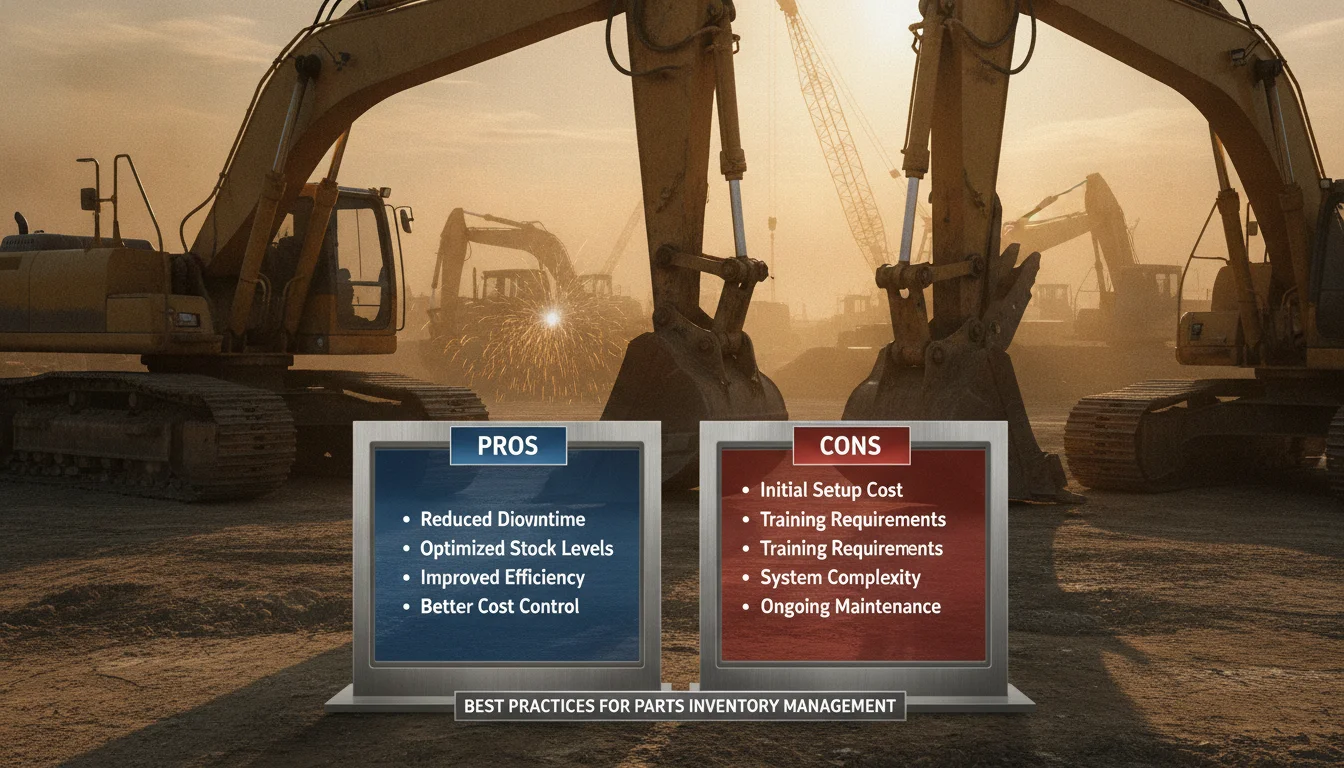
Pros
- Reduced downtime: Critical parts are on hand when equipment fails, cutting repair time from days to hours.
- Lower emergency costs: Planned reorders eliminate rushed shipping premiums and emergency procurement fees.
- Better maintenance metrics: Technicians spend time wrenching, not searching for parts or waiting on deliveries.
- Improved cash flow: Right-sized inventory frees up capital that would otherwise sit on shelves as slow-moving stock.
- Stronger supplier relationships: Consistent, planned ordering gives suppliers visibility and often results in better pricing and priority service.
Cons
- Setup investment: Building a structured system requires upfront time, software costs, and staff training.
- Ongoing discipline: The system only works if every part movement is recorded accurately and consistently.
- Obsolescence risk: Parts stocked for equipment that gets retired or upgraded become dead capital if not reviewed regularly.
- Software dependency: A CMMS or inventory platform introduces technology risk; system downtime or data errors can disrupt operations if there's no manual backup process.
Care and Maintenance of Your Inventory System
A parts inventory system degrades without regular attention. Stock levels drift from reality, slow-moving parts accumulate, and the data your team relies on becomes unreliable. These practices keep the system accurate.
Conduct Regular Audits
Regular inventory audits verify that physical stock matches system records. CDK Global's inventory management guidance recommends conducting these reviews consistently to catch discrepancies before they cause stockouts or over-purchasing. For high-value A items, cycle counts more frequently than for B and C items.
Review Slow-Moving Stock
Parts that haven't moved in over a year deserve a hard look. Are they still relevant to your current equipment fleet? If a machine has been retired, the parts stocked for it are now dead capital. Review slow-moving stock regularly and remove items that no longer serve an active purpose. This frees up both shelf space and working capital.
Track Lost Sales and Stockout Events
Every time a technician needs a part and it isn't in stock, that's a data point. CDK Global's truck parts inventory guidance recommends tracking these stockout events, called lost sales, to adjust inventory levels and better match actual demand. Over time, this data is more reliable than forecasting models alone.
Optimize Storage Solutions
Color-coded bins, logical shelf layouts, and clear zone labeling reduce picking errors and speed up retrieval. For heavy equipment parts, this matters especially for large components like hydraulic cylinders, final drives, and undercarriage parts that require specific storage conditions to prevent damage.
As of 2026, the best practices for parts inventory management have evolved to include predictive analytics and IoT-connected equipment monitoring. Operations that combine structured inventory discipline with modern technology consistently outperform those relying on manual processes and reactive purchasing.
Ready to reduce downtime and control parts costs? Shop OEM-quality spare parts for Caterpillar, Komatsu, Volvo, Atlas Copco, and 40+ brands with global 5-day delivery at 3genexport.com. Explore our parts categories or browse by equipment brand to find exactly what your fleet needs.
Frequently Asked Questions
What are the best practices for parts inventory management?
The core best practices for parts inventory management include organizing and tagging every part, maintaining a complete inventory list with OEM part numbers, setting reorder points based on lead time and usage, applying ABC analysis to prioritize management effort, and using a CMMS to automate tracking and alerts. For heavy equipment fleets, adding lead time analysis and security controls at the parts counter rounds out a complete system.
How can I effectively organize my parts inventory?
Group similar parts together by equipment type or component category, label every bin clearly, and use color-coded storage to give technicians immediate visual cues. Inventory management software with barcode or QR code support automates label generation and links physical bins to digital records, making audits and cycle counts significantly faster.
What is the 80/20 rule in inventory?
The 80/20 rule in inventory management holds that 80% of your operational value comes from 20% of your parts. According to CDK Global Heavy Truck's inventory best practices, focusing tight controls, accurate stocking levels, and priority supplier relationships on that critical 20% delivers the greatest return on your management effort.
What are 8 best practices for inventory management?
The eight best practices covered in this guide are: organize and tag every part, create a comprehensive inventory list, establish clear reorder points, implement ABC analysis, apply the 80/20 rule, use data for demand forecasting, prioritize by lead time and criticality, and implement security controls at the parts counter. Together, these practices form a complete spare parts management system for heavy equipment operations.
How often should I conduct inventory audits?
Audit frequency should match part criticality. High-value A items warrant cycle counts more frequently than B and C items. CDK Global's inventory guidance recommends consistent, regular reviews to catch discrepancies before they cause stockouts or excess purchasing. Many operations run quarterly full audits supplemented by ongoing cycle counts for critical parts.
How can technology help with parts inventory management?
Inventory management software and CMMS platforms provide real-time stock visibility, automated reorder alerts, and work order integration that deducts parts usage automatically. Barcode and QR code systems make physical counts fast and accurate. For multi-site heavy equipment operations, this technology is what makes consistent best practices for parts inventory management scalable across locations and time zones.