
Heavy Parts Inventory Management: 2026 Best Practices
Best practices for heavy parts inventory management cut downtime and free up cash. Learn ABC classification, reorder automation, and vendor strategy.
Loading article…
Article Not Found
The article you're looking for doesn't exist or may have been removed.
Back to BlogBest Practices for Heavy Parts Inventory Management
Best practices for heavy parts inventory management are the structured methods that balance parts availability against capital cost to prevent equipment downtime. Categorize by ABC analysis, automate reorder points, maintain real-time data, and audit stock on a fixed schedule.
Key Takeaways
- ABC classification prioritizes fast-moving A parts for tighter control and smarter stocking decisions.
- Real-time data accuracy prevents ghost inventory, double orders, and costly stockouts.
- Automated min/max reorder points eliminate reactive buying before a machine ever goes down.
- Vendor partnerships with real-time inventory access shorten lead times on critical spares.
- Regular physical audits uncover obsolete parts, hidden shortages, and process failures.
- Criticality analysis combined with ABC classification ensures the most machine-stopping parts get maximum attention.
What Are Best Practices for Heavy Parts Inventory Management?
inventory management are the structured methods used to plan, control, and replenish spare parts for excavators, loaders, haul trucks, and other heavy equipment. The core goal is to avoid overstocking, which ties up capital, while ensuring critical components are on the shelf when a machine breaks down. According to Heavy Vehicle Inspection's 2026 guide, the average heavy equipment breakdown costs $2,000+ per day in downtime, yet 82% of construction companies still track parts manually. That manual approach contributes to 40% higher failure rates compared to digitally managed fleets.
Effective practices include categorizing parts, maintaining accurate real-time records, applying the 80/20 rule, tracking lost sales, auditing stock, and choosing vendors carefully. Each practice reduces the gap between when a part fails and when the replacement arrives. A $40 hydraulic hose fitting can idle a $300,000 excavator for a week if it is not in stock. Proactive stocking of critical spares is not a cost. It is an insurance policy against revenue loss.
The Core Balancing Act
Too little inventory risks fleets taking their business elsewhere. Too much inventory causes cash-flow problems and eats into profits. The balance point is where you hold enough fast-moving parts to meet demand without carrying excessive slow-moving stock. Heavy parts managers must continuously adjust this balance as equipment ages, technology changes, and supplier lead times shift.
Why Reactive Ordering Fails
Reactive ordering means buying parts only after equipment fails. A hydraulic pump takes 3-10 business days to arrive, according to Heavy Vehicle Inspection's maintenance data. During that window, a $300,000 machine sits idle at $2,000+ per day. Proactive stocking eliminates that wait entirely. Ordering after failure guarantees the longest possible downtime every single time.
"The machine is not down because something broke. It is down because the part to fix it is not on the shelf. Spare parts delays are one of the biggest causes of heavy equipment downtime, and they are almost entirely preventable." - Heavy Vehicle Inspection, 2026
Best Practices for Heavy Parts Inventory Management Start with ABC Classification
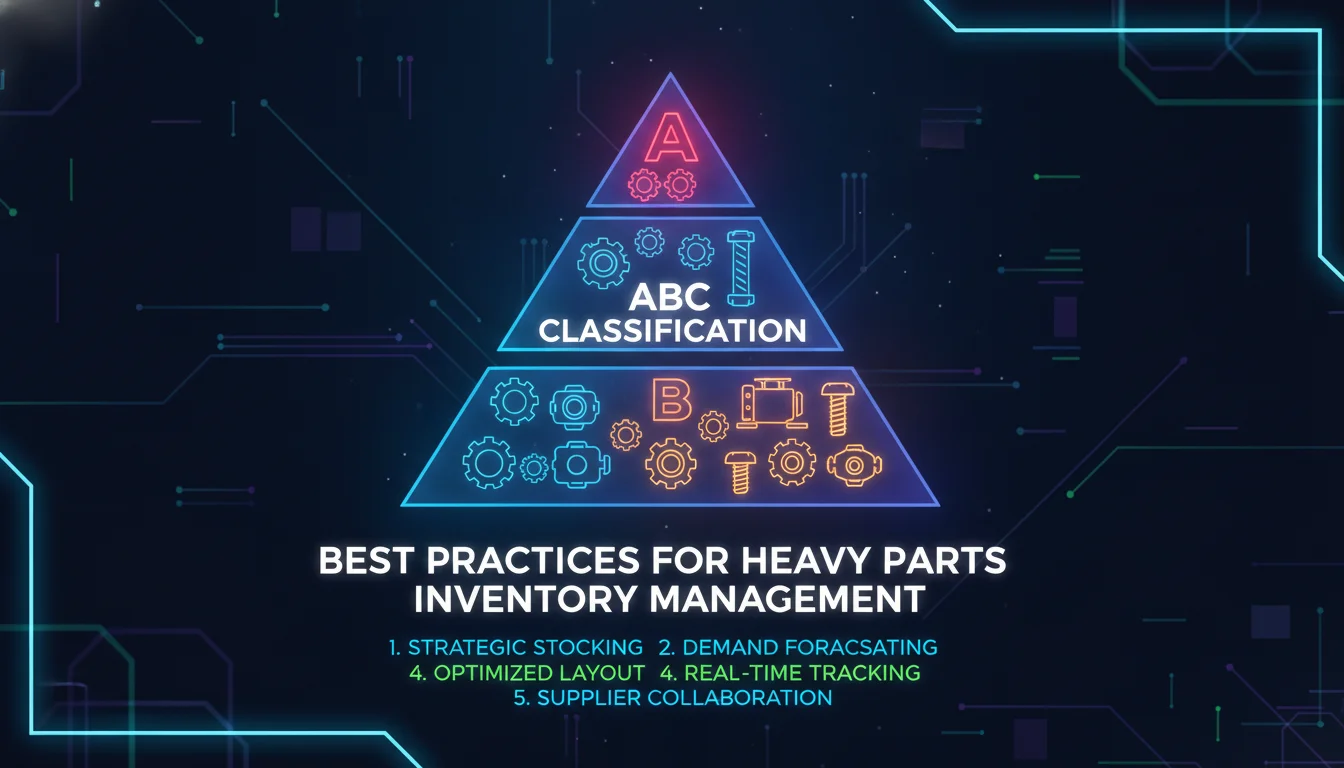
ABC classification ranks inventory items by annual consumption value or movement frequency, and it is the single most effective starting point for any heavy parts operation. In heavy equipment parts, A parts move quickly, C parts are the slowest, and B parts fall in between. According to CDK Global Heavy Truck, for most businesses, 80% of profits come from 20% of inventory. That 20% corresponds to your A items: filters, brake pads, belts, and common hydraulic fittings. You must be laser-focused on managing that 20% and stocking those parts at the right level.
Applying the 80/20 Rule to Heavy Parts
The 80/20 rule states that roughly 80% of your parts sales value comes from 20% of your SKUs. To apply it, run a sales report by part number over the last 12 months. Identify the top 20% of parts that generate the majority of revenue and assign them an "A" classification. Set higher service levels for these parts and review their demand monthly. Parts that move quickly today can become obsolete tomorrow as fleets retire assets and adopt new technology, so revisit categorizations on a fixed schedule.
Critical Spares Planning with Criticality Analysis
Criticality analysis identifies which parts are essential for the smooth functioning of a system and which are less important. Parts with high criticality ratings are maintained in higher quantities, and quick access is prioritized to minimize downtime. A hydraulic pump for a key excavator is far more critical than a cab air filter. Combine criticality with ABC classification: an A part that is also critical gets maximum attention, while a C part that is non-critical can be stocked minimally or drop-shipped on demand.
Achieving Real-Time Data Accuracy and Audit Discipline

Real-time data accuracy is the foundation of every other best practice for heavy parts inventory management. Without live visibility, parts get double-ordered, misplaced, or consumed by one machine while another waits. Digital tracking with barcode or QR scanning eliminates ghost inventory. Use a consistent method for identifying parts and confirm your part numbers match the vendor's. One proven standard is Vehicle Maintenance Reporting Standards (VMRS), a coding system that ensures part numbers are consistent across the industry and makes parts easier to source, per CDK Global Heavy Truck.
Step-by-Step Inventory Audit Process
- Schedule a full physical count at least quarterly for A items, semi-annually for B items, and annually for C items.
- Freeze all part movements during the count to prevent inaccuracies from parts being issued mid-count.
- Compare counted quantities against system records and investigate every variance above your defined threshold.
- Update system records only after a second person verifies the discrepancy.
- Record the number of days each part was in stock to sharpen reorder timing over successive cycles.
Regular audits identify obsolete parts, uncover shortages, and reveal process failures like unrecorded issues or receipts. Skipping audits is how ghost inventory accumulates silently for months.
Tracking Lost Sales and Seasonality
Lost sales are instances when a repair needed a part or a customer wanted to order one, but it was not in stock. Track these events in your inventory software. Also adjust stock levels for seasonality: if certain parts sell better in winter, increase stock levels before the cold season arrives and reduce them in spring. Over time, this data becomes one of the most reliable inputs for demand forecasting.
Automating Reorder Points and Min/Max Stocking Levels
Automating reorder points is one of the most impactful this type of management because it removes human error from the most time-sensitive decision in your operation. A reorder point is the inventory level that triggers a new purchase order. Min/max stocking levels define the lowest and highest quantities you want on hand for each SKU. Without automation, critical spares run out unnoticed. By the time someone realizes the last hydraulic filter was used, it is already too late.
How Demand Forecasting Works
Demand forecasting uses historical usage data and market conditions to predict which parts you will need in the future. Your inventory management software analyzes past consumption, seasonality, and supplier lead times to generate stocking recommendations. According to Fleetpal, if you know your fleet's trucks typically need a tire replacement every 60,000 miles, you can plan those replacements in advance and ensure the required parts are in stock before the need arises.
Integrating Parts with Work Orders and Assets
Every part issued should be logged against a vehicle ID and a work order. This creates a cost-per-hour history and reveals high-maintenance assets before they become budget problems. A CMMS (Computerized Maintenance Management System) links inspections, work orders, and parts inventory so you can predict future needs based on actual machine usage. When parts consumption is not tracked against specific machines, you cannot calculate true cost-per-hour, identify high-maintenance assets, or predict future parts needs accurately.
"For fleet businesses, effective parts inventory management is the backbone of smooth operations, undisrupted business, and happy customers. If a truck is grounded because of a missing part, you're not just losing time - you're losing money on jobs that aren't completed." - Fleetpal Team, 2026
What to Look For in Heavy Parts Inventory Software
The right software for best practices for heavy parts inventory management should offer barcode and QR scanning, min/max alerts, demand forecasting, and vendor integration in a single platform. It must also be accessible from mobile devices so field technicians can check parts availability directly from a service truck without calling back to the shop.
Key Software Features
- Real-time inventory counts with barcode or QR code support.
- Min/max reorder point automation with email or text alerts.
- Vendor connectivity to view supplier stock levels and locations in real time.
- Work order integration to assign parts to specific assets and build cost-per-hour data.
- Reporting on inventory turnover, lost sales, and obsolete parts.
Price Range Expectations
Heavy parts inventory software generally falls into three tiers. Budget options offer basic tracking but typically lack forecasting or mobile apps. Mid-range systems add min/max automation, barcode scanning, and vendor integrations. Premium CMMS platforms deliver full asset management, IoT sensor integration, and advanced analytics. For a single-location fleet, a mid-range system with CMMS functionality usually offers the best total cost of ownership. Request quotes from multiple vendors and compare implementation and training costs alongside the subscription fee.
Comparison Table: Inventory Management Approaches
| Approach | Best For | Key Features | Cost Level | Downtime Impact |
|---|---|---|---|---|
| Manual spreadsheets | Very small fleets (1-3 assets) | Basic counts, no alerts | Labor only | High: missed reorders common |
| Standalone inventory software | Growing fleets (4-20 assets) | Min/max alerts, barcode scanning | Subscription-based | Moderate: limited integration |
| CMMS with parts module | Large or mixed fleets | Work order integration, demand forecasting, vendor portals | Higher subscription | Low: proactive stocking enabled |
| ERP system | Dealerships or multi-site operations | Full accounting, inventory, and sales integration | Highest cost and implementation | Low: complex setup required |
Pros and Cons of Structured Heavy Parts Inventory Management
Pros
- Reduces unplanned downtime by ensuring critical spares are on the shelf before failure occurs.
- Frees up working capital by eliminating excess slow-moving stock through ABC classification.
- Improves supplier relationships through consistent, data-driven ordering rather than emergency calls.
- Creates auditable cost-per-hour data that identifies high-maintenance assets early.
- Scales across single-site and multi-site operations with the right CMMS platform.
Cons
- Initial setup of a CMMS or inventory system requires time, staff training, and upfront investment.
- ABC classifications must be reviewed regularly or they become outdated as fleets change.
- Demand forecasting accuracy depends on clean historical data, which takes time to accumulate.
- Vendor real-time inventory access is not universally available, especially from smaller regional suppliers.
Vendor Management, Obsolete Parts, and Warehouse Organization
Strong supplier relationships are a genuine competitive advantage in heavy parts operations. Applying best practices for heavy parts inventory management to your vendor strategy means choosing suppliers who offer parts at prices that allow profit without sacrificing quality, and who provide real-time access to their inventory levels and locations. If you do not have a part in stock, that real-time visibility lets you source it quickly from a nearby location and prevent the customer from going elsewhere.
Choosing Reliable Suppliers
Establish clear, detailed return policies with each vendor before you place your first order. Understand the return window and follow it. Work with suppliers who commit to documented lead times and offer drop-ship options for slow-moving items. Real-time vendor inventory access is especially valuable for critical spares with long lead times, where a one-day sourcing advantage can mean the difference between a same-week repair and a two-week idle.
Dealing with Obsolete Parts
Obsolete parts consume shelf space that could hold revenue-generating stock. Return them within the vendor's stated return window. If that deadline passes, discount the selling price to clear shelf space. As a last resort, sell them as scrap or dispose of them properly and write them off as a loss. Letting obsolete parts accumulate is a slow drain on both space and working capital.
How to Organize a Heavy Parts Warehouse or Service Truck
Use color-coded bins to provide visual cues for different part categories: red for critical spares, yellow for fast movers, blue for slow movers. According to Maintainly, many modern warehouses use random coding systems, where each part is assigned a location code managed by software for efficient retrieval. This approach maximizes storage space and flexibility. For service trucks, assign each part a fixed location and label shelves with part numbers. Use QR codes on bins that link to the inventory system so technicians can scan and update counts from the field. Schedule a monthly tool and expendable count to prevent shrinkage.
How 3GEN Export Supports Your Parts Inventory Strategy
Applying best practices for heavy parts inventory management only works when your supplier can actually deliver. At 3GEN Export, we supply OEM-standard spare parts for Caterpillar, Komatsu, Volvo, Atlas Copco, and 40+ additional brands to procurement teams and fleet managers worldwide. Our global logistics network supports 5-day delivery to most destinations, which means your min/max reorder system can operate on tight lead-time assumptions rather than conservative safety-stock buffers.
Whether you need hydraulic seals, filters, undercarriage components, or engine parts, our team can confirm compatibility, cross-reference OEM part numbers, and ship from the closest stocking location. That speed directly reduces the cost of any unplanned breakdown. Shop OEM-quality spare parts with global 5-day delivery at 3genexport.com.
Frequently Asked Questions
What is the 80/20 rule in heavy parts inventory?
The 80/20 rule states that roughly 80% of your parts sales value comes from 20% of your SKUs. Focus tight inventory control on that top 20% to maximize profitability and minimize stockouts on the parts that matter most.
How often should I audit heavy parts inventory?
Audit A items at least quarterly, B items semi-annually, and C items annually. More frequent cycle counts on critical spares prevent stockouts and keep your system records accurate between full physical counts.
What are min/max stock levels?
Min/max stock levels are the predefined low and high inventory quantities for each part number. When on-hand quantity hits the minimum, the system triggers a reorder up to the maximum, removing the need for manual monitoring.
What is the best inventory management software for heavy parts?
The best software integrates barcode scanning, min/max alerts, demand forecasting, and work order tracking in one platform. A CMMS with a parts module is ideal for fleets that need to link parts consumption to specific assets and build accurate cost-per-hour data.
How do I deal with obsolete heavy parts?
Return obsolete parts within the vendor's return window. If that deadline passes, discount them to clear shelf space. As a final option, scrap them and write off the loss to free up capital and storage for active inventory.
What is the difference between spare parts inventory and regular inventory?
Spare parts inventory is a stock of components kept on hand to repair or replace failed elements in equipment or machinery. Regular inventory typically refers to finished goods held for sale. Spare parts support internal maintenance operations rather than direct customer sales.