
Bulldozer Ripper Shank Parts: Buying Guide 2026
Shop bulldozer ripper shank parts with confidence. Compare OEM vs aftermarket, ripper boot types, and brand compatibility for CAT, Komatsu & more.
Loading article…
Article Not Found
The article you're looking for doesn't exist or may have been removed.
Back to BlogKey Takeaways
- Bulldozer ripper shank parts break up hard, compacted soil and rock, making site preparation faster and safer.
- Single shank rippers concentrate maximum force for deep ripping; multi-shank rippers cover more area in looser material.
- Aftermarket parts deliver OEM-level performance at a lower cost and fit a wide range of bulldozer brands and models.
- Ripper boot selection (short, intermediate, or long) directly affects machine productivity and shank protection.
- Hardened steel construction and correct pin retention are the two most important quality indicators to check before buying.
- Regular inspection, cleaning, and lubrication are the three maintenance habits that extend part life most reliably.
Bulldozer ripper shank parts are the ground-engaging components mounted at the rear of a dozer that fracture hard, compacted soil, rock, and frozen ground so material can be moved efficiently. Choosing the wrong type or a poorly matched fit costs you productivity and accelerates wear across the entire ripper system.
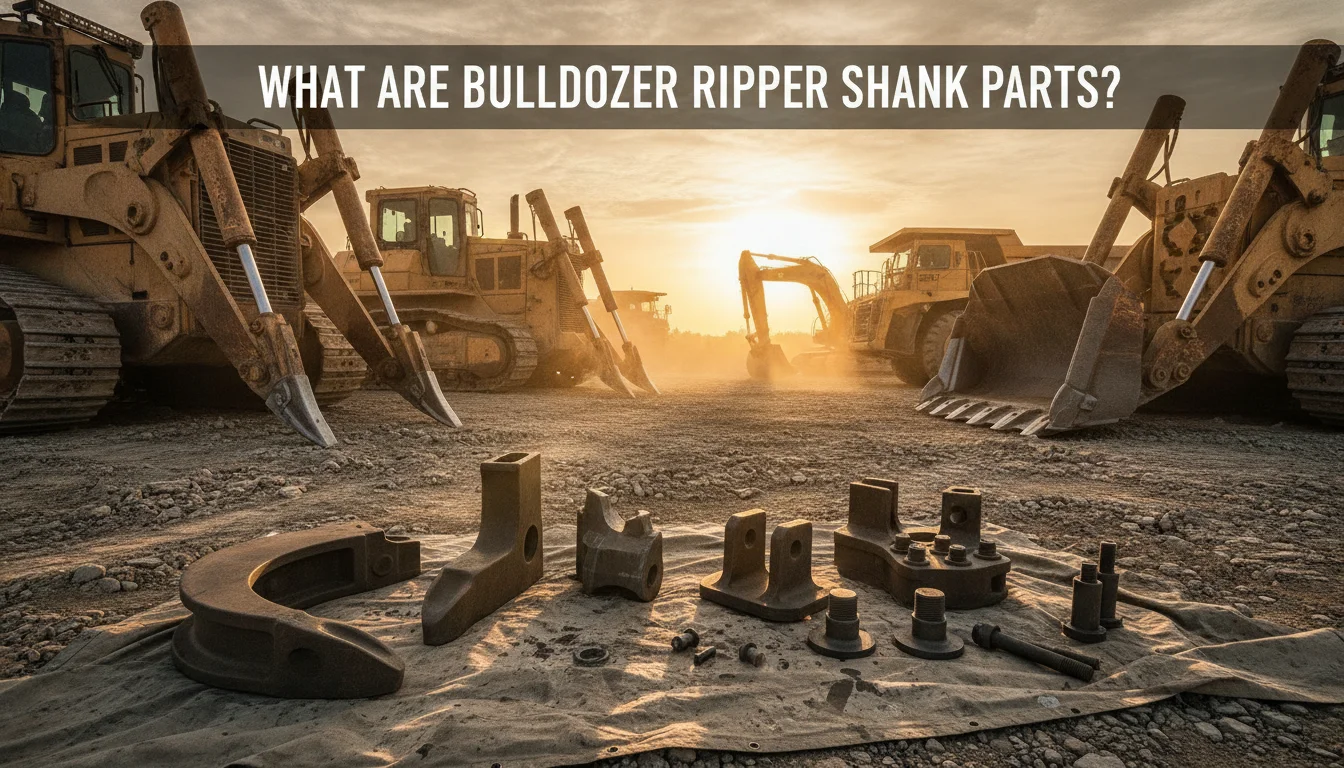
What Are Bulldozer Ripper Shank Parts?
Bulldozer ripper shank parts are specialized ground-engaging tools (GET) that attach to the ripper frame at the rear of a bulldozer and penetrate dense material that would otherwise require heavier or more expensive equipment. According to manufacturer specifications from Caterpillar, a complete ripper system includes the shank body, ripper tips (boots), shank protectors, adapters, and retention pins - each component playing a distinct role in overall system performance.
At its most basic, the ripper shank is a long, curved, claw-like instrument. As the dozer moves forward, the shank fractures the ground, breaking up tough spots that would challenge other machinery. Ripper shanks are typically around 18 inches long and curved to optimize penetration angle, per industry maintenance data from ground-engaging tool suppliers.
Beyond soil work, ripper shanks cut through and remove roots from trees or plants, clearing topsoil issues and deeper ground imperfections. They've become a practical alternative to drilling or blasting in many site preparation scenarios.
"The right ripping tools can make all the difference in improving your productivity. Tooth penetration can be the key to ripping success." - Caterpillar Ground Engaging Tools Product Documentation
Types of Ripper Shank Parts
- Single Shank Rippers: Designed for deep ripping and heavy conditions. They concentrate the bulldozer's maximum ripping force into a single focal point, delivering maximum penetration. Best for rock, hardpan, frozen ground, and permafrost.
- Multi-Shank Rippers: Used in looser material or when shallower ripping depth is required. Well-suited for pre-ripping large areas ahead of scrapers or other machines, and for working adjacent to highwalls where clearance is limited.
- Ripper Boots (Teeth and Tips): Fitted to the ripper shank using a pin retention system, these components penetrate the ground and protect the shank body from abrasion and impact. Available in short, intermediate, and long lengths.
Why Choose Aftermarket Parts?
Aftermarket parts are a dependable, cost-effective alternative to OEM parts - and for high-wear components like ripper shanks, the cost difference adds up fast across a fleet. Parts wear out during the life of a machine, sometimes quite frequently, and the best way to control costs is to source from a reliable aftermarket supplier.
As of 2026, the global market for ground-engaging tools continues to grow as construction, mining, and infrastructure projects expand across Asia, the Middle East, and Africa. Procurement managers at these projects are increasingly turning to quality aftermarket GET suppliers to manage budgets without compromising uptime.
Benefits of Aftermarket Ripper Shank Parts
- Cost-Effectiveness: Aftermarket parts typically cost less than OEM parts, allowing for meaningful savings - especially on bulk orders for fleet operations.
- Wide Availability: Quality aftermarket suppliers maintain extensive inventories, reducing lead times and keeping your machines running. Some suppliers stock over 50,000 parts across GET categories.
- Cross-Brand Compatibility: Aftermarket parts can often be used across different brands and models, providing flexibility when managing a mixed fleet of CAT, Komatsu, Volvo, or other dozers.
- OEM-Level Performance: Many aftermarket parts are engineered to meet or exceed OEM specifications, so you're not trading quality for price.
"Aftermarket parts offer reliability and affordability without sacrificing quality. No matter what you are using, you can find a replacement part that works for it." - DMC Wear Parts, Aftermarket GET Specialists
Ripper Boot Selection: Short, Intermediate, or Long?
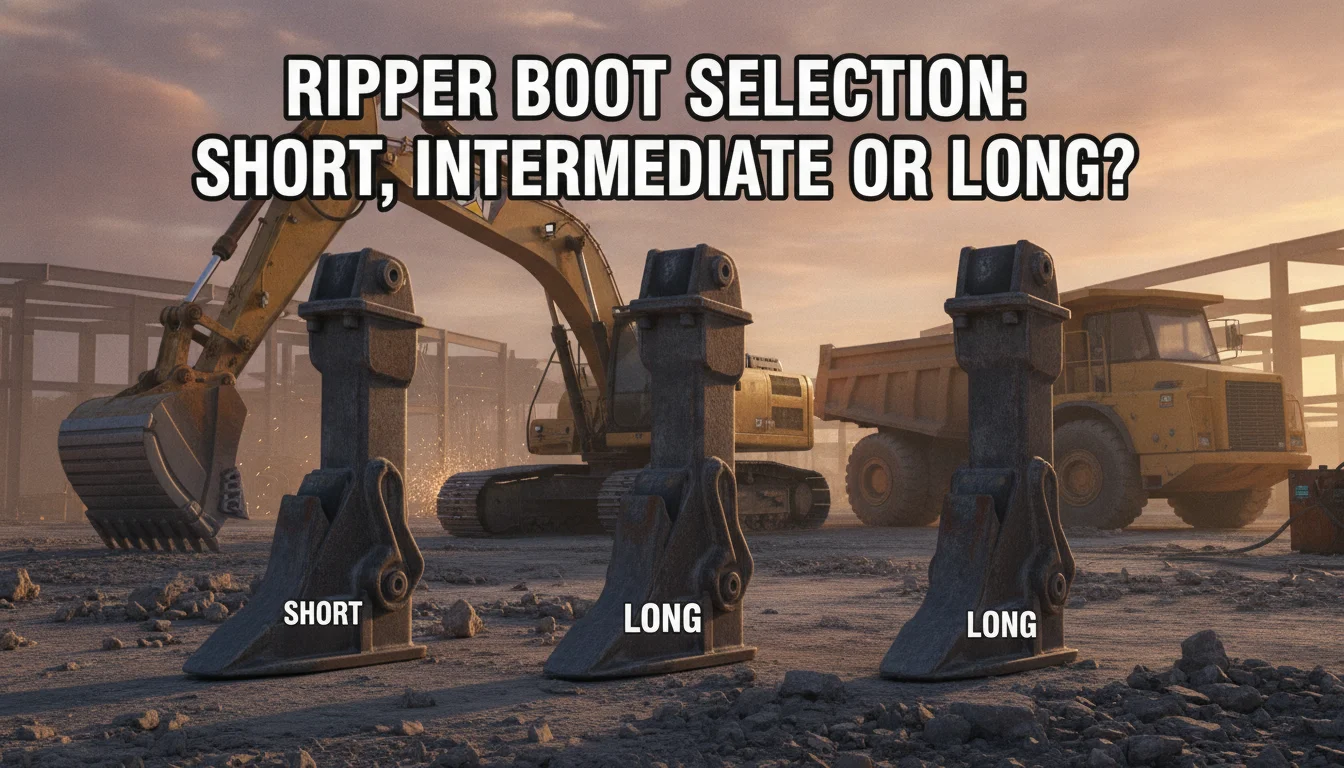
Selecting the correct ripper boot has a direct effect on the performance of your entire machine and the productivity of your operation. Per guidance from ground-engaging tool specialists, boot length should match your specific digging conditions:
- Short Tips: Designed for extreme digging conditions. They sacrifice some wear material for strength, making them the right call in high-impact rock or heavily compacted ground where breakage risk is high.
- Intermediate Tips: A solid general-purpose option for moderate impact and abrasion conditions. These are the most commonly specified boot for mixed-use site preparation work.
- Long Tips: Best suited to low-impact but abrasive conditions. They offer more wear material and represent the best value for money when breakage risk is lower and abrasion is the primary concern.
Ripper boots are also available in symmetrical centreline designs or penetration-style profiles for more aggressive ripping. Always match the boot profile to your ground conditions - using the wrong style reduces penetration efficiency and accelerates shank wear.
Brand Compatibility: CAT, Komatsu, and More
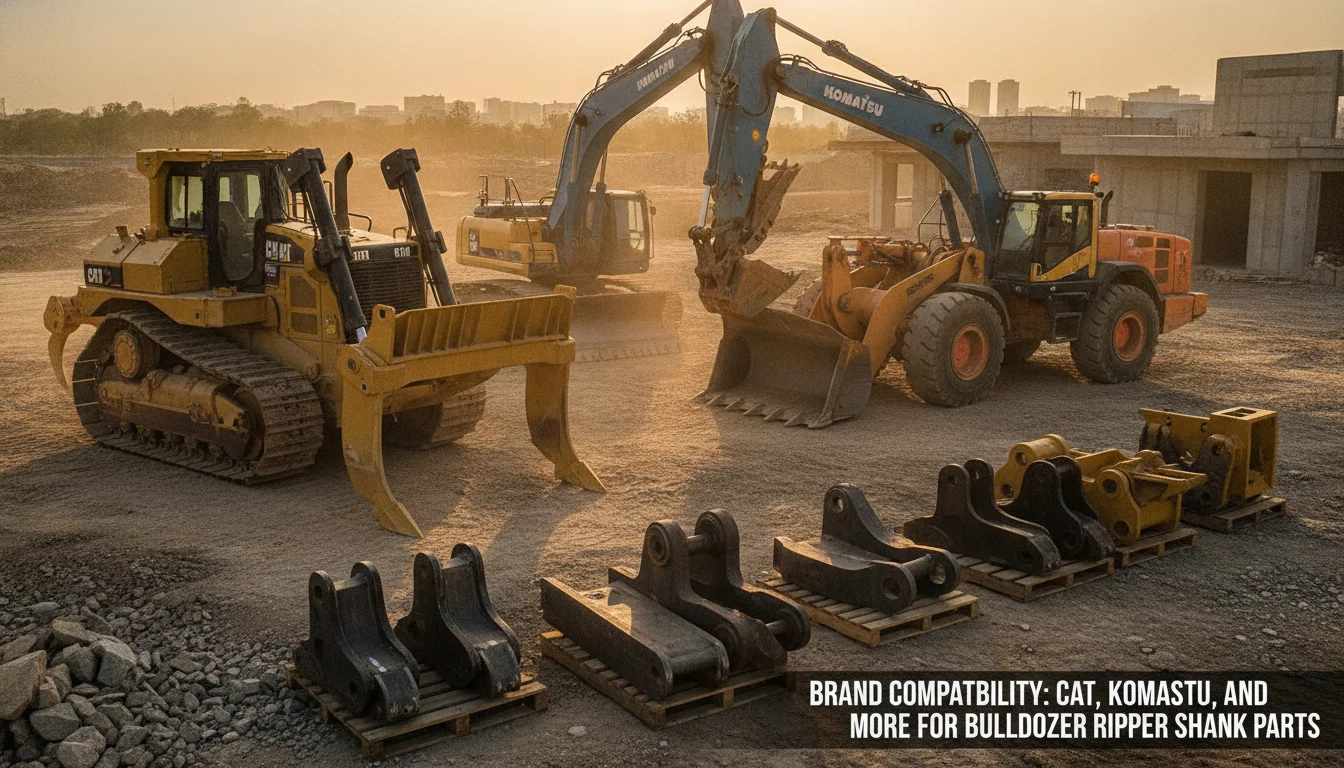
Brand compatibility is one of the first things to confirm before ordering replacement parts. The ripper shank market covers a wide range of OEM-style fitments, and getting the wrong part number means downtime while you wait for the correct component.
For Caterpillar dozers, common ripper shank part numbers include the 8E8414 (a 91.5-inch shank for D9/D10 series, 3.5 inches thick and 14 inches wide), along with related components such as the 4T4502 tooth, 9W8365 ripper guard, 103-8115 shank adapter, and 107-3361 shank nose. Other verified CAT-style shank SKUs include 8E8411, 8E8412, 8E8413, 8E8415, 8E8416, 8E5339, 8E5340, 8E5342, 8E5346, 8E5347, 9W7382, 9J3139, 9J8913, 9J8923, 8J3215, 8J5299, 1U1257, 1049277, 1144503, and 1182140.
Komatsu dozers are another major category. Quality aftermarket suppliers carry Komatsu-style ripper shanks and boots that fit the same pin retention systems as OEM parts, so installation requires no modification.
When ordering, always cross-reference your dozer's model and serial number against the supplier's compatibility chart. A D9 shank will not fit a D6 frame, and using an incorrect shank puts stress on the ripper frame that can cause structural damage over time.
What to Look For When Buying Bulldozer Ripper Shank Parts
The right purchase decision comes down to five practical criteria: material quality, dimensional fit, pin retention system, boot availability, and supplier reliability.
Material Quality
Look for shanks made from hardened steel with verified heat treatment. The shank body absorbs enormous impact forces during operation, and low-grade steel will crack or deform under heavy ripping loads. Quality aftermarket shanks are manufactured to the same hardness specifications as OEM parts. Ask your supplier for material certification if you're procuring for a large fleet.
Fit and Compatibility
Confirm the part number against your bulldozer's model and serial number. Check bolt hole spacing, shank thickness, width, and length against OEM specifications. For example, the CAT 8E8414 shank has bolt hole spacing of 8.66 inches from the edge to the center of the first hole and 17.32 inches to the second - these dimensions must match your ripper frame exactly.
Pin Retention System
The pin retention system secures the ripper boot to the shank. Caterpillar's CapSure hammerless design, for instance, allows fast boot removal and installation without hammering, reducing injury risk during maintenance. When evaluating aftermarket options, confirm the retention system is compatible with your existing boots or that replacement boots are readily available.
Supplier Reliability and Lead Time
For global operations, lead time matters as much as price. A shank sitting in a warehouse in the wrong country does you no good when a machine is down on a job site. Prioritize suppliers with proven global shipping capability and in-stock inventory. At 3GEN Export, we ship OEM-quality ripper shank parts worldwide with a 5-day delivery target to most destinations.
Price Range Expectations
Prices for these parts vary based on brand, type, and quality. Here's a general breakdown based on current market data:
- Budget: $100 - $300 for basic aftermarket ripper boots and tips.
- Mid-Range: $300 - $800 for higher-quality aftermarket shanks and system components.
- Premium: $800 and above for OEM parts or specialized aftermarket solutions. Note: a CAT 8E8414 shank for D9/D10 series is listed at $4,787 from OEM-style suppliers, reflecting the size and complexity of large dozer components.
Comparison of Ripper Shank Options
| Type | Best Use | Price Range | Compatibility | Key Advantage |
|---|---|---|---|---|
| Single Shank | Deep ripping, rock, frozen ground, permafrost | $300 - $800+ | Model-specific (e.g., CAT D9/D10) | Maximum penetration force at a single point |
| Multi-Shank (3 or 5 shank) | Pre-ripping, looser material, large area coverage | $200 - $600 | Various models | Wider coverage, faster pre-ripping |
| Ripper Boots (Short) | Extreme impact conditions, hard rock | $50 - $150 | Multiple brands | Maximum strength, breakage resistance |
| Ripper Boots (Intermediate) | General-purpose, moderate conditions | $75 - $175 | Multiple brands | Balanced wear life and strength |
| Ripper Boots (Long) | Low-impact, abrasive conditions | $100 - $200 | Multiple brands | More wear material, best value in soft ground |
How to Choose the Right Ripper Shank for Your Application
Choosing correctly starts with understanding your ground conditions and your dozer's rated ripping capacity. Here's a practical decision framework used by experienced procurement managers.
Step 1: Assess Your Ground Conditions
Hard rock, frozen ground, and heavily compacted hardpan all demand a single shank ripper with short or intermediate boots. Looser material, pre-ripping ahead of scrapers, or agricultural ground preparation calls for a multi-shank setup with intermediate or long boots. Not all surfaces should be ripped - evaluate the material before committing to a configuration.
Step 2: Match the Shank to Your Dozer Model
A CAT D11 requires a different shank profile than a D6 or D9. Komatsu D155 and D375 dozers have their own frame dimensions and bolt patterns. Always start with your dozer's model and serial number, then cross-reference against the supplier's compatibility chart. Using an undersized shank on a large dozer wastes the machine's ripping capacity; using an oversized shank on a smaller dozer risks frame damage.
Step 3: Select the Boot Profile
Once you've chosen the shank, select the boot based on impact vs. abrasion balance. Symmetrical centreline boots work well in mixed conditions. Penetration-style boots are better for aggressive ripping in dense material where initial ground entry is the main challenge.
Step 4: Verify the Retention System
Confirm that the boot's pin retention system matches your shank. Hammerless systems like CAT's CapSure reduce maintenance time and injury risk. If you're switching from a hammer-based system, factor in the cost of adapter components.
Step 5: Confirm Lead Time and Availability
For active job sites, a part that's out of stock or stuck in customs is as bad as no part at all. Confirm your supplier has the part in stock and can ship to your location within your downtime tolerance. This is especially critical for remote mining and infrastructure projects where logistics are already complex.
Pros and Cons of Aftermarket vs. OEM Ripper Shank Parts
Pros
- Lower cost: Aftermarket parts consistently come in below OEM pricing, which matters on high-wear components replaced frequently.
- Wider availability: Aftermarket suppliers often carry larger inventories and can ship faster than OEM dealer networks.
- Cross-brand fit: A single aftermarket supplier can cover CAT, Komatsu, Volvo, and other brands, simplifying procurement for mixed fleets.
- OEM-equivalent performance: Quality aftermarket parts are engineered to meet or exceed OEM specifications in hardness, dimensional accuracy, and wear life.
- Flexible ordering: Bulk pricing and global shipping options make aftermarket sourcing practical for large fleet operators.
Cons
- Quality varies by supplier: Not all aftermarket parts are equal. Low-grade imports may use softer steel that wears faster or cracks under heavy loads.
- Warranty considerations: Some OEM warranties may be affected by the use of non-OEM parts. Verify your equipment warranty terms before switching.
- Compatibility risk: Without careful part number verification, aftermarket parts can be mismatched - always cross-reference against OEM specs.
- Limited documentation: Some aftermarket suppliers provide less technical documentation than OEM sources, making spec verification harder.
Care and Maintenance of Ripper Shank Parts
Proper maintenance of your ripper system is the most cost-effective investment you can make. A well-maintained shank and boot set lasts significantly longer than a neglected one, and the labor cost of regular inspection is a fraction of the cost of an unplanned replacement.
Regular Inspections
Inspect the ripper shank and all components after every shift in demanding conditions, or at minimum weekly during active use. Look for cracks in the shank body, bends or deformation, excessive wear on the boot tip, and looseness in the pin retention system. Catching a cracked shank early prevents catastrophic failure that can damage the ripper frame itself.
Pro Tip: Keep a set of go/no-go wear gauges on site. Many GET suppliers provide these free with bulk orders. They take the guesswork out of boot replacement decisions and prevent operators from running boots past their safe wear limit.
Cleaning
After each use, clean the ripper shank parts to remove dirt, debris, and other contaminants. Packed clay and fine abrasive material accelerate corrosion at pin retention points and can make boot removal difficult during the next service interval. A pressure wash at end of shift takes minutes and saves hours of maintenance labor later.
Lubrication
Ensure all moving parts and pivot points are adequately lubricated to reduce friction and wear. Follow the manufacturer's recommendations for lubrication intervals and grease types. On most dozer ripper systems, the beam pivot and cylinder pins require regular greasing - neglecting these points leads to accelerated wear on components that are far more expensive to replace than the shank itself.
Boot Replacement Timing
Replace ripper boots before they wear through to the shank body. Once the shank itself starts taking abrasion damage, you're looking at a much larger repair bill. Intermediate-length boots in moderate conditions typically give a reliable service window, but always let ground conditions and inspection results drive the replacement decision rather than a fixed calendar schedule.
2026 Outlook: What's Changing in the Ripper Shank Market
This year, procurement teams sourcing bulldozer ripper shank parts are navigating a market shaped by two main forces: global infrastructure investment and supply chain diversification. Large-scale mining and construction projects across Southeast Asia, the Middle East, and Sub-Saharan Africa are driving sustained demand for GET components, particularly for CAT and Komatsu dozer fleets.
At the same time, buyers are moving away from single-source OEM dependency and building relationships with quality aftermarket suppliers who can offer consistent stock, competitive pricing, and reliable global logistics. Hammerless retention systems, like Caterpillar's CapSure design, are becoming more common across new equipment deliveries - meaning replacement parts procurement needs to account for these newer retention standards when ordering boots and adapters.
For fleet managers planning parts budgets in 2026, the practical advice is straightforward: identify your highest-wear GET items, establish a reliable aftermarket supply relationship, and keep a buffer stock of ripper boots on site for your most active machines. Downtime is always more expensive than inventory.
Frequently Asked Questions
What is a bulldozer ripper shank?
A bulldozer ripper shank is a long, curved ground-engaging tool mounted at the rear of a dozer that breaks up hard ground, compacted soil, rock, and frozen material. It attaches to the ripper frame and works with ripper boots (tips) and shank protectors to form a complete ripping system. The shank concentrates the dozer's drawbar force into a penetrating action that fractures dense material for easier loading and movement.
How do I know which ripper shank parts to buy?
Start with your bulldozer's model and serial number, then cross-reference against the supplier's compatibility chart. Confirm shank dimensions (length, width, thickness), bolt hole spacing, and pin retention system compatibility. Also consider your ground conditions: hard rock and frozen ground call for a single shank with short or intermediate boots, while pre-ripping in looser material suits a multi-shank setup with longer boots.
Are aftermarket ripper shank parts reliable?
Yes, quality aftermarket parts are engineered to meet or exceed OEM specifications and deliver reliable performance at a lower cost. The key is sourcing from a reputable supplier who can provide material certifications and dimensional verification. Low-grade imports do exist in the market, so vet your supplier carefully and ask for references from similar fleet applications.
What maintenance do ripper shank parts require?
Regular inspections after each shift or weekly during active use, cleaning after every use to remove abrasive material from pin retention points, and lubrication of all pivot points and beam pins are the three core maintenance tasks. Replace ripper boots before they wear through to the shank body to avoid costly shank damage. Catching wear early is always cheaper than emergency replacement.
Can I use ripper shank parts from different brands on my dozer?
Many aftermarket ripper shank parts are designed to be compatible across brands, but always verify compatibility with your specific model before ordering. A shank designed for a CAT D9 will not fit a D6 frame, and dimensional mismatches can damage the ripper frame. Cross-reference part numbers carefully and use a supplier's compatibility chart or speak directly with their technical team.
What is the difference between a ripper shank and a ripper boot?
The ripper shank is the main structural body of the ripping attachment - the long, curved steel arm that mounts to the ripper frame. The ripper boot (also called a ripper tip or ripper tooth) is the replaceable wear component that attaches to the end of the shank via a pin retention system. Boots are designed to be replaced regularly as they wear, protecting the more expensive shank body from direct abrasion and impact damage.