
How to Choose a Construction & Mining Parts Supplier
Compare a construction and mining equipment parts supplier by OEM coverage, warranty, and delivery speed. Get 3GEN Export's 2026 procurement checklist now.
Loading article…
Article Not Found
The article you're looking for doesn't exist or may have been removed.
Back to Blog- Prioritize parts identification support over the lowest sticker price; misidentified parts cause avoidable downtime.
- OEM, aftermarket, and remanufactured parts each solve different problems; match the part type to the failure mode and budget.
- Mixed-fleet coverage matters; choose a construction and mining equipment parts supplier that can source across Komatsu, Sandvik, Epiroc, Atlas Copco, Chicago Pneumatic, Caterpillar, and hydraulic brands.
- Warranty, return policy, and logistics speed are procurement safeguards, not extras.
- Planned maintenance and proper storage extend part life more than any single premium upgrade.
A construction and mining equipment parts supplier is a distributor that stocks and ships OEM, aftermarket, and remanufactured components for drills, loaders, haul trucks, and hydraulic systems. Compare suppliers by identification support, inventory depth, warranty terms, and shipping speed before you order.
Key Takeaways
- A parts supplier should offer parts identification help, not just an order form.
- Mixed fleets need one supplier that can cover Komatsu, Caterpillar, Sandvik, Epiroc, Atlas Copco, and Chicago Pneumatic equipment.
- OEM parts protect warranty compliance; aftermarket and remanufactured parts often cut cost without cutting reliability.
- Warranty length, return policy, and logistics reach determine how fast a downed machine gets back to work.
- Total landed cost, including downtime, matters more than unit price alone.
- Planned maintenance and correct storage extend the service life of any replacement part.
The difference between a good supplier and an expensive mistake often shows up only after a machine is down. According to MMPAS, a $50 component can stop a machine worth hundreds of thousands of dollars, so buyers should look well beyond the lowest online price.
What to Look For in a Construction and Mining Equipment Parts Supplier
A this type of supplier is a distributor or reseller that stocks, sources, and ships replacement components for heavy equipment used in mining, quarrying, and construction. The strongest suppliers combine catalog breadth with technical knowledge, because part numbers alone rarely tell the full story when a haul truck, hydraulic excavator, or pneumatic drill is down.
Parts Identification and Technical Support
The first test is whether the supplier can help identify the correct component from a serial number, part number, or even a photograph. According to MMPAS's 2026 supplier guide, the right supplier must help identify the correct component, understand equipment applications, offer suitable OEM or aftermarket options, and get the part where it needs to go before downtime becomes the largest item on the invoice. A supplier that only processes order line items adds little value when a mixed fleet includes machines from Komatsu, Caterpillar, Sandvik, Epiroc, Atlas Copco, and Chicago Pneumatic.
Inventory Depth and Mixed-Fleet Coverage
Inventory depth is not just about the number of SKUs. Vintage Parts, for example, lists over 8,778 construction and mining part items from more than a dozen original manufacturers, including Caterpillar, Komatsu, Liebherr, Hitachi, John Deere, and Link-Belt. That breadth matters for older equipment, where OEM production may have ended but exact-fit parts still exist. For active fleets, Road Machinery & Supplies Co. supports mining equipment from Komatsu, Astec, Epiroc, and Sandvik, and its parts inventory includes a warranty and guaranteed fit protection. Choose a this kind of parts supplier that can handle both mixed OEM fleets and aftermarket alternatives under one roof, so your team isn't juggling five vendor logins to fix one fleet.
Warranty, Return Policy, and Logistics Speed
Warranty and return terms are procurement safeguards. Vintage Parts advertises a 30-Day Return Policy, which reduces risk when ordering by part number alone. Logistics speed is equally critical for remote mining operations; RMS notes that many service providers are not equipped or staffed to provide service to remote mining operations. A the and mining equipment parts supplier with on-site service capabilities and a distribution network can keep a downed machine from becoming a multi-day outage. As of 2026, global buyers increasingly weigh shipping lead time as heavily as price, since a part stuck in customs does nothing for a stalled job site.
Step-by-Step Supplier Selection Process
- Step 1: Collect the exact part number, serial number, and machine model. This narrows the search and avoids version mismatches.
- Step 2: Confirm whether you need an OEM, aftermarket, or rebuilt component. Match the part type to the failure mode, warranty requirements, and budget.
- Step 3: Verify the supplier's brand coverage and parts identification support. Ask whether they source for Komatsu, Sandvik, Atlas Copco, Chicago Pneumatic, or your specific fleet.
- Step 4: Check warranty, return policy, and guaranteed fit protection. A 30-day return policy is a useful baseline for high-value parts.
- Step 5: Compare total landed cost, not just unit price. Include freight, import duties if applicable, and downtime cost per hour.
A $50 component can stop a machine worth hundreds of thousands of dollars. The right supplier must help identify the correct component, understand equipment applications, offer suitable OEM or aftermarket options, and get the part where it needs to go before downtime becomes the largest item on the invoice. MMPAS, 10 Best Mining Spare Parts Suppliers in the USA (2026)
OEM vs Aftermarket vs Remanufactured: Which Model Fits Your Fleet?
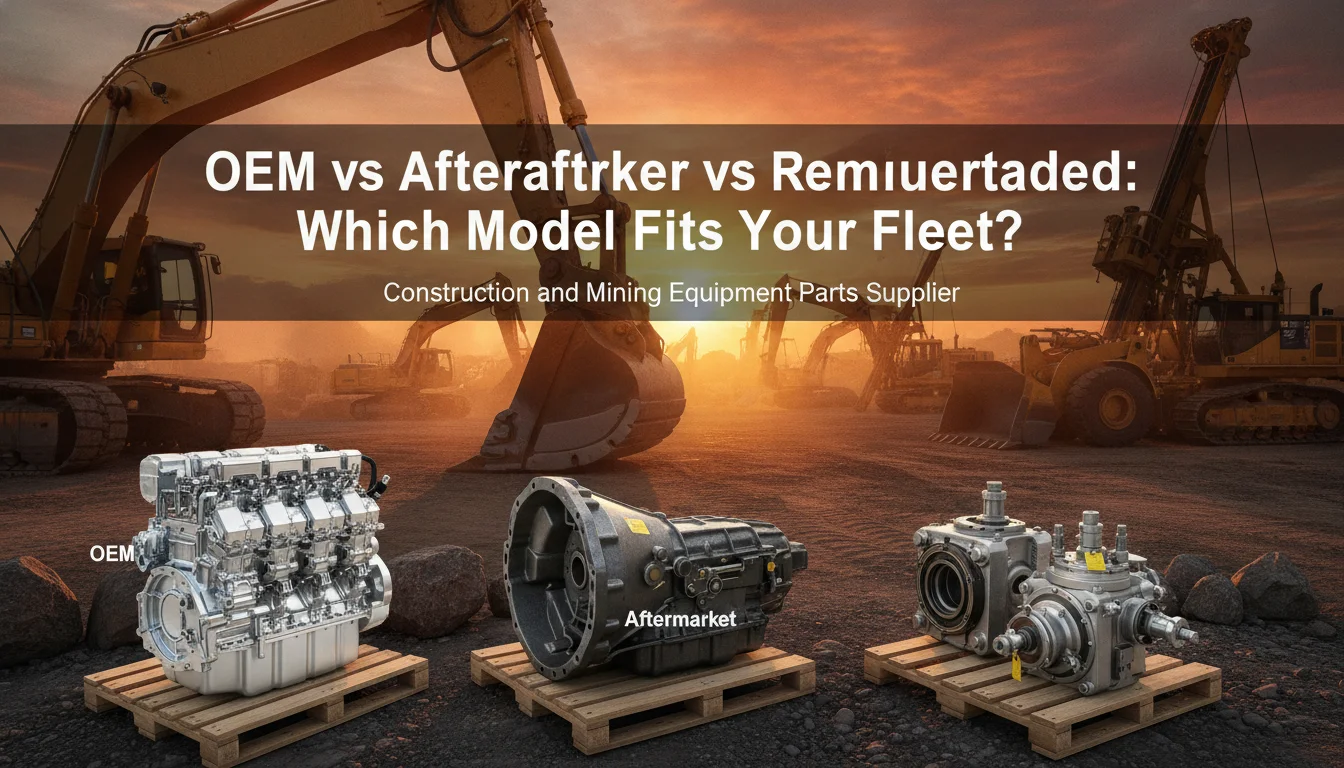
OEM, aftermarket, and remanufactured parts each fit a different budget and risk profile, and the right choice depends on the failure mode and how critical the component is. OEM parts are made by the original equipment manufacturer or its licensed suppliers. Aftermarket parts are made by a different company than the original equipment manufacturer and are often designed to improve the original part, according to DMC Wear Parts. Remanufactured parts are rebuilt to original specifications; used parts are removed from a donor machine and sold as-is. A reliable supplier will carry all three and help you decide which fits the application.
OEM Parts: Original Manufacturer Fit
OEM parts provide the closest match to original specifications and are often required for warranty compliance on newer machines. Haladjian Minerals Solutions, a multi-brand distributor based in France, supplies wear parts and mechanical parts for Metso and Sandvik crushing and grinding equipment, which are common in mineral processing. For hydraulic systems, Roch USA supplies OEM and aftermarket main pumps, charge pumps, gear pumps, travel motors, swing motors, main control valves, and final drives designed for mining environments with extreme temperatures and heavy loads.
Aftermarket Parts: Value and Upgrade Potential
Aftermarket parts can match or exceed OEM durability at a lower price, but quality varies by manufacturer. DMC Wear Parts defines aftermarket mining equipment parts as items manufactured by a different company than the original piece of equipment, generally made for specific purposes and designed to improve the original part. Vikay Mining Equipments, a global supplier from India, positions its new aftermarket replacement parts as OEM quality for Atlas Copco and Chicago Pneumatic rock drills, drifters, wagon drills, and air tools. The key is not the label but the metallurgy, tolerance, and warranty behind the part.
Remanufactured and Used Components: Cost vs Risk
Remanufactured components are disassembled, cleaned, machined, and tested to meet O.E. specifications, offering a middle ground between new OEM and used. Used parts are the lowest upfront cost but carry the highest fit and wear risk. MMPAS's ranking includes suppliers like H-E Parts and ProParts & Equipment that source remanufactured and used components depending on application and availability. For critical drivetrain or hydraulic assemblies, remanufactured with a warranty often beats used.
| Supplier Type | Pros | Cons | Best For |
|---|---|---|---|
| OEM Parts | Exact fit, warranty compliance, known durability | Higher price, sometimes longer lead times | Newer machines under warranty; critical safety components |
| Aftermarket Parts | Lower cost, potential design improvements, wide availability | Quality varies; may void warranty if not approved | Older equipment, wear parts, non-safety components |
| Remanufactured Parts | Significant cost savings vs new OEM, warranty included | Availability limited; core charge may apply | Transmissions, pumps, final drives, engines |
| Used Parts | Lowest upfront cost, immediate availability for obsolete models | Unknown wear, limited warranty, potential hidden damage | Vintage or discontinued machines; emergency temporary fixes |
Pros and Cons of Working With a Multi-Brand Parts Supplier
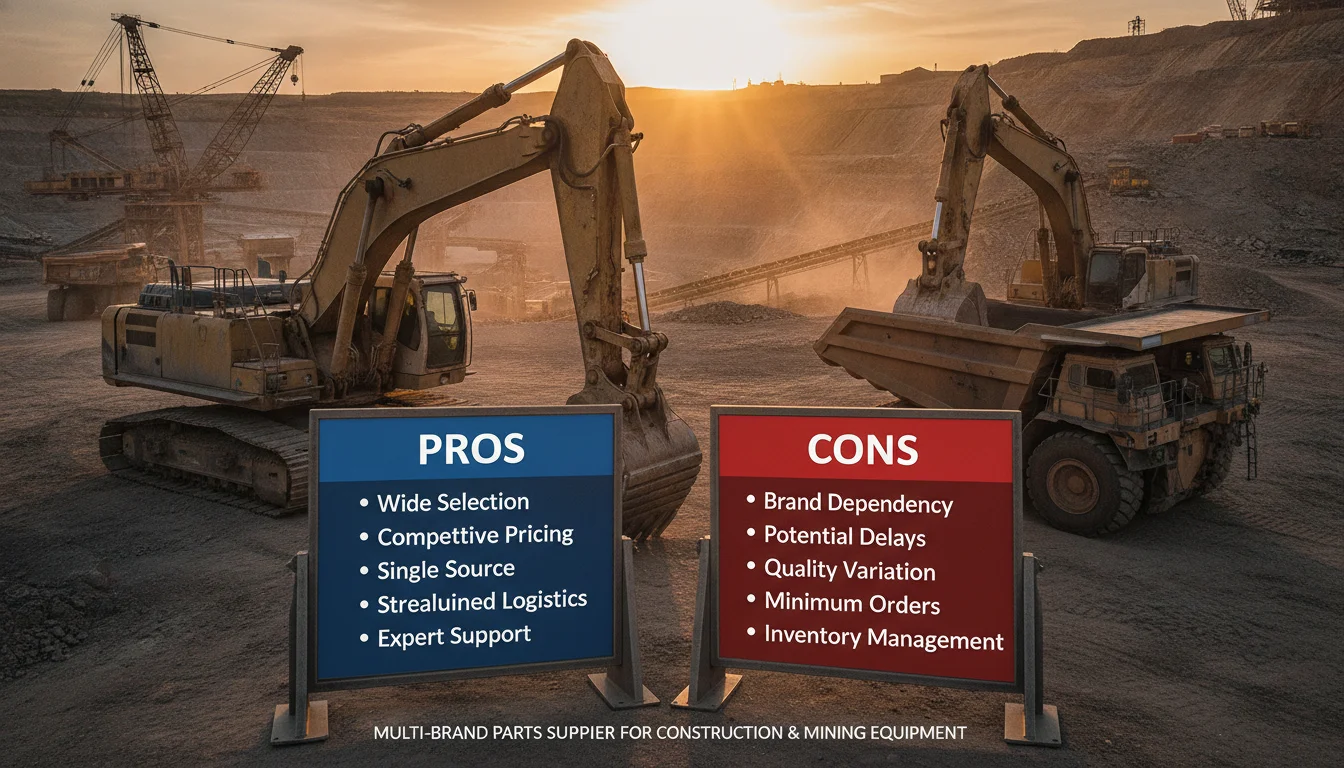
Pros
- One point of contact for mixed fleets covering Komatsu, Caterpillar, Sandvik, Volvo, and Atlas Copco equipment.
- Access to OEM, aftermarket, and remanufactured options under one order, which simplifies budgeting.
- Faster identification of correct parts using serial numbers, reducing costly misorders.
- Stronger negotiating position on freight and lead times when consolidating purchase volume.
Cons
- Broader catalogs sometimes mean less specialization in a single niche brand or part category.
- Warranty terms can vary by part type within the same supplier, so buyers must check each line item.
- Remote sites may still face longer transit times depending on the supplier's distribution network.
How to Match Parts to Your Equipment Fleet
Matching parts to a fleet works best when you group components the way a mechanic builds a capability set: drills, hammers, pumps, and undercarriage parts sourced together for one machine class. These combinations work for common mining and construction equipment configurations.
Drill and Air Tool Combinations
For pneumatic rock drilling, match a Chicago Pneumatic rock drill with a compatible pusher leg, coupling sleeve, shank adapter, and drill bit. Suppliers list these as a set: rock drill, pneumatic drifter, pusher legs, DTH hammer, and air line lubricators. Pair a Chicago Pneumatic hand drill with a chipping hammer and a paving breaker for surface construction and light demolition; all three share the same compressed air supply requirements.
Hydraulic System and Undercarriage Pairings
For hydraulic excavators and haul trucks, combine a main pump, swing motor, travel motor, and main control valve from a single hydraulic specialist when possible. Roch USA offers this combination along with final drives for mining machinery operating in harsh environments, extreme temperatures, and heavy loads. For tracked machines, pair undercarriage parts, track chains, rollers, idlers, sprockets, with grader blades and carbide bits to keep the machine moving and cutting.
Wear Parts and Ground-Engaging Tools
Wear parts are fundamental components of mining machines and need to be regularly checked and replaced to ensure efficient mineral production, according to Haladjian Minerals Solutions. For a crusher, pair a concave, mantle, and cheek plate from a Metso or Sandvik wear parts catalog. For a loader, pair bucket teeth, cutting edges, and wear liners. Planned replacement of these consumables prevents the larger mechanical failures that follow.
Failure of any mechanical part can result in the forced shutdown of aggregate production machines, a situation that can be avoided with planned maintenance operations. Haladjian Minerals Solutions
Price Ranges and Value Tiers
Price expectations vary by part type, brand, and condition, but the overall value equation should include uptime cost. A $50 component can stop a machine worth hundreds of thousands of dollars, so the cheapest unit price is rarely the cheapest total cost.
Budget Tier: Commodity Wear Parts
Budget-tier parts include drill bits, cutting edges, teeth, seals, filters, and air line lubricators. These are high-volume consumables where aftermarket suppliers compete on price and availability. Quality still matters: a poorly heat-treated drill bit can fail mid-shift and cost far more than the price difference.
Mid-Range Tier: Common Replacement Components
Mid-range parts include hoses, cylinders, bearings, pins, bushings, and smaller hydraulic components. Vintage Parts lists items such as a 1/2 inch ID x 31 inch hose assembly, high pressure cutoff switches, gaskets, tail/stop/turn lamps, steering valve spools, and tachometer shafts for Caterpillar equipment. These parts often have direct OEM and aftermarket equivalents, and a 30-day return policy reduces procurement risk.
Premium Tier: Critical Drivetrain and Hydraulic Assemblies
Premium-tier parts are main pumps, final drives, swing motors, transmissions, torque converters, and electric drive haul truck components. These are high-dollar items where OEM or proven remanufactured sources make sense. Haladjian Minerals Solutions supplies mechanical and wear parts for Metso and Sandvik crushing and grinding machines; RMS provides component refurbishment and replacement for mining equipment, including a full-service hydraulics maintenance division. Expect longer lead times and the need for core returns or serial number verification.
Care & Maintenance: Extending the Life of Replacement Parts
A replacement part's service life depends on installation, lubrication, contamination control, and storage. Planned maintenance is the difference between a scheduled replacement and a forced shutdown.
Planned Maintenance and Inspection Schedules
Haladjian Minerals Solutions notes that failure of any mechanical part can result in the forced shutdown of aggregate production machines, a situation that can be avoided with planned maintenance operations. Build a schedule around operating hours: inspect wear liners, hydraulic hoses, and undercarriage components at intervals recommended by the equipment manufacturer. Keep a parts usage log to predict future replacement needs.
Storage and Handling for Spare Parts
Store hydraulic components in clean, dry, temperature-stable conditions. Keep machined surfaces protected with rust inhibitor and cap open ports to prevent contamination. For drill bits and wear parts, organize by part number and machine model so a midnight breakdown does not turn into a parts identification exercise.
Pro Tip: Keep a laminated cross-reference sheet at the parts counter matching your fleet's OEM part numbers to their aftermarket and remanufactured equivalents. It shaves minutes off every emergency order, and minutes matter when a haul truck is parked.
When to Repair vs Replace
Repair makes sense for a cracked housing or a minor leak where the core is sound. Replace when wear exceeds the manufacturer's discard specification, when the cost of machining and testing approaches the price of a remanufactured unit, or when the part has already been rebuilt multiple times. MMPAS highlights that many suppliers now offer repair or rebuild support alongside parts sourcing, which changes the economics for expensive assemblies.
Regional and Global Sourcing Considerations
Regional sourcing matters because part availability and lead times differ sharply between local distributors and global suppliers with cross-border logistics networks. Buyers searching for a construction and mining equipment parts supplier near a specific region, whether that's a domestic distributor or an overseas source, should weigh transit time against catalog depth. A supplier limited to one country's inventory may struggle with older or imported machines, while a global construction and mining equipment parts supplier with warehousing across multiple regions can often match or beat local lead times on common wear parts. This year, more procurement teams are qualifying at least one international supplier as a backup source, specifically to avoid single-point-of-failure risk on critical components.
Conclusion: Choosing a Reliable Construction and Mining Equipment Parts Supplier
The best construction and mining equipment parts supplier for your operation combines catalog breadth, parts identification expertise, transparent warranty terms, and logistics reach. It should support your entire mixed fleet, whether that includes Komatsu haul trucks, Atlas Copco drill rigs, Chicago Pneumatic air tools, Sandvik crushers, or Caterpillar dozers, without forcing you to manage a dozen separate vendor relationships. Start with the part number, verify the supplier's brand coverage and return policy, then compare total landed cost including downtime. A supplier that answers the phone when a machine is down at 2 a.m. is worth more than a few points of margin on a wear part. Shop OEM-quality spare parts with global 5-day delivery at 3genexport.com.
Frequently Asked Questions
How do I choose a construction and mining equipment parts supplier?
Choose a supplier with parts identification support, brand coverage for your mixed fleet, transparent warranty and return terms, and fast logistics to your site. Compare total landed cost including downtime, not just unit price.
What is the difference between OEM and aftermarket mining equipment parts?
OEM parts are made by the original equipment manufacturer; aftermarket parts are made by a different company and are often designed to improve the original part. Both can be high quality, but aftermarket quality varies by manufacturer.
Do construction and mining equipment parts suppliers offer returns?
Return policies vary. Some suppliers, like Vintage Parts, advertise a 30-day return policy. Always confirm return terms and guaranteed fit protection before ordering high-value components.
Which parts should I buy OEM vs aftermarket?
Buy OEM for warranty compliance and critical safety components; consider aftermarket for older equipment, wear parts, and non-safety components where quality can be verified.
How fast can a supplier ship replacement parts to a remote mine?
Speed depends on the supplier's distribution network and on-site service capabilities. Some suppliers, like Roch USA, offer 24/7 support and worldwide reach; ask for guaranteed lead times before you need the part.
What maintenance records help a supplier identify the right part?
Provide the part number, serial number, machine model, and operating hours. A parts usage log and failure history help the supplier recommend the correct OEM, aftermarket, or remanufactured option.