
Construction Equipment Preventive Maintenance Guide
Construction equipment preventive maintenance cuts repair costs 25% and extends machine life. Get OEM-based schedules, checklists, and expert tips.
Loading article…
Article Not Found
The article you're looking for doesn't exist or may have been removed.
Back to BlogConstruction equipment preventive maintenance is a scheduled, proactive system of inspections, lubrication, fluid analysis, and component replacement designed to prevent breakdowns, lower repair bills, and extend machine life.
Key Takeaways
- preventive maintenance can reduce machinery repair bills by 25 percent, according to MacAllister Machinery, saving roughly $6,000 on an $80,000 machine over 5,000 operating hours.
- Preventive maintenance is a proactive management system built on OEM intervals and engine hours, not a reactive fix after failure.
- The four common maintenance strategies are preventive, predictive, condition-based, and reactive. Predictive uses telematics data from Caterpillar VisionLink or John Deere Operations Center.
- Equipment-specific checks, including excavator hydraulics, bulldozer tracks, and crane cables, must be combined with fluid analysis and daily operator inspections.
- A documented this type of maintenance program protects resale value and extends equipment lifespan across your entire fleet.
- A dedicated coordinator, OEM-based intervals, and structured records are the three non-negotiables of any successful program.
What Is Construction Equipment Preventive Maintenance?
Defining Preventive Maintenance for Heavy Equipment
this kind of preventive maintenance is a proactive management strategy that involves routine inspections, regularly scheduled servicing, and upkeep for normal wear. It extends well beyond greasing pivot points and changing engine oil. According to MacAllister Machinery, a complete preventive maintenance program includes systematic inspections, modification and replacement of components, performance testing, and analysis.
Routine maintenance is a subset of the broader program. It covers lubrication, oil changes, and filter changes on a scheduled basis. The distinction matters: routine maintenance is a single task, while the equipment preventive maintenance is a management system that incorporates scheduled tasks, condition data, and repair history.
How Preventive Maintenance Differs from Run-to-Failure Repairs
Reactive repair is the direct opposite of preventive maintenance, and it is the most expensive approach a fleet can take. It couples the cost of the repair itself with unplanned downtime, emergency parts delivery, and often secondary damage to adjacent components. As Tread notes, the construction industry saying holds true: a dime of routine and preventive maintenance is worth a dollar in repairs.
maintenance helps anticipate wear before it becomes failure. Corrective actions are taken continuously to ensure reliability and performance. The practical outcome is that fleets replace parts on schedule, rather than waiting for a tracked excavator to seize a final drive on a remote jobsite.
The Seven Commonly Cited Elements of a PM Program
Across dealer service guides, fleet management platforms, and heavy equipment training programs, seven elements appear consistently. construction equipment is most complete when it includes all of the following:
- Scheduled inspections at daily, weekly, and hour-based intervals.
- Lubrication control for pins, bushings, bearings, and pivot joints.
- Fluid analysis for engine oil, hydraulic fluid, coolant, and fuel.
- Filter management for air, oil, fuel, and hydraulic systems.
- Wear component monitoring for undercarriage, cutting edges, and belts.
- Documentation of maintenance actions, fault codes, and oil sample results.
- Operator and technician training on inspection points and service procedures.
How a Preventive Maintenance Program Protects Fleet Budgets
The 25 Percent Repair Bill Reduction Backed by Dealer Data
Construction equipment preventive maintenance can reduce machinery repair bills by 25 percent, according to MacAllister Machinery. In a dealer example, an $80,000 machine that would normally require about $24,000 in maintenance and repair costs during 5,000 operating hours drops to approximately $18,000 when a sound preventive program is followed. That $6,000 difference per machine multiplies quickly across a fleet of excavators, dozers, and articulated trucks.
"Preventive maintenance can reduce machinery repair bills by 25 percent. An $80,000 machine that requires approximately $24,000 in maintenance and repair costs during 5,000 operating hours drops to $18,000 with a sound PM program." - MacAllister Machinery, Caterpillar dealer, Indiana and Michigan
Downtime, Safety, and Resale Value
Poor maintenance is a leading cause of equipment failures, worker injuries, and worker deaths in the construction industry, according to Heavy Equipment College. Construction equipment preventive maintenance reduces wear and tear, prevents breakdowns, enhances longevity, and saves money by minimizing repair, replacement, and labor costs. The average cost for a piece of heavy equipment is over $20,000, as reported by ConstructConnect, so a large share of a company's assets may be tied up in construction vehicles and heavy equipment.
Documented maintenance history also protects resale value. Buyers and auction inspectors consistently pay more for equipment with complete service records because those records reduce uncertainty about engine hours, hydraulic health, and undercarriage wear.
Why Engine Hours, Not Mileage, Drive Service Intervals
Heavy equipment service is typically tracked by engine hours rather than mileage, following OEM recommendations or internal shop standards. An excavator does not accumulate road miles the way a service truck does. It may idle for hours, operate at high load for short bursts, or work in dust and mud. Engine-hour tracking aligns service actions with actual operating stress, which is why OEM manuals specify intervals in hours for engine oil, hydraulic oil, final drives, and undercarriage components.
Core Maintenance Strategies for Heavy Equipment Fleets

Four Strategies: Preventive, Predictive, Condition-Based, and Reactive
Fleet managers choose from four common equipment maintenance strategies. According to Fleetio, preventive maintenance guarantees service based on engine hours and usage cycles, predictive maintenance uses real-time telematics data to trigger service before failures occur, condition-based maintenance responds to inspection findings and visible wear, and reactive repair is completed only after a failure.
| Strategy | Service Trigger | Best Fit | Main Drawback |
|---|---|---|---|
| Preventive | Engine hours or calendar intervals | Fleet-wide baseline and warranty compliance | Manual tracking can miss intervals |
| Predictive | Telematics fault codes and sensor data | High-value, remote, or critical path equipment | Requires telematics investment and data review |
| Condition-based | Inspection reports and visible condition | Components with variable wear rates | Depends on inspection discipline |
| Reactive | Breakdown or failure | Low-criticality standby tools | Highest unplanned downtime cost |
Predictive Telematics: Caterpillar VisionLink and John Deere Operations Center
Predictive maintenance closes the gap between scheduled service and actual component condition. It draws from data collection to determine if an issue is likely to occur so it can be intercepted before it impacts production. For construction equipment, telematics from Caterpillar VisionLink and John Deere Operations Center can provide early warning of potential failures by automatically pulling fault codes, engine hours, and sensor data. This is especially valuable on large earthmoving spreads where a single loader failure can idle an entire pipe crew.
Hybrid Approaches That Work in the Real World
Most profitable fleets do not rely on one strategy alone. They use preventive intervals as the baseline, condition-based checks for high-wear items such as bucket teeth and track adjusters, and predictive telematics for engines, transmissions, and hydraulic pumps. Reactive maintenance may still be tolerated for low-cost support equipment, but never for production-critical primary machines. Match the strategy to asset criticality and failure consequence, not to a one-size-fits-all rule.
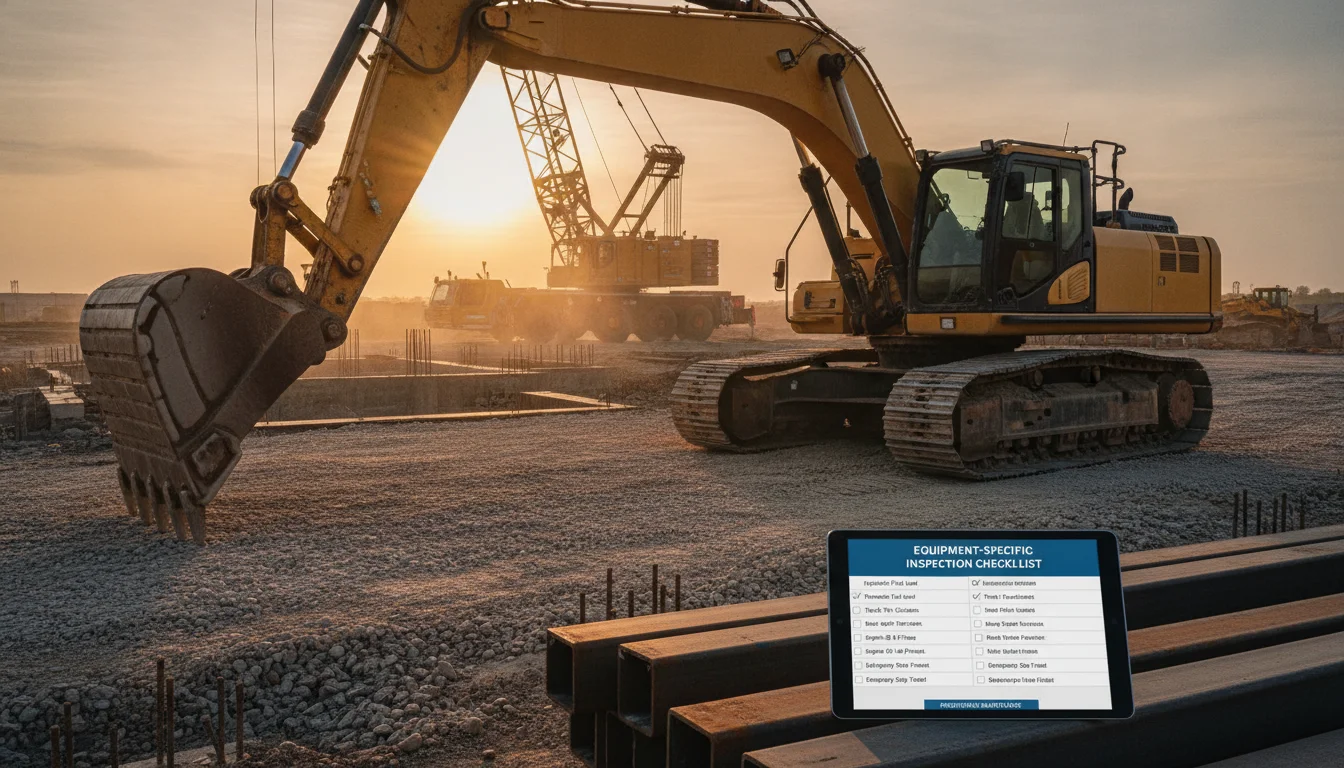
The Equipment-Specific Inspection Checklist
Excavators, Bulldozers, and Cranes: Different Components, Different Risks
Every machine type has its own failure hotspots. According to Limble, excavators require hydraulic system inspections for oil levels, leaks, and the integrity of hoses and seals; boom and arm checks for cracks or damage in welds and joints; undercarriage examination of tracks, rollers, and drive sprockets; engine maintenance including oil changes, filter replacement, and coolant level checks; and electrical system tests for battery, lighting, and control panel functionality.
Bulldozers require blade inspections for wear and alignment, track checks for wear and tension adjustments, and transmission checks for slippage or leaks. Cranes and lifting equipment add wire rope inspection, boom section alignment, and load moment indicator calibration to the list. Loaders and graders require similar attention to cutting edges, articulation joints, and hydraulic cylinders.
Daily Operator Walk-Arounds vs. Hour-Based Service Intervals
Daily inspections catch visible problems before an operator starts a shift. Hour-based service intervals address fluid and filter life, valve adjustments, and component replacements that require accumulated operating time. According to ML Heavy Construction Equipment, effective construction equipment preventive maintenance schedules include daily inspections, hour-based service intervals, fluid analysis, and structured documentation. Daily walk-arounds should cover lights, leaks, track or tire condition, fluid levels, and any abnormal noise from the previous shift.
Documentation as a Diagnostic and Cost-Control Tool
Records of all maintenance inspections and performance issues help address potential problems before they result in breakdowns. According to Mobil's construction equipment maintenance best practices, staying organized is the key. Good records make it easier to identify the root cause of a failure and prevent similar occurrences. For example, if the same hydraulic hose fails on one excavator every 400 hours, the record points to a routing or heat issue rather than an isolated part defect.
Pros and Cons of Construction Equipment Preventive Maintenance
Pros
- Lower repair costs: A structured program can cut machinery repair bills by 25 percent, according to MacAllister Machinery, by catching failures before they escalate.
- Reduced unplanned downtime: Scheduled service keeps machines on the job. Emergency breakdowns on critical-path equipment can idle entire crews.
- Improved operator safety: Poor maintenance is a leading cause of worker injuries and deaths in construction, per Heavy Equipment College. Preventive checks directly reduce that risk.
- Protected resale value: Documented service history gives buyers confidence and supports higher auction and trade-in prices.
- Warranty compliance: Following OEM intervals maintains eligibility for manufacturer warranties, protecting against costly out-of-warranty repair bills.
- Extended machine lifespan: Clean oil, proper filtration, stable cooling, and consistent lubrication allow components to reach or exceed their designed service-hour targets.
Cons
- Upfront time and resource investment: Building a program requires assigning a coordinator, gathering OEM manuals, enrolling machines in fluid analysis, and training operators. That takes time before savings materialize.
- Risk of over-maintenance: Strictly time-based intervals can result in replacing components that still have useful life remaining, adding unnecessary parts cost.
- Manual tracking gaps: Without fleet management software or telematics, engine-hour tracking relies on manual logs that are easy to miss or falsify under production pressure.
- Telematics investment required for predictive programs: Caterpillar VisionLink and John Deere Operations Center deliver real value, but they require hardware, subscription costs, and staff time to review alerts.
Lubrication, Fluids, and Contamination Control
Clean Oil and Proper Filtration
Every major component on a machine has a measurable service life. Engines, hydraulic pumps, cooling systems, and undercarriages are designed to operate for a specific number of hours before rebuild or replacement becomes necessary. According to ML Heavy Construction Equipment, clean oil reduces internal engine friction and proper filtration limits hydraulic contamination. Contamination is the leading cause of hydraulic system failures, so filter changes and breather maintenance matter as much as oil changes themselves.
Fluid Analysis: More Than an Oil Change
Oil analysis identifies wear metals, coolant leaks, fuel dilution, and dirt ingress before a component fails. MacAllister Machinery includes S-O-S fluid analysis for fuel, oil, and coolants as part of its preventive maintenance program options. A single sample can distinguish between a normal wear pattern and an impending crankshaft bearing failure. For high-hour engines and hydraulic systems, fluid analysis should be performed at every oil drain or at OEM-recommended sampling intervals.
"Keeping records of all maintenance inspections and performance issues will help address potential problems before they result in breakdowns and more easily identify the root cause of a failure to prevent similar occurrences. Staying organized is the key." - Mobil Serv Engineering Team, construction equipment maintenance best practices
Cooling System Integrity and Consistent Lubrication
Stable cooling systems prevent heat-related damage, and consistent lubrication reduces metal-on-metal contact, according to ML Heavy Construction Equipment. Overheating accelerates oil degradation, head gasket failure, and transmission damage. Daily coolant level checks, radiator fin cleaning, and fan belt inspection are low-cost actions that protect high-cost assemblies. Lubrication intervals for pins and bushings should follow OEM specifications and be shortened in abrasive or wet conditions.
Building a Maintenance Schedule Around OEM Intervals and Site Conditions
Reading OEM Recommendations Correctly
OEM manuals are not generic suggestions. They define oil viscosity requirements, filter change intervals, hydraulic oil cleanliness targets, and torque specifications. According to Fleetio, construction equipment preventive maintenance should adhere to OEM guidelines for best operating practices. Check your equipment's recommended maintenance intervals first, then apply company-specific factors like climate, operating loads, and site environment. That guidance from Wheeler Cat is the starting point for any schedule.
Adjusting for Climate, Load, and Jobsite Environment
A crawler excavator working in fine dust will need more frequent air filter service than the same model working in wet clay. Arctic cold affects fluid viscosity and battery performance, while desert heat stresses cooling systems and hydraulic oil. Operating loads also change intervals: a wheel loader moving shot rock at full bucket load every cycle ages faster than one handling topsoil. No universal calendar can replace site-level adjustment. Schedules must be living documents, reviewed after each season or major project phase.
Hour-Based, Calendar-Based, and Hybrid Scheduling
Use hour-based schedules for engine oil, hydraulic filters, and undercarriage measurement. Use calendar-based schedules for time-sensitive items like coolant condition, fire extinguisher inspections, and structural bolts that can loosen even in storage. A hybrid approach is common: construction equipment preventive maintenance programs typically layer daily inspections, hour-based service intervals, and fluid analysis as three distinct levels of control. The schedule should specify which tasks are operator-performed, which require a service technician, and which require dealer-level diagnostic equipment.
Technology, Telematics, and Maintenance Documentation
Telematics Data from Caterpillar VisionLink and John Deere Operations Center
Telematics turns a scheduled maintenance program into an early warning system. Caterpillar VisionLink and John Deere Operations Center provide fault codes, engine hours, fuel burn, idle time, and location data. This allows a service department to see that a dozer is idling excessively or that a hydraulic temperature sensor is trending upward before a hose bursts. According to Fleetio, predictive maintenance uses real-time telematics data to monitor asset health and trigger service before failures occur.
From Manual Logs to Fleet Management Software
Manual logbooks are better than no records, but they are hard to search, easy to lose, and often incomplete. Fleet management software automates maintenance tracking, reducing the risk of unexpected downtime. The first step in many programs, according to ConstructConnect, is to assign a dedicated person responsible for managing construction equipment preventive maintenance. That person should centralize all pertinent information, including repair schedules, telematics alerts, owner's manuals, and parts availability, in one location.
Using Maintenance History to Protect Resale Value
When you sell or trade a machine, the buyer is not just buying steel and rubber. They are buying the remaining service life of the engine, hydraulic pump, and undercarriage. Documented maintenance history reduces buyer uncertainty and supports a higher price. OEM dealer networks and auction houses increasingly use service records to determine floor pricing. That is why construction equipment preventive maintenance is also a financial record-keeping function, not only a mechanical task.
Step-by-Step: How to Roll Out a Preventive Maintenance Program
A Numbered Implementation Sequence for Any Fleet Size
Use the following sequence to move from ad hoc repairs to a managed construction equipment preventive maintenance system.
- Step 1: Assign a dedicated maintenance coordinator. According to ConstructConnect, a dedicated person should manage the program, centralize records, and be accountable for schedule compliance.
- Step 2: Inventory every asset and gather OEM manuals. List each machine, serial number, current engine hours, and warranty status. Do not forget support equipment and road vehicles.
- Step 3: Establish baseline service intervals. Use OEM hour-based intervals and apply site-specific adjustments for climate, load, and dust.
- Step 4: Launch daily operator inspections. Train operators on walk-around checkpoints and require a written or electronic report before each shift.
- Step 5: Introduce fluid analysis and telematics monitoring. Enroll critical engines, hydraulics, and final drives in an oil sampling program, and enable telematics fault alerts where available.
- Step 6: Review records monthly and adjust intervals. Use maintenance history to identify repeat failures, update critical spare parts inventory, and refine service scheduling.
Common Rollout Mistakes That Undermine PM Programs
The most common mistake is treating construction equipment preventive maintenance as a paper checklist rather than a management system. Other mistakes include deferring service to hit short-term production targets, manually tracking engine hours without verification, using universal intervals instead of OEM specs, and failing to train new operators on inspection points. Another frequent error is excluding support equipment. A job can stop just as completely when a flatbed truck battery dies or a service crane fails as when a primary excavator breaks down.
Training Operators and Service Technicians
Training should not be optional. MacAllister Machinery lists customer training seminars and training and safety videos as part of a complete preventive maintenance program. Operators who understand why a track tension check matters are more likely to report a loose track before it throws. Service technicians need regular updates on diagnostic technology, fluid sampling procedures, and OEM engineering changes. Heavy Equipment College also emphasizes that preventive maintenance is key to performance, longevity, and operator safety.
As of 2026, the fleets with the lowest downtime combine OEM-based hour intervals, daily operator inspections, fluid analysis, telematics data, and a dedicated coordinator who uses maintenance records to make the next service smarter than the last. Construction equipment preventive maintenance succeeds when it becomes a daily discipline, not a monthly paperwork exercise.
Need OEM-quality replacement parts to support your preventive maintenance program? Shop hydraulic seals, filters, undercarriage components, and more with global 5-day delivery at 3genexport.com.
Frequently Asked Questions
What is preventive maintenance of equipment?
Preventive maintenance is a proactive maintenance strategy that involves routine inspections, regularly scheduled equipment servicing, and upkeep for normal wear. It is performed on a schedule based on engine hours or calendar intervals to prevent failures before they happen, rather than reacting after a breakdown occurs.
What are the 7 elements of preventive maintenance?
The seven commonly cited elements are scheduled inspections, lubrication control, fluid analysis, filter management, wear component monitoring, documentation, and operator and technician training. Together they address both mechanical wear and the data needed to manage a fleet effectively over time.
What are the 5 types of preventive maintenance?
Maintenance management frameworks often list five types: preventive, predictive, condition-based, corrective, and predetermined maintenance. In heavy equipment fleets, preventive is time- or hour-based, predictive uses telematics data, and condition-based responds to inspections and visible wear.
What is TBM and CBM in TPM?
TBM is time-based maintenance, which follows fixed intervals such as engine hours or calendar days. CBM is condition-based maintenance, which triggers service when inspection or telematics data shows a developing fault. TPM, or Total Productive Maintenance, integrates both approaches into a broader reliability culture across the entire operation.
How often should construction equipment be serviced?
Service intervals should follow OEM recommendations based on engine hours and operating conditions. Daily operator inspections, hour-based fluid and filter changes, and periodic fluid analysis are the three layers of a sound construction equipment preventive maintenance schedule.
Does preventive maintenance actually reduce repair costs?
Yes. According to MacAllister Machinery, construction equipment preventive maintenance can reduce machinery repair bills by 25 percent. An $80,000 machine can save about $6,000 over 5,000 operating hours when a preventive program is followed consistently.