
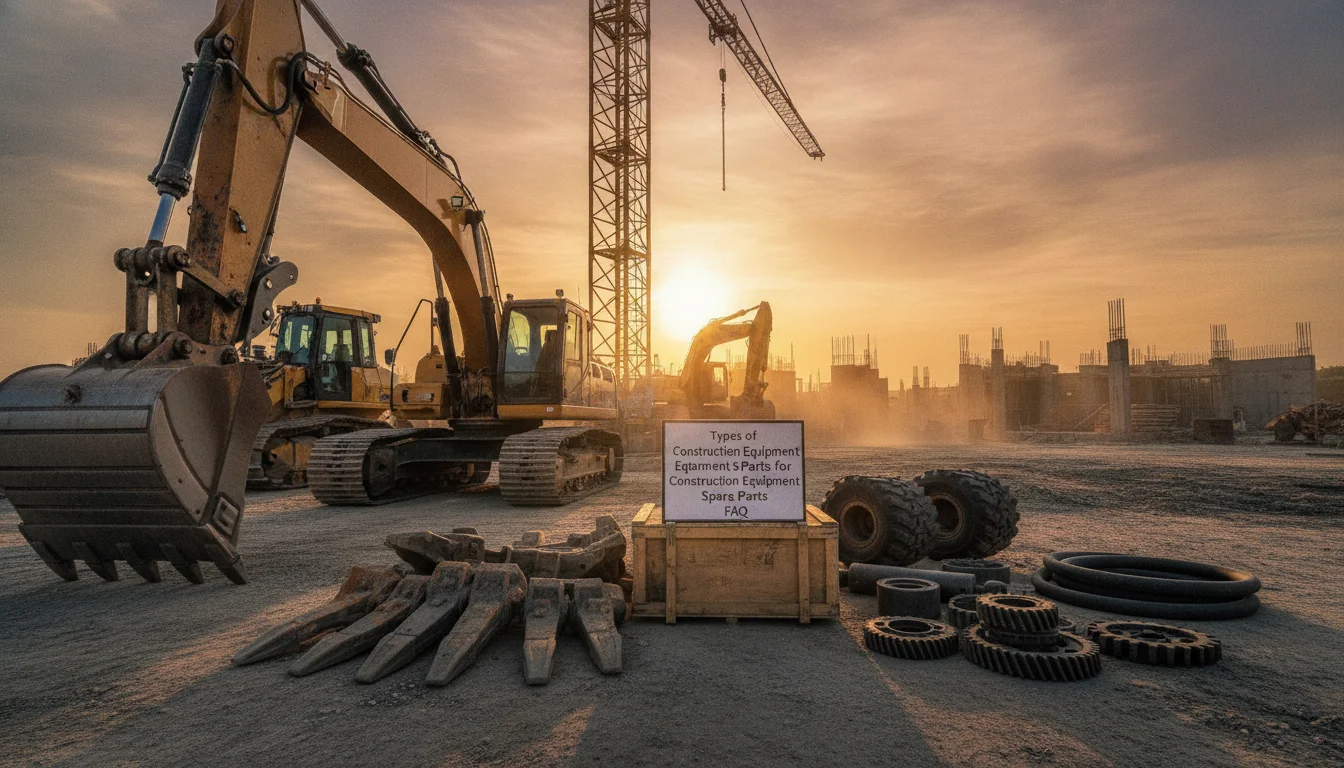
Construction Equipment Spare Parts FAQ Guide 2026
Your construction equipment spare parts faq answered: OEM vs aftermarket, sourcing tips, warranty terms, and global delivery from 3GEN Export.
Loading article…
Article Not Found
The article you're looking for doesn't exist or may have been removed.
Back to BlogThe construction equipment spare parts FAQ is a practical reference covering every critical question procurement managers, fleet supervisors, and equipment operators ask before sourcing replacement components for heavy machinery. Get the answers you need before your next order.
Key Takeaways
- OEM parts guarantee compatibility and protect your warranty; aftermarket parts can reduce cost but require careful supplier vetting.
- Remanufactured parts are rebuilt to OEM specifications and often represent the best balance of cost and reliability.
- Always have your machine's make, model, and serial number ready before ordering - serial number breaks can change part requirements entirely.
- Regular inspections and telematics-based monitoring prevent costly breakdowns and extend equipment lifespan.
- Warranty terms vary dramatically between OEM and aftermarket suppliers; read the fine print before purchasing.
- As of 2026, global supply chain improvements mean OEM-quality parts can reach most markets within 5 business days when sourced from established exporters.
Types of Construction Equipment Spare Parts
Construction equipment spare parts fall into distinct categories based on their origin, condition, and function. Understanding these categories is the foundation of every smart procurement decision.
1. OEM Parts
OEM (Original Equipment Manufacturer) parts are produced by the same manufacturer that built your machine. For Caterpillar equipment, that means genuine Cat-manufactured components. For Komatsu, Volvo, or Atlas Copco machines, OEM means parts built to the exact tolerances those brands specify.
- Advantages: Guaranteed compatibility, no guesswork on fit, full warranty compliance.
- Disadvantages: Higher unit cost, sometimes longer lead times for specialized components.
According to manufacturer specifications, OEM components are engineered to the same standards as the original parts installed at the factory. That precision matters most on high-stress components: hydraulic pumps, engine injectors, and transmission assemblies.
2. Aftermarket Parts
Aftermarket parts come from third-party manufacturers who produce components designed to fit OEM machines. Quality varies significantly across suppliers.
- Advantages: Lower purchase price, wider availability for older or discontinued models.
- Disadvantages: No guaranteed quality standard, potential compatibility issues, may void OEM warranty.
Industry maintenance data shows that aftermarket parts are typically designed to a specific price point rather than a specific performance standard. Some aftermarket suppliers produce excellent components; others cut corners on materials. Vetting your supplier is non-negotiable.
"We had a customer who bought a starter from an online seller. That part ended up shorting out, catching the machine on fire and causing a total loss." - Craig McMicken, District Support Manager, EquipmentShare
3. Used and Remanufactured Parts
Used parts are salvaged from retired machines. Remanufactured parts (also called reman parts) are disassembled, inspected, rebuilt, and tested to meet OEM specifications before resale.
- Advantages: Lower cost than new OEM parts, reduced environmental impact, reman parts often carry a warranty.
- Disadvantages: Salvaged parts carry unknown quality history; remanufactured parts require a reputable rebuilder to be reliable.
Reman parts hold a clear advantage over raw salvage. According to industry maintenance data, remanufactured components are rebuilt to OEM specifications and may be warranty-compliant, offering significant savings without compromising performance. Salvaged parts, by contrast, come with no quality guarantee and no service history.
4. Consumable vs. Integral Parts
Beyond origin, parts also split into two functional categories that affect how you stock and budget for them.
Consumable parts require regular replacement due to predictable wear. These include engine oil, hydraulic fluid, air and fuel filters, undercarriage components (rollers, track pads, pins, bushings, links), brake pads, and bucket teeth. Plan these into your maintenance budget on a fixed cycle.
Integral parts are core components that affect fundamental machine operation. These include engine belts, injectors, gaskets, hydraulic hoses, pumps, valves, cylinders, drivetrain components, and transmission assemblies. Integral part failures are rarely gradual - they tend to cause immediate downtime.
OEM vs. Aftermarket vs. Remanufactured: Comparison Table
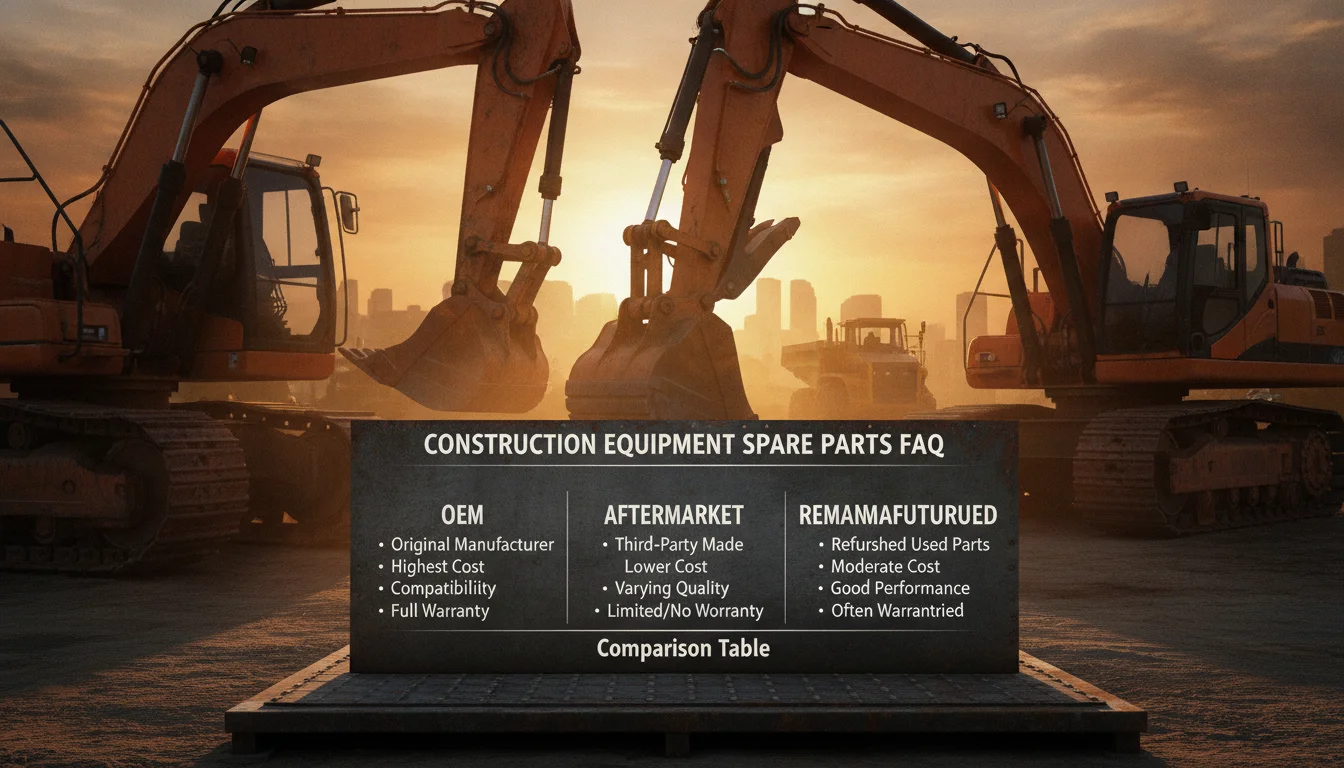
This construction equipment spare parts FAQ comparison covers the three main sourcing options side by side so you can make the right call for your fleet and budget.
| Criteria | OEM Parts | Aftermarket Parts | Remanufactured Parts |
|---|---|---|---|
| Fit & Compatibility | Exact fit guaranteed | Varies by supplier | Built to OEM spec |
| Quality Standard | Factory specification | No universal standard | OEM-equivalent after rebuild |
| Cost | Highest | Lowest | Mid-range |
| Warranty Compliance | Full compliance | May void warranty | Often warranty-compliant |
| Availability (Older Models) | Limited for discontinued | Often available | Good for major assemblies |
| Lead Time | Can be longer for specialty | Usually fast | Moderate |
| Environmental Impact | Standard | Standard | Lower (reuse of cores) |
| Best For | Warranty-active machines, critical systems | Budget-constrained, older fleets | Cost savings without quality compromise |
How the Parts Sourcing Process Actually Works
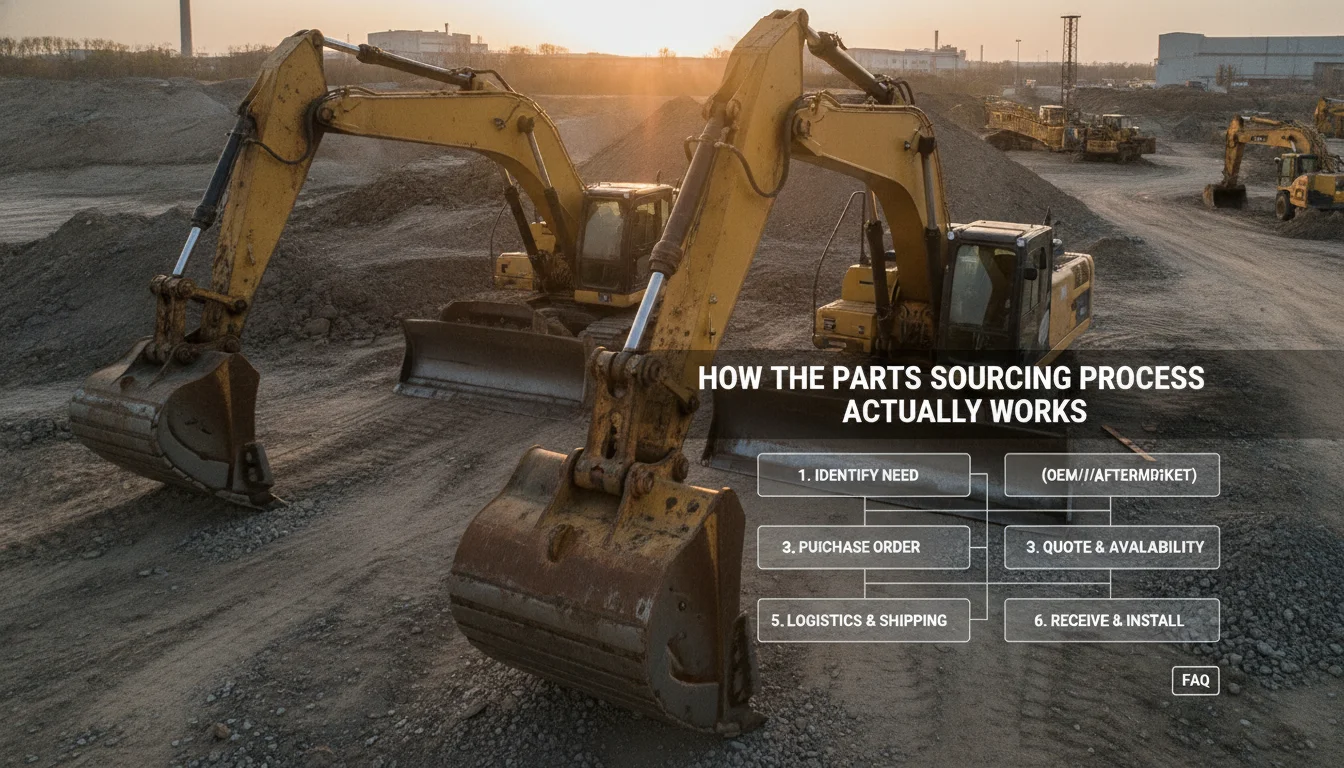
Understanding how construction equipment spare parts move from manufacturer to your job site helps you make faster, smarter procurement decisions. The supply chain has more steps than most buyers realize.
Step 1: Part Identification
Every replacement starts with accurate identification. You need the machine's make, model, serial number, and the specific part number from your service manual or OEM parts catalog. Serial number breaks are critical here. According to manufacturer specifications, a manufacturer may update a machine's design mid-production run, meaning two machines with the same model designation but different serial numbers may require completely different parts.
Ordering without confirming the serial number break is one of the most common and expensive mistakes in heavy equipment procurement. A part that looks identical may have different internal tolerances or mounting dimensions.
Step 2: Supplier Selection
Once you have the correct part number, you choose your supply channel. Options include authorized OEM dealers, specialized parts exporters (like 3GEN Export), online marketplaces, and local distributors. Each channel has different lead times, pricing structures, and quality guarantees.
Authorized dealers offer the highest confidence on OEM parts but often carry premium pricing. Specialized exporters with established OEM-quality supply chains can deliver equivalent parts globally at competitive prices. Online marketplaces carry the highest risk of counterfeit or substandard components.
Step 3: Verification and Order Placement
Before confirming any order, verify the part number against your equipment manual, confirm the supplier's return policy, and check whether the part comes with a warranty. For critical systems (hydraulics, engine, transmission), never compromise on this step.
Step 4: Logistics and Delivery
As of 2026, global logistics infrastructure has improved substantially for industrial parts. Established exporters can ship OEM-quality components to most international markets within 5 business days. For remote mining and energy sites, confirm whether the supplier has experience with customs documentation and freight forwarding to your specific region.
Step 5: Installation and Documentation
Install parts according to OEM service bulletins. Document every replacement with part numbers, installation dates, and technician sign-off. This documentation is essential for warranty claims and for building the maintenance history that helps you predict future replacement needs.
When to Replace Spare Parts
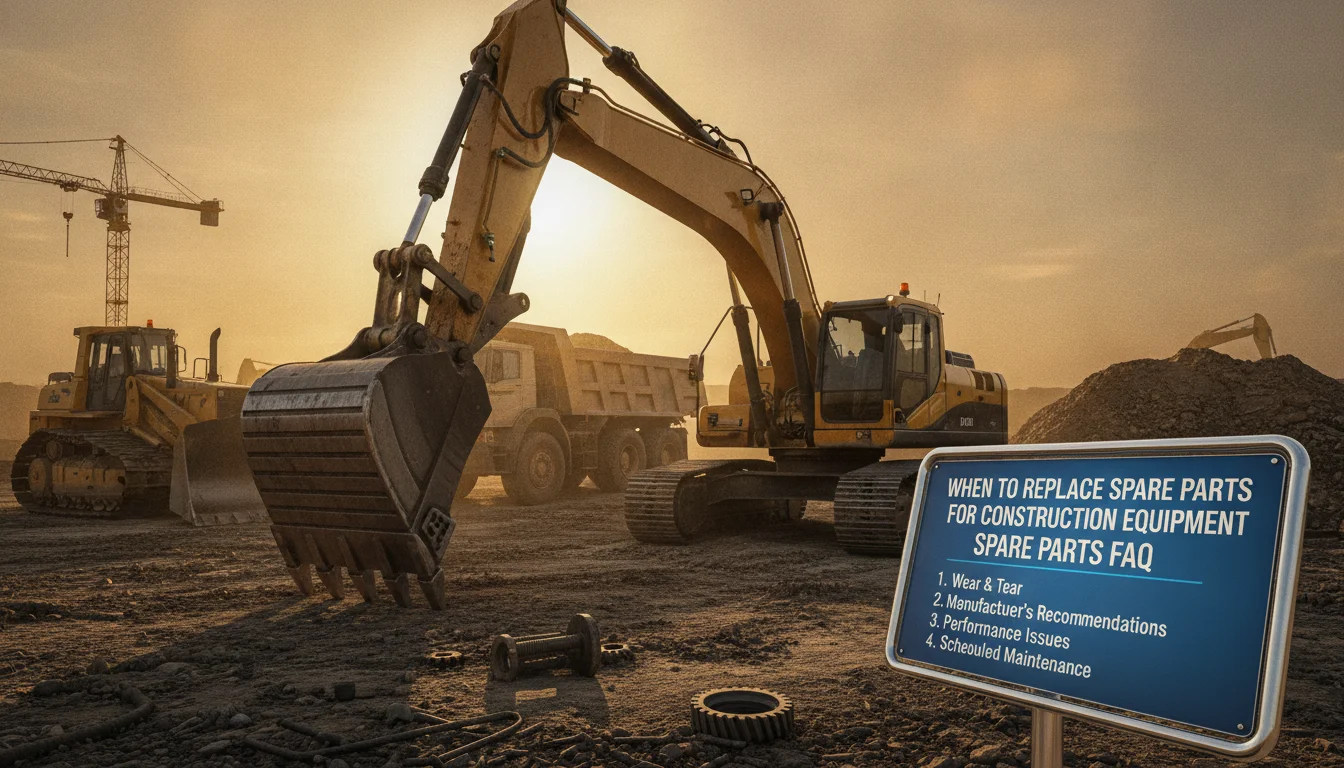
Knowing when to replace construction equipment spare parts is as important as knowing which parts to buy. Replacing too late causes breakdowns; replacing too early wastes budget.
1. Signs of Wear and Tear
Visible wear is the most obvious trigger. Inspect belts, hoses, undercarriage components, and hydraulic lines regularly. Cracks, dents, and physical damage to hydraulic hoses, bucket teeth, and track components indicate immediate replacement need. Check fluid levels for contamination and degradation - discolored or particulate-laden fluid signals internal component wear.
2. Performance Issues
Reduced performance often precedes visible failure. Power loss, unusual vibrations, sluggish hydraulic response, and abnormal operating sounds all signal underlying component issues. Catching these symptoms early means replacing a single part rather than an entire assembly.
A damaged hydraulic hose on an excavator, for example, doesn't just affect the hose. It reduces hydraulic pressure across the system, degrades performance, and can damage the pump if left unaddressed. The cascade effect of ignoring one worn component is a well-documented pattern in fleet maintenance.
3. Scheduled Maintenance Intervals
Follow the manufacturer's maintenance schedule without exception. OEM service bulletins specify replacement intervals based on operating hours, load cycles, and environmental conditions. Document equipment usage and maintenance history meticulously. This data becomes the foundation for predictive maintenance planning.
4. Environmental Factors
Operating conditions accelerate wear beyond standard intervals. Extreme temperatures, high-dust environments (common in mining and quarrying), and heavy-load applications all shorten component life. Adjust your inspection frequency and replacement schedule based on actual operating conditions, not just calendar time.
5. Telematics and IoT Monitoring
This year, telematics adoption across heavy equipment fleets has reached a point where real-time component monitoring is standard practice for professional fleet managers. IoT devices track equipment health continuously, flagging anomalies before they become failures. Automate maintenance reminders based on usage data rather than relying on operator observation alone.
How to Source Construction Equipment Spare Parts: A Practical Guide
This section of the construction equipment spare parts FAQ walks through the sourcing process with concrete, actionable steps for procurement managers and fleet supervisors.
Step 1: Compile Your Equipment Data
Before contacting any supplier, gather the complete equipment profile: make, model, year of manufacture, serial number, and current operating hours. For fleets with multiple machines, maintain a centralized equipment register. This single step eliminates the most common sourcing error: ordering parts that don't fit.
Step 2: Identify the Correct Part Number
Cross-reference the part number in your OEM service manual. If the manual is unavailable, contact the OEM dealer with your serial number and request the correct part number directly. Never order based on visual similarity alone.
Step 3: Evaluate Your Sourcing Options
Compare OEM, aftermarket, and remanufactured options using the criteria that matter most for your situation: budget, machine warranty status, criticality of the component, and required lead time. For warranty-active machines, OEM parts are the safe default. For older machines outside warranty, high-quality aftermarket or reman parts often deliver better value.
Step 4: Vet Your Supplier
A reliable supplier offers more than a parts catalog. Look for suppliers with a strong reputation, verifiable quality standards, clear return policies, and responsive customer service. For international procurement, confirm the supplier's experience with export documentation, customs compliance, and freight to your region. Partnering with an authorized dealer or established OEM-quality exporter ensures access to parts that meet specifications and protect your machine's warranty.
Step 5: Assess Total Cost of Ownership
Purchase price is only one component of cost. Factor in installation labor, expected service life, warranty coverage, and the cost of potential downtime if the part fails prematurely. A cheaper part that fails in 6 months costs more than a premium part that lasts 3 years. Industry maintenance data consistently supports this calculation for critical components.
Step 6: Prioritize Parts Availability for Critical Components
Parts availability directly determines how long your machine sits idle. For critical components on your highest-utilization machines, consider stocking mandatory spares on-site. Mandatory spares are essential components that, if failed, would cause immediate and significant downtime. Identify these for each machine in your fleet and keep them in inventory.
Warranty Considerations for Spare Parts
Warranty terms for construction equipment spare parts vary dramatically between manufacturers, suppliers, and part types. Understanding these terms before purchasing protects your investment.
1. Types of Warranties
Full coverage warranties protect against defects in materials and workmanship without prorating or depreciation deductions. When a covered part fails, the supplier replaces it at no charge, sometimes including associated labor costs. These warranties typically apply to new OEM parts and premium aftermarket components.
Limited warranties include restrictions on what's covered, how coverage applies, or what costs the warranty actually pays. Common limitations include labor exclusions, consequential damage exclusions, and pro-rated coverage that reduces the supplier's obligation over time. According to industry maintenance data, fleet managers and maintenance professionals often discover too late that warranty coverage they assumed existed doesn't apply to their situation.
2. Warranty Compliance
Using non-OEM parts on a machine still under manufacturer warranty can void that warranty. OEM warranties typically include stipulations requiring approved or OEM-certified parts for certain components to remain compliant. In rare cases, OEMs will allow aftermarket parts for specific repairs, but each instance is handled case by case. Always check warranty terms before making repairs, and document all maintenance and part replacements for future warranty claims.
3. Remanufactured Parts and Warranty
Remanufactured parts occupy a useful middle ground. Many reman components are rebuilt to OEM specifications and carry their own warranty, making them warranty-compliant alternatives to new OEM parts. This makes reman parts particularly valuable for fleet managers balancing cost control with warranty protection.
"Warranty terms vary dramatically between manufacturers, suppliers, and part types. Knowing what's actually covered - and what isn't - helps you budget accurately and manage risk effectively." - Advantage Construction Equipment & Parts
Common Mistakes to Avoid When Buying Construction Equipment Spare Parts
The construction equipment spare parts FAQ wouldn't be complete without addressing the errors that cost fleets the most time and money. These are the patterns we see repeatedly.
Mistake 1: Ordering Without Confirming the Serial Number Break
Two machines with the same model number but different serial numbers may require completely different parts. Serial number breaks occur when a manufacturer updates a machine's design mid-production run. Ordering based on model number alone, without confirming the serial number break, is a reliable way to receive the wrong part and extend your downtime by days.
Mistake 2: Choosing Price Over Quality on Critical Components
Aftermarket parts designed to a price point rather than a performance standard are a false economy on high-stress components. Hydraulic pumps, engine injectors, and transmission components that fail prematurely don't just cost the price of the part. They cost labor, downtime, and potentially cascade damage to connected systems. Reserve cost-cutting for consumables and low-criticality wear parts.
Mistake 3: Ignoring Warranty Implications
Installing an aftermarket part on a warranty-active machine without checking the warranty terms first is a common and expensive oversight. If a major failure occurs and the OEM determines that a non-compliant part contributed to it, the entire repair falls outside warranty coverage.
Mistake 4: Buying from Unvetted Online Sellers
The online marketplace for heavy equipment parts includes reputable suppliers and counterfeit operations. A part that looks identical to the OEM component may have inferior metallurgy, incorrect tolerances, or no quality testing behind it. The consequences range from premature failure to, in extreme cases, safety incidents. Always verify supplier credentials before purchasing.
Mistake 5: Failing to Stock Mandatory Spares
For high-utilization machines on remote sites, not stocking critical spare parts on-site is a planning failure. When a mandatory spare fails and the nearest supplier is days away, the cost of downtime quickly exceeds the cost of carrying inventory. Identify the 5-10 most failure-prone components for each machine type in your fleet and keep them on hand.
Mistake 6: Skipping Documentation
Every part replacement should be documented with the part number, installation date, operating hours at installation, and technician sign-off. Without this record, warranty claims become difficult, maintenance patterns are invisible, and resale value suffers. A maintenance management system, even a simple spreadsheet, is better than no system at all.
Realistic Scenario: Hydraulic Hose Failure on a CAT 320 Excavator
Consider a fleet supervisor managing three CAT 320 excavators on a road construction project. One machine develops a hydraulic hose leak mid-shift. The operator notices sluggish boom response and reports it immediately.
The supervisor checks the machine's serial number and cross-references the correct hose assembly part number in the service manual. The fleet carries a small stock of hydraulic hoses for this exact machine type, so the replacement is on-site. The machine is back in operation within 2 hours.
Now consider the alternative: no on-site stock, an unvetted online supplier, and a 3-day wait for a part that turns out to be the wrong specification because the serial number break wasn't checked. That's 3 days of downtime on a machine that costs real money per idle hour, plus the cost of reordering the correct part.
The difference between these two outcomes is preparation: knowing your parts, knowing your supplier, and stocking mandatory spares for your highest-utilization machines. This is the practical application of everything covered in this construction equipment spare parts FAQ.
Best Practices for Maintenance and Replacement
Regular maintenance is the most cost-effective investment a fleet manager can make. Reactive maintenance, where you wait for failure before acting, consistently costs more than proactive replacement.
1. Schedule Regular Inspections
Conduct routine inspections on all major components: hydraulic systems, engines, undercarriage, electrical systems, and structural elements. Inspect belts, hoses, and filters at every service interval. Keep detailed records of every inspection, noting component condition and any anomalies observed.
2. Train Your Operators
Operators are your first line of detection. Train them to recognize early warning signs: unusual vibrations, changes in hydraulic response, abnormal sounds, and fluid leaks. Encourage immediate reporting of any performance change. An operator who flags a problem early saves the fleet the cost of a major repair.
3. Implement a Maintenance Management System
Use technology to track maintenance schedules, part replacement history, and component service life. Telematics systems provide real-time equipment health data and can automate maintenance reminders based on actual usage rather than calendar estimates. As of 2026, telematics integration is standard on most new heavy equipment and retrofittable on older machines.
4. Build a Relationship with a Reliable Supplier
A supplier who knows your fleet, understands your equipment mix, and can prioritize your orders during peak demand is a genuine operational asset. Look for suppliers that offer both OEM and aftermarket options, provide fast global shipping, and back their parts with clear warranty terms. For international operations, confirm the supplier's capability to handle export documentation and customs compliance for your specific markets.
Pros and Cons of OEM vs. Aftermarket Parts
Every procurement decision in the construction equipment spare parts FAQ ultimately comes down to this trade-off. Here's a clear breakdown.
Pros
- OEM parts: Exact fit, full warranty compliance, factory-grade quality, and long-term reliability on critical systems.
- Aftermarket parts: Lower purchase price, wider availability for older and discontinued models, faster sourcing in some markets.
- Remanufactured parts: OEM-equivalent performance at mid-range cost, often warranty-compliant, lower environmental impact through core reuse.
- Stocking mandatory spares: Eliminates downtime on critical failures, reduces dependence on supplier lead times for high-priority machines.
Cons
- OEM parts: Higher cost, sometimes longer lead times for specialty components, limited availability for very old or discontinued models.
- Aftermarket parts: No universal quality standard, potential compatibility issues, risk of voiding OEM warranty, variable supplier reliability.
- Remanufactured parts: Quality depends entirely on the rebuilder's standards; not all reman suppliers are equal.
- Carrying on-site inventory: Ties up capital in stock, requires proper storage conditions, and creates obsolescence risk if the machine is retired.
2026 Outlook: What's Changing in Heavy Equipment Parts Procurement
The construction equipment spare parts FAQ landscape is shifting in 2026. Several trends are reshaping how procurement managers source and manage replacement components.
Global supply chain resilience has improved since the disruptions of previous years. Established OEM-quality exporters now maintain larger regional inventory buffers, reducing lead times for common components. For procurement managers in Africa, Southeast Asia, and the Middle East, this means faster access to parts that previously required weeks of lead time.
Telematics and predictive maintenance are moving from optional to standard. Fleets using real-time monitoring data are shifting from reactive to predictive replacement cycles, reducing both unplanned downtime and unnecessary preventive replacements. This data-driven approach is becoming a competitive requirement, not just a best practice.
Counterfeit parts remain a serious risk in online marketplaces. As of 2026, procurement teams are placing greater emphasis on supplier verification and parts authentication, particularly for hydraulic and engine components where failure consequences are severe.
For international buyers, working with exporters who have established customs and freight expertise continues to be the most reliable path to fast, compliant delivery. 3GEN Export ships OEM-quality parts for Caterpillar, Komatsu, Volvo, Atlas Copco, and 40+ brands to global markets with 5-day delivery capability.
Frequently Asked Questions
What are the requirements for spare parts?
Spare parts must meet the specifications of the original equipment, including compatibility with the machine's make, model, and serial number. According to manufacturer specifications, parts must match the exact tolerances and material standards of the original components to ensure safe, reliable operation. Always verify the part number against your OEM service manual before ordering.
What are the three types of spares?
The three types of spare parts are OEM parts, aftermarket parts, and used or remanufactured parts. OEM parts offer guaranteed compatibility and warranty compliance. Aftermarket parts provide cost savings but vary in quality. Remanufactured parts are rebuilt to OEM specifications and often represent the best balance of cost and reliability for machines outside their original warranty period.
What is the warranty period for spare parts?
Warranty periods vary by manufacturer, supplier, and part type. OEM parts typically carry longer and more comprehensive warranties than aftermarket alternatives. Full coverage warranties replace defective parts at no charge; limited warranties include restrictions on labor, consequential damage, and coverage duration. Always review warranty terms in writing before purchasing, and document all installations to support future claims.
What are mandatory spares?
Mandatory spares are critical components that must be kept on hand to prevent extended downtime when a failure occurs. These are typically the parts most likely to fail on a given machine type and the parts whose failure would immediately halt operations. Fleet managers identify mandatory spares for each machine in their fleet and stock them on-site, particularly for machines operating in remote locations far from supplier networks.
How can I ensure I am buying the right spare parts?
Always verify the part number using your equipment's serial number and OEM service manual. Confirm the serial number break for your specific machine, as two machines with the same model designation may require different parts. Work with reputable suppliers who can cross-reference part numbers and provide documentation of part specifications. Never order based on visual similarity alone.
How often should I replace spare parts?
Replacement frequency depends on the specific component, operating conditions, and manufacturer maintenance schedules. Consumable parts like filters, fluids, and undercarriage components follow predictable replacement cycles based on operating hours. Integral components are replaced based on inspection findings, performance data, and OEM service bulletins. Telematics systems can automate replacement scheduling based on actual usage data, which is more accurate than calendar-based estimates.
Does using aftermarket parts void my equipment warranty?
Using aftermarket parts on a machine still under OEM warranty can void that warranty, depending on the component and the manufacturer's terms. Most OEM warranties require approved or OEM-certified parts for covered components to remain compliant. In rare cases, OEMs allow aftermarket parts for specific repairs on a case-by-case basis. Always check your warranty terms before installing any non-OEM component, and document the decision and rationale.