
Construction Equipment Trends 2026 2027: Full Guide
Construction equipment trends 2026 2027 are reshaping fleets with AI, electrification, and autonomy. Get the full breakdown and source OEM parts fast.
Loading article…
Article Not Found
The article you're looking for doesn't exist or may have been removed.
Back to BlogConstruction equipment trends 2026 2027 are the structural shifts redefining how fleets are built, operated, and maintained across construction, mining, and energy sectors worldwide. AI, electrification, autonomy, and data-driven maintenance are no longer pilot programs. They are operational realities reshaping procurement decisions right now.
Key Takeaways
- AI and Automation: AI-powered predictive maintenance and autonomous machinery are scaling from mining into general construction, reducing downtime and labor dependency.
- Electrification: The electric construction equipment market was valued at $13.6 billion in 2024 and is projected to reach $106.9 billion by 2034, driven by tightening emissions regulations and falling battery costs.
- Data-Driven Operations: Telematics and digital twins are enabling real-time monitoring and predictive maintenance across entire fleets, not just individual machines.
- Labor Shortages: North America faces a projected 2.2 million worker gap by 2026, making autonomous and AI-powered systems a business continuity necessity.
- Compact Equipment Growth: Mini excavators and compact track loaders continue to dominate sales due to versatility, urban compatibility, and strong attachment ecosystems.
- Rental Market Expansion: The American Rental Association projects combined U.S. construction and industrial equipment rental revenue to reach $83.5 billion in 2026, up 3.4% from the prior year.
Why Construction Equipment Trends 2026 2027 Matter to Procurement Teams
Construction equipment trends 2026 2027 matter because the machines entering fleets today carry significantly more embedded technology than those purchased five years ago. A modern excavator contains sophisticated computers, sensors, and emissions control systems that change how parts are sourced, how maintenance is scheduled, and how operators are trained. Procurement managers who understand these shifts make better capital allocation decisions. Those who don't get caught holding aging iron that can't connect to the data ecosystems their clients now require.
CONEXPO-CON/AGG 2026 confirmed what the data already showed: more than 140,000 professionals walked the Las Vegas show floor to see electric machines from every major OEM, AI-powered operator assistance systems, autonomous earthmovers, and drone inspection platforms that were pilot programs two years ago and are now shipping to job sites. The Deloitte 2026 Engineering and Construction Industry Outlook confirmed firms are accelerating investments in autonomous equipment, robotics, AI-powered scheduling, and prefabrication. The machines are getting smarter. The question is whether your maintenance data, inspection records, and fleet management systems are ready.
"The rental revenue increase indicates the preference for renting over ownership. The reasons are many for the growth, including the access to the equipment versus the asset ownership and the economics of renting." - Tom Doyle, Vice President of Program Development, American Rental Association
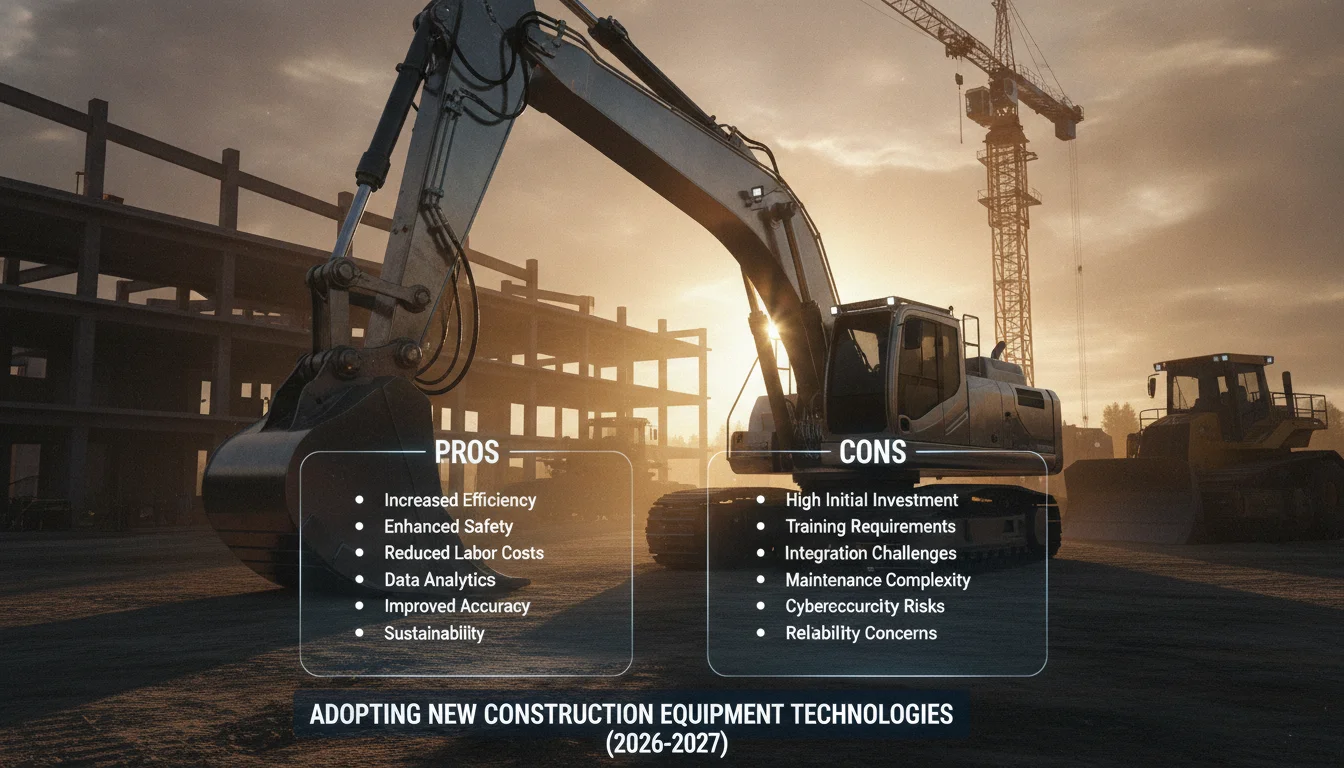
Pros and Cons of Adopting New Construction Equipment Technologies
Pros
- Reduced downtime: AI-based predictive maintenance systems are expected to cut equipment downtime by up to 28% by 2027, according to industry projections cited by fleet management platforms.
- Lower operating costs: Electric and hybrid machines reduce fuel consumption and maintenance intervals, improving total cost of ownership over a machine's lifecycle.
- Labor gap mitigation: Autonomous and semi-autonomous equipment allows smaller crews to maintain output levels, directly addressing the projected 2.2 million worker shortage in North America.
- Better project visibility: Digital twins and telematics give project managers real-time data on machine location, utilization, and health, reducing reactive decision-making.
- Stronger resale value: Machines with integrated telematics and grade control systems command higher resale prices as buyers increasingly expect these features as standard.
Cons
- Higher upfront capital cost: Electric machines, autonomous systems, and AI-enabled platforms carry significant purchase premiums over conventional equipment.
- Data quality dependency: The Deloitte 2026 Engineering and Construction Industry Outlook flagged that poor-quality data continues to undermine AI and analytics solutions, reducing ROI for fleets that haven't digitized their maintenance records.
- Parts and service complexity: Advanced electronics and battery systems require specialized technicians and parts supply chains that many regional dealers are not yet equipped to support.
- Connectivity requirements: Telematics and AI systems depend on reliable site connectivity. Remote and underground operations face real limitations that can negate the benefits of smart systems.
- Training investment: Operators and maintenance crews need structured upskilling programs before they can extract full value from autonomous and AI-assisted equipment.
1. The Rise of AI and Automation
AI and automation are the most consequential forces shaping construction equipment trends 2026 2027, moving from experimental deployments to standard fleet expectations across earthmoving, lifting, and material handling categories.
1.1 AI-Powered Predictive Maintenance
AI-powered predictive maintenance is moving from pilot programs to production deployments across major fleets. AI systems analyze hydraulic fluid temperatures, pressure anomalies, vibration patterns, and engine performance data to predict component failures 2-4 weeks before they occur. By 2027, AI-based predictive maintenance systems are expected to cut equipment downtime by up to 28%, according to industry projections. Komatsu's Smart Construction ecosystem and Caterpillar's AI-enabled VisionLink platform lead implementation among OEMs.
The AI construction market is projected to surpass $4.5 billion by 2026. Over 53% of organizations say predictive maintenance alerts are the most important telematics feature when selecting a vendor, according to ABI Research. The AI vehicle inspection market is projected to reach $6.9 billion by 2033.
What this means practically: predictive AI needs structured historical data to learn from. Inspection records, work orders, parts replacement history, and fluid analysis trends form the training dataset. Fleets that have been collecting digital maintenance data for two or more years will have that foundation. Fleets still on paper will have nothing for the AI to learn from. The data you collect today determines whether predictive AI works for you in 2027.
1.2 Autonomous Equipment
Autonomous machinery is transitioning from mining-only deployments to general construction. The autonomous construction equipment market is valued at $10 billion in 2025, growing at a 7.9% CAGR through 2032. Semi-autonomous and fully autonomous machines now feature GPS guidance, LiDAR sensors, and AI algorithms for navigation, obstacle avoidance, and repetitive task execution. Develon premiered its cabinless Concept-X excavator at CONEXPO 2026, signaling where the major OEMs are heading.
Autonomous excavators have demonstrated measurable improvements in some deployments, with grading costs reduced by up to 30% while maintaining consistent accuracy, according to data cited by construction technology platforms. This is not about replacing operators wholesale. It is about augmenting them: machines take over repetitive, high-risk tasks while skilled workers focus on supervision, planning, and complex decision-making.
1.3 Enhanced Operator Assistance
Modern construction equipment is increasingly equipped with AI-driven operator assistance systems. Grade control is a clear example. It no longer feels like a premium add-on. Komatsu's PC158USLCi-12 is the company's first tight tail swing excavator with Intelligent Machine Control (IMC) 3.0. All of Hyundai's Next Generation crawler excavators from the HX230L through HX400L feature advanced standard 2D machine guidance and control for enhanced digging precision. Caterpillar's Ease of Use system and Topcon's entry-level 3D MC-Edge setup are bridging the gap between high-end automation and everyday jobsite use.
How AI Maintenance Systems Work: The Underlying Mechanics
Understanding how these systems function helps procurement teams ask the right questions when evaluating vendors. An AI predictive maintenance system operates in three layers.
Layer 1: Data collection. IoT sensors embedded in the machine continuously capture temperature, pressure, vibration frequency, fluid levels, and cycle counts. This data streams to an onboard controller and simultaneously to a cloud platform via cellular or satellite connection.
Layer 2: Pattern recognition. The AI model compares incoming sensor data against a baseline of normal operating parameters for that machine type, age, and workload profile. Deviations from baseline trigger anomaly flags. The model improves over time as it accumulates more machine-specific history.
Layer 3: Actionable alerts. When the model identifies a pattern that historically precedes a failure, it generates a maintenance alert with a recommended action and a projected failure window. Fleet managers receive this alert through a dashboard or mobile app, allowing them to schedule the repair during planned downtime rather than reacting to a breakdown mid-shift.
The critical dependency is data quality. As the Deloitte 2026 Engineering and Construction Industry Outlook noted, poor-quality data continues to undermine AI solutions across the industry. Garbage in, garbage out applies directly here.
2. Electrification of Construction Equipment
Electrification is one of the defining construction equipment trends 2026 2027, driven by tightening emissions regulations in urban markets and a meaningful decline in battery costs that is making electric machines economically viable beyond niche applications.
2.1 Growth of Electric Machinery
The electric construction equipment market was valued at $13.6 billion in 2024 and is projected to reach $106.9 billion by 2034, reflecting a CAGR of 23.3%. This growth is driven by the need for cleaner, quieter machinery that can operate in urban areas with strict emissions regulations. Europe leads on regulatory pressure, with urban zones carrying the strictest emission standards globally. This is driving innovation in electric mini-excavators specifically, where the compact form factor aligns well with current battery energy density.
2.2 Hybrid Solutions
Hybrid machinery is gaining traction as a practical bridge for fleets that need to reduce emissions without accepting the range and charging limitations of fully electric machines. These machines reduce fuel consumption and emissions while maintaining the power needed for heavy-duty tasks. For procurement managers sourcing equipment for mixed-use fleets, hybrid machines offer a lower-risk entry point into electrification.
2.3 Battery Technology Advancements
Battery pack prices fell below $100/kWh in 2024 and continue declining, according to industry data cited by fleet management platforms. This reduction in cost is making electric and hybrid solutions more accessible to construction companies, accelerating the shift toward electrification. Hydrogen-powered heavy equipment is on the horizon for 2028 and beyond, but battery-electric remains the dominant near-term path for compact and medium-duty machines.
What to Watch Out For: Electrification Pitfalls
Fleet managers moving toward electric equipment face several practical challenges that don't appear in OEM marketing materials.
- Charging infrastructure cost: Installing adequate charging capacity at a depot or job site requires significant electrical infrastructure investment. This cost is rarely included in equipment price comparisons.
- Cold weather performance: Battery capacity degrades in low temperatures. Fleets operating in northern climates need to account for reduced range and longer charge times during winter months.
- Parts supply chain immaturity: Electric drivetrain components, battery management systems, and high-voltage connectors are not yet as widely stocked as diesel equivalents. Lead times for specialized components can be longer, making a reliable global spare parts supplier critical.
- Technician certification: High-voltage systems require certified technicians. Many regional dealers are not yet equipped, which can extend repair timelines significantly.
3. Data-Driven Decision Making
Data-driven decision making is a central theme across construction equipment trends 2026 2027, with telematics, digital twins, and predictive analytics shifting fleet management from reactive to proactive across the entire project lifecycle.
3.1 Telematics and Real-Time Monitoring
Telematics systems are becoming standard in construction equipment, providing real-time data on performance, fuel consumption, and maintenance needs. OEM telematics platforms are now maturing: Caterpillar's VisionLink, Komatsu's Smart Construction, and Volvo's ActiveCare Direct are examples of systems that aggregate machine data across entire fleets. This data enables managers to make informed decisions that enhance productivity and reduce costs. According to manufacturer specifications, telematics-connected machines allow service intervals to be optimized based on actual operating conditions rather than fixed hour-based schedules.
3.2 Digital Twins
Digital twin technology is gaining adoption, allowing project managers to create virtual replicas of physical assets and entire job sites. This technology helps in monitoring progress, identifying inefficiencies, and optimizing workflows. Digital twins have shown the ability to reduce rework by up to 40%, primarily by improving visibility and coordination across project teams, according to data cited by construction technology platforms. When equipment is connected to these systems, every machine becomes a data source, feeding insights back into the project in real time.
3.3 Predictive Analytics
Predictive analytics is being used to forecast project timelines and resource needs. By analyzing historical data, construction companies can anticipate delays and adjust workflows proactively, enhancing overall project efficiency. AI-driven systems in 2026 are capable of analyzing jobsite data in real time, optimizing schedules, predicting delays, and adjusting workflows dynamically. Instead of reacting to problems, contractors can anticipate them before they impact timelines.
"Poor-quality data continues to undermine analytics and AI solutions, reducing ROI and limiting competitive advantage. The machines are getting smarter. The question is whether your maintenance data, inspection records, and fleet management systems are ready for what these machines need." - Deloitte 2026 Engineering and Construction Industry Outlook
4. Addressing Labor Shortages
The construction industry faces a projected labor gap of 2.2 million workers in North America by 2026, according to analysis by the Information Technology and Innovation Foundation, making this one of the most urgent drivers behind construction equipment trends 2026 2027.
4.1 Automation as a Solution
With fewer skilled workers available, automation is becoming essential for operational continuity. Autonomous equipment can perform repetitive tasks, allowing human operators to focus on supervision and complex decision-making. This is not a future scenario. It is happening now on job sites across North America, Europe, and Asia-Pacific.
4.2 Training and Upskilling
As automation increases, there is a growing need for training programs that equip workers with the skills to operate advanced machinery and manage automated systems effectively. Augmented reality is playing a growing role here. AR tools guide operators through maintenance and repairs, displaying internal components and step-by-step instructions. This reduces downtime and ensures safe handling of complex equipment without requiring an experienced technician to be physically present.
4.3 Flexible Workforce Solutions
Companies are exploring flexible workforce solutions, including subcontracting and hiring temporary workers, to address immediate labor needs while investing in long-term training and development. The rental market is also absorbing some of this pressure: renting equipment with operator packages allows contractors to scale capacity without adding permanent headcount.
5. Compact Equipment Dominance
Compact construction equipment continues to dominate the market, and this trend is firmly embedded in construction equipment trends 2026 2027 due to the segment's versatility, urban compatibility, and expanding attachment ecosystems.
5.1 Mini Excavators and Compact Track Loaders
Mini excavators and compact track loaders (CTLs) continue to dominate sales. These machines hit a sweet spot in size and versatility. They are powerful, portable, and adaptable. Contractors can trench, grade, lift, and load with each platform. CTLs are getting larger: Kubota just launched its largest CTL yet, the SVL110-3, while Cat, Manitou, and Takeuchi have all launched large-frame CTLs in recent years. The mini excavator market continues to expand, with more than 20 brands competing, and OEMs like Kioti entering the segment to capture market share.
5.2 Versatility and Adaptability
Buyers increasingly want one machine that can perform multiple applications rather than purchasing separate machines for every task. This is driving innovation in compact machinery design and expanding the attachment market. Wide attachment compatibility is now a primary purchasing criterion, not a secondary consideration.
5.3 Rental Market Growth
The rental market for compact equipment is expanding significantly. The American Rental Association's latest forecast expects combined U.S. construction and industrial equipment and general tool rental revenue to reach $83.5 billion in 2026, up 3.4% from the prior year. ARA expects growth to accelerate to 4.4% in 2027 and 5.1% in 2028. Mega projects, data center buildouts, and public infrastructure work are concentrating demand and pushing rental utilization rates higher across specialty categories.
6. Sustainability and Environmental Considerations
Sustainability requirements are no longer just PR. They are a prerequisite to bid on government contracts in many markets, making environmental compliance a direct business driver within construction equipment trends 2026 2027.
6.1 Emission Regulations
Strict emission regulations are pushing manufacturers to innovate. Europe's urban zones carry the strictest standards globally, driving the fastest adoption of electric mini-excavators and hybrid loaders. Electric and hybrid machines are being developed to meet these standards while maintaining the performance levels contractors require.
6.2 Sustainable Materials
There is a growing emphasis on using sustainable materials in construction equipment manufacturing, including lightweight composites that reduce energy consumption during operation. Advances in composites and anti-wear components produce lighter, stronger machinery with improved fuel efficiency and better operator ergonomics.
6.3 Circular Economy Practices
Manufacturers are exploring circular economy practices, focusing on equipment lifecycle management and recycling to minimize waste and environmental impact. For procurement teams, this means evaluating not just the purchase price but the full lifecycle cost and end-of-life disposition of major assets.
7. Emerging Technologies in Construction Equipment
Several emerging technologies are influencing construction equipment trends 2026 2027 beyond the headline categories of AI and electrification.
7.1 Drones for Site Monitoring
Drones are becoming essential tools for site monitoring, providing aerial data for mapping, progress tracking, and safety inspections. What were pilot programs two years ago are now shipping to job sites as standard workflow tools. Their integration with machinery monitoring systems enhances project efficiency by giving managers a real-time aerial view that ground-level telematics cannot provide.
7.2 Augmented Reality for Training and Maintenance
AR technology is being used to train operators on complex machinery and guide technicians through maintenance procedures. By providing interactive step-by-step guides overlaid on the actual machine, AR reduces downtime and improves safety during maintenance and operation. This is particularly valuable for fleets adopting new electric or autonomous equipment where technician familiarity is low.
7.3 Robotics in Construction
Robotic systems are being deployed for tasks such as trenching, grading, and material transport, allowing for greater precision and efficiency. Unmanned jobsite zones, where machines operate independently without direct human control, are emerging as a defined operational model. Advances in physical AI are accelerating this shift, with machines becoming capable of interpreting complex site conditions in real time.
7.4 Wearable Technology for Worker Safety
Smart wearables track vital signs, detect hazards, and alert workers in real time. Integrated with site management systems, these devices enhance safety and compliance, reducing workplace accidents. As autonomous equipment zones expand, wearables that communicate machine proximity and movement to nearby workers are becoming a critical safety layer.
How to Apply These Trends: A Practical Step-by-Step Guide for Fleet Managers
Understanding construction equipment trends 2026 2027 is only useful if you can translate them into concrete procurement and maintenance decisions. Here is a practical sequence for fleet managers and procurement teams.
- Audit your current data infrastructure. Before investing in AI or telematics, assess what maintenance data you are already collecting and in what format. Paper-based records cannot feed AI models. If your fleet is not digitized, start there. This is the foundation everything else depends on.
- Connect OEM telematics on all new acquisitions. When purchasing new equipment from Caterpillar, Komatsu, Volvo, or other major OEMs, ensure telematics activation is included in the purchase agreement. The data collected in the first 12-24 months of machine life becomes the baseline for predictive maintenance models.
- Evaluate electrification readiness at your depots. Before ordering electric machines, assess your electrical infrastructure. Determine whether your depot can support the charging load, and factor infrastructure upgrade costs into the total cost of ownership comparison against diesel equivalents.
- Pilot compact autonomous or semi-autonomous equipment on one project. Rather than committing the entire fleet to autonomous systems, select one project with well-defined repetitive tasks (grading, trenching, material transport) and run a controlled pilot. Measure grading cost per unit, cycle time, and operator hours against a conventional baseline.
- Build a parts supply chain for advanced components. Electric drivetrain components, sensor arrays, and AI controller modules are not yet widely stocked by regional dealers. Establish relationships with global spare parts suppliers who can source OEM-quality components with short lead times. Downtime on a technology-heavy machine is more expensive than downtime on a conventional one because the failure modes are less familiar to local technicians.
- Invest in operator and technician training before the equipment arrives. Schedule AR-assisted training programs and manufacturer certification courses in advance of new machine delivery. Waiting until the machine is on site to start training extends the time before the equipment reaches full productivity.
- Review your rental vs. buy calculus annually. With rental revenue growing and mega projects concentrating demand, the economics of renting specialty equipment are improving. Reassess the rent-versus-buy decision for any machine that will be used for fewer than 600-800 hours per year.
Comparison: Key Technology Approaches in Construction Equipment 2026 2027
| Technology | Maturity Level (2026) | Primary Benefit | Main Challenge | Best Fit |
|---|---|---|---|---|
| AI Predictive Maintenance | Scaling now | Up to 28% downtime reduction | Requires 2+ years of digital maintenance history | Fleets with 10+ machines and digitized records |
| Semi-Autonomous Grading | Scaling now | Consistent accuracy, reduced operator fatigue | High upfront cost, operator retraining | Large earthmoving projects with repetitive tasks |
| Fully Autonomous Equipment | Emerging (2027+) | Operates without human intervention | Regulatory approval, site connectivity | Mining, large-scale infrastructure |
| Electric Compact Machines | Maturing now | Zero emissions, lower noise, reduced fuel cost | Charging infrastructure, cold weather range | Urban construction, indoor demolition |
| Hybrid Heavy Equipment | Maturing now | Fuel savings without range limitations | Higher purchase price than diesel | Mixed-use fleets transitioning from diesel |
| Digital Twins | Scaling now | Up to 40% rework reduction | Data integration complexity | Large projects with multiple machine types |
| Drone Site Monitoring | Maturing now | Real-time aerial progress data | Regulatory airspace restrictions | Large open sites, linear infrastructure |
| Hydrogen Heavy Equipment | Emerging (2028+) | Zero emissions at full power output | Fueling infrastructure, cost | Heavy earthmoving where battery range is insufficient |
Realistic Scenario: A Mid-Size Contractor Navigating the 2026 2027 Transition
Consider a mid-size civil contractor operating a fleet of 35 machines across road construction and utility projects in a North American market. As of 2026, they face three simultaneous pressures: a skilled operator shortage, a municipal client requiring lower-emission equipment on urban contracts, and a competitor who has adopted AI-assisted grade control and is winning bids on tighter margins.
Their procurement team starts by auditing the fleet. Twelve machines are connected to OEM telematics. The remaining 23 are not. Maintenance records for the unconnected machines are in paper logbooks. The first decision is not to buy new equipment. It is to retrofit telematics on the highest-utilization machines and digitize the last three years of paper maintenance records. This takes 90 days and costs a fraction of a new machine purchase.
Next, they identify two urban contracts where electric compact equipment is now a client requirement. Rather than purchasing, they rent two electric mini-excavators for the project duration. This avoids the charging infrastructure investment at their main depot while satisfying the client requirement and generating operational data on electric machine performance in their specific work conditions.
For the grade control gap, they specify factory-installed 2D machine guidance on their next three excavator purchases rather than retrofitting aftermarket systems. The cost delta is manageable, and the factory integration is more reliable than aftermarket retrofits.
Twelve months later, the telematics data from the retrofitted machines has generated enough history for the AI maintenance platform to flag two hydraulic pump anomalies before failure. Both repairs are completed during scheduled downtime. The contractor estimates the avoided breakdowns saved roughly two to three times the cost of the telematics retrofit program.
This is how construction equipment trends 2026 2027 play out in practice: not as a single large technology bet, but as a sequence of targeted decisions that build capability incrementally.
Common Mistakes to Avoid When Adopting New Equipment Technologies
Fleet managers navigating construction equipment trends 2026 2027 consistently encounter the same avoidable errors. Here is what to watch for.
- Buying technology before building the data foundation. AI and predictive maintenance platforms require historical data to function. Purchasing an AI maintenance subscription before digitizing your records produces no useful output and wastes budget.
- Underestimating total cost of ownership for electric machines. The purchase price comparison between electric and diesel is only the starting point. Charging infrastructure, battery replacement cycles, specialized technician costs, and cold-weather performance penalties all affect the real economics.
- Treating autonomous equipment as a direct headcount replacement. Autonomous machines still require supervision, maintenance, and skilled intervention when they encounter conditions outside their programmed parameters. Cutting operator headcount to zero on an autonomous deployment is a reliability risk.
- Ignoring parts supply chain readiness for new technology. A machine with advanced electronics or an electric drivetrain that sits idle for three weeks waiting for a specialized component costs far more in downtime than a conventional machine waiting for a standard hydraulic part. Verify parts availability and lead times before committing to new technology platforms.
- Skipping the pilot phase. Committing an entire fleet to a new technology based on OEM demonstrations rather than real-world pilot data is a common and expensive mistake. Run a controlled pilot on one project before scaling.
- Neglecting operator training timelines. Advanced machine guidance, autonomous systems, and electric drivetrains all require operator and technician training that takes time. Starting training after the machine arrives on site delays productivity and increases the risk of misuse.
How 3GEN Export Supports Fleets Navigating These Trends
As construction equipment trends 2026 2027 push fleets toward more complex machines, the spare parts supply chain becomes more critical, not less. Advanced electronics, hydraulic systems, and powertrain components on modern Caterpillar, Komatsu, Volvo, Atlas Copco, and other OEM machines require parts sourced to OEM specifications. A substandard seal kit or a non-spec hydraulic component on a machine with an integrated AI maintenance system can generate false sensor readings and undermine the predictive maintenance data you've spent months building.
We supply OEM-quality spare parts for 40+ brands with global delivery. Whether you're sourcing hydraulic cylinder seal kits for a CAT 320, undercarriage components for a Komatsu PC200, or engine parts for a Volvo EC380, our team can confirm compatibility, check stock, and ship within 5 business days to most global destinations. Fast delivery matters when a machine is down and your project timeline is bleeding.
Shop OEM-quality spare parts with global 5-day delivery at 3genexport.com. Explore our full brand catalog or browse by parts category to find what your fleet needs.
8. Preparing for the Future: What Comes Next
As we look ahead through 2027 and beyond, construction equipment trends 2026 2027 point toward three converging developments that will define the next phase of the industry.
First, agentic AI fleet management, where AI systems don't just alert humans to problems but autonomously schedule maintenance, order parts, and coordinate service crews, is moving from concept to early deployment. This will require procurement teams to evaluate software platforms alongside hardware when making equipment purchasing decisions.
Second, fully autonomous fleets operating in defined zones without any human supervision are expected to scale in mining and large infrastructure by 2028. The regulatory frameworks are still catching up, but the technology is ready in controlled environments.
Third, hydrogen-powered heavy equipment is on the 2028-plus horizon for applications where battery energy density remains insufficient. Fleets investing in hydrogen now are primarily in heavy mining and long-haul earthmoving.
Investing in AI, automation, and electrification will be crucial for construction firms aiming to enhance productivity and address labor shortages. Embracing data-driven decision-making through telematics and digital twins will enable better project management and operational efficiency. Understanding and adapting to construction equipment trends 2026 2027 is not optional for firms that want to remain competitive in the decade ahead.
Frequently Asked Questions
What are the key construction equipment trends for 2026 and 2027?
The key construction equipment trends 2026 2027 include AI-powered predictive maintenance scaling to production deployments, autonomous and semi-autonomous equipment moving beyond mining into general construction, electric compact machines becoming standard in urban markets, digital twins reducing rework, and the rental market reaching $83.5 billion in 2026. Labor shortages are accelerating all of these shifts by making automation a business continuity necessity rather than an optional upgrade.
How is AI impacting construction equipment maintenance?
AI is enabling predictive maintenance by analyzing sensor data from hydraulic systems, engines, and drivetrain components to identify failure patterns 2-4 weeks before a breakdown occurs. By 2027, AI-based predictive maintenance systems are expected to cut equipment downtime by up to 28%, according to industry projections. The critical requirement is a foundation of structured digital maintenance history: fleets still on paper records cannot benefit from these systems.
What role does electrification play in construction equipment in 2026?
Electrification is driven by tightening emissions regulations in urban markets and falling battery costs, with battery pack prices dropping below $100/kWh in 2024. The electric construction equipment market was valued at $13.6 billion in 2024 and is projected to reach $106.9 billion by 2034 at a 23.3% CAGR. Electric compact machines are the most mature segment, while hydrogen-powered heavy equipment remains a 2028-plus development.
Why is compact equipment so important in construction right now?
Compact equipment, including mini excavators and compact track loaders, dominates sales because it can perform multiple tasks in restricted urban spaces, is easy to transport between job sites, and supports a wide range of attachments that reduce the need for multiple specialized machines. Buyers in 2026 increasingly want one machine that handles multiple applications, and compact platforms deliver that versatility better than any other segment. The segment is also the primary beneficiary of electrification, since battery energy density is sufficient for compact machine duty cycles.
How are construction companies addressing the labor shortage?
Companies are adopting autonomous and semi-autonomous equipment to maintain output with smaller crews, investing in AR-assisted training programs to upskill existing workers faster, and using flexible workforce solutions including subcontracting and equipment rental with operator packages. According to analysis by the Information Technology and Innovation Foundation, the construction industry in the US and Europe faces a growing labor shortage driven by large-scale infrastructure and data center expansion. Automation is the primary structural response, not a temporary workaround.
What emerging technologies should fleet managers watch beyond AI and electrification?
Fleet managers should track drone site monitoring (now shipping to job sites as standard workflow tools), augmented reality for technician training and maintenance guidance, wearable safety technology for workers operating near autonomous equipment zones, and agentic AI fleet management platforms that autonomously schedule maintenance and coordinate service. Digital twins are also maturing rapidly, with documented ability to reduce project rework by up to 40% by improving real-time visibility and coordination across project teams.