
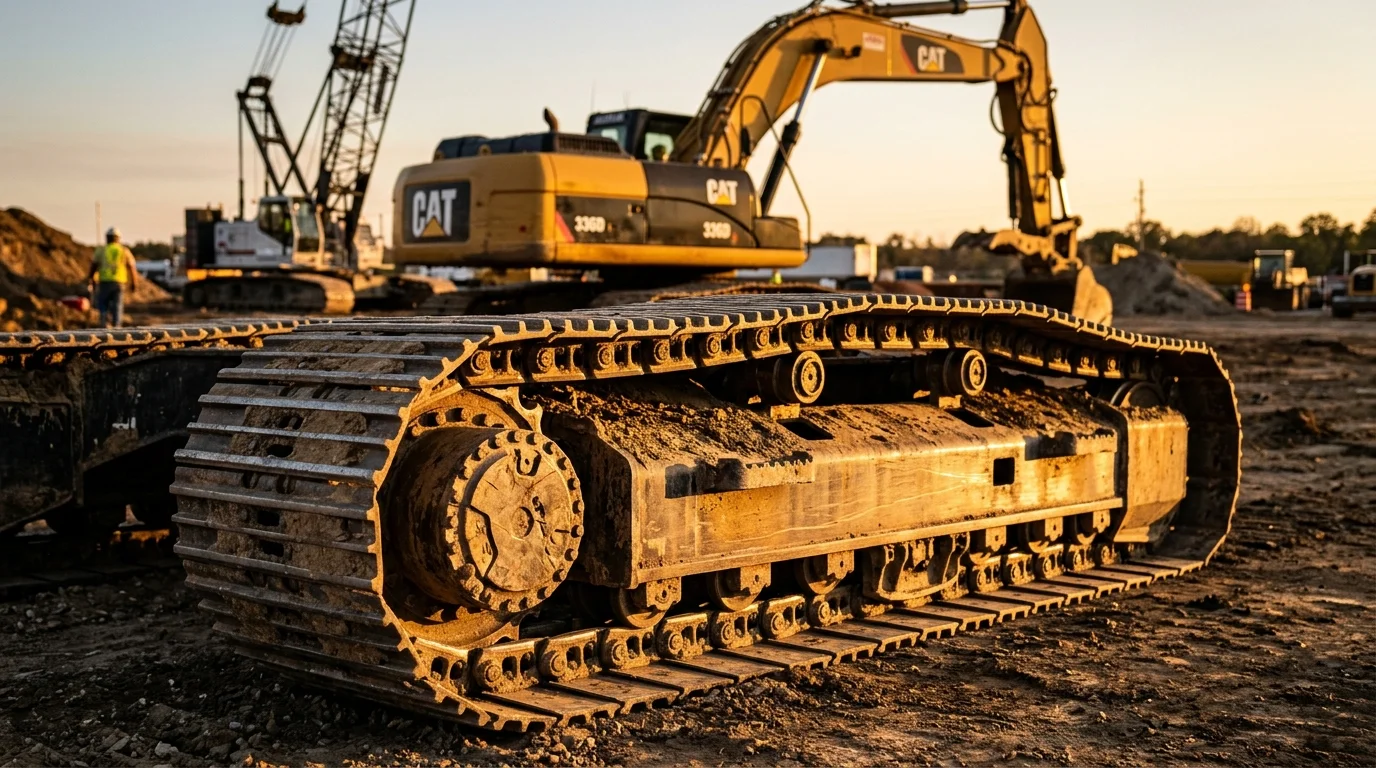
Construction Equipment Undercarriage Parts: 2026 Guide
Shop construction equipment undercarriage parts with confidence. Compare OEM vs aftermarket, learn maintenance tips, and get global 5-day delivery at
Loading article…
Article Not Found
The article you're looking for doesn't exist or may have been removed.
Back to BlogKey Takeaways
- Construction equipment undercarriage parts form a complete system: track chains, shoes, idlers, rollers, sprockets, pins, and bushings all work together.
- The undercarriage represents a significant share of your total heavy equipment maintenance budget - quality parts reduce that cost over time.
- OEM parts guarantee fit and finish; quality aftermarket parts can match OEM specifications at a lower price point.
- Regular inspection, cleaning, and lubrication are the three habits that extend undercarriage life most reliably.
- As of 2026, global supply chains have stabilized, making fast international delivery of undercarriage components more accessible than ever.
- Choose suppliers with broad inventories and verified compatibility data to avoid costly fitment errors.
Construction Equipment Undercarriage Parts: Complete Buying Guide for 2026
Construction equipment undercarriage parts are the structural and mechanical components that support, move, and stabilize tracked heavy machinery across excavators, dozers, compact track loaders, and more. Choosing the right parts keeps your fleet productive and your maintenance budget under control.
Understanding Undercarriage Components
The undercarriage of heavy equipment is a complete system of interdependent parts, and every component affects the wear rate of the others. These are the core elements you need to understand before purchasing:
- Track Chains: Two rows of individual links joined with pins and bushings. They provide the primary mobility path for the machine.
- Track Shoes: Attached to the links via pins, hinges, or bolts, track shoes distribute the machine's weight across the ground. They come in steel and rubber, each suited to different terrain and application types.
- Idlers: Front and rear idler wheel assemblies support the track and maintain proper tension. Casted, forged, or fabricated idler types are available in hundreds of configurations depending on machine class.
- Rollers: Positioned between the track and the undercarriage frame, rollers reduce friction and carry the machine's load. Top (carrier), bottom, and single or double flange variants are available for different equipment types.
- Sprockets: Drive sprockets engage with the track chain to convert final drive power into forward movement. Sprocket segments are also available for machines where full sprocket replacement is not cost-effective.
- Pins and Bushings: These form the hinges that allow track chain links to articulate around sprockets and idlers. As pins and bushings wear, track pitch extends and the chain runs loose - a condition that accelerates wear across the entire system.
"The majority of maintenance and part costs for track-type equipment comes from its undercarriage. Selecting high-quality parts is essential to keeping your machines running efficiently and to save costs." - DMC Wear Parts, industry undercarriage specialist with over 20 years of experience
Two Types of Undercarriage: Tracked vs. Wheeled
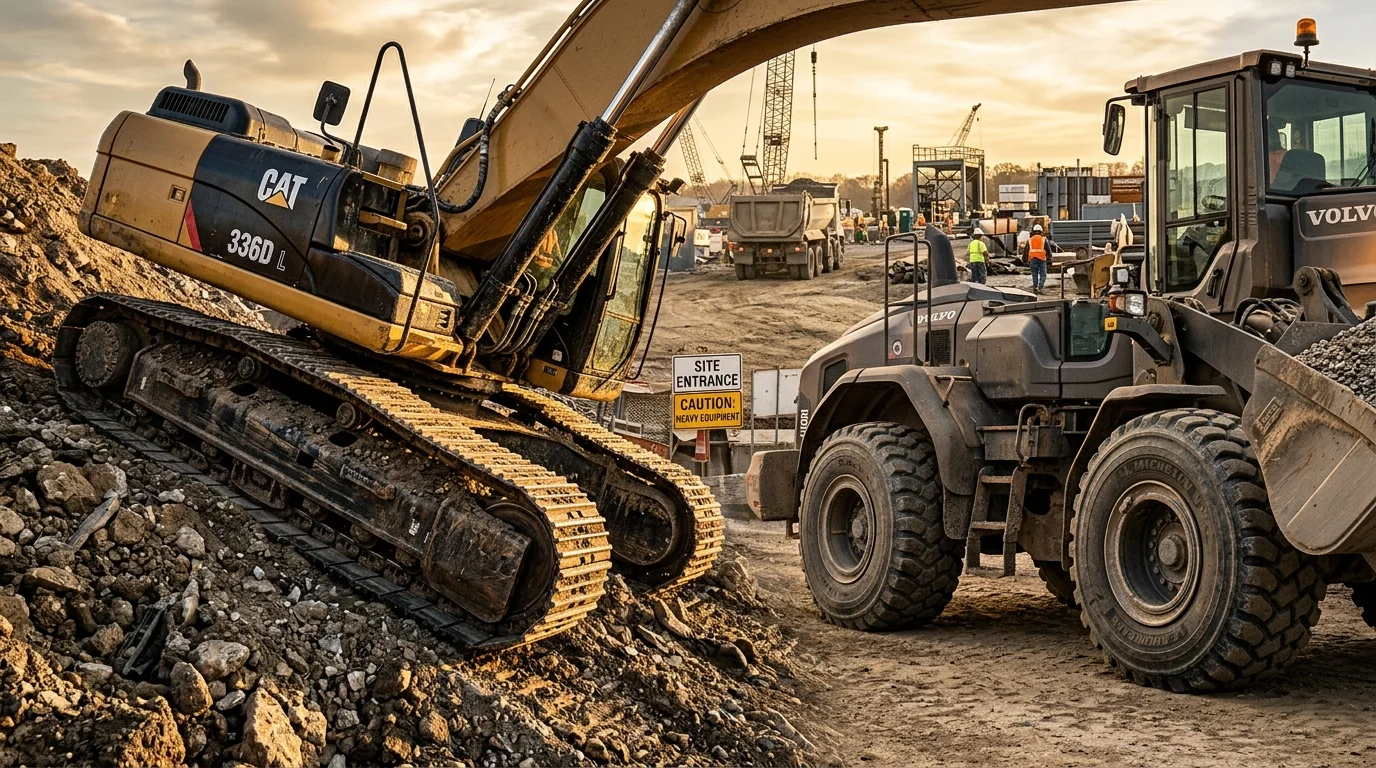
Heavy equipment undercarriages fall into two broad categories, and the distinction drives every parts decision you make. Tracked undercarriages are used on machines operating over rough, soft, or uneven terrain - excavators, bulldozers, multi-terrain loaders, and forestry equipment. Wheeled undercarriages are common on machines that travel primarily on paved or compacted surfaces, such as certain skid steers. This guide focuses on tracked undercarriage systems, which carry the highest maintenance demand and the broadest parts selection.
OEM vs. Aftermarket Undercarriage Parts
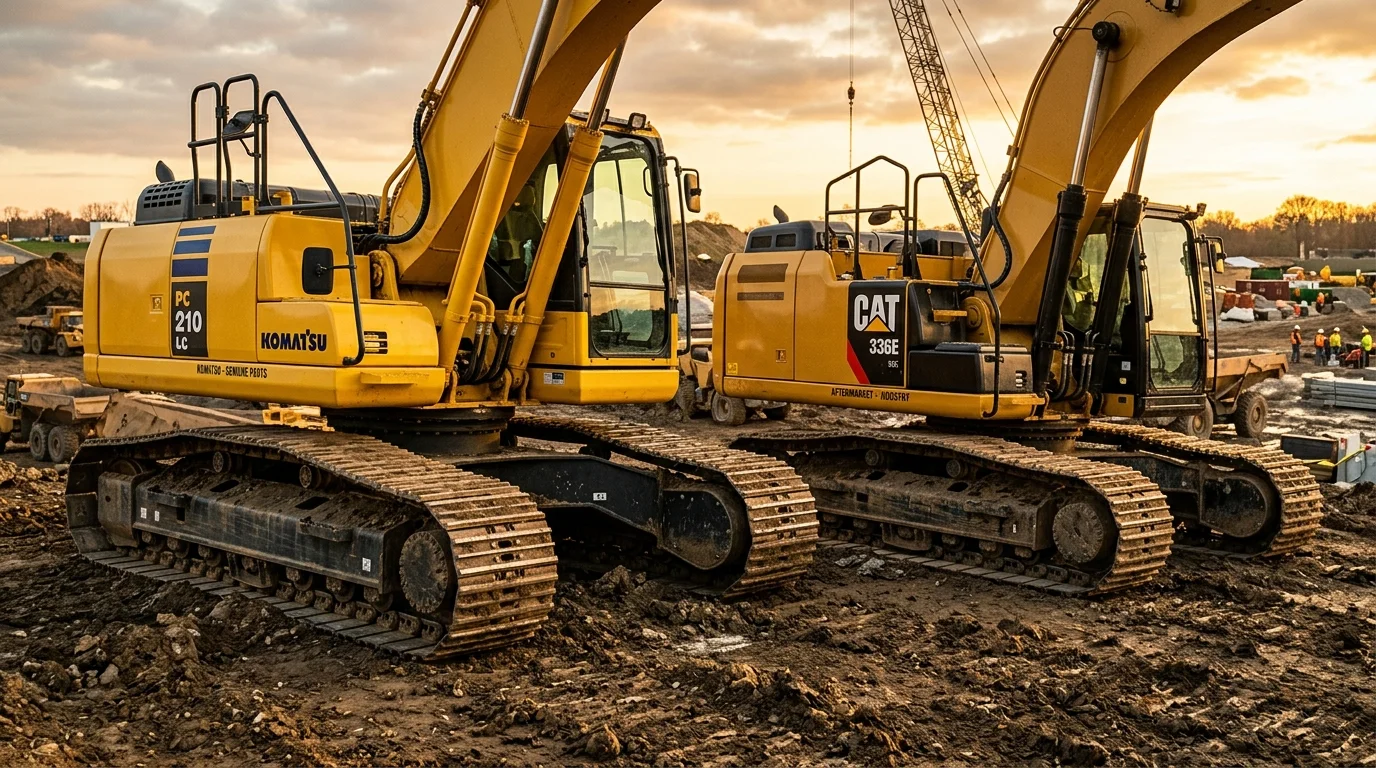
OEM (Original Equipment Manufacturer) parts and quality aftermarket parts each have a legitimate place in a well-managed fleet maintenance program. The right choice depends on your machine's age, application intensity, and budget cycle.
OEM Parts
OEM parts are produced by or to the exact specifications of the original machine manufacturer - Caterpillar, Komatsu, Volvo, John Deere, Kobelco, and others. They guarantee dimensional accuracy, material grade, and compatibility with your specific model and serial number range. The trade-off is price: OEM parts carry a premium that reflects engineering validation and brand assurance.
Aftermarket Parts
Quality aftermarket parts are engineered to meet or exceed OEM specifications. Suppliers like Berco produce undercarriage components in configurations covering thousands of machine models, with options including dry, greased, sealed, lubricated, and heavy-duty chain variants. For fleet operators managing high machine counts, aftermarket parts can deliver comparable performance at a meaningfully lower per-unit cost - provided you source from reputable manufacturers with documented quality standards.
"With the widest product range, minimum costs per hour, longer durability and best performance in the most challenging applications, our spare parts for construction bulldozers are ready to face customers' challenges." - Berco, global undercarriage components manufacturer
Pros and Cons of OEM vs. Aftermarket Undercarriage Parts
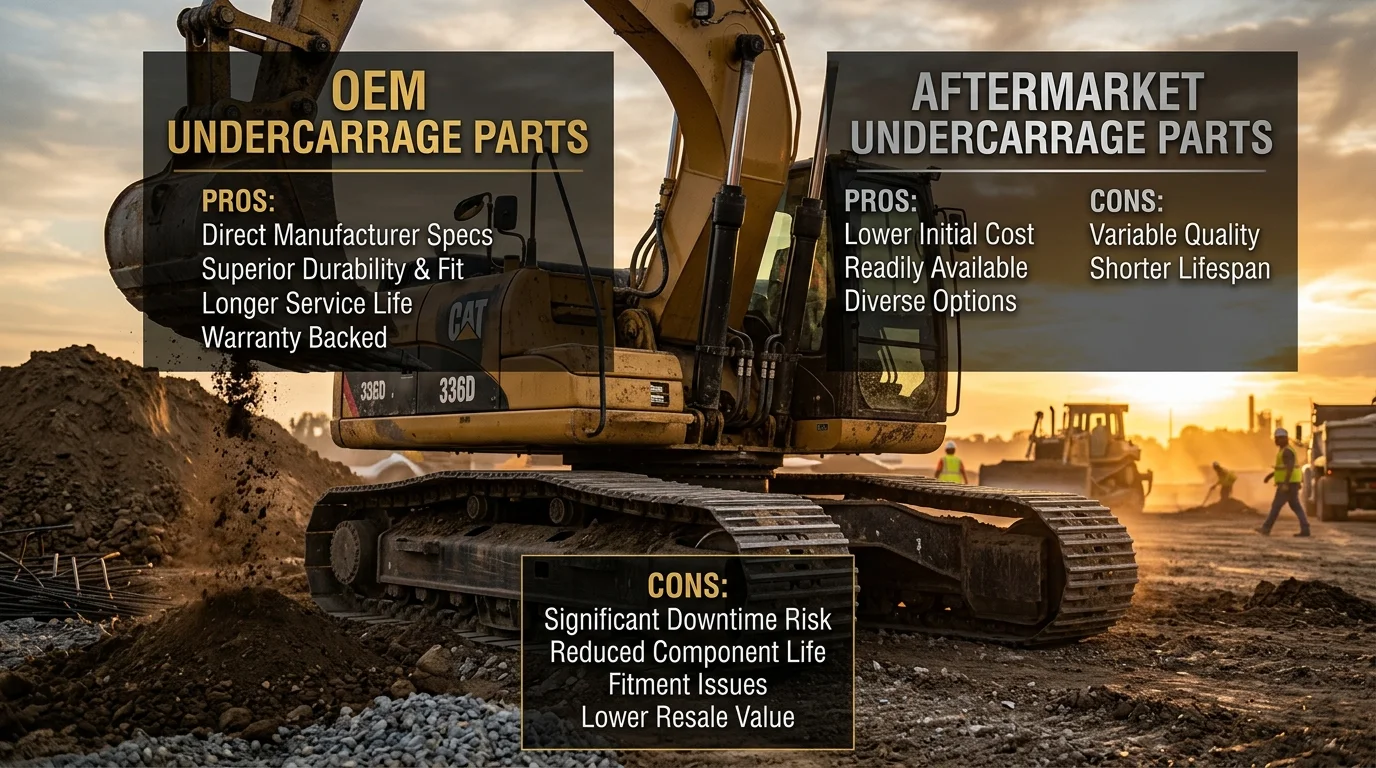
Pros
- OEM parts: Guaranteed fit and compatibility with your exact machine model and serial number.
- OEM parts: Full manufacturer warranty coverage and documented quality validation.
- Aftermarket parts: Lower acquisition cost, often significantly so for high-wear consumable components like track shoes and bottom rollers.
- Aftermarket parts: Broader availability across multiple suppliers, reducing lead time risk when OEM stock is constrained.
- Aftermarket parts: Many reputable aftermarket manufacturers offer configurations not available through OEM channels, including heavy-duty upgrades for extreme applications.
Cons
- OEM parts: Higher unit cost, which compounds quickly across large undercarriage rebuild projects involving multiple rollers, idlers, and track chains.
- OEM parts: Longer lead times when parts are sourced directly from the manufacturer or through exclusive dealer networks.
- Aftermarket parts: Quality varies significantly between suppliers - low-grade aftermarket components can wear faster and damage adjacent parts.
- Aftermarket parts: Compatibility verification is the buyer's responsibility; always confirm part numbers and serial number ranges before ordering.
What to Look For When Buying Undercarriage Parts
Selecting the right undercarriage component requires more than matching a part number. Here are the criteria that matter most in practice:
- Material and Heat Treatment: For track links and rollers, look for deep heat treatment case depth and differential quenching on roller shells. These processes provide high wear resistance at the rail diameter while maintaining mechanical strength at the inner diameter - preventing deformation under load.
- Exact Model and Serial Number Fit: Undercarriage parts are highly model-specific. A sprocket for a Komatsu PC300-7 (part reference 207-30-74141) will not fit a PC400LC-7L (part reference 208-30-74140). Always confirm the full model designation and serial number range before ordering.
- Terrain Suitability: Track shoe width, grouser profile (single, double, or triple grouser), and material choice should match your operating environment. Triple grouser shoes with mud holes suit soft ground; narrower single grouser shoes work better on hard, compacted surfaces.
- Supplier Inventory Depth: A supplier with broad stock across multiple warehouse locations can ship the next day. A supplier with limited stock creates lead time risk that translates directly into machine downtime.
- Warranty Terms: Confirm warranty coverage before purchase. Reputable suppliers provide documented warranty terms for both OEM and aftermarket components.
- Compatibility Documentation: Ask for a parts book reference or OEM cross-reference number. Suppliers who can provide this data are more reliable than those who cannot.
How to Choose the Right Parts for Your Application
Matching undercarriage parts to your specific machine and job site conditions is the single most important factor in getting full wear life from your investment. Here is how to approach the decision systematically.
Step 1: Identify Your Machine Exactly
Start with make, model, and serial number. For example, a Caterpillar 312B excavator uses a Track Adjuster Assembly (part reference 4I7338, priced around $300.00 from verified suppliers). A John Deere 450DLC uses a Track Spring Assembly (part reference 9244702, priced around $2,470.00). These are not interchangeable. Serial number ranges matter because manufacturers often update undercarriage specifications mid-production run.
Step 2: Assess Your Operating Conditions
Hard rock quarry work demands different track shoe profiles and chain specifications than soft ground excavation or forestry clearing. Berco notes that construction dozers travel at speeds up to approximately 10-12 km/h and move for 80-90% of their Service Meter Unit hours - meaning the undercarriage is under load almost constantly. High-duty-cycle machines need heavier heat treatment and more wear material in the track link profile.
Step 3: Decide on OEM or Aftermarket
For machines under warranty or in critical production roles where any compatibility risk is unacceptable, OEM is the safer choice. For older machines, high-wear consumables, or fleet operations where cost per hour is the primary metric, quality aftermarket parts from documented manufacturers are a sound option.
Step 4: Verify Lead Time and Logistics
Downtime costs real money. Confirm that your supplier can ship within your required window. As of 2026, 3GEN Export offers global delivery on OEM-quality undercarriage components, with shipping to most destinations within five business days.
Price Range Guide: Budget, Mid-Range, and Premium
Undercarriage part pricing spans a wide range depending on component type, machine class, and quality tier. Here is a practical reference based on verified market data from competitor evidence:
| Component Type | Budget / Entry Tier | Mid-Range | Premium / OEM |
|---|---|---|---|
| Track Nuts and Bolts | Under $2.00 per unit (e.g., M18 track nut at $0.96) | $2–$10 per unit | OEM-spec fastener kits |
| Track Shoes (single grouser) | $55–$90 per shoe | $90–$150 per shoe | $150+ per shoe, premium alloy |
| Bottom Rollers | $65–$100 per roller | $100–$250 per roller | $250+ per roller, forged |
| Top / Carrier Rollers | $150–$250 per roller | $250–$400 per roller | $400+ per roller |
| Sprockets | $110–$200 per unit | $200–$400 per unit | $400–$530+ per unit |
| Idler Assemblies | $295–$500 per unit | $500–$900 per unit | $900–$1,460+ per unit |
| Track Spring / Recoil Assemblies | $620–$780 per unit | $780–$1,800 per unit | $1,800–$3,830 per unit |
| Track Link Assemblies (full) | Varies by machine class | Mid-range excavator class | $4,800+ for large excavators |
These price ranges are drawn from verified competitor market data and reflect new-condition parts. Used or reconditioned components are available at lower price points but carry higher fitment and wear risk.
Comparison of Undercarriage Parts by Machine Type
| Machine Type | Primary Undercarriage Parts Needed | Key Brands Supported | Typical Application |
|---|---|---|---|
| Medium Excavator (5–30 ton) | Bottom rollers, track chains, idlers, sprockets, track shoes | Caterpillar, Komatsu, Kobelco, JCB, Doosan | Construction, civil works, utility |
| Large Excavator (30+ ton) | Full track group assemblies, heavy-duty rollers, recoil springs | Caterpillar, Komatsu, Volvo, Hitachi | Mining, quarrying, large earthworks |
| Crawler Dozer (7–50 ton) | Track links, shoes, sprocket segments, idlers, carrier rollers | Caterpillar D8, Komatsu D85, John Deere | Road building, land clearing, mining |
| Compact Track Loader | Rubber tracks, drive sprockets, bottom rollers, idler wheels | Bobcat, ASV, Case, Kubota, New Holland | Landscaping, light construction, agriculture |
| Mini Excavator (1.5–6 ton) | Rubber tracks, forged rollers, sprockets, idlers | Kubota, Bobcat, Caterpillar 305E2, John Deere | Urban construction, utilities, rental fleets |
| Forestry and Specialty Equipment | Heavy-duty track chains, grouser bars, ice lugs, equalizer bars | Various OEM and aftermarket | Logging, mulching, feller bunchers |
Care and Maintenance of Undercarriage Parts
Regular maintenance is the most cost-effective investment you can make in your undercarriage system. According to manufacturer maintenance guidelines and industry maintenance data, the following practices have the greatest impact on component life:
- Daily Debris Removal: Clean accumulated mud, rock, and debris from the tracks regularly, especially in winter or when working in clay-heavy soils. Packed material increases internal pressure on pins and bushings and accelerates wear.
- Track Tension Management: Add tension for hard surface operation. Reduce tension when working on soft, muddy, or snowy ground. Incorrect tension is one of the leading causes of premature undercarriage wear.
- Regular Inspections: Check tracks, links, pins, bushings, idlers, and sprockets at consistent intervals. Look for elongated track pitch (a sign of pin and bushing wear), uneven roller wear, and fluid leaks around seals.
- Daily Fluid Leak Check: Perform a daily check for fluid leakage under and around the undercarriage. Roller seal failure, if caught early, is a minor repair. Left unaddressed, it leads to bearing failure and full roller replacement.
- Lubrication: Ensure all moving parts receive adequate lubrication. Sealed-for-life rollers reduce this burden, but track adjuster grease fittings and recoil assemblies still require periodic attention.
- Rotation and Replacement Sequencing: When replacing worn components, assess the condition of adjacent parts. Replacing a sprocket without checking the track chain pitch - or installing new track shoes on a worn chain - wastes money and shortens the life of the new parts.
"We recommend a preventive maintenance approach to avoid costly breakdowns. Clean accumulated debris from the tracks regularly, check tracks, links, pins, bushings, idlers, and sprockets regularly for wear and tear, and do a daily check for fluid leakages under and around the undercarriage." - Fortis HD, heavy equipment maintenance specialists
Specific Part Numbers and Compatibility Reference
Part number accuracy is non-negotiable in undercarriage procurement. A single digit error can result in a part that physically resembles the correct component but fails within hours due to dimensional mismatch. Below are verified part number examples from competitor market data to illustrate the level of specificity required:
- Caterpillar 312B Track Adjuster Assembly: Part# 4I7338 - $300.00
- John Deere 450DLC Track Spring Assembly: Part# 9244702 - $2,470.00
- Komatsu PC300-7 / PC300LC-7 Track Spring Assembly: Part# 207-30-74141 - $2,250.00
- Komatsu PC490-10 / PC400LC-7L Track Spring Assembly: Part# 208-30-74140 - $2,800.00
- Komatsu D85EX-15 Track Spring Assembly: Part# 154-30-73130 - $3,830.00
- Kobelco SK290LC / SK330LC Track Spring Assembly: Part# LC54D00009F1 - $1,800.00
- JCB JS130 Track Spring Assembly: Part# JNA0224 - $620.00
- JCB JS240 Track Spring Assembly: Part# JBA0130 - $884.00
- Bobcat MT52 / MT55 Sprocket: Part# 7107228
- Bobcat MT50 Bottom Roller: Part# 7109409
Always cross-reference part numbers against your machine's serial number range. Manufacturers update undercarriage specifications during production runs, and the same model designation can have multiple valid part numbers depending on build date.
2026 Outlook: What's Changing in Undercarriage Parts Procurement
This year, procurement teams are navigating a more favorable supply environment than the disruptions of prior years. Global logistics have stabilized, and aftermarket suppliers have expanded warehouse networks to reduce regional lead times. The trend toward telematics-integrated maintenance scheduling is also gaining traction: fleet managers are using machine hour data to trigger undercarriage inspections proactively rather than reactively, which reduces emergency part orders and the premium pricing that comes with them.
Demand for rubber track components continues to grow as compact track loaders and mini excavators expand their share of urban construction and utility work. Steel track systems remain dominant in mining and large-scale earthworks, where ground conditions and machine weight make rubber tracks impractical. As of 2026, 3GEN Export stocks undercarriage components for 40-plus equipment brands, with global shipping to most destinations within five business days.
Frequently Asked Questions
What are the main parts of an undercarriage?
The main components include track chains, track shoes, idlers, rollers (top, bottom, and carrier types), sprockets, and pins and bushings. Each part plays a specific role in supporting the machine's weight, transmitting drive power, and maintaining track tension. When one component wears beyond its service limit, it accelerates wear in adjacent parts.
What is the difference between an excavator undercarriage and a dozer undercarriage?
Excavator undercarriages are designed for stationary digging cycles with frequent rotation and minimal travel distance. Dozer undercarriages, by contrast, travel continuously at speeds up to approximately 10-12 km/h and move for the majority of their service hours. This means dozer undercarriage components require deeper heat treatment, more wear material in the track link profile, and more frequent service intervals.
How do I know when undercarriage parts need replacement?
Key indicators include excessive machine vibration during travel, uneven or accelerated wear on track shoes, visible elongation of track pitch (the chain runs loose), fluid leaks around roller seals, and difficulty maintaining proper track tension. A regular inspection schedule - checking links, pins, bushings, idlers, and sprockets at consistent intervals - catches these issues before they cascade into more expensive failures.
Are aftermarket undercarriage parts as reliable as OEM parts?
Quality aftermarket parts from reputable manufacturers are engineered to meet or exceed OEM specifications and are a sound choice for most maintenance applications. The critical variable is supplier quality: low-grade aftermarket components can wear faster and damage adjacent parts. Always source from suppliers who can provide OEM cross-reference numbers, documented material specifications, and clear warranty terms.
What is the typical lifespan of undercarriage components?
According to industry maintenance data, undercarriage component life varies based on machine type, operating conditions, and maintenance discipline. Track chains and shoes on a well-maintained machine in moderate conditions can reach 1,000 hours or more of service life. Heavy-duty applications in rock, abrasive soil, or high-speed travel will reduce that figure. Consistent maintenance - correct track tension, daily cleaning, and timely inspections - has the greatest impact on achieving full component life.
Where can I source construction equipment undercarriage parts with fast global delivery?
Reputable suppliers maintain broad inventories across multiple warehouse locations to minimize lead times. Online specialists stock thousands of SKUs covering Caterpillar, Komatsu, Volvo, John Deere, Kobelco, Bobcat, Kubota, and dozens of other brands. 3GEN Export supplies OEM-quality undercarriage components globally, with delivery to most destinations within five business days. Contact our parts specialists with your machine make, model, and serial number for a fast quote.
Conclusion
Investing in quality undercarriage components is one of the highest-leverage maintenance decisions a fleet operator can make. The undercarriage represents a significant share of total heavy equipment maintenance costs - and the right parts, sourced from verified suppliers and maintained correctly, extend machine life and protect your project timelines.
Understand your components, match parts to your specific machine and application, and build a maintenance routine around daily inspection and cleaning. That combination delivers more operational hours per dollar than almost any other maintenance investment in tracked equipment.
Shop OEM-quality spare parts with global 5-day delivery at 3genexport.com. Our parts specialists are ready to help you identify the right undercarriage components for your fleet - fast.