
Construction Machinery Hydraulic Parts Suppliers Guide
Find trusted construction machinery hydraulic parts suppliers with OEM-quality components, global delivery, and expert guidance for 2026 procurement
Loading article…
Article Not Found
The article you're looking for doesn't exist or may have been removed.
Back to BlogBuying Guide: Construction Machinery Hydraulic Parts Suppliers (2026)
Construction machinery hydraulic parts suppliers are companies that source, stock, and distribute hydraulic components, including pumps, cylinders, valves, and hoses, for heavy equipment used in construction, mining, and energy sectors.
Key Takeaways
- Hydraulic systems are the backbone of excavators, bulldozers, cranes, and loaders. Choosing the wrong parts supplier costs you more than money.
- OEM part number verification is the single most important step before placing any order.
- Reputable parts suppliers offer documented compatibility, traceable quality standards, and real lead times.
- Aftermarket parts can match OEM performance when sourced from verified suppliers with ISO-certified manufacturing.
- Fluid contamination causes the majority of preventable hydraulic failures. Maintenance discipline matters as much as part quality.
- As of 2026, supply chain pressure on hydraulic components continues. Stocking critical spares in advance is a sound procurement strategy.
Understanding Hydraulic Systems in Construction Machinery
Hydraulic systems are the primary force-delivery mechanism in construction machinery, converting fluid pressure into the lifting, pushing, and pulling power that moves earth, steel, and concrete. Without a functioning hydraulic circuit, an excavator is scrap metal. Key components include:
- Hydraulic Pumps: Convert mechanical energy into hydraulic flow and pressure. Piston, gear, and vane pump designs each suit different duty cycles and pressure ranges.
- Hydraulic Cylinders: Convert fluid pressure back into linear mechanical force. Single-acting cylinders handle simpler tasks like dump bed lifting. Double-acting cylinders, which provide force in both directions, are standard in excavator booms, loader arms, and bulldozer blades.
- Hydraulic Valves: Control flow direction and regulate pressure throughout the circuit. Types include directional control valves, pressure relief valves, proportional valves, and check valves.
- Hydraulic Power Units (HPUs): Integrate pump, reservoir, valves, and filters into a single system that drives other hydraulic components. Most HPUs are designed for straightforward field replacement.
- Hydraulic Hoses and Fittings: Transport pressurized fluid between components. Hose ratings must match system pressure specifications. Using undersized hose in a high-pressure circuit is a safety hazard, not just a performance issue.
"Hydraulic technology is essential for driving heavy construction equipment, providing the pushing, pulling, lifting and demolishing power." - FMPTE Hydraulic Equipment Technical Overview
What to Look For When Buying Hydraulic Parts
The most important factor when evaluating this type of suppliers is verified compatibility with your specific machine model and serial number range. Everything else, including price and lead time, is secondary to getting the right part the first time.
Material Quality
High-quality hydraulic components use hardened steel, forged aluminum alloys, or precision-cast iron depending on the application. Seals and O-rings must be rated for the fluid type and operating temperature range of your machine. Cheap seals fail early, and a failed seal on a hydraulic cylinder means a full teardown.
Compatibility and OEM Part Numbers
Always cross-reference the OEM part number before ordering. Hydraulic pumps and motors for Caterpillar, Komatsu, Volvo, Hitachi, and John Deere are not interchangeable, even when they look identical externally. Shaft dimensions, port configurations, and displacement ratings vary by model year. A reputable supplier will confirm compatibility before shipping.
Supplier Reputation and Certifications
Choose this kind of parts suppliers with verifiable industry credentials. ISO 9001 certification is a meaningful quality signal. Look for suppliers whose repair work meets factory catalog specifications, not just generic tolerances. Customer references from fleet operators in your industry carry more weight than marketing claims.
Lead Time and Stock Availability
As of 2026, global supply chain disruptions continue to affect hydraulic component availability, particularly for piston pumps and specialty valves. Ask suppliers directly about stock levels before committing to a purchase order. A supplier with 20,000+ products in stock can ship same-day. A supplier who drop-ships from overseas may quote you a two-week lead time when your machine is sitting idle.
Price Range Guidance
Hydraulic parts span a wide cost range depending on component type, brand, and whether you choose OEM or aftermarket:
- Budget tier: Aftermarket seal kits, hose assemblies, and fittings from verified suppliers. Suitable for high-wear consumables where OEM pricing is difficult to justify on older machines.
- Mid-range tier: Quality aftermarket pumps, motors, and cylinders from established manufacturers. These parts meet OEM specifications and carry manufacturer warranties. Best value for most fleet maintenance programs.
- Premium tier: Genuine OEM components from Caterpillar, Komatsu, Volvo, or other original manufacturers. Recommended for machines under warranty, critical applications, or where downtime risk is highest.
Pros and Cons of Sourcing from Specialized Hydraulic Parts Suppliers
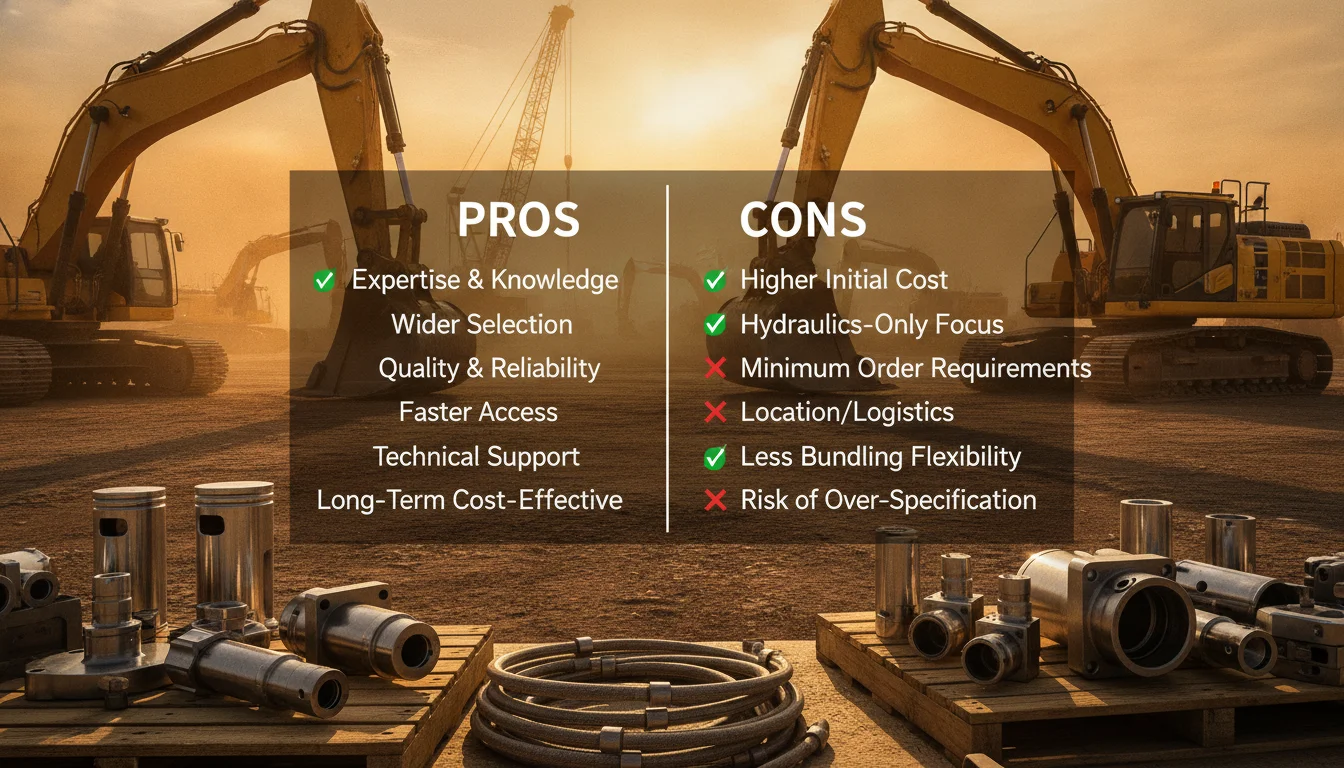
Pros
- Deeper inventory: Specialized the machinery hydraulic parts suppliers stock components that general industrial distributors do not carry.
- Technical expertise: Staff who understand hydraulic circuits can help you identify the correct part and flag compatibility issues before they become field problems.
- Faster lead times: Suppliers with dedicated hydraulic stock can ship same-day or next-day on common components.
- Repair services: Many specialized suppliers offer in-house hydraulic repair and reconditioning, which can reduce cost on high-value components like piston pumps and motors.
- Global sourcing networks: Established suppliers maintain relationships with manufacturers and distributors worldwide, giving you access to parts that are locally unavailable.
Cons
- Price variation: Specialized suppliers may charge a premium over online marketplaces. Always compare total cost including shipping and lead time, not just unit price.
- Geographic limitations: Some suppliers serve regional markets only. If you operate equipment across multiple countries, you need a supplier with international shipping capability.
- Quality inconsistency in aftermarket: Not all aftermarket hydraulic parts meet OEM specifications. Vetting supplier quality standards is essential before placing large orders.
- Minimum order requirements: Some distributors require minimum order quantities that may not suit smaller fleets or one-off repair needs.
Top Construction Machinery Hydraulic Parts Suppliers
Established construction machinery hydraulic parts suppliers vary significantly in specialization, geographic reach, and service capabilities. The table below compares leading options based on verified competitor data.
| Supplier | Specialty | Location | Experience | Key Strength |
|---|---|---|---|---|
| D&S Hydraulics | Excavator pumps, motors, cylinders, remanufacturing | Bend, OR (373 SE Bridgeford Blvd) | 45 years | Remanufacturing + full machine shop |
| Hydraulic Supply Company | Full hydraulic, pneumatic, and industrial product range | 40+ locations, USA | 75 years (est. 1947) | 20,000+ products, same-day shipping, trusted by 700,000+ customers |
| Norman Equipment | Hydraulic components and systems, fluid power | New Berlin, WI | 80 years (est. 1946) | ISO 9001 calibration, pumps to 6,000 PSI, couplers to 15,000 PSI |
| FridayParts | Aftermarket hydraulic parts for heavy equipment | Online supplier | Established supplier | Wide catalog, competitive pricing on aftermarket components |
| Parker Hannifin | Fluid and motion control systems, seals, filtration | Global (est. 1917) | 100+ years | Global leader across aerospace, industrial, and construction sectors |
| Bosch Rexroth | Hydraulic components, drives, control systems | Global | Est. 2001 (Bosch Group) | Drive and control technologies for industrial and mobile machinery |
| 3GEN Export | OEM-quality spare parts for Caterpillar, Komatsu, Volvo, Atlas Copco, and 40+ brands | Global shipping | International B2B specialist | 5-day global delivery, competitive pricing, verified OEM-standard parts |
"Our vendors are world wide, our re-sale territory is world wide. We pride ourselves on quality and service being the main focus with all repairs and product." - D&S Hydraulics, Inc. (dshydraulics.com)
How to Choose the Right Supplier for Your Operation
Choosing among construction machinery hydraulic parts suppliers depends on your fleet size, equipment brands, geographic location, and how much downtime risk you can absorb. Here is a practical framework.
Step 1: Define Your Equipment Profile
List every machine in your fleet by brand, model, and serial number range. Identify which hydraulic components have the highest failure frequency based on your maintenance records. This tells you which parts you need a reliable supply chain for, and which you can source opportunistically.
Step 2: Verify OEM Part Numbers
Pull the OEM part numbers from your service manuals or manufacturer documentation. Cross-reference these against the supplier's catalog before ordering. Any supplier worth working with will confirm compatibility in writing. If they cannot provide a part number cross-reference, that is a red flag.
Step 3: Evaluate Quality Certifications
Ask for ISO certification documentation, quality test reports, or OEM authorization letters. Norman Equipment, for example, holds ISO 9001 certified hydraulic gauge calibration up to 10,000 PSI. That level of documented quality assurance matters when you are ordering components for high-pressure circuits.
Step 4: Assess Lead Times Against Your Downtime Tolerance
A mining operation running 24-hour shifts cannot wait two weeks for a hydraulic pump. A municipal fleet with backup equipment may have more flexibility. Match your supplier's lead time capability to your actual operational risk. For critical applications, maintain a small buffer stock of high-wear items like seal kits, hose assemblies, and filter elements.
Step 5: Compare Total Cost, Not Just Unit Price
Factor in shipping cost, import duties for international orders, warranty terms, and the cost of a wrong-part return. A slightly higher unit price from a supplier who guarantees compatibility and ships within 24 hours is almost always cheaper than a lower price from a supplier who ships the wrong part in two weeks.
Maintenance Tips for Hydraulic Systems
Proper maintenance of hydraulic systems extends component life, prevents catastrophic failures, and protects your parts investment. These practices apply regardless of which construction machinery hydraulic parts suppliers you use.
Regular Inspections
Conduct routine visual inspections of all hydraulic components: cylinders, hoses, fittings, and pump housings. Look for external leaks, surface corrosion, hose abrasion, and fitting weepage. Early detection of a failing seal or cracked hose prevents a minor repair from becoming a full system replacement. Per manufacturer service bulletins, inspection intervals should align with machine operating hours, not calendar time.
Fluid Quality and Contamination Control
Contaminated hydraulic fluid is the leading cause of premature component failure. Use the fluid grade specified in your OEM service manual and replace it on schedule. When adding fluid in the field, use clean, sealed containers and filtered fill equipment. Particle contamination at levels invisible to the naked eye can score pump internals and destroy valve spools. According to manufacturer specifications, most hydraulic systems require fluid with cleanliness ratings that can only be maintained through proper filtration and handling discipline.
Component Replacement Timing
Replace worn or damaged components before they cause secondary damage. A leaking cylinder seal that is ignored will eventually score the cylinder bore, turning a $50 seal replacement into a full cylinder rebuild. Keep a stock of high-wear consumables: seal kits, filter elements, and hose assemblies for your most critical machines.
Pro Tip: Pressure Testing After Repairs
After any hydraulic repair or component replacement, pressure-test the circuit before returning the machine to full-duty operation. This confirms the repair integrity and identifies any secondary issues before they cause a field failure. Norman Equipment's repair department, for example, tests all repaired components to meet factory catalog specifications before release.
2026 Outlook: What Procurement Managers Need to Know
This year, procurement teams sourcing hydraulic components face a market shaped by two competing forces. Global demand for hydraulic parts continues to rise, driven by construction activity, agricultural mechanization, and energy infrastructure investment. At the same time, supply chain disruptions and raw material cost pressures persist, particularly for precision-machined components like piston pumps and high-pressure valves.
Industry data shows that manufacturers are investing in automation and local sourcing to reduce lead times, but these improvements are gradual. The practical implication for procurement managers: build supplier relationships before you need emergency parts, not during a breakdown. Diversify your supplier base across at least two qualified construction machinery hydraulic parts suppliers so that a single supply disruption does not ground your fleet.
Sustainability is also entering hydraulic procurement decisions. Leading manufacturers including Parker Hannifin and Bosch Rexroth are accelerating development of lightweight, energy-efficient hydraulic components. As of 2026, these products are entering the market for new equipment builds, but the installed base of existing construction machinery will continue to rely on conventional hydraulic parts for years to come.
Why Source Hydraulic Parts Through 3GEN Export
We supply OEM-quality hydraulic parts for Caterpillar, Komatsu, Volvo, Atlas Copco, and more than 40 additional brands. Our global logistics network delivers to construction, mining, and energy operations worldwide, typically within five business days. Every part ships with full compatibility documentation and OEM-standard quality assurance.
If your machine is down and you need the right hydraulic component fast, shop OEM-quality spare parts with global 5-day delivery at 3genexport.com. Browse our hydraulic parts categories or explore parts by equipment brand.
Frequently Asked Questions
Who are the biggest hydraulic parts manufacturers globally?
The largest hydraulic parts manufacturers include Parker Hannifin (founded 1917), Bosch Rexroth, Eaton Corporation, and Danfoss. These companies supply components across construction, agriculture, aerospace, and industrial sectors worldwide. For heavy construction equipment specifically, Kawasaki, Linde, and Rexroth are major OEM hydraulic system suppliers to brands like Caterpillar, Komatsu, and Volvo.
What are the main components of a hydraulic system in construction equipment?
The core components are hydraulic pumps, hydraulic cylinders, hydraulic valves, hydraulic power units (HPUs), hoses, and fittings. Each plays a distinct role: pumps generate flow, cylinders convert pressure into linear force, valves control direction and pressure, and hoses connect everything under operating pressure. Filters and reservoirs are also critical to system health.
Can I use aftermarket hydraulic parts instead of OEM parts?
Yes, quality aftermarket hydraulic parts are a cost-effective alternative to OEM components, provided they meet the same dimensional and performance specifications. The key is sourcing from verified construction machinery hydraulic parts suppliers who can document compatibility and quality standards. For machines under manufacturer warranty, check your warranty terms before substituting aftermarket parts.
How do I verify that a hydraulic parts supplier is reputable?
Check for ISO certifications, years in business, customer references from fleet operators in your industry, and whether the supplier can provide OEM part number cross-references. Reputable construction machinery hydraulic parts suppliers will confirm compatibility in writing and stand behind their parts with a clear warranty policy. Avoid suppliers who cannot provide traceable documentation for the components they sell.
How often should hydraulic systems be maintained on construction equipment?
Maintenance intervals should follow the OEM service manual for your specific machine, typically measured in operating hours rather than calendar time. Fluid and filter changes, seal inspections, and hose checks are the most frequent tasks. High-duty-cycle machines in dusty or high-temperature environments may require shorter intervals than the standard schedule.
What is the typical lifespan of hydraulic components on heavy equipment?
Lifespan varies significantly by component type, operating conditions, and maintenance discipline. Hoses and seals are consumables that may need replacement every few years under normal use. Pumps and motors on well-maintained machines can last the life of the equipment. Neglected fluid quality or contamination can reduce component life to a fraction of its potential, regardless of part quality.