
Construction Machinery Parts Suppliers: 2026 Buyer Guide
Compare construction machinery parts suppliers by inventory, pricing, and warranty. Practical steps to avoid downtime and order the right part the first
Loading article…
Article Not Found
The article you're looking for doesn't exist or may have been removed.
Back to BlogKey Takeaways
- Part condition matters: New OEM, aftermarket, rebuilt, and used parts each have trade-offs in cost, warranty, and longevity.
- Verify compatibility: Always cross-reference the machine serial number and part number before ordering from any construction machinery parts suppliers.
- Evaluate total cost: A low upfront price can lead to higher downtime if a part fails prematurely.
- Look for technical support: Suppliers with trained parts specialists reduce the risk of ordering incorrect components.
- Compare warranties: New and rebuilt parts often carry better warranty coverage than used parts.
- Consider lead time: Fast shipping can prevent costly project delays; some suppliers ship most orders within 24 hours.
Introduction
Construction machinery parts suppliers are companies that stock and sell new, used, rebuilt, and aftermarket components for equipment like excavators, dozers, and loaders. The right choice depends on compatibility, inventory depth, and support.
parts suppliers serve a global market of contractors, fleet managers, and equipment owners who need to keep machines running. A good supplier offers more than a catalog. They bring inventory depth, brand coverage, and the expertise to match the correct component to a specific make and model. According to TVH, the company stocks over 8 million known references for construction equipment, which shows the scale required to support fleets operating across dozens of countries.
We've watched this market shift over the years, and one thing hasn't changed: the supplier relationship you build before an emergency is the one that saves you during one. As of 2026, buyers have more options than ever, but that also means more room for costly mistakes if you don't know what to look for.
How to Evaluate Construction Machinery Parts Suppliers
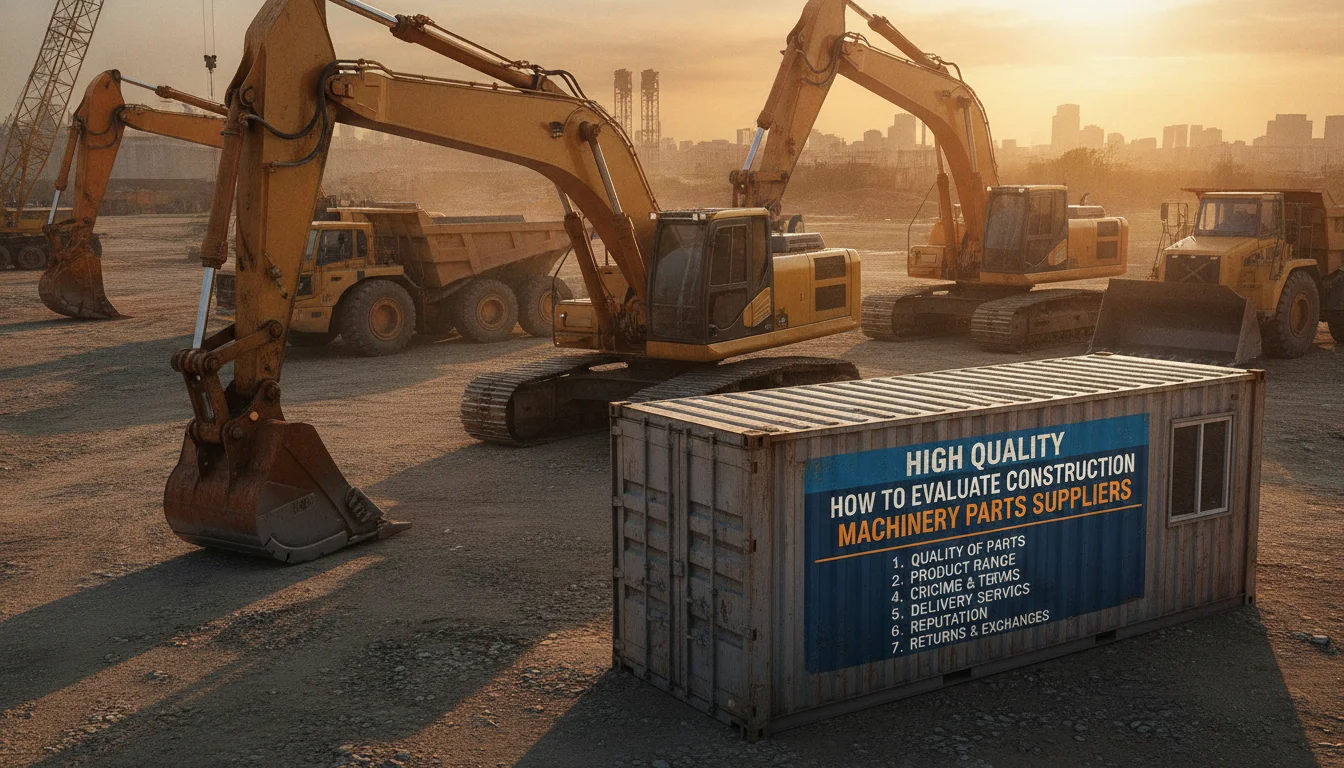
Evaluating this type of suppliers means checking brand coverage, part condition options, inventory depth, pricing transparency, and support quality before you commit to an order. A systematic approach here saves both money and downtime.
- Confirm brand and model coverage. Many construction machinery parts suppliers specialize in brands like Caterpillar, Komatsu, John Deere, Volvo, and Case. Machinery Parts Warehouse, for example, lists parts for over 50 manufacturers, including legacy brands like Austin Western and Lorain.
- Assess part condition and sourcing. Suppliers like AMS Parts offer new, used, rebuilt, and salvage parts across more than 20 makes, including Bobcat, Daewoo, Doosan, JCB, and Takeuchi. Understanding the difference between these conditions determines both cost and reliability.
- Verify inventory depth and availability. ConEquip reports access to over 3,000 vendors, which lets it source hard-to-find components quickly. A supplier with a large vendor network can often locate a part that a smaller reseller simply can't.
- Evaluate pricing and warranty. Compare quotes from multiple sources. Always ask about warranty terms for rebuilt or remanufactured components, since coverage varies widely between vendors.
- Test customer support. Call a parts specialist with your machine serial number and see how quickly they identify the correct part. H&R Construction Equipment Parts reports serving over 50,000 customers since 1984, which points to long-term industry trust.
"We shop at TVH because you are a global supplier for a large number of brands. I can easily research and shop online, and most orders are shipped within 24 hours." - Rental company from Spain, as featured on TVH's website.
Industry maintenance data consistently shows that undercarriage and final drive failures rank among the costliest sources of unplanned downtime on tracked machines, which is why matching wear parts to serial-number-specific specs matters more than chasing the lowest sticker price.
What to Look For When Buying Parts
Buying the right part means checking material quality, fit against your machine's exact serial number, supplier reputation, and realistic price expectations before placing an order. These criteria apply whether you need a single bucket link or a complete final drive assembly.
Material and Build Quality
Aftermarket parts should meet or exceed OEM specifications. Look for suppliers that specify materials like forged steel for undercarriage components and precision-machined hydraulic parts. Low-quality castings or soft seals may save money initially but fail under heavy loads.
Fit and Compatibility
Always provide the machine serial number, not just the model, because manufacturers make mid-series changes. For example, a final drive for a Komatsu D65EX-16 differs from one for a D65PX-15. Reputable construction machinery parts suppliers verify part numbers against your serial number before shipping anything.
Supplier Reputation and Support
Check customer reviews and ratings before you commit. Machinery Parts Warehouse holds a 4.2-star rating based on customer feedback, while ConEquip is rated 4.9 based on more than 4,000 reviews. Ask about warranty terms, return policies, and whether trained parts specialists are available by phone or email.
Price Range Expectations
Prices for individual parts vary dramatically depending on condition and complexity. Based on listings from H&R Construction Equipment Parts, a bucket link for a Komatsu PC200-7 runs $265.99, a radiator $1,110, a track spring assembly $1,600, and a new final drive for a Caterpillar 315B costs $11,120. Rebuilt final drives for Komatsu D65 series machines range from $9,410 to $11,960. Use these examples to set budget expectations: small wear items often run under $500, mid-range hydraulic or cooling components fall between $1,000 and $3,000, and major drivetrain components can exceed $10,000.
Types of Construction Machinery Parts: New, Used, Rebuilt, and Aftermarket
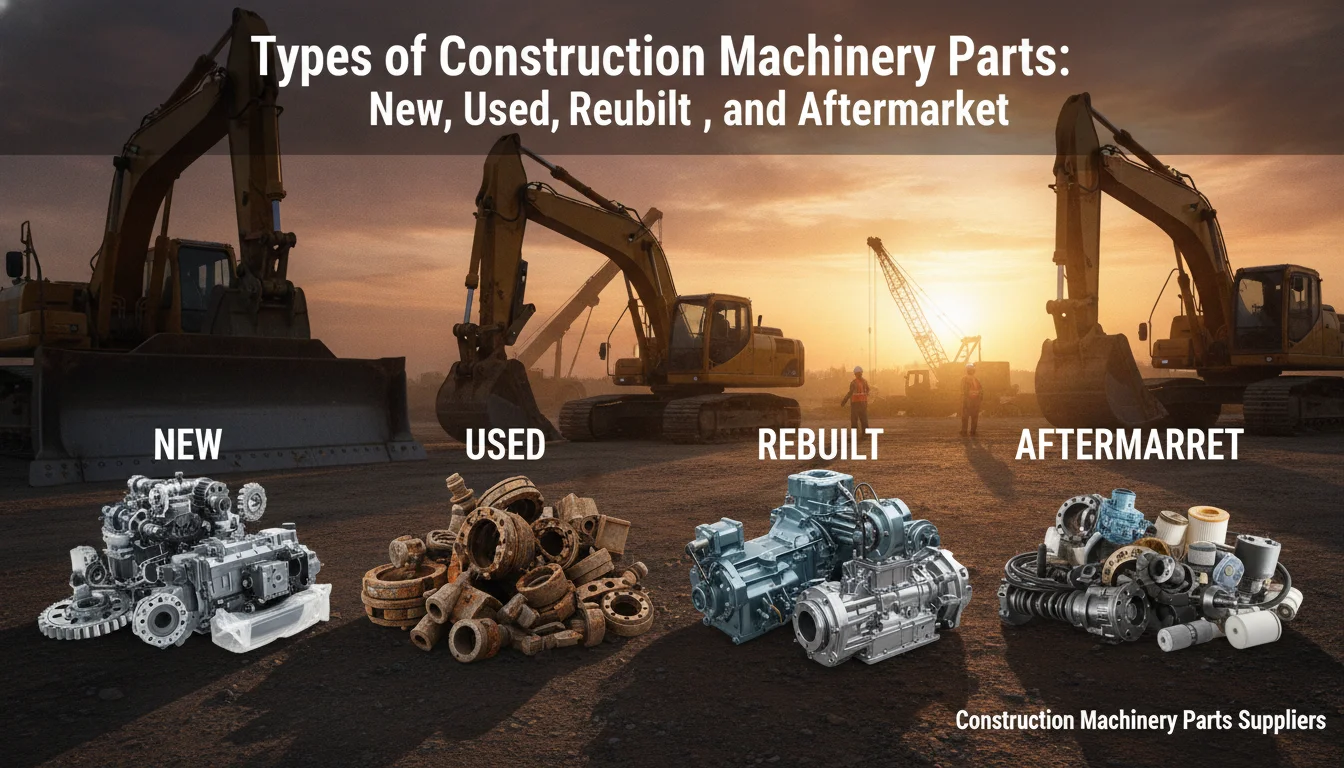
Construction machinery parts fall into four main categories: new OEM, new aftermarket, rebuilt or remanufactured, and used or salvage. Each category balances cost, availability, and reliability differently, and knowing which fits your situation prevents overspending or under-protecting a critical machine.
Aftermarket Parts
Aftermarket parts are components manufactured by companies other than the original equipment manufacturer (OEM). They often cost less than OEM parts but vary widely in quality. Look for suppliers that state ISO-certified manufacturing or back their inventory with a quality guarantee.
Rebuilt and Remanufactured Parts
Rebuilt parts are used components that have been disassembled, inspected, and restored to like-new condition. Remanufactured parts go through a more rigorous process, often including new seals, bearings, and testing, and may carry a warranty similar to new parts.
Used and Salvage Parts
Salvage parts come from dismantled machines and represent the most affordable option. They carry higher risk because wear history is unknown, but they're often the only realistic option for older or discontinued models.
| Part Condition | Pros | Cons | Example Price (from H&R) | Best For |
|---|---|---|---|---|
| New OEM | Exact fit, full warranty, longest life | Highest cost | $11,120 (Caterpillar 315B final drive) | Critical components, new machines |
| New Aftermarket | Lower cost than OEM, wide availability | Quality varies by manufacturer | Varies; some suppliers discount heavily off OEM list price | Non-critical parts, budget-conscious fleets |
| Rebuilt/Reman | Cost savings over new, restored to spec | May have shorter warranty than new | $9,410-$11,960 (Komatsu D65 final drives) | Major components like final drives, transmissions |
| Used/Salvage | Lowest cost, available for older machines | Unknown wear, limited warranty | $265.99 (bucket link), $1,110 (radiator) | Emergency repairs, legacy equipment |
Note: Prices are examples from H&R Construction Equipment Parts and may vary by supplier and market conditions.
How to Pair Parts for Maximum Equipment Performance
Pairing parts correctly means replacing related components together rather than in isolation, since a worn part in one system often accelerates failure in a connected system. Smart equipment owners think in systems, not single parts, and that mindset extends life across the whole machine.
Undercarriage and Final Drive Packages
When replacing track rollers or idlers, also inspect final drives. A worn undercarriage can accelerate final drive wear by creating excessive vibration and misalignment. Many suppliers sell complete undercarriage kits and can recommend a matching final drive based on your machine's hours and application.
Hydraulic System Pairings
Pair hydraulic pumps with matched cylinders and seal kits. Mismatched components can cause pressure drops, overheating, and premature seal failure. For excavators, install a new main pump alongside a filter and fluid change to prevent contamination from old debris.
Engine and Cooling System Kits
Combine engine rebuild kits with new radiators and oil coolers to prevent overheating after a major overhaul. Global Wholesale Parts specializes in engine rebuild kits, turbochargers, and cooling components, and recommends replacing cooling system parts at the same time as an engine rebuild to avoid recirculating contaminants back into a freshly rebuilt engine.
Notable Suppliers in the Market
The construction machinery parts suppliers listed below represent established players worth researching, each with a distinct mix of inventory, pricing, and service model.
- Machinery Parts Warehouse - Based in Peru, IL and Miami, FL, this supplier carries new, used, rebuilt, and aftermarket parts for over 50 brands including Caterpillar, Komatsu, John Deere, Case, and Volvo. Customer rating: 4.2 stars.
- AMS Parts - Offers new, used, rebuilt, and salvage parts for over 20 makes including Bobcat, Daewoo, Doosan, JCB, and Takeuchi. Phone: 1-800-255-6253.
- TVH - A global supplier with over 8 million known references. Focuses on construction, aerial work platforms, and telehandlers. Many orders ship within 24 hours.
- H&R Construction Equipment Parts - In business since 1984, serving over 50,000 customers. Specializes in final drives, transmissions, and undercarriage parts. Phone: 1-800-333-0650.
- ConEquip Parts - Provides access to over 3,000 vendors, offering new aftermarket, rebuilt, and used parts. Phone: 1-716-836-5069. Rated 4.9 based on 4,000+ reviews.
- Global Wholesale Parts - Focuses on engine, drivetrain, and critical-component sourcing, including engine rebuild kits, turbochargers, and hydraulics, with a membership-style ordering platform for contractors and fleets.
3GEN Export operates in this same space, connecting buyers worldwide with OEM-standard parts across 40+ brands, and we'd point to inventory depth and verified compatibility as the two factors that separate reliable construction machinery parts suppliers from the rest.
Care and Maintenance for Extended Part Life
Proper maintenance can meaningfully extend the service life of most components, and it starts with following manufacturer-specified intervals rather than reactive repairs. Consistent habits here protect the investment you just made in new or rebuilt parts.
Preventive Maintenance Schedules
Follow manufacturer intervals for oil changes, filter replacements, and undercarriage adjustments. For hydraulic systems, regular fluid sampling can detect contamination before it damages pumps and cylinders. Pro Tip: Log fluid sample results by machine serial number so you can spot a trend before a component fails.
Proper Storage and Handling
Store hydraulic components in clean, dry environments to prevent contamination. Seal open ports on pumps and cylinders during storage. Keep electrical parts in moisture-proof packaging to avoid corrosion.
Monitoring Part Wear
Use telematics or regular manual inspections to catch wear before failure. Track roller wear, hose abrasion, and engine oil consumption trends closely. Early replacement of a low-cost wear item can prevent a far more expensive downstream failure to a final drive or hydraulic pump.
Pros and Cons of Working With Third-Party Construction Machinery Parts Suppliers
Pros
- Access to new, used, rebuilt, and aftermarket options under one relationship, which gives more flexibility on budget.
- Faster sourcing for discontinued or legacy machine parts through large vendor networks.
- Competitive pricing compared to ordering exclusively through OEM dealer channels.
- Dedicated parts specialists who can cross-reference serial numbers and reduce ordering errors.
Cons
- Quality varies significantly between aftermarket manufacturers, so vetting is essential.
- Used and salvage parts carry unknown wear history and typically shorter or no warranty.
- Lead times on rare or specially sourced parts can still run several days despite fast-shipping claims.
Frequently Asked Questions
How do I choose between new OEM and aftermarket parts?
New OEM parts guarantee exact fit and full warranty but cost more upfront. Aftermarket parts can save money but require a reputable supplier to ensure quality. For safety-critical or high-stress components, OEM is often the safer choice.
Can I buy construction machinery parts online?
Yes, many construction machinery parts suppliers offer online catalogs with search by make, model, and part number. Some ship within 24 hours, but you should always verify return policies before ordering.
What information do I need to order the correct part?
Provide the machine make, model, serial number, and, if possible, the OEM part number. This information allows a parts specialist to confirm exact compatibility before shipping.
Are used construction machinery parts reliable?
Used parts can be reliable for non-critical components if sourced from a trusted salvage yard with inspection guarantees. Always ask about wear measurements and return options before buying.
How do I know if a supplier is legitimate?
Check customer reviews, industry tenure, warranty terms, and whether the company has physical locations or transparent contact information. A supplier that has operated for decades and provides a phone number with live support is usually trustworthy.
What is the typical lead time for construction machinery parts?
Lead times vary by supplier and part type. Some suppliers aim to ship most orders within 24 hours, while specially sourced used parts may take several days. Always confirm lead time before placing an emergency order.
Conclusion: Choosing the Right Construction Machinery Parts Suppliers
Selecting among construction machinery parts suppliers is a decision that directly impacts equipment uptime, maintenance costs, and project timelines. Focus on suppliers that offer transparent part condition descriptions, verified compatibility, competitive pricing, and responsive support. Whether you need a $265 bucket link or an $11,000 final drive, the right partner keeps your fleet moving. Evaluate your options, request quotes, and build a relationship with a supplier that understands your equipment mix.
Shop OEM-quality spare parts with global 5-day delivery at 3genexport.com, backed by a team that understands both the machinery and the procurement pressure you're under.