
Crusher Wear Parts for Mining: Complete Buying Guide
Compare crusher wear parts for mining by alloy, fitment, and cost per ton. Practical buying tips from 3GEN Export, plus global 5-day delivery options.
Loading article…
Article Not Found
The article you're looking for doesn't exist or may have been removed.
Back to BlogCrusher wear parts for mining are the consumable components, such as jaw plates, mantles, concaves, blow bars, and liners, that absorb abrasion and impact inside crushing equipment. Choosing the right alloy and profile cuts downtime and lowers cost per ton.
Key Takeaways
- for mining protect the crusher frame by sacrificing themselves to abrasion and impact before the structure takes damage.
- Wear parts vs. spare parts: wear parts are consumable surfaces; spare parts are mechanical components like bearings, shafts, and toggles.
- Material drives service life: high manganese steel work hardens, high chrome iron resists sliding abrasion, and TIC inserts or ceramic composites deliver the highest wear resistance in severe mining applications.
- Replace in sets: for cone crushers, change the mantle and bowl liner together to maintain chamber geometry and even wear.
- Fitment matters: aftermarket patterns commonly cover Metso, Nordberg, Symons, Sandvik, KPI-JCI, Telsmith, Cedarapids, Superior, Minyu, Pegson, and Finlay.
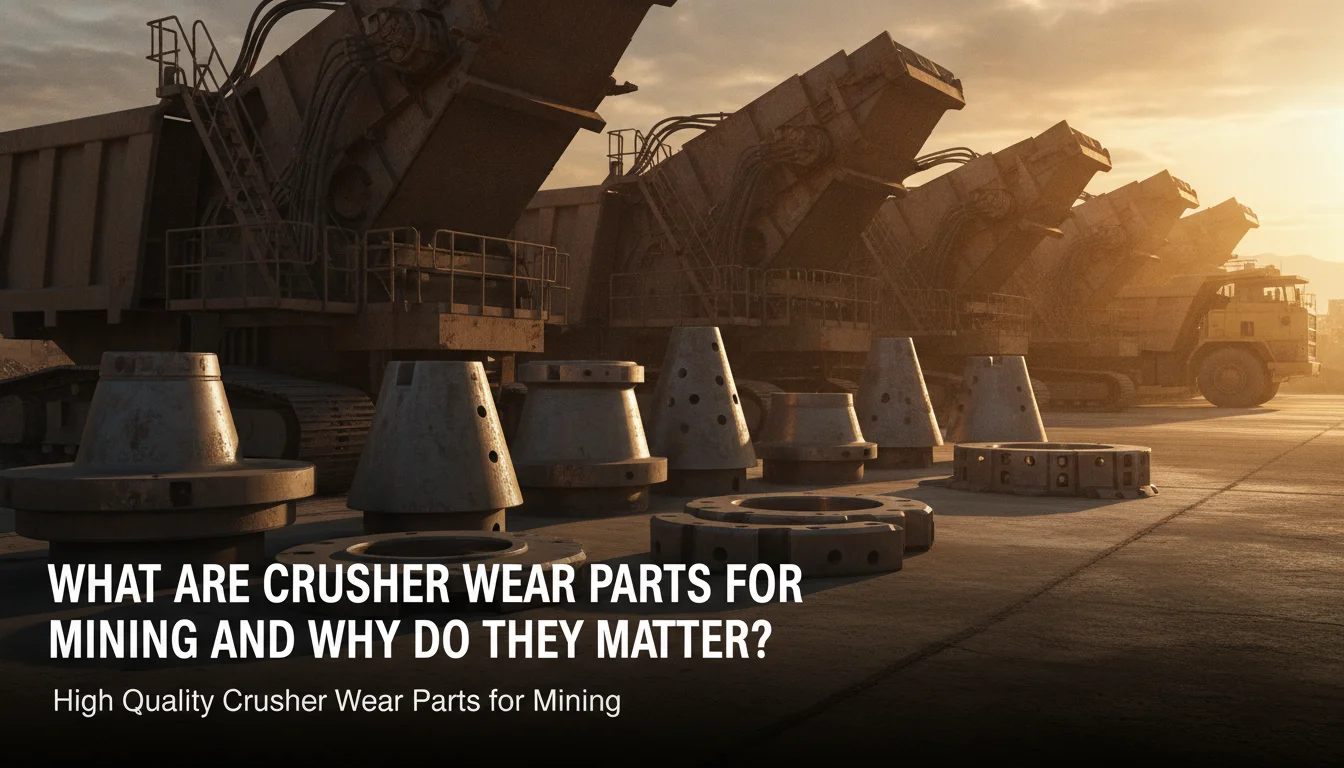
What Are Crusher Wear Parts for Mining and Why Do They Matter?
this type of mining are the components that make direct contact with rock, ore, and other abrasive feed material inside a crushing chamber. According to Mellott Company, crusher parts fall into two main categories: wear parts and spare parts. Wear parts are the components that naturally wear down over time, including jaw plates, mantles, concaves, blow bars, and liners. Spare parts are the mechanical components that may need replacement, such as bearings, shafts, toggles, and hydraulic parts. Selecting the correct wear parts is one of the fastest ways to improve efficiency and profitability on any crushing site.
Manganese steel has been used in crusher wear parts for decades because of its work-hardening properties. As rocks meet the surface of the manganese steel its exterior layer hardens. Weir
Wear Parts vs. Spare Parts
Wear parts are consumable surfaces that sacrifice themselves to protect the crusher frame and moving components. Spare parts keep the crusher mechanically operational. Both categories are stock-critical, but wear parts have a direct impact on production output, material gradation, and cost per ton. A worn or poorly matched jaw plate or mantle will degrade the entire process even when bearings and shafts are in good condition.
Why Material Selection Is a Cost Control Issue
this kind of for mining fail because they face extreme mechanical stress every single shift. Hard rock, sharp edges, high impact loads, and abrasive materials create continuous surface damage. In many cases, failure starts as normal wear but becomes premature when the wrong alloy is selected, the part is installed incorrectly, or the machine runs outside its ideal range. Real service life depends on both part design and operational discipline, not on the alloy alone.
Types of Crusher Wear Parts for Mining
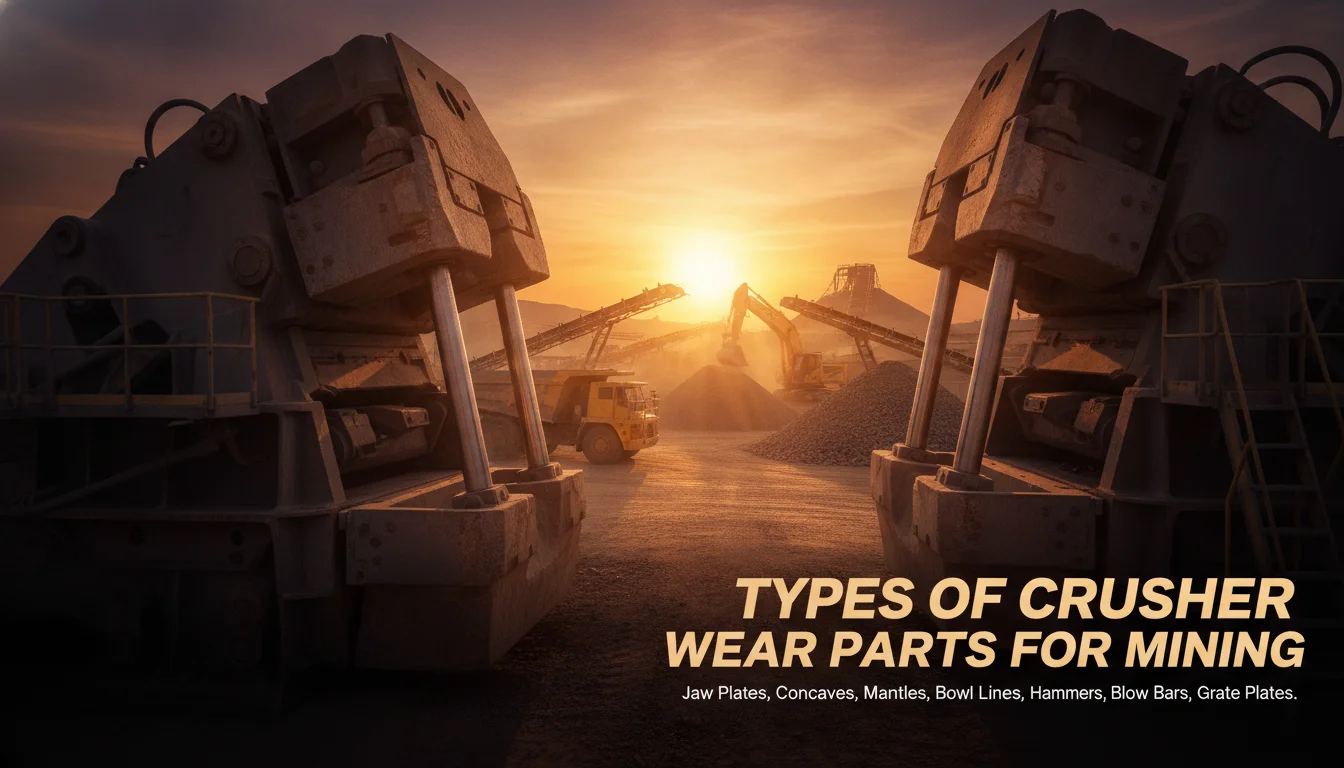
The term covers a family of components specific to each crusher type, and the main wear surfaces for jaw, cone, impact, and gyratory machines all absorb abrasion differently. Matching the wear component to the crusher's mechanical action is the starting point for any procurement decision.
Jaw Crusher Wear Parts
Jaw crushers use fixed and movable jaw plates, cheek plates, and toggle plates. These parts are typically cast in high manganese steel grades such as Mn13, Mn18, and Mn22, or in Mn-Cr alloy steel. For severe abrasive feed, TIC insert jaw plates add extra wear resistance. The tooth profile on jaw plates should match the feed, whether that's coarse quarry rock or recycled concrete.
Cone Crusher Wear Parts
Cone crushers use mantles and bowl liners, also called concaves, plus feed cones. These are profiled to match the chamber and can be supplied in standard or short-head variations for different feed sizes and closed-side settings. According to Weir, when evaluating liner replacements, operators should change the mantle and bowl at the same time so the parts match when commissioning and wear at the same rate.
Impact and Gyratory Wear Parts
Impact crushers use blow bars, impact plates, and side liners. Hammer crushers use hammer heads, grate bars, and breaker plates. Gyratory crushers use mantles with concave segments, plus accessories such as rim liners, spider caps, and spider arm liners. VSI machines add anvils and shoes to the list, and each application benefits from matching the specific component to how the machine actually breaks rock.
VSI Rotor Wear Parts
A vertical shaft impactor (VSI) relies on a different wear part family than jaw, cone, or horizontal impact crushers. The rotor assembly typically uses tip inserts or rotor tips, distributor plates, wear plates, and feed tubes, along with anvils or shoes depending on whether the machine runs in rock-on-rock or rock-on-metal mode. Because the rotor spins at high speed, uneven wear on these components can throw the assembly out of balance, so operators should inspect rotor tips and distributor plates on a set schedule rather than waiting for visible failure.
Beyond the Crusher: Related Mining Castings
Crushing circuits rarely operate in isolation, and several adjacent wear items are worth budgeting for alongside your core the wear parts for mining. Penticton Foundry notes that its chrome white iron castings extend into apron feeder liners, grizzly screens, transfer chute liners, mill liners, and surge bin liners, all of which see similar sliding and gouging abrasion. If your operation runs conveyors alongside the crushing plant, mining-grade conveyor belting is often quoted and shipped alongside liners and blow bars so the whole material handling chain gets serviced in one order.
Outfitting the Whole Crushing Circuit
For a complete changeout, pair jaw plates with cheek plates. For cone crushers, order the mantle, bowl liner, and feed cone together. For impactors, combine blow bars with impact plates and side liners. Many suppliers also stock changeout accessories such as torch rings, mantle caps, feed plates, epoxy backing compound, and rubber isolation springs. Ordering liners and accessories together avoids the small missing part that can hold up an entire changeout.
Material Options and Alloy Performance
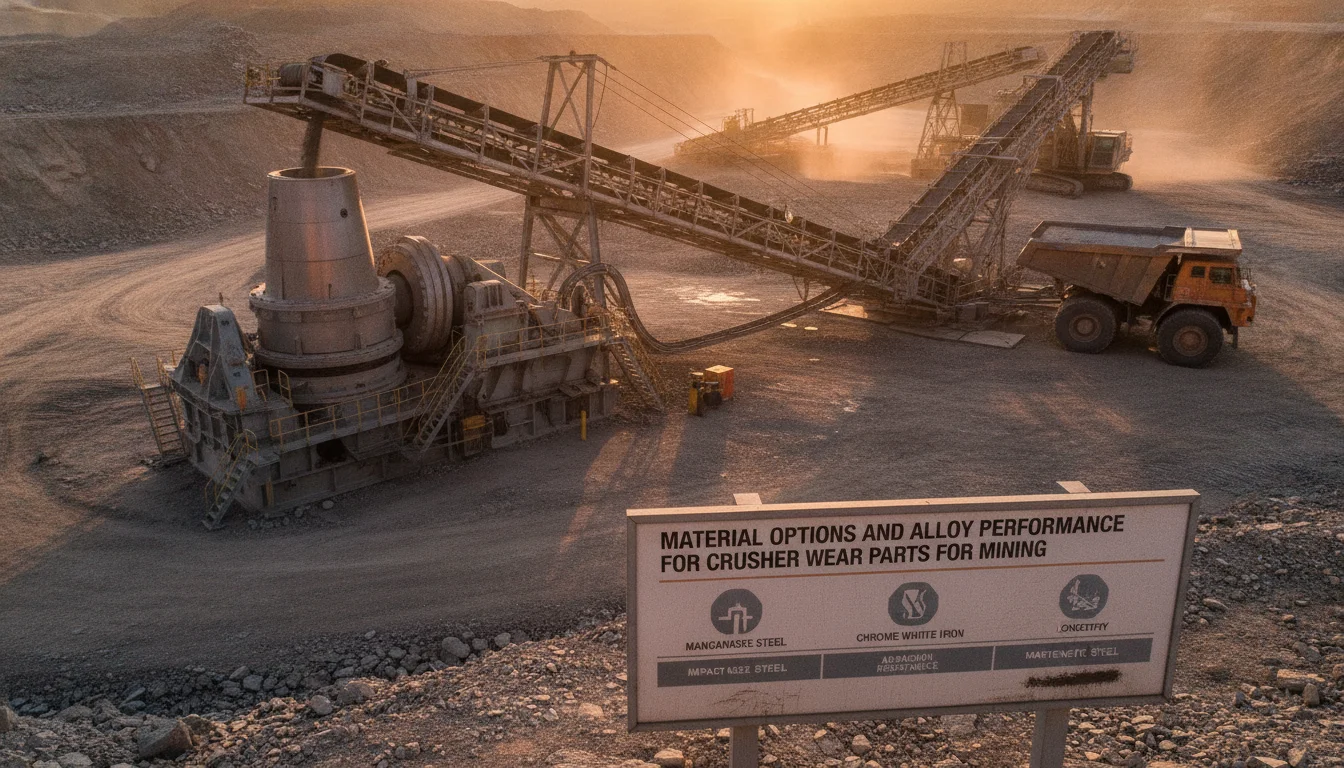
The material used to manufacture crusher liners plays a critical role in performance and service life. Different alloys balance hardness, toughness, and wear resistance, and the table below summarizes the main material families used across crusher wear parts for mining.
| Material | Hardness (HRC) | Wear Resistance | Typical Applications | Notes |
|---|---|---|---|---|
| High Manganese Steel | 45-55 | ★★★☆☆ | Jaw plates, hammers | Work hardening, high toughness |
| High Chrome Iron | 56-65 | ★★★★☆ | Blow bars, impact plates | High hardness, more brittle |
| Martensitic Steel | 48-58 | ★★★★☆ | Blow bars, hammers | Balance of strength and ductility |
| TIC Inserts | >60 | ★★★★★ | Jaw plates, blow bars | Super wear-resistant inserts |
| Ceramic Composite | >65 | ★★★★★ | Impact parts | Lightweight, superior resistance |
Manganese Steel and Work Hardening
Manganese steel has been used in crusher wear parts for decades because of its work-hardening properties. The exterior layer hardens when rock strikes the surface, producing a material that resists wear and handles higher impact blows compared to other alloys. However, a common misconception holds that higher manganese percentages automatically create a more robust wear part. Manganese alloys typically contain carbon and chrome, and increasing any of these ingredients requires adjustment to the wider recipe. Without an application review, manganese increases can actually result in weaker or less reliable parts.
Chrome White Iron and Martensitic Steel
High chrome white iron is particularly well suited to the sliding and gouging abrasion found in mining. According to Penticton Foundry, the physical metallurgy of high chrome white iron means it will outlast AR400 by a factor of 10 and AR600 by a factor of 3. Martensitic steel offers a balance of strength and ductility, making it a workable choice for blow bars and hammers in mixed-impact applications where pure high chrome iron may be too brittle.
Mining involves processing large volumes of hard and abrasive materials like granite, iron ore, and copper ore. These materials cause rapid wear to crushing components, and unplanned downtime due to wear part failure can cost a mining operation significant money per hour of lost production.
TIC Inserts and Ceramic Composites
For severe abrasion, TIC inserts and ceramic composites deliver the highest wear resistance ratings available. TIC inserts sit embedded in a steel or manganese matrix and show up most often in jaw plates and blow bars. Ceramic composites are lightweight and provide superior resistance in impact parts. These premium options extend changeout intervals in hard rock mining, but they aren't always the best economic choice in lower-abrasion circuits.
What to Look For When Buying Crusher Wear Parts
Buying crusher wear parts for mining is not simply matching a part number to a catalog page. The right purchase balances material chemistry, profile fitment, inventory availability, and total cost per ton.
Fitment and Pattern Accuracy
Aftermarket wear parts must match the crusher's chamber profile and mounting dimensions exactly. Common fitment coverage includes Metso, Nordberg, Symons, KPI-JCI, Telsmith, Sandvik, Cedarapids, Superior, Minyu, Pegson, and Finlay. If your crusher make isn't on that list, a photo and a few measurements will often let a supplier work from an existing pattern library or engineer a custom profile.
Alloy Recipe and Application Match
Don't select a liner based on manganese percentage alone. Ask the supplier for the full alloy recipe and the engineering logic behind it. Weir notes that its Trio® and ESCO® alloys are carefully optimized in the Mn/C/Cr ratio and adjusted to the wider formula. The right alloy for a jaw crusher processing abrasive granite differs from an impact crusher handling lower-silica recycled concrete. A supplier that asks about feed material, closed-side setting, and tonnage is far more likely to recommend the correct chemistry.
Inventory, Lead Time, and Support
Deep inventory reduces downtime more reliably than almost any other purchasing decision. Metso states it operates 150 distribution centers worldwide, a scale that illustrates why proximity to stock matters for wear parts. Some North American suppliers position inventory regionally so common cone and jaw profiles are already on a rack when you call, backed by dealer and PSSR (Product Support Sales Representative) networks for on-site support. As of 2026, global buyers increasingly expect the same responsiveness from international suppliers, which is why confirming local stock and lead time for non-stocked profiles should happen before you commit to any vendor.
How to Specify the Right Crusher Wear Part
- Identify the crusher make, model, and feed material. If you don't have the part number, a photo and a few measurements will usually do.
- Confirm the current profile and wear pattern. Note whether the chamber is standard or short-head and record remaining liner thickness.
- Select the alloy based on abrasion and impact conditions. Match high manganese to high-impact zones, high chrome to sliding abrasion, and TIC or ceramic to severe abrasion.
- Verify stock, lead time, and total order. Add accessories like epoxy backing material, torch rings, and mantle caps to the same order so the changeout isn't delayed by a small missing part.
Pros and Cons of Aftermarket Crusher Wear Parts
Aftermarket crusher wear parts for mining offer real advantages in cost and lead time, but they come with tradeoffs buyers should weigh against OEM sourcing.
Pros
- Often lower cost per unit than OEM parts, without necessarily sacrificing alloy quality
- Broad pattern libraries covering Metso, Nordberg, Symons, Sandvik, and other major brands mean faster fitment matching
- Suppliers with regional or global stock can ship faster than waiting on a single OEM distribution channel
- Custom profile engineering is available when your machine isn't a common pattern
Cons
- Quality varies significantly between manufacturers, so casting quality and alloy documentation need verification
- Fitment errors are possible if measurements or part numbers aren't confirmed before ordering
- Some premium alloys (TIC inserts, ceramic composites) carry a higher upfront cost that only pays off in high-abrasion applications
- Warranty terms and installation support differ by supplier, so service backing needs to be confirmed upfront
Price Ranges and Budgeting
Prices for crusher wear parts for mining vary with alloy, size, casting complexity, and order volume. No verified list pricing is publicly available across the suppliers we reviewed, so treat the following as a tiering framework rather than a quote.
Budget Tier: Standard Manganese Castings
Standard manganese jaw plates and cone liners are typically the most economical entry point. They work well where impact is high and abrasive sliding is moderate. Lower initial cost can mean more frequent changeouts, so compare total cost per ton over a full season rather than the sticker price alone.
Mid-Range: High Chrome and Martensitic Alloys
High chrome iron and martensitic steel parts occupy the middle cost band. They offer better wear resistance in abrasive applications, but high chrome iron is more brittle and may not suit high-load impact zones. Martensitic steel can be a practical bridge between cost and durability.
Premium: TIC Inserts and Ceramic Composites
TIC insert and ceramic composite components sit at the premium tier. They extend liner life enough to justify the higher price in hard rock and high-abrasion circuits, especially where changeout labor is costly. Use these selectively where wear life is the binding constraint on production.
Total Cost of Ownership
Compare cost per ton, not just purchase price, when evaluating crusher wear parts for mining. A lower-priced manganese liner that lasts half as long and requires twice the changeout labor is rarely the better value. Ask for documented wear life in similar feed conditions, and factor in freight, installation, and downtime when comparing quotes across suppliers.
Care, Maintenance, and Installation Tips
Proper installation and monitoring extend the life of any crusher wear part regardless of alloy. Even the best alloy underperforms if it's installed on a dirty surface or operated outside design parameters.
Pre-Installation Checks
Inspect mounting surfaces, backing material, and part compatibility before installation begins. Clean mating faces, verify part numbers, and confirm the profile matches the chamber. Use the correct epoxy backing compound and follow the manufacturer's torque sequence. Incorrect installation frequently causes premature failure, especially in cone and gyratory crushers.
Pro Tip: Keep a log of remaining liner thickness at every inspection, not just at changeout. Sudden deviation from the normal wear curve is often the earliest warning sign of a feed change or a machine setting drifting out of spec, and catching it early can save an entire liner set.
Monitoring Wear Life
Track operating hours and tonnage against each liner set consistently. Record remaining thickness at regular intervals to predict changeout timing accurately. A sudden deviation from normal wear usually signals a change in feed material or machine settings. Monitoring also helps you compare alloy performance and supplier quality over time, which matters when qualifying a new source for crusher wear parts for mining.
Rotating and Replacing Components
For cone crushers, change the mantle and bowl liner at the same time so the components match and wear at the same rate. For jaw crushers, replace fixed and swing jaws together once the tooth profile is lost. Rotate blow bars where possible to expose unworn edges and stretch service life further.
The right crusher wear parts for mining balance alloy chemistry, chamber fit, inventory availability, and total cost per ton. Work with a supplier that asks about your feed material and application before quoting a profile. That approach protects uptime and lowers long-term operating costs across the life of the machine.
Frequently Asked Questions
How do I know which crusher wear parts fit my machine?
Provide the crusher make, model, and OEM part number if you have it. If you don't have a part number, a photo and a few measurements can let a supplier match the pattern from an existing library.
What is the best material for mining crusher wear parts?
There's no single best material for every application. High manganese steel suits high-impact jaw and cone applications, high chrome iron suits sliding abrasion in blow bars, and TIC inserts or ceramic composites suit severe abrasion. Choose based on feed material and crusher type.
Should I buy cheaper manganese wear parts or premium TIC inserts?
Compare total cost per ton, not just purchase price. If premium inserts outlast manganese several times over and reduce changeout labor, they may be the better value in hard rock mining, while standard manganese may be sufficient in lower-abrasion circuits.
How often should crusher wear parts be replaced?
Replacement timing depends on feed abrasiveness, tonnage, and alloy selection. Track thickness and wear patterns, and replace liners before the base metal is exposed or throughput and gradation start to degrade.
What are the main parts of a crusher?
A crusher's main components split into wear parts and spare parts. Wear parts include jaw plates, mantles, concaves, blow bars, and liners, while spare parts include bearings, shafts, toggles, and hydraulic components that keep the machine mechanically operational.
Do aftermarket wear parts work as well as OEM parts?
High-quality aftermarket wear parts built from experienced pattern libraries can match or exceed OEM performance. Look for documented alloy recipes, casting quality, and fitment references before switching suppliers.
Sourcing reliable crusher wear parts for mining shouldn't mean choosing between quality and speed. 3GEN Export supplies OEM-standard wear and spare parts for Caterpillar, Komatsu, Volvo, Sandvik, Metso, and 40+ additional brands, backed by global 5-day delivery. Shop OEM-quality spare parts with global 5-day delivery at 3genexport.com and keep your crushing circuit running on your schedule, not your supplier's.