
Energy Industry Heavy Equipment Parts Trends 2026
Energy industry heavy equipment parts trends are reshaping procurement in 2026. Explore electrification, IoT, and supply chain shifts driving market
Loading article…
Article Not Found
The article you're looking for doesn't exist or may have been removed.
Back to BlogKey Takeaways
- The energy industry heavy equipment parts market sits within a broader sector valued at $190.04 billion in 2024, projected to reach $278.64 billion by 2034 at a 4.90% CAGR.
- Electrification and hybrid machinery are creating demand for electric drivetrains, battery systems, and high-voltage components across power generation, oilfield, and renewable energy sectors.
- Smart technology integration, including IoT sensors, predictive maintenance, and digital twins, is transforming parts management and reducing unplanned downtime in energy operations.
- Circular economy practices like remanufacturing, recycling, and component reuse are extending equipment life while cutting costs and waste.
- Asia-Pacific dominates the heavy equipment parts market, fueled by infrastructure investment and rapid industrialization, while North America and Europe focus on upgrading aging energy infrastructure.
- Supply chain resilience strategies, including local sourcing and digital supply networks, are mitigating procurement risk for energy equipment operators worldwide.
Energy industry heavy equipment parts trends are the forces reshaping procurement, maintenance, and parts design across power generation, oilfield, and renewable energy sectors in 2026. Electrification, digitalization, and circular economy practices are the three dominant forces driving this shift.
Energy Industry Heavy Equipment Parts Trends: A Market Overview
parts trends are reshaping a multi-billion-dollar global market that spans power generation, oilfield services, and renewable energy machinery. According to Zion Market Research, the heavy equipment components and parts market was valued at USD 190.04 billion in 2024 and is projected to reach USD 278.64 billion by 2034, with a CAGR of 4.90%. These trends are not uniform. They vary by equipment type, component category, and geography. For the energy industry specifically, parts must withstand extreme conditions, from offshore drilling rigs to high-temperature turbine environments, making durability and performance non-negotiable.
Global Market Size and Forecasts
Different research firms offer varying projections, reflecting the breadth of this market. Mordor Intelligence estimates the construction and mining equipment spare parts market at USD 174.04 billion in 2025, growing to USD 264.12 billion by 2030 at an 8.70% CAGR. Reliable Business Insights projects a 9.5% CAGR for the broader heavy equipment parts market through 2033. These discrepancies reflect differing scopes. Some reports include all heavy equipment; others focus on construction and mining specifically. For this type of trends, the hybrid nature of the equipment matters: a bulldozer used in fossil fuel site preparation shares parts with one used in construction, but energy sector applications demand additional certifications and materials resistant to chemical exposure or extreme temperatures.
| Report Source | Market Size (Base Year) | Forecast Size | CAGR | Scope |
|---|---|---|---|---|
| Zion Market Research | $190.04B (2024) | $278.64B (2034) | 4.90% | Global heavy equipment components and parts |
| Mordor Intelligence | $174.04B (2025) | $264.12B (2030) | 8.70% | Construction and mining equipment spare parts |
| Reliable Business Insights | Not disclosed | Not disclosed | 9.5% | Heavy equipment parts (broad) |
Drivers of Change in Energy Equipment
Several forces are propelling this kind of parts trends forward. A global rise in electricity demand, fueled by population growth and urbanization, is expanding power generation infrastructure and creating sustained demand for equipment and replacement parts. The shift to renewable energy sources such as wind and solar is generating specialized component needs: turbine gearboxes, solar tracking motors, and biomass boiler parts, for example. Grid modernization initiatives are pushing utilities to invest in new transformers, switchgears, and smart grid equipment, all of which require robust aftermarket support. According to Benchmark International, wind turbine equipment remains the dominant segment within wind energy, with onshore installations leading, and this translates directly into parts demand for blades, bearings, and control systems.
Aftermarket vs. OEM Parts in Energy Sectors
The aftermarket plays a critical role in the heavy equipment parts ecosystem. For energy operators, the choice between OEM parts and aftermarket alternatives hinges on cost, availability, and reliability. OEM parts guarantee exact specifications and often carry warranty protection, but they can cost significantly more than certified aftermarket options. Aftermarket suppliers, including 3GEN Export, have narrowed the quality gap by adhering to ISO 9001 standards and offering remanufactured components that meet or exceed OEM performance. We're seeing growing acceptance of certified aftermarket parts, especially for older machinery where OEM support has waned. For remote energy sites where minimizing downtime is mission-critical, that acceptance is accelerating fast.
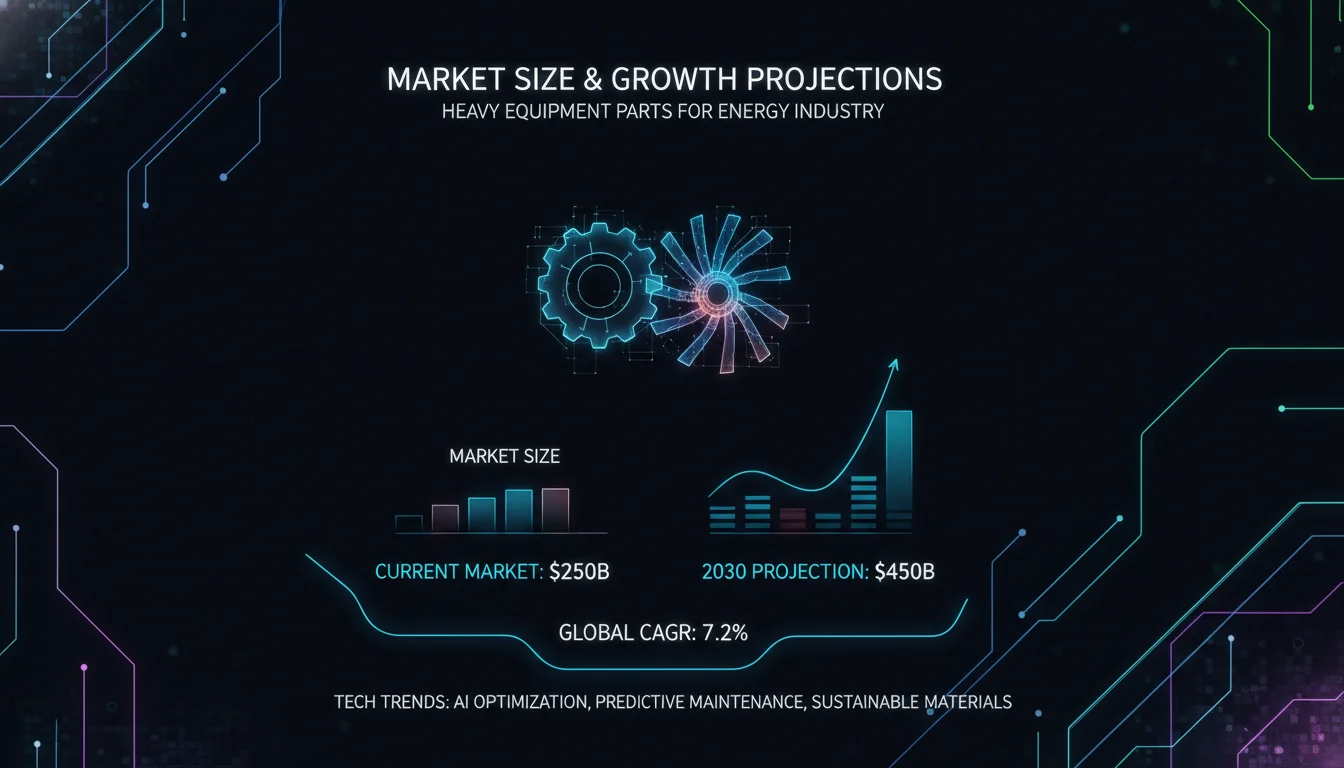
Market Size and Growth Projections for Heavy Equipment Parts
Valuation Across Key Reports
As illustrated in the table above, market valuations vary across research firms, but the consistent theme is robust growth. The energy industry's heavy equipment parts subset is arguably larger than general numbers suggest because it includes specialized power generation and oilfield equipment not captured in generic construction machinery studies. Offshore oil rigs require blowout preventers, top drives, and mud pumps, all components with high wear rates and limited second-source options. the industry heavy equipment parts trends reflect this nuance: the aftermarket for oilfield production equipment is a substantial segment, driven by ongoing maintenance of aging wells and the adoption of enhanced oil recovery techniques.
Equipment Type Segmentation: Where the Parts Demand Lives
Understanding which equipment types drive parts demand is essential for procurement planning. According to Zion Market Research, excavators represent the leading equipment segment by market share, while loaders are among the fastest-growing. Engine parts hold the largest share by component type, with hydraulic components recording strong growth. For energy applications specifically, the picture shifts: drilling equipment, production tools such as separators, pumps, compressors, and storage tanks, and renewable energy machinery each create distinct parts profiles. A procurement manager sourcing for a wind farm has very different needs from one supporting an oilfield operation, even if both are buying from the same broad market.
| Equipment Type | Key Parts Categories | Energy Application |
|---|---|---|
| Excavators | Undercarriage, hydraulic cylinders, engine parts | Pipeline trenching, site preparation |
| Bulldozers | Track assemblies, blades, final drives | Oilfield site clearing, wind farm construction |
| Loaders | Buckets, lift arms, transmission parts | Coal handling, biomass loading |
| Drilling Equipment | Blowout preventers, top drives, mud pumps | Oil and gas extraction |
| Wind Turbines | Gearboxes, bearings, blades, control systems | Onshore and offshore wind generation |
Growth Catalysts in Energy Applications
Infrastructure development worldwide acts as a major catalyst. The U.S. government's $2 trillion infrastructure plan, highlighted by NedTrax, emphasizes upgrading transportation, broadband, and energy systems, which directly boosts demand for heavy equipment parts. In Asia-Pacific, rapid industrialization in China and India fuels both mining and power plant construction, straining supply chains and creating opportunities for parts suppliers. trends in these regions lean toward cost-effective aftermarket parts, driven by budget constraints and the sheer volume of machinery in operation.
Challenges and Restraints
Despite strong growth, the market faces real hurdles. Supply chain disruptions, rising raw material costs, and a shortage of skilled labor all impact parts availability and pricing. For energy companies operating in remote areas, such as wind farms in rural India or oilfields in the Middle East, logistical bottlenecks can extend lead times from weeks to months. These pressures are pushing stakeholders to embrace digital supply networks and local warehousing, redefining traditional procurement models.
Electrification: The Top Energy Industry Heavy Equipment Parts Trend
Electrification is the most significant of all energy industry reshaping procurement today. Heavy machinery historically powered by diesel engines is being replaced or retrofitted with electric and hybrid systems. This shift is particularly pronounced in the energy sector, where equipment such as electric drive mud pumps, battery-electric mining trucks, and hybrid wind turbine installation cranes are becoming mainstream. The benefits are clear: zero tailpipe emissions, lower noise levels, and reduced fuel and maintenance costs. As NedTrax notes, electric machines have fewer moving parts than their diesel equivalents, which translates into longer service intervals and a fundamentally different spare parts profile.
Electric Drive Systems and Battery Components
For parts suppliers, electrification demands a new inventory of components: lithium-ion battery packs, inverters, electric motors, and regenerative braking systems. High-voltage cables and connectors must meet stringent safety standards for mobile machinery. parts trends show that companies like Thyssenkrupp and XCMG are already expanding their electric equipment lines, creating a ripple effect through the parts aftermarket. At 3GEN Export, we've seen a meaningful surge in inquiries for electric drivetrain parts over the past year, a clear signal of accelerating adoption across our global customer base.
Hybrid Solutions for Oilfield and Mining
In energy-intensive applications like mining and oilfield operations, hybrid systems offer a pragmatic middle ground. Hybrid excavators and loaders use a smaller diesel engine combined with an electric motor, improving fuel efficiency while retaining some conventional parts. This hybrid approach introduces new components alongside legacy ones: power electronics, thermal management units, and specialized cooling systems. this type of trends indicate that hybrid machinery will dominate the transition phase before full electrification becomes feasible for the heaviest equipment. For aftermarket suppliers, this means stocking both legacy and next-generation parts simultaneously, a complex but necessary adaptation.
Cost Benefits and Operational Efficiency
Beyond environmental gains, the economic case for electrification is compelling. Electric equipment reduces energy costs compared to diesel, and regenerative braking can recover energy in applications like cranes and material handlers. These savings free up capital for more frequent parts replacements and upgrades. this kind of parts trends show a clear pattern: as operating expenses fall, fleet managers are more willing to invest in premium, long-life components, further boosting the aftermarket for quality parts.
Digitalization: Smart Parts and Predictive Maintenance
Digitalization is changing how heavy equipment parts are monitored, maintained, and replaced across the energy sector. The integration of Industry 4.0 technologies, including IoT sensors, cloud-based analytics, and digital twins, enables real-time condition monitoring. According to Benchmark International, digital twin tools allow for real-time monitoring and optimization of turbines, improving operational efficiency and cutting maintenance costs. For energy companies, this means unplanned downtime can be reduced significantly. the industry heavy equipment parts trends now heavily favor smart components embedded with sensors that communicate wear status and predict failure points before they become costly breakdowns.
"The energy sector's embrace of digital twins and predictive analytics is reshaping parts logistics. At 3GEN Export, we're seeing a meaningful increase in demand for sensor-enabled hydraulic components, as operators move from reactive to condition-based maintenance."
- Senior Parts Specialist, 3GEN Export
IoT and Telematics Integration
Modern heavy equipment comes factory-fitted with telematics systems that transmit data on engine load, fluid temperatures, and component wear. Aftermarket IoT kits can retrofit older machines, bringing them into the digital fold. trends confirm that telematics is no longer a luxury; it is a baseline requirement for fleet management in competitive energy markets. Companies like Titan International and Allied Heavy Equipment Parts have introduced IoT-compatible undercarriage and engine components that send alerts when performance thresholds are breached.
Predictive Maintenance: A Step-by-Step Implementation
Effective predictive maintenance reduces parts consumption by replacing only what is needed, when it is needed. Here is a proven workflow:
- Install IoT sensors on critical components, including engines, hydraulic pumps, and slew bearings, to measure vibration, temperature, and pressure.
- Collect real-time data into a centralized cloud platform capable of handling high-frequency industrial data streams.
- Apply machine learning algorithms to identify anomaly patterns and predict remaining useful life.
- Schedule maintenance windows during planned operational lulls to minimize production losses.
- Continuously update models with fresh operational data to refine prediction accuracy over time.
energy industry show that companies using predictive maintenance can achieve meaningful parts cost savings annually, making it one of the highest-ROI digital investments available to fleet managers today.
"Predictive maintenance shifts the conversation from 'what broke?' to 'what will break, and when?' For procurement teams managing large energy equipment fleets, that shift is the difference between controlled costs and emergency spending."
- 3GEN Export Technical Advisory Team
Remote Diagnostics and Part Replacement
Remote diagnostics allow technicians to troubleshoot equipment without traveling to site, a critical advantage for remote energy installations like offshore platforms or desert solar farms. Using secure connections, experts can read error codes, update firmware, and guide on-site personnel through parts replacement procedures. This approach reduces mean time to repair (MTTR) substantially and is a key feature of modern parts trends, particularly for operators managing geographically dispersed fleets.
Circular Economy and Sustainable Parts Strategies
The circular economy is a core element of this type of trends, not a niche concept. Remanufacturing, recycling, and component reuse are extending product lifecycles and reducing the environmental footprint of heavy machinery. For the energy sector, where equipment often operates in ecologically sensitive areas, these practices align with corporate sustainability goals and regulatory mandates.
Remanufacturing and Reuse
Remanufacturing restores a used part to like-new condition, offering a significant cost advantage over new OEM parts. Engine components, hydraulic cylinders, and turbochargers are prime candidates. this kind of parts trends show that remanufactured parts are increasingly preferred for legacy equipment in oilfield and power generation sectors, where long production runs justify frequent overhauls. Standards like ISO 9001 ensure remanufactured parts meet safety and performance benchmarks that energy operators require.
Recycling and Material Innovation
Design-for-recycling is gaining traction across the industry. Manufacturers are selecting materials that can be easily separated and recycled at end-of-life. High-strength steel used in excavator arms can be melted down and reused, while biodegradable hydraulic fluids reduce environmental risk at sensitive sites. the industry heavy equipment parts trends highlight material innovation such as self-lubricating composites and additively manufactured metal parts that minimize production waste and simplify end-of-life recycling.
Lifecycle Extension Strategies
Rather than replacing entire machines, many energy operators opt for mid-life refurbishments. This involves replacing key wear parts, including bushings, pins, and seals, while upgrading electronics to extend service life by additional years. These strategies lower the total cost of ownership and reduce demand for new raw materials, creating a clear win for both operators and the environment. For procurement managers, this approach also provides budget predictability that full equipment replacement cannot match.
Pros and Cons of Current Energy Industry Heavy Equipment Parts Trends
Pros
- Lower total cost of ownership: Electrification and predictive maintenance reduce fuel, labor, and unplanned repair costs over the equipment lifecycle.
- Improved parts availability: Digital supply networks and nearshoring initiatives are shortening lead times and reducing stockout risk for critical components.
- Extended equipment life: Remanufacturing and circular economy practices allow operators to keep proven machinery productive for longer, deferring capital expenditure.
- Better maintenance planning: IoT sensors and telematics give procurement teams advance warning of component wear, enabling scheduled replacements instead of emergency orders.
- Growing aftermarket quality: Certified aftermarket suppliers adhering to ISO 9001 standards are delivering OEM-equivalent performance at competitive prices.
Cons
- Complex inventory requirements: The transition to electric and hybrid equipment means suppliers must stock both legacy diesel parts and new-generation components simultaneously.
- Higher upfront investment: Electrification and digitalization require significant capital outlay for new equipment, sensor systems, and software platforms before savings materialize.
- Skills gap: Technicians trained on diesel systems need retraining to service high-voltage drivetrains and IoT-enabled components, creating a short-term labor constraint.
- Supply chain vulnerability: Specialized components for electric drivetrains and smart systems often have fewer second-source options, increasing procurement risk.
- Data security concerns: Connected equipment and digital supply networks introduce cybersecurity risks that energy operators must actively manage.
Supply Chain Resilience for Energy Equipment Parts
Supply chain resilience is now a strategic priority for anyone tracking trends. The COVID-19 pandemic exposed fragility in global supply chains, and the heavy equipment parts sector was no exception. For energy producers, delays in parts delivery can halt operations entirely, so risk mitigation is not optional.
Local Sourcing and Risk Mitigation
Many companies are shifting from sole-source procurement to multi-sourcing strategies. Local or regional suppliers reduce lead times and transportation costs while insulating operations against geopolitical disruptions. In North America, parts distributors are establishing warehouses near major energy hubs like Houston for oil and gas, and Oklahoma City for wind. energy industry reflect a clear increase in nearshoring initiatives since 2020, driven by hard lessons learned during pandemic-era supply disruptions.
OEM vs. Aftermarket Parts: A Strategic Choice
The supply chain resilience trend further blurs the line between OEM and aftermarket parts. While OEMs like Caterpillar and Komatsu maintain extensive dealer networks, independent aftermarket players are investing in inventory management software and rapid shipping to compete on speed. For time-sensitive repairs, the ability to ship a part quickly from a local 3GEN Export hub often outweighs the OEM's brand premium. parts trends show a growing preference for "just-in-case" inventory models over "just-in-time" philosophies, particularly for high-criticality components.
Digital Supply Networks
Digital supply networks leverage cloud-based platforms, blockchain, and AI to provide end-to-end visibility. A power utility can now track a transformer part from manufacturing to installation, with smart contracts automatically triggering reorders when stock runs low. These technologies are redefining this type of trends by cutting procurement cycle times and reducing costly errors in parts ordering and fulfillment.
Regional Energy Industry Heavy Equipment Parts Trends
Geographic variation is a critical dimension of energy industry heavy equipment parts trends. Infrastructure spending, regulatory frameworks, and resource availability create distinct regional markets with different procurement priorities.
Asia-Pacific: The Growth Engine
Asia-Pacific dominates both production and consumption of heavy equipment parts. China and India are investing heavily in power plants, mining operations, and renewable energy projects. According to Zion Market Research, Asia-Pacific is projected to maintain the largest market share through 2034, with Mordor Intelligence confirming it as both the largest and fastest-growing regional market. Energy industry heavy equipment parts trends here are characterized by high volumes, price sensitivity, and rapid uptake of electric construction machinery in urban centers. Japan and South Korea are leading in hydrogen fuel cell development, potentially creating a new niche for parts supporting hydrogen-powered heavy equipment.
North America's Infrastructure Boom
The U.S. $2 trillion infrastructure plan provides a substantial tailwind for parts demand. Upgrades to the electrical grid, expansion of wind farms, and replacement of aging oilfield equipment are all contributing to sustained procurement activity. In Canada, oil sands operations consume large quantities of heavy equipment parts resistant to abrasive wear. The North American market's emphasis on safety and environmental compliance drives demand for certified, high-quality aftermarket parts, aligning with the broader energy industry heavy equipment parts trends toward premium components with documented performance histories.
Europe's Green Deal and Equipment Modernization
Europe's decarbonization agenda, including the European Green Deal, mandates emission reductions that require newer, cleaner equipment. This creates a dual opportunity: selling parts for new electric and hybrid machinery while providing upgrade kits for existing fleets. Energy industry heavy equipment parts trends in Europe show increased remanufacturing activity since 2022, supported by government subsidies that favor circular economy businesses. The region is also a leader in digital twin adoption, with wind farm operators using simulated models to optimize part replacement schedules and reduce unnecessary inventory.
Future Outlook: Innovations Shaping Parts Design
Looking ahead, energy industry heavy equipment parts trends will be shaped by materials science, autonomous systems, and regulatory evolution. The parts of tomorrow will be lighter, smarter, and more integrated than anything the industry has seen before.
Next-Generation Materials
Advances in composites, ceramics, and additive manufacturing are enabling parts that are both stronger and lighter. Carbon-fiber-reinforced polymers are replacing steel in certain loader arms, reducing fuel consumption. 3D printing allows for on-demand production of complex parts like fuel injectors, cutting lead times from weeks to days. These materials are particularly relevant for the energy sector, where weight reduction and corrosion resistance are critical for offshore and wind applications.
Autonomous Equipment and Parts Implications
Autonomous heavy equipment, already deployed at some mining sites, requires a different parts profile entirely. Redundant sensors, high-speed data buses, and fail-safe actuators become critical components. As energy companies deploy autonomous drills and robotic maintenance vehicles, the aftermarket must adapt by stocking these specialized electronics. Energy industry heavy equipment parts trends point toward a future where software updates are as essential as mechanical parts, blurring the line between hardware and digital service contracts.
Long-Term Industry Projections
The parts market will shift from a purely transactional model to a service-based one, where suppliers offer guaranteed uptime contracts backed by real-time data. Energy industry heavy equipment parts trends will increasingly be driven by analytics, predicting not just when a part will fail, but how to optimize the entire machine's lifecycle. For stakeholders like 3GEN Export, staying ahead means investing in remanufacturing capabilities, digital inventory systems, and a global logistics network that can deliver the right part at the right time, anywhere in the world.
Frequently Asked Questions
What are the main energy industry heavy equipment parts trends in 2026?
The dominant trends include electrification and hybridization of machinery, integration of IoT sensors and predictive maintenance, adoption of circular economy practices like remanufacturing, and a focus on supply chain resilience through local sourcing and digital networks. As of 2026, these forces are reshaping procurement strategies for fleet managers across power generation, oilfield, and renewable energy sectors.
How is electrification impacting heavy equipment parts in the energy industry?
Electrification is shifting demand from traditional diesel engine parts to electric drivetrains, battery systems, and high-voltage components. It also reduces maintenance needs due to fewer moving parts, but requires new aftermarket expertise and inventory. Parts suppliers must now stock both legacy and next-generation components to serve fleets in transition.
What is the market size for heavy equipment parts in the energy sector?
While specific energy-sector figures are not separately reported, the broader heavy equipment components and parts market was valued at $190.04 billion in 2024 and is projected to reach $278.64 billion by 2034, according to Zion Market Research. The energy industry is a significant contributor, given its extensive use of specialized equipment in power generation, oilfield, and renewable energy applications.
Which regions are leading in heavy equipment parts demand for energy applications?
Asia-Pacific currently leads both production and consumption, driven by rapid infrastructure development in China and India. North America sees strong demand from infrastructure spending and energy sector modernization, while Europe focuses on green energy transitions and remanufacturing. Each region presents distinct procurement priorities and price sensitivities.
How does predictive maintenance change the heavy equipment parts business?
Predictive maintenance reduces unplanned downtime and unnecessary part replacements by using IoT data to replace components only when needed. This shifts the business model from reactive sales to proactive service agreements, improving customer retention and margins for parts suppliers. For energy operators, it converts unpredictable emergency spending into manageable, scheduled maintenance budgets.
Are aftermarket parts reliable for energy industry equipment?
Yes, when sourced from reputable suppliers that adhere to ISO standards and rigorous testing. Aftermarket parts, especially remanufactured ones, can offer the same performance as OEM at a lower cost, and are increasingly accepted across the energy sector for non-critical and legacy equipment. The key is verifying supplier certifications and quality documentation before purchase.