
Energy Sector Heavy Equipment Leasing Parts Guide
Energy sector heavy equipment leasing parts explained: lease types, cost comparisons, maintenance tips, and OEM-quality parts with global 5-day delivery.
Loading article…
Article Not Found
The article you're looking for doesn't exist or may have been removed.
Back to BlogKey Takeaways
- Energy sector heavy equipment leasing parts decisions hinge on two lease structures: operating and capital leases.
- Leasing preserves working capital and gives your operation access to current equipment without large upfront costs.
- Choosing the right leasing partner, one with energy sector expertise, directly affects uptime and project outcomes.
- Regular maintenance of leased equipment protects your compliance standing and prevents costly lease-end penalties.
- Total cost of ownership analysis, covering parts, maintenance, depreciation, and financing, should drive every lease-versus-buy decision.
- OEM-quality replacement parts keep leased machines running at spec and reduce the risk of lease disputes over equipment condition.
What Are Energy Sector Heavy Equipment Leasing Parts?
Energy sector heavy equipment leasing parts are the OEM-standard replacement components that keep leased machinery, from excavators to generators, operating at full spec throughout the lease term.
Why Leasing Dominates Heavy Equipment Strategy in the Energy Sector
leasing parts decisions are driven by one core reality: the machinery required for oil and gas, power generation, and renewable energy projects carries price tags that make outright purchase a capital-intensive gamble. Leasing shifts that risk.
According to the Equipment Leasing and Financing Association's published guidance, equipment leasing is a structured financial arrangement where a business pays to use machinery for a defined period without taking ownership. In the energy sector, where project timelines shift and technology evolves quickly, that flexibility is operationally critical.
The NAICS classification 532412 covers construction, mining, and forestry machinery rental and leasing, and it specifically includes well drilling machinery and earthmoving equipment, two categories central to energy operations. Companies operating under this classification range from national players like Ashtead US Holdings and Custom Truck One Source to regional specialists serving specific basins or project types.
As of 2026, leasing is also gaining ground in the electric equipment segment. Volvo CE, working through Volvo Financial Services, has structured all-inclusive electric lease bundles that combine a maintenance package, extended warranty, and DC fast-charging infrastructure into a single agreement. That model reflects where the broader market is heading: bundled, lower-risk access to capital equipment.
"Leasing electric equipment removes some of the stress of committing to new technology. If you finance with companies who understand the machines and how they're used, they can help put together the right package that gets you in a machine. It's essentially a trial run for you." - Volvo CE, The Scoop Blog, June 2024
Pros and Cons of Energy Sector Heavy Equipment Leasing
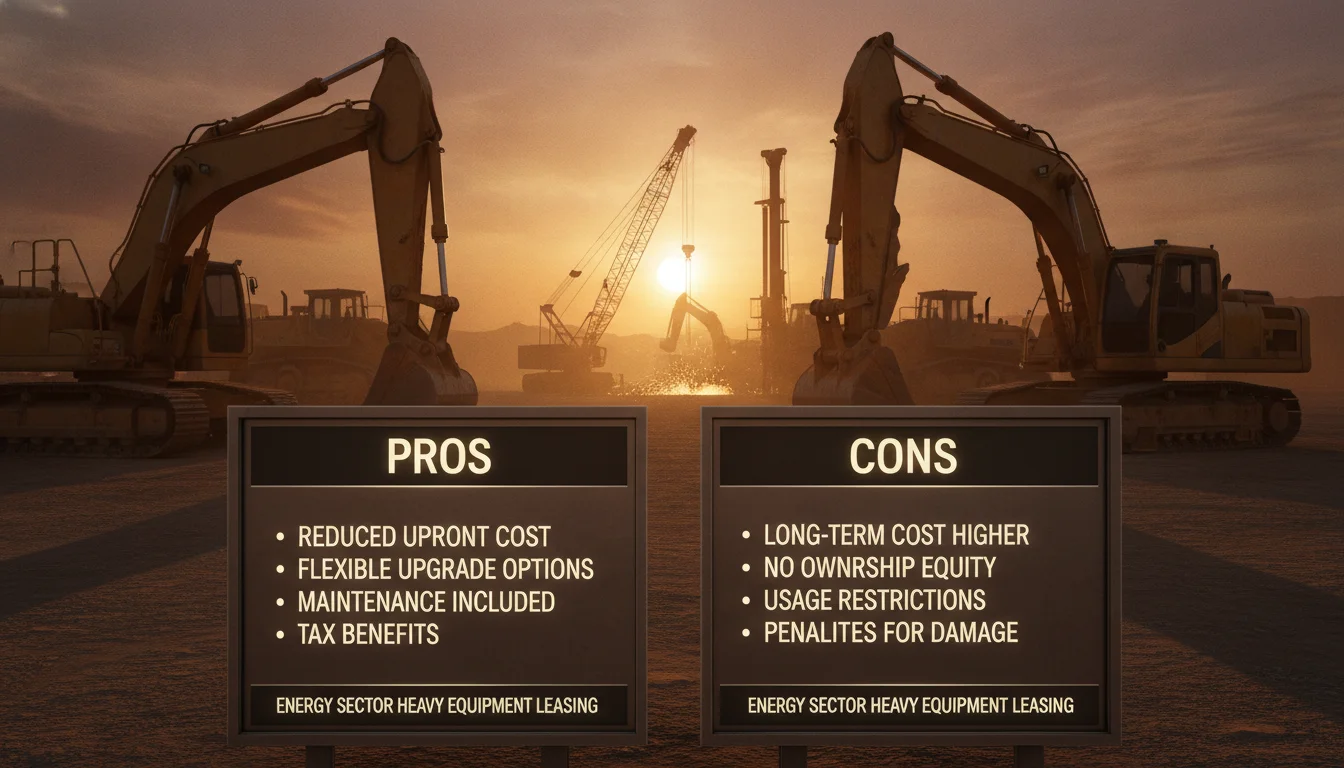
Pros
- Capital preservation: Leasing eliminates the need for large down payments, freeing working capital for operations, parts inventory, and labor.
- Technology access: Short-term operating leases let you rotate into newer equipment as project specs or emissions regulations change.
- Maintenance coverage: Many leasing agreements, particularly operating leases, include wear-and-tear maintenance and repair costs within the contract terms.
- Cash flow predictability: Fixed monthly lease payments make budgeting more reliable than unpredictable ownership repair cycles.
- Credit building: Consistent lease payments can strengthen your company's credit profile for future financing.
Cons
- No equity accumulation: When you lease, you don't build an asset. There's nothing to sell or trade in when the project ends, as Volvo CE notes in their published leasing guidance.
- Usage restrictions: Lease agreements often cap operating hours or impose geographic restrictions that can conflict with remote energy site requirements.
- Parts and repair limitations: Some leases restrict where and how you source replacement parts, which can complicate procurement of this type of parts mid-contract.
- Long-term cost: Over a full equipment lifecycle, total lease payments can exceed the purchase price, particularly for machinery with long useful lives.
Operating Lease vs. Capital Lease: Which Structure Fits Your Operation?
The two primary lease structures for this kind of leasing parts procurement are operating leases and capital leases, and they serve fundamentally different financial and operational purposes.
Operating Leases
Operating leases are short-term agreements where the lessee uses the equipment without any obligation to purchase at term end. According to Glesby Marks' published leasing guidance, generators are commonly structured on three-year operating leases. This structure suits equipment that may become obsolete quickly or that you only need for specific project phases.
Capital Leases
Capital leases are long-term agreements that function similarly to a loan: the lessee carries the asset on their balance sheet and typically has the option to purchase at term end. Glesby Marks notes that excavators commonly follow five-year lease terms, and because useful life typically extends beyond the lease period, many clients elect to take title at term end. This structure suits equipment expected to remain productive across multiple project cycles.
| Lease Type | Typical Duration | Ownership Option | Maintenance Included | Best For |
|---|---|---|---|---|
| Operating Lease | Short-term (e.g., 3 years for generators) | No | Yes, typically | Rapidly evolving technology, project-specific use |
| Capital Lease | Long-term (e.g., 5 years for excavators) | Yes, at term end | Varies by agreement | Equipment with long useful life, fleet building |
Evaluating Equipment Needs for Energy Sector Operations
Before signing any lease, map your actual operational requirements against the equipment categories available. Energy sector projects span a wide range of machinery types, and the wrong selection creates both productivity gaps and unnecessary lease costs.
Key equipment categories relevant to the sector heavy equipment leasing parts procurement include:
- Excavators: Essential for pipeline trenching, site preparation, and earthmoving. Caterpillar, Komatsu, and Volvo are the dominant OEM brands. Per Glesby Marks' published guidance, excavators typically follow five-year lease terms given their extended useful life.
- Generators: Critical for power supply at remote drilling and renewable energy construction sites. Generator leases commonly run three years, per industry leasing data.
- Loaders and Dozers: Used for material handling, site clearing, and overburden removal in mining and energy extraction contexts.
- Compressors and Trenchers: Frequently leased for natural gas pipeline and utility infrastructure projects.
- Cranes: Required for turbine installation, module lifting, and heavy structural work on energy facilities.
Per Glesby Marks' published framework, evaluating operating conditions matters as much as equipment type. Rugged machines deployed to remote energy sites must be configured for heavy-duty conditions, not warehouse or yard environments.
"Selecting the right mix of heavy machinery and construction equipment is essential for ensuring your teams have the tools they need to perform their work safely, effectively, and with the right level of capability for the job." - Glesby Marks Equipment Leasing
Choosing the Right Leasing Partner for Energy Sector Projects
Your leasing partner's industry knowledge directly affects how well the agreement serves your operation. A partner unfamiliar with energy sector conditions will write terms that create friction at exactly the wrong moments.
When evaluating leasing companies for parts access and support, look for these capabilities:
- Energy sector experience: Partners who understand drilling cycles, remote site logistics, and project-driven usage patterns will structure more workable agreements.
- Flexible lease terms: Agreements should accommodate seasonal demand, project extensions, and equipment swaps without punitive fees.
- Maintenance and parts support: As Heartland Financial Group notes in their published leasing guidance, most leasing companies include maintenance and repair costs for wear-and-tear within the lease package, though limitations apply to where and how you can seek repairs.
- OEM parts access: Confirm that the lease agreement permits or facilitates sourcing of OEM-standard replacement parts. Using non-compliant parts can void lease terms and create liability exposure.
- End-of-term options: Understand resale value, title transfer options, and equipment return conditions before signing.
Total Cost of Ownership: Lease vs. Buy in the Energy Sector
Total cost of ownership analysis is the only reliable basis for a lease-versus-buy decision on energy sector and machinery. Monthly lease payments are visible; the full cost of ownership is not.
A complete TCO comparison must include:
- Initial purchase price or down payment (typically 10-30% for heavy equipment, per Heartland Financial Group's published guidance)
- Ongoing maintenance and OEM parts costs
- Depreciation over the equipment's useful life
- Financing costs if purchasing on credit
- Storage, insurance, and compliance costs tied to ownership
- Opportunity cost of capital tied up in an owned asset
Leasing is often more cost-effective for equipment used intensively on specific projects but not needed continuously. Ownership makes more financial sense for machinery that runs at high utilization across multiple years and retains strong resale value.
Wagner Equipment Co., the authorized Caterpillar dealer for Colorado, New Mexico, and far west Texas, notes in their published economic analysis that when the broader economy contracts, businesses that own heavy equipment face the full burden of depreciation and carrying costs, while lessees can exit or restructure agreements more readily.
Maintenance of Leased Equipment: Protecting Your Compliance and Your Budget
Proper maintenance of leased heavy equipment is not optional. Most lease agreements include return condition clauses that hold lessees financially responsible for damage beyond normal wear. Skipping scheduled service on energy sector heavy equipment leasing parts and systems creates both operational risk and lease-end liability.
Regular Maintenance Checks
Establish a documented maintenance schedule aligned with OEM service intervals for the specific equipment brands in your fleet. Key tasks include:
- Checking and replacing hydraulic fluid, engine oil, and coolant at OEM-specified intervals
- Inspecting wear components: undercarriage on excavators and dozers, cutting edges on loaders, seals on hydraulic cylinders
- Cleaning equipment to prevent abrasive buildup, particularly critical in dusty energy site environments
- Verifying filter condition across air, fuel, and hydraulic systems
Pro Tip: For Caterpillar, Komatsu, and Volvo equipment, always source OEM-standard replacement parts. Using non-OEM components on leased machinery can trigger lease compliance issues and void manufacturer warranties. At 3GEN Export, we supply OEM-quality parts for all three brands with global delivery in as little as 5 days.
Documentation and Compliance
Keep detailed service records for every maintenance action: date, technician, parts replaced, and hours at service. This documentation protects you during lease audits, insurance claims, and equipment return inspections. Per OSHA guidelines on heavy equipment operation, maintenance records are also a core component of workplace safety compliance on energy sector job sites.
OEM Parts for Leased Equipment: Why It Matters
Energy sector heavy equipment leasing parts sourcing is where many operators lose money quietly. Using substandard aftermarket components on leased machinery creates three compounding problems: accelerated wear, lease compliance risk, and potential warranty voidance on the lessor's asset.
OEM-standard parts, built to the exact specifications of Caterpillar, Komatsu, Volvo, Atlas Copco, and other major brands, maintain the performance tolerances the lease agreement assumes. When a hydraulic seal fails on a leased CAT 320 excavator at a remote energy site, you need a verified replacement fast, not a generic part that may not hold to spec under operating pressure.
At 3GEN Export, we've supplied OEM-quality spare parts for Caterpillar, Komatsu, Volvo, and 40+ other brands to procurement teams across the energy, mining, and construction sectors since 2006. Our global logistics network delivers to over 150 countries, with standard lead times of 5 days or fewer for stocked components.
For more on selecting the right parts for your fleet, see our guides on heavy equipment parts procurement and OEM brand compatibility.
Frequently Asked Questions
What are the two types of equipment leases?
The two primary types are operating leases and capital leases. Operating leases are short-term, do not transfer ownership, and typically include maintenance coverage. Capital leases are long-term, function similarly to a loan, and usually give the lessee the option to purchase the equipment at term end.
Who are the leading companies that build heavy machinery for the energy sector?
Caterpillar, Komatsu, and Volvo are among the dominant OEM manufacturers supplying heavy machinery to energy sector operations worldwide. Each offers equipment lines specifically configured for mining, oil and gas, and power generation applications, along with dedicated parts and service networks.
Why are heavy equipment sales falling in some markets?
As Wagner Equipment Co. notes in their published economic analysis, heavy equipment demand is closely tied to broader economic conditions. When capital becomes constrained, companies shift toward leasing rather than purchasing, which can reduce outright sales volumes. Advances in electric equipment technology are also prompting some buyers to lease rather than commit to purchasing current-generation machines.
What credit score is needed for equipment leasing?
Requirements vary by leasing company and transaction size. For large-scale energy sector heavy equipment leasing parts and machinery agreements, lessors typically evaluate full financial statements, not just credit scores. Smaller transactions generally benefit from stronger credit profiles, and building a track record of on-time lease payments improves access to better terms over time.
How do I ensure leased equipment stays compliant with lease return conditions?
Follow OEM-specified maintenance intervals, use OEM-standard replacement parts, and keep detailed service records for every maintenance action. Most lease return disputes arise from undocumented wear or non-OEM parts that accelerated component degradation beyond normal use thresholds.
Where can I source OEM-quality parts for leased heavy equipment in the energy sector?
3GEN Export supplies OEM-standard spare parts for Caterpillar, Komatsu, Volvo, Atlas Copco, and 40+ brands with global delivery in 5 days or fewer. Our parts catalog covers energy sector heavy equipment leasing parts needs across excavators, generators, compressors, and more. Visit 3genexport.com/parts-categories to source components for your fleet.