
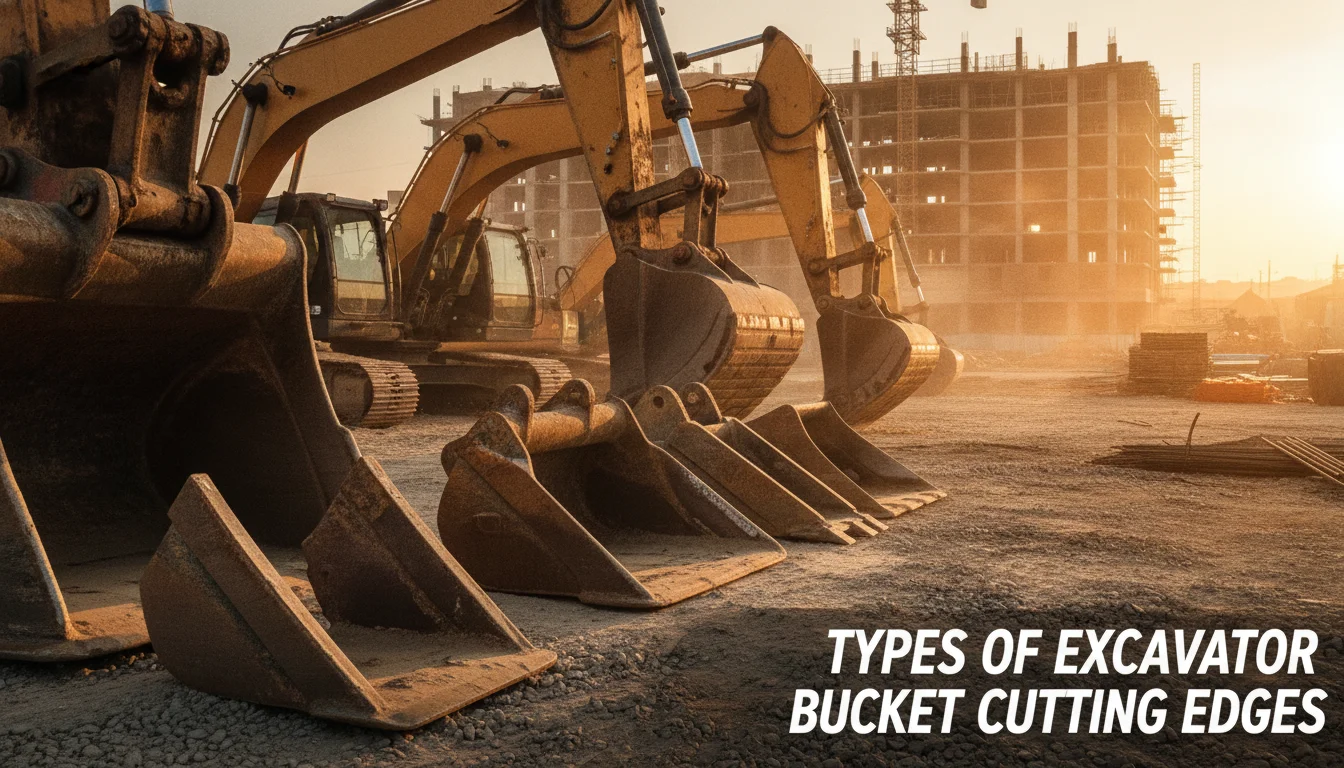
Excavator Bucket Cutting Edges: Full Guide
Excavator bucket cutting edges explained: types, materials, top brands & maintenance tips for B2B buyers. Shop OEM-quality parts with fast global delivery.
Loading article…
Article Not Found
The article you're looking for doesn't exist or may have been removed.
Back to BlogExcavator bucket cutting edges are hardened wear components attached to the bucket lip that make direct contact with the ground during digging, trenching, and material loading. Choosing the right type protects your bucket, reduces fuel use, and cuts total ownership cost.
Key Takeaways
- Match the cutting edge material to your ground conditions: high carbon steel for general work, boron steel for abrasive or high-impact sites.
- Bolt-on edges allow fast field replacement; weld-on edges deliver greater strength for heavy-duty continuous operation.
- Verify dimensions, bolt-hole pattern, and thickness before ordering - a mismatched edge accelerates bucket wear.
- Inspect edges at every service interval and replace before significant wear reaches the bucket lip itself.
- OEM-compatible edges from verified suppliers (Caterpillar, Komatsu, Volvo, John Deere, Bobcat) are available across a wide price range to suit any fleet budget.
Types of Excavator Bucket Cutting Edges
cutting edges fall into two primary attachment categories: bolt-on and weld-on. Each suits different operational priorities, and choosing the wrong one costs you time and money on the job site.
Bolt-On Cutting Edges
Bolt-on cutting edges use pre-drilled holes that align with the bucket's existing mounting points. Installation takes minutes with basic hand tools, which means less downtime when an edge wears out mid-project. This type is the preferred choice for fleets that rotate equipment across multiple sites or need fast field repairs. Reversible bolt-on designs - common in widths from 62" to 96" - let you flip the edge and double its service life before disposal.
Weld-On Cutting Edges
Weld-on cutting edges are fused directly to the bucket lip, creating a continuous bond with no bolt holes to crack or loosen under repeated impact. They perform best in continuous heavy-duty applications: rock quarrying, demolition, and deep trench work where bolt-on hardware would fatigue quickly. The trade-off is replacement time. Removing a weld-on edge requires cutting equipment and skilled labor, so plan replacements during scheduled maintenance windows rather than reactive repairs.
Serrated Cutting Edges
Serrated profiles add a toothed pattern along the blade face, improving penetration into compacted soil and clay. According to supplier specifications from Blue Diamond Attachments, serrated cutting edge kits are available in standard widths from 36" to 84", with pricing reflecting the additional machining involved. They are particularly effective in mixed-material conditions where a flat edge would skip or deflect.
Materials Used in Cutting Edges
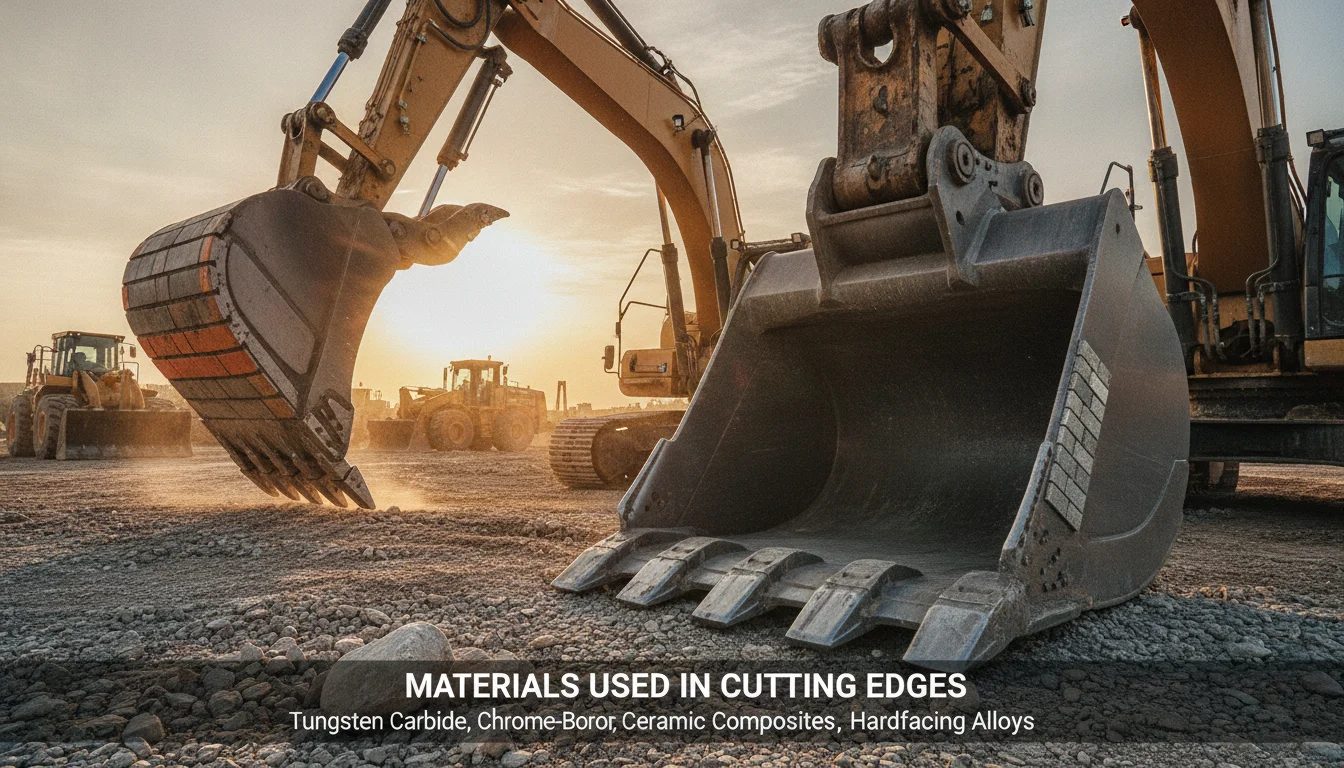
The material of this type of edges determines how long they last and how well they perform under specific ground conditions. Three materials dominate the market.
High Carbon Steel
High carbon steel offers a reliable balance of hardness and cost for general excavation. It handles standard soil, sand, and light gravel without excessive wear. For fleets running mixed applications across varied terrain, high carbon steel edges provide predictable service life and straightforward sourcing from most OEM and aftermarket suppliers.
Boron Steel
Boron steel delivers superior hardness and toughness, making it the material of choice for abrasive conditions: crushed rock, recycled concrete, and dense compacted fill. Per manufacturer specifications, boron steel edges resist deformation under high-impact loads better than standard carbon grades, which translates directly to longer replacement intervals and lower per-hour wear costs.
Alloy Steel
Alloy steel cutting edges are engineered for specialized applications where both wear resistance and structural toughness are critical. They are common in mining and quarrying environments where edges face simultaneous abrasion and shock loading. Alloy grades typically carry a price premium over high carbon options, but the extended service life justifies the investment in high-utilization fleets.
Pros and Cons of Bolt-On vs. Weld-On Cutting Edges
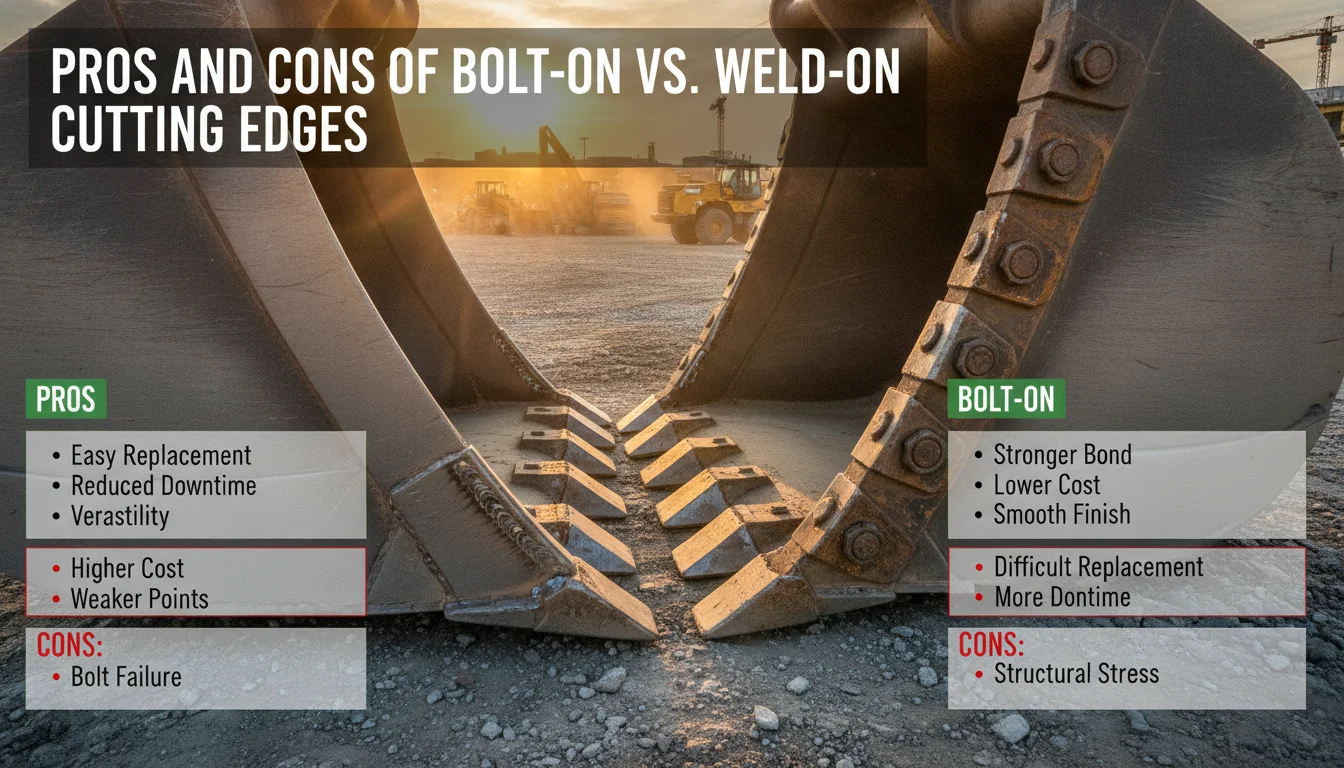
Both attachment methods have clear strengths and real limitations. Understanding them helps procurement managers specify the right solution for each machine in their fleet.
Pros
- Bolt-on: Fast field replacement with basic tools, no welding equipment required on site.
- Bolt-on reversible: Flip the edge to use both faces, effectively doubling service life per unit.
- Weld-on: No bolt hardware to loosen or shear under repeated high-impact loads.
- Weld-on: Continuous edge profile eliminates stress concentration points around bolt holes.
- Both types: Available in OEM-compatible dimensions for Caterpillar, Komatsu, Volvo, John Deere, and Bobcat equipment.
Cons
- Bolt-on: Bolt holes can crack or elongate in extreme impact applications, requiring more frequent hardware checks.
- Bolt-on: Hardware must be re-torqued periodically - neglecting this leads to edge movement and accelerated bucket lip wear.
- Weld-on: Replacement requires cutting tools and welding capability, increasing labor time and cost.
- Weld-on: Cannot be reversed; once worn, the entire edge must be cut off and replaced.
What to Look For When Buying Excavator Bucket Cutting Edges
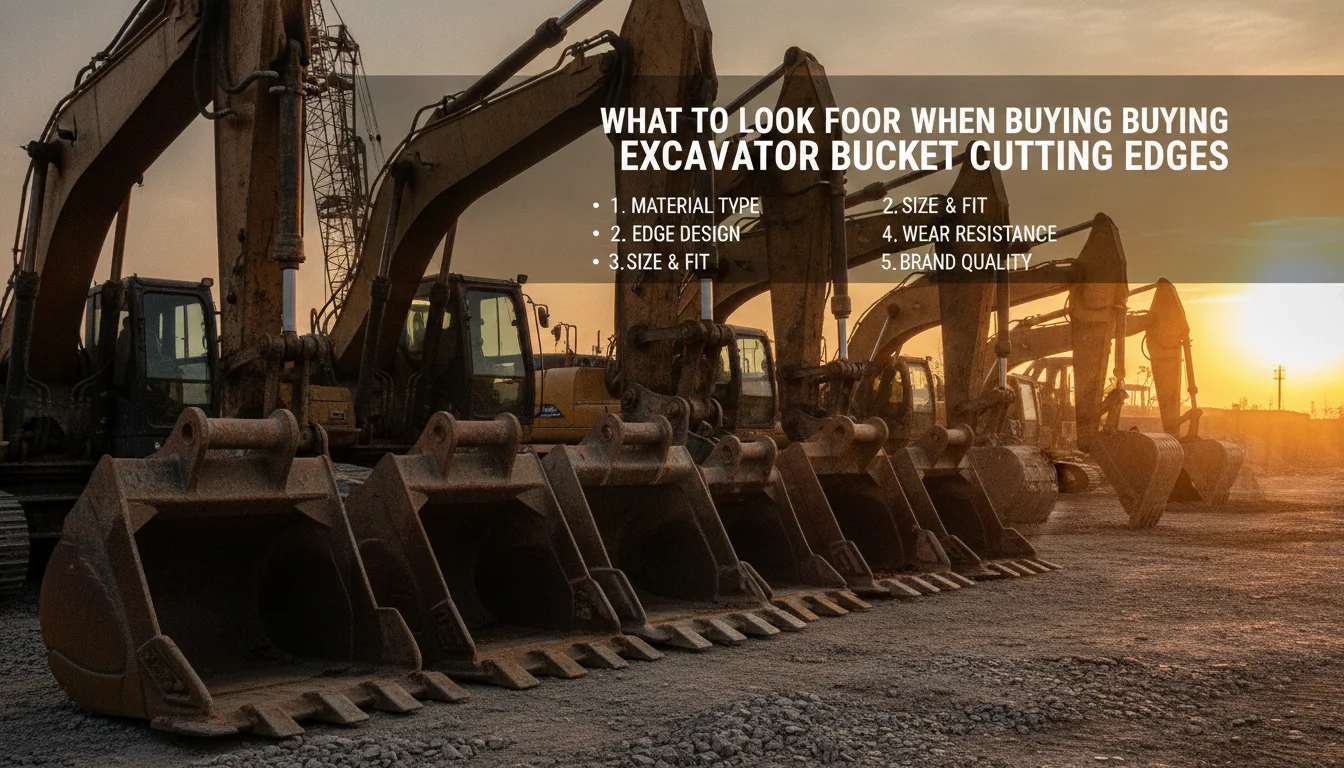
Selecting the right this kind of cutting edges requires matching three variables: material grade, physical dimensions, and application demands. Getting any one of these wrong shortens service life and can damage the bucket itself.
Material Grade
Start with your ground conditions. Rocky, abrasive, or high-impact sites demand boron or alloy steel. General earthmoving on mixed soil works well with high carbon steel. Specifying a harder grade than necessary adds cost without benefit; under-specifying accelerates wear and increases replacement frequency.
Dimensional Fit
Confirm the edge length, width, thickness, bolt-hole pattern, and hole spacing against your bucket's OEM spec sheet before ordering. A cutting edge that doesn't align precisely with the bucket's mounting points will shift under load, causing uneven wear and potential structural damage to the bucket lip. Reference the OEM service bulletin for your specific machine model - Caterpillar, Komatsu, and Volvo all publish dimensional tolerances for their bucket wear parts.
Price Range
Based on verified competitor pricing, excavator bucket cutting edges range from roughly $72 for a compact Komatsu-style edge (part 12F-70-31261, 35.88" long) up to $433 for a John Deere-compatible edge (part T171386, 50.27" long). Serrated kit assemblies from Blue Diamond Attachments run from approximately $242 for a 36" kit to $490 for an 84" kit. Budget accordingly for your bucket size and replacement frequency.
"Our ground engaging tools are designed and built to deliver the performance and rugged durability needed for a wide variety of applications. Produced for strength, maximum wear life and superior breakage resistance, our G.E.T. components move more material over a longer period with less downtime." - Empire Tractor Parts, Ground Engaging Tools product page
Application-Based Edge Selection
Matching excavator bucket cutting edges to the specific application is as important as matching them to the machine. The same bucket can require different edge specifications depending on what it's digging.
- General earthmoving and grading: Flat bolt-on high carbon steel edges. Fast to replace, cost-effective at scale.
- Rock and quarry work: Boron steel weld-on or heavy bolt-on edges with reinforced bolt patterns. Prioritize impact resistance over ease of replacement.
- Trenching in compacted soil or clay: Serrated bolt-on edges. The toothed profile breaks compacted material more efficiently than a flat blade.
- Demolition and recycled material handling: Alloy steel edges with side cutters and end bits for full bucket protection.
- Precision grading and finishing: Flat, smooth-profile edges that maintain grade accuracy without tearing the surface.
Care and Maintenance of Cutting Edges
Proper maintenance of excavator bucket cutting edges extends service life and protects the bucket structure underneath. These practices apply regardless of material or attachment type.
Regular Inspections
Inspect cutting edges at every scheduled service interval and after any high-impact work session. Look for uneven wear patterns, cracking near bolt holes, and edge thinning that approaches the bucket lip. Catching wear early prevents the far more expensive scenario of replacing a damaged bucket rather than just the edge.
Hardware Checks on Bolt-On Edges
Re-torque all mounting bolts after the first 8-10 hours of operation on a new edge installation, then check at each subsequent service. Loose hardware allows the edge to shift, which concentrates stress on individual bolt holes and accelerates both edge and bucket wear.
Cleaning
Remove packed mud, clay, and debris from behind the cutting edge after each shift in sticky or cohesive soils. Material buildup between the edge and bucket lip traps moisture, accelerates corrosion, and can cause the edge to seat unevenly - leading to premature failure at the mounting points.
Replacement Timing
Replace cutting edges before wear reaches the bucket lip. Operating with a fully worn edge transfers ground contact forces directly to the bucket structure, causing damage that costs significantly more to repair than a timely edge replacement. According to industry maintenance practice, monitoring edge thickness at each service interval is the most reliable way to schedule replacements proactively rather than reactively.
"Selecting the proper bucket cutting edges is not just about durability - it's also about enhancing fuel efficiency, reducing maintenance intervals, and ultimately lowering your total cost of ownership." - Hawk Excavator, Cutting Edges for Excavator Buckets guide
How to Replace a Cutting Edge on an Excavator Bucket
Replacing excavator bucket cutting edges follows a straightforward process for bolt-on types. Weld-on replacement requires cutting equipment and welding capability, so the steps below address the more common bolt-on procedure.
- Position the bucket safely. Lower the bucket to the ground on a flat, stable surface. Engage all safety locks and shut down the machine before approaching the work area.
- Remove worn hardware. Use an impact wrench to remove all mounting bolts and retaining hardware. Inspect bolt holes in the bucket lip for elongation or cracking before fitting the new edge.
- Clean the mounting surface. Remove all dirt, rust, and debris from the bucket lip where the new edge will seat. A clean, flat contact surface ensures proper load distribution across the full edge length.
- Align the new edge. Position the replacement edge so all bolt holes align precisely with the bucket's mounting points. Misalignment by even a few millimeters will cause uneven stress distribution and premature failure.
- Install and torque hardware. Thread all bolts by hand first to confirm alignment, then torque to the OEM specification for your bucket model. Do not use impact tools for final torque - use a calibrated torque wrench.
- Re-torque after break-in. After the first 8-10 operating hours, re-torque all bolts to the specified value. New edges settle slightly under load, and this step is critical to long-term retention.
Comparison of Top Brands
The table below reflects verified pricing from competitor supplier data as of 2026. Prices vary by edge length and specific part number.
| Brand | Attachment Type | Material | Verified Price Range |
|---|---|---|---|
| Caterpillar | Bolt-On | High Carbon Steel | $130 - $177 (per Romac Parts data) |
| Bobcat | Bolt-On | High Carbon Steel | $107 - $187 (per Romac Parts data) |
| John Deere | Bolt-On | Alloy Steel | $97 - $433 (per Romac Parts data) |
| Komatsu | Bolt-On | High Carbon Steel | From $72 (per Romac Parts data) |
| Volvo | Bolt-On | High Carbon Steel | From $167 (per Romac Parts data) |
Note: Prices above reflect aftermarket-compatible edges from third-party suppliers. OEM direct pricing will differ. Contact 3GEN Export for current pricing on OEM-quality excavator bucket cutting edges with global delivery.
Frequently Asked Questions
What type of steel is best for bucket cutting edges?
Boron steel is the preferred choice for heavy-duty and abrasive applications because of its superior hardness and resistance to deformation under high-impact loads. High carbon steel is the practical choice for general earthmoving where conditions are less severe and cost-per-replacement matters more than maximum wear life.
Where can I find replacement cutting edges for buckets?
OEM-compatible replacement cutting edges are available through specialized heavy equipment parts suppliers, OEM dealer networks, and global B2B exporters like 3GEN Export, which stocks edges compatible with Caterpillar, Komatsu, Volvo, John Deere, and Bobcat equipment. Verify part numbers and dimensions against your OEM service manual before ordering to ensure correct fit.
How do you weld a cutting edge on a bucket?
Clean both the bucket lip and the new edge thoroughly, removing all rust, paint, and debris from the contact surfaces. Align the edge precisely and tack-weld at multiple points before running full beads to prevent warping. Use a welding process and filler material rated for the edge's steel grade, and allow the assembly to cool slowly to avoid stress cracking in the heat-affected zone.
Are bucket teeth worth it alongside cutting edges?
Yes. Bucket teeth improve penetration into hard or compacted material and reduce the load transferred to the cutting edge during initial ground engagement. Using teeth and cutting edges together extends the service life of both components and reduces overall fuel consumption per cubic meter of material moved.
How often should excavator bucket cutting edges be replaced?
Replacement frequency depends on material hardness, operating hours, and ground conditions. Inspect edge thickness at every service interval and replace before wear reaches the bucket lip. In high-abrasion applications like rock quarrying, replacement may be needed every few hundred operating hours; in general earthmoving, edges can last considerably longer with proper maintenance.
What is the typical cost of excavator bucket cutting edges?
Based on verified supplier data as of 2026, aftermarket-compatible edges range from roughly $72 for compact machine sizes up to $433 or more for larger OEM-compatible profiles. Serrated kit assemblies run from approximately $242 to $490 depending on width. OEM direct pricing and global shipping costs will affect your landed cost - request a quote from 3GEN Export for current delivered pricing to your location.