
Excavator Swing Motor Repair: Complete 2026 Guide
Master excavator swing motor repair with our 2026 guide: diagnosis, step-by-step rebuild, repair vs. replace decisions, and OEM parts sourcing.
Loading article…
Article Not Found
The article you're looking for doesn't exist or may have been removed.
Back to BlogKey Takeaways
- Excavator swing motor repair starts with accurate diagnosis: slow swing speed, unusual noises, and external leaks are the three primary warning signs.
- The swing motor is a hydraulic piston motor paired with a planetary gear reduction unit. Understanding both is essential before attempting any repair.
- Repair is cost-effective for minor wear. Replacement makes more sense when the swash plate or cylinder block is severely scored.
- OEM-quality seals, valve plates, and piston kits are available for Hitachi, Caterpillar, Komatsu, Volvo, John Deere, and 40+ other brands.
- As of 2026, overhaul kits for common models range from roughly $500 to $3,400 depending on motor size and brand, making repair a financially sound first option in most cases.
- Proper hydraulic fluid selection and monthly inspections are the two most effective ways to prevent premature swing motor failure.
Excavator swing motor repair is the process of diagnosing, disassembling, and restoring the hydraulic motor that rotates an excavator's upper structure. Done correctly, it returns the machine to full productivity at a fraction of replacement cost.
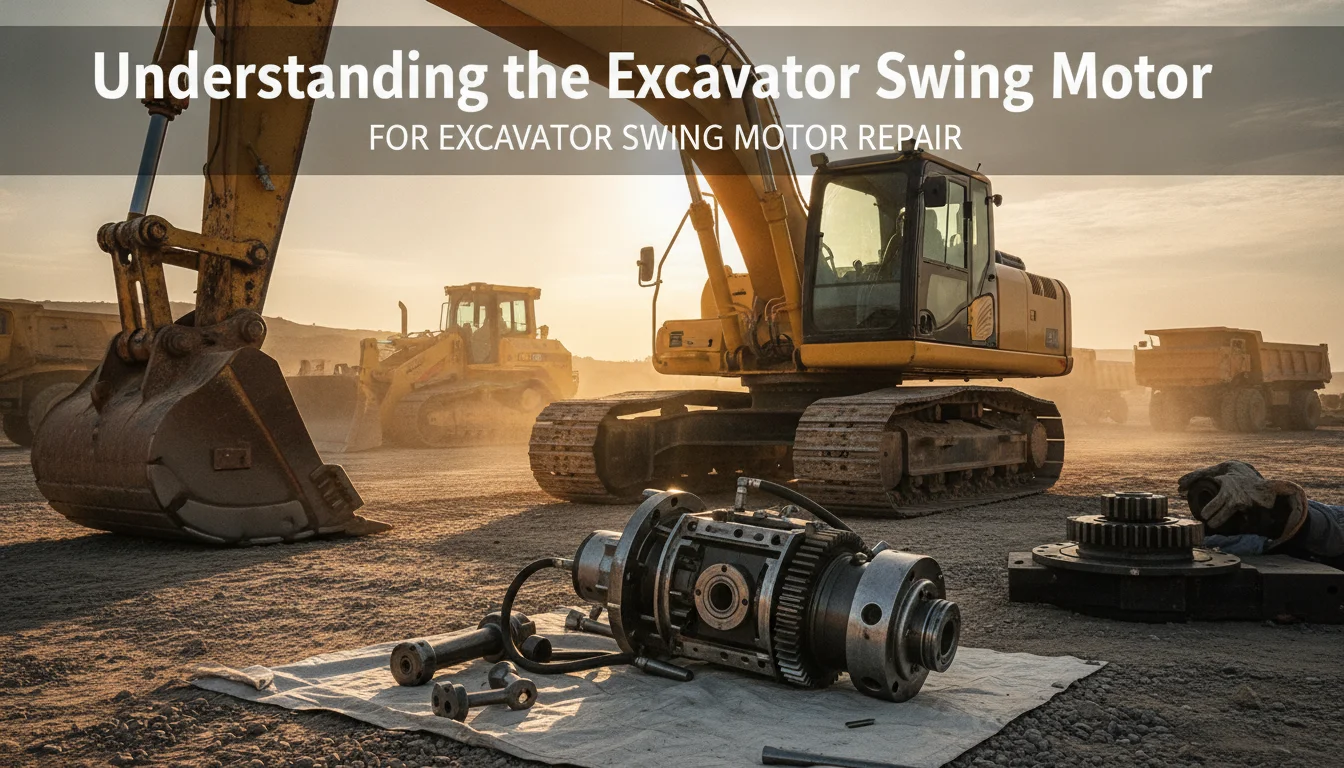
Understanding the Excavator Swing Motor
An excavator swing motor is a hydraulic piston motor that allows the upper structure of the excavator to rotate independently of the undercarriage. This component is essential for performing various tasks, including digging, loading, and lifting. The motor operates by converting hydraulic pressure into rotational force, enabling smooth and controlled movement. Without a functioning swing motor, the machine cannot complete a single productive dig cycle.
Components of the Swing Motor
- Hydraulic Pistons and Cylinder Block: The pistons reciprocate inside the cylinder block bores under hydraulic pressure. Wear between pistons and bores causes internal leakage, reducing efficiency before full failure occurs.
- Planetary Gear Reduction: Bolted directly to the motor, this gearbox reduces output speed and multiplies torque. Damaged planetary gears typically require full assembly replacement.
- Swash Plate: The angled plate that pistons push against. Its angle determines the stroke length of each piston and therefore the torque output. According to field teardown data from experienced rebuilders, wear on the swash plate is often catastrophic and not economically repairable.
- Valve Plate: Controls the timing of hydraulic flow into and out of each cylinder bore. Scoring on the valve plate face is a key failure indicator during teardown inspection.
- Seals and O-Rings: The first line of defense against external leaks. These are the most common repair items: relatively low cost, but critical if ignored.
Functionality of the Swing Motor
The swing motor receives hydraulic fluid from the pump, which is then directed through a control valve. This valve regulates the flow to the motor, allowing the operator to control the speed and direction of the swing. When the operator moves the joystick, the control valve directs hydraulic fluid to either Port A or Port B on the swing motor, determining both direction and speed.
How the Swing Circuit Works: A Deeper Look
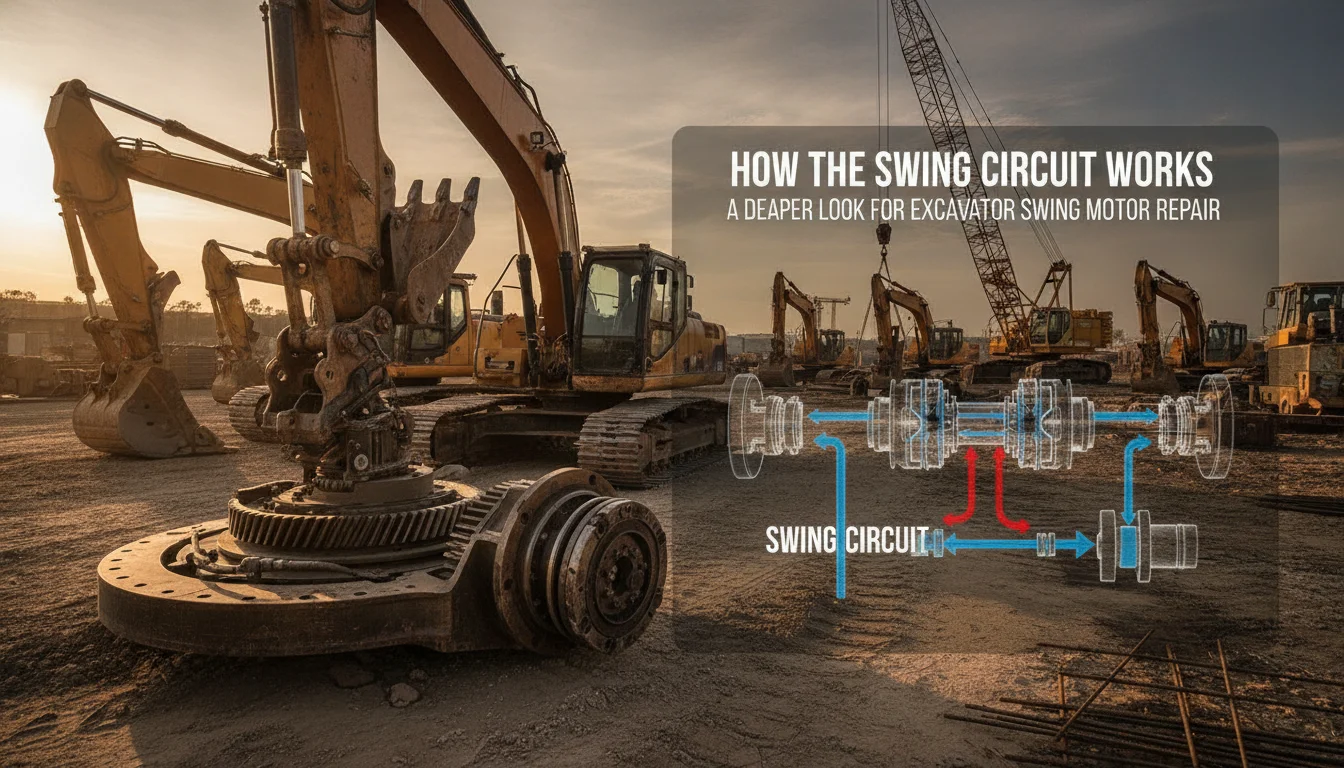
Understanding the full hydraulic circuit is essential for accurate excavator swing motor repair diagnosis. A misdiagnosis leads to an expensive wrong part order, and the machine still won't work.
Here is how hydraulic pressure flows through the system, step by step:
- Pump Delivers Pressure: The variable displacement hydraulic pump draws fluid from the tank and delivers it at high pressure, typically in the range of 3,000 to 5,000 PSI, to the swing control valve.
- Operator Controls the Valve: Moving the swing joystick shifts a spool inside the control valve, directing high-pressure fluid to either Port A or Port B on the swing motor, determining direction and speed.
- Motor Converts Pressure to Rotation: Pressurized fluid pushes against pistons in the cylinder block. The angled swash plate converts this reciprocating force into rotation on the output shaft.
- Gearbox Multiplies Torque: The motor spins fast but with moderate torque. The planetary gearbox reduces speed and multiplies torque, delivering the force needed to rotate a fully loaded upper house.
- Return Flow: Spent fluid exits through the return port, passes through the control valve, and returns to the hydraulic tank to complete the circuit.
"A key diagnostic insight: if swing speed is reduced but the motor shows no external leaks and no unusual noise, the problem may originate in the hydraulic pump or control valve, not the swing motor itself. Always pressure-test the full circuit before condemning the motor." - Based on field guidance from experienced hydraulic system technicians and OEM service bulletin recommendations.
This circuit-level understanding is what separates a competent repair from an expensive guessing game. Before pulling the swing motor, verify that pump output pressure meets manufacturer specifications and that the control valve spool is moving freely.
Common Problems with Excavator Swing Motors
Understanding common issues that affect the swing motor is vital for timely repairs. Most problems arise from wear and tear, improper maintenance, or hydraulic system failures. According to experienced operators and field technicians, most swing-related issues do not appear overnight: a slightly slower swing motion, a faint vibration, or unusual noises during rotation are typically early warning signs that appear weeks before full failure.
"In practice, most swing-related issues do not appear overnight. Ignore the early warning signs, and a minor problem can quickly turn into a full-blown failure that stops the machine on site. This usually happens at the worst possible moment, with a load hanging and deadlines already tight." - Adapted from field observations documented by hydraulic system specialists.
Symptoms of Swing Motor Failure
- Slow Swing Speed: A noticeable decrease in swing speed can indicate internal leakage between pistons and cylinder bores, or low hydraulic pressure from the pump.
- Unusual Noises: Grinding or whining noises may suggest worn gears in the planetary reduction unit or damaged bearings on the output shaft.
- Hydraulic Leaks: External leaks around shaft seals and O-rings lead to pressure loss and decreased performance. These are the most common repair items and the least expensive to fix when caught early.
- Vibration During Swing: Abnormal vibration often points to worn planetary gears or a damaged drive shaft.
- Drift or Creep: If the upper structure drifts when the joystick is in neutral, the brake valve or relief valve inside the motor assembly may be failing.
Diagnosing Swing Motor Issues
To accurately diagnose issues with the swing motor, operators should perform regular inspections and maintenance checks. This includes:
- Inspecting hydraulic fluid levels and quality.
- Checking for leaks around the motor and hoses.
- Listening for unusual sounds during operation.
- Pressure-testing the swing circuit to isolate whether the fault is in the motor, the pump, or the control valve.
- Checking the swing control valve spool for free movement before condemning the motor.
Step-by-Step Process for Excavator Swing Motor Repair
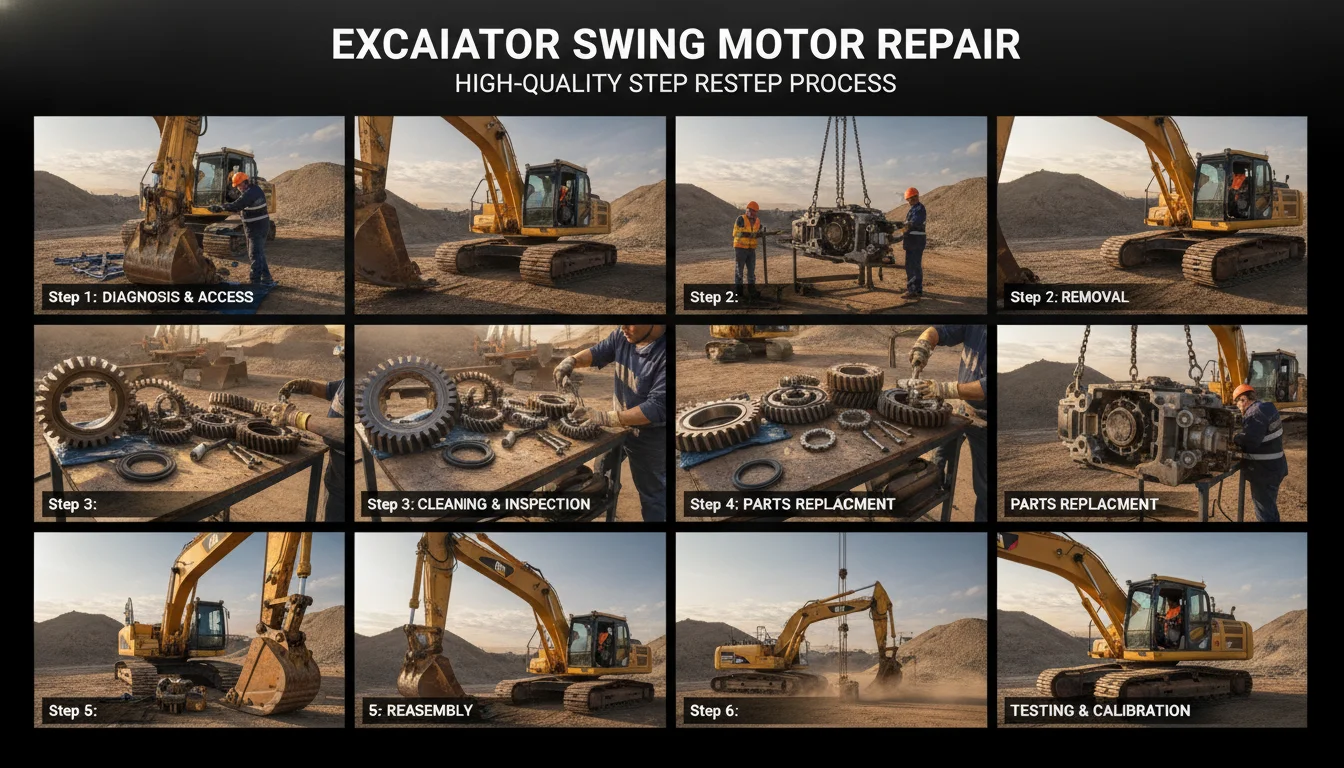
Excavator swing motor repair follows a systematic sequence to ensure all components are functioning correctly. Skipping steps, especially the pressure-relief step, creates serious injury risk. Follow this process exactly.
Step 1: Safety First
Before starting any repair work, ensure the excavator is turned off and all safety measures are in place. Lower the work equipment to the ground, stop the engine, and loosen the breather slowly to release pressure inside the hydraulic tank. Disconnect the battery and relieve hydraulic pressure to avoid accidents. Escaping fluid under pressure can penetrate skin and cause serious injury.
Step 2: Remove the Swing Motor
- Locate the swing motor, typically mounted on the rear of the upper structure beneath the cab platform.
- Place an oil pan beneath the motor before disconnecting any lines. When pipes and hoses are disconnected, oil inside the piping will flow out.
- Disconnect hydraulic pipe assemblies and pilot line hoses. Cap all open ports immediately to prevent contamination.
- Sling the swing motor assembly and remove the mounting bolts. The motor device weight is approximately 35 kg (77 lb) for mid-size machines, so use appropriate lifting equipment.
- Carefully remove the swing motor assembly from the machine.
Step 3: Inspect and Diagnose
Once the motor is removed, inspect all components for wear or damage. Pay special attention to:
- Piston and cylinder block bores for scoring or wear patterns.
- Swash plate surface for signs of wear or damage. Wear here is often irreparable.
- Valve plate face for scoring, which is a key failure indicator.
- Seals and O-rings for hardening, cracking, or extrusion damage.
- Planetary gear teeth for pitting, spalling, or missing material.
Step 4: Replace Worn Components
Replace any worn or damaged parts with OEM or high-quality aftermarket components. For most mid-size excavators, a complete swing motor overhaul kit includes all seals, O-rings, valve plate, pistons, and retaining hardware. Ensure all seals are replaced to prevent future leaks. Never reuse old O-rings, even if they appear undamaged visually.
Step 5: Reassemble and Bleed
Reassemble the swing motor and reinstall it on the excavator. Before starting the engine, bleed the air from the swing motor: remove the air vent plug, pour in hydraulic oil until it overflows from the port, then tighten the plug lightly. Start the engine, run at low idle, and check that oil comes from the plug port. Tighten the plug fully. Reconnect hydraulic lines and electrical connections, then test the motor by running the excavator and checking for proper operation, leaks, and swing speed.
What to Watch Out For: Common Mistakes in Swing Motor Repair
Excavator swing motor repair fails most often not because of bad parts, but because of avoidable errors during the process. Here are the mistakes we see most frequently in the field.
- Skipping the air-bleed step: Reinstalling a swing motor without bleeding air from the case will cause the motor to run dry on startup, destroying new seals and bearings within minutes.
- Reusing old O-rings: O-rings compress and deform during service. Reusing them almost always results in a leak within the first few operating hours after reassembly.
- Contaminating the hydraulic system: Leaving ports open during removal allows dirt and moisture into the circuit. Even small contamination accelerates wear on the new valve plate and pistons.
- Misdiagnosing the root cause: Replacing the swing motor when the actual fault is a worn hydraulic pump or a sticking control valve spool is an expensive mistake. Always pressure-test the full circuit first.
- Using the wrong hydraulic fluid: Fitting a rebuilt motor and then running it on fluid that doesn't meet manufacturer viscosity specifications will shorten its service life significantly. Always verify fluid spec against the OEM service manual before refilling.
- Undertorquing mounting bolts: The swing motor mounting bolts must be torqued to specification. For mid-size machines, tightening torque is typically in the range of 57.4 kgf·m (414 lbf·ft), per OEM service documentation. Undertorquing causes vibration and eventual bolt fatigue failure.
Repair vs. Replace: Making the Right Decision
When faced with a failing swing motor, the repair-versus-replace decision directly determines your total cost of ownership and how long the machine stays out of service. This decision can significantly impact operational costs and downtime.
Factors to Consider
- Cost of Repair vs. Replacement: Evaluate the cost of parts and labor for repair against the cost of a new or refurbished motor. As of 2026, overhaul kits for common models such as the Kawasaki M2X146 (used in Hitachi EX200-5) are priced around $1,400, while a full new motor assembly costs considerably more.
- Age of the Equipment: Older machines may warrant replacement, while newer models generally benefit from repair.
- Condition of the Swash Plate: If the swash plate is severely worn, the cost of machining or sourcing a replacement often pushes the repair cost close to a rebuilt unit price. In that case, a rebuilt assembly is the smarter call.
- Downtime: Consider how long repairs will take and how that impacts your operations. A rebuilt unit shipped from stock can sometimes get the machine running faster than waiting for individual components.
When to Choose Repair
Repair is often the best choice when the damage is limited to seals, O-rings, and the valve plate. These components are inexpensive relative to the motor assembly, and the labor involved is straightforward for a competent hydraulic technician. Regular maintenance also extends the life of the swing motor significantly.
When to Choose Replacement
Replacement is advisable when the motor is severely damaged, particularly when the swash plate or cylinder block shows deep scoring. If the cost of repair approaches the price of a rebuilt unit, choose the rebuilt unit: you get a warranty and a known service life. Additionally, if the motor has a history of repeated failures, replacement may be more cost-effective over the machine's remaining life.
Comparison of Repair Options
| Option | Typical Cost Range | Estimated Downtime | Warranty | Best For |
|---|---|---|---|---|
| Seal & O-Ring Repair | Low | 1-2 Days | Limited (parts only) | External leaks, early-stage wear |
| Full Overhaul (Kit) | Moderate ($500-$3,400 depending on model) | 2-4 Days | Limited (parts only) | Internal wear, valve plate scoring |
| Rebuilt/Reman Unit | Moderate-High | 2-5 Days | Limited (rebuilder warranty) | Swash plate damage, repeated failures |
| New OEM Replacement | High | 3-7 Days (sourcing) | Full OEM warranty | Severe damage, newer machines |
Pros and Cons of Repairing vs. Replacing Your Swing Motor
Pros of Repair
- Significantly lower upfront cost compared to a new or rebuilt assembly.
- Faster turnaround when overhaul kit parts are in stock and a technician is available on site.
- Preserves original OEM motor assembly, which is already matched to the machine's hydraulic circuit.
- Overhaul kits are available for a wide range of brands including Hitachi, Komatsu, Caterpillar, John Deere, Volvo, Kawasaki, and Doosan.
Cons of Repair
- Risk of misdiagnosis: if the root cause is not fully identified, the repaired motor may fail again quickly.
- Labor-intensive process requiring a skilled hydraulic technician and a clean workspace.
- No full warranty coverage: if a component was missed during inspection, the motor may fail before the next scheduled service.
- Not cost-effective when the swash plate or cylinder block requires replacement, as these components drive repair cost close to rebuilt unit pricing.
Realistic Scenario: Swing Motor Failure on a Mid-Size Excavator
Consider a fleet maintenance supervisor managing a Hitachi EX200-5 on a civil construction project. The operator reports that swing speed has dropped noticeably over the past two weeks. There are no visible external leaks and no unusual noise. The supervisor's first instinct is to order a swing motor, but a pressure test of the full circuit reveals that pump output is within specification and the control valve spool moves freely.
A teardown of the swing motor reveals scoring on the valve plate face and worn O-rings on the shaft seal. The cylinder block and swash plate are within acceptable wear limits. The supervisor orders a swing motor overhaul kit for the Kawasaki M2X146 (part reference for Hitachi EX200-5), priced at approximately $1,400. The technician completes the rebuild in two days, bleeds the air from the motor correctly, and returns the machine to service.
Total downtime: two days. Total parts cost: roughly $1,400. The alternative, a new motor assembly, would have cost considerably more and taken longer to source. This is the kind of decision that separates reactive maintenance from a well-managed fleet operation.
Swing Motor Overhaul Kits: What's Available in 2026
As of 2026, overhaul kits for excavator swing motor repair are available for a wide range of models and brands. Here is a reference table of common kits based on current market availability:
| Motor Model | Compatible Excavator | Kit Type | Approximate Price (USD) |
|---|---|---|---|
| Kawasaki M2X146 | Hitachi EX200-5 | Full Hydraulic Overhaul Kit | ~$1,400 |
| Nachi PCL-120-18B | Yuchai YC35, Yanmar ViO55, Komatsu PC40MR | Repair Parts Kit | ~$496-$725 |
| Kawasaki M5X180 | John Deere 290GLC/300GLC, Hitachi ZX290LC-5N | Full Overhaul Kit | ~$699 |
| Kayaba LVW060 | Various mid-size excavators | Full Hydraulic Overhaul Kit | ~$1,924 |
| Kayaba LZV120 | Large excavators | Full Hydraulic Overhaul Kit | ~$3,379 |
| Standard Kit (Hitachi EX120-2) | Hitachi EX120-2 | Full Hydraulic Overhaul Kit | ~$603 |
Prices above are based on current market listings and are subject to change. Contact our team at 3genexport.com for current pricing and availability for your specific model.
Maintenance Tips for Swing Motors
Regular maintenance is the most cost-effective investment you can make in your excavator swing motor. The following practices, applied consistently, prevent the majority of swing motor failures we see in the field.
Regular Inspections
- Check hydraulic fluid levels and quality at least monthly, or more frequently in high-use or dusty environments.
- Inspect for leaks and wear on seals and hoses during every scheduled service.
- Monitor swing speed at the start of each shift and note any changes. A gradual slowdown is an early warning sign.
- Listen for unusual noises during rotation. Grinding suggests gear wear; whining suggests bearing or seal issues.
Hydraulic Fluid Maintenance
Using the correct hydraulic fluid is critical for the performance of the swing motor. Ensure that the fluid meets the manufacturer's viscosity and performance specifications. Contaminated or degraded fluid accelerates wear on the valve plate and piston bores faster than almost any other factor. Change intervals should follow OEM service manual recommendations, and fluid samples should be analyzed periodically to catch contamination early.
Pro Tip: Fluid Sampling
Pro Tip: Send a hydraulic fluid sample to a certified lab every 500 operating hours. Elevated iron and copper particles in the sample are early indicators of internal motor wear, often detectable weeks before any external symptom appears. This practice alone can prevent unplanned downtime on critical machines.
Professional Servicing
Schedule professional servicing at regular intervals. Technicians can perform a thorough inspection, pressure-test the swing circuit, and address potential issues before they become serious problems. For high-utilization machines in mining or quarrying applications, more frequent service intervals are warranted.
Sourcing OEM-Quality Parts for Excavator Swing Motor Repair
The quality of parts used in excavator swing motor repair directly determines how long the repair lasts. Using substandard seals or valve plates saves money upfront and costs far more in repeat failures and additional downtime.
At 3GEN Export, we supply OEM-standard swing motor overhaul kits and components for Caterpillar, Komatsu, Hitachi, Volvo, John Deere, Doosan, Hyundai, and 40+ additional brands. Our parts meet or exceed OEM specifications and are sourced from verified manufacturers. We ship globally with a 5-day delivery target to most destinations, so your machine doesn't sit idle waiting for parts.
Whether you need a complete overhaul kit for a Kawasaki M2X146, individual shaft seals for a Komatsu swing motor, or a full planetary carrier assembly for a Hitachi EX60, our team can identify the correct part by model, serial number, or motor part number. Browse our full parts categories or search by brand to find the right components for your machine.
Frequently Asked Questions
What are the common swing motor problems?
Common problems include slow swing speed, unusual grinding or whining noises, external hydraulic leaks, vibration during rotation, and upper structure drift when the joystick is in neutral. Regular monthly inspections can identify most of these issues before they cause a full breakdown. Slow swing speed in particular is often the first symptom of internal valve plate wear or piston bore leakage.
Where can I buy a swing motor or overhaul kit?
Swing motors and overhaul kits can be purchased from OEM dealers, authorized distributors, or specialist aftermarket suppliers like 3GEN Export. Always confirm compatibility by providing your excavator model, serial number, and the motor part number stamped on the motor housing. Overhaul kits for common models are available for immediate shipment with global 5-day delivery.
What type of oil does a swing motor excavator require?
Most excavator swing motors require hydraulic oil that meets specific viscosity and performance standards defined in the OEM service manual for your machine. Using the wrong fluid, particularly one with incorrect viscosity, accelerates wear on the valve plate and piston bores. Always refer to the manufacturer's specifications and verify the fluid grade before refilling after any excavator swing motor repair.
What is the function of the swing motor?
The swing motor allows the upper structure of the excavator to rotate independently of the undercarriage, enabling efficient operation during digging, loading, and lifting tasks. It is a hydraulic piston motor working in combination with a planetary gear reduction unit. Without it, the machine cannot complete a single productive work cycle.
How often should I inspect the swing motor area?
Inspect the swing motor area at least once a month under normal operating conditions. In high-use applications such as mining, quarrying, or demolition, increase inspection frequency to every two weeks. Catching a minor seal leak or a gradual drop in swing speed early can prevent a full motor failure that takes the machine out of service for days.
How long should a quality rebuilt swing motor last?
A well-rebuilt swing motor using quality OEM-standard components can last from 3,000 to 5,000 operating hours, depending on usage intensity, hydraulic fluid quality, and how consistently the machine is maintained. Machines operating in abrasive or high-temperature environments will see shorter service intervals. Following the maintenance practices outlined in this guide gives rebuilt motors the best chance of reaching the upper end of that range.