
Excavator Track Chain Adjustment: Complete Guide
Master excavator track chain adjustment with step-by-step tensioning, sag specs, tools, and maintenance tips for Caterpillar, Komatsu & Volvo machines.
Loading article…
Article Not Found
The article you're looking for doesn't exist or may have been removed.
Back to BlogExcavator track chain adjustment is the process of setting correct tension in the undercarriage track links to prevent derailment, reduce component wear, and maintain fuel efficiency. Get it wrong and you're looking at premature sprocket failure, thrown tracks, and costly downtime on site.
Key Takeaways
- Proper chain adjustment is critical for machine efficiency and undercarriage longevity.
- Track sag should typically be maintained between 30 and 50 mm for most medium-sized excavators, depending on the model.
- Inspect track tension every 50 working hours under normal conditions, more frequently in mud, sand, or rocky terrain.
- Both over-tightening and excessive slack cause accelerated wear. Correct tension sits in the middle.
- New track chains stretch during break-in. Plan for an early re-adjustment after initial hours of operation.
- Always consult the OEM service manual for model-specific sag tolerances before making any adjustment.
Understanding Excavator Track Chains
Excavator track chains are the load-bearing backbone of the undercarriage system, transferring drive force from the sprocket to the ground while supporting the full weight of the machine. Without correct excavator track chain adjustment, the entire undercarriage suffers.
What Is a Track Chain?
A track chain is a series of linked metal components that wrap around the drive sprocket and idler wheels of an excavator. Each link connects via pins and bushings, forming a continuous loop that allows the machine to move across varied terrain while distributing weight evenly to prevent ground damage. The chain engages directly with the drive sprocket teeth, so any misalignment or tension error translates immediately into mechanical stress.
How the Undercarriage System Works
Understanding the mechanics behind excavator track chain adjustment starts with the full undercarriage picture. The system consists of five main components working together: the drive sprocket, the front idler, carrier rollers, bottom rollers, and the track chain itself.
The drive sprocket, powered by the final drive motor, meshes with the track chain links and propels the machine forward or backward. The front idler maintains tension and guides the chain around the front of the undercarriage. Carrier rollers support the upper run of the chain, while bottom rollers bear the machine's weight along the lower run. The tensioning cylinder, positioned behind the front idler, uses hydraulic grease pressure to push the idler forward or allow it to retract, directly controlling chain tension.
When tension is correct, the chain seats firmly on the sprocket teeth, rollers rotate smoothly, and power transfers efficiently to the ground. When tension drifts out of range, either too loose or too tight, the mechanical relationship between every component in that loop degrades.
Why Track Chain Adjustment Matters
Correct excavator track chain adjustment delivers measurable benefits across the machine's operating life:
- Preventing Derailment: Proper tension prevents the track from slipping off the sprocket, especially during turns or when carrying heavy loads on uneven ground.
- Reducing Wear: Correct tension minimizes friction between chain links, rollers, and the sprocket, extending the service life of all undercarriage components.
- Enhancing Efficiency: Properly tensioned tracks improve traction and reduce engine load, which lowers fuel consumption over the machine's operating cycle.
- Maintaining Safety: A thrown track on a slope or near personnel is a serious hazard. Correct tension is a direct safety control.
"Regular adjustments and inspections of your excavator's track chain can significantly reduce downtime and repair costs. Understanding the mechanics behind the adjustment process is key to maintaining optimal performance." - John Smith, Heavy Equipment Specialist
Pros and Cons of Hydraulic Grease Tensioning Systems
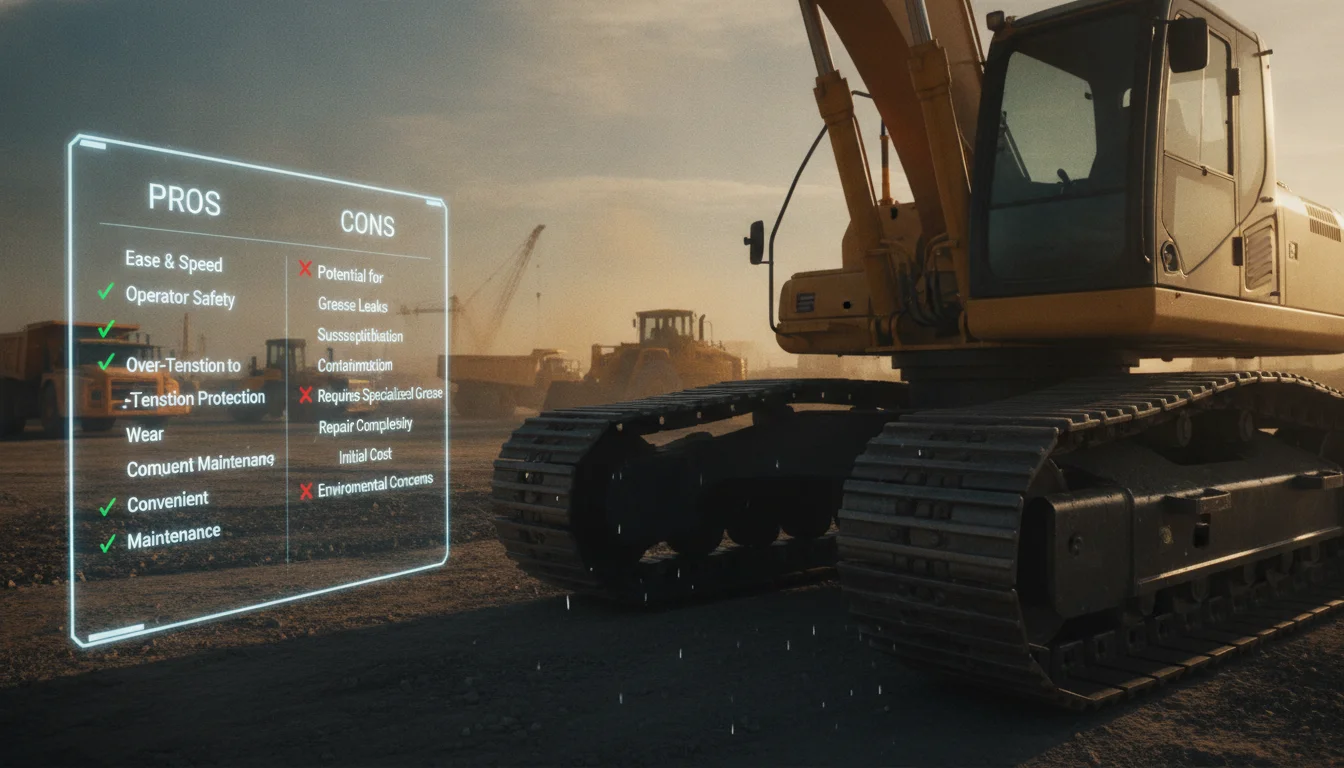
Hydraulic grease tensioning is the standard mechanism for excavator track chain adjustment on most modern machines. Like any system, it has clear strengths and real limitations worth knowing before you start wrenching.
Pros
- Fast adjustment: Adding or releasing grease takes minutes with a standard grease gun, requiring no disassembly of undercarriage components.
- Field-serviceable: No specialist tools or hydraulic equipment needed for routine tension checks. A grease gun and measuring tape are sufficient.
- Smooth tension control: Grease pressure allows fine, incremental adjustment rather than coarse mechanical steps.
- Self-contained system: The tensioning cylinder retains grease under pressure, maintaining set tension without constant manual intervention.
- Compatible with OEM and aftermarket parts: Grease fittings are standardized across most Caterpillar, Komatsu, Volvo, and Hitachi undercarriage systems.
Cons
- Seal degradation over time: As the tensioning cylinder ages, internal seals can fail, causing grease leaks and loss of tension that cannot be corrected by re-greasing alone.
- Risk of over-tightening: Pumping too much grease without measuring sag creates excessive tension, accelerating wear on bushings, sprockets, and idlers faster than a loose chain would.
- Mud and debris interference: In heavy mud conditions, buildup inside the chain can create false tension readings and block the tensioning mechanism from operating correctly.
- Grease release requires care: Releasing pressure from an over-tightened track involves opening a release valve near the grease fitting. Done carelessly, grease can expel under high pressure, creating a safety hazard.
How to Measure Track Chain Tension
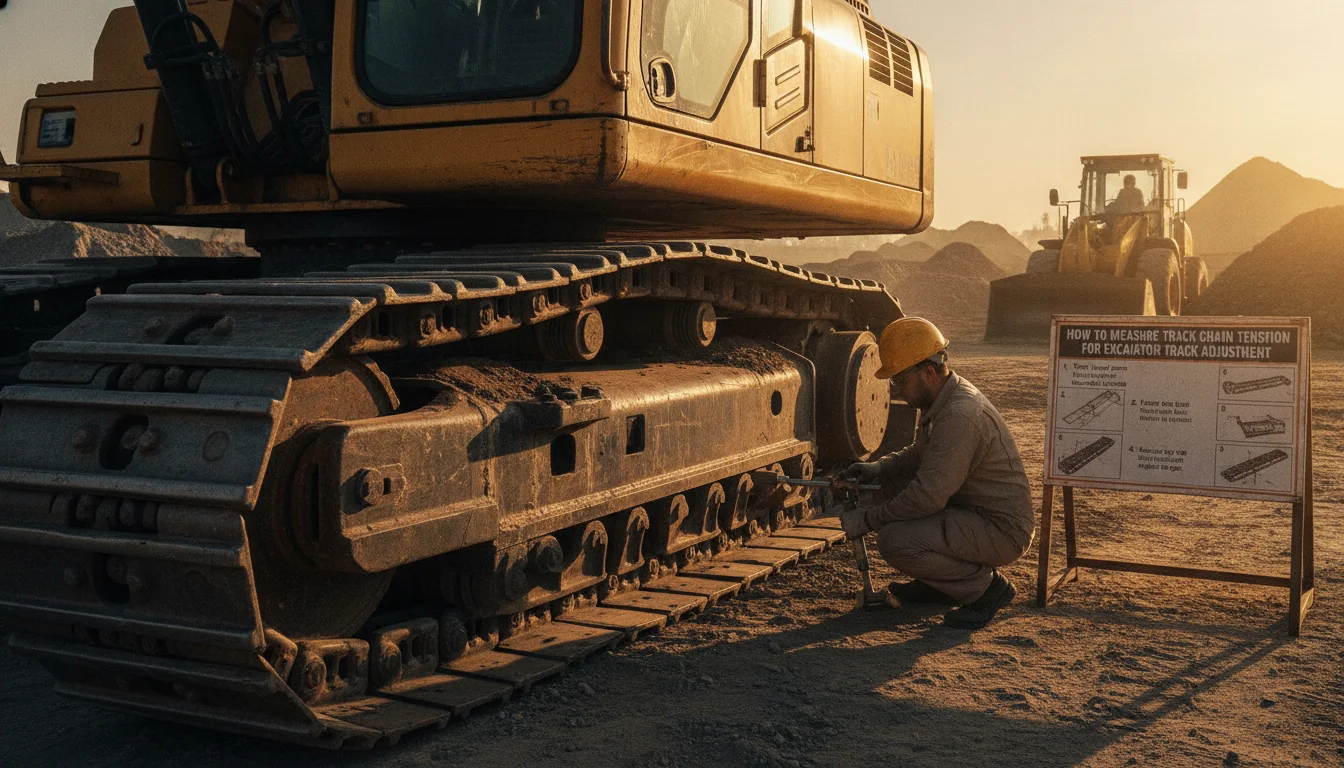
Measuring track chain tension accurately is the foundation of any excavator track chain adjustment procedure. Without a reliable baseline measurement, any adjustment is guesswork.
Tools Needed
- Measuring tape
- Straightedge or level (minimum 600 mm length)
- Track gauge (optional, for precision work on large machines)
- Electronic tension meter (optional, for scheduled maintenance on large mining excavators)
- Grease gun with appropriate fitting
- OEM service manual for your specific model
Step-by-Step Measurement Process
- Position the machine on flat ground. Park the excavator on level, firm ground. Avoid soft or uneven surfaces that could affect the measurement.
- Lift the excavator. Use the arm and bucket to raise the machine until the track on the side being measured hangs free above the ground. Ensure the machine is stable before proceeding.
- Run the track. Rotate the track for at least one full revolution. This seats the chain evenly and removes any temporary bunching from the measurement zone.
- Place the straightedge. Lay the straightedge across the top of the track, spanning from the front idler to the rear carrier roller. The straightedge should bridge both high points.
- Measure the sag. Use the measuring tape to determine the vertical drop at the midpoint of the track chain, between the straightedge and the lowest point of the chain. For most medium-sized excavators in the 10 to 40-tonne operating weight range, this sag should be between 30 and 50 mm, according to manufacturer specifications from multiple OEM service bulletins.
- Check OEM specifications. Always cross-reference your measurement against the excavator's service manual. Smaller mini excavators may have lower sag tolerances, while large mining equipment may specify slightly higher values.
"Tracks are often found too tight on used machines. There is a lack of knowledge on how to adjust track tension and what the correct required sag is. Too-tight tracks cause extended wear on bushings, sprockets, and idlers." - Scribd: Tracked Excavator Chain Adjustment technical document
Adjusting the Track Chain Tension: Step-by-Step
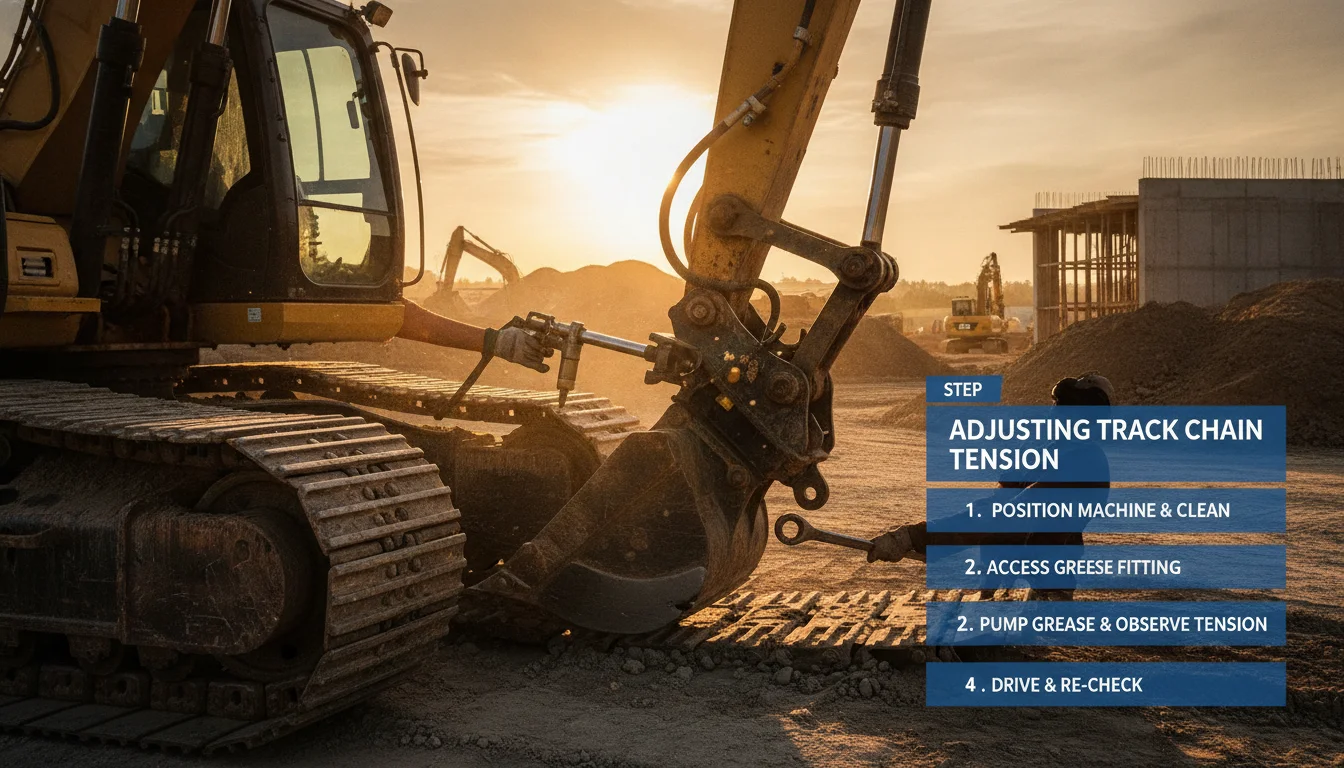
Once you have your baseline measurement, excavator track chain adjustment is a straightforward process using the machine's built-in hydraulic tensioning system. Follow these steps precisely.
Identifying the Tensioning Mechanism
Most excavators use a hydraulic tensioning cylinder positioned behind the front idler. Locate the grease fitting (nipple) on the track frame near the idler wheel. On most Caterpillar, Komatsu, and Volvo machines, this fitting is accessible from the side of the track frame, often protected by a cover plate. Clean the area thoroughly before attaching any tools to prevent contamination of the tensioning system.
Increasing Tension (Track Too Loose)
- Prepare the grease gun. Use a high-quality grease gun loaded with the grease specified in your OEM manual. Ensure the coupler is clean and fully seated on the fitting before pumping.
- Pump grease in controlled strokes. Add grease in increments of 3 to 5 pump strokes, then re-measure sag. Do not pump continuously without checking, as over-tightening is a common and damaging mistake.
- Monitor sag as you work. After each increment, re-measure the vertical drop at the midpoint. Stop pumping when the sag falls within the OEM-specified range.
- Run the track and re-check. Lower the machine, run the track for one full revolution, lift again, and take a final measurement to confirm the adjustment held.
Reducing Tension (Track Too Tight)
- Locate the release valve. On most tracked excavators, a release pin or valve is mounted near the grease fitting. This is the controlled exit point for grease under pressure.
- Open the release valve slowly. Turn the release valve counterclockwise by small increments only. Grease inside the tensioning cylinder is under significant pressure. Never remove the valve completely. Keep personnel clear of the release area.
- Allow grease to escape gradually. Let grease exit until the idler retracts enough to bring sag into the correct range. Re-measure after each partial release.
- Close the valve and verify. Once the correct sag is achieved, close the release valve, run the track, and confirm the measurement is stable.
Excavator Track Chain Adjustment: Comparison of Methods and Tools
Different situations call for different approaches to excavator track chain adjustment. The table below compares the main methods and tools used across field and workshop settings.
| Method / Tool | Best For | Accuracy | Equipment Needed | Notes |
|---|---|---|---|---|
| Straightedge + Measuring Tape | Field adjustment, all machine sizes | Good | Straightedge, tape measure | Standard method per most OEM manuals. Reliable for routine checks. |
| Track Gauge | Precision checks, medium to large machines | Very Good | Dedicated track gauge tool | Measures clearance between chain and idler. Faster than straightedge on familiar machines. |
| Electronic Tension Meter | Scheduled maintenance, large mining excavators | Excellent | Electronic meter, calibration equipment | Provides precise tension readings. Overkill for routine field work but valuable for fleet maintenance programs. |
| Finger / Visual Check | Quick field estimate only | Poor | None | Not recommended as a sole method. Use only as a rough initial indicator before measuring properly. |
| Grease Gun (tensioning) | All machines with hydraulic tensioning | N/A (adjustment tool) | Grease gun, correct grease type | Standard adjustment tool. Pair with measurement method for accurate results. |
Common Problems Affecting Track Chain Tension
Several factors cause excavator track chain tension to drift out of specification, and recognizing them early prevents expensive undercarriage repairs.
Environmental Factors
Operating in muddy or sandy conditions causes material to pack inside the track chain, artificially tightening the system or blocking the tensioning mechanism from functioning correctly. Rocky terrain accelerates link and bushing wear, upsetting tension balance faster than normal. Regular cleaning of the undercarriage after work in these conditions is not optional. It is a direct maintenance requirement.
Wear and Tear on Tensioning Components
As the excavator accumulates hours, seals inside the tensioning cylinder degrade and can begin leaking grease. When this happens, the idler retracts and the chain goes slack. Re-greasing provides only a temporary fix. The correct repair is replacement of the tensioning cylinder seals or the full tensioning assembly. At 3GEN Export, we supply OEM-standard tensioning cylinder seal kits for Caterpillar, Komatsu, Volvo, Hitachi, and Doosan undercarriage systems with global delivery.
New Track Chain Break-In Stretch
New track chains naturally stretch during the initial break-in period as pins and bushings seat under load. According to manufacturer specifications, this initial stretch is expected and normal. Failing to re-adjust tension promptly after the first operating hours causes poor engagement between chain links and the drive sprocket, accelerating wear on both components. Plan for an early inspection and adjustment after fitting any new track chain.
Operator Habits
Frequent sharp turns, prolonged uneven loading, and high-speed travel on hard surfaces stretch the track chain over time and require more frequent adjustments. Training operators on smooth turning technique and appropriate travel speeds on hard ground directly reduces the frequency of excavator track chain adjustment intervals and extends undercarriage life.
Common Mistakes to Avoid During Track Chain Adjustment
Excavator track chain adjustment errors are among the most common causes of premature undercarriage failure. Here are the mistakes we see most often in the field.
Over-Tightening the Track
This is the single most frequent error. Operators assume tighter is safer. It is not. Excessive tension increases friction between the chain and every roller, bushing, and sprocket tooth it contacts. The result is accelerated wear across the entire undercarriage, often requiring component replacement far earlier than the machine's service schedule would predict. Always measure before and after adjustment. Never pump grease without checking sag.
Adjusting Without Lifting the Machine
Measuring sag with the machine sitting on the ground gives an inaccurate reading because the track is compressed against the rollers. The correct procedure requires lifting the relevant side of the machine so the track hangs freely. Skipping this step means your measurement is wrong before you start.
Ignoring the OEM Manual
Sag specifications vary between models. A mini excavator and a 40-tonne machine have different tolerances. Using a generic figure without checking the manufacturer's manual for your specific model is a shortcut that costs money. Each machine and brand has a specific value or tolerance range. Consult it every time.
Neglecting to Clean Before Adjusting
Mud, sand, and debris packed around the grease fitting and tensioning mechanism interfere with accurate adjustment and can contaminate the tensioning cylinder. Always clean the area thoroughly before attaching the grease gun.
Releasing Grease Pressure Carelessly
When releasing tension from an over-tightened track, the grease inside the tensioning cylinder is under significant pressure. Removing the release valve completely or opening it too fast can cause grease to expel forcefully, creating a safety hazard. Open the release valve slowly, in small increments, and keep personnel clear of the release zone.
Realistic Scenario: Track Adjustment on a Komatsu PC200 After Muddy Site Work
Consider a fleet maintenance supervisor managing a Komatsu PC200 excavator returning from two weeks of work on a waterlogged civil construction site. The machine has been operating in deep mud, and the operator reports the track feels sluggish and the machine is pulling slightly to one side during travel.
The supervisor lifts the machine using the arm and bucket, runs the track for a full revolution, and places a straightedge across the upper run. The measured sag is 18 mm, well below the 30 to 50 mm range specified in the Komatsu PC200 service manual. The track is over-tightened, likely due to mud packing inside the chain during site work.
The supervisor locates the release valve near the grease fitting on the track frame, opens it slowly by a quarter turn, and allows grease to escape in controlled increments. After each partial release, he re-measures sag. After three release cycles, sag reaches 38 mm, within specification. He closes the valve, lowers the machine, runs the track, lifts again, and confirms the measurement is stable at 36 mm.
Total time on the job: under 20 minutes. The pulling sensation during travel disappears. This is a routine excavator track chain adjustment executed correctly, preventing what could have become a premature roller and bushing replacement costing several times the value of the grease and time invested.
Maintenance Tips for Track Chains
A consistent maintenance approach to excavator track chain adjustment and undercarriage care extends component life and reduces total cost of ownership across the machine's service life.
Regular Inspections
Inspect track chain tension every 50 working hours under normal operating conditions. In harsh environments, including heavy mud, sand, or rocky terrain, increase inspection frequency. Industry maintenance data shows that undercarriage costs represent a significant portion of total excavator operating costs, making proactive inspection one of the highest-return maintenance activities available to fleet managers.
Cleaning and Lubrication
Keep the track frame, tensioning mechanism, and grease fitting clean after every shift in demanding conditions. Regularly lubricate the tensioning cylinder according to the OEM schedule to prevent corrosion and ensure the mechanism operates freely when adjustment is needed.
Track Chain Wear Monitoring
As of 2026, most OEM service programs for Caterpillar, Komatsu, and Volvo excavators include undercarriage wear measurement as a scheduled service item. Track link pitch elongation, bushing wear, and sprocket tooth profile are all measurable indicators that tell you when adjustment alone is no longer sufficient and component replacement is required. Monitoring these values alongside regular excavator track chain adjustment gives you a complete picture of undercarriage health.
Consulting the Manual
Always refer to the manufacturer's service manual for specific maintenance schedules and tension specifications. OEM documentation is the authoritative source for your machine. Generic guides, including this one, provide a solid framework, but model-specific values always take priority.
Excavator Track Chain Adjustment: 2026 Outlook
This year, undercarriage maintenance practices are evolving alongside telematics integration in modern excavator fleets. Several OEM programs now offer remote monitoring of undercarriage wear indicators, giving fleet managers early warning of tension drift and component wear before failure occurs. This does not replace physical excavator track chain adjustment, but it does reduce the risk of missing an inspection interval on a busy site.
For older machines and fleets operating without telematics, the fundamentals remain unchanged: measure every 50 hours, adjust to OEM specification, clean after demanding site conditions, and replace worn tensioning components before they cause chain or sprocket damage. The cost of a tensioning cylinder seal kit is a fraction of the cost of a full undercarriage rebuild.
At 3GEN Export, we supply OEM-quality undercarriage parts including track chains, tensioning cylinders, seal kits, idlers, sprockets, and rollers for Caterpillar, Komatsu, Volvo, Hitachi, Doosan, and 40-plus additional brands. Updated for 2026, our inventory covers current and legacy machine models with global 5-day delivery to construction, mining, and energy project sites worldwide.
Frequently Asked Questions
How do you tighten an excavator track chain?
Locate the grease fitting near the front idler on the track frame. Attach a clean grease gun loaded with the OEM-specified grease. Pump grease in increments of 3 to 5 strokes, re-measuring sag after each increment until the vertical drop at the midpoint of the upper track run falls within the manufacturer's specified range, typically 30 to 50 mm for medium-sized machines. Run the track for a full revolution and confirm the measurement before returning the machine to service.
How much slack should an excavator track have?
For most medium-sized excavators in the 10 to 40-tonne operating weight range, track chain sag should be maintained between 30 and 50 mm, measured at the midpoint of the upper run with the machine lifted and the track hanging freely. Smaller mini excavators may have lower specified values, and large mining machines may specify slightly higher tolerances. Always check the OEM service manual for your specific model before adjusting.
Why does my excavator track keep getting loose?
The most common causes are degraded seals in the tensioning cylinder allowing grease to leak, mud or debris buildup interfering with the tensioning mechanism, natural stretch of a new track chain during break-in, and operator habits such as frequent sharp turns or high-speed travel on hard surfaces. If re-greasing does not hold tension for a normal inspection interval, inspect the tensioning cylinder seals for leakage and replace as needed.
What is the correct sag for a mini excavator track?
Mini excavator track sag specifications vary by brand and model. As a general reference, many mini excavators specify lower sag values than their larger counterparts, but the only reliable figure is the one in your machine's OEM service manual. Using a generic number without checking the manual risks over-tightening or under-tensioning, both of which accelerate undercarriage wear.
How often should I inspect my excavator's track chain tension?
Inspect track chain tension every 50 working hours under normal operating conditions, according to manufacturer maintenance schedules. In harsh environments such as deep mud, sand, or rocky terrain, increase inspection frequency. New track chains should be inspected and adjusted earlier than the standard interval to account for initial break-in stretch.
Can I adjust excavator track tension without lifting the machine?
You should not rely on measurements taken with the machine sitting on the ground, as the track is compressed against the rollers and the sag reading will be inaccurate. The correct procedure requires lifting the relevant side of the machine so the track hangs freely before measuring. Adjusting without a proper measurement risks over-tightening, which accelerates wear across the entire undercarriage system.