
Excavator Track Chain and Sprocket Guide 2026
Excavator track chain and sprocket selection, maintenance, and replacement guide for 2026. OEM-quality parts, fast global delivery at 3genexport.com.
Loading article…
Article Not Found
The article you're looking for doesn't exist or may have been removed.
Back to BlogKey Takeaways
- The excavator track chain and sprocket form the core of your undercarriage system: get either wrong and the whole assembly degrades faster.
- Three chain types cover virtually every application: greased, SALT, and dry. Each suits different machine sizes and duty cycles.
- According to manufacturer data, greased chains last 20-30% longer than dry chains. SALT chains extend internal bushing life by up to 50% compared to greased chains.
- Always replace the chain and sprocket together. Fitting a new sprocket to a worn chain accelerates failure on both components.
- Track pitch ranges from 101mm to 260mm across machines from 3T mini excavators to 80T quarry plant. Match pitch precisely to your model.
- OEM-specification parts from ISO 9001-approved facilities are the baseline for acceptable quality in heavy-duty applications.
Excavator track chain and sprocket is the drive assembly that transfers hydraulic motor power into ground movement across every tracked machine. The chain forms a continuous steel loop; the sprocket is the toothed wheel that engages it. Both must be matched in pitch and condition to keep your undercarriage running.
Understanding Excavator Track Chains
Excavator track chains are the structural backbone of the undercarriage, connecting every component in the system and transmitting drive force to the ground. As competitor data from Imara Engineering confirms, every other undercarriage part either drives the chain, supports it, or guides it. When the chain wears and loses pitch accuracy, every component it contacts degrades simultaneously.
Track chains are manufactured from high-strength alloy steel, heat-treated for wear and fatigue resistance. The core components are chain plates, connecting pins, seals, and a buffer system. Seals keep lubricant in and abrasive material out. The buffer system absorbs vibration and reduces direct metal-to-metal contact under load.
Types of Track Chains
- Greased Chains (140mm-260mm pitch): Grease-filled and sealed with polyurethane seals. The seal keeps abrasive material away from the pin and bush, so the joint wears slowly. Per manufacturer data, greased chains last 20-30% longer than dry chains. Standard choice for midi to large excavators.
- SALT Chains (Sealed and Lubricated Track): Oil-filled for dozers and heavy tracked plant. The oil cuts internal friction between pin and bushing. According to OEM specification data, SALT chains extend internal bushing life by up to 50% compared to greased chains. Used where maximum internal wear resistance is required.
- Dry Chains (101mm-135mm pitch): No lubrication. Used on mini excavators and lighter machines. No manufacturer produces a greased chain below 135mm pitch. Dry chains require more frequent inspection and earlier replacement than sealed alternatives.
Track Chain Specifications to Match Your Machine
Pitch is the single most critical specification. It is the distance between the centers of two adjacent link pins, and it must match your sprocket exactly. A mismatch of even a few millimeters causes the chain to ride up the sprocket teeth rather than seat in the tooth valley, accelerating wear on both components.
- Pitch: Ranges from 101mm (3T mini excavators) to 260mm (80T quarry plant and dozers), per Astrak DuraTrack range data.
- Number of links: Varies by model. Always confirm against the OEM service manual for your specific machine serial number.
- Material: High-strength alloy steel with surface hardening. Per GFM Parts technical data, chain link hardness below HV 450 is a root cause of abnormal wear.
- Master pin type: Easy-fit or press-fit. Confirm before ordering. The wrong master pin type means the chain cannot be assembled on-site without specialist tooling.
"The track chain itself, the continuous steel link assembly that forms the loop connecting all undercarriage components, is the backbone that holds the entire undercarriage system together. When the track chain wears, elongates, and loses its pitch accuracy, every component it contacts is affected simultaneously." - Imara Engineering Supplies, undercarriage technical reference
Understanding Excavator Sprockets
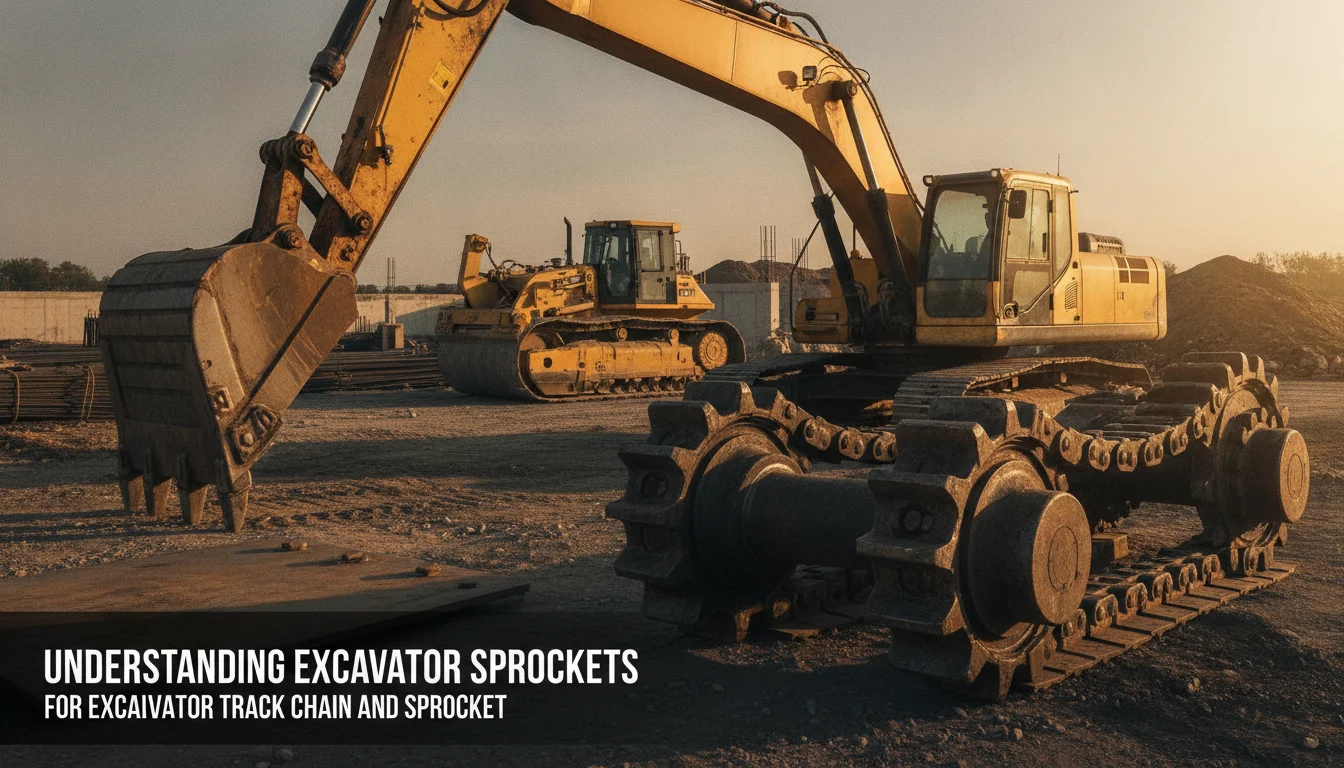
The sprocket is a toothed wheel mounted at the rear of the track frame that transfers power from the hydraulic motor to the and sprocket assembly, propelling the machine forward or backward. It does not bear the machine's weight. Its only job is to drive the chain.
Sprocket teeth are hardened by induction hardening, not surface hardening alone. As VemaTrack's technical documentation explains, if only the surface is hardened, the sprocket wears rapidly over time. Induction hardening penetrates deeper into the tooth, giving it the wear resistance needed for the loads involved.
Types of Sprockets
- Standard (One-Piece) Sprockets: A metal inner ring with bolt holes or a compression hub and a gear ring in one unit. Pressed or bolted directly onto the drive hub. Standard for excavators. Replacement requires removing the entire unit.
- Segmented Sprockets: Individual segments bolted together to form the complete gear ring. Used primarily on bulldozers. Segments can be exchanged without dismantling the track link assembly, reducing downtime on high-utilization machines.
- Heavy-Duty Sprockets: Reinforced construction for high-load quarry and mining applications. Typically feature sand notches machined into the tooth profile to reduce packing of soil between the bushing and the cogwheel.
Key Sprocket Selection Criteria
- Pitch match: The sprocket tooth profile must align with your chain pitch. A sprocket designed for 190mm pitch chain will not correctly engage a 171mm chain.
- Induction-hardened teeth: Confirm this is specified. Surface-hardened-only teeth wear significantly faster under continuous load.
- Model compatibility: Sprockets are machine-specific. Confirm by make, model, and serial number range before ordering.
- Sand notches: For machines working in sandy or muddy conditions, sand notches in the tooth profile reduce abrasive packing and extend service life.
"Sprocket teeth are hardened by means of induction hardening. If only the surface is hardened, then the sprocket or segment will wear very fast over time." - VemaTrack undercarriage technical documentation
How to Read Wear Patterns on Track Chains and Sprockets
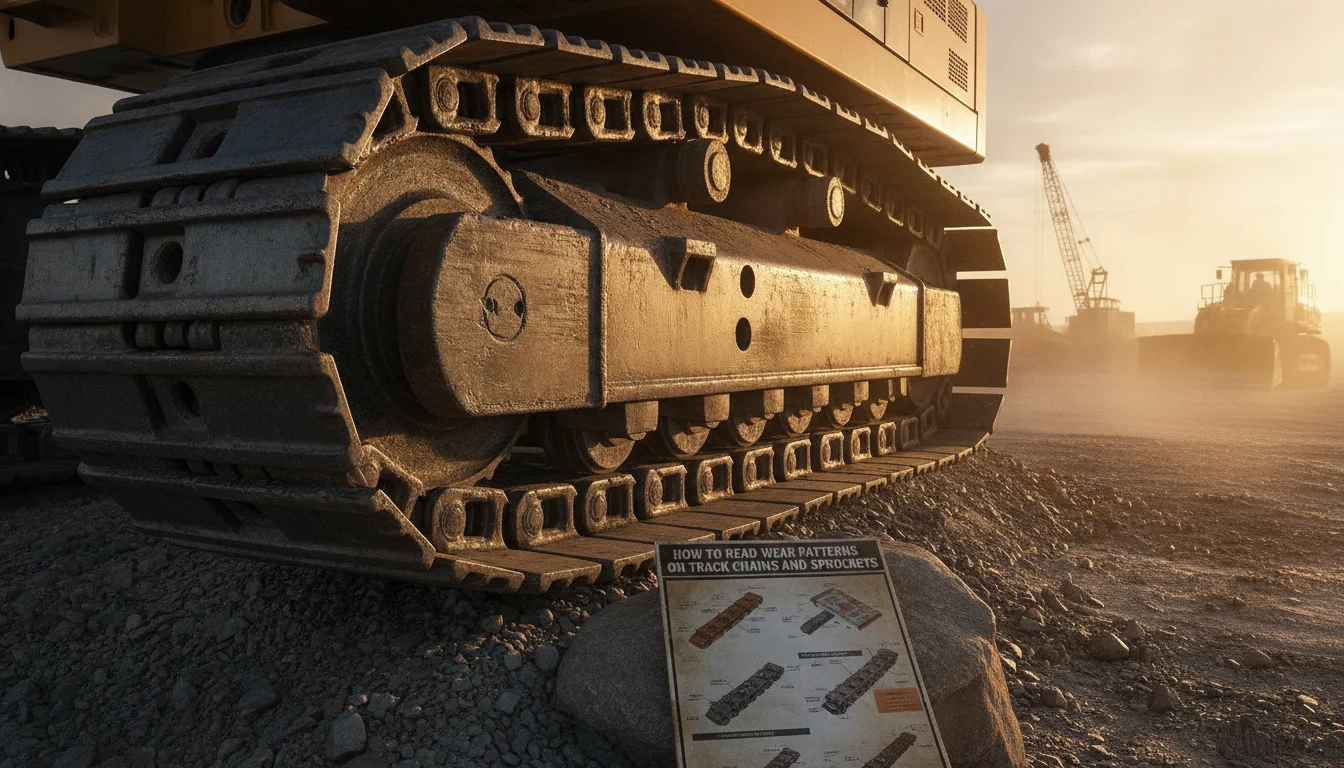
Wear patterns on your this type of sprocket tell you exactly what is failing and why. Reading them correctly prevents misdiagnosis and unnecessary parts spend.
Chain Wear Indicators
- Chain stretch (elongation): Internal pin and bush wear shows as chain stretch. Measure pin centers across four or five links against the new-chain specification. On a 50-link chain, 1mm of pin wear plus 1mm of bush enlargement adds roughly 100mm to overall length, per Astrak technical data.
- Stiff joints: Links that no longer articulate freely indicate severe internal wear or seized pins.
- Flat spots on the bush: A sign of an extremely worn chain that has passed its service limit.
- Bushing counterbore or pin boss deformation: Worn pin ends or loose pins indicate the chain is beyond economic repair.
Sprocket Wear Indicators
- Sharp tooth points: The only reason a sprocket becomes sharp is increased chain pitch from internal wear. As VemaTrack confirms, the chain's bushing no longer runs in line with the hollow part of the sprocket, causing the points to sharpen. Sharp teeth are a chain wear symptom, not an isolated sprocket problem.
- Lateral wear: Caused by worn chain guides, a twisted undercarriage, poor idler guidance, or abrasive material packing between the bushing and cogwheel.
- Chain jumping the sprocket: Can indicate worn sprockets, a broken track adjuster spring, worn track rollers, or a pitch mismatch.
Maintenance of Excavator Track Chains and Sprockets
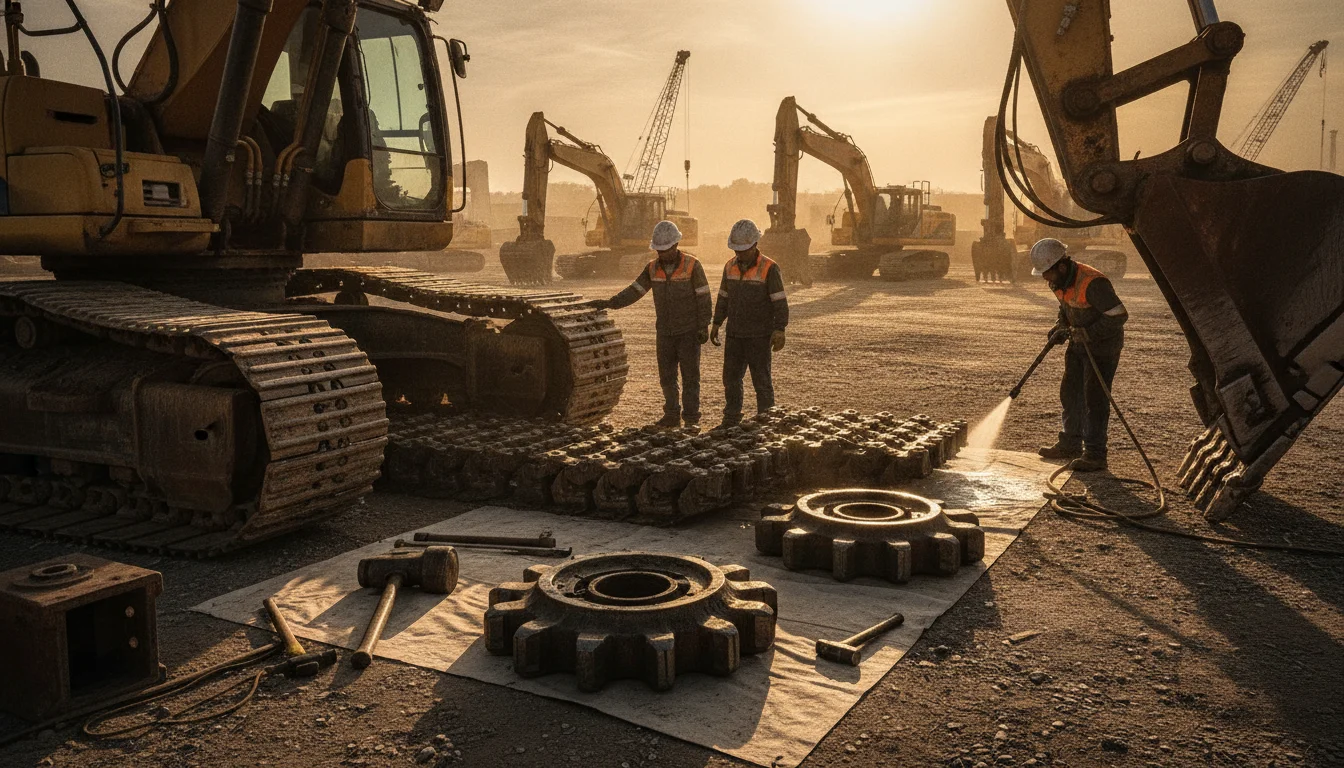
Regular maintenance is the most cost-effective investment you can make in your this kind of and sprocket system. Deferred maintenance compounds: a worn seal leads to lubrication loss, which accelerates pin and bush wear, which sharpens the sprocket, which destroys a new chain fitted to an old sprocket.
Inspection Schedule
- Check for chain elongation against OEM specification at each service interval. Do not wait for visible sag.
- Inspect seals for leaks. On SALT chains, oil loss is the primary cause of accelerated internal wear and sharp sprocket teeth.
- Monitor track tension. Too tight causes accelerated pin and bush wear. Too loose causes the chain to jump the sprocket and damages rollers.
- Check sprocket tooth profile at every major service. Sharp points mean the chain pitch has increased and both components need attention.
- Inspect for lateral wear on chain rails. Excessive lateral wear usually points to alignment issues or a track shoe that is too wide for the application.
Lubrication
- Greased chains: replenish with high-quality lithium-based grease at manufacturer-specified intervals. GFM Parts technical data recommends high-temperature lithium-based grease for applications where seal aging is a concern.
- SALT chains: inspect oil fill integrity. Any leak accelerates internal wear immediately. Address seal failures before returning the machine to service.
- Dry chains: inspect frequently. No internal lubrication means wear accumulates faster. Replace before elongation causes sprocket damage.
Pro Tip: Extend Chain Life Through Operating Practice
Astrak's technical guidance identifies several operator habits that extend chain life without any parts cost: use the narrowest shoe that still gives adequate flotation, dig over the idlers rather than the sprockets, maintain correct track tension, keep the undercarriage clean, and minimize reversing. Excavator chains are designed to wear less traveling forward.
Replacement Guidelines
Knowing when to replace your the track chain and sprocket prevents a small parts cost from becoming a full undercarriage rebuild.
- Replace the chain when elongation exceeds the manufacturer's specified limit. Continuing to run an elongated chain destroys the sprocket.
- Replace sprockets when teeth are sharp or when lateral wear has removed material from the tooth flanks.
- Always replace the chain and sprocket together. As VemaTrack's technical team states: never only replace a sprocket. If a dry-chain excavator sprocket needs replacement, the track links must be replaced as well, and vice versa. Fitting new components to worn mates wastes both parts.
- For oil-lubricated (SALT) chains that are not leaking, consider replacing segments before end of cycle to gain additional service hours from the chain.
How to Choose the Right Excavator Track Chain and Sprocket
Selecting the correct excavator track chain and sprocket starts with three data points: machine make and model, serial number range, and the pitch of the existing chain. Everything else follows from those three.
What to Confirm Before Ordering
- Compatibility: Make, model, and serial number range. Sprockets and chains are not universal across model years of the same machine.
- Pitch: Measure the existing chain or confirm from the OEM service manual. Do not estimate.
- Master pin type: Easy-fit or press-fit. Determines what tooling you need on-site for assembly.
- Quality standard: OEM specification, manufactured in ISO 9001-approved facilities. Astrak's DuraTrack range, for example, carries warranty rates of 0.3% to 2% across the range and a 12-month warranty on excavator track chains.
- Supplier lead time: For global procurement, confirm stock availability and shipping timelines before committing. A part that ships in five days beats a cheaper part that ships in six weeks when your machine is idle.
Brand Compatibility Reference
As of 2026, OEM-specification excavator track chain and sprocket assemblies are available for all major brands. The table below covers the most common makes in global fleet operations.
Comparison Table: Excavator Track Chain and Sprocket Types
| Type | Material | Pitch Range | Typical Price Range | Durability | Best Application |
|---|---|---|---|---|---|
| Greased Chain | Alloy Steel | 140mm - 260mm | $300 - $800 | Moderate-High | Midi to large excavators, general construction |
| SALT Chain | Alloy Steel | 228mm - 260mm | $500 - $1,200 | High | Dozers, heavy quarry plant, high-utilization machines |
| Dry Chain | Alloy Steel | 101mm - 135mm | $200 - $500 | Moderate | Mini excavators, light-duty tracked machines |
| Standard Sprocket | Induction-Hardened Steel | Varies by model | $200 - $600 | Moderate | Standard excavator applications |
| Segmented Sprocket | Forged Hardened Steel | Varies by model | $400 - $800 | High | Bulldozers, high-utilization tracked plant |
| Heavy-Duty Sprocket | Reinforced Steel | Varies by model | $600 - $1,500 | Very High | Mining, quarry, extreme-duty applications |
Pros and Cons of OEM vs. Aftermarket Excavator Track Chain and Sprocket
Pros
- OEM-specification parts guarantee pitch accuracy and material hardness to the original design standard, protecting the rest of your undercarriage investment.
- ISO 9001-approved manufacturing provides documented quality control and traceable warranty support.
- Matched sets (chain and sprocket ordered together) eliminate compatibility risk and simplify procurement.
- Global stock availability from specialist suppliers means lead times of days, not weeks, for most major brands.
- Greased and SALT chains deliver measurably longer service life than dry alternatives in medium-to-heavy applications, reducing total cost per operating hour.
Cons
- Higher upfront cost for OEM-specification or heavy-duty components versus budget aftermarket options.
- Segmented sprockets require more precise installation than one-piece units. Incorrect torque on segment bolts causes premature failure.
- SALT chains are more sensitive to seal damage than greased chains. A single seal failure causes rapid internal wear if not caught quickly.
- Pitch-specific ordering means errors in specification result in parts that cannot be used. Always verify against the OEM service manual before ordering.
Frequently Asked Questions
When should I replace my excavator sprocket?
Replace your excavator sprocket when the teeth become sharp or when lateral wear has removed material from the tooth flanks. Sharp sprocket teeth are caused by increased chain pitch from internal pin and bush wear, so a worn sprocket almost always means the chain needs replacing too. Inspect both components together at every major service interval.
How do I know what size sprocket I need for my chain?
The sprocket tooth profile must match your chain pitch exactly. Confirm the pitch from your OEM service manual using the machine make, model, and serial number range. Do not measure a worn chain to determine pitch: internal wear causes elongation that will give you a false reading. Use the new-chain specification from the manufacturer.
What are the tracks on an excavator called?
The tracks on an excavator are called track chains: continuous loops of interconnected steel links that provide mobility and distribute the machine's weight across the ground. The full undercarriage system includes the track chain, sprocket, idler, track rollers, carrier rollers, and track adjuster.
What are the two main types of sprockets?
Standard (one-piece) sprockets are used on excavators and bolt or press directly onto the drive hub as a single unit. Segmented sprockets consist of individual segments bolted together to form the gear ring, primarily used on bulldozers because individual segments can be replaced without dismantling the track link assembly.
How can I extend the life of my excavator track chain and sprocket?
Maintain correct track tension, keep the undercarriage clean, use the narrowest track shoe that gives adequate flotation, and minimize reversing. Dig over the idlers rather than the sprockets where possible. Inspect seals at every service interval and address lubrication loss immediately. Replace worn components before they damage the mating parts.
What is the average lifespan of an excavator track chain?
Lifespan varies significantly based on machine size, application, ground conditions, and maintenance quality. Manufacturer data and industry maintenance records indicate service lives ranging from 2,000 to 5,000 operating hours under normal conditions. Greased chains consistently outlast dry chains in comparable applications, and SALT chains deliver the longest internal component life in heavy-duty use.
Ready to source OEM-quality excavator track chain and sprocket components with verified compatibility and fast global delivery? Shop the full undercarriage range at 3genexport.com and get your machine back to work.