
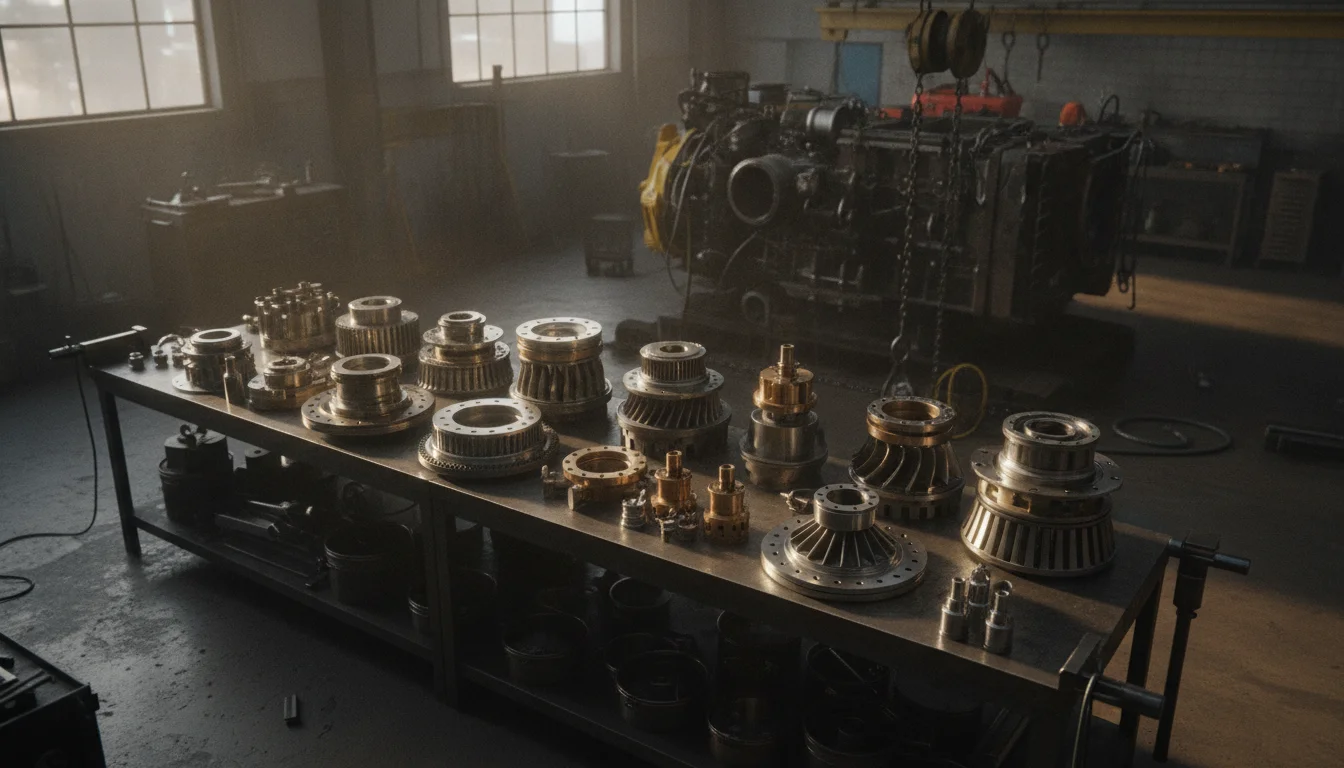
Gas Turbine Engine Components: Parts & Functions
Gas turbine engine components explained for procurement teams: compressor, combustor, turbine, materials, and sourcing tips. Shop OEM parts at 3genexport.
Loading article…
Article Not Found
The article you're looking for doesn't exist or may have been removed.
Back to BlogGas turbine engine components are the core mechanical parts that make up an internal combustion engine using air as its working fluid, converting chemical fuel energy into mechanical power for aviation, power generation, and industrial drive applications.
Key Takeaways
- Gas turbine engines consist of four primary sections: the inlet, compressor, combustor, and turbine, each performing a distinct and critical function.
- Material selection is non-negotiable. Titanium alloys, nickel-based superalloys, and cobalt-chromium compounds are chosen specifically for their thermal stability and strength-to-weight ratio.
- The compressor and turbine are mechanically linked on a shared shaft. If one degrades, the other suffers directly.
- When sourcing replacement parts, OEM compatibility and supplier track record matter more than unit price alone.
- Routine inspection intervals vary by operating conditions. Follow OEM service bulletins rather than generic schedules.
Overview of Gas Turbine Engine Components
A gas turbine engine is built around four main sections: the inlet, compressor, combustor, and turbine. According to fundamental gas turbine engineering principles, these four steps - intake, compression, combustion, and expansion - occur simultaneously in different physical locations, unlike a piston engine where they happen sequentially in the same cylinder. That distinction is what makes the gas turbine so compact and powerful relative to its output.
"Although conceptually the gas-turbine engine is a simple device, the components for an efficient unit must be carefully designed and manufactured from costly materials because of the high temperatures and stresses encountered during operation." - Britannica, Gas-Turbine Engine
1. Inlet Section
The inlet section directs ambient air into the engine with minimal turbulence and pressure loss. Its geometry - whether circular subsonic or variable-geometry supersonic - directly shapes how much air mass reaches the compressor. A poorly designed or damaged inlet starves the entire engine of the airflow it needs. For industrial and power-generation turbines, inlet filtration systems are also part of this section, protecting downstream components from particulate contamination.
2. Compressor Section
The compressor increases incoming air pressure before it enters the combustor. Two main designs are used: axial-flow compressors, which handle large air volumes efficiently and dominate in aviation and large industrial turbines, and centrifugal-flow compressors, which are more compact and suited to smaller units. Per manufacturer specifications, the compressor system is typically constructed from oxidation-resistant nickel-based alloys to handle the mechanical stress and elevated temperatures of sustained compression. The combination of the shaft, compressor, and turbine is collectively called the turbomachinery.
3. Combustor Section
The combustor is where compressed air mixes with fuel and ignites. According to industry engineering data, the high-temperature combustion chamber must be built from superalloys capable of withstanding temperatures exceeding 1,300 degrees Celsius. These alloys typically include cobalt, chromium, nickel, carbon, iron, titanium, aluminum, tungsten, manganese, and molybdenum in various combinations. Not all compressed air burns directly. A significant portion bypasses the burning zone and mixes with combustion gases downstream to bring turbine inlet temperatures within operational limits.
4. Turbine Section
The turbine extracts energy from the high-temperature, high-pressure gases produced in the combustor. That energy drives the compressor on the same shaft and delivers remaining power as shaft output or thrust. As noted by Parametric Solutions Inc., turbine blades are typically made from nickel-based superalloys selected for their ability to maintain structural integrity under extreme thermal and mechanical stress. Most of the turbine's output goes directly to driving the compressor. Only the surplus is available for useful work.
5. Exhaust Section
The exhaust section manages the exit of spent gases. In jet engines, a convergent nozzle accelerates exhaust flow to generate thrust. In industrial power turbines, the exhaust feeds heat recovery systems that improve overall plant efficiency. The nozzle also controls mass flow through the entire engine, making it a key performance variable rather than a passive outlet.
Step-by-Step Process of Gas Turbine Operation
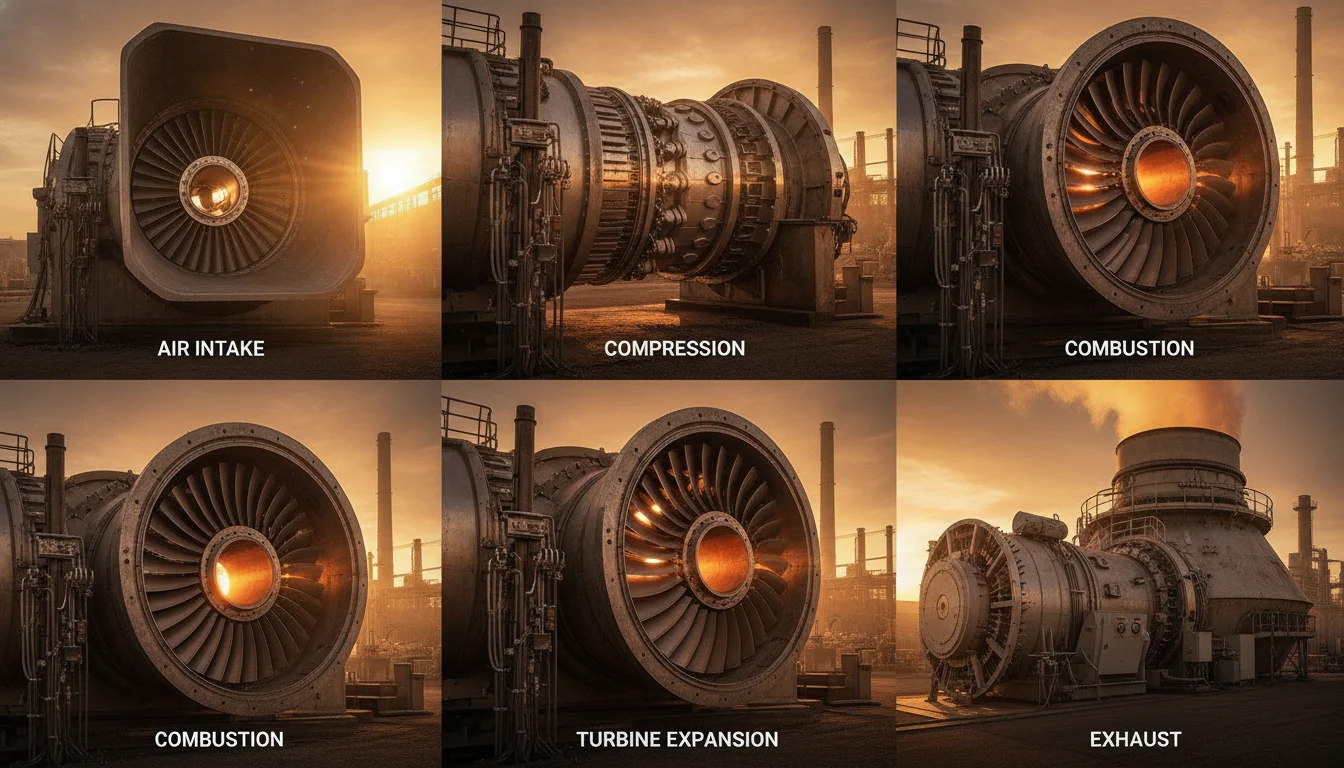
- Air Intake: Ambient air enters through the inlet section. Duct geometry and filtration quality determine how cleanly air reaches the compressor.
- Compression: The compressor - axial, centrifugal, or multi-stage - raises air pressure significantly. This is where energy input begins.
- Combustion: Compressed air enters the combustor, mixes with fuel, and ignites. Bypass air moderates the exit temperature to protect the turbine.
- Energy Extraction: High-pressure gases expand through the turbine stages, spinning the rotor and driving the compressor shaft. Surplus energy becomes useful output.
- Exhaust: Spent gases exit through the nozzle or exhaust duct. In combined-cycle plants, this heat is recovered for additional power generation.
Comparison of Gas Turbine Engine Components
| Component | Primary Function | Key Materials | Impact on Efficiency |
|---|---|---|---|
| Inlet | Directs and conditions incoming air | Aerodynamic alloys, filtration media | High - poor intake reduces compressor performance |
| Compressor | Raises air pressure for combustion | Nickel-based alloys, titanium alloys | Critical - directly sets pressure ratio and thermal efficiency |
| Combustor | Burns fuel-air mixture at constant pressure | Superalloys (Ni, Co, Cr, Ti blends) | Direct - combustion quality determines power output and emissions |
| Turbine | Extracts energy from hot gases | Nickel-based superalloys | Essential - turbine efficiency determines net shaft power |
| Exhaust / Nozzle | Accelerates exhaust or enables heat recovery | Heat-resistant steels | Significant in combined-cycle and jet applications |
Raw Materials in Gas Turbine Engine Components

Material selection is where gas turbine engineering gets demanding. According to Parametric Solutions Inc., metals such as titanium and nickel are preferred across multiple sections because of their high strength-to-weight ratio, corrosion resistance, and thermal stability. These metals are routinely alloyed with others to extend performance limits.
- Inlet fan blades: Titanium-based alloys, chosen for fracture resistance when foreign objects enter the engine.
- Compressor components: Durable, oxidation-resistant nickel-based alloys.
- Combustion chamber: Superalloys containing cobalt, chromium, nickel, carbon, iron, titanium, aluminum, tungsten, manganese, and molybdenum - rated for temperatures above 1,300°C.
- Turbine blades and discs: Nickel-based superalloys, sometimes with thermal barrier coatings to extend service life.
"The materials used in making the components of gas turbine engines are specifically selected to survive the extremely high temperatures and high-pressure environment within the engine system." - Parametric Solutions Inc., 2018
Pros and Cons of Gas Turbine Engines
Pros
- High power-to-weight ratio: For the same output, a gas turbine is significantly smaller and lighter than a comparable reciprocating engine, per Britannica's engineering data.
- Continuous rotary output: Unlike piston engines, gas turbines deliver shaft power directly without converting reciprocating motion, reducing mechanical complexity.
- Fuel flexibility: Industrial gas turbines can operate on natural gas, diesel, and various synthetic fuels depending on combustor design.
- Scalability: From microturbines to large combined-cycle power plants, the core architecture scales across a wide output range.
Cons
- High component cost: Superalloy turbine blades and precision-cast combustor liners are expensive to manufacture and replace.
- Sensitive to inlet air quality: Particulate contamination degrades compressor blades and reduces efficiency over time. Filtration maintenance is non-optional.
- Complex maintenance requirements: Hot-section inspections require specialized tooling and trained personnel. Skipping intervals accelerates failure.
- Efficiency losses at part load: Gas turbines are optimized for full-load operation. Running at reduced output drops thermal efficiency noticeably.
What to Look For When Buying Gas Turbine Engine Components
Sourcing engine components requires more discipline than standard industrial procurement. The operating environment inside a turbine leaves no margin for substandard parts.
- OEM compatibility: Verify that components match your specific engine model and serial number range. Dimensional tolerances in turbomachinery are tight, and a near-fit is a failure waiting to happen.
- Material certification: Request material test reports (MTRs) confirming alloy composition. For hot-section parts, this is non-negotiable.
- Supplier track record: Work with suppliers who have documented experience in gas turbine parts, not generalist industrial distributors. Ask for references in your industry segment.
- Quality over unit price: A cheaper combustor liner that fails early costs multiples of the savings in unplanned downtime and secondary damage.
- Lead time and logistics: For global operations, confirm the supplier's ability to ship internationally with proper export documentation and packaging for sensitive components.
Care and Maintenance of Gas Turbine Engine Components
Regular maintenance keeps this type of components performing within design parameters and prevents cascading failures. Follow OEM service bulletins for your specific engine model rather than generic interval guides, since operating conditions vary significantly between applications.
- Routine inspections: Borescope inspections of the hot section allow technicians to assess blade condition, combustor liner integrity, and nozzle guide vane wear without full disassembly.
- Inlet filter maintenance: Clean or replace inlet filters on schedule. Compressor blade erosion from particulate ingestion is cumulative and irreversible without blade replacement.
- Compressor washing: Online and offline compressor washing removes fouling deposits that reduce airflow and pressure ratio. Frequency depends on operating environment.
- Prompt replacement of worn parts: Delaying replacement of a degraded turbine blade or combustor liner risks secondary damage to adjacent components, multiplying repair costs.
- Documentation: Maintain complete service records for each engine. Traceability of parts and maintenance history is required for most regulatory frameworks and resale value.
Frequently Asked Questions
What are the five main sections of a gas turbine engine?
The five main sections are the inlet, compressor, combustor (combustion chamber), turbine, and exhaust or nozzle section. Each section performs a distinct function in the intake-compression-combustion-expansion-exhaust cycle that all internal combustion engines follow.
What are the main components of a turbine?
The turbine section itself consists of turbine blades (rotors), stator vanes, nozzle guide vanes, turbine discs, and the casing. Turbine blades are typically made from nickel-based superalloys and may include internal cooling channels to manage the extreme thermal loads they experience during operation.
What materials are used in gas turbine engine components?
Material selection depends on the section. Inlet fan blades use titanium-based alloys for impact resistance. Compressor components use oxidation-resistant nickel-based alloys. Combustion chambers use superalloys rated for temperatures above 1,300°C, containing cobalt, chromium, nickel, and other elements. Turbine blades use nickel-based superalloys, often with thermal barrier coatings.
What are the 5 stages of a turbine engine?
The five operational stages are: air intake, compression, combustion, energy extraction (expansion through the turbine), and exhaust. In a gas turbine, all five stages occur simultaneously in different physical locations, which is the fundamental difference from a piston engine where they occur sequentially in the same cylinder.
How often should gas turbine engine components be inspected?
Inspection intervals are defined by OEM service bulletins and vary based on engine type, fuel quality, and operating environment. Borescope inspections of the hot section are typically performed at intervals specified in the engine's maintenance manual. Follow manufacturer specifications rather than generic schedules to avoid both over-maintenance and premature failures.
Can I replace gas turbine components without OEM parts?
Aftermarket components are available for many this kind of engine components, but compatibility verification is critical. Any replacement part must meet the dimensional, material, and certification requirements of the original. For hot-section components in particular, use suppliers who can provide full material traceability and quality documentation.