
Global Heavy Equipment Market Forecast: 2026-2033
Our global heavy equipment market forecast breaks down 2026-2033 data from six research firms, regional shares, and OEM trends for smarter fleet buying.
Loading article…
Article Not Found
The article you're looking for doesn't exist or may have been removed.
Back to BlogThe global heavy equipment market forecast is a set of research projections estimating how large the heavy construction equipment sector will grow between now and the early 2030s. Research firms put the figure anywhere from USD 226 billion to USD 337 billion depending on scope and base year.
Key Takeaways
- Research firms peg the market forecast between USD 226.91 billion and USD 337.25 billion by the early 2030s, depending on scope and base year.
- Asia Pacific holds the largest regional share, at 40-45% in 2025, according to MarketsandMarkets.
- The United States commands 71.4% of the North American market, backed by the Bipartisan Infrastructure Law.
- Earthmoving equipment remains the volume leader, while material handling equipment is projected to grow 7% yearly in North America.
- Electrification (LFP batteries at a projected 17.8% CAGR) and autonomous systems are reshaping OEM strategy.
- Capital intensity, emissions compliance costs, and raw material volatility remain the top restraints on growth.
Projections by Research Firm
No single this type of forecast matches another exactly, because research firms use different base years, end dates, and market definitions. That variance isn't a flaw. It's a map of uncertainty. For equipment buyers, fleet managers, and dealers, the useful exercise is reading the range rather than fixating on one headline number.
| Research firm | Base value | Forecast value | CAGR | Period | Scope |
|---|---|---|---|---|---|
| MarketsandMarkets | USD 154.62B (2025); USD 160.11B (2026) | USD 226.91B (2033) | 5.1% | 2026-2033 | Global |
| Verified Market Research | ~USD 140.1B current | USD 253.5B (2031) | 6.81% | 2024-2031 | Global |
| The Business Research Company | USD 215.46B (2025) | USD 295.73B (2030) | 6.5% | 2025-2030 | Global |
| InsightAce Analytic | USD 202.84B (2024) | USD 333.52B (2034) | 5.2% | 2025-2034 | Global |
| Spherical Insights | USD 203.92B (2023) | USD 337.25B (2033) | 5.16% | 2023-2033 | Global |
| Market Data Forecast | USD 77.04B (2025) | USD 119.82B (2034) | 5.03% | 2026-2034 | North America |
According to MarketsandMarkets, the global heavy construction equipment market is projected to grow from USD 160.11 billion in 2026 to USD 226.91 billion by 2033, at a CAGR of 5.1%. Its analysis segments the market by equipment type, propulsion, power output, engine capacity, application, electric construction equipment, battery chemistry, and region.
Understanding the Variance in Forecasts
Other firms publish different numbers for the same question. Verified Market Research, cited by Recycling Today, values the current heavy construction equipment market at about USD 140.1 billion and expects USD 253.5 billion by 2031, a 6.81% CAGR from 2024 to 2031. The Business Research Company reports a 2025 market size of USD 215.46 billion and a 2030 projection of USD 295.73 billion, a 6.5% CAGR. InsightAce Analytic estimates USD 202.84 billion in 2024 rising to USD 333.52 billion by 2034 at a 5.2% CAGR. Spherical Insights estimates USD 203.92 billion in 2023 and USD 337.25 billion by 2033 at a 5.16% CAGR. The differences stem from scope, equipment categories, and whether mining equipment is folded in.
The demand for sophisticated machinery is driven by the increasing necessity for robust infrastructure as cities expand.
What the Numbers Mean for Equipment Buyers
Treat any this kind of market forecast as a range, not a precise point. A 5.1% CAGR and a 6.81% CAGR can both be correct if one includes autonomous mining trucks and the other doesn't. Procurement teams should anchor on the segment and region they actually operate in, then use the broader market direction as context for pricing and lead times.
What Actually Counts as Heavy Construction Equipment?
Equipment Taxonomy: Earthmoving, Material Handling, and Heavy Vehicles
Heavy construction equipment refers to heavy-duty vehicles specially designed for executing construction tasks. The Business Research Company defines the category through three main groups: earthmoving equipment, material handling equipment, and heavy construction vehicles. Earthmoving equipment covers machines used for digging, grading, land clearing, and site preparation, including excavators, loaders, dozers, and motor graders. Material handling equipment covers cranes, forklifts, and conveyors that move materials within a job site. Heavy construction vehicles include dump trucks and haulers that transport earth, aggregates, and debris.
Core Applications from Excavation to Recycling
Applications tracked in market research are grouped by excavation and demolition, heavy lifting, tunneling, material handling, and recycling and waste management. Mining and earthmoving applications are distinct but often folded into broad forecasts. The construction industry accounts for the largest end-user share in North America, at 50.3% in 2025, according to Market Data Forecast. That reflects housing, commercial building, and infrastructure work as the primary demand pools.
Why a Clear Definition Matters for Forecasting
CAGR stands for compound annual growth rate, a measure of annual growth over a specified period. A forecast that includes mining haul trucks will produce a different market value than one limited to construction excavators and compactors. Before comparing a 5.1% CAGR against a 6.81% CAGR, confirm whether the base year, segment list, and geography actually match. This is why any the heavy equipment market forecast should always be read alongside its scope notes, not in isolation.
Regional Outlook for the Global Heavy Equipment Market Forecast
Asia Pacific: The Largest and Fastest-Growing Region
Asia Pacific holds the largest regional share of the heavy construction equipment market. MarketsandMarkets reports the Asia Pacific segment accounted for 40-45% of the global market in 2025, and The Business Research Company also identifies Asia-Pacific as the largest region that year. Urbanization in Asia and Africa is a primary demand driver, per Verified Market Research. Spherical Insights projects Asia Pacific to grow the fastest of any region through its forecast window.
North America: Infrastructure Law and the United States Lead
The North American heavy construction equipment market was valued at USD 77.04 billion in 2025 and is projected to reach USD 119.82 billion by 2034 at a 5.03% CAGR, according to Market Data Forecast. The United States commanded 71.4% of the North American total in 2025, backed by federal programs such as the Bipartisan Infrastructure Law. Mexico and Canada are expanding through large-scale infrastructure investments, resource extraction, and fleet modernization. The North America autonomous heavy construction equipment segment accounted for a 42.3% revenue share in 2025, per MarketsandMarkets.
Europe, Latin America, and the Middle East: Incremental Gains
Europe, Latin America, and the Middle East show up in global reports as steady contributors rather than segment leaders. Verified Market Research notes that corporate headquarters and manufacturing bases in North America, Europe, and portions of Asia-Pacific occupy the majority of market share. Stringent emissions rules in Europe are pushing electrification and alternative fuel adoption, while infrastructure programs in the Gulf states continue to support heavy equipment demand in that region.
Segment-Level Forecast: Equipment Type, Propulsion, and Power Output
Earthmoving Equipment Remains the Volume Leader
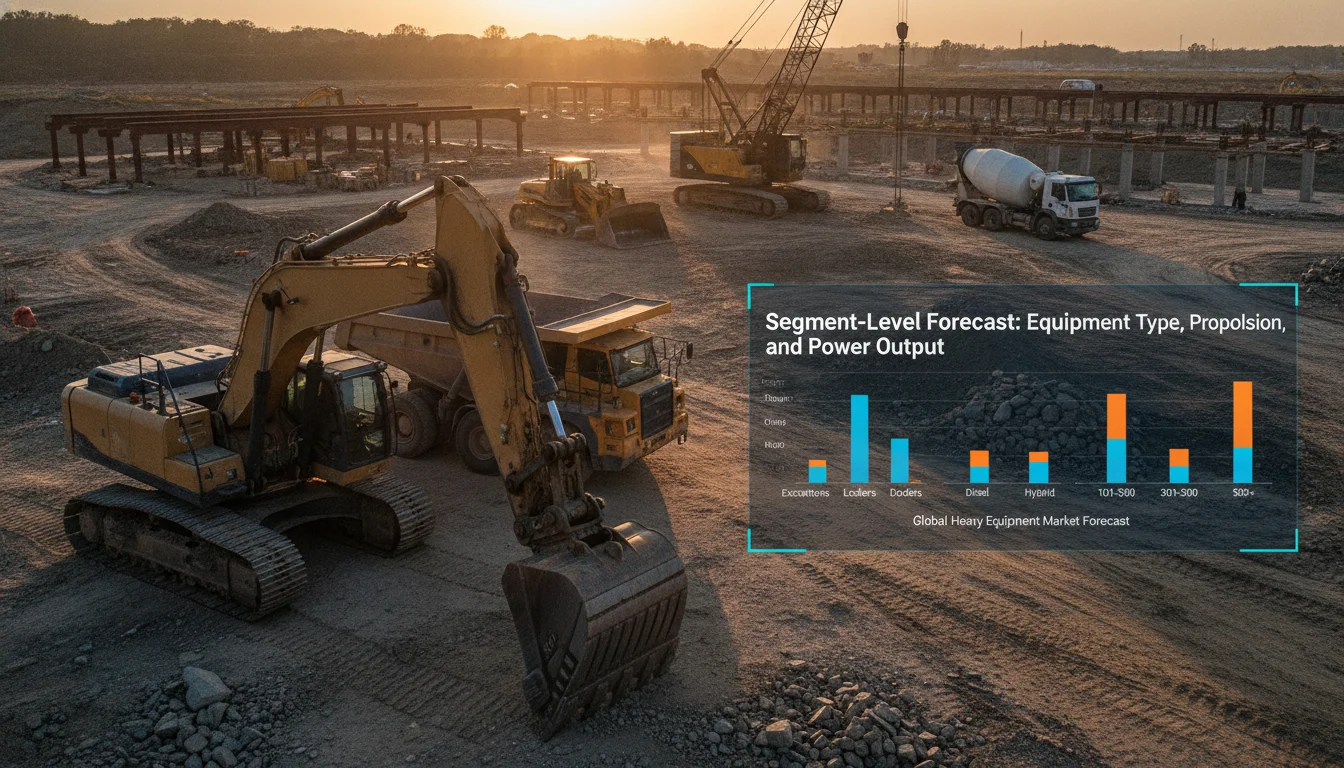
Earthmoving equipment is consistently the largest equipment category in both regional and global data. In North America, earthmoving equipment secured a 43.5% market share in 2025, according to Market Data Forecast. The Business Research Company projects earthmoving equipment will gain USD 40.56 billion by 2030, followed by material handling equipment at USD 19.82 billion and heavy construction vehicles at USD 9.68 billion. Those gains signal where fleet investment is concentrating right now.
Electric Loaders, LFP Batteries, and Clean Propulsion
Electrification is no longer a footnote in the forecast. By battery chemistry, the lithium iron phosphate segment is projected to achieve the highest CAGR at 17.8% during the forecast period, according to MarketsandMarkets. Lithium iron phosphate (LFP) is a lithium-ion battery chemistry known for thermal stability and longer cycle life, increasingly used in electric construction equipment. Electric loaders are expected to grow at the highest rate by equipment type, while CNG/LNG/RNG propulsion is projected to grow fastest among propulsion categories.
Power Output and Engine Capacity Trends
By power output, the 201-400 HP segment is projected to register the highest CAGR at 4.7%, according to MarketsandMarkets. By engine capacity, the under-5L segment is projected to grow at 4.4%. These mid-power and compact engine bands reflect a shift toward versatile machines for urban and infrastructure projects, where maneuverability, emissions compliance, and fuel efficiency matter more than raw horsepower.
Key Drivers Shaping the Global Heavy Equipment Market Forecast
Urbanization and Public Infrastructure Spending
Rapid urbanization in Asia and Africa is the single biggest driver behind current projections. Verified Market Research describes demand for sophisticated machinery as driven by the increasing necessity for robust infrastructure as cities expand. Government investment in public works, energy security, and transportation creates ongoing opportunities for manufacturers and suppliers alike. In North America, the Bipartisan Infrastructure Law and related federal programs support demand, with the construction industry representing 50.3% of regional end use.
Technology Adoption: Telematics, Automation, and Fleet Monitoring
Telematics is the integrated use of telecommunications and onboard monitoring systems to track machine location, engine hours, fuel use, and maintenance needs. OEMs are enhancing offerings with predictive maintenance and basic fleet monitoring, improving uptime and lifecycle efficiency. MarketsandMarkets identifies a broader shift toward connected, automated, and electrified construction equipment across the industry. These capabilities matter because they cut downtime and make rental fleets more predictable to operate.
Replacement Cycles and Rental Flexibility
Contractors increasingly use rentals for cost flexibility and rely on telematics to monitor uptime, safety, and maintenance. The capital intensity of new equipment pushes many buyers toward rental and leasing models instead of outright ownership. Replacement of aging fleets in developed markets also supports steady demand, even when new project starts fluctuate quarter to quarter.
Restraints and Risk Factors in the Global Heavy Equipment Market Forecast
Capital Intensity and Financing Hurdles
Restraint analysis is essential to stress-test any global heavy against real-world buying behavior. The high cost of capital is a major obstacle for the heavy construction equipment market, according to InsightAce Analytic. Some potential buyers are discouraged by the substantial capital necessary for acquisition and operation, according to Verified Market Research. That puts a ceiling on automation appetite and slows adoption of advanced machines among smaller contractors.
Environmental Regulations and Compliance Costs
Stringent environmental regulations result in costly upgrades and modifications, which can decrease profit margins and increase operational costs for manufacturers, according to Verified Market Research. Emissions rules push OEMs toward electrification and alternative fuels, but compliance adds engineering and testing expense along the way. Buyers in Europe and North America often face the heaviest compliance burden of any region.
Raw Material Volatility and Supply Chain Pressure
Volatile raw material prices expose equipment makers to fluctuations in steel, aluminum, and other critical materials. That complicates budgeting and financial planning for both manufacturers and buyers, according to Verified Market Research. Supply chain constraints and skilled labor shortages continue to limit growth, according to MarketsandMarkets. These constraints mean lead times and pricing volatility are baked into any realistic market forecast, not an afterthought.
Supply chain constraints and skilled labor shortages continue to limit the growth of the heavy construction equipment market, even as underlying demand for infrastructure and construction activity remains strong.
Technology Trends: Electrification, Autonomy, and Alternative Fuels
Electric Construction Equipment and Battery Chemistry
Electric models are becoming more common across passenger vehicles, public transport, and heavy machinery alike. The maturation and decreasing cost of advanced technology, combined with stricter emission regulations, have made electrification workable in construction equipment, according to InsightAce Analytic. The LFP battery segment is the fastest-growing battery chemistry, with a 17.8% CAGR projected by MarketsandMarkets. Electric loaders are expected to grow at the highest rate of any equipment type.
Autonomous and Connected Equipment
North America leads in autonomous heavy construction equipment, with a 42.3% revenue share in 2025. Autonomy in construction equipment includes remote-controlled dozers, self-driving haul trucks, and semi-autonomous excavators. Connectivity through telematics is the foundation underneath all of it: without real-time data, autonomy can't deliver production gains. MarketsandMarkets notes that predictive maintenance and basic fleet monitoring are already improving uptime and lifecycle efficiency across fleets.
CNG, LNG, RNG, and Hydrogen Pathways
Among propulsion types, CNG/LNG/RNG is projected to grow at the highest rate from 2026 to 2033. These fuels offer lower tailpipe emissions than diesel without the charging infrastructure constraints that come with battery-electric machines. Hydrogen fuel cells remain a longer-term pathway for high-power equipment, but they're not yet the dominant driver in any current global heavy equipment market forecast.
Competitive Landscape: OEMs and Regional Leaders
Global OEM Leaders
A competitive landscape section in any global heavy equipment market forecast highlights the companies most likely to shape pricing and technology direction. Major market players include Caterpillar (US), Komatsu Ltd. (Japan), Deere & Company (US), Hitachi Construction Machinery Co., Ltd. (Japan), Xuzhou Construction Machinery Group (China), SANY Group (China), and AB Volvo (Sweden), according to MarketsandMarkets. These firms have adopted partnerships and investments to serve growing demand. In North America, Caterpillar, Komatsu, AB Volvo, Hitachi Construction Machinery, and Deere are identified as key companies by Market Data Forecast.
Niche and Emerging Players
Liebherr (Switzerland), J C Bamford Excavators Ltd. (UK), and Kobelco Construction Machinery Co., Ltd. (Japan) have secured strong footholds in specialized niches, according to MarketsandMarkets. These companies often lead in compact equipment, lifting technology, and specialized excavators. HD Hyundai Construction Equipment North America is also active in the region through distributor and dealer networks. If you're sourcing parts for any of these brands, our brands directory lists compatibility across 40+ manufacturers.
Strategic Focus for 2026 and Beyond
OEMs are aligning around four priorities: electrification, autonomous operation, telematics-enabled service contracts, and regional manufacturing. Global brands and regional specialists alike are investing in electric compact models, alternative fuel options, and aftermarket service networks. As of 2026, the global heavy equipment market forecast rewards companies that balance product innovation with parts availability and financing solutions, not just headline horsepower or battery range.
Using a Global Heavy Equipment Market Forecast for Procurement and Planning
How Should Procurement Teams Read Market Projections?
Procurement teams should read market projections by starting with the range across firms, not a single headline number. A global heavy equipment market forecast from one firm can look bullish while another looks conservative, simply because equipment definitions and base years differ. For a fleet decision, compare forecasts by equipment type and region that match your actual operating footprint.
Step-by-Step Approach to Applying Forecast Data
- Step 1: Select comparable forecasts. Choose two or three forecasts that cover your geography and equipment class, such as North America or earthmoving equipment specifically.
- Step 2: Record the baseline figures. Note the base-year value, forecast-year value, and CAGR, and confirm whether mining machines are included.
- Step 3: Map the fastest-growing segments. Material handling equipment is projected to rise 7% yearly in North America; mining and excavation is projected to grow 8%.
- Step 4: Compare against your fleet. Weigh those segment growth rates against your current fleet age and utilization, then plan replacement for classes with high growth and high service demand.
- Step 5: Factor in technology transitions. Weigh LFP battery chemistry at a projected 17.8% CAGR and autonomous systems before committing to long-lived diesel assets.
When to Buy, Rent, or Upgrade
If capital cost is the main constraint, rental and leasing provide flexibility while OEMs expand electric and telematics-equipped fleets. If your work includes highway, bridge, or energy projects backed by public spending, long-term ownership of earthmoving equipment may still pencil out. The right decision depends on utilization, financing terms, and local emissions rules, not just the headline CAGR quoted in a global heavy equipment market forecast. For buyers keeping older machines running longer instead of replacing them outright, sourcing OEM-standard components for CAT, Komatsu, and Volvo fleets through our parts categories page is often the more cost-effective path.
Pros and Cons
Pros
- Multiple independent research firms agree on the same growth direction, giving buyers directional confidence even if the exact figures differ.
- Segment-level data (earthmoving, material handling, electrification) lets procurement teams plan by category instead of guessing from one aggregate number.
- Regional breakdowns, especially for North America and Asia Pacific, make it easier to align fleet decisions with local infrastructure spending.
- Technology trend data (LFP batteries, telematics, autonomy) gives fleet managers a head start on planning equipment transitions.
Cons
- Forecast values vary widely (from roughly USD 227 billion to USD 337 billion by the early 2030s) depending on scope, making a single