
Global Heavy Equipment Parts Market Size (2026 Data)
Global heavy equipment parts market size ranges from $22B to $190B by scope. See 2026 data, CAGR forecasts, and OEM comparisons from top research firms.
Loading article…
Article Not Found
The article you're looking for doesn't exist or may have been removed.
Back to BlogThe global heavy equipment parts market size is a figure that changes dramatically depending on scope and definition. As of 2026, estimates range from $22.1 billion for construction aftermarket parts alone to $190.04 billion when counting all heavy equipment components across industries.
Key Takeaways
- The market size is not one number. It depends on whether a report counts only aftermarket construction parts or all heavy machinery components across every industry.
- The construction equipment aftermarket alone is projected to grow from $28.53 billion in 2025 to $40.39 billion by 2030 at a 7.3% CAGR, according to The Business Research Company.
- Broader heavy equipment components and parts were valued at $190.04 billion in 2024 and are forecast to reach $278.64 billion by 2034, according to Zion Market Research.
- Construction and mining equipment spare parts are estimated at $174.04 billion in 2025, reaching $264.12 billion by 2030 at an 8.70% CAGR, per Mordor Intelligence.
- Asia-Pacific is the largest and fastest-growing region across nearly every report we reviewed.
- Leading OEMs include Caterpillar, Komatsu, Deere, Hitachi, XCMG, SANY, Volvo, Liebherr, JCB, and Kobelco.
Why the Global Heavy Equipment Parts Market Size Varies by Definition
What Counts as a "Part"?
A heavy equipment part is any component, attachment, or consumable used to maintain, repair, or upgrade heavy machinery. This includes engine parts, hydraulic systems, undercarriage components, electrical parts, wear parts, and filters. The definition matters because some reports include only spare parts sold after the original equipment sale, while others capture factory-installed components on new machines.
For example, The Business Research Company defines construction equipment aftermarket as parts, accessories, and services sold after the initial sale. In contrast, Zion Market Research covers both OEM and aftermarket components across excavators, bulldozers, loaders, crushers, dump trucks, and other equipment. This difference alone explains why one report shows $28.53 billion for 2025 and another shows $190.04 billion for 2024.
OEM vs. Aftermarket Segmentation
OEM parts are produced by the original equipment manufacturer and sold through authorized dealer networks, while aftermarket parts are produced by third-party suppliers and sold through independent channels. The aftermarket segment is often split further by sales channel, online versus offline, and by product type such as engine parts, hydraulic parts, and wear parts.
According to DataIntelo, engine parts held the largest share at 32.5% of the construction aftermarket parts market in 2025. This segmentation matters because a report focused only on aftermarket parts will always show a smaller this type of size than one that includes OEM components installed during assembly.
The Construction-Only Subset vs. All Heavy Equipment
The this kind of market size may refer narrowly to construction equipment spare parts, or broadly to all heavy equipment used in mining, agriculture, forestry, and infrastructure. For instance, Mordor Intelligence estimates construction and mining equipment spare parts at $174.04 billion in 2025, while WiseGuy Reports values construction equipment spare parts at only $26.2 billion in 2025.
That gap isn't a contradiction. It's the difference between including mining equipment and excluding it. Buyers and operators must always check whether a report's market definition covers construction only, construction and mining, or all heavy equipment before comparing figures.
The heavy equipment parts market isn't one market but several overlapping segments. A single dollar figure means little unless you know whether it represents construction-only aftermarket parts, all construction and mining spare parts, or the full universe of heavy equipment components including OEM parts.
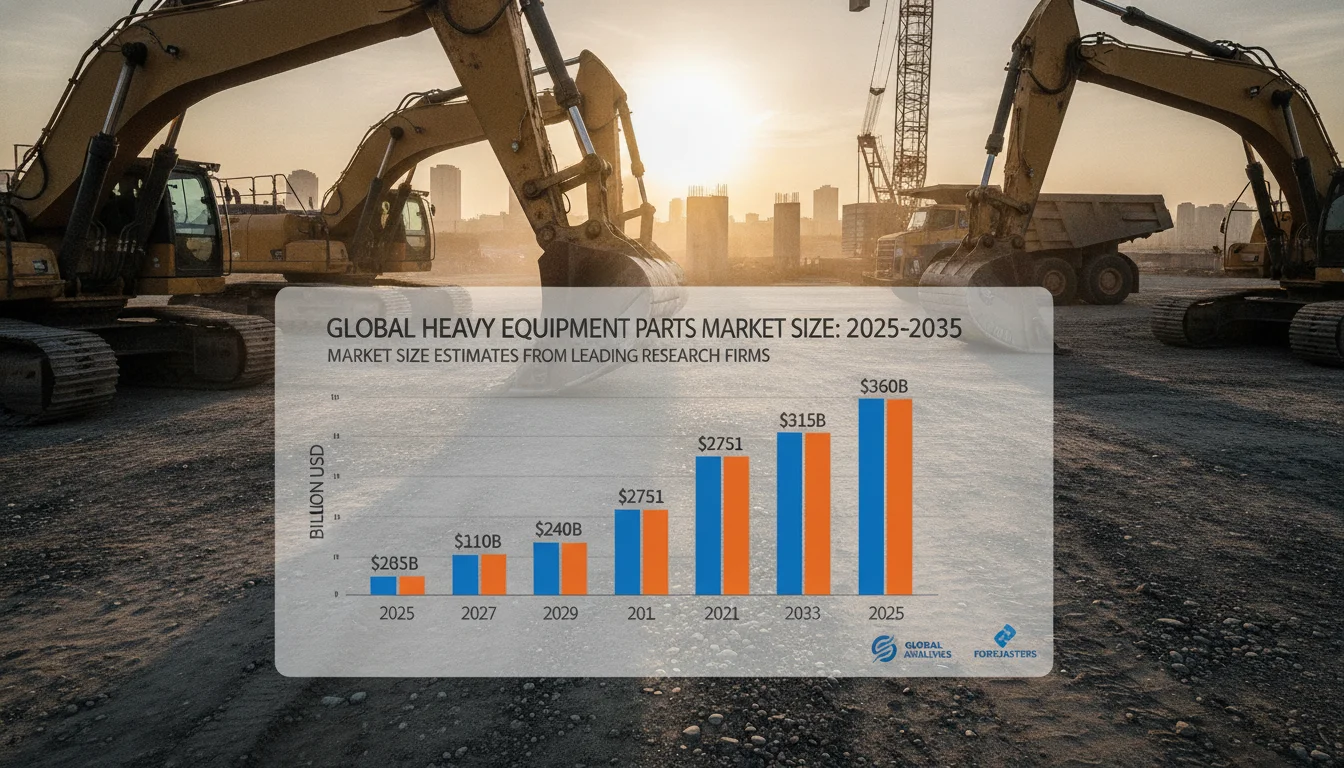
2025 to 2035 Market Size Estimates from Leading Research Firms
Construction Equipment Aftermarket: $28.53 Billion to $40.39 Billion
According to The Business Research Company's Construction Equipment Aftermarket Market Report 2026, this segment grew from $28.53 billion in 2025 to $30.44 billion in 2026 at a CAGR of 6.7%, and is expected to reach $40.39 billion by 2030 at a 7.3% CAGR. This narrow scope includes parts and services for earthmoving, road building, material handling, cranes, and concrete equipment sold after the initial sale.
The report identifies earthmoving and road building equipment as the largest opportunity, with an expected incremental gain of $6.37 billion by 2030. Asia-Pacific was the largest and fastest-growing region in this segment.
Broader Heavy Equipment Components and Parts: $190.04 Billion to $278.64 Billion
Zion Market Research's 2025 to 2034 forecast lands much higher because it covers all heavy equipment components: engine parts, hydraulic components, transmission parts, undercarriage parts, electrical components, and wear parts, across construction, mining, agriculture, and forestry. The report values this scope at $190.04 billion in 2024 and projects $278.64 billion by 2034 at a CAGR of roughly 4.90%.
In this broader scope, excavators lead by equipment type, engine parts are the largest component segment, and hydraulic components are projected to record sizable revenue. Asia-Pacific is expected to dominate, followed by North America.
Construction and Mining Equipment Spare Parts: $174.04 Billion to $264.12 Billion
Mordor Intelligence's Construction and Mining Equipment Spare Parts Market report puts the 2025 market size at $174.04 billion, reaching $264.12 billion by 2030 at a CAGR of 8.70%. This scope includes engine parts, hydraulic systems, transmission parts, and electrical parts for excavators, loaders, bulldozers, cranes, and dump trucks.
The report notes Asia-Pacific as both the largest and fastest-growing market, driven by urbanization, population growth, and expansive infrastructure projects. Telematics and IoT-enabled systems are increasing demand for specialized components.
Comparison of Published Heavy Equipment Parts Market Size Estimates
| Source | Scope | Base Year | Base Value (USD) | Forecast Year | Forecast Value (USD) | CAGR |
|---|---|---|---|---|---|---|
| The Business Research Company | Construction equipment aftermarket | 2025 | 28.53 billion | 2030 | 40.39 billion | 7.3% |
| Mordor Intelligence | Construction and mining equipment spare parts | 2025 | 174.04 billion | 2030 | 264.12 billion | 8.70% |
| Zion Market Research | Heavy equipment components and parts (all industries) | 2024 | 190.04 billion | 2034 | 278.64 billion | 4.90% |
| WiseGuy Reports | Construction equipment spare parts | 2025 | 26.2 billion | 2035 | 35 billion | 2.9% |
| Spherical Insights | Heavy equipment spare parts | 2025 | 95.2 billion | 2035 | 185.65 billion | 6.91% |
| DataIntelo | Aftermarket parts in construction | 2025 | 22.1 billion | 2034 | 38.1 billion | 6.2% |
The Whole Equipment Picture: New Machine Sales vs. Parts Demand
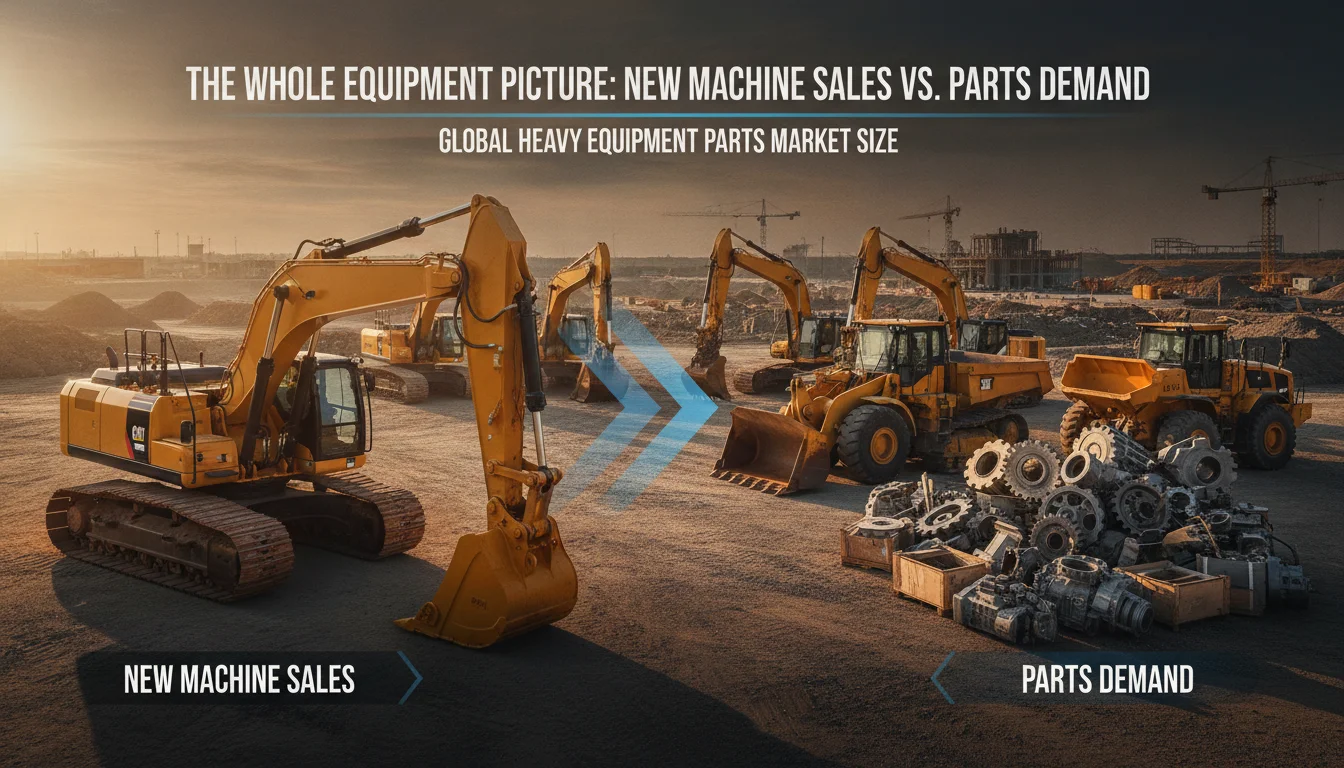
New equipment sales and parts demand are two distinct but connected markets, and reports covering the whole heavy construction equipment category (including new machine sales) post far larger figures than parts-only reports. According to MarketsandMarkets, the global heavy construction equipment market is projected to grow from $160.11 billion in 2026 to $226.91 billion by 2033 at a 5.1% CAGR, and that figure captures full machine sales, not just replacement parts.
That distinction matters for procurement teams building budgets. A parts buyer should never cite the total equipment market size when estimating spare parts spend. The same MarketsandMarkets report notes the Asia-Pacific heavy construction equipment market held the largest regional share, in the 40-45% range in 2025, reinforcing the regional pattern seen across the parts-specific reports above.
Key Market Drivers Shaping Heavy Equipment Parts Demand
Infrastructure and Urbanization Pressure
Infrastructure spending and urban development are the primary drivers behind rising demand for heavy machinery and replacement parts worldwide. Government-backed projects in China, India, Southeast Asia, and parts of Africa are creating sustained demand for both new equipment and the parts that keep it running.
The Business Research Company attributes historic growth to increasing adoption of heavy construction equipment and expansion of infrastructure and road construction activity. Mordor Intelligence similarly ties market expansion to global infrastructure development and large-scale projects. These drivers are structural: as roads, bridges, ports, and housing projects multiply, the installed base of excavators, loaders, and cranes grows, and each machine requires a lifetime stream of parts.
Aging Fleets and Routine Maintenance
Aging equipment fleets drive recurring parts demand because older machines require frequent maintenance to meet operational standards. DataIntelo identifies equipment aging and maintenance demand as a key driver, noting engine parts held a 32.5% share of aftermarket construction parts in 2025.
Zion Market Research highlights that heavy equipment experiences high wear and tear, making durable replacement parts vital for efficiency. An aging fleet isn't a one-time event. It creates recurring demand for filters, seals, undercarriage components, and hydraulic rebuild kits, which stabilizes the global heavy equipment parts market size across economic cycles.
Telematics, IoT, and Predictive Maintenance
Predictive maintenance uses real-time machine data to anticipate component failure before it causes downtime. The Business Research Company lists the shift toward predictive maintenance and digital aftermarket platforms as a forecast-period driver. MarketsandMarkets reports that OEMs are enhancing offerings with predictive maintenance and fleet monitoring to improve uptime and lifecycle efficiency.
These technologies affect the parts market in two ways. They reduce unplanned failures, but they also increase demand for higher-precision sensors, control modules, and data-connected components. The result is a shift toward higher-value parts in the mix, which supports stronger average selling prices.
According to Mordor Intelligence, the increasing adoption of advanced technologies in heavy machinery, such as telematics, automation, and IoT-enabled systems, has further driven demand for specialized components, enhancing the market's growth prospects.
Heavy Equipment Parts Market Segmentation: Equipment, Component, and Application
By Equipment Type: Excavators, Loaders, Dozers, Dump Trucks
Excavators lead nearly every segmentation breakdown because they operate in the harshest, most abrasive conditions of any machine category. Zion Market Research states that the excavators segment is expected to lead the heavy equipment components and parts market, while loaders are expected to grow considerably.
WiseGuy Reports segments construction equipment spare parts by excavators, bulldozers, crushers, loaders, and forklifts. The Business Research Company breaks the aftermarket into earthmoving and road building equipment, material handling and cranes, and concrete equipment. Across all reports, earthmoving machines, meaning excavators, dozers, and loaders, consistently represent the largest parts opportunity.
By Component Type: Engine Parts, Hydraulics, Undercarriage, Electrical
Engine parts dominate component-level revenue in nearly every report we reviewed. DataIntelo reports engine parts as the largest product segment at 32.5% of the construction aftermarket parts market in 2025. Zion Market Research adds that engine parts are the largest component segment in the broader heavy equipment market, while hydraulic components are projected to record sizeable revenue over the forecast period.
HTF Market Insights includes track and undercarriage parts as a major category, which matters especially for tracked machines in mining and construction. Electrical components are growing as equipment becomes more electrified and sensor-equipped.
By Application: Construction, Mining, Agriculture, Forestry
Construction remains the leading application for heavy equipment parts, followed by mining, according to Zion Market Research. Mordor Intelligence covers construction and mining together, finding that mining expansion in the energy and minerals sectors requires more heavy equipment and, consequently, more durable replacement parts.
Agriculture and forestry are smaller but non-negligible applications, particularly for tractors, harvesters, and specialized machines. HTF Market Insights segments applications into construction, mining, agriculture, forestry, and material handling, reinforcing that a true global heavy equipment parts market size estimate must consider multiple end-use industries, not construction alone.
Regional Dynamics: Asia-Pacific Leads, North America and Europe Follow
Which Region Leads the Heavy Equipment Parts Market?
Asia-Pacific leads the global heavy equipment parts market size across nearly every research firm we reviewed, both in absolute value and growth rate. The Business Research Company states that Asia-Pacific was the largest and fastest-growing region for construction equipment aftermarket.
Mordor Intelligence names Asia-Pacific as both largest and fastest-growing for construction and mining equipment spare parts, citing rapid urbanization, population growth, and expansive infrastructure projects. Zion Market Research projects that Asia-Pacific will dominate the global heavy equipment components and parts market, followed by North America. China and India are the primary engines, with government infrastructure programs and expanding mining output fueling parts demand.
North America's Technology and Aftermarket Maturity
North America stands out as a mature market with a strong installed base and high adoption of telematics and predictive maintenance. MarketsandMarkets reports that North America accounted for a 42.3% revenue share of the autonomous heavy construction equipment market in 2025, signaling the region's early adoption of advanced machinery.
This translates into demand for specialized electronic parts, sensors, and software-connected components. The United States and Canada also have significant rental fleet operators, who prioritize genuine OEM parts and rapid turnaround to minimize downtime.
Europe's Sustainability and Electrification Push
Europe's heavy equipment parts market is increasingly shaped by tightening emissions regulations and electrification. MarketsandMarkets notes that electrification and hybrid machines are gaining momentum due to tighter environmental standards. This shift is creating a growing aftermarket for battery systems, electric motors, power electronics, and lithium iron phosphate battery components.
The same report states that the lithium iron phosphate segment is projected to achieve the highest CAGR of 17.8% during the forecast period, though that figure applies to the broader heavy construction equipment market, not parts alone. For parts specifically, European operators are replacing older diesel engine components with hybrid-compatible parts, a transition likely to define the next decade of demand.
Competitive Landscape and Top Heavy Equipment Manufacturers
OEM Giants: Caterpillar, Komatsu, Deere, Hitachi, XCMG, SANY, Volvo
MarketsandMarkets lists major players in the heavy construction equipment market as Caterpillar (US), Komatsu Ltd. (Japan), Deere & Company (US), Hitachi Construction Machinery Co., Ltd. (Japan), Xuzhou Construction Machinery Group (China), SANY Group (China), and AB Volvo (Sweden). These OEMs aren't just equipment sellers. They're also the largest suppliers of genuine OEM parts through dealer networks.
Their parts divisions benefit from locked-in customer bases, proprietary engineering data, and service contracts. Brand loyalty and warranty compliance keep OEM parts at a premium, even as independent suppliers compete on price. We work directly with buyers sourcing compatible parts across all of these brands, and we've seen firsthand how OEM lead times can stretch procurement timelines when local stock runs out.
Niche and Emerging Players: Liebherr, JCB, Kobelco
MarketsandMarkets identifies Liebherr (Switzerland), J C Bamford Excavators Ltd. (UK), and Kobelco Construction Machinery Co., Ltd. (Japan) as distinguished players in specialized niche areas. These companies secure strong footholds in targeted equipment types, such as JCB in backhoe loaders and Liebherr in cranes and mining excavators, which creates dedicated aftermarket part demand.
Their niche focus allows them to maintain high parts margins and deep technical support. For parts buyers, this means access to specialized components that are often harder to cross-reference with generic alternatives.
Aftermarket Parts Suppliers and Distribution Channels
Beyond OEMs, a large ecosystem of independent aftermarket suppliers, distributors, and e-commerce platforms serves the global heavy equipment parts market. The Business Research Company segments sales channels into online and offline, noting the forecast period will see expansion of online aftermarket procurement.
DataIntelo includes distribution channels of online and offline, with offline still dominant but digital platforms growing. Independent suppliers often reverse-engineer parts for popular models, offering lower-cost alternatives. The rise of online marketplaces and OEM digital storefronts is reducing friction, but it also creates challenges in verifying part authenticity and compatibility, which is exactly why buyers should work with suppliers who guarantee OEM-standard specifications on every order.
Pros and Cons of Sourcing from a Fragmented Global Market
Pros
- Multiple supply channels mean buyers rarely face a single point of failure; if an OEM dealer is out of stock, verified aftermarket suppliers can often fill the gap faster.
- Competition between OEM and aftermarket suppliers keeps pricing more competitive than a single-source model would allow.
- Growing digital procurement platforms make it easier to compare specs, lead times, and pricing across global suppliers.
- A large, diversified supplier base supports faster global shipping options, since more regional stocking points exist.
Cons
- Fragmented data makes it hard to get a single, reliable global heavy equipment parts market size figure for forecasting or budgeting.
- Verifying part authenticity and compatibility takes more diligence when sourcing outside authorized OEM dealer networks.
- Supply chain disruptions and volatile raw material prices, particularly for steel and aluminum, can create inconsistent lead times across suppliers.
- Buyers unfamiliar with cross-referencing part numbers risk ordering incompatible components, especially for older or regionally specific machine models.
How to Evaluate Heavy Equipment Parts Market Size Reports
Step 1: Identify the Report's Scope and Segmentation
Start by checking whether a report covers aftermarket only or includes OEM parts, and whether it includes construction only, mining, agriculture, or all heavy equipment. A narrow construction aftermarket report such as The Business Research Company's $28.53 billion 2025 figure cannot be compared directly to Zion's $190.04 billion for all heavy equipment components. Always read the market definition and list of included equipment and component types.
Step 2: Cross-Check Base Year and Forecast Methodology
Different reports use different base years, 2024, 2025, or 2026, and forecast periods ranging from 2030 to 2035. The CAGR calculation is sensitive to the starting point and inclusion of historical data. For example, DataIntelo's 6.2% CAGR runs from 2025 to 2034, while Spherical Insights' 6.91% CAGR runs from 2026 to 2035. Check the report's methodology for primary interviews, secondary databases, and triangulation before treating any single figure as definitive.
Step 3: Compare CAGR Against Market Driver Evidence
A credible report ties its CAGR to identifiable drivers such as infrastructure spending, fleet age, mining output, and technology adoption. If a report claims a modest CAGR but the supporting evidence shows flat construction activity and declining mining investment, question the forecast. Conversely, a high CAGR like Mordor's 8.70% for construction and mining spare parts is backed by Asia-Pacific urbanization and the shift to telematics.
Use the comparison table above to see how different scopes produce different CAGRs. This variation is normal industry data behavior, and it should guide your procurement and investment decisions rather than confuse them.
This year's data confirms what most procurement teams already sense on the ground: the global heavy equipment parts market size can't be reduced to one number. Depending on scope, 2025 estimates range from $22.1 billion for construction aftermarket parts to $190.04 billion for all heavy equipment components and parts. What matters more than the headline figure is the trend, and every credible report we reviewed points to sustained growth driven by infrastructure, aging fleets, and technology adoption. Buyers, suppliers, and investors should choose the market definition that matches their operational needs and rely on multiple sources rather than any single figure.
Whatever segment of the global heavy equipment parts market size you're navigating as a buyer, the practical challenge is the same: sourcing OEM-standard components fast enough to avoid costly downtime. That's the gap we built 3GEN Export to close. Shop OEM-quality spare parts with global 5-day delivery at 3genexport.com.
Frequently Asked Questions
What is the global heavy equipment parts market size?
The global heavy equipment parts market size ranges from $22.1 billion for construction aftermarket parts in 2025 to $190.04 billion for all heavy equipment components in 2024, depending on scope. The wide range reflects differences in whether reports include OEM parts, mining equipment, or non-construction industries.
Who are the top 10 heavy equipment manufacturers in the world?
Major OEMs include Caterpillar, Komatsu, Deere & Company, Hitachi, XCMG, SANY, AB Volvo, Liebherr, JCB, and Kobelco. These companies dominate equipment sales, and their dealer networks supply the largest share of genuine OEM parts globally.
Who is bigger, Caterpillar or John Deere?
Caterpillar is widely recognized as the larger heavy equipment manufacturer overall, while John Deere holds a major position with a strong agricultural machinery focus. In construction equipment revenue, Caterpillar typically leads, but Deere excels in agricultural equipment segments.
Is JCB bigger than Caterpillar?
No, Caterpillar is generally larger than JCB by total revenue and global market share. JCB remains a significant player, especially in backhoe loaders and telehandlers, but it doesn't match Caterpillar's overall heavy equipment scale.
Which region leads the heavy equipment parts market?
Asia-Pacific is the largest and fastest-growing region, driven by rapid urbanization and infrastructure projects in China and India. North America and Europe follow as mature, technology-focused markets with strong telematics and electrification adoption.
What factors drive heavy equipment parts demand?
Key drivers include infrastructure and urbanization, aging equipment fleets requiring frequent maintenance, mining expansion, and the shift toward telematics, IoT, and predictive maintenance. These factors increase both replacement part volume and the value of specialized, higher-precision components.