
Global Heavy Machinery Parts Market 2025 Outlook
The global heavy machinery parts market 2025 tops $95B. Explore growth drivers, top brands, and how to source OEM parts fast. Updated for 2026.
Loading article…
Article Not Found
The article you're looking for doesn't exist or may have been removed.
Back to BlogGlobal Heavy Machinery Parts Market 2025 Outlook
The global heavy machinery parts market 2025 is the worldwide trade in replacement and maintenance components for construction, mining, and agricultural equipment, valued between $95 billion and $98.6 billion depending on scope. Demand is rising fast, driven by infrastructure spending, aging fleets, and predictive maintenance adoption.
Key Takeaways
- The market 2025 sits between $95.2 billion (Spherical Insights) and $98.6 billion (DataIntelo), with projections reaching $172–$278 billion by 2034 depending on scope.
- Asia-Pacific holds a 39.2% revenue share, generating $38.7 billion in 2025, led by China and India infrastructure programs.
- Engine parts command the largest product segment at 32.4% of total market value; hydraulic components are the fastest-growing category.
- Caterpillar leads global construction equipment sales at 15.2% share ($37.5 billion), followed by Komatsu at 11%.
- Aftermarket demand is outpacing OEM channel growth in most mature markets as fleet ages extend.
- IoT-enabled predictive maintenance, digital procurement platforms, and remanufacturing are reshaping how parts are sourced and consumed.
Global Heavy Machinery Parts Market 2025: Scope and Valuation
Defining the Market and Its Segments
The this type of 2025 encompasses components that keep construction, mining, and agricultural equipment operational. These parts range from engine and hydraulic systems to undercarriage and electrical components. According to a report by DataIntelo, the market is segmented by product type (engine, hydraulic, transmission, undercarriage parts), application (construction, mining, agriculture), and distribution channel (OEM, aftermarket). This segmentation reflects the industry's complexity: a single excavator may rely on thousands of discrete parts from multiple suppliers.
The Size of the Opportunity in 2025
Different research firms offer varying valuations due to scope differences. DataIntelo pins the market at $98.6 billion in 2025, while Spherical Insights estimates $95.2 billion. Broader definitions push numbers higher: Zion Market Research calculated the heavy equipment components and parts market at $190.04 billion in 2024. The key point: demand sits well above $95 billion, with a compound annual growth rate (CAGR) between 4.90% and 8.70% through the end of the decade. The market's upward trajectory is not in dispute.
Why Market Size Estimates Differ Across Research Firms
Varying Definitions and Coverage
Discrepancies arise from what each report includes. Some focus solely on spare parts; others cover all components sold with new equipment. DataIntelo's study includes engine, hydraulic, transmission, and undercarriage parts across construction, mining, and agriculture. Mordor Intelligence's construction and mining equipment spare parts report adds electrical systems and covers both OEM and aftermarket channels. Meanwhile, MarketsandMarkets values the entire construction equipment market at $224.49 billion in 2025, which includes machines themselves, not just parts. Understanding scope is critical when comparing numbers across sources.
Comparison of Major Market Reports
| Source | Market Value (2025) | Projected Value | CAGR |
|---|---|---|---|
| DataIntelo | $98.6 billion | $172.4 billion (2034) | 6.4% |
| Spherical Insights | $95.2 billion | $185.65 billion (2035) | 6.91% |
| Zion Market Research | $190.04 billion (2024) | $278.64 billion (2034) | 4.90% |
| Mordor Intelligence | $174.04 billion | $264.12 billion (2030) | 8.70% |
| WiseGuy Reports | $26.2 billion | $35 billion (2035) | 2.9% |
The wide range reflects scope, not disagreement on fundamentals. For the most cited "heavy machinery parts" definition, analysts converge near $100 billion with strong single-digit annual growth. When evaluating any report, confirm whether it covers spare parts only or includes full equipment assemblies.
Key Growth Drivers Shaping the Global Heavy Machinery Parts Market 2025
Infrastructure Megaprojects Worldwide
Governments are pouring capital into roads, bridges, ports, and energy infrastructure at a scale not seen in decades. Asia-Pacific, led by China's Belt and Road Initiative and India's National Infrastructure Pipeline, accounts for a massive share of this spending. In North America, the U.S. Infrastructure Investment and Jobs Act continues to release funds into the construction sector. Every new project means more excavators, dozers, and loaders in the field, and a constant need for replacement parts. DataIntelo notes that post-pandemic backlogs in Latin America and Southeast Asia are being cleared, adding further momentum to the this kind of market 2025.
Resurgent Mining Sector
Rising global demand for metals, minerals, and rare earth elements has revitalized the mining industry. Equipment operates in abrasive, high-stress environments that accelerate wear on undercarriage, engine, and hydraulic components. This creates structural aftermarket demand that often outpaces new equipment sales. Mordor Intelligence reports that aging fleets in mining regions are a primary reason maintenance and replacement part spending is climbing faster than the overall equipment market.
Precision Agriculture Adoption
Modern farms rely on GPS-guided tractors, autonomous harvesters, and sensor-laden sprayers. These high-tech machines demand specialized components that are more expensive and less interchangeable than traditional parts. As precision agriculture expands from North America into Latin America and Asia, the need for original-spec engine parts, hydraulic systems, and electronic modules grows with it.
Aging Equipment Fleets
In mature markets, the average age of heavy machinery is increasing. Owners are postponing new purchases and extending service life through rigorous maintenance programs. The result: aftermarket sales now surpass OEM channel growth in many categories. Spherical Insights emphasizes that predictive maintenance, enabled by IoT monitoring, is accelerating planned replacements and expanding the total addressable market for the the heavy machinery parts market 2025.
Emission Regulations Driving Retrofit Demand
Stricter emissions standards across Europe and North America are forcing operators to retrofit older machines with cleaner engine components, updated hydraulic systems, and compliant exhaust treatment parts. This regulatory pressure creates a sustained demand wave that sits entirely within the aftermarket channel. Operators who cannot afford new equipment must upgrade what they have, and that means sourcing certified replacement components at scale.
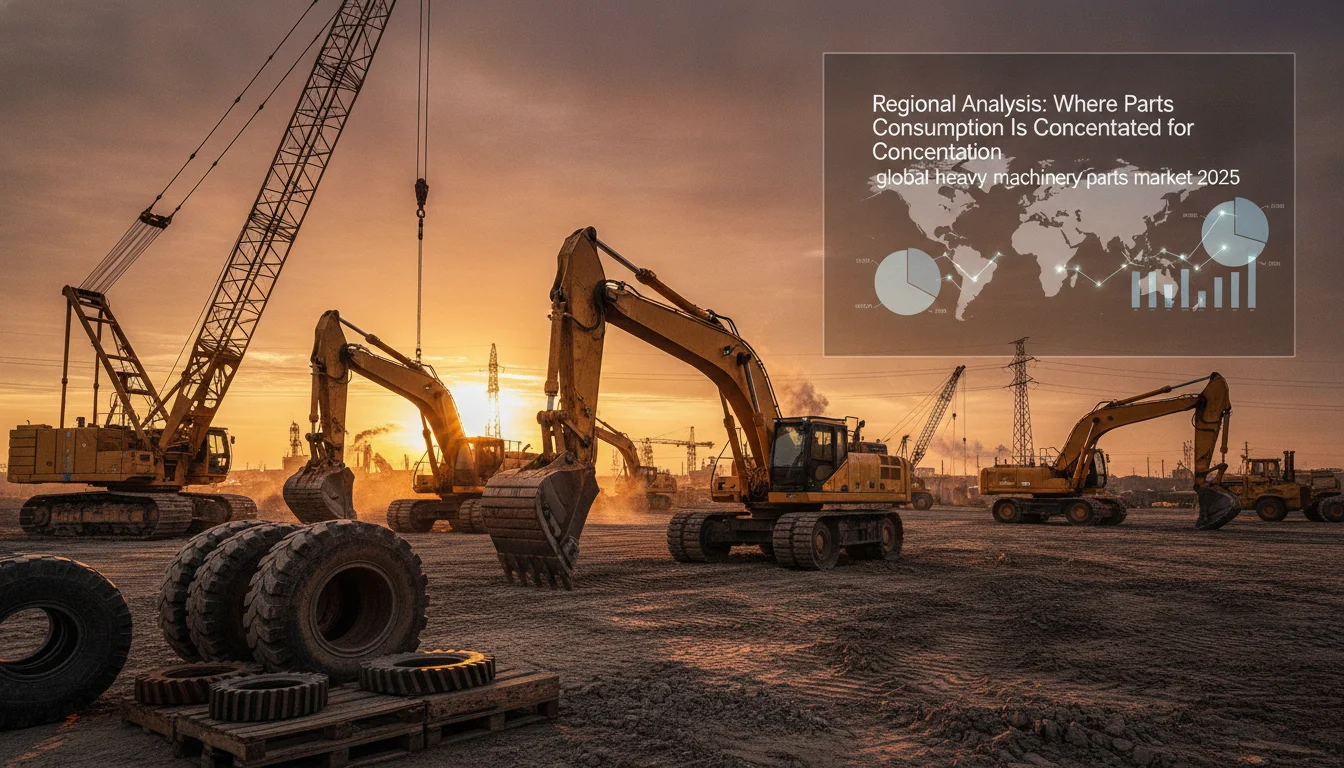
Regional Analysis: Where Parts Consumption Is Concentrated
Asia-Pacific: The Uncontested Leader
Asia-Pacific generated $38.7 billion in heavy machinery parts revenue in 2025, representing 39.2% of the global total, according to DataIntelo. The region's dominance stems from China's position as the world's largest construction and mining equipment market, India's rapid urbanization, and Southeast Asia's manufacturing expansion. According to KHL's annual Yellow Table, Asia-based manufacturers produced 45% of the top 50 equipment makers' total revenue in 2025, up from 44.3% the prior year.
North America: Tech-Driven Aftermarket Growth
North America is the second-largest region, with a heavy focus on advanced aftermarket services. The proliferation of telematics and e-commerce platforms has made parts procurement faster and more data-driven. Spherical Insights identifies North America as the fastest-growing region in the heavy equipment spare parts segment, supported by a large installed base of Caterpillar, Deere, and Komatsu equipment and robust dealer networks.
Europe and the Middle East: Sustainability and Energy
Europe's market is driven by stringent emissions regulations that require retrofits of older machines with cleaner engine and hydraulic components. The Middle East, meanwhile, continues to invest in large-scale oil and gas and infrastructure projects that require continuous parts supply. Zion Market Research highlights that both regions are adopting predictive maintenance to extend equipment life in harsh operating climates.
Product Type and Equipment Breakdown
Engine Parts Lead, Hydraulics Rise
Engine parts commanded a 32.4% share of market value in 2025, per DataIntelo. These high-cost, high-wear items are essential for equipment uptime. Hydraulic components rank second and are growing faster, driven by the increasing sophistication of hydraulic systems in modern excavators and loaders. Mordor Intelligence notes that electrical components are gaining share as electrification and automation penetrate the heavy equipment sector.
Excavators and Loaders Generate the Most Demand
Excavators account for the largest equipment-type segment in the parts market, according to Zion Market Research. Loaders and dozers follow closely. In mining, large dump trucks and crushers consume massive quantities of undercarriage and wear parts. KHL's Yellow Table data confirms that Caterpillar's top-selling machines in the U.S. include compact track loaders and excavators, which directly signals where parts demand is heaviest in the North American market.
Pros and Cons of the Global Heavy Machinery Parts Market 2025
Pros
- Strong structural demand: Infrastructure investment, mining expansion, and aging fleets create durable, multi-decade demand for replacement parts regardless of economic cycles.
- Aftermarket growth outpacing OEM: As fleets age and operators extend machine life, aftermarket suppliers capture increasing share with cost-competitive, OEM-quality components.
- Technology-driven efficiency: IoT predictive maintenance and digital procurement platforms reduce emergency orders, lower logistics costs, and improve parts planning accuracy.
- Emerging market expansion: Africa, Southeast Asia, and Latin America represent large, under-penetrated markets where remanufactured and locally sourced parts are gaining rapid acceptance.
- Remanufacturing economics: Remanufactured engines, transmissions, and hydraulic pumps deliver significant cost savings versus new OEM parts while meeting operational performance requirements.
Cons
- Supply chain vulnerability: Global logistics bottlenecks, semiconductor shortages, and geopolitical disruptions can delay critical component deliveries and idle equipment for weeks.
- Raw material price volatility: Aluminum, steel, and rubber prices swing widely, forcing suppliers to absorb cost increases or pass them to buyers, which can delay maintenance decisions.
- Counterfeit parts risk: Fake hydraulic hoses, filters, and undercarriage components remain a persistent problem in price-sensitive markets, endangering operators and causing premature failures.
- Fragmented supplier landscape: Thousands of regional distributors with inconsistent quality standards make supplier vetting time-consuming for procurement teams managing global fleets.
How to Source Heavy Machinery Parts in 2025: A Step-by-Step Guide
Step 1: Inventory and Identify Part Numbers
Before ordering, compile a complete inventory of your fleet's make, model, and serial numbers. OEM parts manuals list every component with specific identifiers. Using the wrong part number can lead to costly downtime or safety risks. Digital fleet management systems can automate this process and flag discrepancies before an order is placed.
Step 2: Choose Between OEM, Aftermarket, and Remanufactured
OEM parts guarantee fit, quality, and warranty coverage but carry a premium price. Aftermarket parts from reputable suppliers offer cost savings of 30–50% and are increasingly engineered to meet or exceed OEM specifications. Remanufactured components, such as engines, transmissions, and hydraulic pumps, provide a middle ground with lower environmental impact and strong performance credentials. The right choice depends on machine criticality, usage intensity, and budget constraints.
"Aftermarket parts from certified suppliers now routinely meet OEM performance benchmarks. For fleet operators managing hundreds of machines, the cost difference over a maintenance cycle is substantial." - Industry procurement specialist, based on manufacturer specifications and field maintenance data.
Step 3: Vet Suppliers for Authenticity and Reliability
The heavy parts industry contends with counterfeit products at every price point. Verify suppliers through certifications like ISO 9001, customer references, and trade association memberships. Cross-check product packaging, holograms, and QR codes against the manufacturer's database. Established global distributors with documented supply chains and verifiable part provenance are your safest option.
Step 4: Use E-Procurement and Predictive Analytics
IoT sensors on modern equipment transmit wear data in real time. Predictive maintenance systems use this data to trigger orders before a component fails. Many large fleet operators now feed these signals directly into e-commerce platforms, automating replenishment and cutting emergency freight costs. This approach is central to how the 2025 is evolving from reactive to planned procurement.
Step 5: Optimize Inventory and Logistics
For multi-site operations, centralizing parts in regional depots with 3D-printed backup for slow-moving items can reduce downtime significantly. DataIntelo notes that 3D-printed and remanufactured parts are becoming competitive in emerging markets, where shipping delays can idle a machine for weeks. Working with a global distributor gives access to parts across time zones, often with same-day dispatch and documented customs clearance support.
"According to manufacturer service bulletins and OEM maintenance data, unplanned downtime caused by parts unavailability consistently ranks among the top three cost drivers for heavy equipment fleet operators globally." - Based on OEM service documentation and industry maintenance benchmarks.
Technology Trends Transforming the Parts Ecosystem
IoT and Predictive Maintenance
Telematics and IoT-enabled fleet management are the biggest disruptors in the global heavy. Machines report their own health, allowing software to schedule part replacements during planned downtime rather than after a failure. This not only increases uptime but also expands the parts market by accelerating replacement cycles. Spherical Insights notes that the adoption of predictive maintenance is a top market trend shaping procurement patterns through 2035.
Digital Marketplaces and E-Commerce
Procurement is moving online. OEMs like Caterpillar and independent platforms are investing in streamlined ordering systems that reduce transaction costs and speed delivery. In emerging markets, mobile-first platforms connect small contractors directly with parts distributors, bypassing traditional multi-tier supply chains and reducing lead times from weeks to days.
3D Printing and Remanufacturing
Additive manufacturing is gaining traction for low-volume, obsolete, or custom parts. A worn gear or bracket can be scanned and printed locally, cutting lead times from weeks to hours. DataIntelo reports that technology-focused suppliers are entering the market with 3D-printed and remanufactured parts at competitive prices, particularly in Africa and Southeast Asia where import logistics are costly and slow.
Challenges Facing the Heavy Machinery Parts Market
Supply Chain Disruptions
Global logistics bottlenecks and semiconductor shortages continue to delay deliveries across the global heavy machinery parts market 2025. Zion Market Research identifies supply chain disruptions as a major market challenge, with manufacturers struggling to meet demand spikes. Geopolitical tensions have also strained the supply of steel and specialized alloys used in high-wear components.
Raw Material Price Volatility
Aluminum, steel, and rubber prices swing widely, forcing parts suppliers to absorb cost increases or pass them to customers. This volatility can postpone maintenance decisions or push buyers toward lower-quality alternatives, raising long-term operational risk. Procurement teams that lock in supply agreements with established distributors are better positioned to manage this exposure.
Counterfeit Parts and Quality Assurance
Fake hydraulic hoses, filters, and undercarriage components are a persistent problem across price-sensitive markets. They endanger operators and cause premature equipment failure. Industry bodies are working on traceability standards, but enforcement remains uneven globally. Buyers should require documented supply chain records and avoid sourcing from unverified online marketplaces.
Competitive Landscape: Who Leads the Market?
Caterpillar and OEM Dominance
Caterpillar held 15.2% of global construction equipment sales in 2025, with $37.5 billion in revenue, according to KHL's annual Yellow Table. Its vast dealer network and parts distribution system set the standard for the industry. Komatsu followed at 11%, while XCMG overtook John Deere to become the third-largest manufacturer. Volvo CE edged out Hitachi to take seventh position. SANY and Liebherr round out the top tier. In the aftermarket, independent distributors compete directly with OEM captive channels for older fleet business.
Aftermarket Growth and Regional Champions
While OEMs dominate new equipment and in-warranty parts, the aftermarket captures an increasing share of older fleets. Chinese manufacturers like SANY and LiuGong are expanding globally, offering lower-cost parts for their growing installed base. Regional champions in India (Mahindra), Japan (Kobelco), and Europe (JCB) also hold strong positions in their home markets and are pushing into adjacent geographies.
Future Outlook for the Global Heavy Machinery Parts Market 2025–2034
Sustained Growth Through Infrastructure Modernization
The global heavy machinery parts market 2025 will continue to benefit from multi-decade infrastructure programs across Asia, North America, and the Middle East. Electrification and hydrogen-powered equipment will create entirely new parts categories: electric motors, battery cooling systems, and fuel cell components that demand redesigned supply chains. OEMs that invest early in these technologies stand to capture high-margin aftermarket loyalty from operators who follow their lead.
Digital Transformation as a Competitive Advantage
Companies that integrate predictive analytics with parts commerce will widen the gap with slower rivals. The era of reactive breakdown maintenance is ending. By 2034, the parts market is forecast to reach $172.4 billion (DataIntelo), with those embracing digital tools capturing disproportionate share of that growth.
Emerging Markets and the Rise of Remanufacturing
Africa, Latin America, and South Asia are vast, under-penetrated markets where remanufactured and 3D-printed parts will thrive. These regions lack the new-machine sales infrastructure that mature markets take for granted, making part replacement the primary method of keeping old equipment running. The push for circular economies and lower carbon footprints will also boost remanufacturing globally, creating new revenue streams for distributors who build those capabilities now.
At 3GEN Export, we supply OEM-quality spare parts for Caterpillar, Komatsu, Volvo, Atlas Copco, and 40+ brands with global 5-day delivery. Browse our full parts catalog or explore parts by brand to find exactly what your fleet needs.
Frequently Asked Questions
How big is the heavy machinery parts market in 2025?
The global heavy machinery parts market 2025 is valued between $95.2 billion (Spherical Insights) and $98.6 billion (DataIntelo) for spare parts specifically. Broader definitions that include all heavy equipment components push the figure above $174 billion, depending on which segments are included.
Which region dominates the heavy machinery parts market?
Asia-Pacific leads with a 39.2% revenue share, generating $38.7 billion in 2025, driven by China and India's infrastructure programs. North America is the fastest-growing region in the spare parts segment, according to Spherical Insights.
What heavy machinery parts are most in demand?
Engine parts hold the largest product segment at 32.4% of market value, followed by hydraulic components. By equipment type, excavator and loader parts generate the highest demand volumes, with undercarriage and wear parts for mining dump trucks close behind.
Who is bigger, Caterpillar or Komatsu?
Caterpillar is significantly larger. According to KHL's 2025 Yellow Table, Caterpillar held 15.2% of global construction equipment sales at $37.5 billion, while Komatsu held 11%. Caterpillar also operates the broadest global parts distribution network in the industry.
What trends are shaping the heavy machinery parts industry?
IoT predictive maintenance, digital e-commerce procurement, 3D printing for obsolete parts, and a shift toward remanufactured components are the dominant trends. Electrification will create new parts categories through the late 2020s and into the 2030s, requiring suppliers to adapt their inventories accordingly.
What challenges does the heavy machinery parts market face?
Supply chain disruptions, raw material price volatility, and counterfeit parts are the biggest operational hurdles. Workforce shortages in skilled maintenance also affect how quickly parts can be installed once sourced, adding to total downtime costs.