
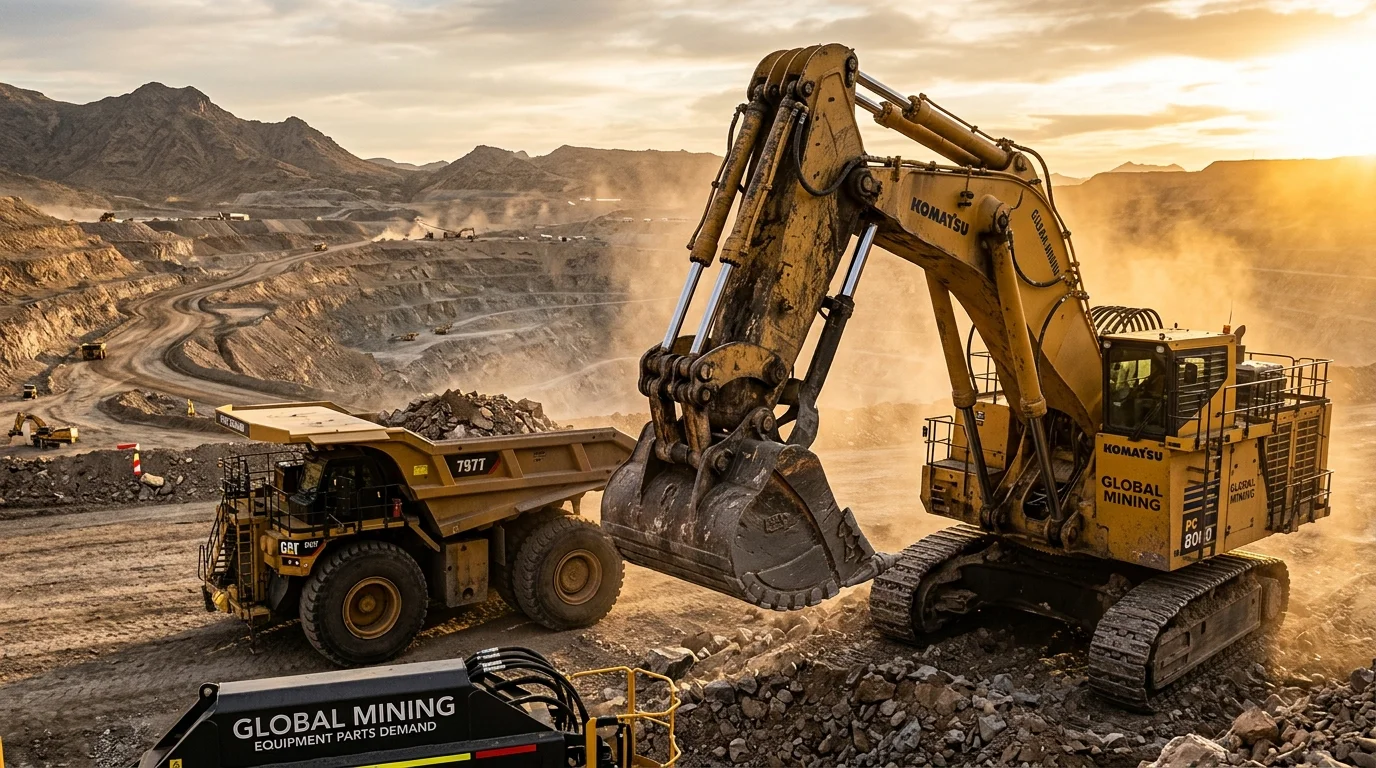
Global Mining Equipment Parts Demand: 2026 Outlook
Global mining equipment parts demand is rising fast. Explore 2026 market data, regional trends, OEM vs aftermarket sourcing, and how to cut procurement
Loading article…
Article Not Found
The article you're looking for doesn't exist or may have been removed.
Back to BlogGlobal mining equipment parts demand is the measure of worldwide procurement activity for components that keep mining machinery running, from hydraulic cylinders and wear plates to sensors and cutting edges. As of 2026, this market sits at USD 13.19 billion and is expanding steadily.
Key Takeaways
- Market Size: The mining equipment parts and attachments market was valued at USD 13.19 billion in 2025 and is projected to reach USD 22.53 billion by 2035.
- Growth Rate: The market is forecast to grow at a CAGR of 5.5% from 2027 to 2035, according to industry reports.
- Regional Leaders: North America holds the largest share; Asia-Pacific is the fastest-growing region.
- Technology Shift: Automation, IoT, and predictive maintenance are reshaping which parts buyers need and how fast they need them.
- Sourcing Strategy Matters: OEM and aftermarket channels each carry distinct trade-offs in cost, lead time, and compatibility.
- Critical Minerals Drive Volume: Copper, lithium, nickel, cobalt, and iron ore projects are the primary engine behind fleet expansion and parts consumption.
Understanding Global Mining Equipment Parts Demand
Demand for mining equipment parts reflects the health of the entire extraction industry. When new mines open, fleets expand and first-fill parts orders surge. When commodity prices hold firm, operators accelerate maintenance cycles rather than defer them. Both dynamics are active right now, which is why procurement managers across five continents are competing for the same hydraulic seals, bucket teeth, and drivetrain components.
The market encompasses everything from consumable wear parts replaced weekly to major structural components overhauled every few years. OEM procurement channels, aftermarket distributors, and e-commerce platforms all compete for this spend. Understanding where demand is growing, and why, helps procurement teams position their supply chains before shortages hit.
Market Overview and Projections
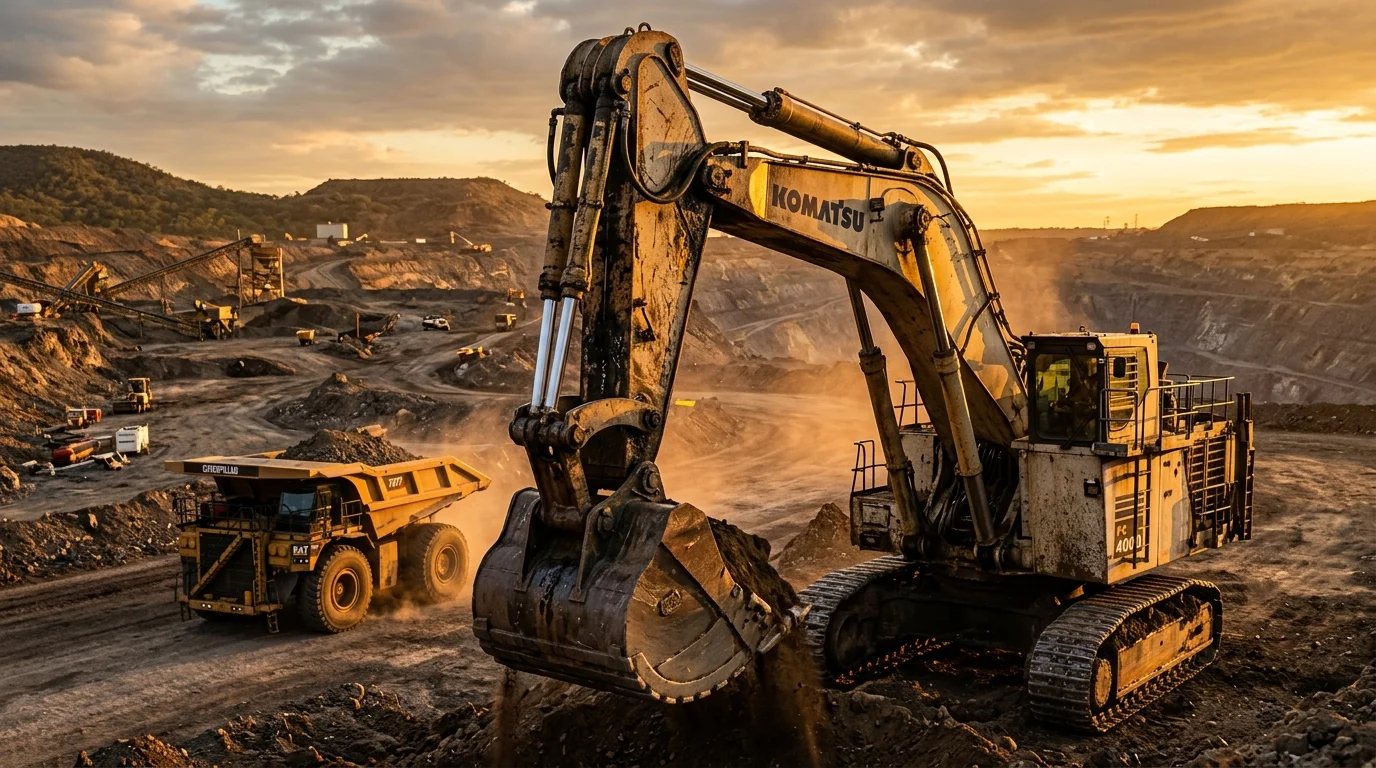
The mining equipment parts and attachments market was valued at USD 13.19 billion in 2025 and is projected to reach USD 22.53 billion by 2035, growing at a CAGR of 5.5% from 2027 to 2035, according to industry reports. This growth is driven by increasing adoption of advanced technologies and rising demand for efficient, durable components across all mining segments.
"Demand is strongest where copper, lithium, cobalt, nickel, and iron ore projects are moving from planning into construction. The mining equipment market is therefore being shaped by technology specifications as well as by mine output." - Mordor Intelligence, Mining Equipment Market Analysis 2026
Market Size and Growth Rate
The broader mining equipment market provides important context. According to Custom Market Insights, the global mining equipment market was valued at USD 133 billion in 2023 and is projected to reach USD 201 billion by 2032, growing at a CAGR of 4.1%. Mordor Intelligence places the 2026 market size at USD 111.67 billion, reaching USD 141.43 billion by 2031 at a CAGR of 4.71%. These figures confirm that parts and attachments represent a structurally growing slice of total equipment spend.
Key Market Drivers
- Rising Mineral Demand: Copper, lithium, and nickel are critical inputs for electric vehicles and renewable energy infrastructure. The International Energy Agency has noted that achieving net-zero goals will require a dramatic increase in mineral extraction, creating sustained long-term demand for mining fleets and their parts.
- Technological Upgrades: Automation, AI, and IoT integration are pushing operators to replace legacy components with sensor-equipped, connectivity-ready parts.
- Sustainability Initiatives: The shift toward eco-friendly operations is driving demand for energy-efficient attachments and lower-emission drivetrain components.
- Fleet Replacement Cycles: Aging equipment across North American and European mines is generating significant replacement parts volume as operators modernize rather than retire entire machines.
How the Parts Supply Chain Actually Works
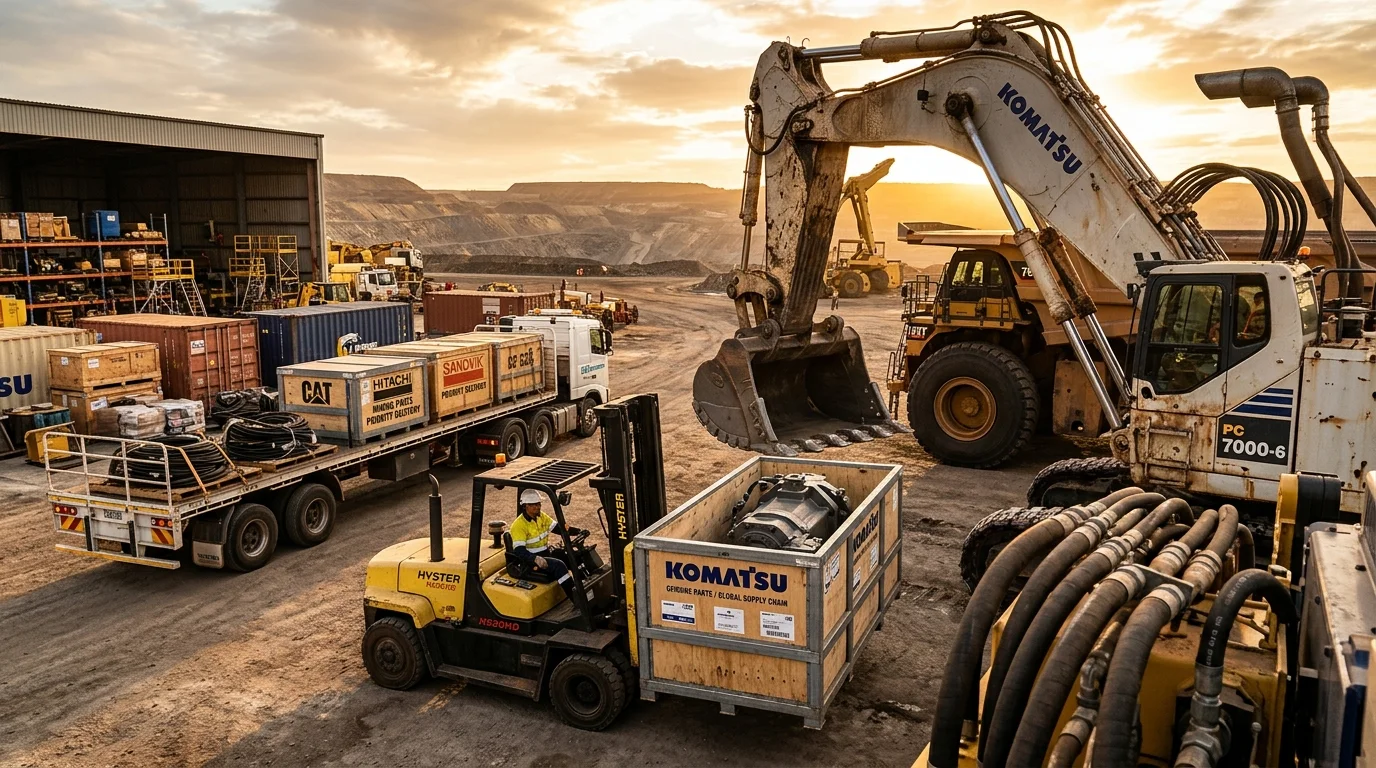
Mining equipment parts move through two primary channels: OEM supply networks and the aftermarket. Understanding both is essential for any procurement manager trying to balance cost, availability, and quality.
OEM Supply Networks
Original equipment manufacturers like Caterpillar, Komatsu, Sandvik, and Epiroc maintain global distribution networks with regional warehouses. When you order a genuine CAT bucket tooth or a Komatsu hydraulic pump, the part travels from a certified manufacturing facility through a regional distribution center to your site. Lead times vary from days to several weeks depending on part complexity and your location. OEM parts carry full manufacturer warranties and guaranteed compatibility, but they typically command a price premium.
For critical components, such as final drives, swing motors, or engine assemblies, OEM sourcing is often non-negotiable. The cost of a compatibility failure on a 300-ton haul truck far exceeds any savings from a cheaper alternative.
Aftermarket and Third-Party Suppliers
The aftermarket segment covers OEM-equivalent parts manufactured to the same specifications but sold outside the original brand's distribution network. Quality varies significantly. Reputable aftermarket suppliers maintain ISO 9001 certification, use the same metallurgical standards as OEMs, and provide full traceability documentation. Lower-tier suppliers cut corners on material grades or dimensional tolerances, which shows up as premature wear or unexpected failure.
At 3GEN Export, we supply OEM-standard parts for Caterpillar, Komatsu, Volvo, Atlas Copco, and 40+ other brands. Every component ships with full compatibility documentation and quality certification. Our global logistics network delivers to most mining regions within five business days.
E-Commerce and Digital Procurement
Digital procurement platforms are growing rapidly, particularly for consumable wear parts. Operators can now compare part numbers, check stock availability across multiple suppliers, and place orders without a sales call. This shift is compressing margins for traditional distributors while giving procurement managers more price transparency than ever before.
How to Build a Resilient Parts Procurement Strategy
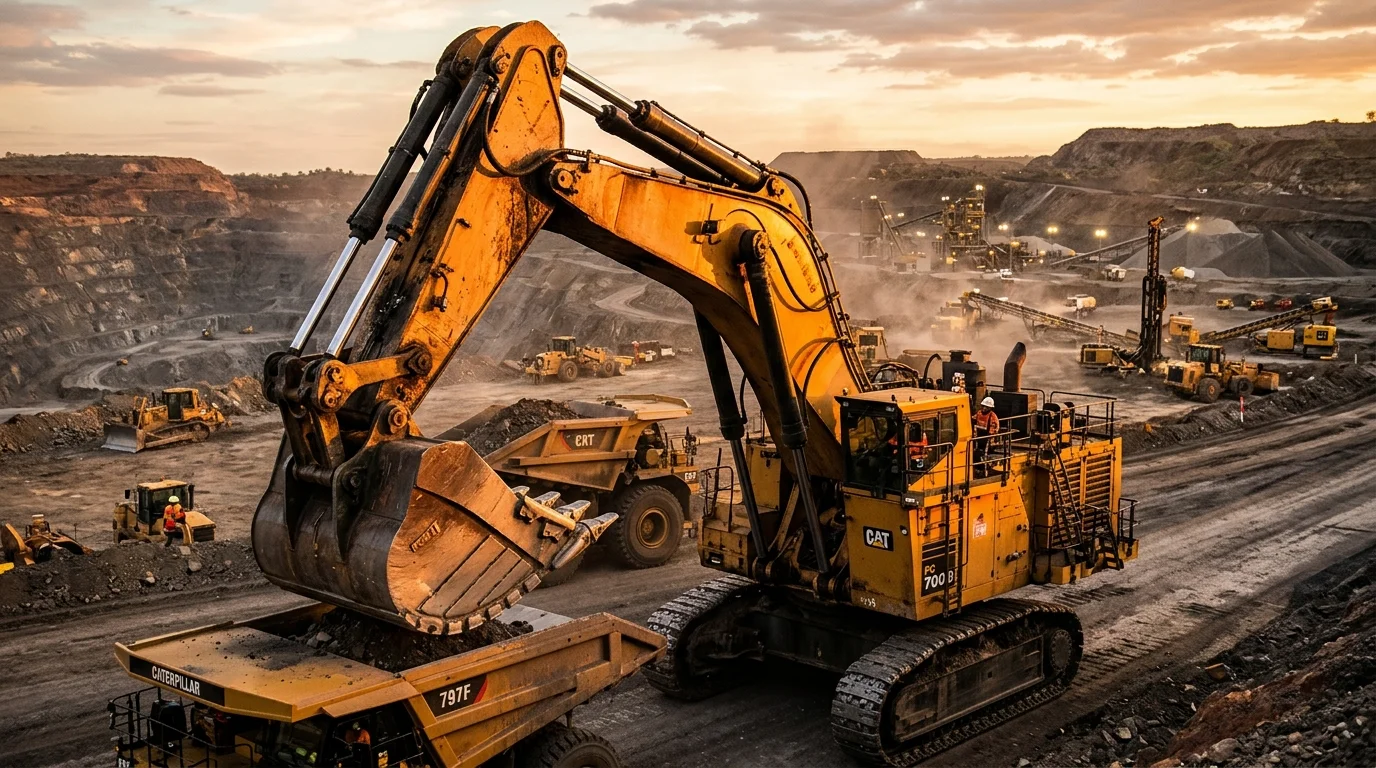
A resilient procurement strategy for mining equipment parts follows a clear sequence. Here are the steps we recommend based on our work with fleet operators across mining regions worldwide.
- Audit your critical parts list. Identify every component with a lead time over 10 days or a failure history that caused unplanned downtime. These are your strategic inventory items.
- Classify parts by criticality and consumption rate. High-criticality, high-consumption parts (bucket teeth, cutting edges, hydraulic seals) should be held in local stock. Low-criticality, low-consumption parts can be sourced on demand.
- Qualify at least two suppliers per critical part. Single-source dependency is the most common cause of extended downtime. A backup supplier for your CAT 390 final drive or Komatsu PC8000 hydraulic pump is not a luxury; it is basic risk management.
- Negotiate consignment or vendor-managed inventory for high-volume consumables. This shifts carrying costs to the supplier while guaranteeing availability at your site.
- Implement a predictive maintenance data feed. Connect equipment telematics to your parts ordering system so that sensor data triggers replenishment orders before failure occurs, not after.
- Review lead times quarterly. Supply chain conditions change. A supplier that delivered in five days last year may be running eight-week backlogs today. Regular reviews prevent surprises.
OEM vs. Aftermarket vs. Rebuilt: A Direct Comparison
Choosing the right sourcing channel depends on the part type, your budget, and your tolerance for risk. This table covers the three main options procurement managers evaluate.
| Factor | OEM Genuine Parts | OEM-Standard Aftermarket | Rebuilt / Remanufactured |
|---|---|---|---|
| Price | Highest | Moderate (typically lower than OEM) | Lowest upfront cost |
| Lead Time | Days to weeks (region-dependent) | Often faster via global distributors | Variable; depends on core availability |
| Warranty | Full OEM warranty | Supplier warranty (varies) | Limited warranty on rebuilt components |
| Compatibility | Guaranteed | High, if supplier is certified | Moderate; verify spec sheet carefully |
| Quality Consistency | Highest | High (ISO-certified suppliers) | Variable by rebuilder |
| Best For | Critical drivetrain, safety systems | Wear parts, hydraulics, filters | Major assemblies on older machines |
| Environmental Impact | Standard | Standard | Lower (extends component life) |
Pro Tip: For excavators like the CAT 390 or Komatsu PC8000, use genuine OEM parts for final drives and swing motors. Switch to certified aftermarket for bucket teeth, cutting edges, and hydraulic seals. This hybrid approach typically reduces parts spend without compromising machine availability.
Pros and Cons of the Current Global Parts Market
Pros
- Growing supply base: More certified aftermarket suppliers are entering the market, giving buyers genuine alternatives to OEM pricing.
- Digital procurement tools: Online platforms now allow real-time price comparison and stock visibility across global suppliers.
- Faster global logistics: Freight networks have recovered from pandemic-era disruptions, and express air freight options now connect most mining regions within five business days.
- Predictive maintenance reducing emergency orders: IoT-enabled equipment generates advance warning of component wear, allowing planned procurement rather than crisis buying.
- Strong aftermarket quality standards: ISO 9001 certification and OEM-equivalent manufacturing specs are now common among reputable aftermarket suppliers.
Cons
- Geopolitical supply risk: Key raw materials for parts manufacturing, including rare earth elements and specialty steel, are concentrated in a small number of countries, creating vulnerability to trade disruptions.
- Price volatility: Steel, copper, and rubber prices fluctuate with commodity markets, passing cost pressure directly to parts buyers.
- Counterfeit parts risk: The growth of e-commerce has made it easier for substandard or counterfeit components to enter supply chains, particularly for high-demand Caterpillar and Komatsu part numbers.
- Long lead times for specialized components: Custom or low-volume parts for older machine models can carry lead times of 8-16 weeks from OEM channels.
- Regulatory complexity: Environmental and safety standards vary by country, complicating cross-border parts procurement for multinational operators.
Regional Insights into Mining Equipment Parts Demand
Demand for mining equipment parts varies significantly across regions, shaped by local mining activity, technology adoption rates, and regulatory environments.
North America
North America remains the largest market for mining equipment parts, driven by a mature mining industry and high levels of technological adoption. The United States and Canada are key players, with significant investments in mining operations and equipment modernization. Fleet electrification projects and autonomous haulage deployments are generating demand for new categories of parts that did not exist five years ago.
Asia-Pacific
Asia-Pacific is the fastest-growing market. According to MarkNtel Advisors, Asia-Pacific is estimated to lead the global mining equipment market with approximately 59% share in 2026. Countries like China and India are ramping up mining activities to meet rising mineral demand, while Australia's resources and energy export earnings are forecast to reach USD 416 billion in 2026-27, according to Australia's Department of Industry, Science and Resources. That level of export activity translates directly into sustained parts consumption across the region's mining fleets.
Europe
Europe, particularly Germany and the UK, emphasizes innovation and sustainability in mining practices. The region is moving toward automation and digital solutions, which is shifting demand toward sensor-equipped components and smart attachments. Regulatory pressure on emissions is also accelerating the replacement of older mechanical parts with cleaner alternatives.
Latin America and Middle East and Africa
Latin America offers emerging opportunities as copper and lithium extraction expands in Chile, Peru, and Argentina. The Middle East and Africa region is growing fastest among all segments tracked by Mordor Intelligence, driven by resource-rich countries attracting new mining investment. Both regions present significant aftermarket opportunities for global parts suppliers with established logistics networks.
Market Segmentation of Mining Equipment Parts
The mining equipment parts market segments across equipment type, application, and technology, each with distinct demand dynamics.
By Equipment Type
- Excavators: Excavators held 31.46% of the mining equipment market share in 2025, according to Mordor Intelligence. Bucket assemblies, hydraulic cylinders, and undercarriage components are the highest-volume parts categories for this segment.
- Loaders and Drills: Essential for surface and underground operations, these machines generate steady demand for wear parts, drill bits, and hydraulic components.
- Attachments: Buckets, blades, cutting edges, and wear plates are consumable items replaced on regular cycles, providing predictable recurring revenue for parts suppliers.
- Mining Trucks: According to MarkNtel Advisors, mining trucks account for approximately 28% of equipment market share in 2026, making drivetrain and suspension components a major parts category.
By Application
- Metal Mining: The dominant application segment, driven by demand for copper, iron ore, nickel, and cobalt. Fleet sizes are large and maintenance cycles are intensive.
- Mineral Mining: Lithium and rare earth extraction is growing rapidly, bringing new equipment types and parts requirements into the market.
- Coal Mining: Facing long-term structural decline in some markets, but still representing significant parts volume in Asia and parts of Latin America.
By Technology
- Traditional Mechanical Parts: Still the majority of volume by unit count, covering everything from engine components to basic hydraulic fittings.
- Advanced Digital Solutions: IoT-enabled sensors, telematics modules, and smart wear indicators are the fastest-growing technology segment. Fully autonomous equipment is forecast to grow at a 12.51% CAGR through 2031, according to Mordor Intelligence, pulling specialized parts demand with it.
Technological Advancements Influencing Demand
Technology is reshaping which parts buyers need, how often they need them, and how they source them.
Automation and Digitalization
Autonomous vehicles and remote monitoring systems are becoming standard in modern mining. Komatsu and Toyota announced a combined project for autonomous light vehicle operation on autonomous haulage systems in 2023. XCMG has deployed 100 autonomous electric mining trucks in China. Each of these deployments creates demand for specialized electronic components, sensors, and connectivity hardware that traditional parts distributors are only beginning to stock.
Electrification
Battery-electric vehicles held a small share of the mining equipment market in 2025, but they are forecast to grow at a 13.71% CAGR through 2031, according to Mordor Intelligence. Komatsu's PC7000-11E electric excavator, showcased at Bauma 2025, signals where the market is heading. Electric drivetrains require entirely different maintenance parts: battery management components, electric motor brushes, and high-voltage cable assemblies are replacing diesel fuel systems and exhaust components.
Predictive Maintenance
Predictive maintenance strategies are reducing emergency parts orders while increasing planned procurement volume. Sensors embedded in hydraulic systems, undercarriages, and drivetrain components generate real-time wear data. When a sensor detects that a hydraulic seal is approaching end-of-life, the system triggers a purchase order automatically. This shift from reactive to proactive procurement is one of the most significant structural changes in how mining companies manage their parts supply chains.
"Fleet replacement remains important, but recurring maintenance, parts, automation support, and electrification services are becoming a larger part of the revenue pool as mine operators prioritize availability and lifecycle performance." - Global Market Insights, Underground Mining Equipment and Services Market Report, September 2026
A Realistic Procurement Scenario: Mid-Size Copper Mine
Consider a mid-size copper mine in Chile operating a fleet of 12 Komatsu PC5500 excavators and 30 CAT 793 haul trucks. The maintenance team runs scheduled 500-hour and 2,000-hour service intervals. At each 500-hour service, each excavator consumes hydraulic filters, oil filters, and a set of bucket teeth. At each 2,000-hour service, hydraulic hose assemblies and undercarriage wear components are replaced.
With 12 excavators cycling through 500-hour services roughly every three months, the mine is placing parts orders continuously. A single delay in bucket tooth delivery can force an excavator to run with worn teeth, reducing dig efficiency and accelerating bucket shell wear. The cost of that delay compounds quickly.
This mine's procurement manager qualifies two suppliers for every high-consumption part: the OEM dealer in Santiago and a certified aftermarket distributor with regional stock in Lima. For critical hydraulic components, OEM parts are specified. For wear items like cutting edges and bucket teeth, the aftermarket supplier wins on price and lead time. This dual-source approach keeps the fleet running without overpaying for parts that do not require OEM certification.
When the mine expanded its fleet by three excavators in early 2026, the procurement team contacted 3GEN Export for first-fill parts packages. We shipped complete hydraulic seal kits, filter sets, and undercarriage components to the Santiago port within five business days, allowing the new machines to enter service on schedule.
Common Mistakes in Mining Parts Procurement
Procurement errors in this sector are expensive. Here are the mistakes we see most often, and how to avoid them.
- Single-source dependency: Relying on one supplier for critical parts is the fastest route to extended downtime. Always qualify a backup source before you need it.
- Buying on price alone: The cheapest bucket tooth that fails in 200 hours costs more than a premium tooth lasting 600 hours. Calculate cost per operating hour, not unit price.
- Ignoring part number cross-references: Aftermarket parts often carry different part numbers than OEM equivalents. Without a verified cross-reference, buyers risk ordering incompatible components. Always request the OEM part number and a confirmed cross-reference from your supplier.
- Deferring maintenance to save money: Pushing through the first signs of hydraulic leaking or undercarriage wear to avoid a parts order is the most common and most costly mistake we see. A USD 200 seal kit deferred becomes a USD 15,000 cylinder replacement.
- Not accounting for lead times in project planning: Long-lead components for new mine builds or fleet expansions need to be ordered months in advance. Treating parts procurement as an afterthought to equipment delivery creates avoidable delays.
- Failing to verify supplier certifications: ISO 9001 certification and OEM-equivalent manufacturing documentation are the minimum standard for aftermarket parts. Buying from uncertified suppliers to save a few percent introduces quality risk that is impossible to quantify until something fails underground.
Challenges Facing the Mining Equipment Parts Market
Despite the positive growth outlook, the parts market faces real headwinds that procurement teams must plan around.
Supply Chain Disruptions
Geopolitical tensions and the lingering effects of pandemic-era logistics disruptions continue to affect the availability of critical components. Specialty steel, rare earth elements used in sensors, and rubber compounds for seals are all subject to supply constraints that can extend lead times without warning.
Regulatory Complexities
Environmental standards and safety protocols vary significantly across mining jurisdictions. A part certified for use in Australian mines may require additional documentation for use in South African or Brazilian operations. Multinational operators need suppliers with the compliance expertise to navigate these requirements across multiple markets.
Counterfeit Parts
The growth of online procurement has made counterfeit parts a genuine operational risk. Substandard components bearing Caterpillar or Komatsu branding have been documented in multiple markets. The consequences range from accelerated wear to catastrophic failure. Buying from certified distributors with full traceability documentation is the only reliable defense.
Future Outlook for Global Mining Equipment Parts Demand
The outlook for this market through 2035 is positive, with several structural forces sustaining demand regardless of short-term commodity price cycles.
Emerging Markets
Asia-Pacific and Latin America present the strongest growth opportunities as mining activities expand to meet rising global demand for critical minerals. Infrastructure investment in these regions is creating new mine sites that will require first-fill parts packages and ongoing maintenance supply chains.
Electrification and the New Parts Landscape
As battery-electric mining equipment enters mainstream use, the composition of parts demand will shift. Diesel engine components will decline as a share of total spend. Battery systems, electric motors, and power electronics will grow. Suppliers who build inventory and expertise in these new categories now will be positioned well for the second half of this decade.
Aftermarket Services Growth
Sandvik's USD 61 million MRO investment in Canada, announced in 2025, signals that major OEMs are taking aftermarket services seriously as a revenue stream. This investment in maintenance, repair, and overhaul infrastructure will raise service quality expectations across the industry and put pressure on independent aftermarket suppliers to match OEM-level support capabilities.
Frequently Asked Questions
What is the current market size of the global mining equipment parts market?
The global mining equipment parts and attachments market was valued at USD 13.19 billion in 2025 and is projected to reach USD 22.53 billion by 2035, according to industry reports. This represents a CAGR of 5.5% from 2027 to 2035.
Which regions are leading in mining equipment parts demand?
North America remains the largest market, driven by a mature mining industry and high technology adoption. Asia-Pacific is the fastest-growing region, with China, India, and Australia all expanding mining capacity significantly. MarkNtel Advisors estimates Asia-Pacific holds approximately 59% of the global mining equipment market in 2026.
What are the key drivers of demand for mining equipment parts?
The primary drivers are rising demand for critical minerals including copper, lithium, nickel, and cobalt, combined with fleet modernization, electrification, and the adoption of automation technologies. Sustainability regulations are also pushing operators to replace older mechanical components with cleaner, more efficient alternatives.
How does automation impact the mining equipment parts market?
Automation creates demand for entirely new categories of parts: sensors, telematics modules, autonomous vehicle control systems, and connectivity hardware. Fully autonomous equipment is forecast to grow at a 12.51% CAGR through 2031, according to Mordor Intelligence, which will pull specialized parts demand with it. Traditional mechanical parts remain dominant by volume but are growing more slowly.
What is the difference between OEM and aftermarket mining parts?
OEM parts are manufactured by or for the original equipment maker and carry full manufacturer warranties and guaranteed compatibility. Aftermarket parts are produced by third-party manufacturers to OEM-equivalent specifications. Reputable aftermarket suppliers hold ISO 9001 certification and provide full traceability documentation. The key is qualifying your supplier carefully: certified aftermarket parts for wear items can deliver significant cost savings without compromising machine availability.
What challenges does the mining equipment parts market face?
The main challenges are supply chain disruptions driven by geopolitical tensions and raw material concentration, regulatory complexity across different mining jurisdictions, counterfeit parts entering online procurement channels, and the long lead times associated with specialized or low-volume components. Building a dual-source procurement strategy and buying only from certified suppliers are the most effective responses to these risks.
Shop OEM-quality spare parts with global 5-day delivery at 3genexport.com. Our team supports procurement managers across mining, construction, and energy sectors with fast sourcing, full compatibility documentation, and competitive pricing on parts for Caterpillar, Komatsu, Volvo, Atlas Copco, and 40+ other brands.