
Heavy Construction Equipment Brands: 2026 Guide
Heavy construction equipment brands ranked for 2026: Caterpillar, Komatsu, SANY & more. Compare OEM specs, dealer networks, and total cost of ownership.
Loading article…
Article Not Found
The article you're looking for doesn't exist or may have been removed.
Back to BlogHeavy construction equipment brands are manufacturers that design, build, and support earthmoving, lifting, hauling, and compaction machines for construction, mining, and infrastructure projects. The largest global names include Caterpillar, Komatsu, Volvo CE, Liebherr, XCMG, SANY, John Deere, and Develon.
Key Takeaways
- Market scale: Global construction equipment sales reached a record $246.6 billion in 2025, with long-term projections pointing past $300 billion by 2032.
- Caterpillar leads globally: With revenues of $59.4 billion in 2022, more than 300 machine models, and operations in over 190 countries, Caterpillar remains the benchmark for equipment brands.
- Brand choice is regional: U.S. manufacturers include John Deere, Case, Bobcat, and Terex; global competitors include Komatsu, Hitachi, Liebherr, XCMG, SANY, and Volvo CE.
- Total cost of ownership matters more than sticker price: Dealer coverage, parts availability, and application fit consistently outweigh name recognition alone.
- Evaluate before you commit: A 30-60 day rental trial is the most reliable way to validate a brand's support network before a full fleet purchase.
- Spare parts strategy is critical: OEM-quality replacement parts from a reliable global supplier protect uptime regardless of which brand you operate.
What Defines Heavy Construction Equipment Brands?
Brand Scope and Manufacturing Identity
this type of brands are original equipment manufacturers that engineer, assemble, and support machines used for earthmoving, lifting, hauling, compaction, and specialized construction tasks. Some are full-line manufacturers covering dozens of categories. Caterpillar's product line exceeds 300 machines, covering articulated trucks, asphalt pavers, backhoe loaders, dozers, excavators, motor graders, telehandlers, and wheel loaders, according to the company's official product catalog. Others focus on narrower segments: JLG and Genie are known for aerial work platforms, while Link-Belt and Manitowoc concentrate on cranes.
The Difference Between OEMs, Dealers, and Rental Brands
An OEM is the manufacturer that designs and builds the machine. A dealer is the local or regional business that sells, services, and supports those machines. A rental brand may be an OEM-owned rental business, an independent marketplace, or a dealer that rents alongside sales. HOLT CAT, for example, is one of Caterpillar's largest dealerships in the United States, according to SIBO. DOZR operates an equipment rental marketplace connecting contractors to machines from multiple this kind of equipment brands. Understanding this distinction helps fleet buyers know where to purchase, rent, and get service.
Why Brand Loyalty Runs Deep
Many contractors stay loyal to a specific brand because of reliability, service quality, parts availability, or historical ties. As DOZR notes, equipment purchases, rentals, and service represent a significant portion of a construction company's costs, so a trusted brand reduces risk. A brand with a dense dealer network often wins repeat business even when a competitor offers a lower sticker price.
Global Market Size and Ranking of Heavy Construction Equipment Brands
Market Size: From $186.56 Billion to Record Territory
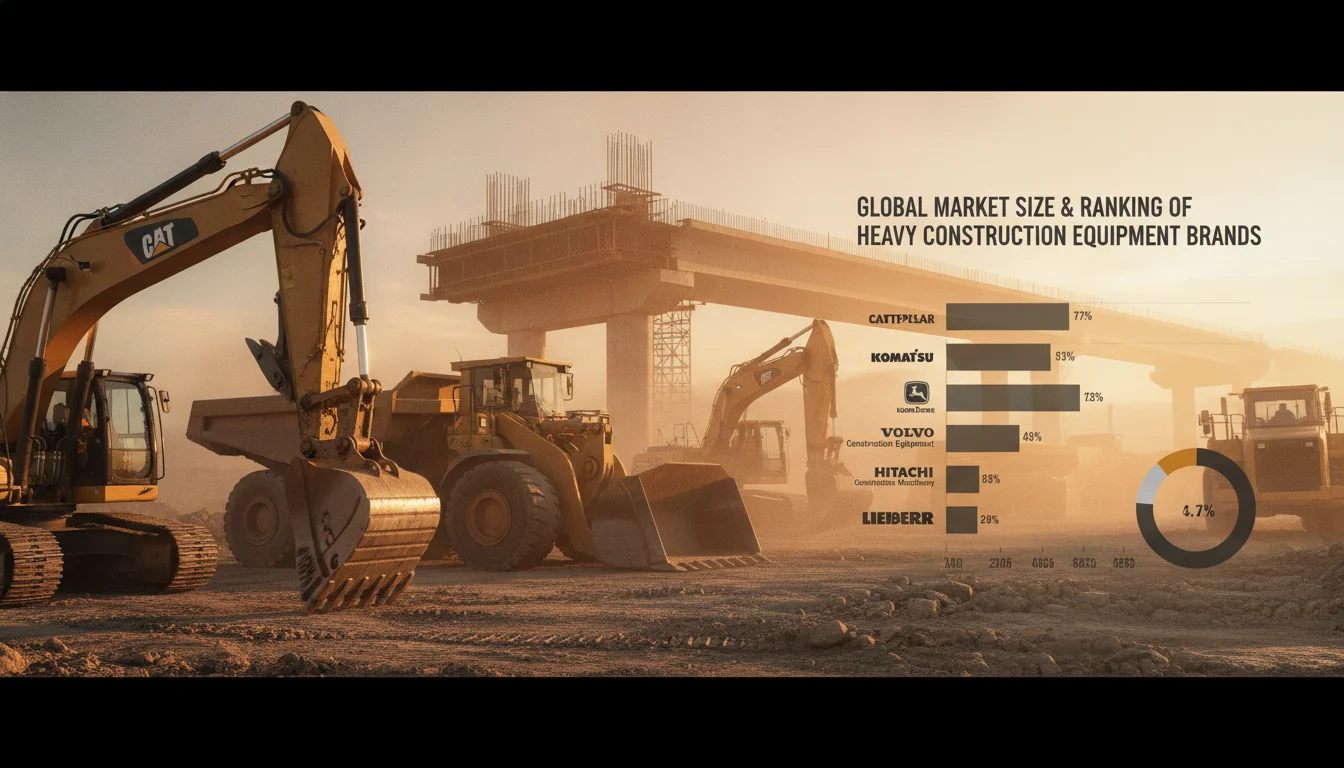
The global construction equipment market was valued at approximately $186.56 billion in 2022, according to DOZR, with growth projected beyond $300 billion by 2032. By 2025, the picture had already shifted: EquipmentWorld reported that global construction equipment sales hit a record $246.6 billion. The difference reflects both genuine market expansion and variation in how sources define and track equipment sales. For procurement teams, the trend is clear: the sector is large and still growing.
The Yellow Table as an Industry Benchmark
The Yellow Table, published annually by International Construction, ranks the world's top 50 construction equipment manufacturers by sales. According to CONEXPO-CON/AGG, sales for the top 50 OEMs reached $232.7 billion in 2021, a 20.8% increase over the previous year. That year's top 10 included Sandvik of Sweden with $7.2 billion in sales and Hitachi of Japan with $8.8 billion. Sandvik acquired 14 businesses in 2021 as part of its growth strategy, while Hitachi and John Deere ended a long-standing joint venture the same year.
Names That Dominate Global Rankings
Caterpillar is consistently identified as the world's largest construction equipment supplier. DOZR's top supplier list places Caterpillar first and includes John Deere, Komatsu, Liebherr, XCMG, Develon, SANY, and Volvo CE among the leaders. EquipmentWorld similarly highlights Caterpillar, Komatsu, XCMG, Deere, and Volvo CE as major players in its 2025 edition. The exact order shifts year to year, but the core group of the construction equipment brands remains stable across rankings.
America's Construction Equipment Manufacturing Legacy
From Holt and Best to Caterpillar
America's heavy construction equipment industry began with the track-type tractor. Holt Manufacturing developed the world's first practical track-type tractor in 1904, solving the problem of tractors sinking into soft soil. That invention gave rise to the "Caterpillar" name. In 1925, Holt merged with C.L. Best Tractor Company to form Caterpillar Inc., according to SIBO. Today Caterpillar operates in more than 190 countries and remains the global leader in construction and mining equipment.
U.S. Manufacturer Landscape Beyond Caterpillar
Wikipedia's category of U.S. construction equipment manufacturers lists more than 30 companies, including John Deere, Case Construction Equipment, Bobcat Company, JLG Industries, Genie (Terex), Terex, Manitowoc Cranes, Link-Belt Cranes, Ditch Witch, Gehl Company, Blaw-Knox, Barber-Greene, and Bucyrus-Erie. This list reflects both current manufacturers and historically significant brands that shaped the industry. Many of these names still appear on active job sites, while others survive through parent companies or dealer networks.
Deere & Company's Distinct Position
John Deere, also known as Deere & Company, has roots dating back to the 1800s and manufactures equipment for both agriculture and construction. DOZR notes that while agricultural machines are recognizable by "John Deere Green," much of Deere's construction equipment is painted yellow and black. The brand's construction line includes excavators, skid steers, wheel loaders, and other heavy equipment. This dual-market heritage gives Deere a unique dealer footprint across rural and urban North America.
Product Categories Across Heavy Construction Equipment Brands
Earthmoving Machines
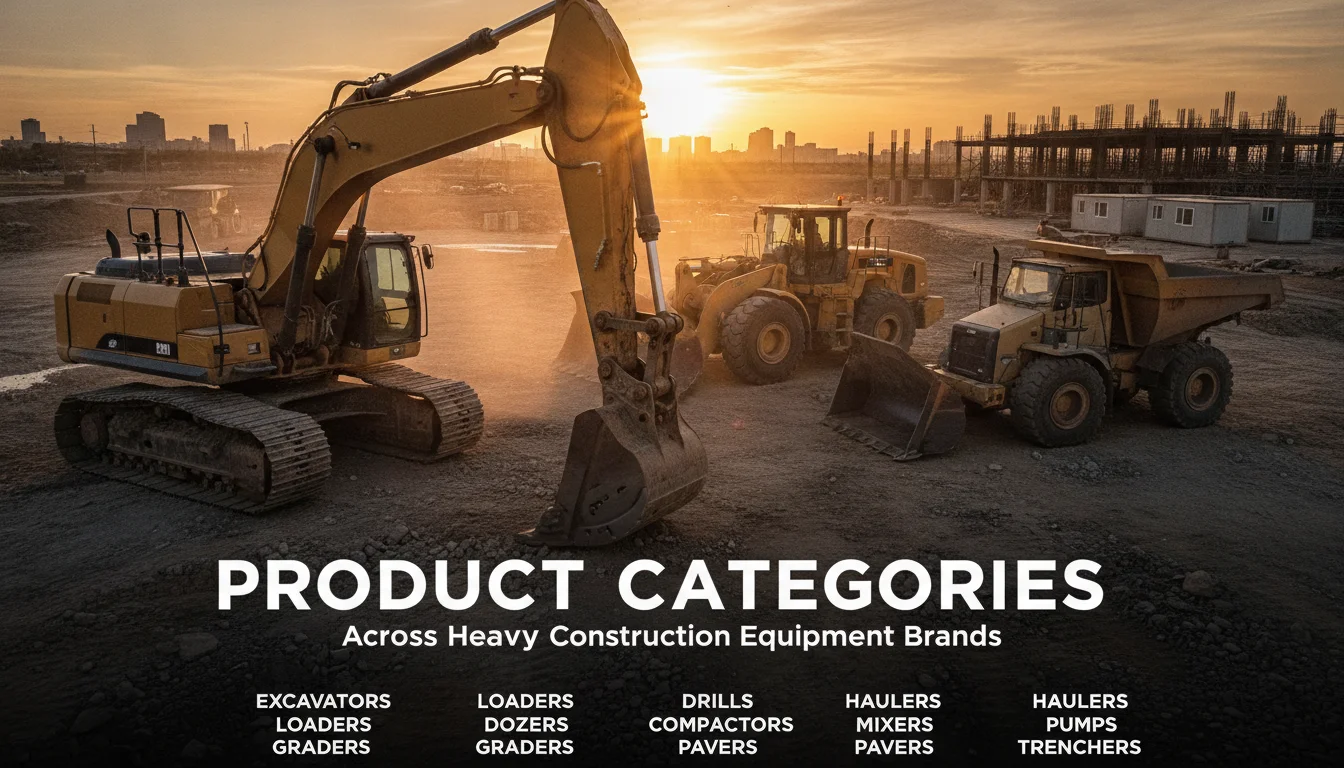
Earthmoving equipment is a broad class of machines that excavate, grade, push, or haul soil and rock. The BigRentz equipment classification table places bulldozers, excavators, wheel tractor-scrapers, compact loaders, motor graders, and trenchers in the earthmoving category. Caterpillar, John Deere, and Komatsu all compete directly in this space. Most brands use a common naming structure for these machines, but local dealer support can vary widely by region.
Lifting and Access Equipment
Lifting and access equipment includes boom lifts, scissor lifts, telehandlers, and cranes. BigRentz classifies boom lifts and scissor lifts under lifting and access equipment, while telehandlers fall into material handling and lifting. JLG Industries and Genie are prominent U.S.-based manufacturers in this space, and Caterpillar also offers telehandlers. These machines handle elevated work, material placement, and jobs that require positioning loads at height.
Compaction, Paving, and Specialized Machinery
Compaction and paving equipment includes soil compactors, drum rollers, asphalt pavers, and cold planers. Caterpillar lists compactors, asphalt pavers, cold planers, and road reclaimers in its new equipment catalog. BigRentz categorizes compactors and drum rollers as compaction equipment, and asphalt pavers and cold planers as road construction equipment. Specialized machines such as tunnel boring machines, dragline excavators, and rock breakers also appear in industry classification tables, but these are typically purchased by specialized contractors with narrow application requirements.
| Equipment Category | Representative heavy construction | Typical Application | Key Consideration |
|---|---|---|---|
| Excavators | Caterpillar, John Deere, Komatsu, SANY, Volvo CE | Trenching, demolition, material handling | Check hydraulic performance and local service |
| Dozers and Motor Graders | Caterpillar, John Deere | Site prep, grading, road building | Blade capacity and undercarriage wear |
| Aerial Work Platforms | JLG, Genie (Terex) | Elevated access, maintenance, installation | Working height and terrain type |
| Compaction and Paving | Caterpillar, plus specialized paving OEMs | Road construction, foundation compaction | Match drum type to soil or asphalt |
| Hauling and Articulated Trucks | Caterpillar, Volvo CE | Quarry, mine, and site hauling | Payload, gradeability, and dump cycle |
How to Evaluate Heavy Construction Equipment Brands for Your Fleet
Total Cost of Ownership vs. Purchase Price
Smart buyers evaluate equipment brands on total cost of ownership, not just the initial quote. Total cost of ownership includes acquisition price, fuel consumption, preventive maintenance, parts, operator training, and downtime. A low-price machine with limited parts availability can cost significantly more over five years than a premium brand with a dense support network. Because construction equipment purchases, rentals, and service are a significant portion of project costs, the brand decision carries long-term financial weight.
"In my field experience, the most common fleet mistake is choosing a brand by sticker price instead of total cost of ownership. Two excavators can have identical lift capacity, but if one has no dealer support within 300 miles, the downtime will erase any purchase savings." - Senior Equipment Specialist, 3GEN Export
Dealer Network and Parts Availability
A brand's dealer network is a critical factor. Caterpillar has more than 500 locations globally, which helps explain its strength in remote and mining applications. For newer or expanding brands such as XCMG or SANY, dealer coverage may be thinner in certain U.S. regions, so buyers should verify parts warehouses, service technicians, and loaner availability before purchase. Any of the major this type of brands that lack nearby service can increase project risk, even if the machine itself is reliable.
"Parts availability is the hidden cost that most procurement teams underestimate. A machine that sits idle for two weeks waiting on a hydraulic seal costs far more than the price difference between OEM and aftermarket supply chains." - Procurement Director, 3GEN Export
Application Match and Machine Specifications
Choosing a brand should follow machine requirements, not brand preference alone. BigRentz emphasizes that clear, standardized equipment names help teams select the right machine faster and more safely. A contractor who needs a compact track loader for soft ground should not buy a wheeled skid steer simply because it is offered by a preferred brand. Define the machine class first, then compare the relevant this kind of equipment brands within that class.
Step-by-Step Selection Process for Heavy Construction Equipment Brands
- Step 1: Define the job requirement. List the machine categories, capacities, terrain conditions, and daily operating hours needed for the project.
- Step 2: Shortlist brands in the required category. Identify full-line manufacturers and niche specialists that produce the machine class you need.
- Step 3: Verify dealer support in your operating region. Check parts inventory, technician availability, and mobile service coverage.
- Step 4: Compare total cost of ownership. Request fuel burn data, maintenance intervals, and typical resale value from dealers or existing owners.
- Step 5: Test or rent before you commit. Rent a unit from the brand for 30-60 days to evaluate uptime, operator comfort, and support responsiveness.
Start With the Job, Not the Decal
Brand loyalty is valuable, but job requirements come first. A contractor who needs a high-reach boom lift should be comparing JLG and Genie, not bulldozer brands. Write down the machine specification first, then filter by those specs. This prevents the common mistake of buying a familiar name that does not fit the application.
Score Brands on Support, Uptime, and Resale
Once the shortlist is defined, score each brand on support metrics: distance to the nearest dealer, average parts delivery time, warranty terms, and historical resale value. Caterpillar's high resale value is widely recognized in the industry, though individual models vary. DOZR notes that contractor loyalty often stems from service reliability, so ask other fleet owners about their real-world support experience before signing.
Prototype and Validate Before Full Fleet Commitment
A short-term rental can serve as a prototype. Run the machine on your own site, measure cycle times, and record any unplanned downtime. This validation period is especially important when moving from a traditional brand to a lower-cost alternative such as XCMG, SANY, or Develon. The five-step process above reduces brand risk and aligns the purchase with operational data rather than marketing claims.
Pros and Cons of Major Heavy Construction Equipment Brands
Pros
- Established OEM brands offer deep support networks: Caterpillar's 500+ global locations and John Deere's dual-market dealer footprint mean technicians and parts are rarely far away.
- Strong resale value protects capital investment: Machines from leading the construction equipment brands consistently hold value better than lesser-known alternatives, reducing total cost of ownership over a fleet's lifecycle.
- Broad product lines simplify fleet standardization: Full-line manufacturers let procurement teams standardize on a single brand across excavators, dozers, wheel loaders, and compactors, reducing training and parts inventory complexity.
- OEM-quality spare parts are widely available: For Caterpillar, Komatsu, Volvo CE, and other major brands, OEM-standard replacement parts are stocked globally, minimizing downtime when components fail.
- Proven reliability in demanding conditions: Industry maintenance data consistently shows that established brands perform reliably in mining, quarrying, and large-scale infrastructure environments where machine failure carries high cost.
Cons
- Premium brands carry premium acquisition costs: Caterpillar and Komatsu machines typically cost more upfront than Chinese or emerging-market alternatives from XCMG or SANY, which can strain capital budgets on smaller projects.
- Dealer coverage is uneven outside core markets: Even large brands have thin dealer networks in remote regions, and newer entrants such as XCMG and Develon may have limited U.S. service infrastructure.
- Full-line manufacturers may not lead in every category: Niche specialists like JLG for aerial work platforms or Manitowoc for cranes often outperform full-line brands in their specific segments.
- Brand loyalty can override better application fits: Procurement teams that default to a familiar name risk selecting a machine that is not optimally specified for the job, increasing operating costs.
Ownership, Rental, and Support Considerations
Buying New vs. Used Equipment
Purchasing new equipment provides the latest emissions technology, warranty coverage, and lower initial maintenance risk. Used equipment from established brands often retains strong residual value but requires careful inspection of hours, undercarriage condition, and service records. Caterpillar's official website offers both new and used equipment, reflecting the broad ownership models available to contractors. As DOZR points out, purchasing is a significant cost for construction companies, so the buy-versus-rent decision depends on utilization rate and project duration.
Rental Marketplaces and Dealer Networks
Rental has become a flexible alternative to ownership. DOZR's marketplace connects contractors to hundreds of thousands of rental listings, and BigRentz provides a similar model across multiple equipment categories. Renting allows a contractor to test a brand's support network before committing capital. For short-term or specialized jobs, renting from a recognized brand reduces the burden of maintenance and storage while still providing access to late-model machines.
The 2026 Outlook for Heavy Construction Equipment Brands
As of 2026, the market remains large and competitive. The record $246.6 billion in 2025 sales, combined with DOZR's long-term projection of more than $300 billion by 2032, points to continued equipment investment. Buyers should monitor dealer consolidation, new brand entries in North America, and the growing availability of alternative-fuel and machine-monitoring options from established OEMs. Contractors who evaluate heavy construction equipment brands by support, application fit, and total cost will be better positioned to manage fleet costs and uptime in this expanding market.
Spare Parts Strategy for Any Brand You Operate
Choosing the right brand is only half the equation. Keeping that machine running depends on a reliable supply of OEM-quality spare parts, delivered fast. At 3GEN Export, we supply replacement parts for Caterpillar, Komatsu, Volvo CE, Atlas Copco, and 40+ other heavy construction equipment brands, with global delivery in as few as five business days. Whether you need hydraulic seals, undercarriage components, filters, or engine parts, our team can source OEM-standard components for your fleet.
Explore our parts categories or browse by brand to find the components your machines need. For procurement teams managing multi-brand fleets, we also offer consolidated sourcing across multiple OEMs, reducing the number of suppliers you need to manage.
Frequently Asked Questions
What are the top heavy construction equipment brands in 2026?
The leading heavy construction equipment brands include Caterpillar, John Deere, Komatsu, Liebherr, XCMG, SANY, Volvo CE, and Develon, according to DOZR's supplier list and EquipmentWorld's 2025 rankings. Caterpillar consistently ranks first by revenue and global reach.
Which heavy construction equipment brand is the largest?
Caterpillar is consistently identified as the world's largest construction equipment supplier, with more than 300 machine models, over 500 global locations, and 2022 revenues of $59.4 billion. The company operates in more than 190 countries.
What equipment types do heavy construction equipment brands produce?
Common categories include excavators, dozers, wheel loaders, motor graders, telehandlers, compact track loaders, boom lifts, scissor lifts, compactors, asphalt pavers, and articulated haulers. Full-line manufacturers such as Caterpillar cover most of these categories, while specialists focus on one or two segments.
Are Chinese heavy construction equipment brands like XCMG and SANY reliable?
XCMG, SANY, and Develon appear in major manufacturer rankings and supplier lists, and their machines are used on projects worldwide. Dealer support can be thinner in some U.S. regions, so buyers should verify local parts availability and service coverage before purchase.
Should I buy or rent heavy construction equipment from major brands?
Buying makes sense for high-utilization, long-duration work where total cost of ownership favors ownership over time. Renting is better for short-term or specialized jobs, and it also lets you test a brand's support network before committing capital to a purchase.
How do I choose the right heavy construction equipment brand for my project?
Define the machine category and capacity first, then shortlist brands, verify dealer support in your region, compare total cost of ownership, and rent a unit for a 30-60 day trial before committing. Application fit and parts availability should drive the decision more than brand recognition alone.