
Heavy Equipment Air Filters Bulk: Buyer's Guide
Source heavy equipment air filters bulk with OEM-grade quality. Compare top brands, filter types, and bulk pricing for global fleets. Fast 5-day delivery.
Loading article…
Article Not Found
The article you're looking for doesn't exist or may have been removed.
Back to BlogHeavy equipment air filters bulk are large-quantity purchases of engine intake filters designed to protect construction, mining, and energy machinery from dust, debris, and airborne contaminants. Buying in bulk keeps fleets running and cuts per-unit costs significantly.
Key Takeaways
- Heavy equipment air filters bulk purchasing reduces per-unit cost and eliminates emergency sourcing delays.
- Match filter type to operating environment: disposable for standard sites, washable for remote operations, HEPA-grade for high-dust environments.
- Always verify OEM part numbers before ordering in bulk. One compatibility error across a large order is an expensive mistake.
- Donaldson, WIX, and Carquest are the leading brands for heavy-duty air filtration across Caterpillar, Komatsu, Volvo, and similar equipment.
- MERV ratings measure filtration efficiency. Higher ratings capture finer particles but may restrict airflow on certain engine configurations.
- 3GEN Export ships OEM-quality filters globally with 5-day delivery, making bulk procurement straightforward for international fleets.
Understanding Heavy Equipment Air Filters
Heavy equipment air filters are purpose-built components that block dust, dirt, and debris from entering an engine's intake system. Without effective filtration, abrasive particles accelerate cylinder wear, reduce combustion efficiency, and shorten engine life. For procurement teams managing fleets across construction, mining, or energy projects, understanding what these filters do, and why bulk sourcing matters, is the starting point for any maintenance strategy.
- Air Filter: A barrier device installed at the engine air intake that captures particulate matter before it reaches combustion chambers. In heavy machinery, these filters handle far higher dust loads than automotive equivalents.
- MERV Rating: The Minimum Efficiency Reporting Value measures how effectively a filter captures particles across a defined size range. Higher MERV ratings indicate finer filtration. For heavy equipment operating in quarries or demolition sites, a higher MERV rating is generally preferable, provided the filter is rated for the engine's airflow requirements.
- Bulk Purchasing: Procuring filters in large quantities, typically at a reduced per-unit price, to maintain on-site inventory and avoid downtime caused by filter shortages.
"Efficient filtration is key to keeping construction operations running smoothly. Advanced filtration technology can support equipment performance and operational efficiency, even in the most demanding environments." - Donaldson Filtration, Construction Industry Overview
Types of Heavy Equipment Air Filters
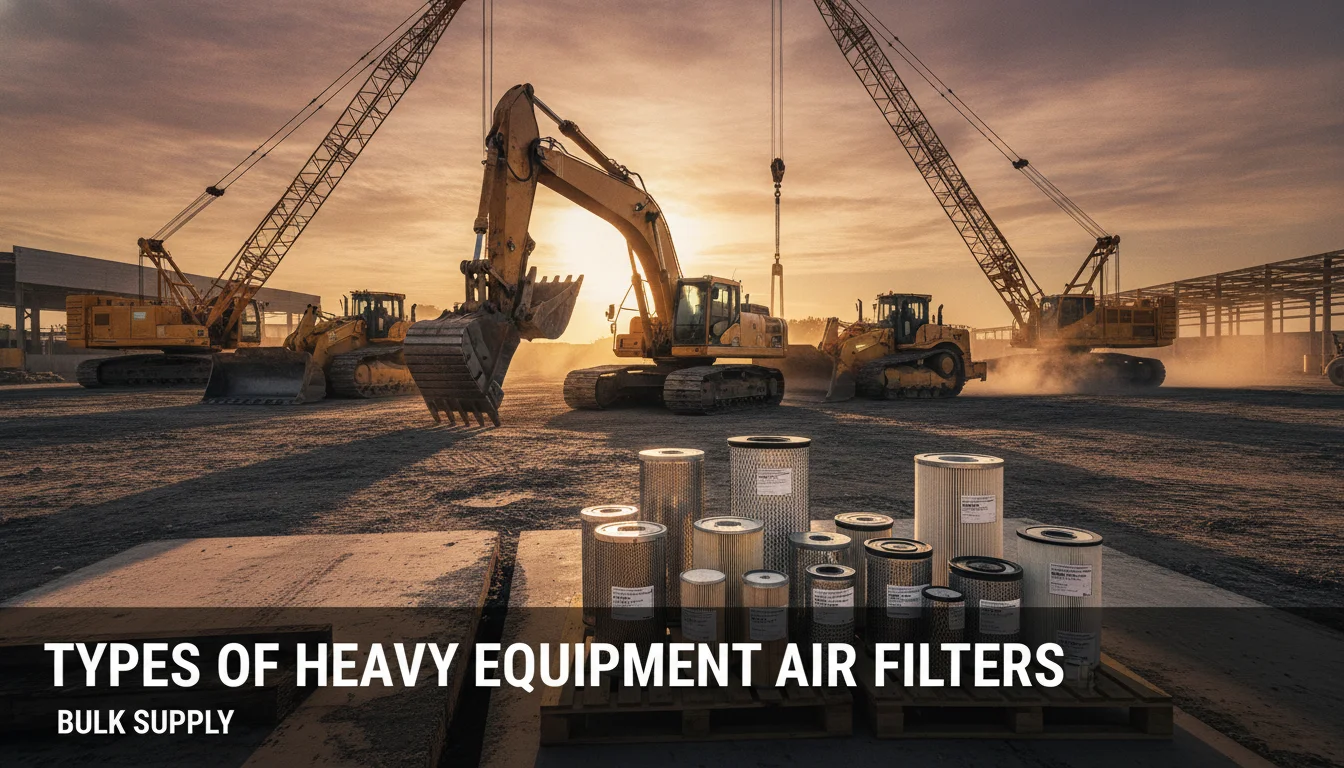
The right filter type depends on your operating environment, maintenance schedule, and total cost targets. Three main categories cover the majority of heavy equipment applications.
1. Disposable Air Filters
Disposable air filters are single-use units, typically constructed from pleated cellulose or synthetic media, and they're the most common choice for fleet maintenance programs. They're straightforward to replace during scheduled service intervals and deliver consistent filtration performance from the moment they're installed. The trade-off is ongoing consumable cost, which is exactly why bulk purchasing makes sense for fleets running multiple machines.
2. Washable Air Filters
Washable filters use synthetic or foam media that can be cleaned and reinstalled multiple times. They're a practical option for remote operations where resupply logistics are difficult. Cleaning requires rinsing with water, allowing the filter to dry completely, and inspecting the media for tears before reinstallation. Per the manufacturer's service instructions, never reinstall a wet filter: moisture in the intake system causes its own set of problems.
3. HEPA-Grade Filters
High-Efficiency Particulate Air filters capture particles down to 0.3 microns. According to manufacturer specifications, HEPA-grade media achieves 99.97% particle capture efficiency at that threshold. These filters are appropriate for equipment operating in environments with extreme fine-dust concentrations, such as underground mining, cement plants, or silica-heavy excavation sites. They carry a higher unit cost, so bulk sourcing is particularly valuable when HEPA filters are part of your standard maintenance kit.
What to Look For When Buying Heavy Equipment Air Filters in Bulk
Sourcing heavy equipment air filters bulk requires more than finding the lowest price per unit. Four criteria determine whether a bulk order actually delivers value.
1. Material Quality
Filter media must withstand the temperature swings, vibration, and sustained airflow demands of heavy machinery engines. Look for reinforced end caps, robust gasket seals, and media that maintains structural integrity under high-restriction conditions. A filter that collapses under load is worse than no filter at all: it sends unfiltered air directly into the engine.
2. OEM Compatibility
Cross-reference every filter against the OEM part number for your specific equipment model. A Caterpillar 320 excavator, a Komatsu PC200, and a Volvo EC220 each require different filter geometries and media specifications. Ordering the wrong filter in bulk quantities is a costly error. At 3GEN Export, we maintain cross-reference databases for Caterpillar, Komatsu, Volvo, Atlas Copco, and 40+ additional brands to eliminate compatibility risk before your order ships.
3. Price Range and Bulk Tiers
Based on competitor market data, individual heavy equipment air filters range from roughly $45 to $175 per unit at retail pricing, depending on filter size, media type, and brand. Bulk orders typically unlock tiered pricing that reduces per-unit cost meaningfully. Carquest part numbers such as 83035 and 83036 are listed at $56.99 to $64.99 per unit at single-unit pricing; volume orders bring that figure down. Plan your bulk quantities around your fleet's service interval schedule to maximize the discount without overstocking perishable inventory.
4. Lead Time and Supply Chain Reliability
A bulk order that arrives three months late doesn't prevent downtime. Confirm your supplier's actual stock position, not just catalog availability, before committing to a large purchase. 3GEN Export maintains ready-to-ship inventory with global 5-day delivery, which matters when a project deadline doesn't move because a filter is on backorder.
Top Brands for Heavy Equipment Air Filters
Three brands dominate the heavy equipment air filtration market and are the most commonly specified in OEM service documentation.
| Brand | Filter Types | Key Features | Typical Price Range (Single Unit) |
|---|---|---|---|
| Donaldson | Disposable, Washable | OEM-grade filtration, heavy-duty construction, wide equipment compatibility | $10 - $150 |
| WIX | Disposable | Engineered for heavy-duty applications, consistent performance across brands | $8 - $175 |
| Carquest | Disposable, Washable | Cross-references to WIX and OEM part numbers, strong bulk availability | $45 - $175 |
Donaldson's construction filtration line covers engine air, hydraulic, fuel, and lube filtration, making them a practical single-source supplier for sites running mixed fleets. WIX heavy-duty filters are widely stocked and cross-reference cleanly to OEM specifications for Caterpillar, Komatsu, and Volvo equipment. Carquest heavy-duty air filters, such as the 83035 (replacing WIX 49035 for John Deere AT390262) and the 83164 (for John Deere 9660STS and 9760STS with 6081 diesel engines), are well-documented in cross-reference catalogs and available through multiple supply channels.
"In the demanding world of heavy machinery and construction equipment, reliable filtration is crucial. A comprehensive range of heavy equipment filters ensures optimal performance, protection, and longevity for valuable machinery." - Iron Wing Parts, Heavy Equipment Filters Overview
Pros and Cons of Buying Heavy Equipment Air Filters in Bulk
Bulk purchasing is the right strategy for most fleet operators, but it's worth understanding both sides before committing to a large order.
Pros
- Lower per-unit cost: Volume pricing tiers reduce what you pay per filter, which adds up quickly across a large fleet.
- Reduced downtime risk: On-site inventory means a filter change never waits on a supplier's lead time.
- Simplified procurement: Fewer purchase orders, fewer supplier interactions, and predictable inventory management.
- Better supplier leverage: Large orders give you negotiating power on pricing, lead times, and shipping terms.
Cons
- Upfront capital commitment: Bulk orders tie up working capital in inventory. Ensure your cash flow supports the purchase before ordering.
- Compatibility risk: A compatibility error on a bulk order is expensive. Verify OEM part numbers before placing the order, not after.
- Storage requirements: Filters must be stored in dry, clean conditions away from direct sunlight and chemical exposure. Improper storage degrades filter media before installation.
Care and Maintenance of Heavy Equipment Air Filters
Proper filter maintenance extends service intervals and protects the engine investment between replacements.
1. Regular Inspection
Inspect air filters at every scheduled service interval and after any operation in unusually dusty conditions. A visually clean filter can still be partially blocked. If your equipment has a restriction indicator on the intake system, treat it as a hard replacement trigger, not a suggestion. A clogged filter forces the engine to work harder, increases fuel consumption, and can allow bypass air to carry contaminants into the intake.
2. Cleaning Washable Filters
Follow the manufacturer's cleaning procedure exactly. Typically this means rinsing from the clean side outward with low-pressure water, not compressed air, which can drive particles deeper into the media. Allow the filter to dry completely before reinstallation. A damp filter installed in a running engine is a maintenance error that creates more problems than it solves.
3. Replacement Scheduling
As of 2026, most OEM service bulletins for heavy construction equipment recommend replacing disposable air filters at intervals tied to operating hours rather than calendar time, since a machine working in a quarry accumulates filter load far faster than one on a paved urban site. Build your bulk order quantities around your fleet's actual operating-hour data, not a generic calendar schedule.
4. Record Keeping
Maintain a filter replacement log for each machine in your fleet. This data identifies equipment operating in abnormally high-dust conditions, validates your bulk order quantities against actual consumption, and provides documentation for warranty claims if engine damage occurs.
"According to manufacturer specifications, air filter service intervals for heavy equipment should be based on operating conditions and restriction indicator readings, not fixed calendar periods alone." - OEM Service Bulletin guidance, general industry practice
How to Order Heavy Equipment Air Filters in Bulk from 3GEN Export
Ordering heavy equipment air filters bulk through 3GEN Export follows a straightforward process designed for B2B procurement teams.
- Identify your equipment models and OEM part numbers. Pull the air filter part numbers from your equipment's service manual or existing filter housings. If you're unsure, our team can cross-reference by machine model and serial number.
- Submit a bulk inquiry. Contact us with your part numbers, required quantities, and delivery destination. We'll confirm stock availability and provide volume pricing within one business day.
- Review compatibility confirmation. We cross-check your part numbers against our OEM compatibility database before the order is processed. This step eliminates the most common and costly bulk ordering error.
- Confirm order and shipping terms. We ship globally with 5-day delivery on in-stock items. For large orders, we can coordinate freight consolidation to reduce shipping cost per unit.
- Receive and inspect your order. All filters ship in original or OEM-equivalent packaging. Inspect on arrival and log receipt into your inventory management system.
Frequently Asked Questions
Where can I buy bulk air filters for heavy equipment?
You can source heavy equipment air filters bulk from specialized filtration suppliers, industrial parts distributors, and global B2B exporters like 3GEN Export. For fleet procurement teams, a dedicated heavy equipment parts supplier is preferable to general retail channels because you get OEM part number cross-referencing, volume pricing, and reliable lead times. 3GEN Export ships to construction and mining operations worldwide with 5-day global delivery.
Where can I buy the cheapest air filters for heavy equipment?
The lowest per-unit price on heavy equipment air filters bulk orders typically comes from volume purchasing through a B2B supplier rather than retail channels. Based on market data, single-unit retail pricing on heavy-duty filters ranges from roughly $45 to $175 depending on the filter and brand. Volume orders reduce that figure. Be cautious with the cheapest options: filters that don't meet OEM specifications can void engine warranties and cause premature wear that costs far more than the savings on the filter itself.
What is the strongest air filter for heavy equipment?
HEPA-grade filters offer the highest filtration efficiency, capturing particles down to 0.3 microns at 99.97% efficiency according to manufacturer specifications. For most heavy equipment applications, a properly rated pleated synthetic filter matched to the OEM specification delivers the right balance of filtration efficiency and airflow. HEPA-grade filters are most appropriate for extreme environments such as underground mining, cement production, or silica-heavy excavation.
How often should I replace heavy equipment air filters?
Replacement intervals depend on operating conditions, not just calendar time. Equipment running in quarries, demolition sites, or arid environments will load filters much faster than machines on standard construction sites. Follow your OEM service bulletin for hour-based intervals and treat restriction indicator readings as hard replacement triggers. Washable filters can be cleaned and reinstalled multiple times, but inspect the media carefully each time for tears or deformation.
What are the benefits of buying air filters in bulk for a fleet?
Buying heavy equipment air filters bulk reduces per-unit cost through volume pricing, eliminates the risk of downtime caused by filter shortages, and simplifies procurement by consolidating orders. For fleet operators managing multiple machines across remote or international project sites, on-site filter inventory is a direct operational advantage. It also gives procurement teams leverage to negotiate better terms with suppliers on pricing and delivery.