
Heavy Equipment Alternator and Starter Guide
Heavy equipment alternator and starter parts for CAT, Komatsu & Volvo. OEM-quality, fast global delivery. Compare specs, brands & pricing at 3genexport.
Loading article…
Article Not Found
The article you're looking for doesn't exist or may have been removed.
Back to BlogKey Takeaways
- A reliable heavy equipment alternator and starter is essential for consistent engine starts and stable electrical output across construction, mining, and energy applications.
- OEM parts guarantee exact fitment; quality aftermarket options from brands like Leece Neville, Mahle, Denso, and Road Choice offer competitive pricing without sacrificing performance.
- Match amperage, voltage (12V or 24V), and mounting style (J-mount or pad mount) to your specific machine before ordering.
- Pricing for alternators and starters spans a wide range depending on brand, output rating, and OEM versus aftermarket sourcing.
- Routine inspections of belts, connections, and voltage output can extend service life significantly and prevent costly unplanned downtime.
- As of 2026, DENSO has expanded its heavy-duty aftermarket portfolio to cover applications from Case IH, Cummins, John Deere, Komatsu, and New Holland, among others.
Heavy equipment alternator and starter systems are the electrical backbone of any diesel-powered machine. These two components work in sequence: the starter cranks the engine to life, and the alternator takes over to keep the battery charged and all onboard systems powered.
Understanding Heavy Equipment Alternators
A heavy equipment alternator generates electrical power while the engine runs, converting mechanical energy into electricity that charges the battery and supports every onboard system, from lighting to engine sensors and fuel injection.
Modern excavators, loaders, graders, and dozers carry far more electrical load than machines built a generation ago. Headlights, air conditioning, navigation systems, and engine management sensors all draw continuous current. Without a properly functioning alternator, the battery drains, the starter motor loses the power it needs, and the machine stops working entirely.
"Alternators play the key role of keeping a machine's battery charged. When a machine's alternator stops working, the battery may lose its charge. In turn, the starter motor cannot function and the machine won't start." - MechLink, The Crucial Role of Alternators in Heavy Equipment, 2025
How Alternators Work
At the core of every alternator is electromagnetic induction. The engine drives a belt connected to the alternator's rotor. That rotor spins inside a set of magnetic coils called the stator, generating alternating current (AC). A built-in rectifier converts that AC to direct current (DC) for battery charging. A voltage regulator keeps output within a safe range, protecting sensitive electronics from voltage spikes.
Note: all-electric heavy equipment, such as battery-powered skid steers and forklifts, does not use a conventional alternator. This guide covers diesel-powered machines.
Key Specifications to Consider
- Amperage output: Higher-output machines require alternators rated for the full electrical load. Heavy-duty units range from 140 amps up to 330 amps or more for demanding applications.
- Voltage: Most heavy equipment operates on 12V or 24V systems. Confirm your machine's system voltage before ordering.
- Mounting style: Common options include J-mount and pad mount. Road Choice, for example, offers both configurations across its alternator line.
- Brushed vs. brushless: Brushless designs generally offer longer service life in high-load, high-temperature environments.
Common Brands and Models
Leece Neville, Mahle (Letrika/Iskra), Denso, Bosch, Delco, and Prestolite are the most widely specified brands for heavy equipment alternators. Each covers distinct machine families:
| Brand | Typical Applications | Voltage Options | Notable Models |
|---|---|---|---|
| Leece Neville | Trucks, buses, fire/emergency, RV | 12V | 4860J Series (200A), 4800/4900 Series |
| Mahle (OEM) | Volvo, Scania, Deutz, John Deere, Massey Ferguson | 12V / 24V | MG382 (24V Volvo/Scania), MG148 (330A heavy duty) |
| Denso | John Deere, Komatsu, Yanmar, Case IH, New Holland | 12V / 24V | Expanded 2026 aftermarket portfolio |
| Bosch | School bus, agriculture, industrial, transit | 12V | AL9963SB / AL9962SB (200A) |
| Delco | Medium and heavy duty, industrial | 12V | 28SI (180A), 22SI, 35SI HP Series (140A) |
| Road Choice | All-makes heavy duty trucks | 12V / 24V | ALT8607 (140A 35SI), ALT8718 (160A 24SI) |
Understanding Heavy Equipment Starters
A heavy equipment starter draws power from the battery to engage the engine's flywheel, converting electrical energy into the mechanical force needed to crank the engine and initiate combustion.
Once the engine fires and reaches self-sustaining speed, the starter disengages automatically. From that point, the alternator takes over all electrical duties. The starter sits idle until the next key cycle, but it must perform reliably every single time, often in extreme cold, extreme heat, or after long idle periods.
How Starters Work
When the operator turns the key or presses the start button, a solenoid closes the circuit between the battery and the starter motor. The motor drives a pinion gear into the flywheel ring gear, spinning the engine until combustion begins. Gear reduction starters use an intermediate gear set to multiply torque, making them well suited to large-displacement diesel engines. Direct drive starters are simpler but require higher current draw to produce equivalent torque.
Key Specifications to Consider
- Torque rating: Large diesel engines require high-torque starters. Match the torque spec to your engine displacement and compression ratio.
- Type: Gear reduction starters deliver more torque per amp and are preferred for heavy equipment. Direct drive starters suit lighter applications.
- Overcrank protection: Some Road Choice starters include built-in overcrank protection to prevent motor burnout during extended cranking attempts.
- Drive-end housing: Rotatable drive-end housings simplify installation across multiple makes and models.
- Compatibility: Always cross-reference the OEM part number against your engine model and serial number.
Common Brands and Models
Road Choice, Denso, and Bosch lead the heavy equipment starter market. As of 2026, DENSO's expanded aftermarket portfolio covers starter applications for Case IH combine harvesters and wheel loaders, Cummins ISC, ISF, ISL, and QSB engines, John Deere tractor series 5, 7, and 9, Komatsu forklift models FD25 through FD50, and multiple New Holland platforms.
| Brand | Typical Applications | Notable Models |
|---|---|---|
| Road Choice | Medium and heavy duty trucks, all-makes | STA6919, STA6907, STA6872, STA6881 (39MT series) |
| Denso | Case IH, Cummins, John Deere, Komatsu, New Holland | 2026 expanded heavy-duty aftermarket range |
| Bosch | Commercial vehicles, construction equipment | Various heavy-duty references |
OEM vs. Aftermarket Parts
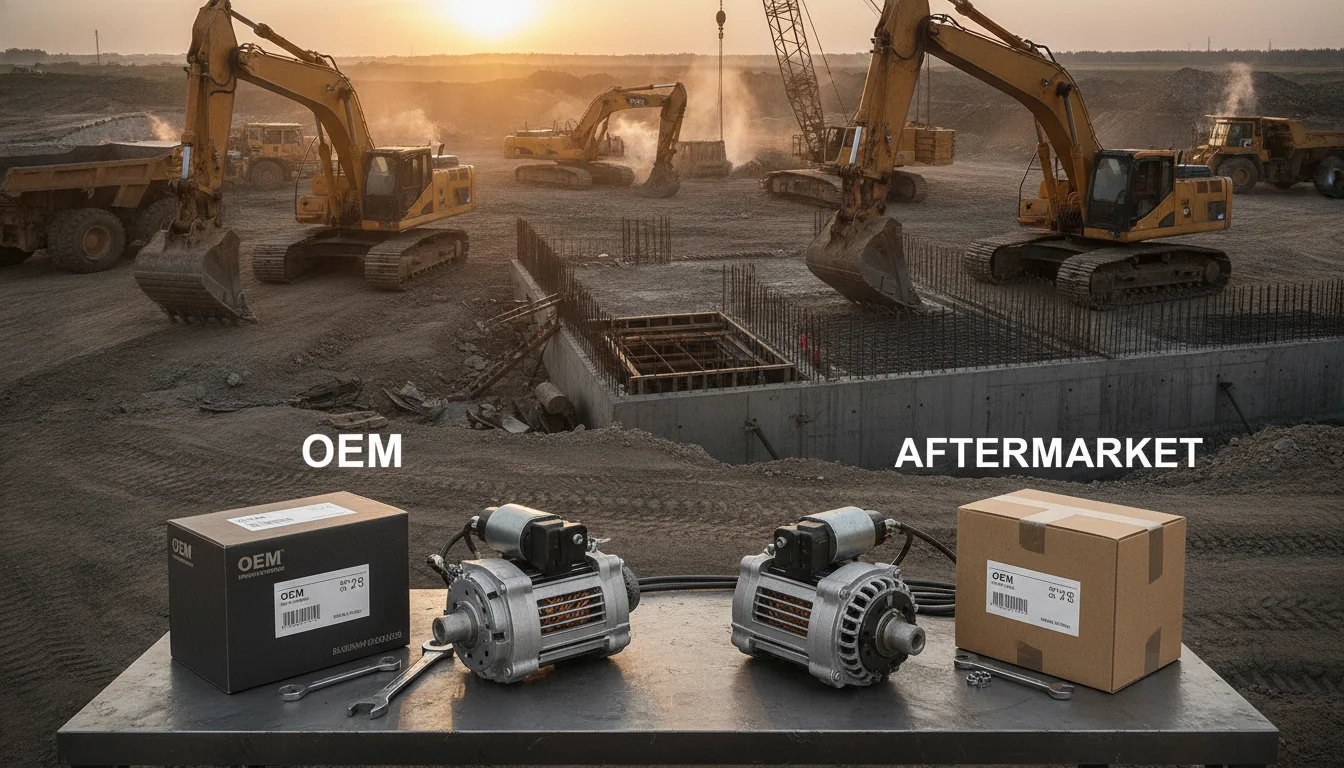
Choosing between OEM and aftermarket for your heavy equipment alternator and starter comes down to three factors: budget, availability, and how critical the application is to your operation.
Pros and Cons of OEM Parts
Pros
- Designed and validated specifically for your machine model, guaranteeing exact fitment and electrical compatibility.
- Typically backed by a manufacturer warranty, reducing financial risk on high-value components.
- Performance matches original factory specifications, which matters on machines with tight electrical load tolerances.
Cons
- Higher purchase price compared to aftermarket alternatives.
- Lead times can be longer, especially for older or less common machine models.
- Availability may be limited in regions outside the OEM's primary distribution network.
Pros and Cons of Aftermarket Parts
Pros
- Significantly lower cost for equivalent performance, particularly from established brands like Leece Neville, Mahle, Denso, and Road Choice.
- Broader availability across global markets, reducing lead time for operations in remote regions.
- Quality aftermarket parts from reputable suppliers are engineered to OEM-equivalent standards and tested for demanding operating conditions.
Cons
- Quality varies widely between suppliers. Low-cost, unbranded units may fail prematurely under heavy load.
- Warranty terms differ by supplier and may not match OEM coverage.
- Incorrect cross-referencing can result in fitment issues if part numbers are not validated against machine serial numbers.
"According to DENSO, the heavy-duty starters and alternators are developed according to OE-based design principles for demanding operating conditions - the same engineering expertise applied to their original equipment supply." - Agritech Magazine, Heavy-Duty Starters and Alternators for Aftermarket Applications, 2026
Pros and Cons of Replacing vs. Rebuilding
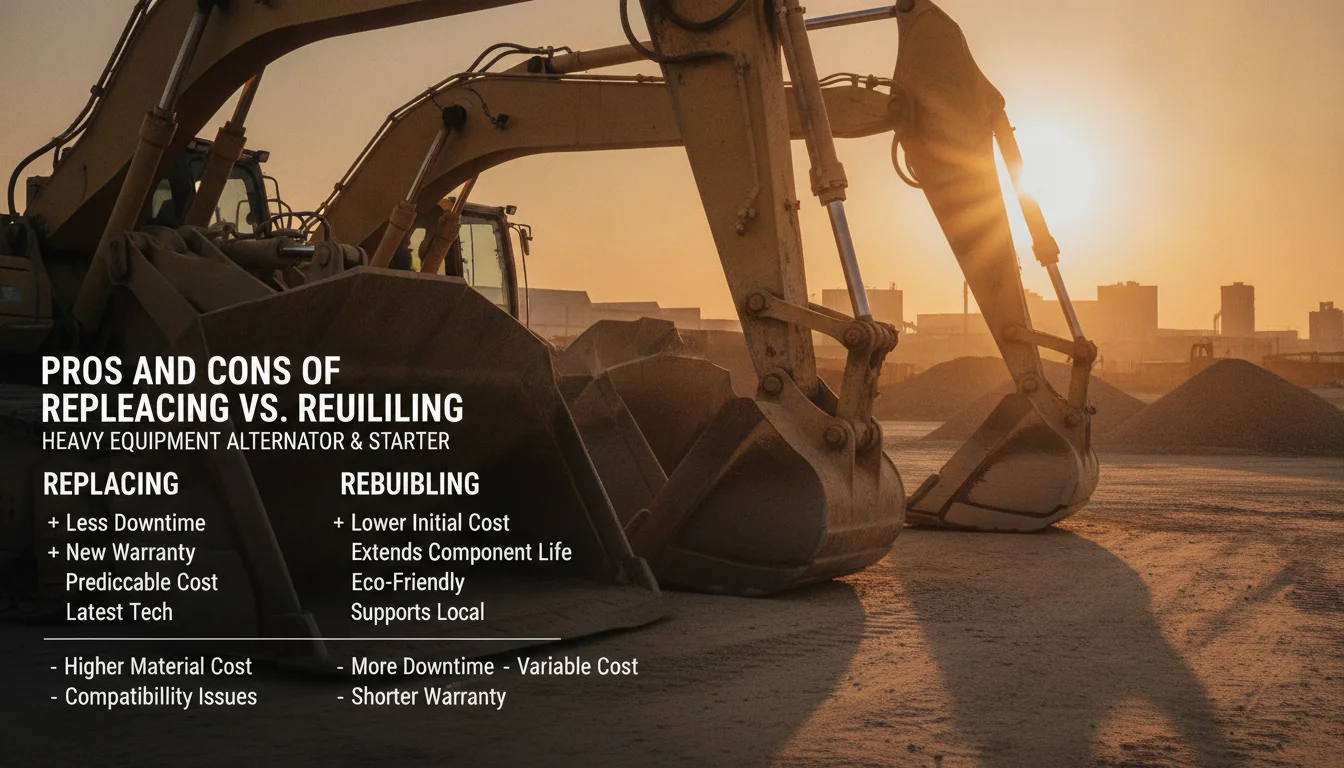
Pros
- New replacement units restore full rated output immediately, with no uncertainty about internal component condition.
- Rebuilt (remanufactured) units offer a cost-effective middle ground, often available for next-day delivery from specialist suppliers.
- Replacement eliminates the labor time and diagnostic risk associated with field repairs on electrical components.
Cons
- New OEM replacements carry the highest upfront cost.
- Rebuilt units depend on the quality of the remanufacturing process. Source only from suppliers with documented rebuild standards.
- In remote job sites, neither option may be immediately available, making preventive replacement before failure the smarter strategy.
Price Ranges for Alternators and Starters
Pricing for a heavy equipment alternator and starter varies based on output rating, brand, and whether the unit is OEM, aftermarket, or remanufactured. The figures below are drawn from current market listings.
Alternator Price Reference Points
| Unit | Brand / Series | Application | Price |
|---|---|---|---|
| Road Choice ALT8718 160A 24SI | Road Choice | Heavy duty trucks | $224.20 |
| Road Choice ALT8719 24SI HP | Road Choice | Heavy duty trucks | $220.97 |
| Road Choice ALT8609 140A | Road Choice | Heavy duty trucks | $379.49 |
| Road Choice ALT8614 36SI Series | Road Choice | Heavy duty trucks | $389.61 |
| Road Choice ALT8607 35SI 140A | Road Choice | Heavy duty trucks | $346.98 |
| Delco 28SI 180A | Delco | Medium and heavy duty | $609.95 |
| Mahle MG148 330A | Mahle OEM | Peterbilt, Mack, Freightliner, Kenworth, International | $1,069.95 |
| Mahle MG382 24V | Mahle OEM | Volvo heavy duty bus, Scania | $1,499.95 |
| Leece Neville 4962PA 320A | Leece Neville | School bus | $1,899.50 |
| Leece Neville 4890JB 320A | Leece Neville | Bus, fire and emergency | $1,949.95 |
Starter Price Reference Points
| Unit | Brand / Series | Application | Price |
|---|---|---|---|
| Road Choice STA6924 39MT | Road Choice | Heavy duty trucks | $404.50 |
| Road Choice STA6881 39MT | Road Choice | Heavy duty trucks | $426.01 |
| Road Choice STA6872 39MT S | Road Choice | Heavy duty trucks | $440.54 |
| Road Choice STA6907 39MT P | Road Choice | Heavy duty trucks | $437.02 |
| Road Choice STA6919 39MT P | Road Choice | Heavy duty trucks | $480.77 |
Pro Tip: Always verify the OEM part number and cross-reference it against your machine's model and serial number before purchasing. A mismatched amperage rating or mounting style can result in fitment failure or electrical system damage.
Where to Buy
For global procurement teams, sourcing a heavy equipment alternator and starter through a specialist supplier with verified OEM cross-references and fast international shipping is the most reliable path. Local parts stores work for common applications, but for Caterpillar, Komatsu, Volvo, and other major brands, a dedicated heavy equipment parts supplier gives you access to a broader inventory and faster lead times.
Care and Maintenance of Alternators and Starters
Proper maintenance of your heavy equipment alternator and starter is the most cost-effective way to avoid unplanned downtime. Most failures are predictable and preventable with routine inspection.
Regular Inspections
- Check drive belts for cracking, glazing, or excessive wear. A slipping belt reduces alternator output and accelerates bearing wear.
- Inspect all wiring connections at the alternator and starter for corrosion, fraying, or loose terminals. Poor connections cause voltage drop and erratic charging.
- Examine mounting brackets for cracks or loose fasteners. Vibration from heavy equipment operation can loosen mounts over time.
- Test battery voltage and charging voltage regularly. If the alternator is not maintaining proper charge voltage, investigate before the battery fails completely.
Cleaning and Maintenance
- Keep both components clear of mud, oil, and debris. Contamination traps heat and accelerates wear on brushes, bearings, and windings.
- Blow out dust and debris from cooling vents with compressed air during scheduled service intervals.
- Replace worn brushes and bearings proactively rather than waiting for complete failure. This is especially relevant for machines operating in high-cycle environments like mining or quarrying.
Pro Tip: If a machine has been sitting idle for an extended period, inspect the starter solenoid contacts before the next start attempt. Corrosion on solenoid contacts is a common cause of no-start conditions on equipment that has been stored.
Brand Comparison: Which Alternator or Starter Is Right for Your Fleet?
Selecting the right brand for your heavy equipment alternator and starter depends on your machine make, operating environment, and procurement priorities. Here is a practical comparison based on application coverage and market positioning.
| Brand | Strengths | Best For | OEM or Aftermarket |
|---|---|---|---|
| Leece Neville | High-output alternators (200A-320A), proven in emergency and bus applications | Fire, emergency, bus, heavy truck | Aftermarket / OEM-equivalent |
| Mahle (Letrika/Iskra) | True OEM supply for Volvo, Scania, Deutz, John Deere, Massey Ferguson | Agricultural and European heavy equipment | OEM |
| Denso | Broad coverage across Case IH, Cummins, Komatsu, New Holland; OE-based design | Construction, agriculture, industrial | OEM and aftermarket |
| Road Choice | Competitive pricing, all-makes coverage, brushed/brushless and J-mount/pad mount options | Fleet procurement, all-makes heavy duty | Aftermarket |
| Bosch | Reliable performance across commercial and agricultural applications | School bus, agriculture, transit | OEM and aftermarket |
| Delco | Widely stocked, strong medium and heavy duty coverage | Industrial and heavy duty trucks | OEM and aftermarket |
Diagnosing Alternator and Starter Failures
Knowing whether you have a failing alternator or a failing starter saves diagnostic time and gets the right part ordered faster. The symptoms are distinct once you know what to look for.
Signs of a Failing Alternator
- Dimming or flickering lights during operation.
- Battery warning light illuminated on the instrument panel.
- Electrical accessories behaving erratically or cutting out.
- Battery draining repeatedly despite being in good condition.
- Unusual whining or grinding noise from the alternator area (often a failing bearing).
Signs of a Failing Starter
- Clicking sound when the key is turned, with no engine crank (solenoid engaging but motor not turning).
- Engine cranks slowly or intermittently.
- Starter engages but does not disengage after the engine starts (freewheeling failure).
- Grinding noise during cranking (worn pinion or ring gear).
- No response at all when the key is turned (could be solenoid, wiring, or motor failure).
Pro Tip: Before condemning the alternator or starter, test the battery and all cable connections first. A weak battery or corroded ground cable mimics both alternator and starter failure symptoms. This is the most common misdiagnosis in field troubleshooting.
Frequently Asked Questions
How much do an alternator and starter cost?
Pricing for a heavy equipment alternator and starter varies widely by brand, output rating, and sourcing. Entry-level aftermarket alternators for heavy trucks start below $250, while high-output OEM units from Leece Neville or Mahle reach $1,499.95 to $1,949.95. Road Choice 39MT starters for heavy duty applications are priced in the $400 to $480 range based on current market listings.
Do a starter and alternator work together?
Yes, they work in sequence rather than simultaneously. The starter draws battery power to crank the engine. Once the engine runs, the alternator generates electricity to recharge the battery and power all onboard systems. A failed alternator will eventually drain the battery to the point where the starter can no longer function.
How do you tell if it's a bad starter or alternator?
A failing starter typically produces a clicking sound or slow crank when the key is turned, with the engine not starting. A failing alternator usually shows up as dimming lights, a battery warning light, or repeated battery drain while the machine is running. Always test the battery and cable connections first, as these symptoms overlap with battery and wiring faults.
Can an alternator be used as a starter?
No. Alternators and starters are engineered for completely different functions and cannot be interchanged. An alternator generates AC electricity from mechanical rotation. A starter converts DC electrical energy into mechanical torque to crank the engine. Their internal designs, gear ratios, and electrical characteristics are incompatible.
What should I look for when buying a heavy equipment alternator and starter?
Cross-reference the OEM part number against your machine's model and serial number. Confirm voltage (12V or 24V), amperage output, and mounting style (J-mount or pad mount). Choose a supplier that validates fitment against manufacturer catalogs and offers fast shipping to minimize downtime. For global procurement, prioritize suppliers with verified inventory and international logistics capability.
How often should I replace my alternator or starter?
There is no fixed replacement interval for heavy equipment alternators and starters. Service life depends on operating hours, load cycles, environmental conditions, and maintenance quality. Inspect both components at every major service interval and replace proactively if output voltage drops, cranking performance degrades, or physical wear is visible. Waiting for complete failure on a working machine is always the more expensive option.
Ready to source OEM-quality alternators and starters for your fleet? Shop heavy equipment alternator and starter components with verified fitment and global 5-day delivery at 3genexport.com. Our team cross-references OEM part numbers for Caterpillar, Komatsu, Volvo, and 40+ brands to get you the right part, fast.