
Heavy Equipment Cooling System Parts: Buyer's Guide
Source the right heavy equipment cooling system parts: radiators, pumps, thermostats & more. OEM-quality, global 5-day delivery. Shop 3genexport.com.
Loading article…
Article Not Found
The article you're looking for doesn't exist or may have been removed.
Back to BlogKey Takeaways
- Core components: radiators, water pumps, thermostats, fan drives, hoses, and reservoirs form every heavy-duty cooling circuit.
- Match parts to your application: construction, agriculture, forklifts, and skid steers each place different thermal demands on cooling components.
- Verify compatibility rigorously: cross-reference OEM part numbers or provide make, model, and serial number to your supplier before ordering.
- Supplier reliability matters: look for same-day shipping, at least a one-year warranty, and proven aftermarket brands like Modine or Denso.
- Preventive maintenance pays: regular coolant analysis and external cleaning prevent the overheating failures that destroy engines and budgets.
Heavy equipment cooling system parts are the components that regulate engine temperature by circulating coolant, dissipating heat, and protecting against freezing, boiling, and corrosion. This guide covers every major component, pricing tiers, compatibility checks, and maintenance practices to help procurement teams source the right parts fast.
Why Heavy Equipment Cooling System Parts Are Critical
A single overheating event can warp cylinder heads or seize pistons, producing repair bills that routinely exceed $10,000. Heavy-duty cooling systems run as closed-loop networks: pressurized coolant absorbs combustion heat, carries it to the radiator, and releases it to the airstream before cycling back through the engine. Every link in that chain must hold under continuous load, high vibration, and extreme ambient temperatures.
According to manufacturer service data, a properly maintained cooling circuit extends engine service life and sustains rated power output even during prolonged heavy-duty cycles. Suppliers such as HNC Truck Parts back their components with a one-year warranty on standard parts and a two-year warranty on charge air coolers, which reflects the durability expected from quality replacement components. For fleets running Caterpillar, Komatsu, Volvo, or Doosan machines, sourcing verified OEM-grade parts is not optional: it is the baseline for keeping iron in the field.
"Cooling system failures account for a disproportionate share of unplanned engine downtime in heavy construction and mining fleets. Proactive replacement of thermostats, hoses, and water pump seals is consistently the lowest-cost intervention available to maintenance teams." - OEM Service Engineering Guidance, Heavy-Duty Diesel Applications
How a Heavy Equipment Cooling System Works
Understanding coolant flow helps you diagnose failures faster and order the right replacement parts the first time. The circuit operates in a continuous loop driven by the water pump.
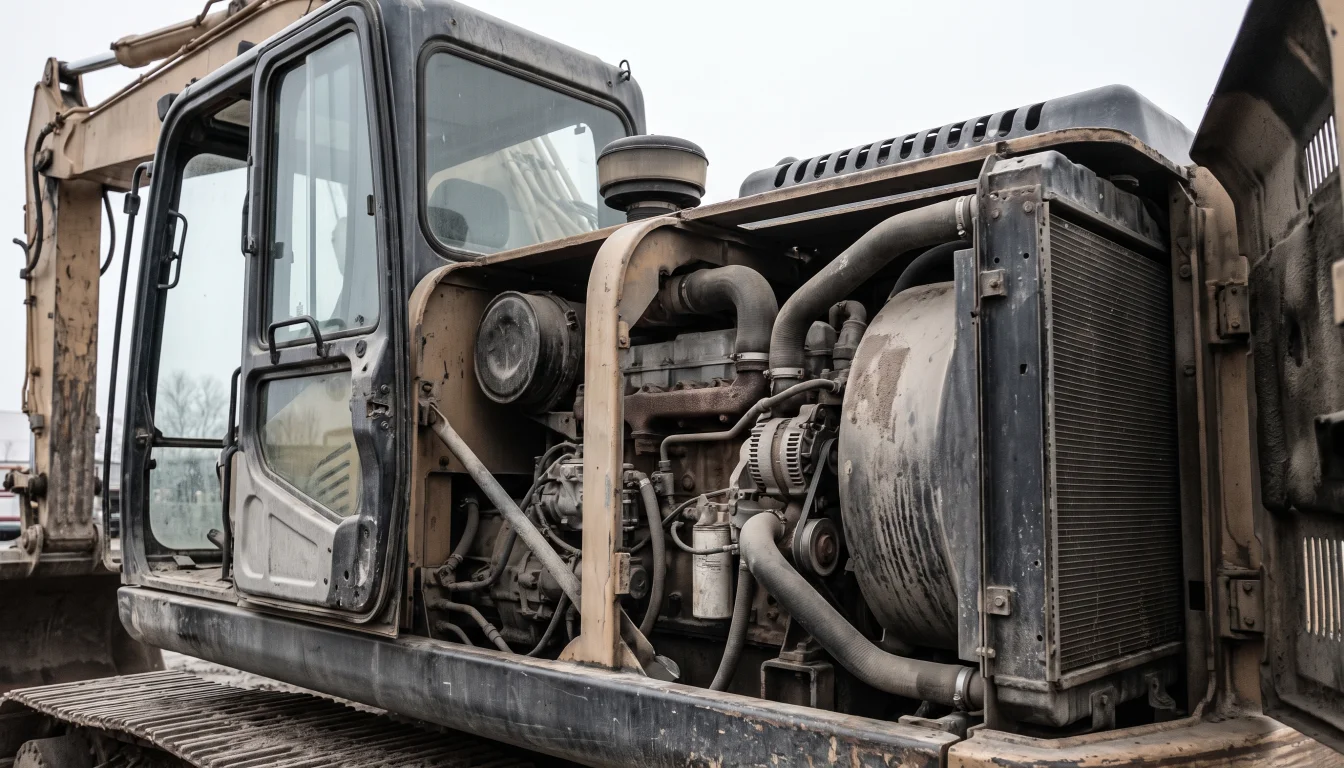
Cold coolant exits the lower radiator tank and enters the engine block, where it absorbs heat from combustion chamber walls and cylinder liners. The thermostat stays closed while the engine is cold, forcing coolant to recirculate through a bypass loop until operating temperature is reached, typically 180-200°F (82-93°C) for heavy diesel engines. Once the thermostat opens, hot coolant flows to the upper radiator tank, passes through the core tubes, and transfers heat to air pulled through the fins by the fan. The cooled fluid returns to the water pump and the cycle repeats.
Charge air coolers (intercoolers) sit in a parallel circuit, cooling compressed intake air from the turbocharger before it enters the engine. Oil coolers handle a third thermal loop, protecting transmission and hydraulic fluid. Pressure caps on the surge tank raise the coolant's boiling point by maintaining 13-16 psi above atmospheric pressure, which is why a failed $4.60 cap can cause a boilover on a $500,000 excavator.
The 5 Main Components of a Heavy Equipment Cooling System
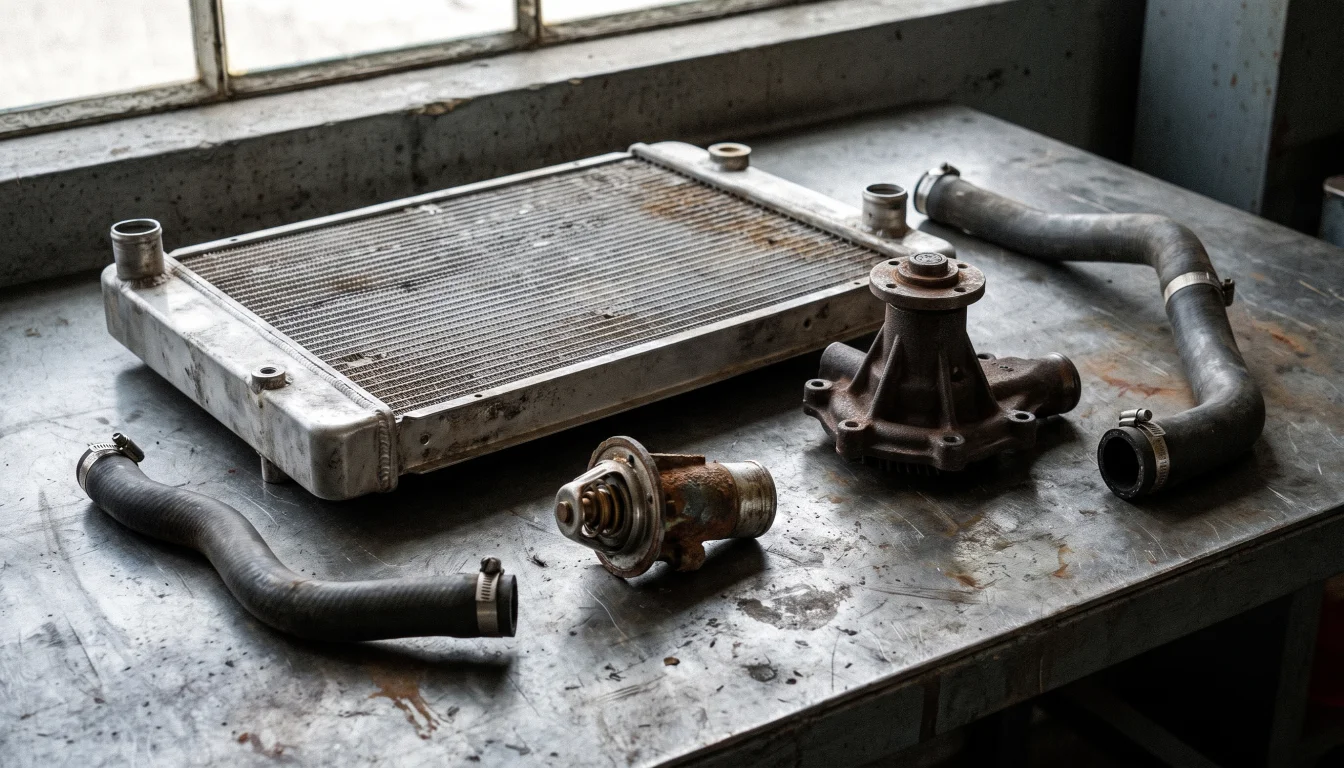
Every cooling circuit relies on five core component groups that work together. Here is what each one does and what it costs to replace.
Radiators
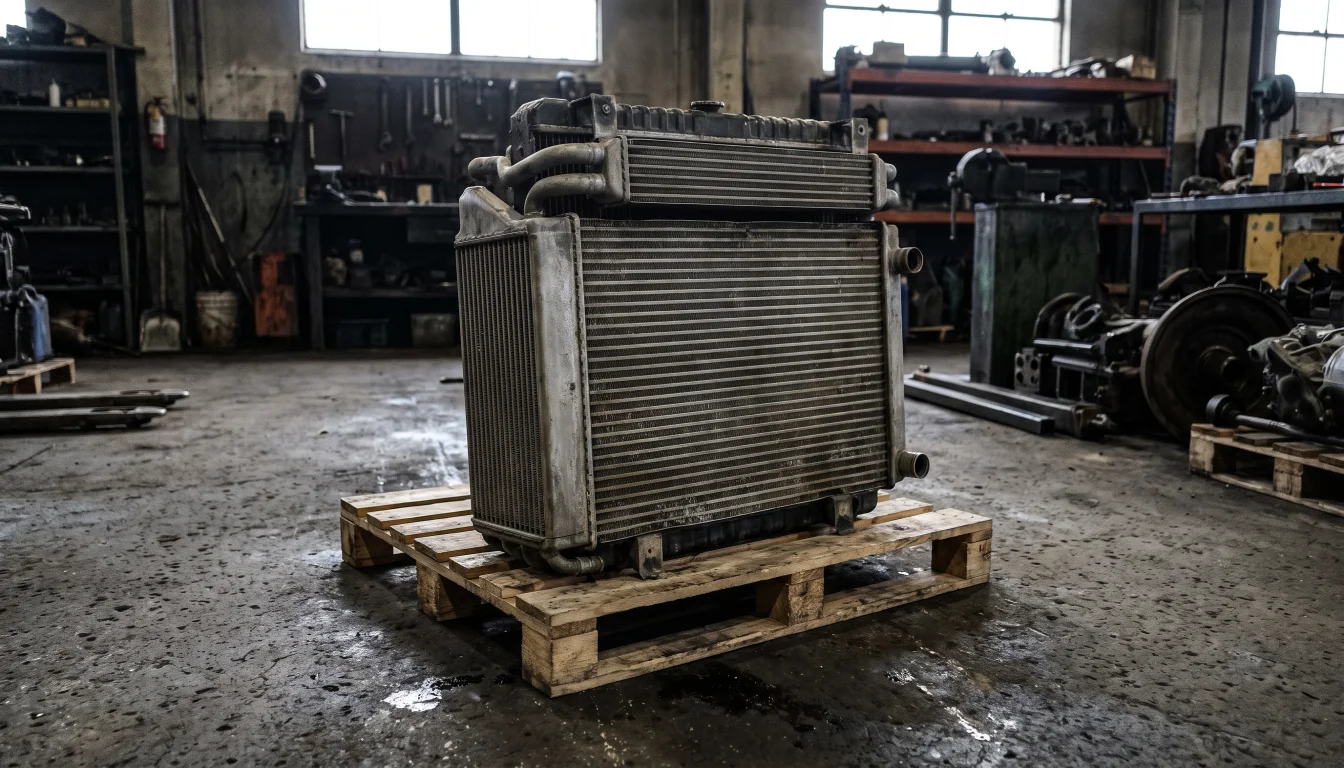
A radiator is the primary heat exchanger, transferring thermal energy from coolant to the airstream through a core of tubes and fins. Complete assemblies vary widely by machine size: a Doosan unit (part 440211-00747) lists at $999.99, while radiator caps are a low-cost consumable - a Ditch Witch 13-psi cap (part 159-137) sells for $4.60. Rocky Mount Radiator supplies modular cores for CAT equipment, allowing core replacement without buying a full assembly.
Material choice matters. Copper-brass cores offer superior heat transfer but add weight. Brazed aluminum cores are lighter and handle high-vibration environments well, making them the preferred choice for most modern construction equipment. Plastic-tank radiators cost less upfront but are more prone to cracking under thermal cycling.
Water Pumps
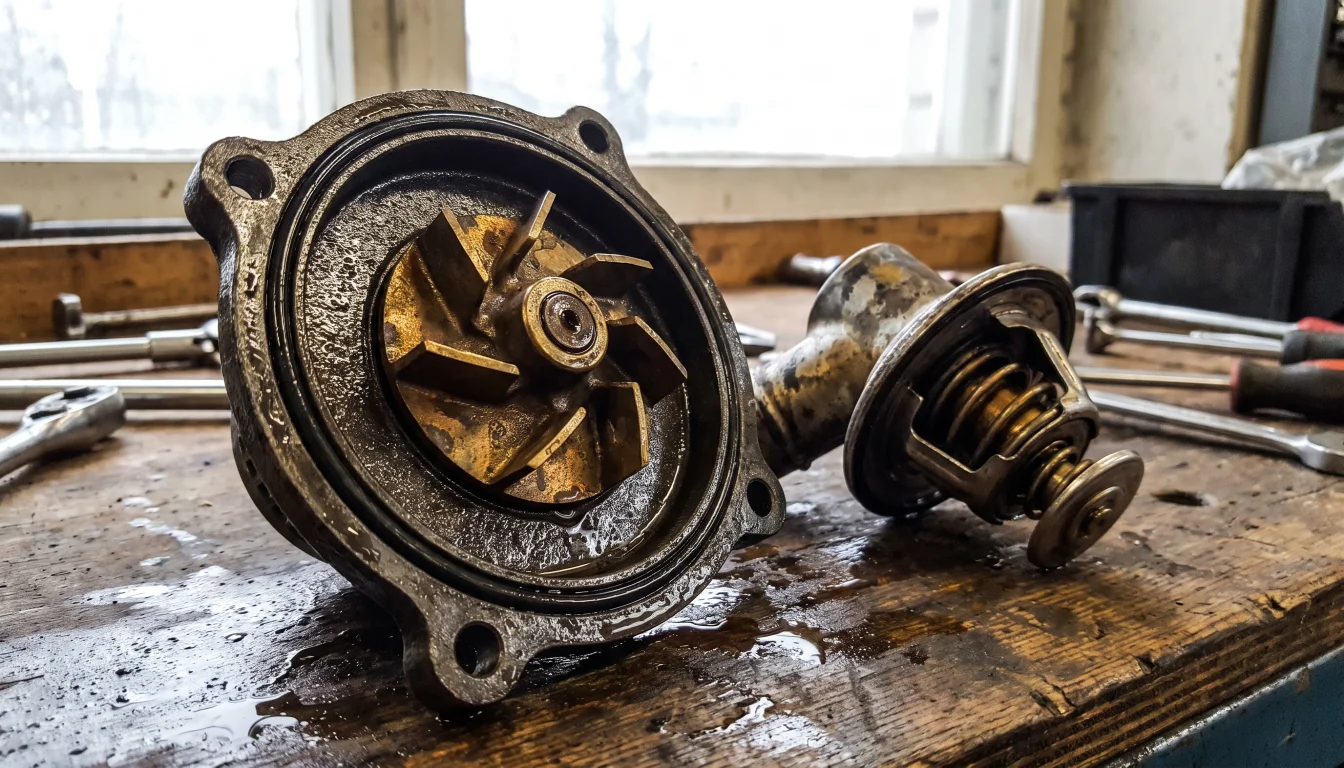
The water pump forces coolant through the entire circuit. Without it, flow stops and temperatures spike within minutes. A Volvo water pump (part 43907963) costs $210.13 as a direct replacement. Auxiliary 12V electric pumps for cab heating or supplemental cooling circuits run around $93.00. Always inspect the shaft seal and bearing play before reinstalling: a weeping seal is a warning, not a maintenance item to defer.
Thermostats
A thermostat is a temperature-sensitive valve that controls coolant flow between the engine and radiator. It is one of the lowest-cost parts in the system and one of the most common failure points. A Calorstat V6937 thermostat lists at $45.00; a Yanmar equivalent runs $52.44. A thermostat stuck closed causes rapid overheating. One stuck open causes the engine to run cold, increasing fuel consumption and accelerating wear on cylinder liners.
Fan Drives and Fans
Fans pull or push air through the radiator core. A SPAL 12V blow fan unit costs $95.00; larger side-channel fans for high-output applications reach $1,250.00. Fan clutches from Horton or BorgWarner engage based on coolant temperature or engine speed, reducing parasitic load when full cooling capacity is not needed. Viscous fan drives from these manufacturers are standard on many Caterpillar and Komatsu platforms.
Hoses and Clamps
Hoses carry pressurized coolant between all components. A Bobcat radiator hose costs $10.91 as an OEM replacement. Silicone aftermarket hoses from BH Tubes start at $8.00 per foot and outlast standard EPDM rubber in high-temperature applications. Constant-torque stainless clamps at $8.25 each maintain consistent sealing force as hoses expand and contract with temperature cycles. Replace clamps every time you replace a hose.
Additional Cooling System Components
Coolant Reservoirs and Surge Tanks
Reservoirs accommodate thermal expansion and provide a visual reference for coolant level. Mytee Products offers universal tanks ranging from $48.99 to $96.79. Custom stainless steel surge tanks for International trucks from BH Tubes cost $900.00, reflecting the precision fabrication required for high-pressure applications. Surge tanks on turbocharged diesel engines must handle both pressure and the return flow from the degas system.
Oil Coolers and Charge Air Coolers
Oil coolers protect hydraulic and transmission fluid from heat degradation. Prices for heavy-duty oil coolers typically fall in the $195-$567 range depending on flow capacity and machine application. Charge air coolers (intercoolers) reduce intake air temperature after the turbocharger, which directly increases engine efficiency and reduces thermal stress on pistons and rings. HNC Truck Parts offers a two-year warranty on charge air coolers, which signals the higher durability standard these components must meet.
OEM vs. Aftermarket: Which Should You Buy?
Aftermarket heavy equipment cooling system parts from reputable manufacturers often match OEM specifications at 30-50% lower cost. That is a defensible saving for fleet procurement teams managing dozens of machines. The key is sourcing from proven brands: Modine and AKG for radiators and coolers, Denso for water pumps and thermostats, Horton and BorgWarner for fan drives, and Gates for hoses and belts.
The risk with low-cost, unbranded aftermarket parts is inconsistent metallurgy and dimensional tolerances. A radiator core with slightly undersized tube walls will fail earlier under vibration. A water pump with a substandard shaft seal will weep coolant within the first 500 hours. Spending 15-20% more for a Modine or Denso part over a generic equivalent is almost always the better lifecycle decision.
"Per SAE heavy-duty cooling system standards, replacement components must meet or exceed the original equipment's pressure rating, flow capacity, and thermal efficiency to maintain engine warranty compliance. Substituting undersized aftermarket parts voids most OEM engine warranties." - SAE International, Heavy-Duty Cooling System Design Guidelines
Coolant Types and Chemical Compatibility
Using the wrong coolant is as damaging as a failed water pump. Heavy-duty diesel engines require low-silicate, SCA-precharged (Supplemental Coolant Additive) formulations to protect wet cylinder liners from cavitation erosion. Standard automotive antifreeze contains high silicate levels that deplete rapidly in diesel applications and leave abrasive deposits on liner surfaces.
As of 2026, three coolant categories dominate the heavy equipment market:
- Conventional (green) coolant: requires SCA top-up every 6-12 months. Low initial cost, high maintenance burden.
- Extended Life Coolant (ELC/OAT): organic acid technology, no SCA required, service intervals of 4-6 years or per OEM specification. Standard on most Volvo, Komatsu, and Caterpillar platforms.
- NOAT/HOAT hybrid coolants: combine organic and inorganic inhibitors. Common on older mixed fleets. Verify compatibility with your specific engine block material before switching.
Never mix coolant types. Mixing conventional and ELC coolants degrades the inhibitor package in both and can cause gel formation that blocks the water pump inlet. Always flush completely before switching formulations.
Cooling System Diagnostics: Pressure Testing and Block Tests
Before ordering replacement parts, confirm the failure source. Replacing a radiator when the actual leak is a cracked surge tank wastes money and time. Two field tests catch most cooling system failures quickly.
Pressure test procedure:
- Allow the engine to cool completely. Remove the radiator cap.
- Attach a cooling system pressure tester to the filler neck.
- Pump to the cap's rated pressure (typically 13-16 psi).
- Hold for 10-15 minutes. Any pressure drop indicates a leak in the system.
- Inspect all hoses, clamps, the water pump weep hole, the radiator core, and the head gasket area for seepage.
Block test (combustion gas check):
- With the engine warm and running, remove the radiator cap carefully.
- Hold a combustion leak detector (block tester) over the filler neck opening.
- Draw air through the tester fluid. A color change from blue to yellow indicates combustion gases in the coolant, confirming a head gasket failure or cracked block.
Industry maintenance data shows that pressure testing takes under 20 minutes and can prevent misdiagnosis that leads to ordering the wrong parts. Add it to your standard pre-order diagnostic checklist.
Rebuilding vs. Replacing Radiators
A complete radiator replacement is not always the right call. For machines where the tanks and end caps are intact but the core is damaged, re-coring is a cost-effective option. Specialty shops like Rocky Mount Radiator supply replacement cores that fit existing tank assemblies, cutting the repair cost to roughly 40-60% of a full assembly price.
Re-coring makes sense when: the tank material is aluminum or brass in good condition, the machine is older and full assemblies are on long lead times, or the core damage is limited to a specific section. It does not make sense when the tanks are cracked, the mounting brackets are corroded, or the machine is under active warranty. For most Caterpillar, Komatsu, and Volvo machines within their service life, a direct OEM-grade replacement assembly is the faster and more reliable path.
Compatibility Verification: Step-by-Step
Ordering the wrong part costs more than the part itself: return shipping, downtime extension, and administrative time add up fast. Follow these steps before placing any order.
- Record your equipment's make, model, and serial number. Serial number is critical: the same model year can have multiple cooling configurations depending on engine option and market region.
- Locate the OEM part number stamped on the old component or listed in the machine's service manual.
- Use the supplier's cross-reference tool or contact tech support with your OEM number. HNC Truck Parts uses a single-number-per-listing system: if your number appears in their search, it is a confirmed direct fit.
- Confirm key specifications: pressure rating (e.g., 13 psi for the cap), inlet and outlet diameters, core dimensions, and mounting bolt patterns.
- Verify coolant compatibility if replacing a water pump or thermostat: some seal materials are not compatible with OAT or NOAT coolant formulations.
Top Suppliers for Heavy Equipment Cooling Parts
The market for these components is served by specialized distributors and manufacturers. Here is how the main players compare.
Distributor Comparison
| Supplier | Specialty | Shipping | Warranty |
|---|---|---|---|
| IronWingParts | 1,000,000+ parts, same-day shipping | Free on orders over $199 | Standard |
| HNC Truck Parts | 45+ years experience, ag/construction/forklifts | $12.95 flat rate | 1 year; 2 years on charge air coolers |
| Intertracts | Excavators, loaders, forklifts, industrial machinery | Fast Canada-wide | Not specified |
| Mytee Products | Reservoirs, sensors, universal fit | Free shipping available | Not specified |
| BH Tubes | Hoses, clamps, custom stainless surge tanks | Varies by order | Not specified |
| Rocky Mount Radiator | Heavy-duty radiators, charge air coolers, oil coolers | Not specified | Not specified |
| 3GEN Export | OEM-grade parts for CAT, Komatsu, Volvo, Atlas Copco, 40+ brands | Global 5-day delivery | OEM-quality assurance |
Trusted Manufactured Brands
Proven brands in this space include Modine, Denso, Horton, BorgWarner, Gates, Calorstat, SPAL, AKG, and Dana Spicer. For OEM-branded parts, look for Bobcat, Doosan, Volvo, Hitachi, Komatsu, and Caterpillar listings. Each brand covers specific machine families, so always confirm fitment before ordering.
Price Ranges and Budgeting
Costs for heavy equipment cooling system parts span a wide range depending on component type and machine size. Use these tiers to plan procurement budgets.
- Budget tier ($4-$60): Radiator caps ($4.60-$25), thermostats ($45-$52), small hoses ($8-$11), gaskets, and clamps ($8.25 each).
- Mid-range tier ($80-$600): Water pumps ($93-$210), electric fans ($95), oil coolers ($195-$567), and larger hose assemblies.
- Premium tier ($900-$1,250+): Complete radiator assemblies ($1,000+), charge air coolers, stainless steel surge tanks ($900), and high-output fans ($1,250).
These price points reflect actual market listings as of 2026. Ordering a complete cooling overhaul kit from a single supplier often reduces per-part cost and guarantees cross-component compatibility, which matters when you are rebuilding a system after an overheating failure.
Pros and Cons of Aftermarket Cooling System Parts
Pros
- Cost savings of 30-50% versus OEM dealer pricing on equivalent components from brands like Modine, Denso, and Horton.
- Faster availability: aftermarket distributors typically carry larger stock than OEM dealers, reducing lead times from weeks to days.
- Broad compatibility: reputable aftermarket brands cover multiple OEM platforms with a single part number, simplifying inventory management for mixed fleets.
- Performance parity: quality aftermarket parts from established manufacturers meet or exceed OEM thermal efficiency and pressure ratings per SAE standards.
Cons
- Quality varies sharply between reputable brands and low-cost generics. Unbranded parts may use substandard alloys or seal materials that fail early.
- Warranty risk: using non-approved aftermarket parts on machines still under OEM engine warranty can void that warranty. Verify before installing.
- Fitment complexity: aftermarket cross-reference databases are not always current. A part listed as compatible may have dimensional differences that require modification.
Care and Maintenance to Extend Cooling System Life
Preventive maintenance on cooling components can avoid catastrophic failures and keep machines running through full shifts. Follow these practices consistently.
- Inspect visually every week: check for leaks, swollen hoses, and bent radiator fins. Catching a weeping hose clamp early costs $8.25. Ignoring it can cost $10,000+.
- Test coolant condition annually: use a refractometer to check freeze and boil protection, and a test strip or lab analysis to verify pH and inhibitor levels. Replace coolant per OEM interval, typically every 2-3 years for conventional coolant or 4-6 years for ELC formulations.
- Clean external surfaces regularly: blow out radiators and charge air coolers with compressed air to remove dust, mud, and debris. Use a soft brush on fin damage. Blocked fins reduce airflow and raise operating temperatures.
- Monitor the thermostat: watch the temperature gauge for abnormal swings. Replace the thermostat if the engine runs consistently cold (stuck open) or overheats rapidly from cold start (stuck closed). At $45-$52, it is the cheapest insurance in the system.
- Replace hoses proactively: EPDM hoses last 5-8 years under normal conditions; silicone hoses last longer but cost more upfront. Replace clamps with every hose change.
- Use the correct coolant formulation: heavy-duty diesel engines require low-silicate, SCA-precharged coolant to protect wet cylinder liners from cavitation erosion. Using automotive antifreeze in a diesel engine accelerates liner pitting.
Shop OEM-Quality Cooling Parts at 3GEN Export
3GEN Export supplies OEM-grade heavy equipment cooling system parts for Caterpillar, Komatsu, Volvo, Atlas Copco, and 40+ additional brands. Every part ships with quality assurance documentation and is cross-referenced to OEM specifications before dispatch. Our global logistics network delivers to construction sites, mining operations, and energy facilities in over 80 countries, with standard delivery in 5 business days.
Whether you need a single thermostat for a Komatsu PC200 or a complete cooling overhaul kit for a Caterpillar 390 excavator, our procurement team can source it, verify fitment, and ship it fast. Browse our full parts catalog or search by brand to find your components now.
Frequently Asked Questions
What are the 5 main parts of a heavy equipment cooling system?
The five core components are the radiator, water pump, thermostat, fan drive, and coolant hoses. Together they circulate and cool the engine's working fluid under continuous load. Charge air coolers and oil coolers are additional circuits that work alongside the primary loop on turbocharged diesel engines.
What are the most common heavy equipment cooling system parts that fail?
Thermostats, water pumps, and radiator hoses are the most frequent failure points due to thermal cycling and vibration. Radiator caps and pressure valves also degrade over time and cause boilover when they can no longer hold rated pressure. Replacing these items on a scheduled basis is far cheaper than dealing with the downstream engine damage they cause when they fail in service.
How do I find the correct part number for my equipment?
Provide your machine's make, model, and serial number to your supplier. Locate the OEM number stamped on the old part and cross-reference it with the supplier's database. Many distributors, including HNC Truck Parts, display one number per listing: if your OEM number appears in their search results, it is a confirmed direct fit.
Can I use automotive cooling parts on heavy equipment?
No. Heavy equipment cooling system parts are engineered for higher flow rates, greater vibration loads, and extreme duty cycles that automotive components cannot sustain. An automotive part may fit physically but will fail prematurely under heavy-duty operating conditions, often voiding engine warranties in the process.
How often should I replace coolant in heavy machinery?
Replace conventional coolant every 2-3 years or per OEM specification. Extended Life Coolant (ELC) formulations can last 4-6 years with annual inhibitor level checks. Neglected coolant becomes acidic, corrodes cylinder liners and radiator cores, and significantly shortens engine service life.
Does aftermarket quality match OEM for cooling parts?
Yes, when sourced from reputable manufacturers like Modine, Denso, or Horton. Quality aftermarket parts meet or exceed OEM thermal efficiency and pressure specifications and typically cost 30-50% less than dealer pricing. The critical factor is sourcing from established brands with verifiable manufacturing standards, not unbranded generics.