
Heavy Equipment Filtration Systems Aftermarket Guide
Heavy equipment filtration systems aftermarket parts from WIX, Donaldson & MANN-FILTER. OEM-quality filters, fast global delivery, competitive pricing.
Loading article…
Article Not Found
The article you're looking for doesn't exist or may have been removed.
Back to BlogHeavy equipment filtration systems aftermarket refers to replacement filters for engines, hydraulics, fuel, and air circuits, produced by independent specialists to meet or exceed OEM specifications. Sourcing from brands like WIX, Donaldson, and MANN-FILTER keeps fleets running in harsh environments while cutting maintenance costs.
Key Takeaways
- systems aftermarket products can match OEM specs at lower cost, extending service intervals and reducing downtime.
- Top brands - WIX, Donaldson, and MANN-FILTER - offer filters tested for extreme dust, vibration, and fluid contamination.
- Proper filter selection based on micron ratings, beta ratios, and ISO cleanliness codes is critical for hydraulic and fuel system protection.
- Predictive maintenance tools, such as MANN+HUMMEL's sensor-based monitoring software, maximize filter usage and prevent unexpected failures.
- High-quality aftermarket filters lower total cost of ownership by reducing component repairs and extending machinery lifecycle.
- Cross-reference tools from every major brand let you match OEM part numbers to aftermarket equivalents instantly.
The Critical Role of Filtration in Heavy Machinery
Why Aftermarket Filters Are Essential
this type of aftermarket products exist because the machines that need them operate in conditions no passenger vehicle ever faces. Excavators, loaders, bulldozers, and haul trucks deal with dust, mud, extreme temperatures, and continuous load cycles that put enormous stress on every component. Filtration is the first line of defense against these threats. An aftermarket filter is designed by a specialist manufacturer to fit OEM specifications, often with material or design improvements that enhance performance or longevity. Unlike OEM filters sold only through dealer networks, the this kind of systems aftermarket offers options from multiple brands at more competitive prices, without sacrificing protection.
Filters are not just consumables. They trap particles, water, and other contaminants before those threats cause wear, corrosion, or catastrophic failure. A single contaminated batch of diesel can ruin high-pressure injectors costing thousands to replace. The right filter prevents that. The aftermarket has matured to a point where its products frequently meet or exceed OEM quality, supported by rigorous testing and tier-1 manufacturing standards.
"Construction machinery, heavy-duty and commercial vehicles that are in use around the clock must function reliably. Cost-intensive downtimes caused by wear and tear and maintenance must be minimized." - MANN+HUMMEL, Construction Filtration Overview
The Hidden Costs of Poor Filtration
When a filter fails or is underspecified, the consequences cascade rapidly. As Hebei Sinft Filter Co., Ltd. outlines, using a casually bought filter that "just works" carries four hidden costs: increased maintenance bills, unscheduled downtime from sudden failures, reduced component life, and higher total operational expense. In construction and mining, downtime can mean missed deadlines and penalty clauses - costs far exceeding the price of the filter itself.
Engine wear from silica dust ingress, varnishing of hydraulic valves from overheated oil, and pitting of fuel injectors from water contamination are all directly linked to inadequate filtration. That is why the the equipment filtration systems aftermarket is not just a replacement category. It is a strategic asset management decision. Selecting filters based on micron ratings, beta ratios, and ISO cleanliness codes is the hallmark of a modern maintenance program.
Types of Heavy Equipment Filtration Systems Aftermarket Components
Full Filter Range by System
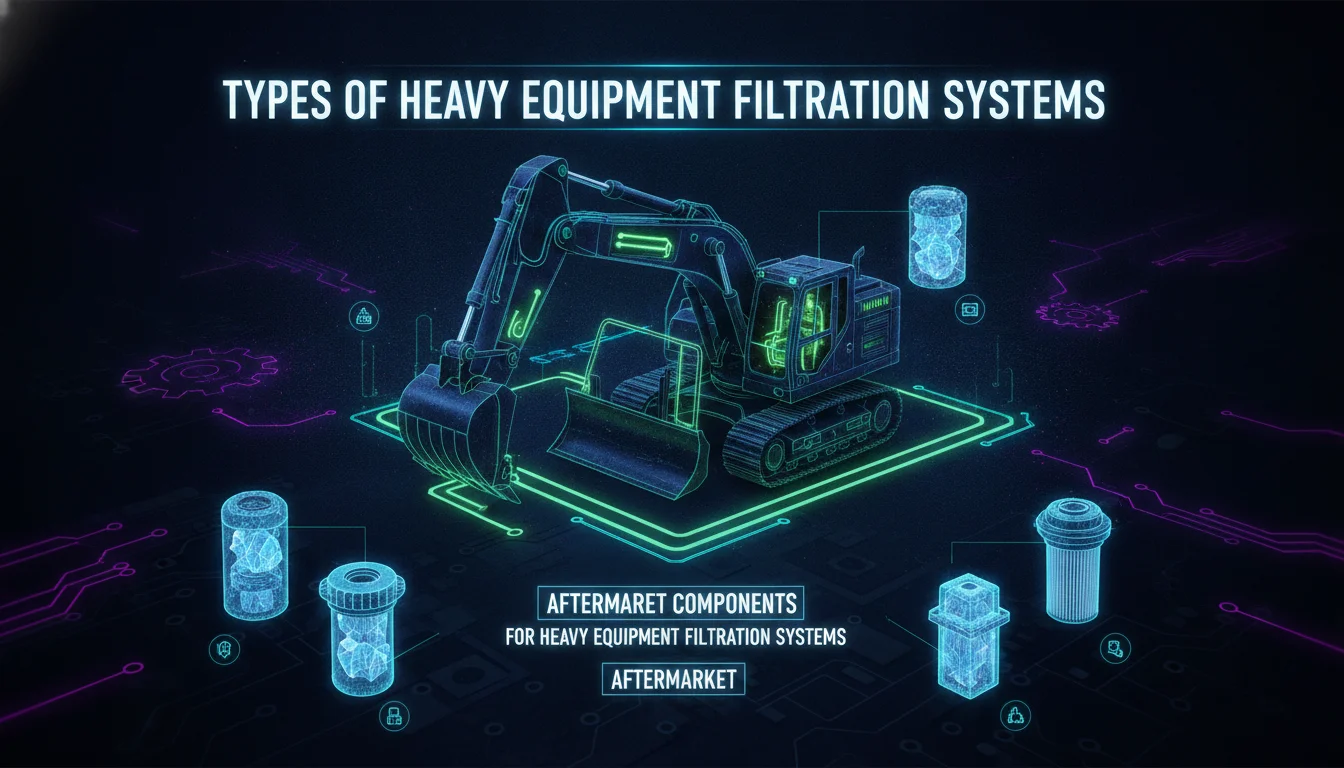
aftermarket coverage spans every fluid and air circuit on a machine. The principal types are:
- Oil Filters: Remove combustion by-products, metal particles, and sludge from engine lubricating oil. Heavy-duty designs use synthetic media and high-collapse-pressure cans to withstand cold-start pressure spikes.
- Fuel Filters: Separate water and trap particulates down to 2-5 microns to protect high-pressure common-rail injectors. Advanced versions include hydrophobic media and coalescing stages.
- Air Filters: Block abrasive dust from entering the combustion chamber. Construction-grade filters often use radial seal designs and multi-stage cyclonic pre-cleaners to handle heavy dust loads.
- Hydraulic Filters: Keep high-pressure hydraulic fluid clean, protecting pumps, valves, and cylinders. Return-line, suction, and pressure filters are common, with absolute ratings as fine as 3 µm.
- Cab Air Filters: Protect operators from respirable crystalline silica and other hazardous dust, often incorporating activated carbon for odor and gas removal.
- Coolant Filters: Prevent scale, rust, and corrosion in the cooling system, maintaining heat-transfer efficiency.
- Transmission and Final Drive Filters: Safeguard precision-machined gear sets against abrasive wear.
Each type is engineered for a specific fluid and duty cycle, and the aftermarket provides cross-reference tools to match OEM part numbers precisely.
Key Market Players
Several global manufacturers dominate the heavy equipment. WIX Filters, a brand of MANN+HUMMEL, holds hundreds of patents and offers a full heavy-duty line covering oil, air, fuel, hydraulic, coolant, and transmission filtration (WIX Heavy Duty). Donaldson is known for advanced engine and hydraulic filters, plus industrial air and dust collection systems (Donaldson Construction). MANN-FILTER, the aftermarket brand of MANN+HUMMEL, emphasizes OE quality and covers a broad range of European construction machinery (MANN-FILTER Construction & Mining). Other notable brands include Baldwin Filters, Fleetguard (Cummins), and Luber-finer, each with strong distribution networks and catalogs spanning hundreds of thousands of part numbers.
"For over 70 years, professionals worldwide have relied on OE quality products from MANN-FILTER to prevent critical issues such as defective hydraulic systems or engine failures that cause costly downtime and breakdowns." - MANN-FILTER, Construction & Mining Applications
Oil and Hydraulic Filtration Systems
Oil Filters for Heavy-Duty Engines
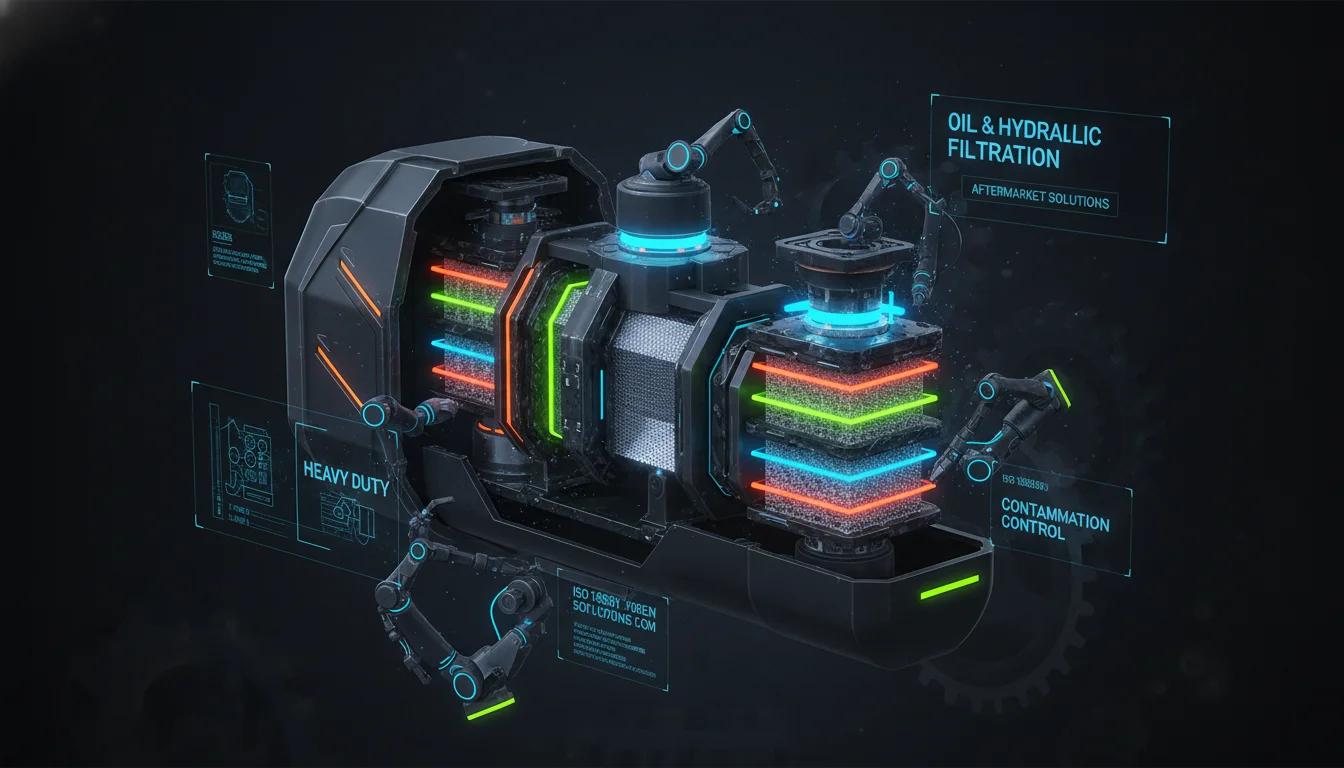
Engine oil filters in the systems aftermarket are designed to handle high soot loading, extreme temperatures, and vibration. A typical construction engine runs at near-full load for hours, accelerating oil degradation. WIX heavy-duty oil filters use synthetic blend media that provides high dirt-holding capacity and low restriction, helping to extend oil drain intervals. Their pleat design and sturdy center tubes prevent collapse during cold starts, when oil viscosity is highest. Many aftermarket filters also include anti-drainback valves to maintain prime and reduce dry-start wear.
Proper oil filter selection is straightforward: match the thread size, gasket diameter, and bypass valve pressure rating to the engine. Cross-reference tools from WIX and other brands allow a technician to enter an OEM part number - a Cat or Komatsu filter number, for instance - and instantly get the correct aftermarket equivalent. This interchangeability is a key element of the this type of aftermarket, enabling mixed fleets to consolidate inventory and reduce carrying costs.
Hydraulic Filter Technologies
Hydraulic systems are the muscle of heavy equipment, and even microscopic particles can score valve spools, erode pump wear plates, and clog servo orifices. Aftermarket hydraulic filters are engineered to achieve and maintain target ISO cleanliness codes, typically 18/16/13 or better for high-pressure systems. According to Donaldson, understanding ISO cleanliness codes and beta ratios is essential for sizing hydraulic filtration correctly. A beta ratio (βx) indicates how many particles of a given size pass through a filter. A beta ratio of 200 for 10 µm means that for every 200 particles entering, only one passes through.
Major aftermarket brands offer spin-on hydraulic filter assemblies, replacement elements, and off-line kidney-loop filtration systems. These off-line units continuously polish a small side stream of fluid to maintain ultra-low particle counts, dramatically extending oil and component life. Donaldson's off-line hydraulic filtration systems are used on construction equipment to enable extended service intervals without sacrificing protection.
Portable and Off-Line Kidney-Loop Filtration
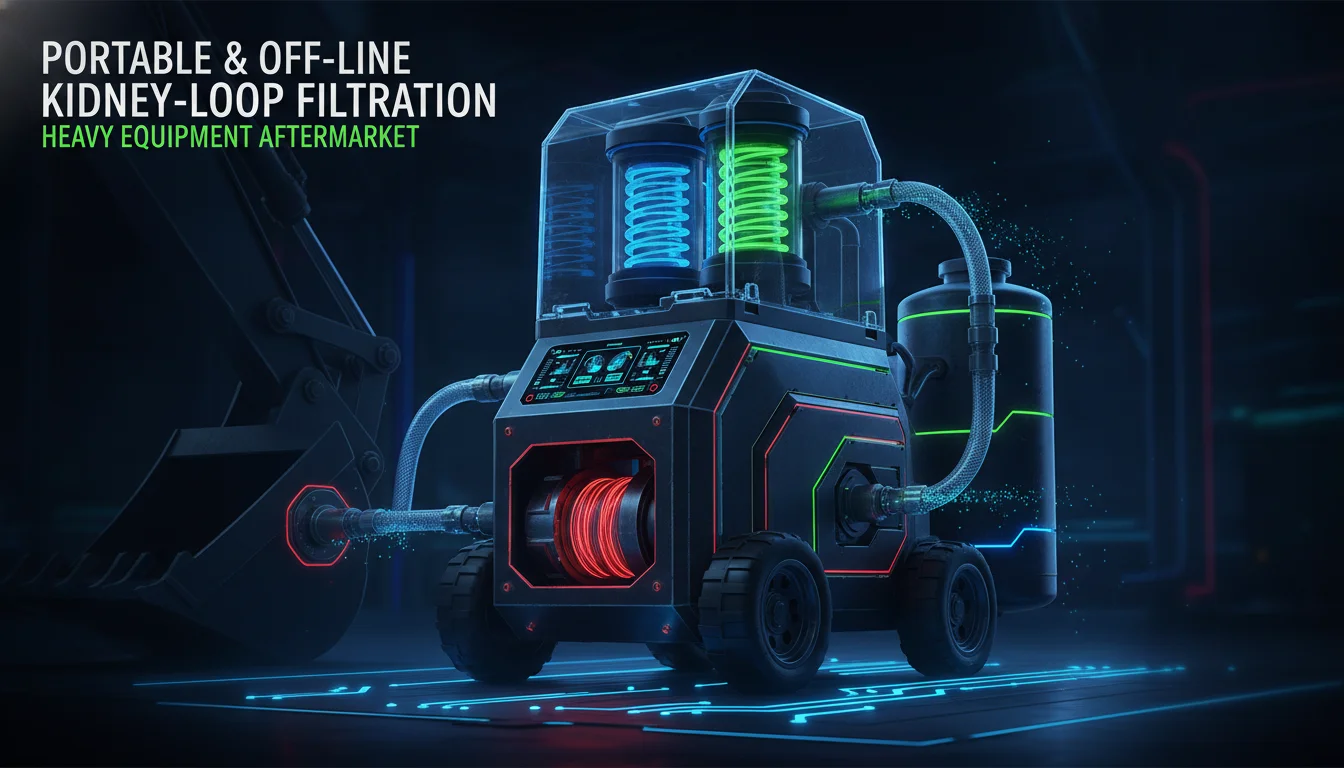
Off-line kidney-loop filtration is one of the most effective ways to maintain fluid cleanliness between scheduled service intervals. These systems divert a portion of hydraulic or lube oil through a dedicated filter circuit running continuously alongside the main system, removing particles and water without interrupting machine operation.
Portable units take this further. Norman Equipment Company's Mighty Might, for example, is a lightweight hand-held transfer filtration system designed for hard-to-reach reservoirs. Its high-viscosity variant handles fluids up to 10,000 SSU at a flow rate of 1 GPM, making it practical for hydraulic and lube oil top-ups in the field. Filter carts and filter panels offer higher-capacity kidney-loop filtration for stationary or semi-stationary applications, covering diesel, hydraulic, and lube oil circuits.
For fleet maintenance supervisors managing multiple machines on a remote site, a portable filtration cart is a cost-effective way to extend fluid life and reduce the frequency of full oil changes. The this kind of systems aftermarket supplies replacement elements for most portable and kidney-loop units, ensuring continuous availability regardless of brand.
Fuel and Air Filtration Systems
Fuel and Water Separation
Modern high-pressure diesel engines require fuel almost free of water and particulate. Aftermarket fuel filters for heavy equipment often combine a water-separating stage with a high-efficiency filter element. WIX fuel filters feature Advanced Quickvent® technology that facilitates rapid water draining, a routine maintenance task on jobsites. Coalescing media cause tiny water droplets to merge, settle, and collect in the bowl for manual or automatic draining.
Donaldson addresses fuel cleanliness with replacement fuel filters and complete fuel filtration systems designed to protect injectors from scarring by hard particles as small as 2 µm. The the equipment filtration systems aftermarket also provides fuel filter assemblies with integrated electric priming pumps and water-in-fuel sensors, simplifying service and reducing the risk of air ingestion after a filter change.
Air Filter Efficiency and Dust Load Capacity
Construction and mining sites generate enormous dust concentrations. An aftermarket air filter must combine high efficiency with high dust-holding capacity to avoid excessive restriction and power loss. According to WIX, their heavy-duty air filters are rated 99.9% efficient in blocking contaminants per the ISO 5011 standard, matching the performance of many OEM filters. Their radial seal designs ensure a positive seal even in vibration-prone installations.
Donaldson's PowerCore® filter media uses a unique pleat geometry to increase surface area within a compact housing, extending filter life and reducing change frequency. The Donaldson Vacuator™ valve, a simple rubber duckbill, automatically expels dust pre-separated by the cyclonic action of the air cleaner, further extending the main filter's service life. These innovations make aftermarket air filters not just substitutes but genuine performance upgrades in the right application.
Selecting the Right Heavy Equipment Filtration Systems Aftermarket Component
Cross-Referencing and Compatibility
The backbone of the aftermarket is accurate cross-referencing of OEM numbers. Every reputable aftermarket manufacturer publishes an online catalog or mobile app - the WIX Filters Catalog App, Baldwin's e-catalog, Donaldson's Filter Finder - that allows a technician to input an OEM part number or machine model and obtain the correct aftermarket filter. Platforms like EquipmentShare's Parts Store simplify sourcing further by listing thousands of filters with brand-specific application data across brands including Fleetguard, Baldwin, and WIX.
Compatibility extends beyond physical fitment. The filter must match the engine's or system's pressure and flow requirements, and for hydraulic filters, the target cleanliness level. Using a filter with an incorrect bypass valve setting can either starve a component of oil during a cold start or allow unfiltered oil to circulate continuously. Careful attention to the OEM's maintenance specifications is non-negotiable.
Evaluating Filtration Efficiency and Capacity
Filtration efficiency is the percentage of particles captured at a given size. Capacity is the mass of contaminant a filter can hold before differential pressure reaches a terminal point. Aftermarket filters often publish these performance curves via ISO laboratory tests. A high-efficiency fuel filter with a 4 µm absolute rating (β4 = 1000) will protect injectors far better than a generic 10 µm filter. Similarly, an air filter with a high dust-holding capacity - measured in grams per ISO 5011 test - will last longer in dusty environments, reducing service frequency.
Fleet managers should request test data from aftermarket suppliers if not already published. Many tier-one brands test their products back-to-back against OEM filters to demonstrate parity or superiority. This transparency is a hallmark of a mature heavy equipment.
Cost vs. Longevity Considerations
Aftermarket filters are almost always less expensive than OEM ones, but the true value lies in lifecycle cost. A filter that costs less but must be changed more often due to premature plugging erodes any initial savings. A premium aftermarket filter that extends service intervals and better protects components delivers a lower total cost of ownership. The heavy equipment filtration systems aftermarket lets users choose the technology level - standard, premium, or extended-life - that best balances upfront cost against maintenance overhead for each asset.
Pros and Cons of Aftermarket Filtration Systems
Pros
- Lower purchase price compared to OEM filters, often significantly so, reducing direct procurement costs.
- Broader availability through distributors, online platforms, and parts stores worldwide, cutting lead times.
- Performance parity or superiority from tier-one brands that publish ISO test data and match OEM specifications.
- Extended-life options that reduce change frequency and lower total cost of ownership over the machinery lifecycle.
- Cross-reference tools that simplify sourcing for mixed fleets running Caterpillar, Komatsu, Volvo, and other brands simultaneously.
- Innovation such as PowerCore media, Vacuator valves, and sensor-based predictive maintenance that OEM channels may not offer at the same price point.
Cons
- Quality variation across brands. Low-cost generic filters may not meet OEM specifications, risking premature component wear.
- Warranty considerations. Some OEM warranties require the use of approved filters. Verify before switching to aftermarket alternatives.
- Incorrect cross-referencing risk. A wrong bypass valve setting or incorrect micron rating can cause more damage than the savings justify.
- Counterfeit risk in some markets. Purchasing from reputable distributors and verified platforms is essential to avoid substandard products.
Comparing Leading Aftermarket Filtration Brands
The table below summarizes key characteristics of prominent brands in the heavy equipment filtration systems aftermarket. Data has been gathered from each company's official product literature and third-party distributors.
| Brand | Filter Types Offered | Notable Features | Typical Applications |
|---|---|---|---|
| WIX Filters | Oil, air, fuel, hydraulic, cabin, transmission, coolant, compressor | 99.9% efficient air filters; Quickvent® fuel/water separation; synthetic blend media; hundreds of patents | Agriculture, construction, mining, on-/off-highway trucks |
| Donaldson | Engine air, lube, fuel; hydraulic assemblies; bulk fuel/water; dust collectors | PowerCore® media, Vacuator™ valves, iCue™ connected technology, ISO cleanliness code support | Construction, mining, power generation, heavy-duty trucks |
| MANN-FILTER (MANN+HUMMEL) | Engine air cleaners, oil, fuel, hydraulic, cabin air | OE quality for European OEMs; activated carbon seat covers; predictive maintenance software; over 80 years of filtration experience | European construction machinery, mining, mobile cranes |
| Fleetguard (Cummins Filtration) | Oil, fuel, coolant, hydraulic, air | NanoNet media, Stratapore, direct Cummins compatibility | Cummins-powered equipment, trucks, gen-sets |
| Baldwin Filters | Lube, air, fuel, hydraulic, coolant | High-collapse spin-ons, corrosion-resistant coatings, broad catalog | Off-highway, marine, industrial, trucks |
These brands are widely available through local distributors, parts stores like EquipmentShare, and online platforms such as Iron Wing Parts, ensuring that heavy equipment filtration systems aftermarket components are accessible even for older or niche machinery.
Maintenance Best Practices and Predictive Strategies
Replacement Intervals and Signs of Filter Failure
Filter replacement intervals for heavy equipment are defined by the OEM, typically in hours of operation - for example, 250-500 hours for engine oil filters and 500-1000 hours for fuel filters. Operating conditions heavily influence actual service life. A machine working in a quarry will load an air filter with dust far faster than the same machine on a road-building site. Visual inspection indicators, such as restriction gauges on air cleaners or pressure differential alarms on hydraulic filter housings, provide real-time feedback. A sudden drop in fuel pressure, black smoke, or erratic hydraulic operation can all signal a plugged filter. The heavy equipment filtration systems aftermarket addresses this variability by offering extended-life options and publishing expected capacity data for each product.
Predictive Maintenance and Sensor Technology
Leading original equipment and aftermarket players are embedding sensors that monitor filter loading in real time. MANN+HUMMEL's predictive maintenance software for construction machinery uses cloud-connected sensors to track the status of each filter, alerting technicians when a change is imminent before restriction affects performance. Per MANN+HUMMEL's published product information, this approach ensures filters are utilized to their maximum efficiency, delivering significant time and cost savings. This moves maintenance from a fixed calendar-based schedule to a condition-based model.
Donaldson's iCue™ Connected Technology for industrial dust collectors similarly monitors filter condition remotely. When applied to engine and hydraulic filtration, such predictive tools help fleet managers optimize heavy equipment filtration systems aftermarket inventory and schedule service during planned downtime, not after a failure.
Economic and Environmental Impact of Aftermarket Filters
Total Cost of Ownership Analysis
Switching to an aftermarket filter strategy can yield measurable savings, but must be evaluated through a total-cost-of-ownership (TCO) lens. Direct savings come from lower filter purchase prices. Indirect savings are often larger: improved uptime because aftermarket components are more readily available, reduced labor costs if the filter design simplifies installation, and extended component life from superior filtration. A construction fleet running multiple excavators, for example, can save meaningfully each year by sourcing heavy equipment filtration systems aftermarket without any compromise in performance.
Sustainability and Material Innovations
The heavy equipment filtration systems aftermarket is also contributing to sustainability goals. As of 2026, some manufacturers now offer filters made from renewable or resource-conserving materials. According to MANN-FILTER's published product literature, their environmentally improved products are made from partly resource-conserving, renewable, and innovative materials, reducing the carbon footprint of each filter change. Longer-life filters also mean fewer elements end up in landfills. Donaldson's PowerCore® air filters can last longer than traditional cellulose filters, cutting waste and logistics emissions. These developments align with growing regulatory pressure on construction companies to reduce environmental impact without compromising operational reliability.
Frequently Asked Questions
What are heavy equipment filtration systems aftermarket products?
Heavy equipment filtration systems aftermarket products are replacement filters for engines, hydraulics, fuel, and air systems produced by independent manufacturers to fit OEM machinery. They often meet or exceed original specifications and are sold through distributors, parts stores, and online platforms worldwide.
Are aftermarket filters as good as OEM filters?
Top-tier aftermarket filters from brands like WIX, Donaldson, and MANN-FILTER frequently match or surpass OEM performance. They are built to international standards, undergo rigorous testing, and publish efficiency and capacity data to demonstrate parity. The key is sourcing from reputable tier-one suppliers rather than unverified generic brands.
How often should heavy equipment filters be replaced?
Replacement intervals depend on the machine, filter type, and operating conditions. Always consult the OEM manual. As a general guide, engine oil filters are typically changed every 250-500 hours, fuel filters every 500-1000 hours, and air filters when restriction indicators signal or at predetermined intervals based on site conditions.
Can I cross-reference aftermarket filters with OEM part numbers?
Yes. Most aftermarket manufacturers provide online catalogs, mobile apps, or filter finder tools where you can enter an OEM number - a Cat or Komatsu part number, for instance - and instantly retrieve the equivalent aftermarket filter. WIX, Donaldson, and Baldwin all offer these tools at no cost.
What is the difference between beta ratio and micron rating?
A micron rating is an absolute or nominal particle size removal claim. Beta ratio (β) quantifies how efficiently a filter captures particles of a specific size. For example, β5=200 means that for every 200 particles 5 µm or larger entering the filter, only one passes through. Beta ratio provides a more precise and verifiable performance measure than a simple micron rating.
How does predictive maintenance improve filtration management?
Predictive maintenance uses sensors to monitor filter condition in real time, alerting technicians when a filter is nearing its maximum dirt-holding capacity. This prevents premature changes, avoids engine damage from plugged filters, and optimizes maintenance schedules. MANN+HUMMEL's sensor-based software for construction machinery is a documented example of this approach in practice.