
Heavy Equipment Fuel Injectors: 2026 Buying Guide
Heavy equipment fuel injectors buying guide: compare OEM vs reman, match part numbers by engine, and get 2026 pricing tiers for Cat, Cummins, and Detroit.
Loading article…
Article Not Found
The article you're looking for doesn't exist or may have been removed.
Back to BlogKey Takeaways
- Match heavy equipment fuel injectors to the exact engine serial number, not just the make and model. Engine prefix and CPL/ESN data drive compatibility.
- Remanufactured injectors rebuilt to OEM tolerances often offer the best balance of cost and reliability for mixed fleets.
- Common rail injectors dominate modern equipment; HEUI and electronic unit injectors remain common in older Cat, Cummins, and Detroit engines.
- Reman injector prices we found in supplier catalogs span roughly $165 to $1,254 depending on engine platform and part number.
- Fuel quality and filtration are the biggest controllable factors in injector lifespan. Rough idle, black smoke, or poor fuel economy signal it's time to inspect or replace.
Heavy equipment fuel injectors are precision components that deliver metered, high-pressure diesel into the combustion chamber at the exact moment the engine needs it. Buyers should match injectors to the exact engine serial number and choose among OEM, remanufactured, or aftermarket units based on budget and uptime needs.
What Are Heavy Equipment Fuel Injectors?
A heavy equipment fuel injector is a precision-engineered component that delivers fuel into the engine's combustion chamber or intake manifold at high pressure, in a fine mist, and at the exact right time. According to EngineersWorld, a fuel injector turns liquid fuel into a fine spray, mixing it with air to create the combustion needed to power construction equipment. Without a properly functioning injector, machinery suffers weak performance, high fuel consumption, and potential engine damage.
Core Function and Operating Pressures
Diesel injection systems operate at extreme pressures to atomize fuel. InjectorHub reports that diesel injectors work under pressure often over 2,000 bar (29,000 psi). EngineersWorld adds that modern high-pressure common rail systems can pressurize fuel up to 220 MPa. These pressures force diesel through small nozzles, creating a fine mist that mixes with compressed air for efficient combustion.
Why Injector Precision Matters in Heavy Equipment
Construction machinery operates under constantly changing loads. An injector has to deliver more fuel for heavy lifting and less during idle periods to keep performance and fuel efficiency in balance. Because injectors fire hundreds of times per minute, even small deviations in spray pattern or timing add up to noticeable power loss, higher emissions, and increased operating cost. For mining, road construction, and heavy lifting work, precision isn't optional.
"A fuel injector turns liquid fuel into a fine spray, mixing it with air to create the combustion needed to power your construction equipment." - EngineersWorld
Types of Fuel Injectors for Diesel Engines
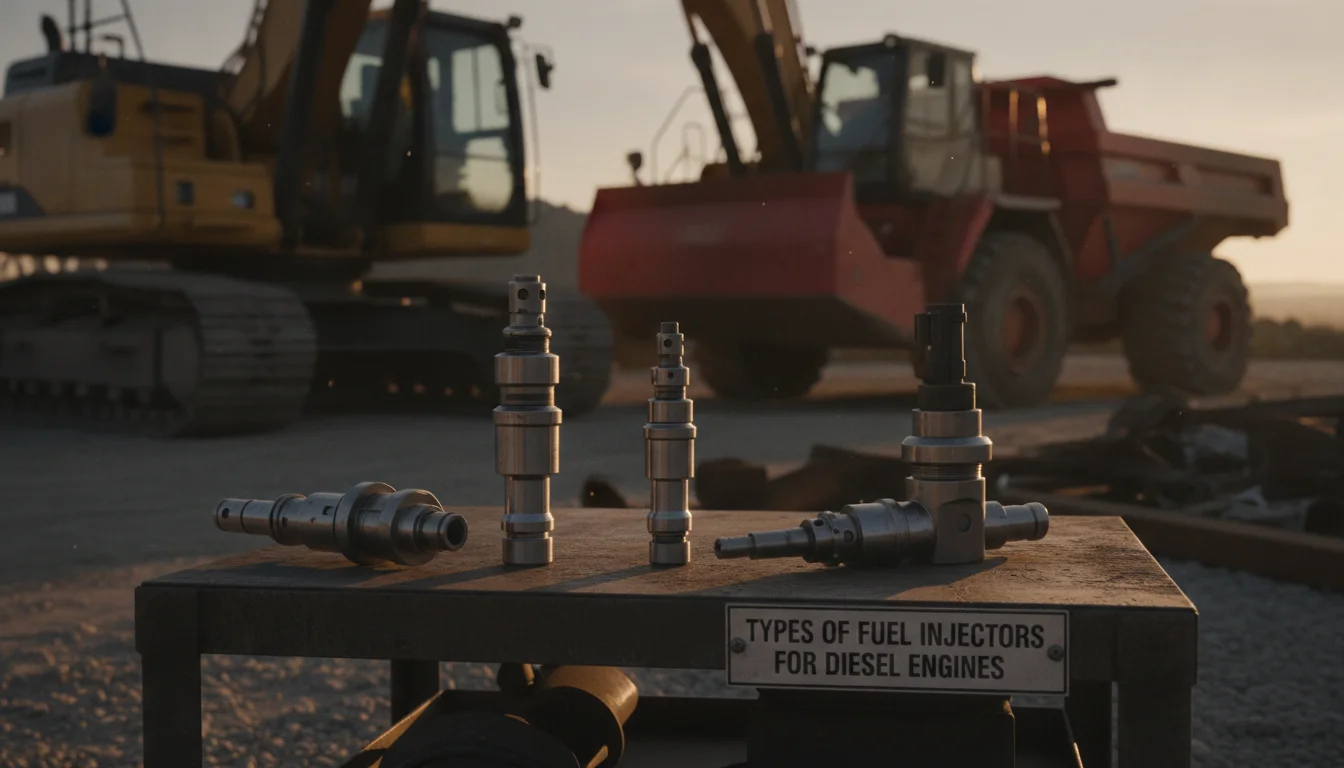
Heavy equipment relies on several injector architectures, and the right type depends on engine model, age, and operating conditions. DieselNet's Electronic Fuel Injection Systems for Heavy-Duty Engines paper identifies major OEM systems including Caterpillar HEUI and MEUI, plus Cummins CAPS, CELECT, HPI, and XPI. For practical buying purposes, three categories cover most construction equipment.
Common Rail Injectors
Common rail systems use a shared high-pressure fuel rail to supply all injectors. This allows multiple injections per cycle: pre-injection, main injection, and post-injection, which improves fuel efficiency, reduces emissions to meet Stage V and Tier 4 standards, and smooths engine operation. Popular models cited by EngineersWorld include Cat 3969626 for C7.1 engines and 510-1695 for C9.3B engines. Most new excavators, loaders, and dozers run common rail systems.
HEUI and Electronic Unit Injectors
HEUI (Hydraulic Electronic Unit Injectors) are common in older Caterpillar C7 and C9 engines. They use hydraulic pressure from the engine oil system to pressurize fuel instead of a separate fuel rail. DieselNet lists HEUI-A and HEUI-B as Caterpillar systems. Electronic unit injectors and mechanically actuated electronically controlled (MEUI) systems are also widespread in older Cat, Detroit, and Cummins engines. These injectors hold up well in harsh conditions, but they're less flexible than modern common rail designs for emissions tuning.
Mechanical and Port Fuel Injectors
Mechanical injectors appear in older engines and are controlled by camshaft movement and mechanical timing. They're simple but less precise. Port fuel injectors spray fuel into the intake manifold rather than directly into the cylinder. Port injection shows up less in heavy construction equipment but appears in some smaller compact loaders and generator sets. When shopping for replacement fuel injectors, knowing whether your engine uses common rail, HEUI, EUI, or mechanical injection is the first filter you should apply.
What to Look For When Buying Heavy Equipment Fuel Injectors
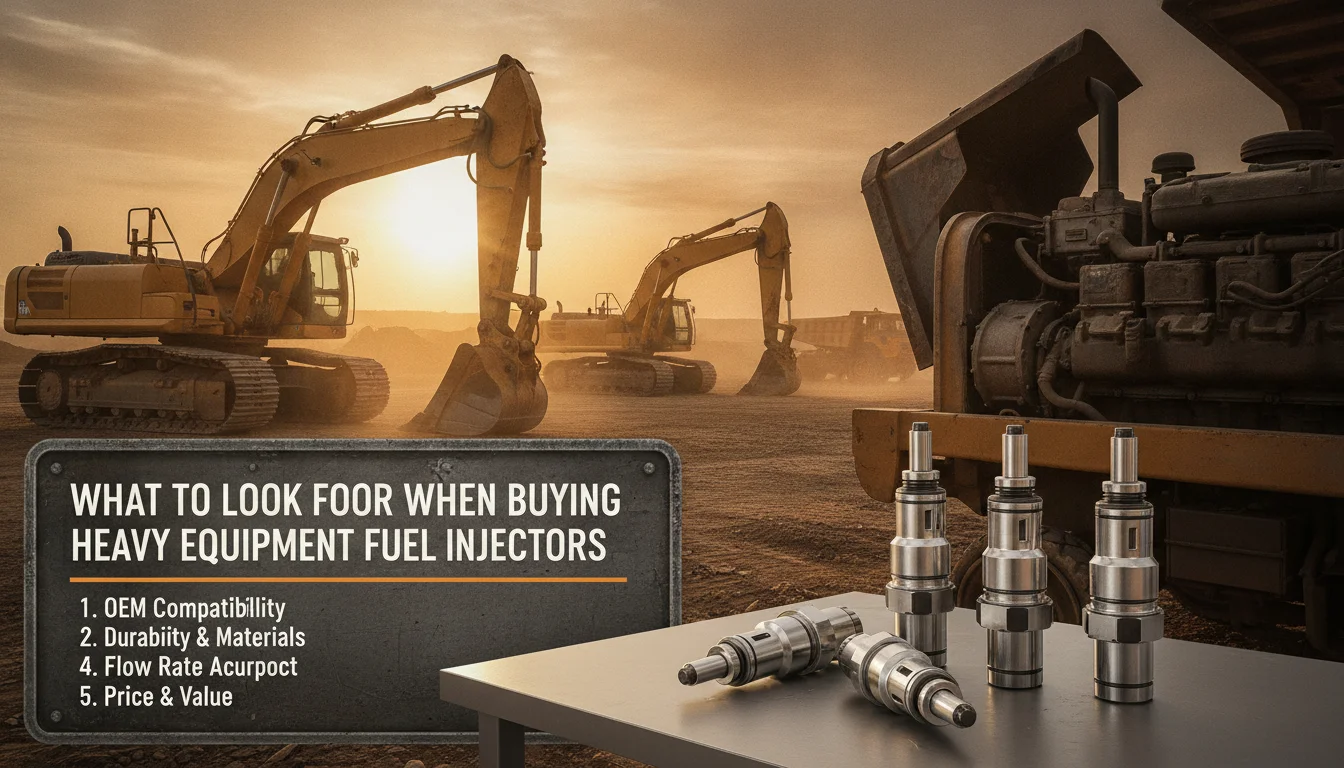
Buying the right this type of injectors means evaluating more than sticker price. You need exact fit, material quality, supplier support, and a clear read on remanufacturing standards. The criteria below apply whether you're replacing a single unit or doing a full set swap.
Material, Fit, and Engine Compatibility
Material quality in the nozzle, solenoid, and internal sealing surfaces determines injector life. A failed or leaking injector can wash cylinder walls, dilute engine oil, or damage pistons. Fit is non-negotiable: cross-reference the OEM part number, engine serial number, and CPL/ESN prefix. For example, a Cummins ISX single cam injector (2897320) is not interchangeable with an ISX dual cam injector. Highway and Heavy Parts organizes hundreds of injectors by engine platform, CPL, and ESN prefix for exactly this reason. Always verify your engine serial number before ordering.
Price Range Expectations (Budget, Mid-Range, Premium)
Price transparency in the aftermarket varies, but supplier catalogs give us a useful reference point. Based on current listings from Highway and Heavy Parts, BPS Diesel, and All Pro Diesel, remanufactured heavy equipment injectors fall into three rough tiers:
- Budget tier (under $200): PAI 209985X reman for Cummins NH/NT 855 at $165.82 (All Pro Diesel).
- Mid-range tier ($350-$650): Caterpillar C15/3406E and Cummins ISX/N14 reman injectors commonly list from $383.84 to $647.82 (Highway and Heavy Parts).
- Premium tier (above $700): Detroit Diesel DD15/DD16 common rail injector at $718.61 (HHP) and Detroit Diesel MBE4000 EPA07 reman at $1,253.89 (All Pro Diesel).
Prices vary by core charge, warranty, and availability. Always confirm whether the listed price includes a refundable core deposit.
Remanufactured vs. New vs. Aftermarket
The choice among OEM new, remanufactured, and aftermarket injectors is the central buying decision, and each approach carries trade-offs.
| Approach | Pros | Cons | Best For |
|---|---|---|---|
| OEM New | Exact factory spec, longest expected life, full manufacturer support | Highest cost, sometimes limited availability | Critical applications, warranty-sensitive fleets |
| Remanufactured | Rebuilt to OEM tolerances, lower cost, often tested for spray pattern and fuel delivery | Quality depends on remanufacturer; core charge may apply | Most construction and mixed fleets |
| Aftermarket | Lowest price, wide availability | Spec may vary from OEM; requires careful supplier vetting | Budget repairs, older machines with low utilization |
"Every remanufactured injector is rebuilt to OEM tolerances for proper spray pattern, fuel delivery, and emissions compliance." - All Pro Diesel
Step-by-Step: How to Select the Right Injector
- Record the engine serial number and OEM part number from the existing injector or engine data plate.
- Identify the injection system type, common rail, HEUI, EUI, or mechanical, using the service manual.
- Cross-reference the OEM number against supplier databases from HHP, All Pro Diesel, or BPS Diesel. Use CPL/ESN prefix filters.
- Compare remanufacturing standards. Ask whether the supplier tests for spray pattern, leak-down, and solenoid response.
- Verify warranty, core charge, and return policy before finalizing. Buy in matched sets if replacing multiple cylinders.
How to Match Injectors to Your Equipment Platform
Matching this kind of fuel injectors to your platform starts with the engine family, not the machine brand painted on the hood. Understanding the most common platforms helps you buy with confidence and avoid mismatched parts, since every component in the fuel system has to work together for reliable performance.
Popular Engine Platforms and Part Number Examples
Competitor inventories show heavy concentration in Caterpillar, Cummins, Detroit Diesel, Paccar, and International platforms. The table below lists representative remanufactured injectors and their listed prices to illustrate platform-specific pricing as of 2026.
| Engine Platform | Example Part Number | Listed Price | Source |
|---|---|---|---|
| Caterpillar C15 ACERT | 10R1273 | $505.38 | Highway and Heavy Parts |
| Caterpillar C15/3406E | 10R8501RFM Black Series | $492.55 | Highway and Heavy Parts |
| Cummins ISX Single Cam | 2897320 | $647.82 | Highway and Heavy Parts |
| Cummins N14 Celect | 3411767PX | $383.84 | Highway and Heavy Parts |
| Detroit Diesel DD15/DD16 | 0986435539 | $718.61 | Highway and Heavy Parts |
| Paccar MX13 | 1972591 | $456.13 | Highway and Heavy Parts |
| Detroit Diesel MBE4000 EPA07 | RA4600100351 | $1,253.89 | All Pro Diesel |
Pairing Injectors with Supporting Components
Replacing injectors without addressing supporting fuel system components can shorten their life. Consider these practical combinations for common equipment setups:
- Caterpillar C15/3406E excavator: Pair a remanufactured 10R8502 injector set with a fresh OEM fuel filter, a verified fuel transfer pump, and a clean fuel pressure regulator. This prevents low inlet pressure from stressing the injector.
- Cummins ISX haul truck: Combine ISX single cam injectors with Cummins factory fuel filtration and a functioning lift pump. Verify fuel pressure at the rail before installation.
- Detroit Series 60 bulldozer: Match Series 60 14L injectors with a high-efficiency air filter and proper engine oil, because HEUI-style injectors on some configurations depend on oil pressure.
- Older mechanical engine: For mechanical injectors, ensure the camshaft lobes and fuel pump timing are within spec; otherwise new injectors won't compensate for worn mechanical actuation.
Care and Maintenance for Long Injector Life
Heavy equipment fuel injectors can run for thousands of hours, but real-world life depends heavily on maintenance rather than any fixed hour figure. There's no universal service interval across all platforms; qualitative factors like fuel quality dominate. The best approach is proactive care rather than waiting for failure.
Fuel Quality and Filtration
Contaminated fuel is the leading cause of injector wear and nozzle erosion. Use the fuel filter specified by the engine manufacturer and replace it on schedule. Drain water separators daily in humid or high-condensation environments, and avoid fueling from unmonitored bulk tanks. According to InjectorHub, clean fuel delivery helps reduce smoke and particulate matter, which directly protects injector tips and seats. Poor filtration forces the injector to handle abrasive particles that damage spraying orifices.
Diagnostic Signs and Replacement Timing
Watch for these symptoms that may indicate one or more failing heavy equipment fuel injectors:
- Rough idle or engine misfire under load
- Loss of power during digging, lifting, or hauling
- Black smoke from the exhaust during acceleration
- Increased fuel consumption without a change in operating pattern
- Hard starting, especially when the engine is warm
- Fuel dilution of engine oil, detected by rising oil level or diesel odor in oil
When replacing injectors, many fleets replace all units in a matched set to maintain balanced fuel delivery. Follow the engine manufacturer's guidance for your specific platform. If one injector fails due to contamination, inspect the entire fuel system before installing replacements.
Pros and Cons of Remanufactured Heavy Equipment Fuel Injectors
Remanufactured injectors give most fleets the strongest balance of reliability and cost, but they aren't the right call in every situation. Here's an honest breakdown.
Pros
- Lower upfront cost than OEM new, often by a wide margin
- Rebuilt to OEM tolerances by reputable remanufacturers, with spray pattern and leak-down testing
- Wide availability across Caterpillar, Cummins, Detroit Diesel, and Paccar platforms
- Core exchange programs reduce waste and keep pricing competitive
Cons
- Quality varies significantly between remanufacturers, so supplier vetting matters
- Core charges and return logistics add complexity to ordering
- Warranty terms are typically shorter than OEM new parts
- Not always the right choice for warranty-sensitive or mission-critical applications
Making the Right Choice for Heavy Equipment Fuel Injectors
Choosing the right heavy equipment fuel injectors comes down to three decisions: exact engine compatibility, remanufacturing quality, and total cost of ownership. A cheap injector that fails after a short service life costs far more in downtime than a quality reman that runs for its full expected lifespan. Verify the engine serial number, confirm the injection system type, and ask the supplier about OEM tolerance testing. The best value usually sits in the mid-range remanufactured tier, where OEM-spec rebuilds from trusted suppliers like Highway and Heavy Parts, BPS Diesel, and All Pro Diesel deliver reliability without the new-part premium. Match the injector to your platform, support it with clean fuel and proper filtration, and monitor for early warning signs. That's the practical path to maximum uptime and lower cost per hour, and it's the same standard our team applies when sourcing spare parts categories for clients running mixed fleets across construction, mining, and energy sites.
As of 2026, global buyers increasingly ask for OEM-quality remanufactured components with predictable lead times rather than the cheapest unit on the page. That shift favors suppliers who can document testing standards and support brand-specific platforms, from Caterpillar and Komatsu to Volvo and Atlas Copco. Shop OEM-quality spare parts with global 5-day delivery at 3genexport.com.
Frequently Asked Questions
What are the three types of fuel injectors used in heavy equipment?
Common rail, HEUI, and electronic or mechanical unit injectors are the most common types. Common rail uses a shared high-pressure rail, HEUI uses engine oil pressure, and electronic unit injectors are cam-actuated with solenoid control.
How do I know which injector fits my engine?
Find the OEM part number on the old injector or the engine data plate, then cross-reference that number with your engine serial number and CPL/ESN prefix in the supplier's database. This is the fastest way to avoid ordering the wrong heavy equipment fuel injectors for your platform.
Should I buy OEM, remanufactured, or aftermarket?
For most construction equipment, remanufactured injectors rebuilt to OEM tolerances offer the best value. Choose OEM new for critical or warranty-sensitive applications, and aftermarket only from suppliers with verifiable specs.
Can I replace just one heavy equipment fuel injector?
Yes, a single injector can be replaced, but replacing as a matched set is often recommended to maintain balanced fuel delivery. If one injector failed from contamination, inspect the entire fuel system first before installing new units.
How long do heavy equipment fuel injectors last?
There's no universal lifespan figure across platforms. Injector life depends on fuel quality, filtration, load cycle, and maintenance; proactive fuel system care extends service life, while rough idle or black smoke signal it's time for replacement.