
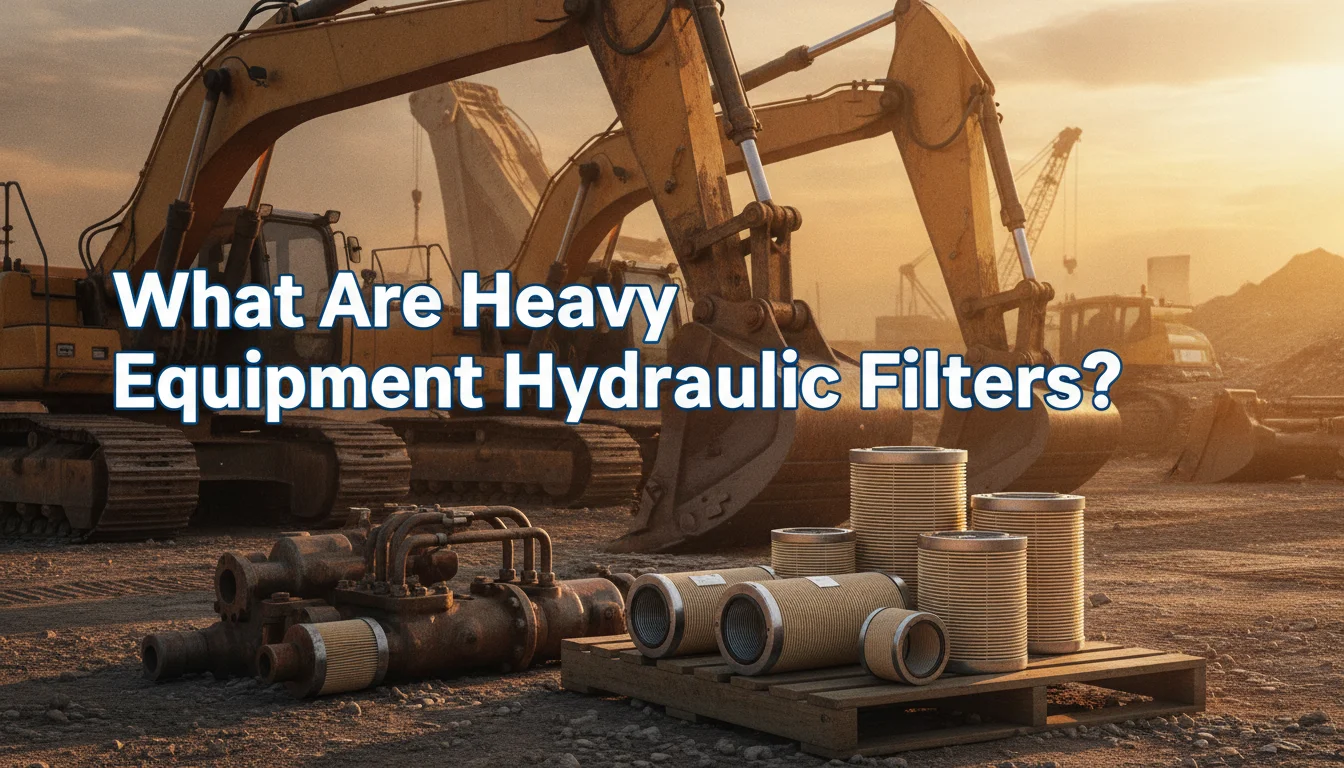
Heavy Equipment Hydraulic Filters: Complete Guide
Heavy equipment hydraulic filters protect pumps, valves, and cylinders. Compare types, specs, brands, and prices.
Loading article…
Article Not Found
The article you're looking for doesn't exist or may have been removed.
Back to BlogHeavy equipment hydraulic filters are devices that remove solid particles, wear debris, and water from hydraulic fluid before they damage pumps, valves, and cylinders. Choosing the right filter requires matching micron rating, flow rate, pressure rating, and thread size to your machine.
Key Takeaways
- According to Hifi Filter, particulate contamination and water in hydraulic oil are the single most important cause of hydraulic system failure and breakdown.
- Match micron rating first: 10-micron filters are standard for return lines; 5-micron options protect precision components.
- Verify flow rate, pressure rating, and thread size before ordering - a spec mismatch causes bypass valve opening or physical fit failure.
- Cross-referencing WIX, Baldwin, Fleetguard, and MANN replacements can match OEM fitment at lower cost.
- Replacement elements start at $11.29; complete spin-on assemblies range from $32.24 to $70.57; OEM units can reach $104.11.
- Most manufacturers specify hydraulic filter replacement at 500 to 1,000 hour intervals - or sooner if a differential pressure indicator enters the red zone.
What Are Heavy Equipment Hydraulic Filters?
hydraulic filters are components that sit in return lines, pressure lines, suction lines, and reservoir breathers to keep contamination away from high-tolerance parts. According to Bailey Hydraulics, hydraulic filters protect system components by preventing contaminants from becoming trapped in small openings. Without proper filtration, abrasive particles accelerate wear on pumps, valves, and cylinders, leading to costly repairs and unplanned downtime.
Why Filtration Matters in Heavy Equipment
Particulate contamination and water are the leading causes of hydraulic system failure. According to Hifi Filter, particulate contamination or the presence of water in oil is the single most important cause of failure and breakdown in hydraulic systems. Donaldson reinforces this, noting that heavy-duty filtration solutions protect engines, hydraulics, compressors, and bulk fuel storage from harmful contaminants. In dusty construction and mining environments, filtration separates impurities, water, and abrasion residues before they degrade lubricant and reduce performance.
Types of Hydraulic Filters
- Spin-on filters: A spin-on filter is a self-contained canister that threads onto a mounting head. These are common return-line filters for compact excavators and log splitters.
- Replacement elements: A replacement element is the internal filter media installed inside a reusable housing. The Lenz element SKU 221011 is a 10-micron, 200 PSI, 20 GPM, 1"-12 UNF option available from Bailey Hydraulics.
- Suction strainers: A suction strainer is a coarse mesh screen placed at the pump inlet. Ironwing lists a Maradyne SU75-SF40 suction strainer with 100 mesh and 2.5" FNPT ports at $105.00.
- Pressure-line filters: Pressure-line filters handle full system pressure and are placed downstream of the pump to protect downstream components.
Hydraulic Cleanliness Standards You Need to Know
For this type of filters to perform as intended, the fluid must meet a target cleanliness level. ISO cleanliness codes classify the number and size of particles in a fluid sample, giving maintenance teams a measurable benchmark. Donaldson publishes resources on Understanding ISO Cleanliness Codes and Beta Ratings in liquid filters - both are essential reading before specifying replacement elements.
ISO Cleanliness Codes
An ISO cleanliness code is a standardized method of expressing particle counts per milliliter of fluid. The code uses three scale numbers for particles larger than 4, 6, and 14 microns. Knowing your machine's target ISO code helps you select this kind of hydraulic filters with the correct micron rating and beta ratio. A system with tight clearances may require a 5-micron filter, while a less critical return line can use 10 or 25 micron.
Beta Ratings Explained
Beta ratio is a measure of filter efficiency at a stated particle size. A filter with a beta ratio of 200 at 10 microns removes 199 out of every 200 particles of that size. This is a more precise comparison than micron rating alone, because two 10-micron filters can have very different beta ratios. When cross-referencing the equipment hydraulic filters, confirm that the replacement filter's beta ratio is equal to or better than the original.
"Particulate contamination or the presence of water in the oil is the single most important cause of failure and breakdown in hydraulic systems." - Hifi Filter, Hydraulic Filtration Solutions
What to Look For When Buying Heavy Equipment Hydraulic Filters
Selecting filters means verifying four specifications before you order: micron rating, flow rate, pressure rating, and port compatibility. Skipping any one of these can cause bypass valve opening, restricted flow, or physical fit failure.
Micron Rating and Beta Ratio
Micron rating is the particle size a filter is designed to capture. Bailey Hydraulics offers heavy equipment in 5, 10, and 25 micron ratings. Ten micron is the most common choice for return lines, while 5 micron is used for precision circuits. Always check the beta ratio alongside the micron rating to understand real-world capture efficiency.
Flow Rate and Pressure Rating
Flow rate, measured in GPM, must match your hydraulic system's return or pressure line volume. Bailey's filter lineup includes 7, 20, 25, 55, 60, and 100 GPM options. Pressure rating matters because the filter housing and element must withstand system pressure. Bailey lists filters rated from 100 PSI to 290 PSI max. A 20 GPM, 200 PSI filter is common for mini excavators and log splitters, while larger machines may need 55 GPM or 70 GPM ratings.
Port Size and Thread Type
Port size and thread type determine whether the filter physically fits your machine. Bailey offers port sizes including 3/4 NPTF, 3/8 NPTF, 1 1/4 NPTF, and 1 1/2 NPTF, and thread sizes such as 1"-12 UNF and 1 1/2"-16 UNF. Always match the OEM thread callout before purchasing. A 1"-12 UNF filter will not thread onto a 3/4 NPTF port.
How to Match Filters to Your Machine
Instead of buying one-off filters, build a filter set that matches your machine's hydraulic system. For a compact excavator or log splitter, pair a 10-micron spin-on return filter with 3/4 NPTF ports and 200 PSI rating - for example, Lenz assembly SKU 221006 - with a 100-mesh suction strainer at the pump inlet. For a high-flow excavator or wheel loader, choose a 10-micron spin-on filter with 70 GPM capacity and indicator ports, such as Chief SKU 226009. If you run OEM-only parts, EquipmentShare lists Takeuchi hydraulic filter 1551101001 for $72.17 and Sany hydraulic pilot filter GLQ009244827 for $22.99, which can be paired with matching OEM oil and fuel filters in a single service kit.
Maintenance Kit Bundles
Crossfilters offers complete maintenance kits that bundle every filter a service needs into one box. The CFKIT maintenance filter kit compatible with a GEHL Z17 compact excavator is priced at $106.00. Bundling hydraulic filters with air, oil, and fuel filters reduces the risk of missing a service item and often lowers per-unit cost across the kit.
Cross-Referencing Heavy Equipment Hydraulic Filters
Cross-referencing this type of filters is the process of matching a manufacturer's part number to equivalent filters from other brands. Crossfilters cross-references WIX, Baldwin, Fleetguard, MANN, and more, letting you enter any manufacturer number to see matching replacements with price and stock. This is particularly useful when OEM filters are backordered or priced at a premium.
How to Verify a Cross-Reference Match
Do not rely on brand name alone. Crossfilters provides free serial-number verification: send your machine's serial number before ordering, and a specialist confirms the exact match. Also compare micron rating, flow rate, pressure rating, and thread size against the original filter. WIX, Baldwin, and Fleetguard publish cross-reference charts for this kind of hydraulic filters that make this comparison straightforward.
Trusted Filter Brands
Known brands include Donaldson, Baldwin, WIX, Fleetguard, MANN Filter, Lenz, Chief, Schroeder, Argo-Hytos, Leemin Hydraulic, and Maradyne Fluid Power. EquipmentShare stocks Baldwin, Fleetguard, Donaldson, and WIX alongside OEM brands such as Takeuchi and Sany. Ironwing lists hydraulic elements from Leemin and Argo-Hytos. Choosing a recognized brand ensures consistent media quality and documented beta ratings.
"Donaldson develops heavy-duty filtration solutions designed to help protect engines, hydraulics, compressors, and bulk fuel storage from harmful contaminants - even in the most demanding environments." - Donaldson Company, Construction Industry Solutions
Price Ranges: Budget, Mid-Range, and Premium
Heavy equipment hydraulic filter pricing depends on whether you need a bare element, a complete spin-on assembly, or an OEM part. Based on observed 2026 listings, budget replacement elements start at $11.29; mid-range spin-on assemblies fall between $32.24 and $70.57; premium and OEM filters can reach $104.11 or more for specialized applications.
Budget Tier (Under $25)
Bailey lists Lenz replacement element SKU 221011 at an MSRP of $15.06 with a sale price of $11.29. Amazon lists 10-micron hydraulic filter assemblies from $16.99 to $20.99, including return line housings compatible with log splitters and mini excavators. These budget options are best for low-pressure return lines and routine replacements.
Mid-Range Tier ($25–$70)
Lenz spin-on assembly SKU 221005 has an MSRP of $52.98 and sells for $39.74. Chief spin-on assembly SKU 226006 lists at $58.33 MSRP and $43.75 sale. Crossfilters sells a WIX 51197 cartridge hydraulic metal canister filter for $35.00. These filters add housing, bypass valve, and sometimes indicator ports, making them suitable for daily-use compact equipment.
Premium and OEM Tier ($70 and Up)
Chief spin-on filter SKU 226009, rated 10 micron, 200 PSI, 70 GPM with indicator ports, lists at $94.09 MSRP and $70.57 sale. EquipmentShare lists Takeuchi hydraulic filter 1551101001 at $72.17 and Takeuchi hydraulic filter 1551000520 at $104.11. Ironwing lists a Maradyne suction strainer at $105.00. Premium the equipment hydraulic filters often include metal housings, high-flow capacity, and indicator ports for condition monitoring.
| Filter Type | Common Specs | Observed Price | Best For |
|---|---|---|---|
| Replacement element | 10 micron, 200 PSI, 20 GPM, 1"-12 UNF | $11.29–$29.45 | Budget element swaps |
| Spin-on assembly | 10 micron, 3/4 NPTF, 15 PSI bypass | $39.74–$65.33 | Return lines on compact equipment |
| High-flow spin-on with indicator | 10 micron, 200 PSI, 70 GPM | $70.57–$94.09 | Large excavators and wheel loaders |
| Suction strainer | 100 mesh, 2.5" FNPT | $105.00 | Pump inlet protection |
| OEM hydraulic filter | Varies by OEM | $22.99–$104.11 | Exact OEM replacement |
Pros and Cons of Aftermarket vs. OEM Hydraulic Filters
Pros
- Cost savings: Aftermarket heavy equipment hydraulic filters from brands like Baldwin, WIX, and Fleetguard typically cost less than direct OEM equivalents while meeting the same micron rating and beta ratio specifications.
- Availability: Cross-referenced aftermarket filters are often in stock when OEM parts are backordered, reducing machine downtime.
- Flexibility: Cross-reference tools let you source from multiple suppliers, giving procurement teams more options for pricing and lead time.
- Kit bundling: Aftermarket suppliers like Crossfilters offer complete maintenance kits that bundle all filters into one order, simplifying service scheduling.
Cons
- Verification required: Not every cross-reference is a true spec match. You must confirm micron rating, beta ratio, flow rate, pressure rating, and thread size independently.
- Warranty risk: Some OEM warranties specify genuine parts. Using aftermarket filters without confirming warranty terms can create liability for fleet managers.
- Quality variance: Unbranded or unknown-origin filters may lack documented beta ratings, making performance comparisons impossible. Stick to recognized brands with published specs.
Installation and Maintenance Best Practices
Replacing heavy equipment hydraulic filters on schedule prevents downtime and protects the entire hydraulic system. Follow these steps for a safe, leak-free swap:
- Step 1 - Depressurize and lock out: Relieve hydraulic pressure and lock out the machine. Lower all attachments to the ground and turn off the engine.
- Step 2 - Drain and remove: Place a drain pan under the filter. Use a strap wrench to loosen and remove the old filter or housing.
- Step 3 - Inspect sealing surfaces: Clean the mounting surface and inspect O-rings, gaskets, and threads for damage. Replace any worn seals before installing the new filter.
- Step 4 - Pre-fill the new filter: For spin-on filters, fill the new canister with clean hydraulic oil and lubricate the seal with a thin film of oil.
- Step 5 - Install and verify: Install hand-tight, then turn an additional 1/2 to 3/4 turn. Top off the reservoir with the specified hydraulic fluid and run the machine at idle while checking for leaks.
Service Intervals and Indicators
Most heavy equipment manufacturers specify hydraulic filter replacement at 500 to 1,000 hour intervals. A Tekamo HD video covering a 1,000-hour service on a Komatsu 228 excavator demonstrates this interval in practice. If your filter has an indicator port or differential pressure gauge, replace the element when the indicator enters the red zone, even if the hour meter is below the scheduled interval.
Buying Heavy Equipment Hydraulic Filters: Final Checklist
Heavy equipment hydraulic filters are not a one-size-fits-all purchase. Start with the micron rating your system requires, verify flow and pressure limits, match the thread size exactly, and use cross-reference tools to compare WIX, Baldwin, Fleetguard, MANN, and Donaldson alternatives. Budget elements under $12 work for simple replacements, while complete spin-on assemblies and OEM filters from $39 to $105 offer added protection and fitment confidence. By building a matched filter set and following service intervals, you extend the life of pumps, valves, and cylinders across your fleet.
As of 2026, 3GEN Export supplies OEM-quality heavy equipment hydraulic filters for Caterpillar, Komatsu, Volvo, and 40+ additional brands with global 5-day delivery. Browse our parts categories or shop by brand to find the exact filter your machine needs. Contact our team for volume pricing and fleet fitment support.
Frequently Asked Questions
What micron hydraulic filter do I need for heavy equipment?
A 10-micron filter is standard for return lines on most heavy equipment. Use 5 micron for precision circuits and 25 micron for suction or less critical applications. Always match the OEM specification for your machine model.
How do I cross-reference a heavy equipment hydraulic filter?
Enter the manufacturer's part number into a cross-reference tool such as the one offered by Crossfilters. It shows matching WIX, Baldwin, Fleetguard, MANN, and other replacements with price and stock. Verify the match by confirming micron rating, beta ratio, flow rate, pressure rating, and thread size against the original.
Are aftermarket hydraulic filters as good as OEM?
Aftermarket heavy equipment hydraulic filters from Donaldson, Baldwin, WIX, and Fleetguard meet or exceed OEM specifications when the micron rating, beta ratio, flow, and pressure match. Cross-referencing with a recognized brand and verifying specs independently maintains system performance and protection.
How much do heavy equipment hydraulic filters cost?
Replacement elements start at $11.29. Spin-on assemblies range from about $32.24 to $70.57, while premium and OEM hydraulic filters can reach $104.11 or more, based on observed 2026 listings.
How often should I change hydraulic filters?
Most manufacturers specify 500 to 1,000 hour intervals for heavy equipment hydraulic filters. If your filter has a differential pressure indicator, replace it when the indicator enters the red zone, regardless of hours on the meter.
Can I clean and reuse a hydraulic filter?
Spin-on and cartridge hydraulic filters are not reusable and should always be replaced. Suction strainers with metal mesh can sometimes be cleaned and reinstalled if the mesh is undamaged and the strainer passes a visual inspection.