
Heavy Equipment Hydraulic Hoses: Buying Guide 2026
Heavy equipment hydraulic hoses buying guide: pressure ratings, SAE specs, and crimp standards. Compare types and shop OEM-quality parts with fast global
Loading article…
Article Not Found
The article you're looking for doesn't exist or may have been removed.
Back to BlogHeavy Equipment Hydraulic Hoses Buying Guide
- Match the hose to the machine's failure mode: boom and arm hoses fail from flex cycles; bucket hoses fail from abrasion.
- Read the layline before buying: it lists SAE spec, inside diameter, max working pressure, and approvals.
- Never exceed the printed maximum working pressure, and choose cover material for rock, spoil, or electrical exposure.
- Budget for common ag and construction sizes at farm retailers; custom assemblies cost more but prevent expensive downtime.
- Prioritize certified crimp specifications for fitting compatibility, especially on high-vibration equipment.
Heavy equipment hydraulic hoses are reinforced, flexible conduits that move pressurized fluid between pumps, valves, and cylinders on excavators, loaders, and cranes. Buy based on SAE pressure rating, reinforcement type, temperature range, bend radius, and cover material.
Key Takeaways
- The layline printed on the hose tells you the SAE spec, inside diameter, and maximum working pressure. Match it exactly when ordering a replacement.
- Boom and arm hoses fail from repeated flex cycles; bucket hoses fail from abrasion. The failure mode determines the spec you need, not just the machine model.
- Never exceed the maximum working pressure printed on the hose. This single rule prevents most catastrophic hydraulic failures on jobsites.
- Thermoplastic non-conductive hoses (SAE 100R7 and 100R8) are required for aerial lifts and utility trucks working near power lines.
- Certified crimp specifications matter as much as the hose itself. A mismatched fitting undermines an otherwise correct hose choice.
- Regular inspection catches cover damage, exposed reinforcement, and leaking fittings before they cause unplanned downtime.
What Are Heavy Equipment Hydraulic Hoses and Why Do They Matter?
hydraulic hoses are flexible, reinforced hose assemblies that carry pressurized hydraulic oil between a machine's pump, control valves, and actuators. They're the only flexible link in an otherwise rigid system, which is exactly why they fail first and demand careful specification.
Hydraulics work because pressure applied to a confined fluid acts equally in every direction, a principle known as Pascal's principle, according to Moreland Hose. This lets a small engine lift several tonnes at the end of a boom. The hose carries that pressure through every flex, vibration, and arc of the machine.
"An excavator moves earth because a pump turns engine power into pressure and a hose carries it to a cylinder. Understanding that chain explains why hoses on a boom fail differently from hoses on a skid steer, and why the same replacement part is wrong for both." - Moreland Hose
Three Layers: Tube, Reinforcement, Cover
Every heavy equipment hydraulic hose has three functional layers. The inner tube is synthetic rubber, typically nitrile for petroleum-based hydraulic oil, and it contains the fluid. The reinforcement layer is braided or spiral high-tensile steel wire, which holds the pressure. The outer cover protects the reinforcement from moisture, abrasion, ozone, and impact. Once the cover wears through, the wire underneath starts corroding and the hose is on borrowed time.
How Pressure Ratings Define Hose Classes
According to Muncie Power, hydraulic hoses are classified by normal operating pressure: low pressure is below 250 PSI with textile or fabric braid reinforcement; medium pressure is up to 3,000 PSI with wire braid; high pressure is 3,000-6,000 PSI with a mix of wire braid and spiral reinforcement. The information printed on the layline includes the manufacturer, hose series, construction standard, internal diameter, maximum working pressure, and any additional approvals. When shopping for this type of hoses, that layline is your fastest specification check.
What to Look For When Buying Heavy Equipment Hydraulic Hoses
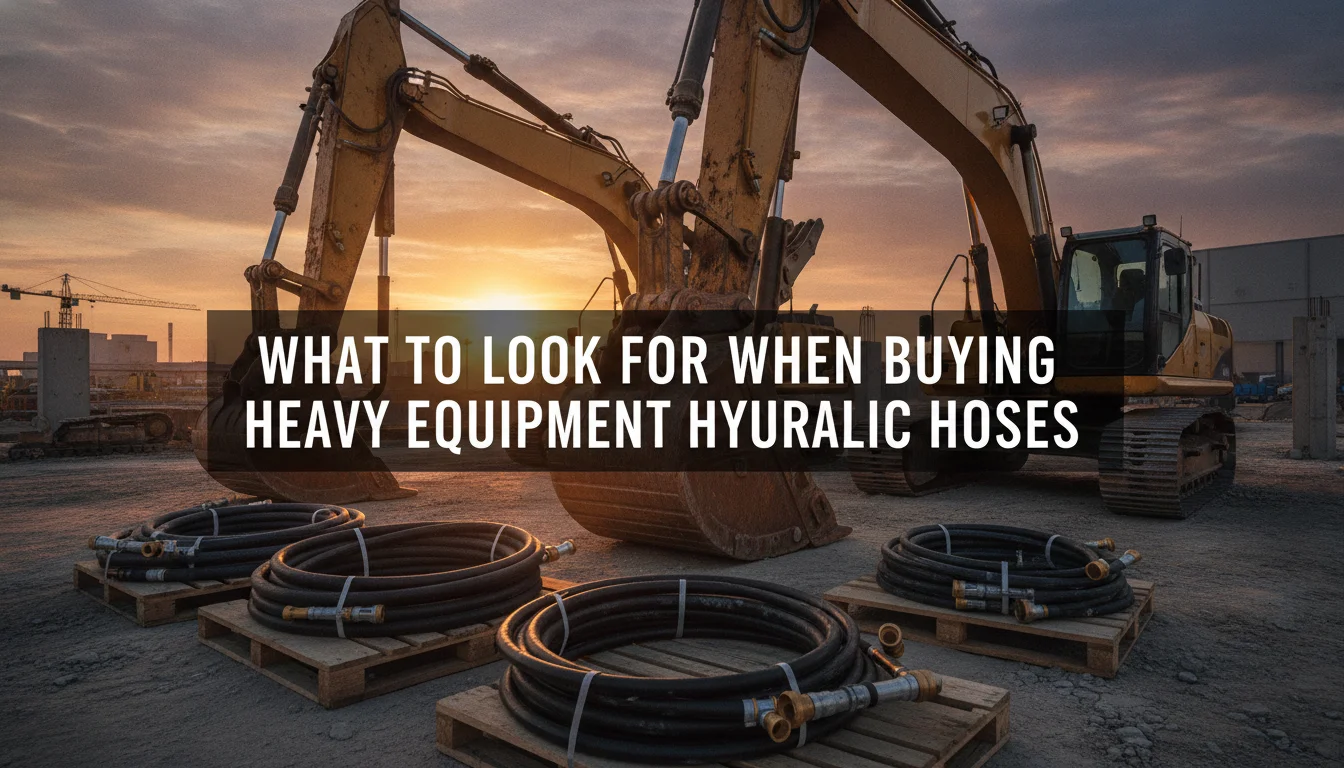
The right this kind of hydraulic hoses prevent downtime and protect the entire hydraulic system. PIRTEK USA product manager Ryan O'Lone advises considering size, pressure rating, temperature ratings, ambient temperature, minimum bend radius, and reinforcement type before you buy.
Pressure Rating and SAE Standards
Start with the pressure rating printed on the existing hose or in the machine's service manual. The maximum working pressure should never be exceeded, per Epiroc. Tractor Supply's catalog lists an SAE 100R2AT two-wire braid hose rated at 4,000 PSI around $34.99 and a 3,500 PSI option around $19.99, giving a rough sense of common retail pricing for standard sizes. Loaders and backhoes often run hoses in the 3,000-4,000 PSI range, but high-impulse excavator circuits may require spiral-reinforced hose rated up to 6,000 PSI.
Temperature, Bend Radius, and Cover Material
Temperature tolerance matters twice: the hose must handle both the temperature of the hydraulic oil it conveys and the ambient temperature of the job site. Minimum bend radius is equally critical. According to Brennan, you need to weigh temperature ranges, pressure ratings, bend diameter, and cover material together, and support brackets should be used where applicable to avoid unnecessary flexing. A bend tighter than the minimum radius damages the reinforcement and shortens service life. On machines working in rock and spoil, cover material matters as much as reinforcement.
Fitting Compatibility and Crimp Specifications
Hydraulic fittings must be compatible with the hose size and type, not just the port. PIRTEK notes there are published certified crimp specifications for assembling the fitting to the hose. The most common fitting material is carbon steel with corrosion-resistant plating, but stainless steel or another corrosion-resistant material may be necessary in harsh environments. For the equipment hydraulic hoses, a properly crimped assembly is as important as the hose itself.
Types of Heavy Equipment Hydraulic Hoses by Application
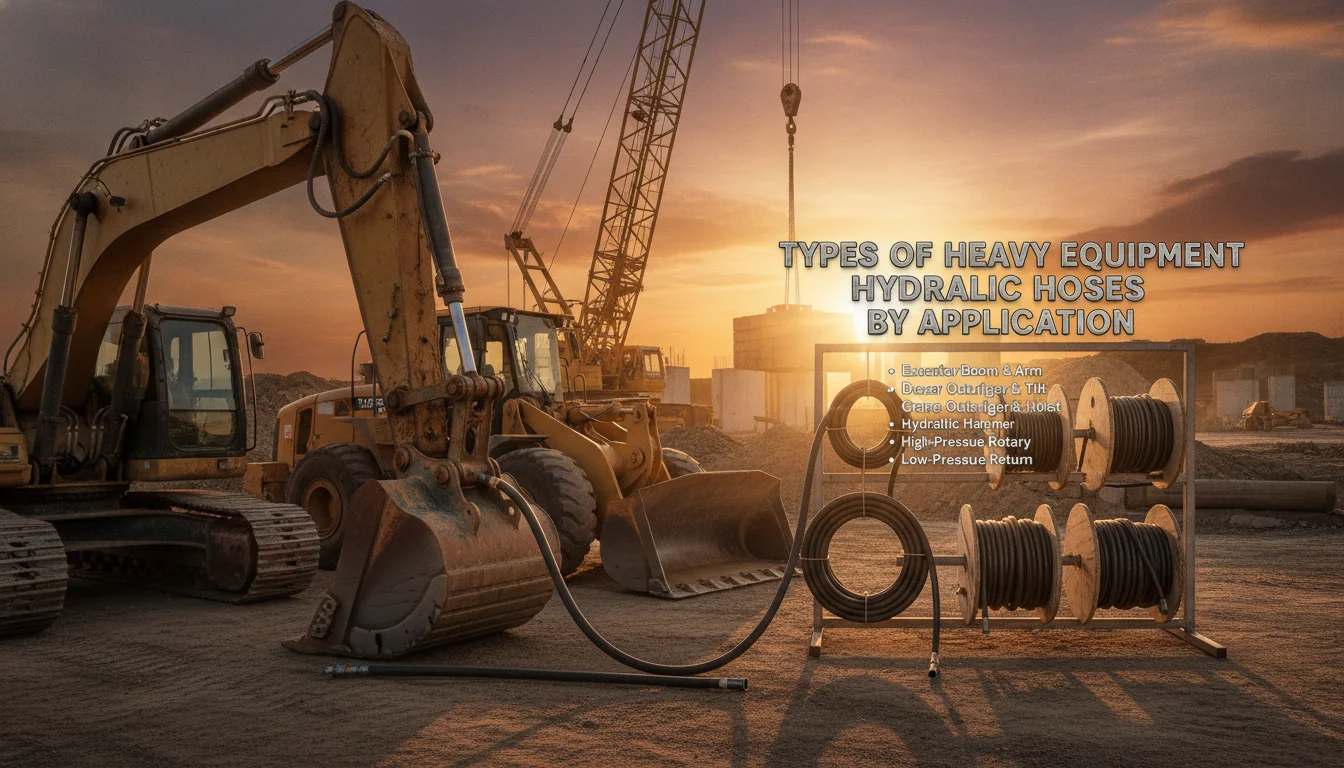
Not all hoses are interchangeable. Where the hose sits on the machine determines whether it fails from flexing or from rubbing, and that dictates the specification you need.
Boom and Arm Hoses vs. Bucket Hoses
According to Moreland Hose, boom and arm hoses fail from flex cycles, while bucket hoses fail from abrasion. Braided hose flexes more readily and suits circuits that move, while spiral reinforcement is used in high-pressure applications and handles pressure spikes better. For a skid steer, the problem is often routing before pressure; for an excavator bucket, choose an abrasion-resistant cover.
Thermoplastic Non-Conductive Hoses for Aerial Lifts and Utility Trucks
In applications where electricity may be present, steel-braid hydraulic hoses carry real conduction risk. Brennan recommends thermoplastic non-conductive hydraulic hoses for aerial-lift platforms, cherry pickers, and mobile utility equipment. SAE 100R8 is a high pressure thermoplastic hose for petroleum, water-based, and synthetic fluids operating from -40°F to 212°F. SAE 100R7 is a medium pressure thermoplastic hose for continuous service from -65°F to 200°F. Both use non-metallic reinforcement such as polyester, nylon, or PTFE.
Comparison Table: Heavy Equipment Hydraulic Hose Styles and Specifications
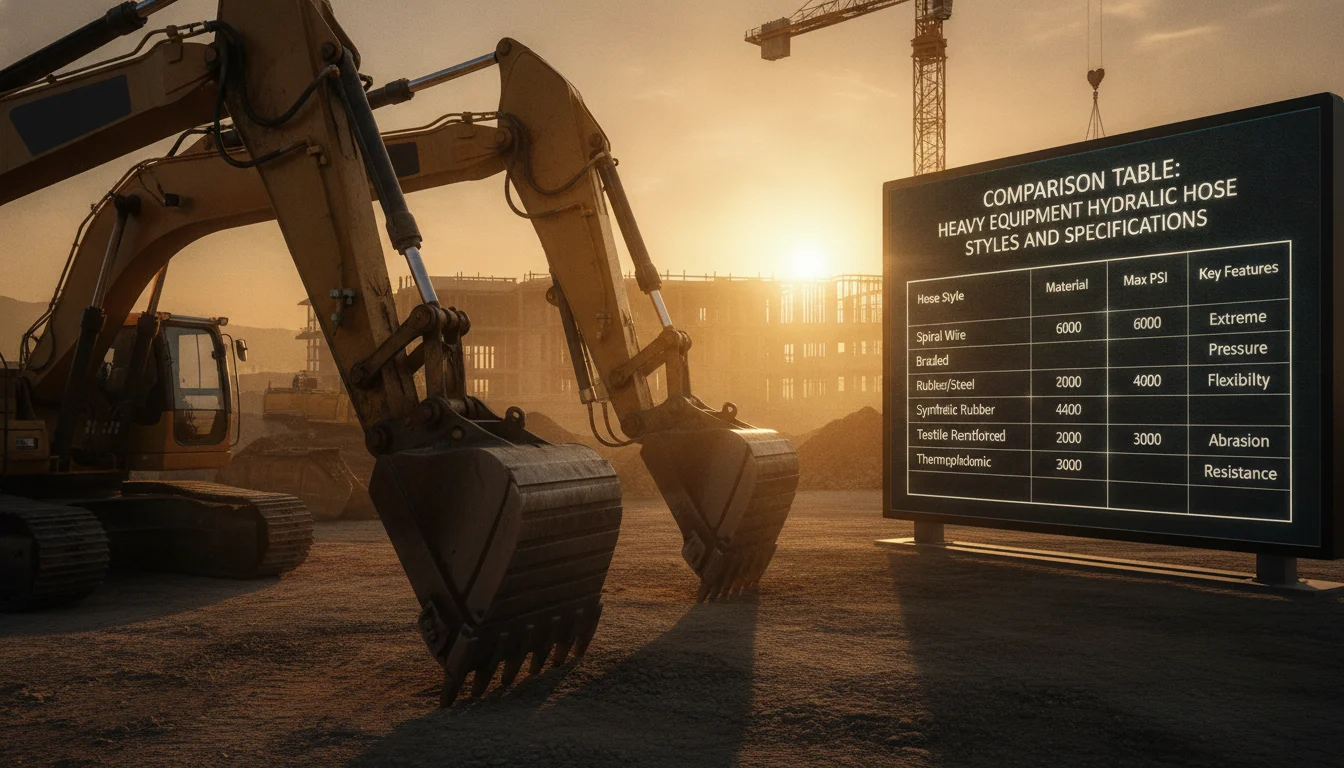
| Hose Style / Spec | Reinforcement | Pressure / Temp Range | Best For | Key Consideration |
|---|---|---|---|---|
| SAE 100R2AT wire braid | Two-wire steel braid | Up to 4,000 PSI | Tractors, loaders, general ag/construction | Good balance of cost and durability; roughly $34.99 example at Tractor Supply |
| Low pressure textile braid | Textile/fabric braid | Below 250 PSI | Return lines, suction lines, low-pressure circuits | Not for high-pressure heavy equipment work |
| High pressure wire spiral | Spiral high-tensile steel wire | 3,000-6,000 PSI | Excavators, high-impulse circuits, constant flexing | Handles pressure spikes; verify minimum bend radius |
| SAE 100R7 thermoplastic | Thermoplastic, non-metallic | Medium pressure; -65°F to 200°F | Aerial lifts, cherry pickers, utility trucks | Non-conductive; use where electricity may be present |
| SAE 100R8 thermoplastic | Thermoplastic, non-metallic | High pressure; -40°F to 212°F | High-pressure non-conductive circuits | Lighter weight and tighter bend radius than steel braid |
| Steel spring protected hose | Wire braid or spiral plus steel spring | Varies by base hose | Demolition attachments, rock work | Steel spring protects against mechanical damage from debris |
How to Choose the Right Heavy Equipment Hydraulic Hoses: Step-by-Step
Use these six steps to match the hose lineup to the machine and the job.
- Step 1: Identify the operating pressure. Check the machine's OEM manual or the existing hose layline. Never exceed the maximum working pressure printed on the hose.
- Step 2: Read the layline. Record the SAE spec, inside diameter, and pressure rating. Match the replacement to those numbers exactly unless upgrading with engineering approval.
- Step 3: Measure length and routing. Account for the hose's path through the boom or chassis, and use support brackets where applicable. Avoid any bend tighter than the manufacturer's minimum bend radius.
- Step 4: Choose reinforcement and cover for the failure mode. If the old hose failed from flexing, consider braided construction with a tighter bend radius. If it failed from rubbing, upgrade the cover or add protective sleeving.
- Step 5: Select compatible fittings. Use certified crimp specifications for the hose and fitting combination. In corrosive environments, choose stainless steel or corrosion-resistant plating.
- Step 6: Test and inspect. After installation, cycle the equipment through full motion and check for leaks, kinks, or contact points. Replace immediately if the cover is damaged.
How to Match Heavy Equipment Hydraulic Hoses to Your Equipment Setups
Think of hose selection like outfitting each attachment for its working environment. Here are four common configurations and the hose setups that fit them.
Excavator Demolition Attachment
Use hoses with steel spring protection, such as Epiroc's heavy duty connection hoses, to prevent mechanical damage when the hose contacts demolished material. Epiroc puts it plainly: saving a modest amount on a hose can cost far more in downtime and repairs when things go wrong, so original manufacturer hoses are recommended for critical circuits.
"In the worst case scenario, problems with hoses may bring work on a jobsite to a halt for one day or they can destroy the hydraulic system of a carrier. Saving 50 euros may cost 100,000 euros when things go wrong." - Epiroc
Skid Steer Loader Bucket
Route the hose away from pinch points and choose an abrasion-resistant cover for rock and spoil. A spiral-reinforced high-pressure hose works well for the loader's lift and tilt circuits, while standard braided hose may be sufficient for auxiliary attachments.
Aerial Lift or Cherry Picker
Outfit these machines with SAE 100R7 or SAE 100R8 thermoplastic non-conductive hoses. The non-metallic reinforcement eliminates the risk of electrical conduction, which is critical when working near utility lines.
Farm Tractor Loader
An SAE 100R2AT two-wire braid hose rated at 4,000 PSI is a common, economical choice for tractor loaders and backhoes. Pair it with carbon steel fittings and corrosion-resistant plating for typical agricultural exposure.
Price Ranges and Where to Buy Heavy Equipment Hydraulic Hoses
heavy equipment are available at farm retailers, hydraulic specialty shops, and OEM dealers, with pricing that varies widely by spec, length, and fitting type.
- Budget tier: Basic 3,500 PSI hydraulic hose can start around $19.99 at Tractor Supply for common sizes. These suit low-pressure return lines or occasional use.
- Mid-range tier: SAE 100R2AT 4,000 PSI hose runs around $34.99 at Tractor Supply and suits most agricultural and light construction equipment.
- Premium tier: Custom assemblies with spiral reinforcement, stainless steel fittings, or steel spring protection cost more upfront. Epiroc's cost framing (a modest saving on the hose versus a major repair bill down the line) argues for paying for quality on critical circuits.
Authorized distributors like Discount Hydraulic Hose and PIRTEK USA offer custom hose assemblies and fitting support. For OEM-specific excavator attachment hoses, contact your equipment dealer or Epiroc directly. At 3GEN Export, we stock OEM-standard hydraulic hoses and fittings for Caterpillar, Komatsu, Volvo, and 40+ brands, shipped globally with fast turnaround so a hose failure doesn't turn into a week of idle equipment. Browse our parts categories or check compatibility by brand.
A Note on DIY Hose Assembly
Some operators build custom hydraulic hoses at home using a crimper and raw hose stock to save time on a nonstandard length. This can work for low-stakes, low-pressure applications, but it's not a substitute for certified crimp specifications on critical circuits. If the hose feeds a boom cylinder or a high-pressure demolition attachment, use a hydraulic shop or OEM assembly instead. The published crimp specs exist because a mismatched crimp can fail well below the hose's rated pressure.
Pros and Cons
Pros
- Correctly specified hydraulic hoses reduce unplanned downtime and protect expensive pump and valve components from contamination.
- A wide range of reinforcement types (braided, spiral, thermoplastic) means there's a purpose-built option for nearly every failure mode and environment.
- Standardized SAE specs and laylines make cross-brand replacement straightforward once you know the numbers.
- Steel spring protection and abrasion-resistant covers extend service life significantly in rock, spoil, and demolition environments.
Cons
- Premium assemblies (spiral reinforcement, stainless fittings, steel spring protection) cost meaningfully more than basic braided hose.
- Incorrect crimp specifications or mismatched fittings can cause failure even when the hose itself is rated correctly.
- Thermoplastic non-conductive hoses, while safer near electrical hazards, add cost and aren't necessary for every application.
- Custom or OEM-specific lengths for excavator attachments may require dealer sourcing rather than off-the-shelf retail purchase.
Care and Maintenance for Longer Service Life
Regular inspection is the single most effective maintenance task for heavy equipment hydraulic hoses. PIRTEK notes that agricultural and construction environments expose hoses to dirt, chemicals, and moisture that degrade them over time.
Inspection Checklist
- Check the outer cover for cracks, cuts, bulges, or exposed reinforcement.
- Look for oil mist or wet spots at fittings and along the hose length.
- Verify that the hose isn't rubbing against metal edges or exceeding its minimum bend radius.
- Inspect fittings for corrosion or movement at the crimp.
Safety Warning
Never search for a hydraulic leak with your hand. A pinhole at working pressure can inject fluid through the skin, causing serious injury. Moreland Hose and industry safety standards both stress this point. If you suspect a pinhole leak, de-pressurize the system and use a piece of cardboard or wood to find it.
Also watch for small rubber particles in filters or valve blocks. According to Epiroc, rubber degradation inside the hose can clog filters, jam valve blocks, and damage the hydraulic pump. An inner diameter that's too small for the required flow also raises internal pressure and oil temperature, which accelerates this kind of wear. Replace hoses before they reach that failure point.
Frequently Asked Questions
What pressure rating do I need for heavy equipment hydraulic hoses?
Match the machine's OEM maximum working pressure and never exceed the rating printed on the hose. Medium pressure hoses handle up to 3,000 PSI; high pressure hoses handle 3,000-6,000 PSI.
How do I read hydraulic hose specifications?
The layline printed on the hose lists the manufacturer, SAE specification, internal diameter, maximum working pressure, and approvals. Match those values when ordering a replacement.
Can I use thermoplastic hydraulic hoses on heavy equipment?
Yes, for aerial lifts, cherry pickers, and utility trucks where electrical conductivity is a hazard. SAE 100R7 and SAE 100R8 thermoplastic hoses use non-metallic reinforcement and are non-conductive.
What is the difference between braided and spiral hydraulic hose?
Braided hose flexes more readily and suits moving circuits, while spiral hose is used in high-pressure, high-impulse applications. The failure mode of the old hose, flexing or abrasion, helps you decide which to buy.
How often should heavy equipment hydraulic hoses be replaced?
There's no universal replacement interval. Inspect regularly and replace any hose with a damaged cover, exposed reinforcement, leaking fittings, or signs of internal degradation such as rubber particles in filters.
Can I make custom heavy equipment hydraulic hoses myself?
DIY methods exist and can work for low-pressure, non-critical lines, but certified crimp specifications ensure the fitting and hose are assembled to published pressure ratings. For critical applications, use a hydraulic shop or OEM assembly.
As of 2026, sourcing the right heavy equipment hydraulic hoses still comes down to the same fundamentals: read the layline, respect the pressure rating, and match reinforcement to the failure mode you're actually seeing in the field. We built 3GEN Export around exactly this problem. Shop OEM-quality spare parts with global 5-day delivery at 3genexport.com, and get your machine back to work instead of waiting on a hose.