
Heavy Equipment Parts Market Growth 2030: Full Guide
Heavy equipment parts market growth 2030 is accelerating fast. See verified forecasts, regional trends, and sourcing strategies for B2B procurement teams.
Loading article…
Article Not Found
The article you're looking for doesn't exist or may have been removed.
Back to BlogKey Takeaways
- The heavy equipment parts market growth 2030 trajectory points to expansion from USD 174.04 billion in 2025 to USD 264.12 billion by 2030, at a CAGR of 8.70%.
- Asia-Pacific leads both market size and growth rate, driven by infrastructure investment in China and India.
- Aging equipment fleets are generating consistent demand for engine parts, hydraulic components, and undercarriage assemblies.
- Digital procurement platforms and predictive maintenance tools are reshaping how buyers source aftermarket parts.
- Quality control remains the top operational risk: low-grade counterfeit parts cause equipment failures and project delays.
- OEM-standard aftermarket suppliers with global logistics capability are best positioned to capture market share through 2030.
Heavy equipment parts market growth 2030 is the sustained expansion of the global spare parts industry serving construction, mining, and energy equipment, projected to reach USD 264.12 billion by 2030 according to Mordor Intelligence. Procurement teams, fleet managers, and parts distributors need to understand what is driving this growth and how to act on it.
Market Overview: Where the Numbers Stand in 2026
The heavy equipment parts market growth 2030 story starts with a clear baseline. According to Mordor Intelligence, the construction and mining equipment spare parts market is valued at USD 174.04 billion in 2025 and is forecast to reach USD 264.12 billion by 2030, reflecting a CAGR of 8.70% over the forecast period. Separately, the construction equipment aftermarket segment, which covers parts, accessories, and services sold after the initial equipment sale, reached USD 28.53 billion in 2025 and is projected to grow to USD 40.39 billion by 2030 at a CAGR of 7.3%, according to The Business Research Company.
These figures represent two different ways of slicing the same underlying demand: more machines in the field, working harder, in tougher conditions, for longer service lives. Every hour a machine runs past its design service interval is an hour that generates parts demand.
"Global infrastructure development and expanding mining activities are propelling steady growth in the construction and mining equipment spare parts market. Urbanization and large-scale projects have spurred a rising demand for construction and mining equipment, creating a parallel need for spare parts to ensure operational efficiency and minimize downtime." - Mordor Intelligence, Construction and Mining Equipment Spare Parts Market Analysis
Key Drivers of Market Growth
- Urbanization: Global urbanization rates climbed from 55.6% to 57.3% between 2019 and 2023, according to Mordor Intelligence data. As cities expand, large-scale construction projects multiply, and so does the demand for excavators, bulldozers, cranes, and the parts that keep them running.
- Aging Equipment Fleets: An aging fleet of heavy machinery across North America, Europe, and parts of Asia requires frequent maintenance and replacement parts. A 20-year-old excavator may still handle earthmoving, but its components endure significantly more stress than newer models, according to McGill Industries' market analysis.
- Technological Advancements: The integration of IoT, telematics, and automation in heavy machinery is driving demand for specialized, compatible spare parts. These systems improve performance but require high-quality components to maintain reliable operation.
- Mining Sector Expansion: Expanding mining activities globally, particularly in metals and energy minerals, are increasing machine utilization rates and accelerating parts wear cycles.
Regional Insights
Asia-Pacific is both the largest and fastest-growing region in the heavy equipment parts market, according to Mordor Intelligence. Countries like China and India are investing heavily in transportation infrastructure, urban development, and industrial capacity, all of which require sustained equipment utilization and parts supply. North America and Europe are channeling investment into modernizing existing fleets and meeting tightening environmental regulations, which creates demand for upgraded components and emissions-compliant parts. The US construction equipment market alone is expanding toward an estimated USD 57.1 billion by 2029, per McGill Industries.
How the Heavy Equipment Parts Market Actually Works
The heavy equipment parts market operates through a layered supply chain that connects OEM manufacturers, authorized distributors, independent aftermarket suppliers, and end-use operators. Understanding this structure is essential for any procurement team trying to optimize cost, lead time, and parts quality.
At the top of the chain, OEMs like Caterpillar, Komatsu, Volvo CE, and Atlas Copco design and manufacture original equipment. They also produce or license genuine spare parts, which carry full OEM specifications and warranty backing. These parts are distributed through authorized dealer networks, which provide technical support and parts availability guarantees.
Below the OEM tier sits the aftermarket. This segment includes two distinct categories. First, there are OEM-standard aftermarket parts: components manufactured to the same specifications as the original, often by the same tier-1 suppliers that produce parts for the OEM, but sold under a different brand at a lower price point. Second, there are non-OEM or generic parts, which vary widely in quality and are the primary source of the counterfeit and low-grade components that create operational risk.
The aftermarket segment is growing faster than the OEM channel because operators are under cost pressure and because the installed base of aging equipment is large. The Business Research Company identifies the growing shift toward predictive maintenance solutions and the rising adoption of digital aftermarket platforms as key trends accelerating this shift.
"In recent years, there has been a deluge of low-quality, albeit 'affordable' parts flooding the heavy equipment parts market." - McGill Industries, The Critical Demand for Heavy Equipment Parts (2025)
Digital procurement platforms are now a third channel. Online marketplaces and B2B e-commerce portals allow operators to source parts globally, compare specifications, and reduce lead times. The Business Research Company lists the expansion of online aftermarket procurement as a primary growth driver through 2030.
Market Segmentation: What Parts Are in Demand
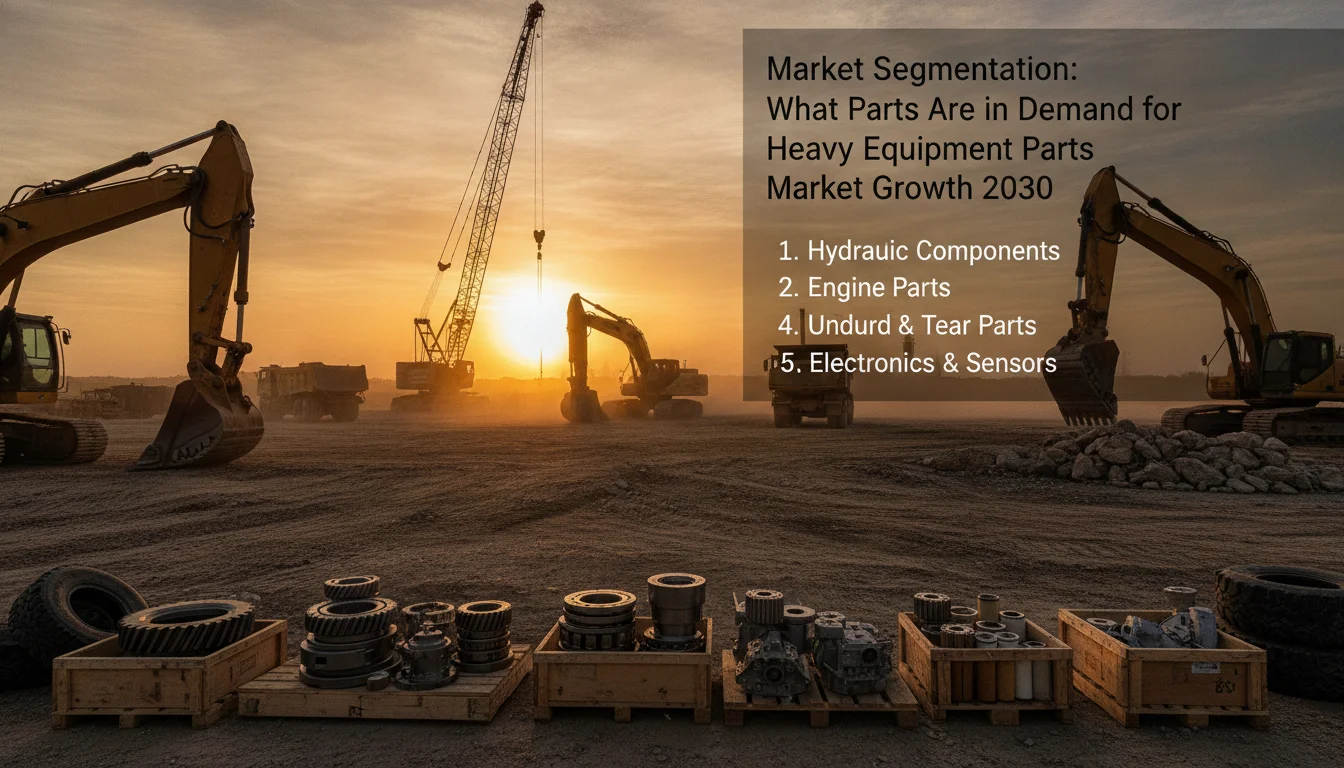
The heavy equipment parts market segments by product type, equipment type, and sales channel. Each segment carries different growth dynamics and procurement considerations.
By Product Type
- Engine Parts: Critical for machine functionality, engine components including pistons, valves, seals, and filters are in consistent demand across all equipment categories. The Business Research Company identifies growing demand for high-durability engine replacement parts as a primary market trend through 2030.
- Hydraulic Systems: Hydraulic components, including cylinders, pumps, hoses, and seal kits, are among the highest-wear parts on excavators, loaders, and cranes. The Business Research Company specifically calls out increasing need for high-performance hydraulic components as a forecast-period driver.
- Track and Undercarriage: On tracked equipment, undercarriage components account for a significant share of total maintenance cost over a machine's service life. Rollers, idlers, sprockets, and track links require regular inspection and replacement.
- Electrical Parts: As machinery integrates more electronic control systems, sensors, and telematics hardware, the demand for reliable electrical components is rising. Compatibility with OEM control systems is a key specification requirement.
- Transmission Parts: Gearboxes, torque converters, and clutch assemblies are high-value components that require precise OEM-specification matching to ensure safe operation.
By Equipment Type
- Excavators: The most widely deployed heavy machine in construction and mining globally. High utilization rates mean frequent parts replacement across hydraulic, undercarriage, and engine categories.
- Loaders: Wheel loaders and skid steers are workhorses in material handling and quarrying operations, generating steady demand for drivetrain and hydraulic parts.
- Bulldozers: Essential for earthmoving and site preparation, bulldozers require regular undercarriage and blade maintenance.
- Cranes: The material handling and cranes segment is projected to generate an incremental USD 3.73 billion in aftermarket revenue by 2030, according to The Business Research Company.
- Dump Trucks: High-cycle haul trucks in mining operations accumulate wear rapidly, driving demand for suspension, drivetrain, and body components.
By Sales Channel
- OEMs: Authorized OEM channels provide guaranteed compatibility and warranty support but typically carry premium pricing and longer lead times for non-stocked items.
- Aftermarket: The aftermarket segment is growing rapidly as operators seek cost-effective maintenance solutions without sacrificing quality. OEM-standard aftermarket suppliers bridge the gap between price and performance.
- Online Sales: Digital platforms are reshaping procurement by enabling global sourcing, real-time inventory visibility, and faster order fulfillment. This channel is expected to grow significantly through 2030.
Comparison: OEM vs. Aftermarket vs. Online Procurement
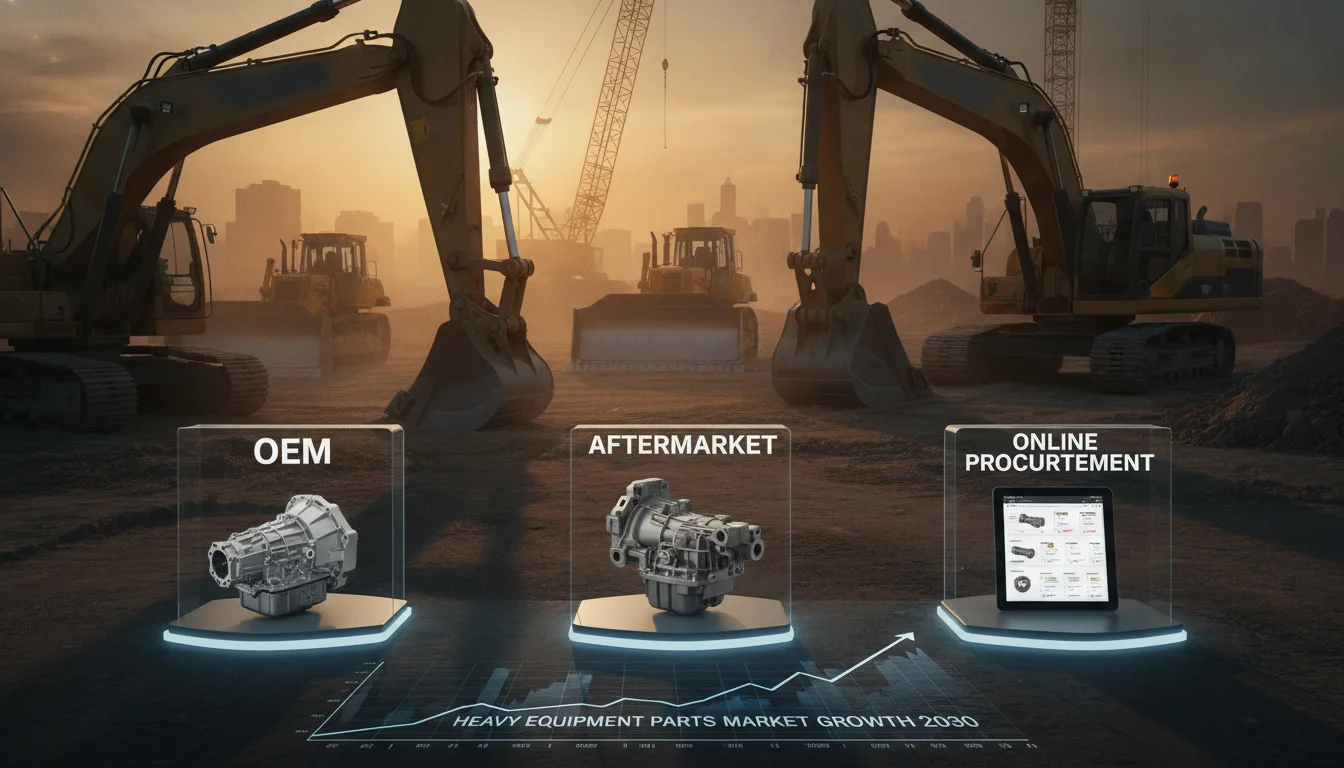
Choosing the right sourcing channel directly affects your total cost of ownership, equipment uptime, and parts availability. Here is how the three main channels compare across key procurement criteria.
| Criteria | OEM Channel | Aftermarket (OEM-Standard) | Online / Digital Platforms |
|---|---|---|---|
| Parts Quality | Guaranteed OEM spec | OEM-equivalent when sourced from reputable suppliers | Variable - depends on supplier vetting |
| Price Point | Highest | Typically 20-40% lower than OEM list price | Competitive, but requires comparison |
| Lead Time | 2-6 weeks for non-stocked items | 3-10 days from specialist distributors | Varies by supplier location and stock |
| Compatibility Assurance | Full OEM documentation | Requires spec verification from supplier | Buyer must verify part numbers independently |
| Global Availability | Limited to dealer network | Wide - global distributors stock common parts | Broadest reach, including hard-to-find parts |
| Warranty Support | Full OEM warranty | Supplier warranty (varies) | Depends on individual seller |
| Best For | Critical systems, new equipment | Routine maintenance, aging fleets | Sourcing rare parts, price benchmarking |
Pros and Cons of the Heavy Equipment Parts Market Outlook
Pros
- Strong, verified growth trajectory: The market's expansion from USD 174.04 billion to USD 264.12 billion by 2030 is supported by multiple independent research firms, giving procurement teams confidence in long-term parts availability and supplier investment.
- Expanding aftermarket options: More OEM-standard aftermarket suppliers are entering the market, increasing competition and driving down prices for routine maintenance parts without sacrificing quality.
- Digital procurement reducing lead times: Online platforms and B2B portals are cutting sourcing time for common parts, enabling faster equipment turnaround and reduced downtime costs.
- Predictive maintenance reducing emergency purchases: IoT-enabled diagnostics allow operators to plan parts purchases in advance, reducing reliance on expensive expedited shipping and emergency sourcing.
- Global supplier networks improving resilience: As the market grows, more regional distributors are stocking critical parts locally, reducing exposure to single-source supply chain disruptions.
Cons
- Counterfeit parts remain a serious risk: Market growth is attracting low-quality suppliers. Counterfeit or substandard parts can cause equipment failures, void warranties, and create safety hazards on job sites.
- Supply chain disruptions persist: Geopolitical tensions and logistics bottlenecks continue to affect parts availability, particularly for specialized components with limited global sourcing options.
- Regulatory compliance adds cost: Tightening environmental regulations in North America and Europe require manufacturers and operators to upgrade components, adding procurement complexity and cost.
- Price volatility in raw materials: Steel, copper, and rubber price fluctuations directly affect parts manufacturing costs and can compress margins for distributors and end-users alike.
- Compatibility verification burden: As machinery integrates more electronic and IoT systems, verifying parts compatibility requires more technical expertise from procurement teams.
Technological Advancements Shaping the Market Through 2030
Technology is reshaping how heavy equipment parts are specified, sourced, and maintained. As of 2026, three technology trends are having the most direct impact on parts demand and procurement strategy.
IoT and Telematics Integration
IoT-enabled machinery generates continuous operational data: engine hours, hydraulic pressure readings, temperature cycles, and component load data. This information feeds directly into maintenance scheduling systems, allowing fleet managers to replace parts based on actual wear data rather than fixed intervals. The result is fewer unexpected failures and more planned parts purchases, which benefits suppliers with reliable inventory and fast fulfillment.
Predictive Maintenance Platforms
The shift toward predictive maintenance is one of the most significant structural changes in the heavy equipment parts market. By using data analytics to anticipate component failures before they occur, operators can schedule maintenance during planned downtime windows rather than reacting to breakdowns. The Business Research Company identifies the growing shift toward predictive maintenance solutions as a primary driver of aftermarket growth through 2030. For procurement teams, this means parts orders become more predictable and lead time management becomes a competitive advantage.
Digital Procurement and E-Commerce
Online aftermarket procurement platforms are eliminating geographic barriers in parts sourcing. A mining operation in West Africa can now source OEM-standard hydraulic seals from a specialist distributor in Europe or Asia within days, rather than waiting weeks for a local dealer to fulfill an order. The Business Research Company lists the expansion of online aftermarket procurement as a key forecast-period trend. For suppliers, this means global reach is no longer optional: it is a baseline requirement for competing in the heavy equipment parts market growth 2030 environment.
AI-Assisted Parts Identification
AI-powered parts identification tools are reducing specification errors in procurement. By cross-referencing machine serial numbers, equipment models, and OEM part number databases, these tools help buyers confirm compatibility before ordering, reducing costly returns and installation errors.
How to Position Your Procurement Strategy for 2030
Understanding the heavy equipment parts market growth 2030 forecast is useful. Acting on it is what separates high-performing fleet operations from reactive ones. Here are concrete steps procurement managers should take now.
Step 1: Audit Your Current Fleet Age and Parts Consumption
Start with a complete inventory of your equipment fleet, including machine age, annual operating hours, and historical parts consumption by category. Machines operating past their design service life will show accelerating parts demand across hydraulic, engine, and undercarriage categories. This audit gives you a baseline for forecasting parts spend through 2030.
Step 2: Qualify OEM-Standard Aftermarket Suppliers
Not all aftermarket suppliers are equal. Qualify suppliers based on documented OEM-specification compliance, quality certifications, and track record with your specific equipment brands. For Caterpillar, Komatsu, Volvo CE, and Atlas Copco equipment, look for suppliers who can provide cross-reference part numbers and material certifications. Avoid suppliers who cannot provide documentation.
Step 3: Establish Global Sourcing Relationships
Single-source procurement is a supply chain risk. Build relationships with at least two qualified suppliers per critical parts category, ideally in different geographic regions. This protects you against the logistics disruptions and regional supply shortages that have affected the market in recent years.
Step 4: Implement Predictive Maintenance Data Collection
If your equipment has telematics capability, connect it to a maintenance management system that tracks component wear data. Use this data to shift from reactive parts purchasing to planned procurement. Planned purchases allow you to negotiate better pricing, consolidate shipments, and reduce expedited freight costs.
Step 5: Leverage Digital Procurement Platforms
Use online B2B platforms to benchmark pricing, identify alternative suppliers for hard-to-find parts, and reduce sourcing lead times. Platforms that specialize in heavy equipment parts offer part number cross-referencing, compatibility verification, and global shipping options that general marketplaces cannot match.
Step 6: Monitor Regulatory Changes in Your Operating Regions
Environmental regulations in North America and Europe are tightening emissions and noise standards for construction equipment. Stay ahead of compliance requirements by identifying which components on your fleet will need upgrading and sourcing compliant replacement parts before regulatory deadlines create supply pressure.
Brand Landscape: Key Manufacturers and Market Position
Brand concentration matters in the heavy equipment parts market. According to McGill Industries' market analysis, Caterpillar holds approximately 42% market dominance in the heavy equipment sector. When nearly half of job sites run Caterpillar equipment, procurement teams face a dual challenge: they need genuine or OEM-standard parts that ensure compatibility, but they must balance that against budgets that can be strained by premium OEM pricing.
Other major OEM brands with significant parts market presence include Komatsu, Volvo CE, Liebherr, Hitachi, and Atlas Copco. Each brand maintains its own parts ecosystem, with proprietary specifications and authorized dealer networks. For procurement teams managing mixed fleets, this creates complexity: a single job site may require parts sourced from multiple OEM channels or a single specialist distributor who stocks across brands.
The aftermarket is also seeing consolidation. Larger distributors are acquiring regional specialists to build global parts networks that can compete with OEM dealer channels on both price and lead time. This trend benefits buyers by increasing competition and improving parts availability, particularly for older equipment models where OEM support has been reduced.
Specialized component suppliers are also growing in influence. As McGill Industries notes, companies like Woodward Inc. are expanding market share in engine control systems that integrate with major OEM equipment. This means parts ecosystems are more interconnected than ever, and procurement teams need suppliers who understand interoperability across brands and component categories.
Common Mistakes to Avoid in Heavy Equipment Parts Procurement
The heavy equipment parts market growth 2030 environment creates both opportunity and risk. These are the procurement mistakes we see most often, and how to avoid them.
Buying on Price Alone
The lowest-priced part is rarely the lowest total cost option. A substandard hydraulic seal that fails after 200 hours costs far more in downtime, labor, and secondary damage than an OEM-standard seal that lasts 2,000 hours. Always evaluate total cost of ownership, not just unit price.
Skipping Part Number Verification
Heavy equipment parts are highly specific. A hydraulic cylinder seal kit for a CAT 320D is not interchangeable with one for a CAT 320E, even though the machines look similar. Always verify the OEM part number against your machine's serial number before ordering. Suppliers who cannot provide part number cross-references are a red flag.
Relying on a Single Supplier
Supply chain disruptions have shown that single-source procurement is a liability. Build a qualified supplier network across at least two geographic regions for your highest-consumption parts categories. This is especially important for hydraulic components and engine parts, where a stockout can halt an entire project.
Ignoring Lead Time in Project Planning
Procurement teams that order parts reactively, after a failure occurs, pay premium prices for expedited shipping and accept whatever lead time the supplier quotes. Teams that plan parts procurement based on maintenance schedules and predictive data can consolidate orders, negotiate better pricing, and avoid project delays.
Underestimating Counterfeit Risk
The influx of counterfeit parts into the heavy equipment market is a documented and growing problem, as McGill Industries confirms. Counterfeit parts often pass visual inspection but fail under operational stress. Require material certifications and quality documentation from all suppliers, and avoid sourcing from unverified online marketplaces.
Realistic Procurement Scenario: Managing a Mixed Fleet Through 2030
Consider a mid-size civil construction company operating a mixed fleet of 40 machines: 15 excavators (CAT 320 and Komatsu PC300), 10 wheel loaders (Volvo L120), 8 bulldozers (Komatsu D65), and 7 cranes (Liebherr LTM series). This fleet profile is typical of contractors working on road and bridge projects across Southeast Asia and the Middle East.
As of 2026, the oldest machines in this fleet are 12-14 years old. Based on industry maintenance data, machines in this age range require significantly more frequent parts replacement across hydraulic, undercarriage, and engine categories compared to machines under 5 years old. The procurement team is managing parts sourcing across four OEM dealer networks, each with different lead times, pricing structures, and stock availability.
The problem: two of the CAT 320 excavators need hydraulic cylinder seal kits urgently. The local CAT dealer quotes a 3-week lead time. The project cannot wait 3 weeks.
The solution: the procurement team contacts a qualified OEM-standard aftermarket supplier with global stock. The supplier confirms OEM part number compatibility, provides material certification documentation, and ships from a regional warehouse. Parts arrive in 5 days. The excavators return to service. The project stays on schedule.
This scenario plays out across thousands of job sites globally every week. It illustrates exactly why the heavy equipment parts market growth 2030 trajectory is driven not just by new machine sales, but by the operational reality of keeping aging fleets productive in demanding conditions.
Challenges Facing the Heavy Equipment Parts Market
Despite the positive outlook for heavy equipment parts market growth 2030, several structural challenges could affect the pace and distribution of that growth.
Quality Control Issues
The influx of low-quality parts in the market poses a significant operational risk. Operators must balance cost and quality when sourcing parts, as low-quality components lead to equipment failures, safety incidents, and warranty voidance. Supplier qualification and documentation requirements are the primary defense.
Supply Chain Disruptions
Global supply chain disruptions, driven by geopolitical tensions and logistics bottlenecks, have affected parts availability across multiple categories. Manufacturers and distributors must maintain broader safety stock and more diversified supplier networks to ensure consistent supply.
Regulatory Compliance
Compliance with environmental regulations is becoming increasingly important, particularly in North America and Europe. Manufacturers must adapt components to meet emissions and noise standards while maintaining cost-effectiveness. This creates both a challenge and an opportunity: operators who plan ahead for compliance upgrades can source parts at better prices than those who wait for regulatory deadlines.
Future Outlook: Heavy Equipment Parts Market Growth 2030 and Beyond
The heavy equipment parts market growth 2030 forecast is well-supported by structural demand drivers that are unlikely to reverse. Updated for 2026, the near-term outlook reflects three converging forces.
Sustainability and Eco-Friendly Parts
As industries face growing pressure to reduce environmental impact, demand is rising for parts manufactured from sustainable materials and designed for longer service life. Manufacturers are investing in durable, eco-friendly replacement part technologies, which The Business Research Company identifies as a key forecast-period development. Longer-lasting parts reduce waste and total cost of ownership simultaneously.
E-Commerce and Digital Distribution Growth
Online sales channels are becoming the default procurement method for routine maintenance parts. This year, more procurement teams are using digital platforms as their primary sourcing tool rather than a secondary option. Suppliers who invest in digital catalog infrastructure, real-time inventory visibility, and global logistics capability will capture a disproportionate share of market growth.
AI and Machine Learning in Supply Chain Management
AI-assisted demand forecasting, inventory optimization, and parts identification are moving from pilot programs to standard practice among leading distributors. These tools reduce stockouts, improve order accuracy, and enable faster fulfillment, all of which directly benefit end-use operators managing tight project schedules.
Frequently Asked Questions
What is driving the growth of the heavy equipment parts market through 2030?
Growth is driven by increasing construction and mining activities globally, rapid urbanization particularly in Asia-Pacific, and the need to maintain aging equipment fleets. Technological integration in machinery, including IoT and telematics systems, is also creating demand for specialized compatible parts. According to Mordor Intelligence, these combined factors support a CAGR of 8.70% through 2030.
Which region is expected to lead the heavy equipment parts market by 2030?
Asia-Pacific is both the largest and fastest-growing region, according to Mordor Intelligence. China and India are investing heavily in infrastructure development, driving sustained demand for construction and mining equipment and the parts that maintain them. North America and Europe are also growing, focused on fleet modernization and regulatory compliance upgrades.
What are the key challenges facing the heavy equipment parts market?
The three primary challenges are quality control, supply chain disruptions, and regulatory compliance. Counterfeit and low-grade parts represent a serious operational risk, as documented by multiple industry sources. Supply chain disruptions from geopolitical tensions and logistics bottlenecks continue to affect availability of specialized components.
What heavy machinery generates the most parts demand?
Excavators generate the highest parts demand volume due to their widespread deployment in construction and mining and their high utilization rates. Hydraulic components, undercarriage parts, and engine components are the highest-consumption categories on excavators. The Business Research Company projects earthmoving and road-building equipment to generate the largest incremental aftermarket revenue gain through 2030.
What is the expected market size for heavy equipment parts by 2030?
The construction and mining equipment spare parts market is projected to reach USD 264.12 billion by 2030, up from USD 174.04 billion in 2025, according to Mordor Intelligence. The construction equipment aftermarket segment specifically is projected to reach USD 40.39 billion by 2030, according to The Business Research Company. These figures reflect different market scope definitions but both confirm strong growth.
How are digital platforms changing heavy equipment parts procurement?
Digital platforms are eliminating geographic barriers in parts sourcing, enabling operators to access global supplier networks, compare specifications, and reduce lead times significantly. The Business Research Company identifies the expansion of online aftermarket procurement as a primary growth driver through 2030. For procurement teams, this means faster sourcing of hard-to-find parts and better price transparency across suppliers.