
Heavy Equipment Parts Procurement Strategy 2026
Master your heavy equipment parts procurement strategy with OEM vs aftermarket guidance, min/max stocking, and digital tools for global fleets in 2026.
Loading article…
Article Not Found
The article you're looking for doesn't exist or may have been removed.
Back to BlogHeavy Equipment Parts Procurement Strategy: A 2026 Field Guide
A heavy equipment parts procurement strategy is a structured plan combining OEM evaluation, supplier qualification, inventory forecasting, and digital workflows to reduce downtime and control costs across construction, mining, and energy fleets.
Key Takeaways
- Proactive inventory planning prevents the most common cause of downtime: waiting on a part, not the repair itself.
- OEM, aftermarket, and remanufactured parts each carry different cost, warranty, and compatibility trade-offs that must be evaluated before purchase.
- Digital tools such as CMMS and parts procurement platforms reduce manual tracking, eliminate duplicate data entry, and create full order visibility.
- Supplier qualification and long-term relationships deliver priority access during shortages and better total cost of ownership.
- A data-driven min/max stocking method matches purchase volumes to actual consumption, with a safety buffer, to avoid overcapitalizing on inventory.
- Serial number breaks mean two machines with the same model number may need different parts - always verify before ordering.
In heavy construction and mining, a failed hydraulic pump or a missing hose fitting can stop a six-figure excavator for days while the part ships, even though the repair itself often takes hours. What eats time is sourcing, shipping, and receiving. That is why a solid procurement strategy has moved from a back-office buying task to an operational risk function. This article synthesizes field-tested advice from dealer networks, fleet maintenance software providers, and heavy equipment parts suppliers into a single framework.
Why Heavy Equipment Parts Procurement Fails Without a Strategy
The Real Cost of Reactive Ordering
Reactive ordering is the single biggest driver of avoidable downtime in heavy equipment fleets. According to Heavy Vehicle Inspection's 2026 parts inventory guide, the average heavy equipment breakdown costs $2,000 or more per day in downtime, while the repair itself often takes only hours. A $40 hydraulic hose fitting can idle a $300,000 excavator for a week if it is not on the shelf. A hydraulic pump can take 3 to 10 business days to arrive, and every day of waiting is direct lost productivity.
That mismatch explains why a well-designed this type of strategy, not repair speed, is the main lever for uptime. The part is often the smallest line item on the work order, but its absence carries the largest financial impact.
Manual Tracking Creates Blind Spots
Manual tracking is one of the most persistent and costly problems in fleet maintenance. Heavy Vehicle Inspection's 2026 guide reports that 82% of construction companies still rely on manual tracking for maintenance and parts, and that manual approach is associated with a 40% higher failure rate compared to digitally managed fleets. When parts teams use spreadsheets, whiteboards, or memory, critical consumption signals get lost. A this kind of procurement strategy cannot run on guesswork - it needs clean data from work orders, inspections, and usage history.
Manual tracking also hides cost spikes. Fleet managers at Ajax Paving Industries of Florida, cited by Gearflow, have said they want more predictable costs to stay within budget. Without digital records, random spikes in maintenance and repair costs are difficult to explain or prevent.
Procurement Is a Process, Not a Purchase
Procurement covers specifying, sourcing, qualifying, negotiating, and receiving parts - not just placing a purchase order. Ascendum Machinery's purchasing guide stresses that working with an authorized dealer ensures parts that fit, meet OEM specifications, and protect warranty. But that is only one side. The other side is internal discipline: knowing what you need before you need it, and tracking every transaction. Most downtime is driven by process gaps, not part failures.
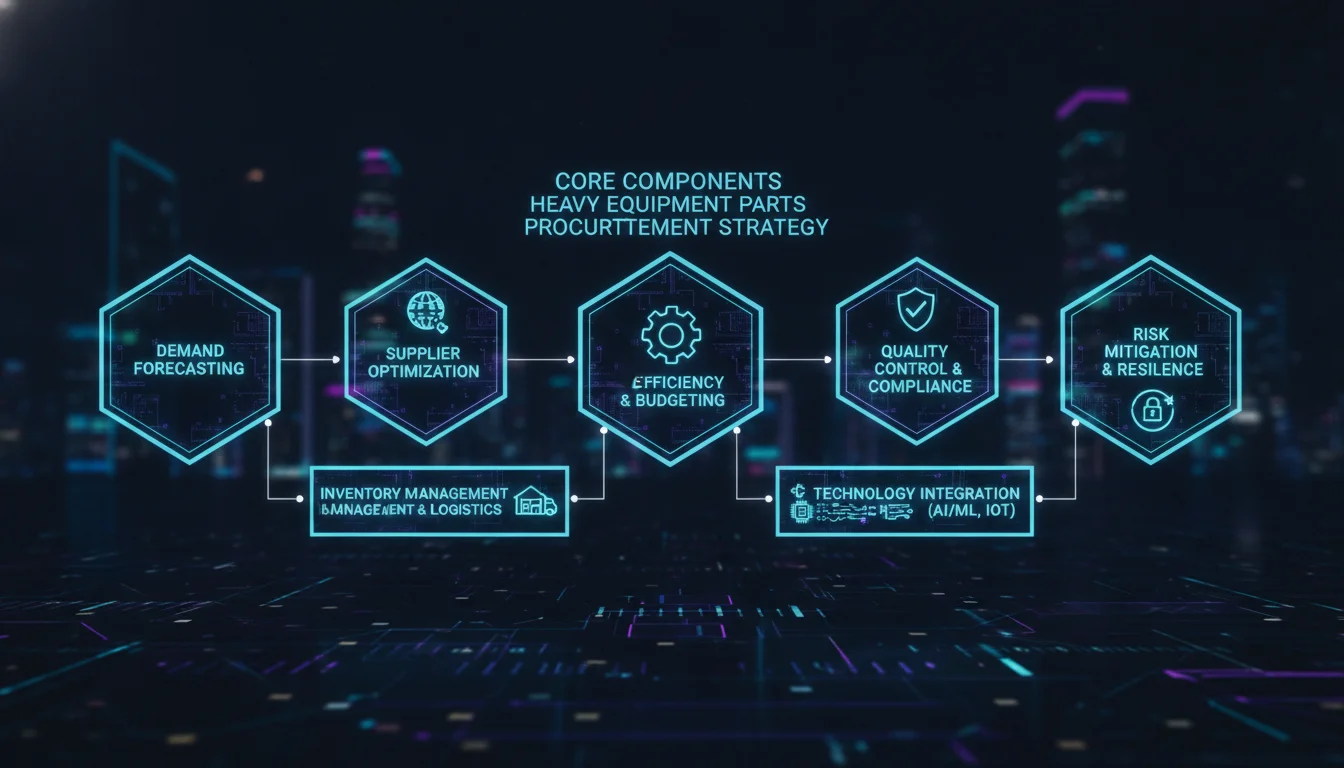
Core Components of a Heavy Equipment Parts Procurement Strategy
Define Requirements and Criticality
Every the equipment parts procurement strategy starts with requirement specification. EquipmentShare's buying guide advises operators to know the machine's make, model, and serial number because different production years of the same model may require different parts. Serial number breaks occur when a manufacturer updates a design partway through a production run, meaning two machines with the same model number but different serial numbers may need different components. Documenting these details is the first line of defense against ordering a part that won't fit.
Criticality mapping adds a second layer. Not all parts carry equal urgency. Classify components by failure impact: high-criticality items like hydraulic pumps, turbochargers, and cylinder heads deserve safety stock, while low-criticality consumables can be ordered as needed.
Qualify Suppliers and Parts Sources
Once requirements are clear, supplier qualification is the next core component. Not all sources carry the same reliability. Authorized dealers offer OEM certification and technical support; independent suppliers may offer interchangeable parts or custom reverse engineering. Ascendum recommends verifying that vendors meet critical industry certifications, such as ISO certification, to reduce the risk of faulty or non-compliant parts entering your supply chain. Your strategy should define acceptable sources in advance: OEM, aftermarket, remanufactured, and custom-engineered.
Use Data to Set Stocking Levels
A data-driven stocking model matches purchase volumes of heavy equipment spare parts to actual consumption rates and adds a safety buffer. McGill Industries gives a clear example: stockpiling 100 piston rings when your fleet uses only eight annually is wasteful, while ordering five track rollers instead of one can prevent weeks of downtime when future needs arise. That balance is the foundation of any effective heavy equipment.
Specifying Requirements Before You Source
Document Make, Model, Serial Number, and Serial Number Breaks
Start with the identity of the asset. EquipmentShare's guide emphasizes that knowing the exact serial number is critical because serial number breaks change part designs mid-production. Without this, even experienced parts teams order incorrect components for excavators, loaders, and dozers. Keep a centralized asset register with serial numbers, hour meters, and maintenance history.
Map Criticality and Consumption Patterns
Heavy Vehicle Inspection's data shows that sourcing delays, not repair time, cause most downtime, so critical spares should be treated as insurance. Analyze 12 to 24 months of usage history to identify consumption rates. This step separates a proactive procurement strategy from reactive buying: you are predicting failure demand rather than reacting to it.
Follow this five-step requirement specification before contacting any supplier:
- Step 1: Record asset serial number, model year, and serial number break.
- Step 2: Identify the failed system and classify part criticality.
- Step 3: Determine maximum acceptable downtime and budget ceiling.
- Step 4: Check OEM warranty clauses and approved parts lists.
- Step 5: Document the requirement in a work order or procurement request.
Set Budget and Warranty Constraints
Before contacting suppliers, set clear constraints. What is the maximum acceptable downtime? Is warranty compliance mandatory? Does the OEM require approved components for certain systems? Ascendum Machinery's guide warns that using unapproved aftermarket parts could void warranty on certain components and leave you responsible for major repair costs. Include those constraints in the specification so suppliers quote accordingly.
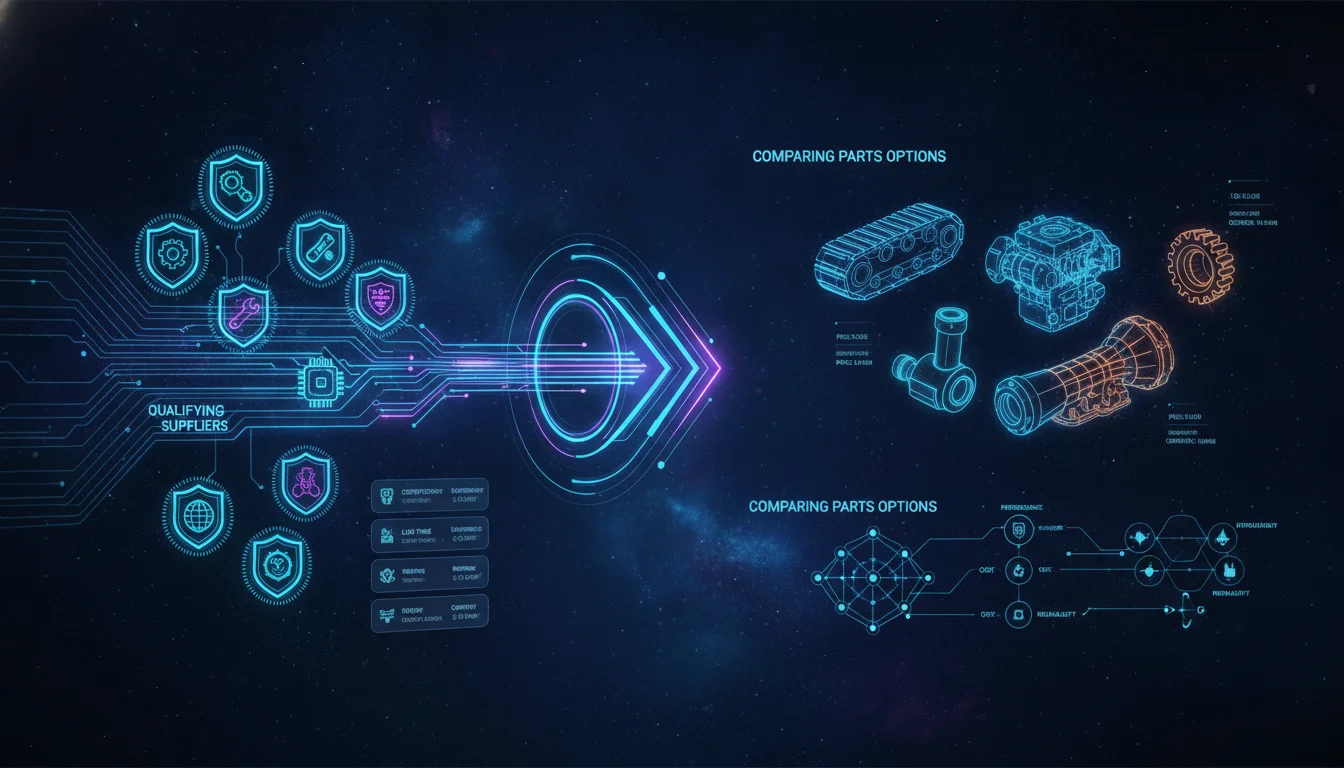
Qualifying Suppliers and Comparing Parts Options
OEM Parts: Fit, Warranty, and Dealer Support
OEM parts are original equipment manufacturer components built to factory specifications. Authorized dealers for brands such as Volvo, Sennebogen, Sandvik, Bobcat, and LeeBoy provide parts that meet OEM specifications and protect machine warranty. According to Ascendum Machinery, partnering with an authorized dealer ensures technical support and faster sourcing, both of which reduce downtime. The trade-off is usually a higher initial cost.
Aftermarket and Interchangeable Parts: Lower Cost, Higher Risk
Aftermarket parts are components made by third-party manufacturers, not the original equipment maker. They can be significantly cheaper and sometimes match or exceed OEM quality, but quality varies widely. Ascendum notes that when standard parts are unavailable or discontinued, parts from other OEMs may be compatible, especially for filters, belts, and electrical systems. Warranty implications must always be checked first. Your this type of strategy should specify when aftermarket is acceptable and when it is not.
Remanufactured and Custom Reverse-Engineered Parts
Remanufactured parts are rebuilt to OEM specifications and may be warranty-compliant, offering significant savings without compromising performance. For obsolete or discontinued components, suppliers with reverse engineering capabilities can recreate unique components to OEM specifications. Custom-engineered parts are especially useful for specialized machinery or when upgrading older systems. These options fill the gap when a direct replacement is impossible.
| Part Type | Typical Fit | Warranty Impact | Best Use |
|---|---|---|---|
| OEM | Exact factory match | Protects warranty when approved | Critical systems, new machines |
| Aftermarket | Varies by manufacturer | May void warranty if unapproved | Non-critical consumables, older machines |
| Remanufactured | Rebuilt to OEM spec | Often warranty-compliant | Major components, cost savings |
| Custom/Reverse-Engineered | Made to spec | Depends on supplier certification | Obsolete or specialized parts |
Implementing a Data-Driven Heavy Equipment Parts Procurement Strategy
Match Purchase Volumes to Actual Consumption
Matching purchase volumes to actual consumption is the core discipline of any data-driven this kind of procurement strategy. McGill Industries advises adding a safety buffer above actual consumption rates to prevent both overcapitalizing on inventory and stockouts. If a fleet consumes eight piston rings annually, keeping a safety buffer of a few additional units is sensible; keeping 100 is not. The same logic applies to track rollers, turbochargers, and cylinder heads.
Use Min/Max Stocking and Critical Spare Lists
Min/max stocking is an inventory control method where each part has a minimum quantity that triggers reorder and a maximum quantity that prevents overstock. Heavy Vehicle Inspection's guide recommends setting min/max levels for critical spares such as hydraulic pumps, hoses, filters, and undercarriage components. A digital CMMS can track consumption automatically and generate purchase requisitions when inventory falls below the minimum threshold. This is the operational backbone of a sound the equipment parts procurement strategy. The same guide reports that fleets using digital CMMS achieve up to 75% downtime reduction compared to reactive manual methods.
"The industry needs this partnership as many companies struggle with a gap in the parts procurement process, which can lead to errors in the parts ordering process and productivity lapses." - Hayden Price, Product Manager, Equipment360, HCSS
Integrate ERP, MRP, and Supplier Collaboration Software
Construction and industrial machinery procurement benefits from tools such as ERP, MRP, and supplier collaboration software. MCH Parts NYC's essential guide notes that these tools streamline procurement processes and improve transparency. When a work order is created, the system should trigger a parts request, route it to approved suppliers, and track order status. This reduces the manual handoffs that cause errors and delays.
Pros and Cons of a Structured Heavy Equipment Parts Procurement Strategy
Pros
- Reduced downtime: Proactive stocking and digital workflows mean parts are on the shelf when machines fail, not in transit.
- Lower total cost of ownership: Evaluating OEM, aftermarket, and remanufactured options against warranty terms prevents false economies and avoidable repair bills.
- Predictable maintenance budgets: Consumption-based forecasting eliminates the random cost spikes that make fleet budgets unreliable.
- Priority supplier access: Long-term relationships with qualified suppliers deliver preferential allocation during shortages, per McGill Industries.
- Scalable across large fleets: Digital CMMS and ERP integration make the process repeatable regardless of fleet size or geography.
Cons
- Upfront investment required: Implementing CMMS, ERP, or procurement software carries licensing and training costs that smaller operations may find significant.
- Data quality dependency: The system is only as good as the consumption data feeding it - poor work order discipline undermines forecasting accuracy.
- Supplier qualification takes time: Building a vetted, ISO-certified supplier network is a multi-month process, not an overnight fix.
- Inventory carrying costs: Safety stock ties up working capital, which requires careful calibration to avoid overcapitalizing on slow-moving parts.
Using Digital Tools to Cut Downtime and Manual Work
Parts Procurement Software Is Not an Online Store
Parts procurement software solves the parts procurement process - it is not a marketplace or online store to buy parts. Gearflow defines it this way after working with fleets across construction, aviation, and manufacturing. The goal is to centralize supplier communication, maximize visibility, and eliminate manual, repetitive tasks. Gearflow reports that parts teams spend 3 to 5 hours a day on manual repetitive tasks, which the software aims to reclaim.
HCSS Equipment360 and Gearflow Parts Hub Pro Integration
One concrete example of digital consolidation: on July 12, 2023, HCSS, based in Sugar Land, TX, and Gearflow, based in Chicago, IL, announced a strategic partnership. According to the HCSS and Gearflow announcement, Gearflow Parts Hub Pro integration with HCSS Equipment360 creates a turnkey solution that digitizes the entire parts ordering process from work order to invoice. The integration removes duplicate entry and gives fleet teams automatic oversight into all parts transactions.
"With Parts Hub Pro and Equipment360, fleet teams can digitize their entire parts ordering process to drastically reduce the costs and equipment downtime stemming from today's parts processes. We can now streamline a customer's process from the moment a part is needed to the moment a part is received." - Ben Preston, COO and Co-Founder, Gearflow
CMMS and Inspection Workflow Integration
Heavy Vehicle Inspection's 2026 guide links inspections directly to parts inventory and work orders. When an inspection flags a worn component, the system can automatically check stock levels and generate a purchase request. This closes the loop from failure detection to part receipt. The result is fewer manual phone calls, less duplicate data entry, and faster repair turnaround. A digitized strategy consistently outperforms spreadsheet-based tracking for exactly this reason.
Cost-Saving Moves That Protect Uptime
Proactive Purchasing vs. Transactional Buying
Transactional purchasing buys parts as needed, which may conserve short-term cash but can be far more costly when lead times extend. McGill Industries explains that advanced purchasing of high-failure items like turbochargers and cylinder heads creates an insurance policy against supply chain disruptions. Scaling this approach across a fleet can lead to six-figure annual savings. The key is to target high-failure, long-lead items - not every part in the catalog.
Supplier Relationships and Prioritized Allocation
Strong supplier partnerships pay dividends during scarcity. McGill Industries notes that parts can be easier to obtain in times of shortage due to trust, responsiveness, and prioritized allocation. Ascendum adds that long-term relationships lead to priority service, exclusive deals, and improved communication. Maintain these relationships with regular feedback, honoring agreements, and collaborating on solutions. This is a soft element that hard data alone cannot replace.
Avoid False Economies of Low-Cost Parts
Lower-priced parts may seem attractive, but sacrificing quality can lead to increased downtime and higher long-term costs. An unapproved aftermarket part may save money upfront but void a warranty, leaving the fleet responsible for major repair costs. Ascendum recommends weighing initial cost against long-term reliability, warranty terms, and parts availability. A mature heavy equipment parts procurement strategy evaluates total cost of ownership, not just purchase price.
Building a Resilient Heavy Equipment Parts Procurement Strategy
The Five-Point Recap
- Specify exact asset and part requirements before sourcing.
- Compare OEM, aftermarket, remanufactured, and custom options with warranty impact in mind.
- Forecast consumption data to set min/max levels and safety stock.
- Digitize procurement and CMMS workflows to reduce manual work.
- Build long-term supplier relationships for priority service and better terms.
Why the Best Strategy Uses Both Dealer Discipline and Software
Dealer-focused guides prioritize authorized parts and warranty compliance; software-focused guides prioritize digitizing procurement workflows. The most resilient heavy equipment parts procurement strategy uses both. It grounds itself in exact asset data and supplier qualification, then adds digital visibility and consumption forecasting to make the process repeatable. Without the first, software automates bad data. Without the second, dealer discipline cannot scale across a large fleet.
Next Steps for Fleet Managers
Start by auditing your last 90 days of parts transactions. Identify which purchases were reactive, which parts had the longest lead times, and which suppliers consistently delivered on time. Then set min/max levels for critical spares, implement a digital procurement or CMMS tool, and document warranty constraints for every asset class. A heavy equipment parts procurement strategy built this way reduces not only parts cost but also the costly downtime that follows every avoidable stockout.
Ready to put this into practice? Shop OEM-quality spare parts for Caterpillar, Komatsu, Volvo, Atlas Copco, and 40+ brands with global 5-day delivery at 3genexport.com.
Frequently Asked Questions
What is a heavy equipment parts procurement strategy?
A heavy equipment parts procurement strategy is a structured plan that combines requirement specification, supplier qualification, inventory forecasting, and digital workflows to reduce downtime and control parts costs. It treats procurement as an operational risk function, not a simple purchasing task.
What is the difference between OEM and aftermarket parts?
OEM parts are made by the original equipment manufacturer to factory specifications; aftermarket parts are made by third parties. OEM parts often protect warranty but cost more, while aftermarket parts may be cheaper but vary in quality and warranty impact. Always verify warranty clauses before substituting aftermarket components on critical systems.
How can I reduce downtime caused by parts delays?
Maintain critical spare inventory based on actual consumption data, integrate a digital CMMS, and qualify suppliers for fast sourcing. According to Heavy Vehicle Inspection's 2026 guide, fleets using digital CMMS can reduce downtime by up to 75% compared to reactive manual methods.
Should I always buy OEM parts for heavy equipment?
Not always. OEM parts are the safest choice for warranty compliance and fit, but aftermarket, remanufactured, and custom reverse-engineered parts can deliver real savings when used for non-critical components or obsolete machines. Always check warranty clauses and supplier certifications first.
What role does parts procurement software play?
Parts procurement software centralizes supplier communication, maximizes order visibility, and eliminates manual duplicate entry. Gearflow reports that parts teams spend 3 to 5 hours a day on manual tasks that dedicated software can reclaim, directly improving fleet uptime and budget predictability.
How do I set inventory levels for spare parts?
Use 12 to 24 months of consumption history to set minimum quantities that trigger reorder and maximum quantities that prevent overstock. Match purchase volumes to actual usage and add a safety buffer for critical high-failure items such as hydraulic pumps, turbochargers, and undercarriage components.