
Heavy Equipment Parts Quality Standards Guide
Heavy equipment parts quality standards define OEM vs aftermarket choices. Learn inspection methods, cost tradeoffs, and global sourcing tips for 2026.
Loading article…
Article Not Found
The article you're looking for doesn't exist or may have been removed.
Back to BlogHeavy equipment parts quality standards are the technical benchmarks and certification requirements that determine whether a replacement component is safe, compatible, and built to last in construction, mining, and energy applications. Getting this wrong costs far more than the price of the part itself.
Key Takeaways
- OEM parts are manufactured to original specifications, ensuring compatibility and reliability across Caterpillar, Komatsu, Volvo, and other major brands.
- Aftermarket parts vary widely in quality; thorough supplier vetting is essential before purchase.
- Visual inspection, functional testing, and proper documentation are the three pillars of part evaluation.
- ISO, ASTM, and OSHA standards form the regulatory backbone for heavy equipment component quality.
- Regular inspections and scheduled maintenance extend equipment life and reduce total cost of ownership.
- Sourcing from verified global suppliers with fast lead times reduces downtime risk significantly.
"Investing in quality parts is not just about immediate costs. It's about long-term reliability and performance of your heavy machinery. A single substandard component can trigger cascading failures across an entire system." - Heavy Equipment Maintenance Industry Expert
Introduction to Heavy Equipment Parts Quality Standards
These standards are essential for ensuring the longevity and performance of machinery used in construction, mining, and other industrial applications. They help operators and maintenance teams choose the right components, whether OEM or aftermarket. Understanding these benchmarks is critical for making informed purchasing decisions that directly affect operational efficiency and worker safety.
As of 2026, procurement managers face a more complex parts landscape than ever before. Global supply chain disruptions, an expanding aftermarket sector, and increasing pressure to reduce downtime have made quality verification a front-line business priority. The difference between a well-sourced part and a substandard one isn't just performance: it's project timelines, warranty coverage, and operator safety.
At 3GEN Export, we've supplied OEM-standard spare parts for Caterpillar, Komatsu, Volvo, Atlas Copco, and 40+ other brands to procurement teams across six continents. The pattern we see repeatedly is this: companies that invest in quality verification upfront spend far less on emergency replacements and unplanned downtime over the life of their fleet.
Types of Heavy Equipment Parts
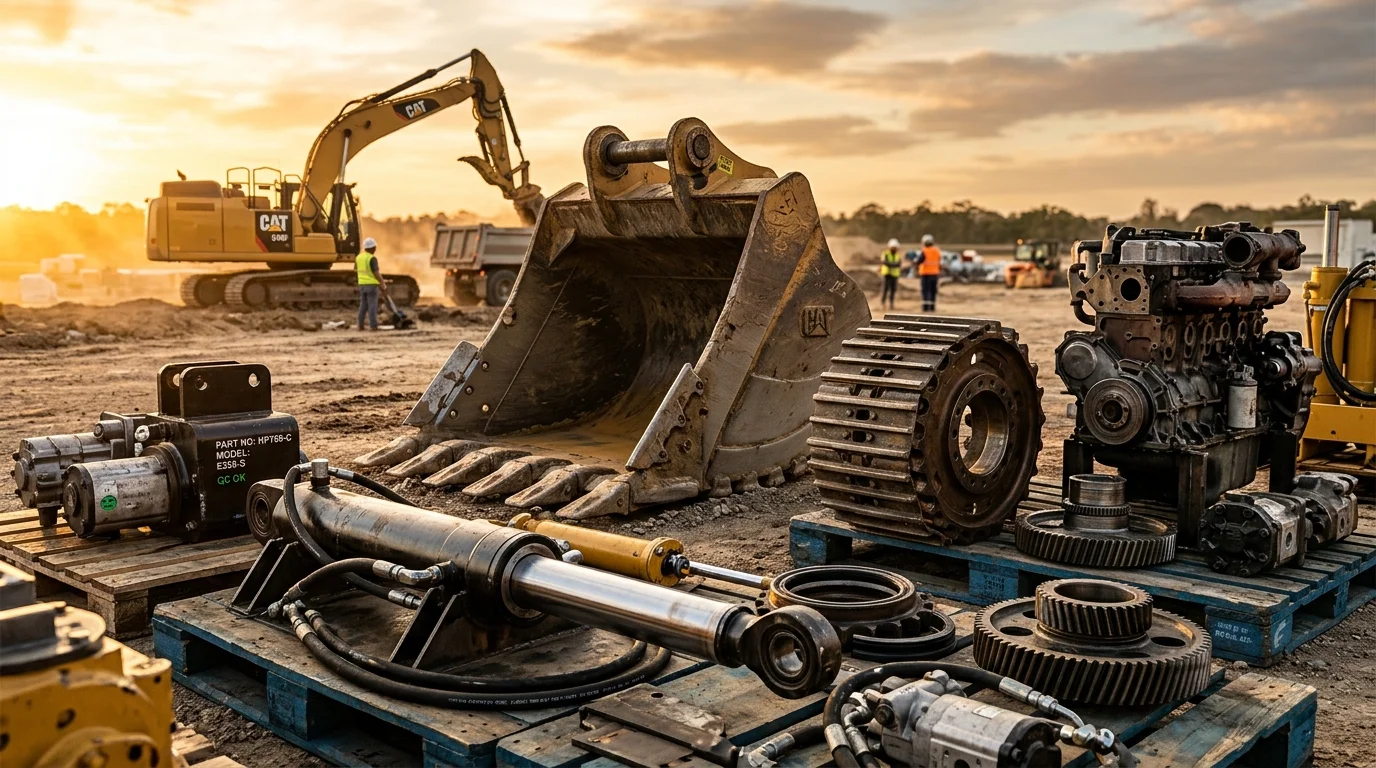
OEM Parts
Original Equipment Manufacturer (OEM) parts are produced by the same company that manufactured the original machinery. These parts are designed to meet the exact specifications and quality standards set by the manufacturer.
- Advantages: Guaranteed compatibility, reliability, and performance. Warranty protection is preserved. No guesswork on fit or function.
- Disadvantages: Typically more expensive and may have limited availability for older or less common models.
For Caterpillar equipment specifically, OEM means genuine Cat parts engineered to Caterpillar's own specifications. According to manufacturer documentation, these components are built to match the original design, materials, and performance criteria exactly. That precision eliminates the compatibility risk that comes with third-party alternatives.
Aftermarket Parts
Aftermarket parts are produced by third-party manufacturers and are designed to fit specific equipment models. The quality of these parts can vary significantly.
- Advantages: Often more affordable and available in a wider range, including for older models where OEM supply has dried up.
- Disadvantages: Quality can be inconsistent, some parts may void warranties, and inferior fit can cause premature wear in adjacent components.
Industry maintenance data shows that aftermarket parts are frequently designed to a specific price point rather than a performance target. As one authorized Cat dealer notes in their parts guide, there is no universal standard of excellence or durability goal applied across the aftermarket sector. That doesn't mean all aftermarket parts are poor: the best ones meet or exceed OEM specifications. But vetting the supplier is non-negotiable.
Used and Remanufactured Parts
Used parts are salvaged from older machinery, while remanufactured parts are refurbished to meet OEM standards.
- Used (Salvage) Parts: Can be cost-effective but carry unknown quality risks. Salvage components have no guarantee of remaining service life.
- Remanufactured Parts: Typically come with warranties and are restored to like-new condition through a controlled process. These are a strong middle-ground option when OEM pricing is prohibitive.
How Quality Standards Actually Work: The Underlying Mechanics
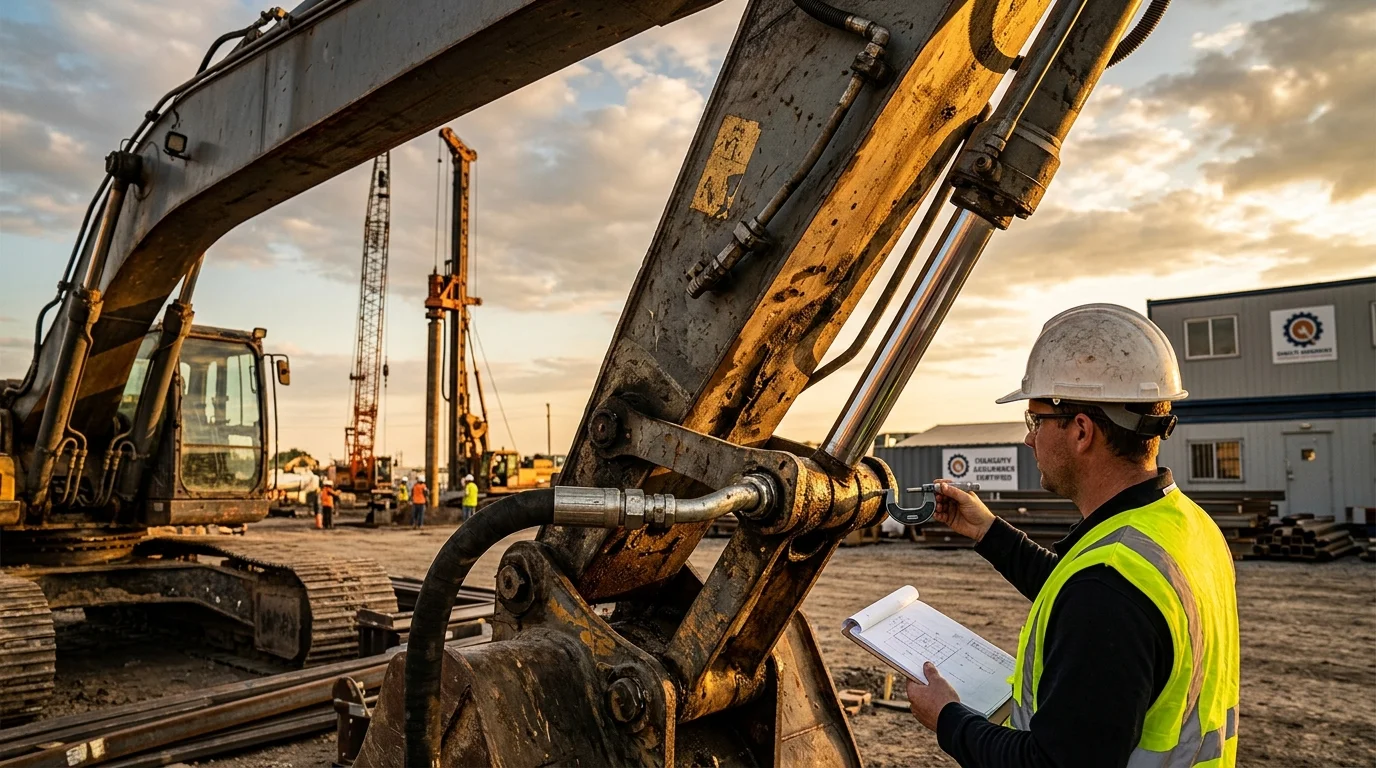
Quality standards for heavy equipment parts operate through a layered system of specifications, testing protocols, and third-party certification. Understanding how this system functions helps procurement teams ask the right questions before signing a purchase order.
At the foundation are material specifications. A hydraulic cylinder rod, for example, must meet defined hardness ratings, surface finish tolerances, and tensile strength requirements. These aren't arbitrary: they're derived from the operating loads, pressures, and temperatures the component will face in service. OEM manufacturers publish these specifications in their service bulletins and technical manuals.
Above the material layer sits the manufacturing process standard. ISO 9001 certification, for instance, requires a supplier to document and consistently follow a quality management system covering everything from raw material sourcing to final inspection. This doesn't guarantee a perfect part, but it does mean failures are traceable and correctable.
The third layer is testing and validation. Before a part ships, it should pass dimensional inspection (does it match the drawing?), functional testing (does it perform under load?), and in many cases, non-destructive testing such as magnetic particle inspection for cracks in structural components.
Finally, documentation ties the system together. A Certificate of Conformance, material test reports, and matching part numbers create a paper trail that lets you verify a part's pedigree at any point in its service life. Without this documentation, you're buying on faith.
"According to industry quality control data, pre-shipment inspection and during-production monitoring are the two most effective intervention points for catching non-conforming parts before they reach the field. Waiting until installation is too late." - Tetra Inspection, Heavy Equipment Quality Control Guide (Updated June 2026)
How to Evaluate Heavy Equipment Parts Quality: A Step-by-Step Process
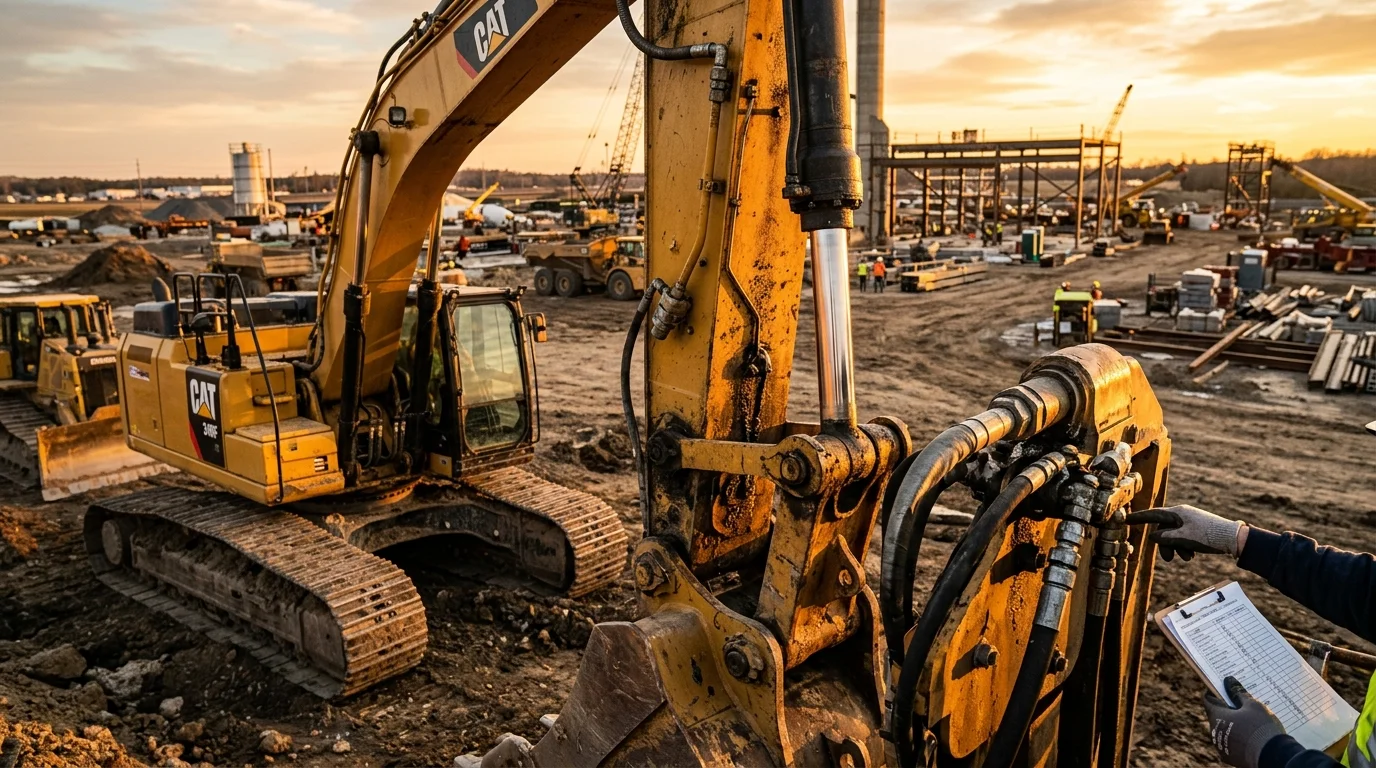
Evaluating a replacement part correctly requires a structured approach. Here are the steps we recommend to procurement managers and maintenance supervisors sourcing components for their fleets.
Step 1: Verify Documentation First
Before you inspect the physical part, check the paperwork. Quality parts always arrive with part numbers that match manufacturer catalogs, a Certificate of Conformance, and warranty information. If a supplier cannot provide these documents, treat that as a disqualifying red flag. Documentation is the fastest filter in the evaluation process.
Step 2: Apply Visual Assessment Techniques
Visual inspection is the first hands-on evaluation step. Key areas to inspect include:
- Overall Condition: Look for signs of wear, damage, or corrosion.
- Critical Areas: Inspect hydraulic cylinders and structural components for cracks, especially around welds and bolt holes.
- Previous Repairs: Check for signs of welding, grinding, or modifications that may affect structural integrity.
- Wear Patterns: Experienced technicians can read wear patterns to predict remaining service life. Normal wear is uniform; abnormal wear indicates a system problem that will affect the new part too.
Document your visual findings with photos. This record supports warranty claims and provides a baseline for future inspections.
Step 3: Conduct Functional Testing
Functional testing validates that components operate as intended under load conditions. This includes:
- Hydraulic Components: Pressure testing to confirm no external leakage or internal bypass. Cylinders must hold full system pressure.
- Electrical Components: Testing under load to verify proper function. Simple continuity checks are not sufficient for complex modules.
- Mechanical Components: Movement testing to check for smooth operation. Transmissions should shift cleanly through all ranges; final drives should run without binding or unusual noise.
- Bearing Components: Check for smoothness and play. Excessive clearance or rough operation indicates replacement is necessary regardless of external appearance.
Step 4: Cross-Reference Against Manufacturer Specifications
Test results mean nothing without a benchmark. Compare your findings against the OEM service manual specifications for that component. If the supplier's part cannot be verified against published specs, request a third-party test report from an accredited laboratory.
Step 5: Assess Supplier Reputation and Track Record
The part is only as reliable as the supplier behind it. Check for ISO 9001 certification, years in business, references from comparable operations, and whether the supplier offers post-sale technical support. A supplier who disappears after the invoice is paid is a liability, not a partner.
Understanding the Standards Framework
Industry Standards and Regulations
Various organizations set quality standards for heavy equipment parts, including:
- ISO Standards: International standards for quality management systems, including ISO 9001 for manufacturing quality and ISO 9001:2015 for supplier qualification.
- ASTM Standards: Specifications for materials and testing methods, widely referenced in North American procurement.
- OSHA Regulations: Per OSHA standard 1926.600, heavy machinery parts that are suspended or held aloft must be substantially blocked or cribbed before workers are permitted to work under or between them. Safety compliance is not optional: it's a legal requirement that directly affects how parts are handled and installed on site.
Quality Control Processes in the Supply Chain
Quality control processes are essential for ensuring that parts meet industry standards. This includes:
- Pre-Production Inspections: Evaluating suppliers before production begins, including factory audits and supplier verification.
- During Production Inspections: Monitoring quality throughout the manufacturing process to catch deviations early.
- Post-Production Testing: Final dimensional and functional checks to confirm parts meet specifications before shipment.
Impact of Quality on Performance
The quality of replacement components directly affects machinery performance. High-quality parts can:
- Reduce unplanned downtime and emergency maintenance costs.
- Enhance operational efficiency and worker safety.
- Extend the service life of the overall machine.
- Protect warranty coverage on newer equipment.
OEM vs. Aftermarket vs. Remanufactured: A Direct Comparison
Choosing between part types is one of the most consequential decisions in fleet maintenance. This table gives procurement managers a clear side-by-side view.
| Factor | OEM Parts | Aftermarket Parts | Remanufactured Parts |
|---|---|---|---|
| Fit and Compatibility | Exact match, no modifications needed | Designed to fit, but tolerances may vary | Restored to OEM dimensions |
| Quality Consistency | High and predictable | Variable: depends heavily on supplier | High when sourced from reputable remanufacturers |
| Price Point | Highest upfront cost | Lowest upfront cost | Mid-range, often 30-50% below OEM |
| Warranty Coverage | Full manufacturer warranty | May void equipment warranty | Typically includes warranty comparable to new |
| Availability for Older Models | Limited as models age out | Often available when OEM supply stops | Good, as cores are sourced from existing machines |
| Documentation | Full OEM documentation | Varies by supplier | Should include remanufacturing certification |
| Best Use Case | Warranty-active machines, critical systems | Non-critical wear parts, budget-constrained fleets | Major components: engines, hydraulic pumps, transmissions |
Pros and Cons of Prioritizing OEM-Standard Quality
Pros
- Guaranteed compatibility eliminates installation risk and reduces technician time.
- Warranty protection is preserved, which matters significantly on newer machines.
- Predictable service intervals allow for better maintenance planning and budget forecasting.
- Reduced risk of cascading failures: a properly fitted part doesn't stress adjacent components.
- Full documentation supports insurance claims, resale value, and compliance audits.
Cons
- Higher upfront cost can strain maintenance budgets, particularly for large fleets.
- OEM supply chains can be slow, especially for older or regional equipment models.
- Limited customization options: OEM parts are built to original specs, not optimized for specific operating conditions.
- Dependency on manufacturer distribution networks can create lead time vulnerabilities in remote markets.
Common Mistakes to Watch Out For
Even experienced procurement teams make avoidable errors when sourcing replacement components. Here are the most common ones we see, and how to avoid them.
Buying on Price Alone
The lowest-cost part is rarely the lowest-cost decision. Aftermarket components designed purely to a price point often lack the material quality or dimensional accuracy of OEM equivalents. A part that fails in three months instead of three years costs you the part price, the labor to replace it, and the downtime while the machine sits idle. Factor total cost of ownership into every sourcing decision.
Skipping Supplier Verification
Not all suppliers claiming ISO certification or OEM equivalence have the documentation to back it up. Before placing a significant order, request factory audit reports, sample test certificates, and references from comparable buyers. A reputable supplier will provide these without hesitation.
Ignoring Wear Pattern Analysis
Replacing a failed part without understanding why it failed is a guaranteed path to repeat failure. Abnormal wear patterns, as noted in salvage part evaluation guides, indicate system-level problems: contaminated hydraulic fluid, misalignment, or overloading. Install a new part into a broken system and it will fail on the same schedule as the old one.
Accepting Parts Without Documentation
A part without a Certificate of Conformance, matching part number, and warranty information is an unverified component. In a compliance audit or insurance claim, undocumented parts create serious liability exposure. Never accept delivery without the full documentation package.
Underestimating Lead Time Risk
Ordering parts reactively, after a failure, means your machine is already down. Build a critical spares inventory based on your equipment's maintenance schedule and historical failure data. For global operations, work with suppliers who can guarantee fast international delivery. At 3GEN Export, we ship OEM-quality parts globally with a 5-day delivery target, specifically to reduce the lead time risk that kills project timelines.
A Realistic Procurement Scenario
Consider a mining operation running a fleet of Komatsu PC490 excavators in a remote location. One machine develops a hydraulic pump failure mid-shift. The site manager has two options: wait two to three weeks for an OEM part through the local dealer network, or source an OEM-equivalent component from a verified global supplier who can deliver within five days.
The site manager contacts 3GEN Export, provides the part number from the service manual, and receives a quote within hours. The part ships with full documentation: Certificate of Conformance, material test report, and warranty terms. The machine is back in service within a week. The alternative, waiting for the dealer network, would have cost the operation multiple additional days of downtime on a machine generating significant daily output value.
This scenario plays out across construction sites, mining operations, and energy facilities worldwide. The difference between a well-prepared procurement strategy and a reactive one is measured in project days and operational costs.
Choosing the Right Parts for Your Equipment
Factors to Consider
When selecting parts, consider the following factors:
- Compatibility: Ensure parts fit and function correctly with your specific equipment model and serial number range.
- Cost vs. Quality: Weigh the initial cost against potential long-term savings from extended service life and reduced downtime.
- Supplier Reputation: Choose suppliers with a proven track record, verifiable certifications, and post-sale technical support.
- Lead Time: For critical components, delivery speed is as important as price. A part that arrives in five days versus three weeks can determine whether a project stays on schedule.
Maintenance and Inspection Protocols
Regular maintenance and inspections are vital for identifying when parts need replacement. Key practices include:
- Daily Inspections: Check for visible signs of wear and damage, fluid levels, and operational anomalies before each shift.
- Scheduled Maintenance: Follow manufacturer guidelines for routine service intervals. These intervals exist for a reason: they're based on engineering data, not guesswork.
- Record Keeping: Maintain detailed logs of inspections, replacements, and repairs. This data drives better procurement decisions and supports warranty claims.
Cost Considerations
While high-quality parts carry a higher upfront cost, they consistently deliver:
- Lower overall maintenance expenses across the fleet lifecycle.
- Increased equipment reliability and operator confidence.
- Longer intervals between replacements, reducing total parts spend over time.
2026 Outlook: What's Changing in Parts Quality and Procurement
The heavy equipment parts market is shifting in several meaningful ways this year. Supply chain regionalization is accelerating, with more procurement teams building relationships with multiple verified suppliers across different geographies to reduce single-source dependency.
Digital documentation is becoming standard. QR-coded Certificates of Conformance, blockchain-tracked part provenance, and digital service records are moving from pilot programs to mainstream practice among major OEMs and their authorized distributors. This makes it easier to verify part authenticity at the point of installation, not just at the point of purchase.
The aftermarket sector continues to grow, driven by aging global fleets and rising OEM prices. This creates both opportunity and risk. The best aftermarket suppliers are investing in ISO certification and third-party testing to differentiate themselves. The worst are flooding the market with counterfeit or substandard components. The ability to distinguish between them is a core procurement competency in 2026.
At 3GEN Export, we're responding to these trends by expanding our verified supplier network, tightening our documentation requirements, and investing in faster global logistics to ensure our customers can source OEM-quality components without the lead times that traditionally forced them toward lower-quality alternatives.
Frequently Asked Questions
What are the OSHA heavy equipment standards?
OSHA standard 1926.600 covers safety and health regulations for construction equipment, including requirements for blocking suspended machinery, setting parking brakes on inclines, and proper tire inflation procedures. These regulations directly affect how parts are handled and installed on job sites. Compliance is a legal requirement, not an option.
What are equipment specifications?
Equipment specifications detail the design, materials, and performance criteria required for machinery and its components, ensuring compatibility and functionality. OEM service manuals and technical bulletins are the authoritative source for these specifications. Always cross-reference part numbers against the manufacturer's catalog for your specific machine serial number range.
What does OEM original equipment manufacturer mean?
OEM refers to parts produced by the original manufacturer of the equipment, built to the exact specifications of the components originally installed in the machine. For Caterpillar equipment, this means genuine Cat parts. For Komatsu, it means genuine Komatsu components. OEM parts eliminate compatibility guesswork and preserve warranty coverage.
What does a heavy equipment daily inspection checklist include?
A daily inspection checklist typically covers fluid levels (engine oil, hydraulic fluid, coolant), visible wear or damage on undercarriage and wear parts, operational tests of all controls and safety systems, and a check of lights, mirrors, and safety equipment. Per OSHA guidelines, equipment left unattended must have appropriate lights or reflectors to identify its location. Consistent daily checks are the earliest warning system for parts that need replacement.
How can I identify high-quality heavy equipment parts?
High-quality parts can be identified through four key checks: proper documentation (part numbers matching manufacturer catalogs, Certificate of Conformance, warranty terms), visual inspection for correct finish and dimensional accuracy, functional testing under load conditions, and supplier verification including ISO certification and references. If any of these four checks cannot be completed, treat the part as unverified.
Are aftermarket parts reliable for heavy equipment?
Aftermarket parts vary widely in quality, from components that meet or exceed OEM specifications to parts that fail prematurely and cause damage to adjacent systems. Reliability depends almost entirely on the supplier's manufacturing standards and quality control processes. Vet the supplier thoroughly: request ISO certification, test reports, and references before committing to a significant purchase. The price saving is only real if the part performs.
Shop OEM-quality spare parts with global 5-day delivery at 3genexport.com. Our team is ready to source verified components for Caterpillar, Komatsu, Volvo, Atlas Copco, and 40+ brands, backed by full documentation and competitive pricing.