
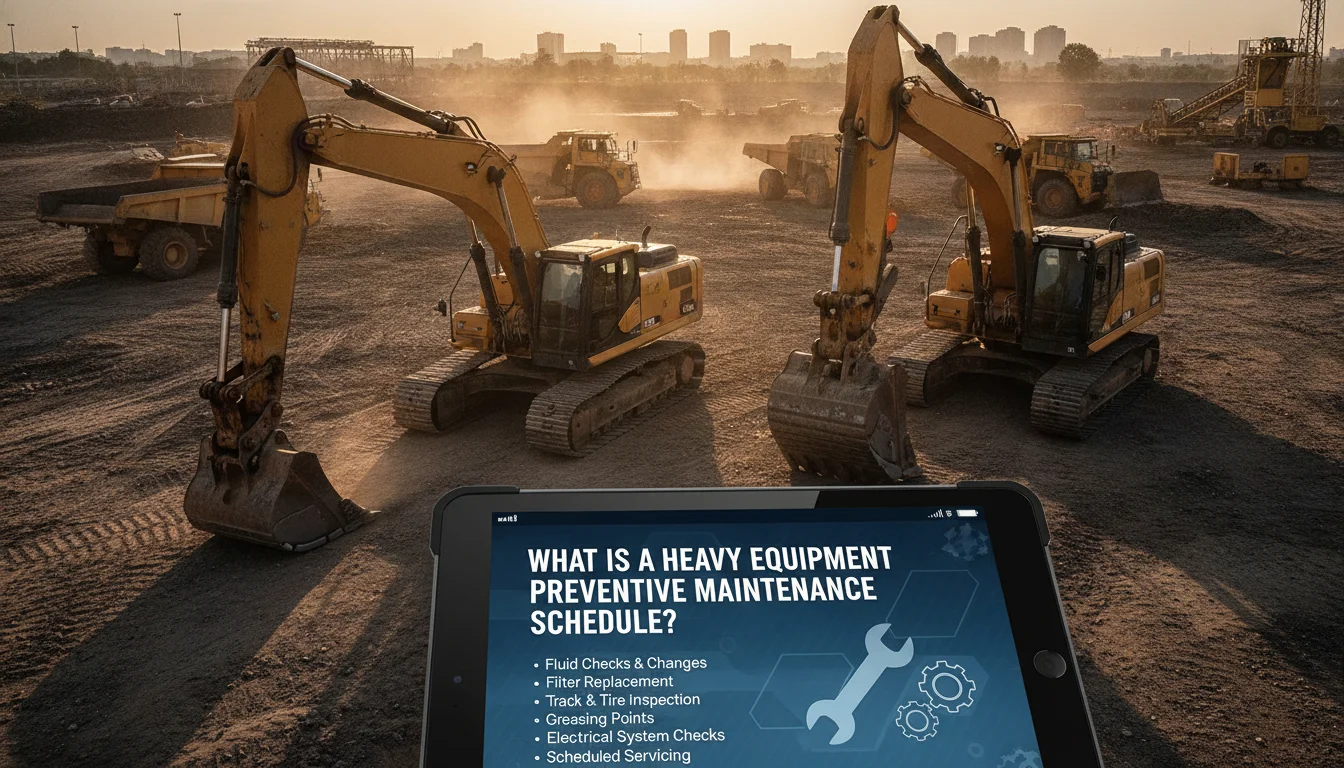
Heavy Equipment Preventive Maintenance Schedule 2026
Your heavy equipment preventive maintenance schedule cuts repair costs 25% and prevents downtime. Get OEM intervals, checklists, and KPIs for 2026.
Loading article…
Article Not Found
The article you're looking for doesn't exist or may have been removed.
Back to BlogA heavy equipment preventive maintenance schedule is a structured program of daily inspections, hour-based fluid and filter service, and documented component checks performed before failures occur. It cuts repair costs by up to 25% and reduces downtime when intervals match OEM specifications and actual site conditions.
Key Takeaways
- A disciplined maintenance schedule reduces repair bills by 25%, based on MacAllister Machinery's documented cost analysis.
- Daily walk-around inspections catch 80% of common failures before they escalate into emergency repairs, according to Heavy Vehicle Inspection's 2026 guide.
- Emergency repairs carry 150-200% cost premiums over scheduled service, making proactive PM the financially sound choice.
- Hour-based service intervals at 50, 100, 250, 500, 1,000, and 2,000 hours prevent contamination buildup and wear accumulation.
- Fluid analysis and structured documentation close the loop from defect detection to completed work order.
- Proactive PM programs reduce overall maintenance costs by 20-30%, per Heavy Vehicle Inspection's fleet data.
What Is a Heavy Equipment Preventive Maintenance Schedule?
Definition and Core Purpose
A this type of schedule is the operational document that assigns specific inspection, lubrication, fluid, filter, and component tasks to hour-meter readings, calendar dates, or both. MacAllister Machinery describes preventive maintenance as an all-inclusive approach from purchase to end of useful life, not just lubricating and changing filters. The schedule is the difference between controlled wear and accelerated damage.
The core purpose is to control three equipment killers: wear accumulation, contamination, and undetected component degradation. Every major component has a measurable service life. Engines, hydraulic pumps, cooling systems, and undercarriages are designed to operate for a specific number of hours before rebuild or replacement becomes necessary. Clean oil reduces internal engine friction, proper filtration limits hydraulic contamination, stable cooling systems prevent heat-related damage, and consistent lubrication reduces metal-on-metal contact.
Preventive vs. Reactive vs. Predictive Maintenance
Reactive maintenance means fixing equipment after it breaks, which carries emergency repair cost premiums of 150 to 200 percent, according to Heavy Vehicle Inspection's 2026 guide. Corrective maintenance is the middle ground: a component's performance has dropped but it still functions. A this kind of maintenance schedule addresses issues before either condition develops.
Predictive maintenance uses condition monitoring, fluid analysis, and telematics to tailor the schedule to actual wear instead of fixed hours alone. The best programs combine calendar-based preventive maintenance and condition-based predictive maintenance. Each machine works different routes and experiences different conditions. A truck running longer routes with more elevation change, for example, needs more frequent service than one running flat highway duty.
Hour Meters, Calendar Days, and Duty Cycles
A the equipment preventive maintenance schedule is not one-size-fits-all. Trucks may run on miles, construction equipment on engine hours, and some assets need calendar-based service regardless of usage. Duty cycle, meaning how hard the machine works in what dust, heat, moisture, and terrain, determines how much you shorten or extend OEM intervals.
According to MacAllister Machinery, preventive maintenance can reduce machinery repair bills by 25 percent. Their documented example: an $80,000 machine requiring approximately $24,000 in maintenance and repair costs during 5,000 operating hours drops to $18,000 under a sound PM program.
Why a Heavy Equipment Preventive Maintenance Schedule Protects Your Fleet Investment
Direct Cost Reduction and Repair Bill Math
Heavy machinery is the most expensive construction equipment you own, and the costliest to repair or replace. A sound schedule directly reduces those costs. According to MacAllister Machinery, preventive maintenance can reduce machinery repair bills by 25 percent. Their example: an $80,000 machine requiring about $24,000 in maintenance and repair costs during 5,000 operating hours drops to $18,000 under a disciplined PM program. These numbers reflect the difference between controlled wear and accelerated damage.
Every deferred oil change or skipped filter replacement lets contaminants circulate and accelerates internal wear. The payback is measurable in real dollars and in machine hours gained. Preventive maintenance also reduces total cost of ownership by minimizing unplanned downtime, major component failures, and premature equipment replacement.
Downtime Avoidance and Operational Continuity
Unplanned downtime costs more than the repair itself. A broken machine stops production, idles crew members, and may trigger project delay penalties. Daily walk-around inspections catch hydraulic leaks, loose hoses, low fluid levels, and attachment wear before they become failures. Heavy Vehicle Inspection reports that daily pre-trip inspections catch 80% of common failures. That early detection rate means most breakdowns are preventable with a disciplined schedule.
Waiting until something breaks usually leads to more expensive repairs and lost productivity. Standardizing inspections and maintenance procedures creates a clear path from inspection to repair, ensuring that what you find on a walk-around actually gets fixed. A proactive maintenance plan keeps your equipment ready for the next job.
Resale Value, Warranty Compliance, and Safety
Buyers and lenders pay more for equipment with complete service histories. A documented heavy equipment shows that hour-based services were completed, contamination was controlled, and major components were monitored. It also protects warranty claims. Many OEM warranties require proof of scheduled maintenance. Safety improves when brakes, steering, rollover protection, and warning systems are inspected on a fixed cadence.
The full list of benefits from a proper PM program includes improved equipment and system reliability, reduction of unexpected breakdown, decrease in expensive parts replacement, extended equipment life, improved resale value, and better parts inventory management. A heavy equipment maintenance checklist is highly recommended to aid in remembering tasks and confirming completion.
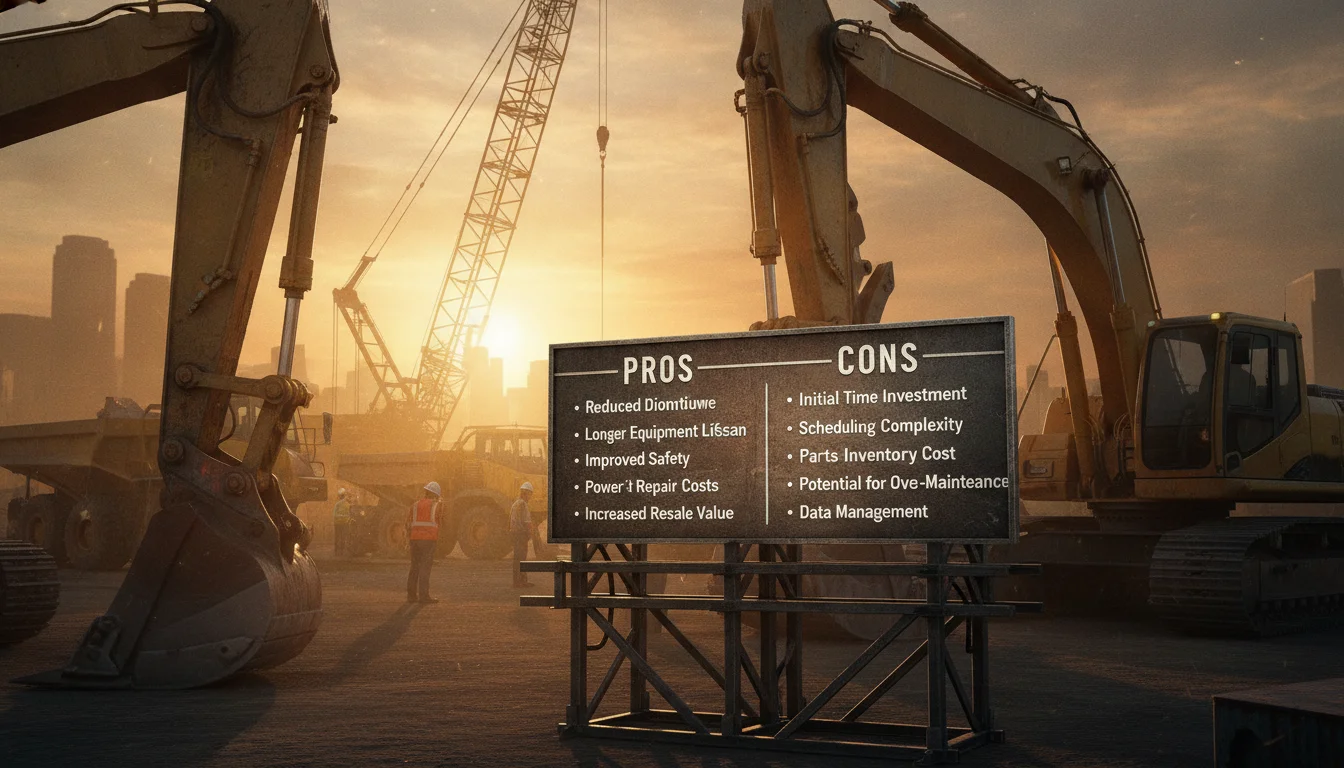
Pros and Cons of a Heavy Equipment Preventive Maintenance Schedule
Pros
- Reduces repair costs by up to 25% through controlled wear and early defect detection.
- Cuts unplanned downtime by catching 80% of common failures during daily inspections.
- Extends equipment service life by keeping oil clean, filtration effective, cooling stable, and lubrication consistent.
- Protects resale value with a documented service history that buyers and lenders trust.
- Supports OEM warranty compliance and reduces exposure to FMCSA audit penalties.
- Improves worker safety through regular inspection of brakes, steering, and rollover protection systems.
Cons
- Requires upfront time investment to build checklists, assign responsibilities, and train operators.
- Scheduled downtime for service can conflict with tight project timelines if not planned in advance.
- Ongoing parts and fluid costs are visible line items, even though they offset far larger repair expenses.
- Schedule compliance depends on discipline: a PM program that exists only on paper provides no protection.
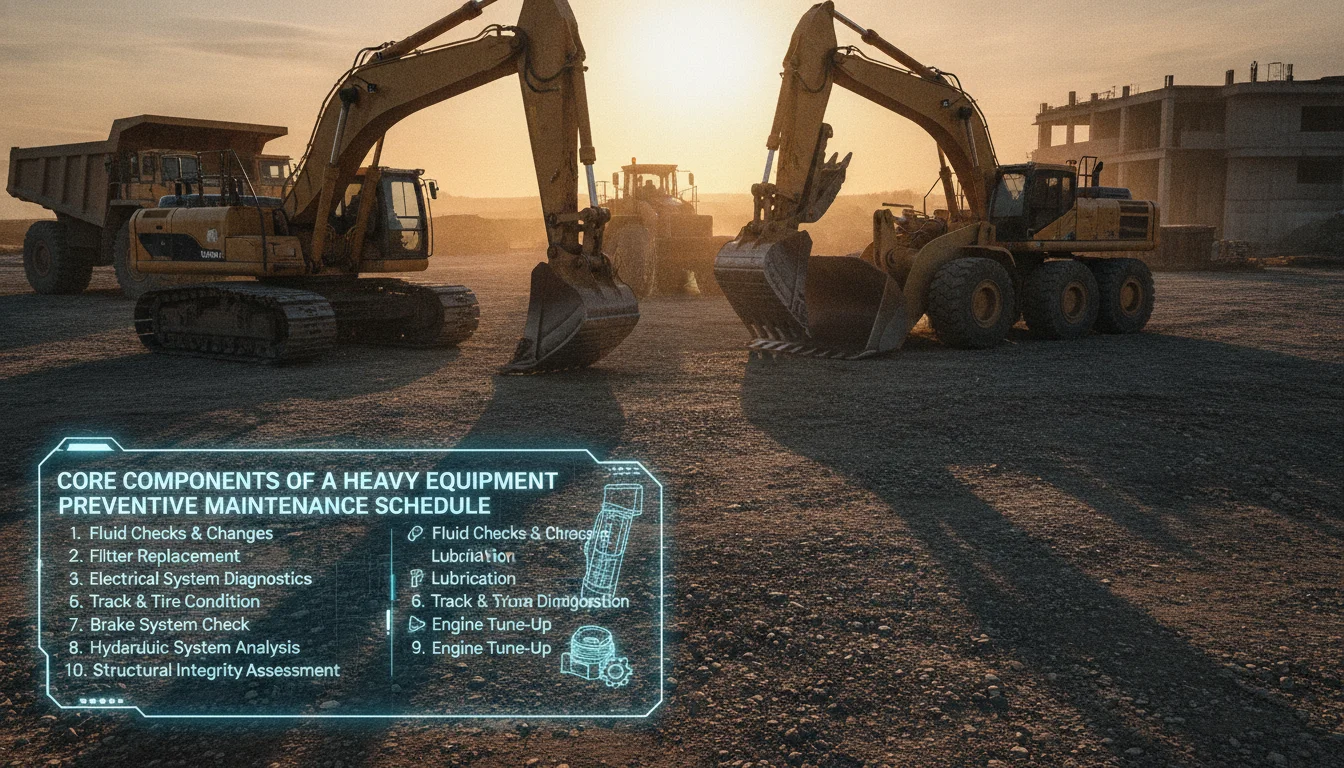
Core Components of a Heavy Equipment Preventive Maintenance Schedule
Daily Walk-Around Inspections
Daily inspections are the front line of any maintenance schedule. Before starting each machine each day, operators should perform a quick walk-around to check hydraulic leaks, low fluid levels, loose or damaged hoses, track or tire condition, warning lights, grease points, and bucket or attachment wear. These checks take only a few minutes and can prevent major repairs later.
Operators should also watch for unusual signs: hissing, grinding, clacking, fluid leakage, discolored or thick exhaust fumes, difficult starts, stalling, and excessive vibration. Any of these should trigger immediate inspection even if the hour meter has not reached the next service interval. Also check for any unauthorized welding that might lead to a loss of warranty.
Hour-Based Fluid and Filter Intervals
Hour-based service intervals are the backbone of a this type of schedule. Common intervals from manufacturer guides and dealer schedules include 8-10 hours, 50 hours, 100 hours, 250 hours, 500 hours, 1,000 hours, and 2,000 hours. At 50 hours, water and sediment may need draining from the fuel tank and bucket teeth or cutting edges should be checked or changed. At 250 hours, many manufacturers recommend engine oil and filter replacement, belt inspection, battery connection checks, cooling system inspection, and greasing all fittings.
At 500 hours, service expands to fuel filters, hydraulic filters, hydraulic hose inspection, drive components, and undercarriage wear. At 1,000 hours, longer service intervals typically involve hydraulic system inspection, cooling system service, valve adjustments on applicable models, drive system inspection, electrical system inspection, and performance testing. At 2,000 hours, many machines need deeper component evaluation, including sprocket and track replacement checks. Always follow your equipment's specific maintenance schedule rather than relying only on generic charts.
Fluid Analysis, Wear Monitoring, and Documentation
Fluid analysis is a condition-monitoring practice that tests engine oil, hydraulic fluid, and coolant for wear metals, contamination, and chemical breakdown. It is a core part of an effective this kind of maintenance schedule because it identifies internal wear before visual inspection can. S-O-S fluid analysis, offered by Caterpillar dealers including MacAllister, includes fuel, oil, and coolant testing. Condition monitoring, electronic information collection, machine inspection data, and historical repair data all feed into a complete picture of asset health.
Wear component monitoring covers undercarriage, bucket teeth, cutting edges, belts, hoses, and filters. Structured documentation links each inspection to a work order, creating a clear path from defect to repair. Without documentation, the schedule cannot be enforced or audited, and you lose the historical record that supports resale value and warranty claims.
Per Heavy Vehicle Inspection's 2026 fleet data, proactive PM programs reduce overall maintenance costs by 20-30%. Fleets that track PM completion rates, mean time between failures, and unscheduled downtime hours consistently outperform those running reactive repair models.
Step-by-Step: How to Build a Heavy Equipment Preventive Maintenance Schedule
A Proven Implementation Sequence
Building a the equipment preventive maintenance schedule from scratch is straightforward if you follow a clear sequence. Here are the five steps:
- Step 1: Collect OEM baseline intervals. Pull the recommended maintenance intervals from the operator's manual for every asset: excavator, wheel loader, compact track loader, dozer, skid steer, or truck. OEM intervals are the non-negotiable starting point.
- Step 2: Assess site conditions and duty cycles. Apply your company-specific situations, including climate, operating loads, dust, terrain, and hours per day. Adjust intervals shorter for severe conditions, or longer only if documented by condition monitoring data.
- Step 3: Define service tiers and assign responsibilities. Create daily, short-cycle, and major-service tiers. Assign who performs daily walk-arounds, who completes 250-hour services, and who reviews fluid analysis results. Write it down and make it official.
- Step 4: Standardize checklists and documentation. Use a heavy equipment maintenance checklist to capture tasks and confirm completion. Organize check-sheets by asset and interval so nothing is missed.
- Step 5: Track compliance and review every 90 days. Monitor PM completion rates, downtime hours, and repair costs. Adjust intervals based on actual failure data, not guesswork.
Aligning the Schedule with Equipment Type and Site Conditions
Mini excavators, skid steers, and compact track loaders have distinct hour-interval needs. For a mini excavator, as-required tasks include cleaning the machine, visual inspection for damage or wear, checking and adjusting the air conditioner belt, adjusting track tension, and inspecting or replacing sprockets. At 8-10 hours, check and change bucket teeth or cutting edges, tighten bolts and nuts, and clean or replace cab air filters. At 50 and 100 hours, electrical connections, blade frame adjustment, wiper inspection, and windshield washer fluid checks become relevant. Cross-reference your OEM manual because intervals vary by brand.
Do not limit yourself to a heavy machinery maintenance manual. Watch for anything unusual about your equipment's performance and cross-reference your checklist to avoid costly breakdowns. Signs such as hissing, grinding, clacking, fluid leakage, discolored exhaust, difficult starts, stalling, and excessive vibration all warrant immediate attention regardless of the hour meter reading.
Common Mistakes That Undermine PM Schedules
The first mistake is treating a schedule as a suggestion rather than an operating standard. Skipping a 250-hour oil change because the machine is needed on a job creates a future emergency repair. The second mistake is failing to adapt to environmental conditions: dust and heat accelerate air filter and coolant degradation faster than OEM base intervals assume.
The third mistake is documenting inspections without closing the loop to repair. A checklist that notes a leaking hose but never generates a work order provides no protection. The fourth mistake is using the same schedule for every asset without accounting for duty cycle. Construction fleets live a very different life than a fleet of heavy-duty diesel trucks, and the maintenance program must reflect that difference.
Heavy Equipment Preventive Maintenance Interval Comparison Table
Reading the Table for Excavators and Earthmoving Machines
The following table compares common service intervals for compact and mid-size equipment. It synthesizes manufacturer and dealer guidance from Fortis HD and Houston Machinery. Use it as a cross-reference, not a replacement for your OEM manual.
| Interval | Primary tasks for excavators and earthmoving machines | Typical trigger |
|---|---|---|
| Daily / As required | Walk-around, fluid level check, grease points, leak detection, attachment wear | Each shift |
| 8-10 hours | Clean machine, visual damage check, track tension, bucket teeth, cab air filter | Daily or every shift |
| 50 hours | Drain water/sediment from fuel tank, check cutting edges, tighten bolts/nuts | Weekly |
| 100 hours | Electrical connections, blade frame, wipers, washer fluid, engine air filter check | Biweekly |
| 250 hours | Engine oil and filter, belts, battery connections, cooling system, grease fittings | Monthly |
| 500 hours | Fuel filters, hydraulic filters, hydraulic hoses, drive components, undercarriage wear | Quarterly |
| 1,000 hours | Hydraulic system, cooling system service, valve adjustments, electrical system, performance test | Semi-annual |
| 2,000 hours | Deep component inspection, sprocket/track replacement check, major system evaluation | Annual |
For a wheel loader, dozer, or compact track loader, the same interval logic applies, but specific tasks shift. Always follow your equipment's specific maintenance schedule and then apply your company-specific situations, including climate, operating loads, and site environment.
Skid Steers, Compact Track Loaders, and Utility Equipment
Skid steers and compact track loaders run high hours in tight spaces, often with attachments that create additional wear. Their heavy equipment should include frequent greasing of pivot points, inspection of quick-attach hardware, and checking hydraulic couplers for leaks. The table above applies, but at 250 hours, pay extra attention to track tension on compact track loaders and tire pressure on wheeled skid steers.
These machines often operate in dusty demolition or landscaping environments. In those conditions, air filter replacement may move from 500 hours to 250 hours or sooner. Check the engine air filter primary and secondary elements at every interval and clean or replace them based on visual inspection, not just the hour meter.
Trucks and Trailers: Mile-Based vs. Hour-Based Scheduling
Heavy-duty diesel trucks follow a parallel schedule based on miles rather than hours. A PM-A interval every 10,000-15,000 miles covers oil and filter change, tire pressure and tread check, brake adjustment inspection, all fluid levels, belt and hose visual check, and lights and signals test. A PM-B every 25,000-30,000 miles adds fuel filter replacement and air filter inspection or replacement. Construction equipment, by contrast, runs on engine hours.
Some assets need calendar-based service regardless of usage, so combine both triggers in your scheduling software. The key is building tiered intervals, daily, short-cycle, and major service, tailored to each asset type in your fleet. A maintenance schedule is only as good as its fit to your actual fleet composition.
PM Frameworks: 80/20, 30-60-90, and the Seven Elements
Understanding the 80/20 Rule in Maintenance
The 80/20 rule in maintenance states that roughly 80 percent of equipment failures come from 20 percent of causes or assets. In practice, a small number of neglected components, often filters, fluids, belts, and grease points, drive most breakdowns. Focusing your heavy equipment preventive maintenance schedule on those high-frequency, low-cost tasks yields disproportionate reliability gains. Heavy Vehicle Inspection's 2026 guide notes that daily pre-trip inspections catch 80% of common failures, reinforcing the same principle.
The 30-60-90 Maintenance Schedule for New-to-Fleet Assets
A 30-60-90 maintenance schedule is a phased onboarding plan for new or newly acquired equipment. In the first 30 days, complete a full baseline inspection, change all fluids and filters unless recently documented, and establish operating condition baselines. At 60 days, review fluid analysis results, re-torque critical fasteners, and adjust service intervals based on actual duty cycle. At 90 days, conduct a full evaluation of wear components, documentation quality, and any repairs completed.
This approach is especially useful for used equipment purchases, where maintenance history may be incomplete. It turns the first three months into a controlled evaluation period rather than waiting for a failure to reveal hidden issues.
Five Types and Seven Elements of Preventive Maintenance
The five types of preventive maintenance are calendar-based maintenance, usage-based (hour or mile) maintenance, condition-based maintenance, predictive maintenance, and prescriptive maintenance. Calendar-based uses fixed dates; usage-based uses hour meters or odometers; condition-based uses inspection findings; predictive uses sensors and trending; prescriptive uses algorithms to recommend actions.
The seven elements of preventive maintenance are inspection, detection, correction, prevention, lubrication, cleaning, and documentation. Inspection finds defects; detection confirms severity; correction repairs before failure; prevention addresses root causes; lubrication reduces friction; cleaning removes contamination; documentation records all work for future decisions. Together, these elements make a heavy equipment preventive maintenance schedule complete and auditable.
Documentation, KPIs, and Digital Inspection Tools
KPIs That Prove Schedule Compliance
To know if your heavy equipment preventive maintenance schedule is working, track key performance indicators. Useful KPIs include PM completion rate (percentage of scheduled services completed on time), mean time between failures (MTBF), mean time to repair (MTTR), unscheduled downtime hours, and maintenance cost per operating hour. Per Heavy Vehicle Inspection's 2026 data, proactive PM reduces maintenance costs by 20-30 percent. If your KPIs are not moving in that direction, your schedule may be misaligned with actual conditions.
Closing the Loop from Inspection to Work Order
The difference between a checklist and a system is what happens after an inspection finds a defect. A digital inspection platform can feed defects directly into work orders with real-time defect tracking and zero compliance gaps. A cracked hose noted at 7 a.m. becomes a repair order by 7:15 a.m., not a breakdown at 2 p.m. Structured documentation also helps you pass audits.
Heavy Vehicle Inspection cites an average FMCSA violation penalty of $7,155 in 2025, with 94 percent of audited carriers found with violations. Organized PM records are your primary defense. Fleets with digital documentation retrieve records faster, contain fewer gaps, and present a cleaner audit trail than those relying on paper logs.
Digital Strategies and Compliance Readiness
Digitizing your heavy equipment preventive maintenance schedule does not require expensive infrastructure. Start with a spreadsheet template, then move to fleet management software if you manage more than a few assets. Equipment management software can store component history, flag upcoming services, and integrate with telematics. Product Link on-board analysis, offered by Caterpillar dealers like MacAllister, provides condition monitoring and electronic information collection. The goal is to make the schedule visible, enforceable, and auditable from any device.
For fleets subject to DOT or FMCSA audits, digital records are easier to retrieve and less likely to contain gaps than paper logs. Real-time defect tracking and compliance dashboards reduce the chance of missed services and give fleet managers a live view of asset health across the entire operation.
OEM Parts and Sourcing: Keeping the Schedule Running
A heavy equipment preventive maintenance schedule is only as effective as the parts going into the machine. Using OEM-standard filters, seals, fluids, and wear components ensures that service intervals deliver the protection the manufacturer designed. Substituting low-grade aftermarket parts at critical intervals, particularly hydraulic filters and engine oil filters, can accelerate the very contamination your PM program is designed to prevent.
For Caterpillar, Komatsu, Volvo, and Atlas Copco equipment, sourcing OEM-quality parts with verified compatibility is non-negotiable. Procurement managers running multi-brand fleets need a supplier who stocks across brands and ships globally without extended lead times. At 3GEN Export, we supply OEM-standard spare parts for 40-plus equipment brands with global delivery. When your 500-hour service is due on a Komatsu PC210 or a Volvo EC300, the right filter needs to arrive before the hour meter does. Browse our parts categories or explore brands we support to confirm availability for your fleet.
Conclusion: Making Your Heavy Equipment Preventive Maintenance Schedule Stick
The Schedule Only Works if It Is Followed
A heavy equipment preventive maintenance schedule is a management commitment, not just a document. The most important drivers of equipment longevity are lubrication control, hydraulic system cleanliness, cooling system integrity, and disciplined interval compliance. Preventive maintenance slows the rate of wear by keeping oil clean, filtration effective, cooling stable, and lubrication consistent. When these systems are maintained on schedule, components perform at peak levels for longer periods.
Preventive maintenance is more than regular maintenance like lubricating and changing filters. It is an intentional approach to equipment management from the time equipment is purchased until the end of its useful life. The benefits include improved equipment and system reliability, reduction of unexpected breakdown, decrease in expensive parts replacement, extended equipment life, improved resale value, and better parts inventory management.
First Steps for Your Fleet
Start today by collecting OEM intervals, writing daily inspection checklists, and scheduling the next 250-hour service for every asset. Document every finding and make sure each defect reaches a work order. The payback is well documented: preventive maintenance can reduce machinery repair bills by 25 percent, and daily inspections catch 80 percent of common failures. A disciplined schedule keeps your fleet ready for the next job.
Shop OEM-quality spare parts with global 5-day delivery at 3genexport.com.
Frequently Asked Questions
What are the 5 types of preventive maintenance?
The 5 types are calendar-based, usage-based, condition-based, predictive, and prescriptive maintenance. They range from fixed-time servicing to algorithm-driven recommendations based on real-time sensor data and equipment history.
What is the 30-60-90 maintenance schedule?
A 30-60-90 schedule is a phased plan for new or newly acquired assets: 30 days for baseline inspection and fluid changes, 60 days for fluid analysis review and re-torque of critical fasteners, and 90 days for full wear component evaluation. It is especially useful for used equipment with incomplete service histories.
What is the 80/20 rule in maintenance?
The 80/20 rule states that roughly 80 percent of failures come from 20 percent of causes or assets. Focus your heavy equipment preventive maintenance schedule on those high-frequency causes, specifically filters, fluids, belts, and grease points, to get the greatest reliability return per maintenance dollar spent.
What are the 7 elements of preventive maintenance?
The 7 elements are inspection, detection, correction, prevention, lubrication, cleaning, and documentation. Each element supports the others to complete the full PM cycle, from finding a defect to recording the repair for future reference.
How often should heavy equipment be serviced?
Common service intervals are daily, 8-10 hours, 50, 100, 250, 500, 1,000, and 2,000 hours. Always follow OEM manual intervals and adjust them shorter for severe operating conditions such as high dust, extreme heat, or heavy load cycles.
Can I use a free heavy equipment preventive maintenance schedule template?
Yes, many dealers and software providers offer free templates in PDF or Excel format. Use any template only after confirming it matches your equipment's OEM intervals and your specific operating environment, since a generic chart applied without adjustment can leave critical service gaps.