
Heavy Equipment Spare Parts Global Marketplace Guide
Source OEM and aftermarket parts through the heavy equipment spare parts global marketplace. Fast global delivery, verified sellers, competitive pricing
Loading article…
Article Not Found
The article you're looking for doesn't exist or may have been removed.
Back to BlogThe heavy equipment spare parts global marketplace is a cross-border B2B platform connecting buyers with verified sellers of OEM, aftermarket, and surplus components for construction, mining, and agricultural machinery. Buyers search by part number, model reference, or part request to compare prices and ship worldwide.
Key Takeaways
- According to Spherical Insights & Consulting, the global heavy equipment spare parts market is projected to grow from USD 95.2 billion in 2025 to USD 185.65 billion by 2035 at a 6.91% CAGR.
- Asia-Pacific holds the largest demand share, while North America is the fastest-growing region.
- Engine parts, hydraulic components, and undercarriage parts are the highest-volume replacement categories.
- Counterfeit prevention, supply chain visibility, and seller verification are critical buying criteria in any global marketplace.
- Seller marketplace plans range from $99 to $349 per month. Part pricing varies by brand, condition, and OEM vs. aftermarket status.
- Total landed cost, not listing price, is the correct metric for cross-border procurement decisions.
What Is a Heavy Equipment Spare Parts Global Marketplace?
A this type of marketplace is a digital or hybrid B2B platform that aggregates listings from multiple sellers across countries, letting buyers search by part number, equipment model, or category and request quotes. Unlike a single-brand dealer portal, a true marketplace includes surplus inventory, dismantled-machine components, and new aftermarket parts from independent suppliers worldwide.
This model solves a core procurement problem. An excavator in Australia may need a hydraulic pump available from a dismantler in the Netherlands or a warehouse in Germany. The marketplace layer provides search, seller verification, quote comparison, and often shipping coordination. For example, Machinery-parts.com positions itself as a leading platform connecting buyers and sellers of industrial spare parts worldwide, listing attachments, spare parts, tyres, and rims.
The value of the this kind of global marketplace lies in aggregation, not inventory ownership. Buyers gain access to a wider pool of verified sellers than any single distributor can offer, which directly reduces lead times and procurement costs.
"Heavy equipment spare parts include components required to maintain, repair, and upgrade construction and industrial machinery. These parts are critical to ensuring operational efficiency, minimizing downtime, and extending equipment lifecycle in harsh operating environments." - HTF Market Intelligence, Heavy Equipment Spare Parts Market Research Report, October 2025
Global Heavy Equipment Spare Parts Market Size and Demand Trends
The global market for heavy equipment spare parts is expanding at a pace that reflects rising infrastructure investment and aging equipment fleets worldwide. According to Spherical Insights & Consulting, the market was estimated at USD 95.2 billion in 2025 and is projected to reach USD 185.65 billion by 2035, growing at a CAGR of 6.91% from 2026 to 2035. A separate analysis by HTF Market Intelligence reports a more conservative CAGR of 5.50% from 2025 to 2033, with a forecast value of USD 40 billion by 2033. The difference reflects varying segmentation and regional definitions, not contradictory market direction.
Asia-Pacific dominated market share in 2025, according to HTF Market Intelligence, while Spherical Insights notes that North America is expected to grow the fastest during the forecast period. Infrastructure development in India and China is a major demand driver, alongside mining activity and equipment replacement cycles.
Demand concentrates in engine parts, hydraulic components, and undercarriage parts. That concentration makes sense: these systems face the highest wear rates and carry the greatest downtime cost when they fail mid-operation. Preventive maintenance and IoT-based predictive monitoring are changing how buyers time their purchases. Instead of reactive sourcing, many fleets now pre-order parts based on sensor data. This shift matters for buyers using a the equipment spare parts global marketplace because it changes inventory expectations and lead-time requirements.
"The implementation of predictive maintenance systems together with IoT monitoring technologies has brought about changes in how spare parts demand patterns develop. E-commerce platforms for spare parts procurement have emerged as a new trend that enhances supply chain operations throughout the world." - Spherical Insights & Consulting, Global Heavy Equipment Spare Parts Market Report, April 2026
Pros and Cons of Using a Heavy Equipment Spare Parts Global Marketplace
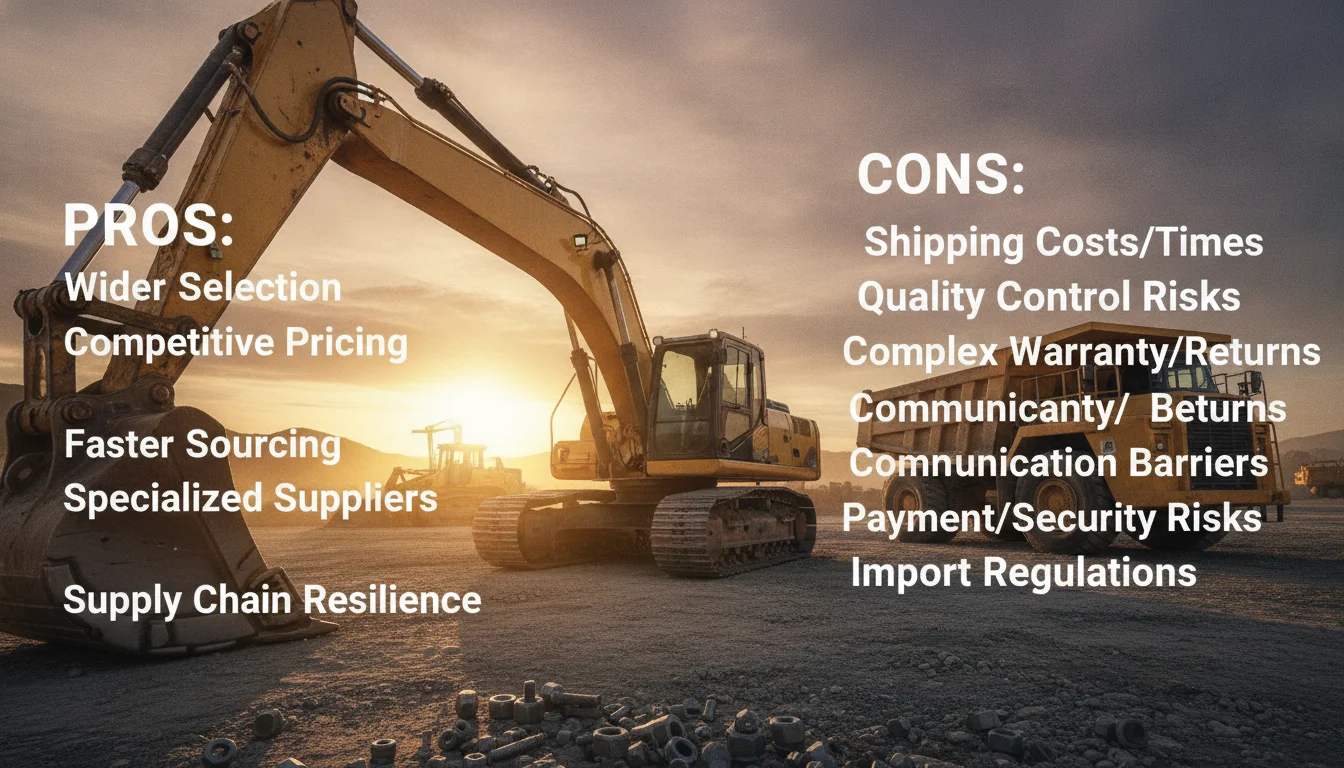
Understanding the trade-offs helps procurement teams make better sourcing decisions before committing to a platform or supplier model.
Pros
- Wider supplier access: A single search surfaces inventory from verified sellers across 120+ countries, reducing dependence on local distributors.
- Competitive pricing: Multiple sellers quoting the same part number drives prices down and gives buyers leverage in negotiations.
- Surplus and hard-to-find parts: Dismantled-machine components and surplus stock appear on marketplaces long after OEM channels discontinue them.
- Faster lead times: Platforms like STS-Global reply to common part requests within 24 hours, with worldwide shipment tracking included.
- Transparent comparison: Buyers can compare new OEM, new aftermarket, used, and reconditioned options side by side before committing.
Cons
- Variable seller quality: Not every seller on an open marketplace meets the same quality standard. Buyer due diligence is non-negotiable.
- Counterfeit risk: Counterfeit parts are a documented challenge in this industry. Platforms without rigorous seller verification increase exposure.
- Hidden landed costs: List prices rarely include freight, customs duties, and import taxes. Total landed cost can differ significantly from the quoted price.
- Complex returns: Cross-border return logistics are slow and expensive. Warranty claims require clear terms agreed before purchase.
What to Look For When Buying Heavy Equipment Spare Parts
Before committing to any purchase on a marketplace, evaluate material quality, fitment, warranty terms, and total landed cost.
Material and Build Quality
Heavy machinery operates under high load, vibration, and extreme temperatures. A replacement part's material specification must match the OEM requirement. For undercarriage parts, that means hardened steel with correct heat treatment. For hydraulic components, it means certified seals and machined surfaces that hold pressure. Ask the seller for material certifications or OEM cross-reference numbers. OEM parts are components made to the original equipment manufacturer's specifications. Aftermarket parts are third-party equivalents that may or may not meet those exact specs.
Fitment and Compatibility
Never buy on description alone. Verify the part number against your machine's serial number, model year, and configuration. Marketplace listings often include part numbers like CAT D6 drawbar 3W-6867 or ripper models for CAT D5/D6/D7 series. If a listing says "fits D6T," confirm whether it covers both the D6T and D6T LGP variants. A part request is a procurement method where buyers submit an incomplete specification and receive quotes from multiple sellers who confirm fitment before shipping.
Warranty, Returns, and Seller Verification
Cross-border purchases require clear warranty terms upfront. Check whether the seller offers a warranty period, who pays return shipping, and how claims are processed. Reputable platforms verify sellers and offer buyer protection. Per STS-Global's published service terms, the company replies to common spare part requests within 24 hours and updates buyers on shipment tracking throughout delivery. That responsiveness is a reliable proxy for after-sales support quality.
Price Range and Total Landed Cost
List prices on global marketplaces can mislead because they rarely include freight, customs duties, and import taxes. Always request a quote with Incoterms specified. For example, MACHINERYPARTS in Germany delivers under DAP Incoterms 2010, meaning the seller bears all transport costs and risk to the named destination. Evaluate every quote as total landed cost, not just the listing price.
Step-by-Step Process for Sourcing from a Heavy Equipment Spare Parts Global Marketplace
The most reliable sourcing process treats the heavy equipment as a structured procurement workflow, not a single-click purchase. Follow these steps to reduce risk and minimize downtime.
- Step 1: Identify the exact part number or serial-number range. Pull the part number from the machine's service manual, the removed component, or the OEM parts diagram. If you only have a model number, use the marketplace search by equipment brand and model, but plan to confirm the exact part with the seller before ordering.
- Step 2: Search across multiple marketplaces and supplier sites. Do not anchor on one platform. Check listing sites like Machinery-parts.com, specialized suppliers like STS-Global, and OEM-certified sellers like MACHINERYPARTS. Compare availability and part condition: new OEM, new aftermarket, used, or reconditioned.
- Step 3: Submit a part request if inventory is not listed. Many platforms accept requests for unlisted parts. This triggers quotes from verified sellers worldwide. Provide full detail: brand, model, serial prefix, part number, desired condition, and delivery deadline.
- Step 4: Vet the seller and request documentation. Ask for photos of the actual part, condition reports, material certifications, and warranty terms. Confirm the seller's location, export history, and typical response time. For high-value parts, request a video call to inspect the component directly.
- Step 5: Compare total landed quotes and finalize payment. Request quotes that include freight, insurance, and Incoterms. Use escrow or platform payment protection where available. After delivery, inspect the part before installation and document any discrepancies immediately.
Common Procurement Mistakes
- Ignoring part-number suffixes: Many OEM part numbers carry suffix codes for material grade or serial-number breaks. The wrong suffix can mean a non-fitting part, even if the base number matches.
- Buying on lowest price alone: A cheap hydraulic pump that fails early costs more in total than an OEM pump that runs its full service life. Factor in replacement labor and downtime.
- Skipping seller verification: Counterfeit parts are a known issue across the global marketplace. Always check for OEM licensing, certifications, or verified partnerships such as Bosch Rexroth authorization before committing.
Comparison of Global Supplier Models for Heavy Equipment Spare Parts
Not every global source operates the same way. Buyers should understand the differences between pure marketplaces, specialized distributors, and OEM-certified parts suppliers before selecting a sourcing channel.
| Supplier Model | Representative Examples | Strengths | Watch Outs |
|---|---|---|---|
| Digital B2B marketplace | Machinery-parts.com | Aggregates surplus and new listings from multiple sellers; search by part number; seller plans from $99 to $349 per month; 50K+ active users across 120+ countries | Seller quality varies; verify each seller individually; buyer protection depends on platform terms |
| Specialized heavy-duty distributor | STS-Global (Denmark) | Supplies CAT, JCB, Komatsu, Liebherr, Cummins, Detroit Diesel, and others; 24-hour response on common parts; worldwide shipment tracking | May not have a self-serve catalog; better suited to high-volume or complex orders |
| OEM-certified parts supplier | MACHINERYPARTS (Germany) | Certified partner and repair partner of Bosch Rexroth since end of 2014; OEM engine parts for Caterpillar, Cummins, Deutz, Perkins, Yanmar, Isuzu; delivers under DAP Incoterms 2010 | Primarily original parts; less flexible on price for aftermarket alternatives |
The table above shows that a this type of marketplace works best when you need quick access to many competing sellers. A specialized distributor offers a known supply chain and a single point of contact. OEM-certified suppliers are the right choice for critical engine or hydraulic components where fitment tolerance and material spec are non-negotiable.
Price Ranges and Budget Expectations for Heavy Equipment Spare Parts
Prices across the this kind of global marketplace vary widely by part category, brand, and condition. Use the tiers below to set realistic procurement budgets before you start sourcing.
Budget Tier: Common Wear Items and Filters
Filters, belts, seals, and small electrical components typically fall in the lowest price band, often under USD 100 to 500 per unit. These parts are high-volume and many aftermarket suppliers compete aggressively on price. A CAT D6 drawbar (part number 3W-6867) is listed at EUR 475 on Machinery-parts.com, sitting squarely in this range. Even at this price point, verify material quality: cheap filters can shorten engine life significantly.
Mid-Range Tier: Hydraulic Components and Undercarriage Segments
Hydraulic cylinders, pumps, track rollers, and idlers typically range from a few hundred to several thousand dollars depending on machine size. These parts carry higher failure risk, so mid-range budgets should include freight and possible core charges. Ripper attachments for CAT D5 and D6 machines list between EUR 6,600 and EUR 10,750 on active marketplace listings, reflecting both steel content and engineering complexity. Always compare new aftermarket against used OEM within this tier before deciding.
Premium Tier: Complete Attachments and Engine Assemblies
Complete engines, final drives, and specialized attachments command premium prices, often EUR 10,000 or more. Buyers in this tier should insist on full documentation: operating hours, rebuild history, and warranty terms in writing. Seller subscription plans are a separate cost: platforms like Machinery-parts.com charge sellers $99 per month for up to 200 product listings, $199 per month for up to 500, and $349 per month for more than 500. Those seller costs influence which suppliers stay active on the platform, which in turn affects your sourcing options.
Across all tiers, the heavy equipment spare parts global marketplace is most cost-effective when you compare total landed cost across at least three sellers. A lower listing price with a significantly longer lead time can cost more in machine downtime than a slightly higher-priced part that ships the same week.
Care and Maintenance of Heavy Equipment Spare Parts
Proper storage and handling extend spare-part shelf life and prevent premature failure before a component ever reaches the machine.
Storage Conditions
Store hydraulic components in a clean, dry environment with all ports sealed. Avoid stacking heavy parts directly on rubber seals or machined surfaces. Keep filters in sealed packaging until the moment of installation to prevent moisture ingress. Electrical components, including starters and alternators, must be protected from condensation and vibration during storage.
Pre-Installation Inspection
Before installation, compare the new part to the removed component. Check for shipping damage, missing hardware, and correct part-number suffixes. For hydraulic parts, flush any residual storage oil and inspect for contamination. For undercarriage components, verify bolt-hole alignment and hardness marks where required by the OEM service bulletin.
Preventive Maintenance Scheduling
Preventive maintenance is the scheduled replacement or repair of components based on operating hours or condition monitoring, intended to minimize unplanned downtime. Using the heavy equipment spare parts global marketplace to pre-source parts for upcoming service intervals reduces lead-time risk. Many fleets now combine preventive schedules with IoT-based predictive alerts, ordering replacement parts only when sensor data indicates imminent wear rather than waiting for failure.
As of 2026, the shift toward predictive procurement is accelerating. Buyers who pre-position parts through a reliable heavy equipment spare parts global marketplace consistently report shorter machine downtime and more predictable maintenance budgets. When evaluating any sourcing platform, prioritize seller verification, part-number accuracy, and total landed cost over headline listing price. That discipline keeps machines running and procurement costs predictable.
Frequently Asked Questions
How do I know a part will fit my machine?
Verify the part number against your machine's serial-number range and model configuration. Submit a part request with full details, and ask the seller to confirm fitment in writing before shipping. Never rely on a generic model description alone.
What is the best value in heavy equipment spare parts?
The best value balances part price, expected service life, and downtime cost. OEM parts for critical systems often deliver a lower total cost than cheap aftermarket alternatives that fail early and require additional labor to replace.
Can I return parts bought from a global marketplace?
Return policies vary by seller. Check warranty terms, return shipping responsibility, and condition requirements before paying. Platform-mediated purchases may offer additional buyer protection, but cross-border returns are slow and expensive, so pre-purchase verification is always the better investment.
How do I avoid counterfeit heavy equipment parts?
Buy from verified sellers, request OEM cross-reference documentation, and check for certifications such as Bosch Rexroth partnership status. Compare physical details like machining quality and packaging against known genuine parts before accepting delivery.
Which brands are most commonly supported in global marketplaces?
Common brands include Caterpillar, Komatsu, JCB, Cummins, Deutz, Perkins, Yanmar, Isuzu, Liebherr, Detroit Diesel, and Bobcat. Specialized suppliers like STS-Global support many of these brands, as does MACHINERYPARTS for engine components and hydraulic systems.
What does DAP Incoterms 2010 mean when buying parts?
DAP (Delivered at Place) means the seller delivers goods to the named destination, bearing all transport costs and risk until arrival. The buyer handles import clearance and any duties at the destination port or facility.
Ready to source OEM-quality spare parts with global 5-day delivery? Shop the 3GEN Export heavy equipment spare parts global marketplace at 3genexport.com and get competitive quotes from verified suppliers today.